Category: music

A day in the Boston Symphony Orchestra Archives with Joannès Rochut

A day in the Boston Symphony Orchestra Archives with Joannès Rochut

by Douglas Yeo (August 15, 2024)

I’ve loved reading, researching, and writing for as long as I can remember. My curious nature leads me to want to know more about things. And when I learn things, I like to tell others about them and share the excitement I feel when I make a new discovery.

Over the years, I’ve published five books and many articles, book chapters, and dictionary entries. If you’re interested in some of what I’ve written over the years, you can find a list of many of my publications HERE. While there, you can click on the names of titles and view PDFs of some of my articles.

At the moment, I am deeply immersed in researching and writing an article about the celebrated French trombonist, Joannès Rochut, who played principal trombone in the Boston Symphony Orchestra from 1925–1930. I have been interested in learning more about Rochut ever since I joined the Boston Symphony Orchestra in 1985.

Yeo_Rochut_ITF_2024

Douglas Yeo giving a presentation about Joannès Rochut, International Trombone Festival, Texas Christian University, Fort Worth, Texas, May 28, 2024

I gave a presentation about Joannès Rochut at the recent International Trombone Festival that was held at Texas Christian University in Fort Worth, Texas. I wrote about my experience at the Festival—including my presentation and other things I did there such as recitals and roundtable discussions HERE. Now I’m continuing the research I conducted to make that presentation and I’m writing a major article about Rochut that will appear in the January 2025 International Trombone Association Journal.

Rochut_Bordogni_1_ed_cover

Douglas Yeo’s copy of the first edition of Joannès Rochut’s  Melodious Etudes for Trombone, selected from the Vocalises of Marco Bordogni (New York: Carl Fischer, 1928)

I would be hard pressed to think of any serious student of the trombone—including professional players who are life-long students—who does not know the name “Joannès Rochut.” That’s because Rochut compiled three volumes of Melodious Etudes that he transcribed from Vocalises of Marco Bordogni that were published by Carl Fischer in 1928. Rochut’s books are among the most important and most frequently used trombone books in the world. Yet, most people don’t know a thing about Joannès Rochut except the fact that he published these books of Bordogni’s music.

One of the things I tell my students—especially my doctoral students who need to write a thesis or dissertation—is that research takes time. It takes discipline. It takes patience. And it requires money. Not everything is free; not everything can be accomplished from the comfort of your favorite chair at home. The Internet is a remarkable, helpful tool (while, at the same time, it is also toxic cesspool), but anyone that assumes they can successfully research a subject simply by putting a few words in a search engine or an artificial intelligence program will found out quickly that they need to do more. There is no substitute for what I call “real research.” Not “compilation,” which is taking the work of others, stitching it together, and rewording it. I’m talking about real research: finding information from diverse sources, connecting dots, and creating a coherent, new narrative that sheds light on things that are not widely known. THAT is research.

Working in and with museums, universities, libraries, archives, and other institutions is essential if one wants to find information that informs research. In my research of Joannès Rochut, I’ve been in contact with many such institutions. The Library of Congress in Washington D.C. has the Serge Koussevitzky Collection. Koussevitzky was the conductor of the Boston Symphony Orchestra when Rochut played in the orchestra, and Rochut also worked for Koussevitzky in Paris before both of them came to Boston. The LOC has letters that Rochut wrote to Koussevitzky, letters that Rochut’s Boston Symphony Orchestra colleague, Jacob Raichman, wrote to Koussevitzky, and programs from Rochut’s and Koussevitzky’s shared time together in Paris.

Ida Bisbee_1926_NEC_NEUME_cropped

Excerpt from page 27 of the 1926 New England Conservatory of Music yearbook, The NEUME, showing Ida Isabella Bisbee, trombone student of Joannès Rochut. Courtesy of New England Conservatory of Music Archives.

The New England Conservatory Archives has yearbooks, student cards, catalogs, and other information about students and faculty including Joannès Rochut and his students. Rochut’s first student at NEC was Ida Isabella Bisbee; she graduated in 1926.

The Sibley Library at Eastman School of Music has the Edna White Collection which contains more photographs of Ida Isabella Bisbee.

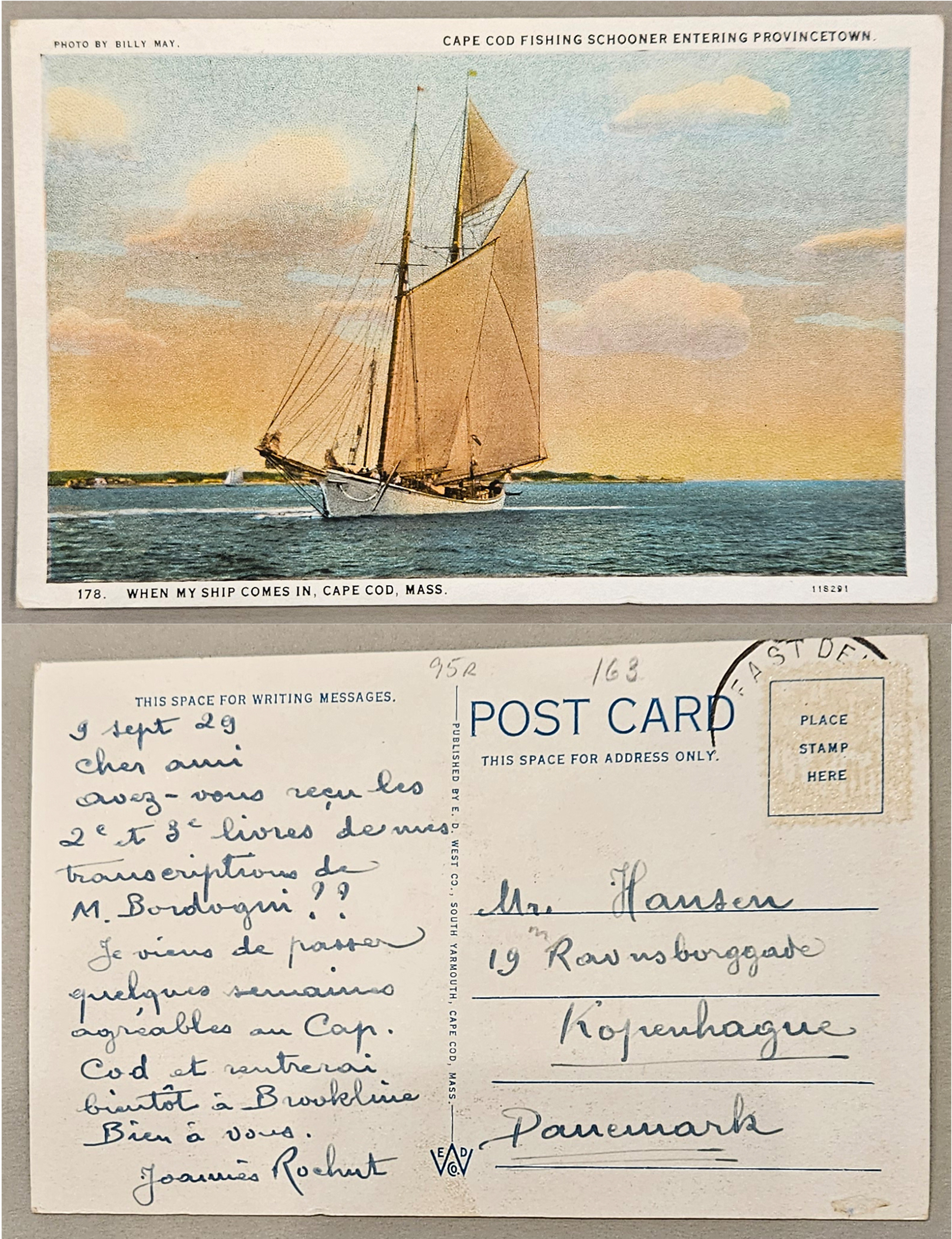
1929_Rochut_to_Hansen_postcard

Postcard from Joannès Rochut to Anton Hansen. The text of the card (translated from the original French) reads: 9 September 1929 [the postcard was mailed from East Dennis, Massachusetts], Dear friend, Have you received the 2nd and 3rd books of my transcriptions of Mr. Bordogni?? I just spent a few pleasant weeks at Cape Cod and will soon return to Brookline. Best Regards, Joannès Rochut. Courtesy of the Royal Danish Library, with thanks to Mogens Andresen for photographing the card on my behalf.

The Royal Danish Library in Copenhagen has the papers of the influential Danish trombonist, Anton Hanson, including many letters that Rochut and Hansen wrote to each other in the 1920s and 1930s.

The National Music Museum in Vermillion, South Dakota, has an extensive collection of information about trombone manufacturers, including Besson (of London) who made an instrument that Joannès Rochut played for several years.

The Registrar of Deeds in Norfolk County, Massachusetts, helped me obtain information about the house that Joannès Rochut and his wife, Louis, purchased in 1927.

The Bibliotheque national de France has many documents relating to the annual Paris Conservatoire Concours at which Joannès Rochut won first prize in 1905.

Then there is networking, connecting with old and new friends, and gratefully receiving their considerable help when I ask questions or ask for their assistance. Benny Sluchin in Paris (who has helped me in countless ways, including taking photographs of Joannès Rochut’s home and grave), David Fetter, Ronald Barron, Mogens Andresen, and Carsten Svanberg, and many more. All of them will be thanked in my article.

JULIE_ROCHUT_Joannes_Boston_business_card

Joannès Rochut’s business card, 1927, courtesy of the Rochut Family

Most importantly, I made contact with the Rochut family in France. The Rochut family has been exceptionally generous in sharing photographs, documents, and information about Joannès Rochut. I have always said that if you are researching a historical individual and you can find a family member who is willing to share things with you, the needles you find in haystacks suddenly turn to diamonds. I am so grateful to the Rochut family for their kind assistance and generosity.

The list goes on. Without connections to these institutions and individuals, my article about Joannès Rochut would amount to no more than a junior high school level term paper on the level with a paper titled, “My Summer Vacation.” 

Sometimes archives are able to provide me with resources through scanning and then sending them to me. In other cases, if it’s not possible for me to get to an archive, a friend of mine is able to view the resources I’m looking for on my behalf. And sometimes, you just have to go yourself.

A few weeks ago, I decided I needed to spend one day researching in the Boston Symphony Orchestra Archives. This is a place that is near and dear to my heart. When I joined the Boston Symphony Orchestra in 1985, I wanted to learn as much as I could about the orchestra and its low brass players in particular, including Joannès Rochut. I asked William Moyer, who at the time (1985) was personnel manager of the BSO (he had played second trombone in the BSO from 1953 to 1966 before becoming personnel manager), if the orchestra had an archive. He took me to a building adjacent to Symphony Hall, what was, at the time, called the Symphony Hall Annex (today, fully renovated, it is the Cohen Wing of Symphony Hall). It was a run down building that the orchestra had plans to renovate someday. Bill and I came to a locked door, he put a key in the door, opened the door, and there was the Boston Symphony Orchestra archives.

It was a shambles. As I walked into the room—a large room with another room next to it—and Bill turned on the light, I saw shelves that stretched from floor to ceiling. There were jumbles of documents, books, and other materials strewn around the room. Filing cabinets were open and documents were falling out. There was no heating or cooling system in the room. It was damp. 

But I could tell right away that the room was full of treasures. Despite the chaotic disorganization of materials, my mind raced and recalled on Howard Carter’s words when he first peered into King Tutankhamen’s tomb and was asked what he saw. “I see wonderful things,” Carter said. Yes. I saw wonderful things.

Yeo_BSO_photo_negatives

Two of the several dozen negatives Douglas Yeo had made from photographs in the proto-Boston Symphony Archives, 1985–1987

Because of my interest in researching Joannès Rochut and other Boston Symphony Orchestra brass players, Bill gave me a key to this room. The BSO had no archivist at the time; Bill just gave me a key. He told me I could look through it and if I found things that were helpful to my research, I could use them. So I did. I spent hundreds of hours in those rooms, during rehearsal breaks, between rehearsals, before concerts, on some of my days off. And this was in the era before personal computers, scanners, or cell-phone cameras. If I found a photograph I thought I would someday use in an article, I needed to take photographs to a photography studio and have large negatives made so I could submit the images to publications. This was expensive. But it was the only way I could have permanent access to the images I wanted to use and continue to reference.

1986_ITA_Journal_BSO_low_brass_Yeo

Cover of the Fall 1986 issue of the International Trombone Association Journal that contains the article by Douglas Yeo, “A Pictorial History of Low Brass Players in the Boston Symphony Orchestra, 1887–1986”

I began to systematically work through the contents of these disorganized rooms, looking for photographs and information about Boston Symphony Orchestra trombone and tuba players. I found a lot. I carefully made new piles of materials on the disorganized shelves, an attempt to bring some order to the mess. I would bring my discoveries to Bill Moyer who shared my excitement and in time, I amassed a great deal of information that eventually found its way into four articles I wrote about Boston Symphony Orchestra brass players (click on the titles to read a PDF of these articles):

These were among my earliest published research projects and if I did them over today, I would do them very differently. My research methods have improved over the years, no doubt about that. But they were an earnest attempt to inform readers about some of the rich history of Boston Symphony Orchestra brass players. Even after my articles were published, I continued my research into the lives and work of the fascinating individuals who played brass instruments in the BSO. 

1987_Yeo_BSO_archives_memo_incipit

The opening paragraphs of a draft memo Douglas Yeo wrote for Boston Symphony Orchestra acting General Manager Daniel Gustin after meetings of the first ac-hoc committee to explore the establishment of the Boston Symphony Orchestra Archives (Douglas Yeo, Steven Ledbetter, Bruce Creditor, and Eleanor McGourty), April 27, 1987

But there was more. Intuitively, I knew that the Boston Symphony Orchestra’s history needed to be better preserved. Two disorganized rooms were not a proper archive. I began talking with others in Symphony Hall about this. I started with Daniel Gustin, who was, at the time, acting General Manager of the Boston Symphony Orchestra. He listened to all I had to say about the need for a proper archives at Symphony Hall. He suggested I get together with others who shared an interest in the BSO’s history and come up with a proposal that he could consider. So I began talking with Bruce Creditor who was Bill Moyer’s assistant. Eleanor McGourty was director of publications for the orchestra—she was responsible for putting together the weekly concert programs for the orchestra along with Steven Ledbetter who, as the orchestra’s musicologist, wrote program notes for the concert programs. Bruce, Steven, Eleanor, and I loved the BSO and its rich history, and we met to put our heads together. After we met, I drafted a memo on April 24, 1987, that summarized some of our discussion. You can read that memo (the opening paragraphs are in the photograph, above) HERE. It was a seminal document, the basis for a subsequent memo that was used by Daniel Gustin and then his successor, Boston Symphony Orchestra General Manager Kenneth Haas, as the orchestra’s management discussed the idea of a proper archive with the Board of Trustees. The happy result was the formal establishment of the Boston Symphony Orchestra Archives and the hiring of a full time archivist, Bridget Carr, who holds the position of Blanche and George Jones Director of Archives/Digital Collections for the Boston Symphony Orchestra, including the Boston Pops, Tanglewood, and Symphony Hall.

If you look at the four articles  I wrote about Boston Symphony brass players that appeared in the International Trombone Association Journal, the T.U.B.A. Journal (now the International Tuba Euphonium Association Journal), the International Trumpet Guild Journal, and The Horn Call (linked above), you will see that most of the material that informed those articles came from the Boston Symphony Orchestra Archives. As I’ve continued my research on Joannès Rochut more recently, it became clear to me that I needed to spend some dedicated time in the BSO Archives to get information that can only be found there. Many archivists around the world have been extremely helpful to me—including Bridget Carr—in locating and sending me documents and photographs. But archivists are not my personal research assistants. There is a limit to what I can ask them to do. And, while I had a long list of things I knew I wanted to see in the BSO Archives, I also wanted to look at resources and files and see what I might find that I didn’t even know I wanted.

So, last Tuesday (August 6, 2024), I flew to Boston to spend a day in the Boston Symphony Orchestra Archives. It was another “crazy day,” my second one this summer. Readers of TheLastTrombone know that when my flight to Texas was cancelled when I was scheduled to attend the International Trombone Festival in Fort Worth, I did the only thing I could do to get to the Festival on time: I drove. 16 hours from Chicago to Fort Worth, 960 miles. Straight through, no overnight stop. Truly crazy. My trip to the BSO Archives was not THAT crazy. OK, I did have to get up at 3:00 am to get my 6:05 am flight from Chicago’s O’Hare airport to Boston’s Logan Airport. And I walked in my front door after my return at midnight the same day. But with a $139 round trip plane ticket (thank you, American Airlines), a couple of Uber rides to and from Logan, parking at O’Hare, and lunch and dinner (of COURSE I had a bowl of New England Clam Chowder and a lobster roll at Legal Sea Foods for dinner at Logan airport), my less than $500 investment in the trip bore rich fruit. 

Yeo_Cassell_Symphony_Hall_2024_08_06

Douglas Yeo and Charles Cassell in the basement of Symphony Hall, Boston, August 6, 2024. Photo by Bridget Carr.

Bridget Carr met me at the Symphony Hall Stage door, and as we wound our way through the hall to the Archives, the first person I saw was my friend, Charles Cassell. We met with a big hug. Charlie is the only member of the Symphony Hall house crew who is still there from the years I was a member of the orchestra (1985–2012). When I was a member of the BSO, I always felt that he and the other members of the house crew were superheroes. They cared so deeply about Symphony Hall and nobody cared more—and knew more—about Symphony Hall than Charlie. I appreciated those great guys of the Symphony Hall house crew, and they appreciated me. It was really, really wonderful to see him.

Douglas Yeo Visits the BSO Archives_IMG_7445

Douglas Yeo in the Reading Room of the Boston Symphony Orchestra Archives, August 6, 2024. Photo by Bridget Carr.

It was an absolute joy to be back in the Boston Symphony Orchestra Archives. It is one of my happy places. Archivist Bridget Carr and I have been good friends for over 30 years. With my long list of things I hoped to find during my time in the Archives in her hand before I arrived, Bridget had them all ready for me in the Archives’ Reading Room. The day flew by and the discoveries mounted up. Bridget was exceptionally accommodating and helpful beyond words as we discussed Joannès Rochut and his time in the Boston Symphony Orchestra. All day long, I kept asking questions, Bridget kept pulling out more resources from the shelves and stacks in the Archives, and we immersed ourself in a moment of time in BSO trombone history nearly 100 years ago.

Sept_1926_BSO_contract_salary_notes_Rochut_CROPPED

Handwritten comments by Boston Symphony Orchestra President of the Board Frederick P. Cabot, referencing Joannès Rochut on a document that was used to guide renewal of player contracts and salary adjustments for the 1926–1927 season. Cabot’s comments about Rochut read, “increase pay – magnificent.” Courtesy of the Boston Symphony Orchestra Archives.

I was interested in learning about BSO member salaries at the time. The records were there. I wanted to learn about the impact of the Great Depression on the Boston Symphony Orchestra. The annual auditor reports were there. I wanted to find more photographs of Rochut with the BSO. They were there. I wanted to find newspaper clippings and reviews of concerts. They were there. 

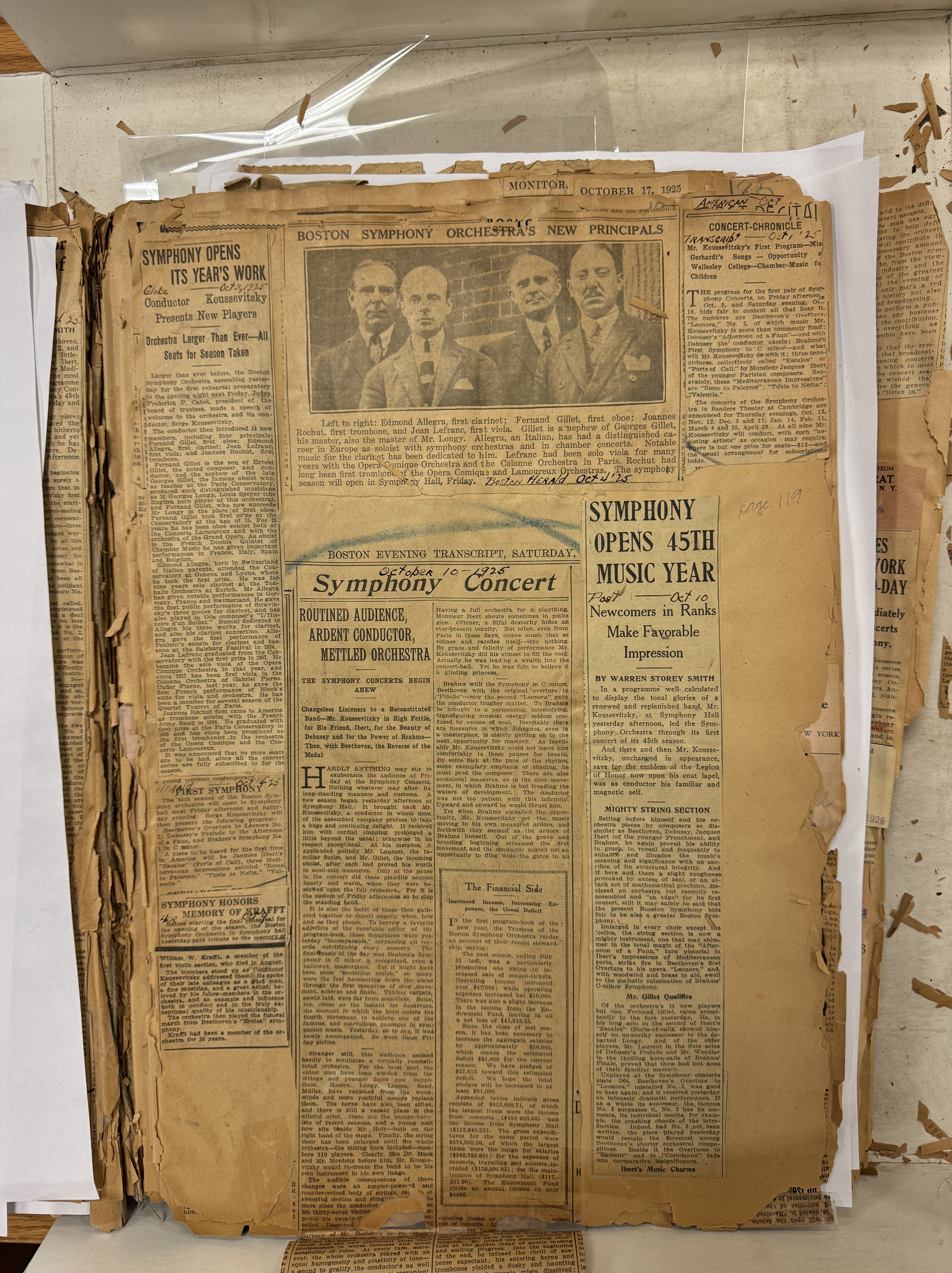
1925_Oct_4_BSO_scrapbook_Rochut_new_members

A page from a Boston Symphony Orchestra scrapbook that includes an announcement in the Boston Herald of “Boston Symphony Orchestra’s New Principals” (October 4, 1925). In the photo at the top of the page, Joannès Rochut is second from right. Courtesy of the Boston Symphony Orchestra Archives.

I found a photograph of Joannès Rochut in a Boston Symphony Orchestra scrapbook from 1925 (above). It appeared in an article in the Boston Herald on October 4, 1925. These scrapbooks proved to be invaluable during my research trip. I must have looked at 15 of them during my visit to the Archives. They are old and brittle, but, fortunately, they also have been photographed so the treasures they hold will be available for researchers to consult long after the fragile paper turns to dust.

Fiedler_Rochut_check_August_1929

A check from Arthur Fiedler to Joannès Rochut, payment for one week of concerts on the Charles River Esplanade, August, 1929. Courtesy of the Boston Symphony Orchestra Archives.

And there were other discoveries, like this check (above) that conductor Arthur Fiedler wrote to Joannès Rochut for playing a week of summer concerts with Boston Symphony Orchestra members on the Charles River Esplanade in Boston during the summer of 1929.

1929_Pops_esplanade_ROCHUT

Arthur Fiedler with members of the Boston Symphony Orchestra in a concert in the Hatch Memorial Shell, Charles River Esplanade, Boston, summer 1929. Courtesy of the Boston Symphony Orchestra Archives.

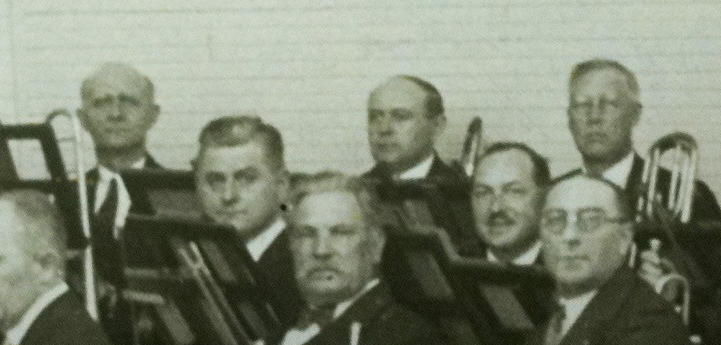
BSO_Rochut_Raichman_Hatch_Shell_1929_detail

Detail of the above photo. Boston Symphony Orchestra trombone section members Joannès Rochut, Jacob Raichman, and Leroy Kenfield, Hatch Memorial Shell, Charles River Esplanade, summer 1929. Courtesy of the Boston Symphony Orchestra Archives.

Bridget brought out a huge photo of Arthur Fiedler with members of the Boston Symphony Orchestra at a Charles River Esplanade concert in the summer of 1929 (above), one of many things that brought Rochut’s time in Boston to life during my visit to the BSO Archives.

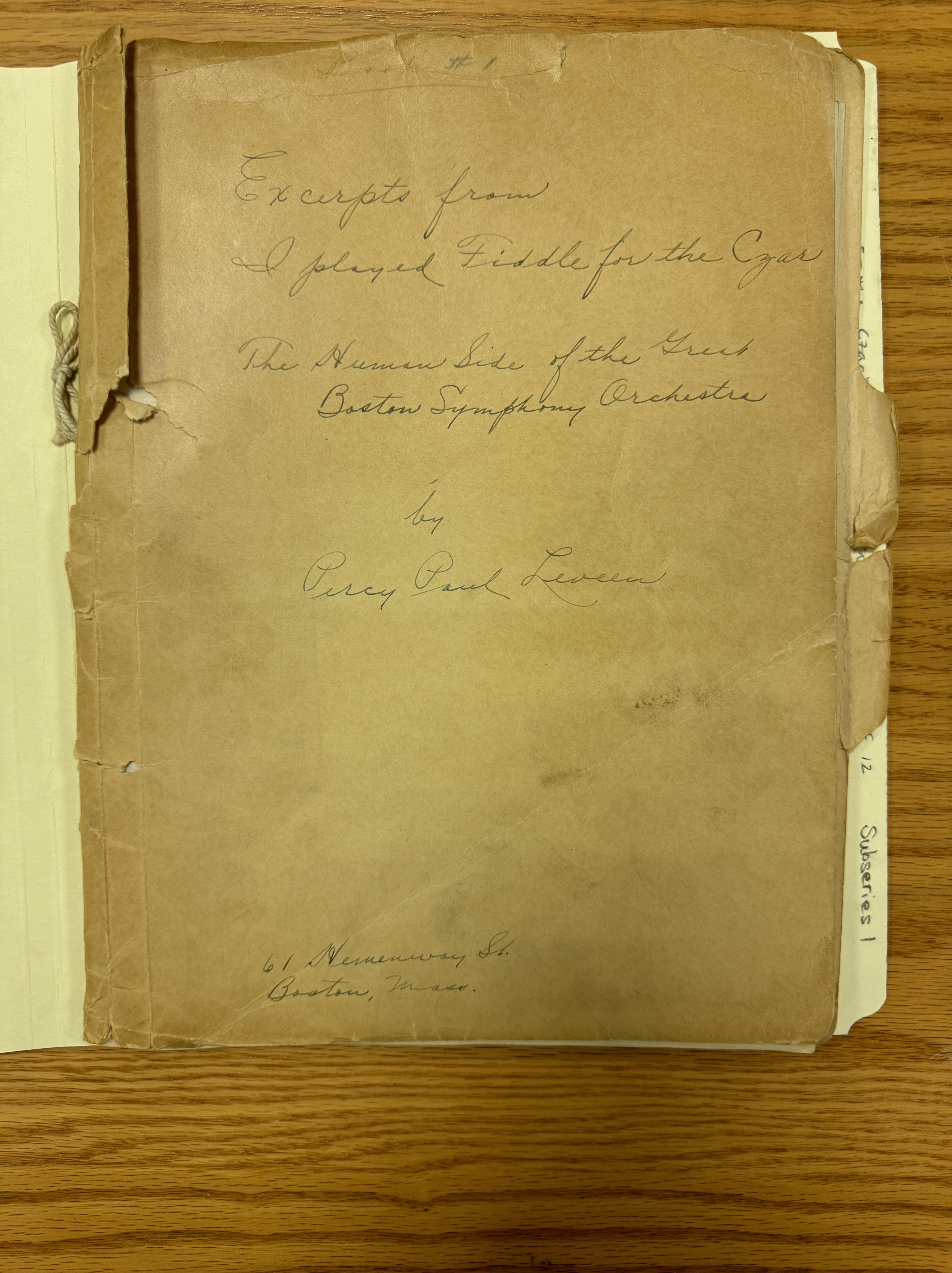
Percy_Paul_Leveen_I_Played_Fiddle_Czar_cover

The cover of Percy Paul Leveen’s unpublished book manuscript, I Played Fiddle for the Czar. Courtesy of the Boston Symphony Orchestra Archives.

The Archives had another treasure I had not previously known about—the memoirs of violinist Percy Paul Leveen, who was a member of the BSO from 1919–1944. Leveen’s unpublished manuscript for a planned book, I Played Fiddle For the Czar—there is no doubt, after reading the manuscript, that “the Czar” was BSO conductor Serge Koussevitzky—provides first person insight to pivotal moments in Boston Symphony Orchestra history. Such as “Black Tuesday,” October 19, 1929, that signaled the beginning of the Great Depression. On that fateful day, the Boston Symphony Orchestra was in Chicago for a concert in Orchestra Hall. Leveen’s comments about how players reacted to those life-changing economic events are riveting. And I will use some of Percy Paul Leveen’s insights in my article. 

Boston_Symphony_Hall_2024_08_06

A view from the stage of Symphony Hall, Boston, August 6, 2024

On my way out of Symphony Hall, I told Bridget I’d like to have a look at the inside of the hall itself. I was very happy to stand on the Symphony Hall stage again. The hall was undergoing the changeover from the Boston Pops season—the usual seats are removed on the main floor and replaced with tables and chairs during Pops—while the orchestra is at its summer home, Tanglewood, and there was maintenance work going on. I played so many concerts in Symphony Hall; seeing it again brought back a lot of memories. I played concerts on that stage for over 27 years, the same stage where Joannès Rochut played many concerts. Symphony Hall remains a very special place to my family and me.

In the days since I’ve returned from my visit to the Boston Symphony Orchestra Archives, my article on Joannès Rochut has taken on a new dimension. I have a lot more work to do in the coming weeks before I hit the submission deadline for my article, but many of the documents and photographs I obtained during my visit will now be part of my article. I am so grateful to Bridget Carr and her staff who are keepers of the history of the Boston Symphony Orchestra, and the value of her helpfulness cannot be overstated.

Douglas_Yeo_Bridget_Carr_BSO_Archives_2024_08_06

Douglas Yeo and Bridget Carr in the Boston Symphony Orchestra Archives, August 6, 2024

This is research. Looking, digging, contacting, networking, visiting, calling, emailing, connecting. Last Tuesday, all of those things came together in Symphony Hall, Boston’s proud temple of music. The fruits of my research on Joannès Rochut will appear in print soon. His story is quite a story, and thanks to places like the Boston Symphony Orchestra Archives and people like Bridget Carr, I will be able to tell it in a way that has never been told before. Stay tuned.

[And here’s a little bonus. Compare this photo of me, below, that I took last week outside of Symphony Hall’s Stage Door with the following photo of three members of the Boston Symphony Orchestra that was taken in 1934, 90 years ago. I love this stuff.]

Douglas_Yeo_Symphony_Hall_stage_door_Aug_6_2024

Douglas Yeo at the Symphony Hall Stage Door, Boston, August 6, 2024

Raichman, VandenBerg, Gebhardt, Boston Sym 1934

Three members of the Boston Symphony Orchestra: Jacob Raichman (trombone), Cornelius Van den Berg (horn), and William Gebhart (horn), Symphony Hall Stage Door, 1934. Courtesy of Irene Raichman Shermont. 

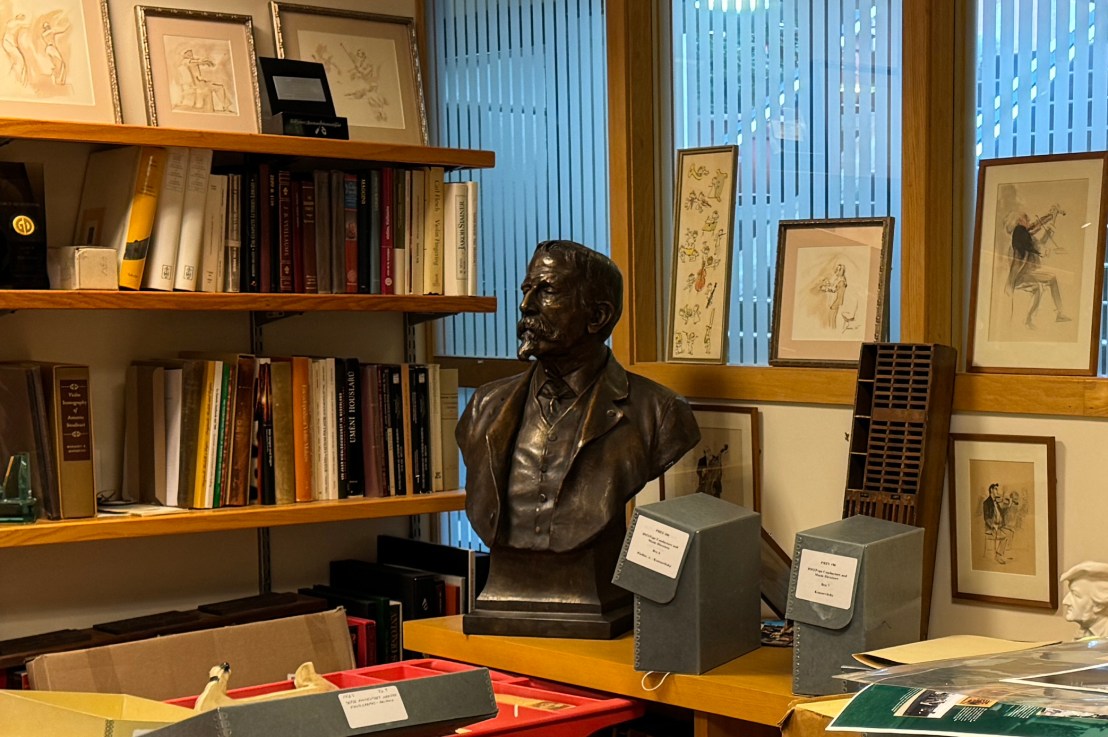
[Header photo: The reading room in the Boston Symphony Orchestra Archives. The bust on the table is of Major Henry Higginson, founder and sustainer of the Boston Symphony Orchestra.]

Fast cars and the value of friendship

Fast cars and the value of friendship

by Douglas Yeo (August 2, 2024)

Life is full of surprises, unexpected moments that lead to bigger things. Try something that’s a little outside your box—your comfort zone—and you’ll probably learn something. If you’re open to learning. Our friends, Phil and Laura Spotts, taught us something about this.

My wife, Patricia, and I met Phil and Laura at our church in 2012. We had just moved to Arizona after I retired from my long career as a member of the Boston Symphony Orchestra. Phil struck me right away as a gregarious, “can do” kind of guy. The kind of person who is always volunteering to do something, make things happen. Phil’s an engineer but not one of those stuffy, geeky, academic types. He’s real, has a great sense of humor, and is always thinking about how to help others. Laura is a gifted pianist who played piano from time to time at our church services, another truly wonderful person. When we met them, they had a son, Cody, and in time, they became Superheroes and adopted two more children, Gage and Annaliese. There was something about this family that made Pat and me smile. We spent time together, went over to each other’s houses for dinner (Phil is a terrific cook, and we still use his fantastic leg of lamb recipe several times a year), we shared life. And our friendship grew even as we were very different people in some ways. For instance, they liked—no, they LOVED—something that was a mystery to me: NASCAR. I’m not gonna lie: before I met Phil and Laura, my life had no place for NASCAR. Growing up in and around New York City and living in Boston for nearly three decades, I fell into the east coast snobbery when it comes to things like NASCAR. “Go fast, turn left.” Doesn’t sound very interesting. Also, fast cars are loud and I work hard to protect my hearing. Big hair, beer, southern accents—those are some of the many stereotypes you bring to something like NASCAR when you’re in a cocoon in some parts of the elitist northeast.

Phil_Laura_PIR_March_2014

Phil and Laura Spotts at Phoenix International Raceway, March 2, 2014

So, when Phil and Laura invited Pat and me to go to a NASCAR race at Phoenix International Raceway (November 2013), my mind quickly buzzed around through all of my NASCAR stereotypes before I said, in a confident voice, “Sure. Let’s go!” And we did. Because this was important to our friends.

PIR_NASCAR_panorama_2013_03_02

Panoramic view of Phoenix International Raceway, March 2, 2014

The experience of going to a NASCAR race is unlike anything I’ve done in my life. I love football, and I enjoy baseball. I know what it is to cheer my team at a game, to engage with other fans around me. But NASCAR was something different all together. First, it was BIG. A lot of people go to races. A. Lot. Some come in campers and motor homes, driving from race to race and living in temporary camps that surround a racetrack, a camp that usually has a popup supermarket, bank, and urgent care center. For race weekend, a NASCAR track becomes a small city.

Phil and Laura had headsets for us that were both excellent hearing protection—I have to say, though, as I looked around from my seat, I was stunned to see so many people who were not wearing any kind of hearing protection, wow—and were connected to Phil’s radio scanner that gave us the race feed. Before the race I kept asking questions. I realized quickly that there was a lot more to NASCAR than the stereotypes I had carried with me for so long. This is a high-tech sport. There is a LOT of money involved. It’s really dangerous for the drivers. Fans are passionate about their drivers and their cars. Sponsorship is really, REALLY important. Pit crews—the crew of technicians who service cars before and during the race—work incredibly hard and fast, like a well-oiled machine. And there is a whole lot of strategy.

Doug_Pat_PIR_2013_11_10

Douglas and Patricia Yeo, Phoenix International Raceway, November 10, 2013

There were other things. At the race, I didn’t have any skin in the game; I didn’t know any drivers, so I asked Phil and Laura who there favorite drivers were. OK, they were now my favorite drivers. But when cars are racing around the track at 180 miles an hour at 130dB (that is loud, like a jet engine ready for takeoff on a runway), there’s no point in cheering during the race. Your driver can’t hear you. Other fans can’t hear you. Heck, you can’t even hear yourself. When the cars were roaring around the track, I didn’t dare take off my headset and expose my ears, so if I wanted to say something to Pat, Phil, or Laura, I pulled out my phone and typed a text message and showed it to them.

PIR_March_2014

Phoenix International Raceway, March 2, 2014

Before the race there was the National Anthem, then a flyover and a prayer, and then we were—literally—off to the races. And somehow, what enfolded in front of me captivated me in a way I didn’t expect. As I saw it with my own eyes, as I gave it a chance, as I tried to understand it, I found myself pulled into it. The old stereotypes fell away; I was learning something new. And I liked it. And that experience would not have happened were it not for friends that asked us to do something that they loved and wanted to share with us. I learned a very important lesson on that day. Several, actually. When, a year later (March 2014), Phil and Laura asked us to go to another race at Phoenix International Raceway, we did.

Then Phil took a new job and their family moved to Tennessee. Pat and I moved to the Chicago area so we could live near our grandchildren. While Phil and I weren’t seeing each other regularly any more—something we did a lot when we both lived in the Phoenix area, especially meeting for lunch at our favorite sushi place, Ah-Hai in Goodyear (yes, there really and truly is amazing sushi in the desert!)—we kept in touch, texting and talking on the phone. Then Phil called one day to tell me Cody started playing the trombone—Phil said that Cody picked the trombone because he had heard me play trombone in our church.

Cody_Spotts_E-Hamilton_HS_trombone

Poster of Cody Spotts, trombonist at East Hamilton High School, Tennessee

Then, last October, Phil texted me. Cody was graduating from high school in a few months and Phil wanted to take him to a NASCAR race as a graduation present. Any race, anywhere. And Cody said, “I want to go to the Chicago Street Race with Mr. Yeo.” Phil and Cody were coming to Chicago and  they asked me to go to another NASCAR race. Of course I said “yes.” I was excited. July 6 and 7, 2024 couldn’t come soon enough.

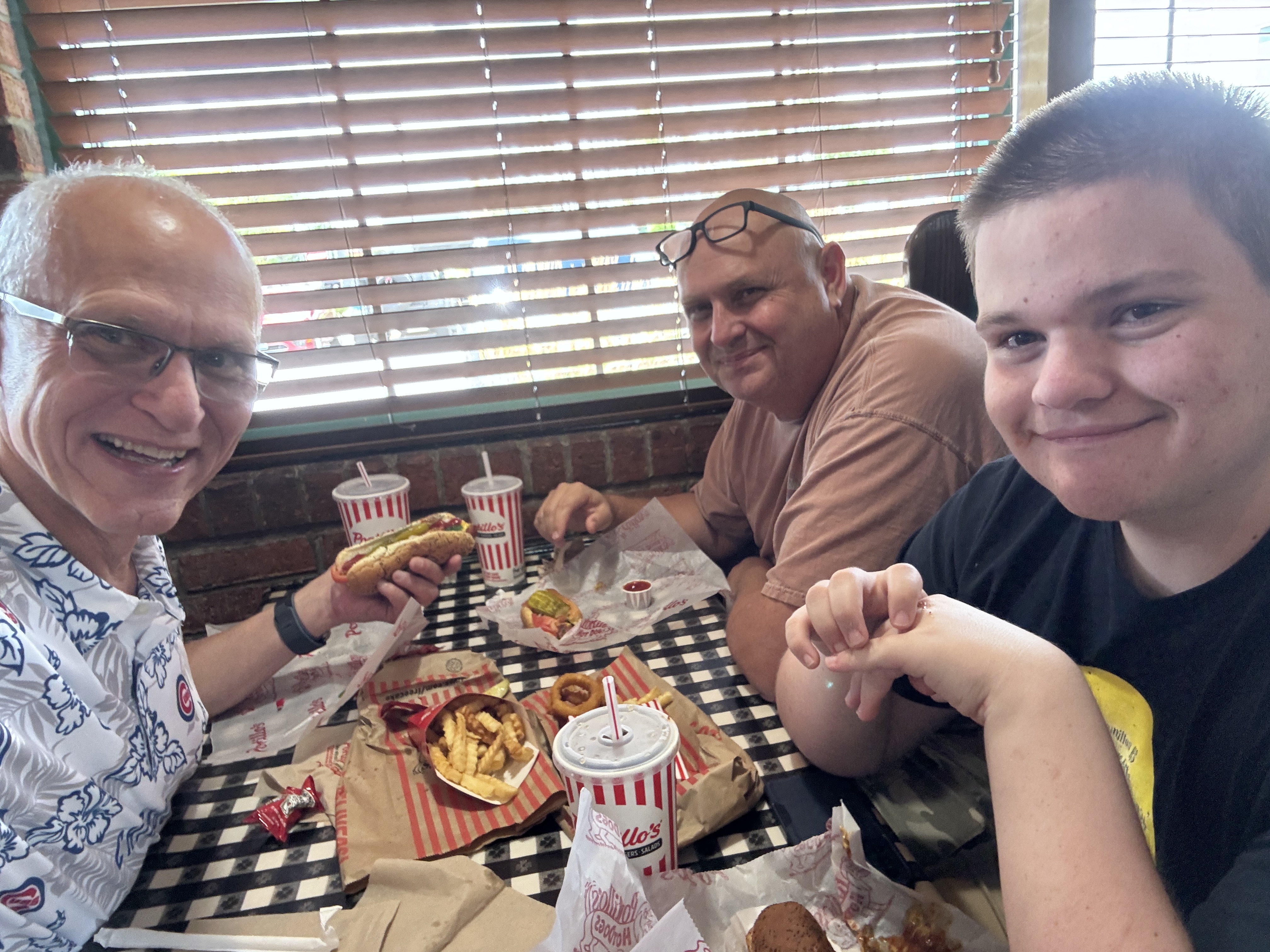
Doug_Phil_Cody_Portillos_NASCAR_2024

Douglas Yeo and, Phil and Cody Spotts, Portillo’s, July 5, 2024

I picked up Phil and Cody at Chicago’s O’Hare airport and because Cody had never been to Chicago, they wanted to immerse themselves in “the full Chicago experience.” We started with lunch at that iconic Chicago hot dog restaurant, Portillo’s. A Vienna Beef hotdog on a sesame seed bun, tomatoes, mustard, relish, dill pickle, raw onions, sport (hot) peppers, celery salt—but NO KETSUP! There’s nothing like it and Portillo’s is the place to get the real deal.

Doug_Cody_Phil_Giordanos_NASCAR_2024

Douglas Yeo and Cody and Phil Spotts, Giordano’s, July 5, 2024

Dinner that night was at Giordano’s where Cody experienced his first Chicago style deep dish pizza. Pat and I don’t eat at Portillo’s and Giordano’s very often—our low fat diet doesn’t have a lot of room for zillion calorie, high fat meals—but, hey, now and then, you gotta live a little.

NASCAR_Chicago_2024_map

Course map for NASCAR 2024 Chicago Street Race

The Chicago Street Race is a unique NASCAR event. It’s a race (two races, actually) that—literally—goes through streets of downtown Chicago. Instead of a long oval track, the Chicago race track is a modified figure-8, a course that snakes through the heart of the city, along Lake Shore Drive, Michigan Avenue, and South Columbus Drive. Phil had gotten Turn 1 Reserved tickets for the three of us in the Jack Daniels Turn 1 Club. I didn’t know what that meant but I found out soon enough.

Cody_Phil_The_Bean_NASCAR_2024

Cody and Phil Spotts at “The Bean” (officially called Cloudgate), Millenium Park, Chicago, July 6, 2024

We took the train from College Avenue Station in Wheaton, Illinois, to downtown Chicago and walked toward Millenium Park near Chicago’s waterfront. There, we walked around as I showed Phil and Cody some of the iconic things in the Park, like “The Bean.” In the photo above, you can see me in my orange Phoenix International Raceway shirt, reflected in this remarkable public art installation, taking this snapshot of Cody and Phil.

Doug_Cody_Phil_NASCAR_2024_sign

Douglas Yeo and Cody and Phil Spotts, Millenium Park, Chicago, July 6, 2024

Once we got through the turnstiles with our wristbands, we made our way to our seats to get a look at our view. It was stunning. As one who knows Chicago pretty well, it was truly remarkable to see the race course laid out on roads and in view of iconic buildings that I had seen in completely different contexts.

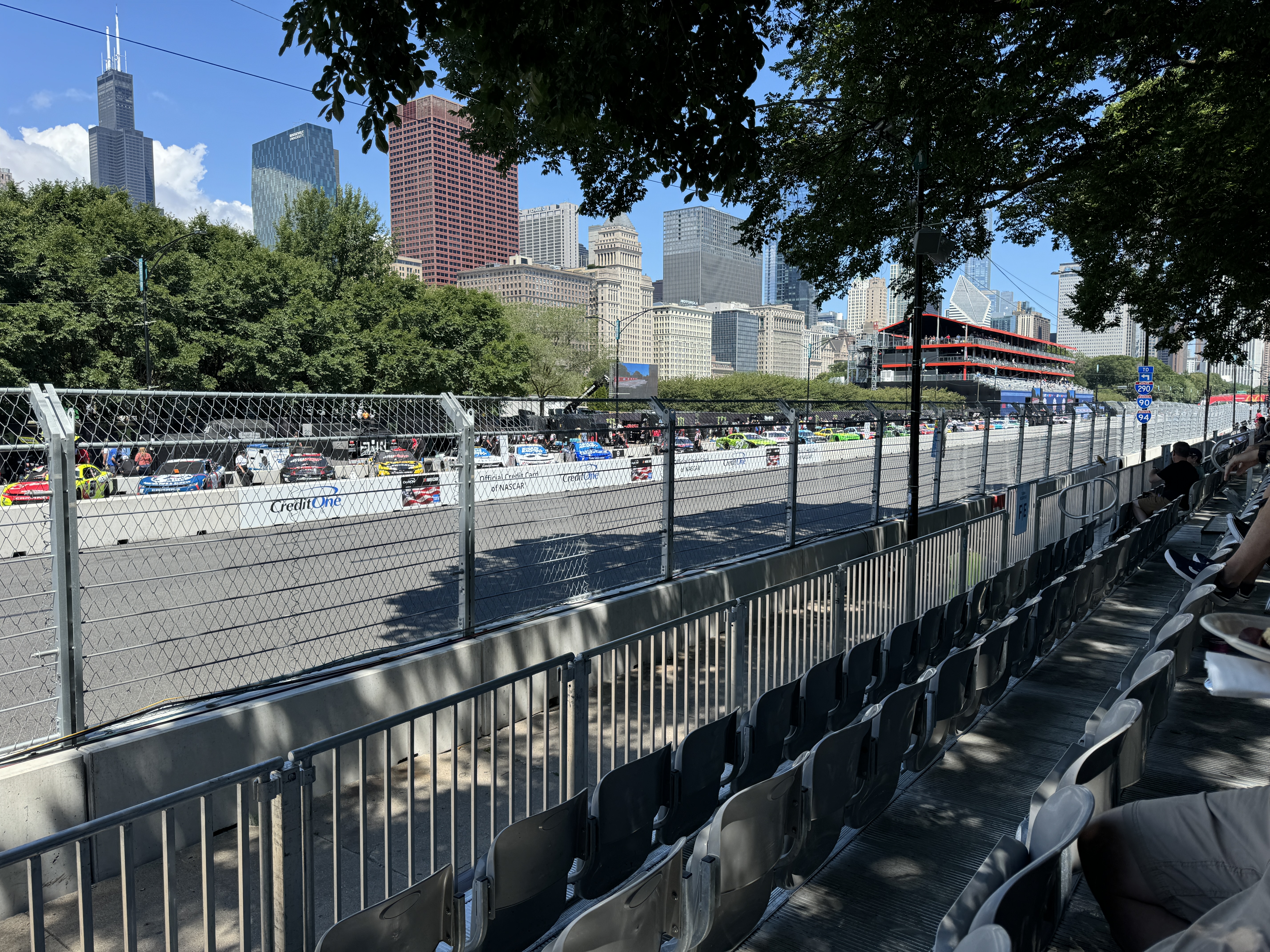
NASCAR_2024_view_turn_1_club

The view from our seats for the NASCAR Chicago Street Race Weekend, Jack Daniels Turn 1 Club, July 6, 2024. The start/finish line was down South Columbus Drive by the grandstand in the right of this photo. The Sears Tower (AKA Willis Tower) is the tall building on the left of the photo, with white antennas on top.

I mean, there we were, seated on South Columbus Drive, with the Sears Tower (OK, I know it’s been called the Willis Tower since 2009, but no Chicagoan calls it by that name) and the hotels of Michigan Avenue in view. I have driven down South Columbus Drive many times on the way home from Chicago Bears games at Soldier Field but traffic is always going north. For the race, the cars would be going south. It took some time for me to get my arms around that. It was surreal to see the city transformed into a racetrack.

Phil_Cody_Doug_club_NASCAR_2024

Phil and Cody Spotts and Douglas Yeo, Jack Daniels Turn 1 Club, July 6, 2024

Phil really outdid himself with tickets in the Turn 1 club; it was a lavish gift. We had terrific reserved seats, a nice, shaded area where we could relax, and UNLIMITED amazing food and drink. During the whole race, the three of us grazed on fantastic food. It was always there for us, all day long. What a special experience it was to sit in such remarkable seats with these amenities. And it happened because of friendship.

MONSTER_drink_cyclists_NASCAR_2024b

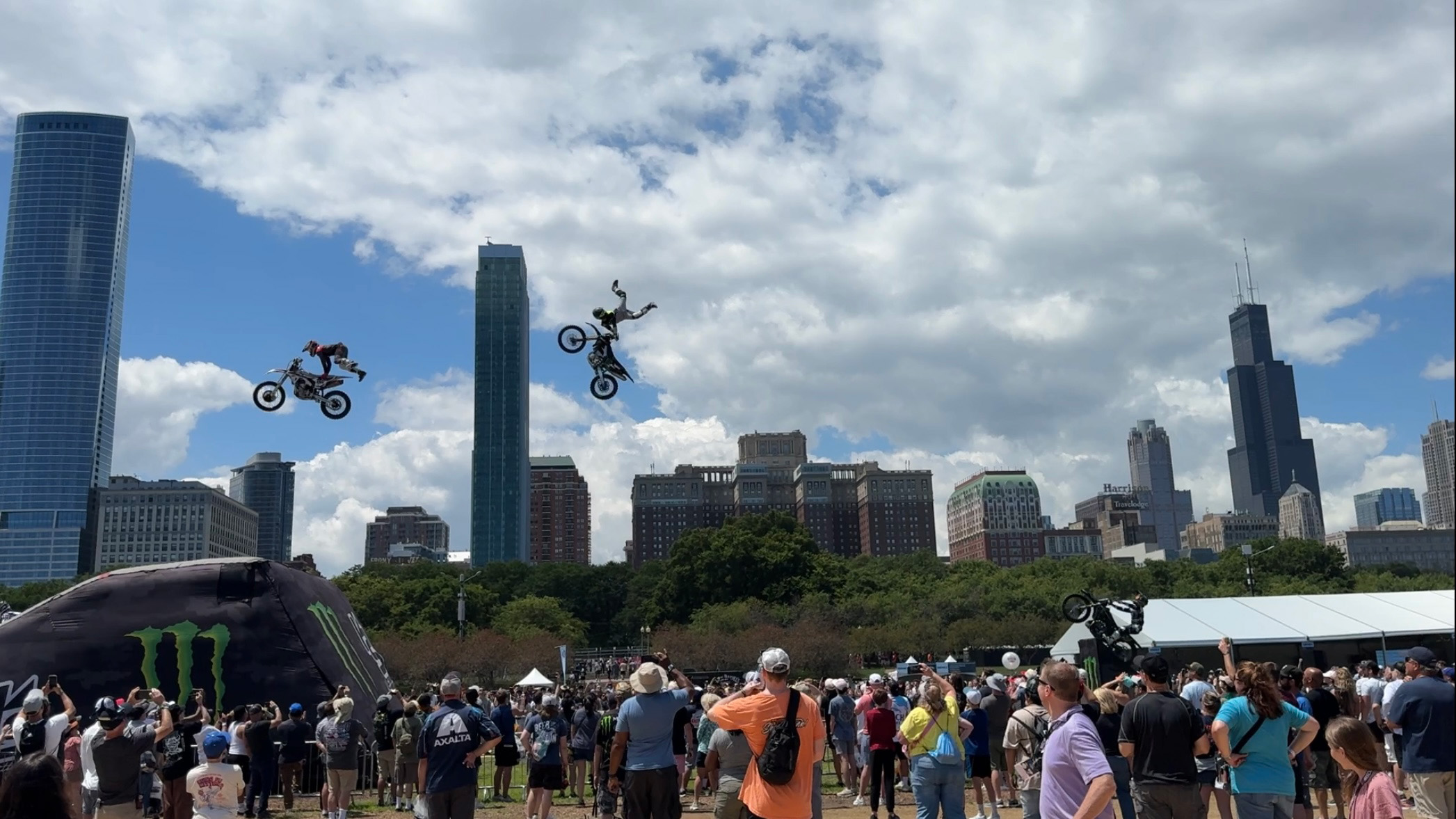
MONSTER Energy Drink acrobatic motorcyclists, Chicago, July 6, 2024

Before the race, we walked around to all of the sponsor tents, the NASCAR shop, and the wide open area where concerts were going on all day. The MONSTER Energy Drink acrobatic motorcyclists did their show; it was breathtaking.

Race_view_finish_Saturday_NASCAR_2024

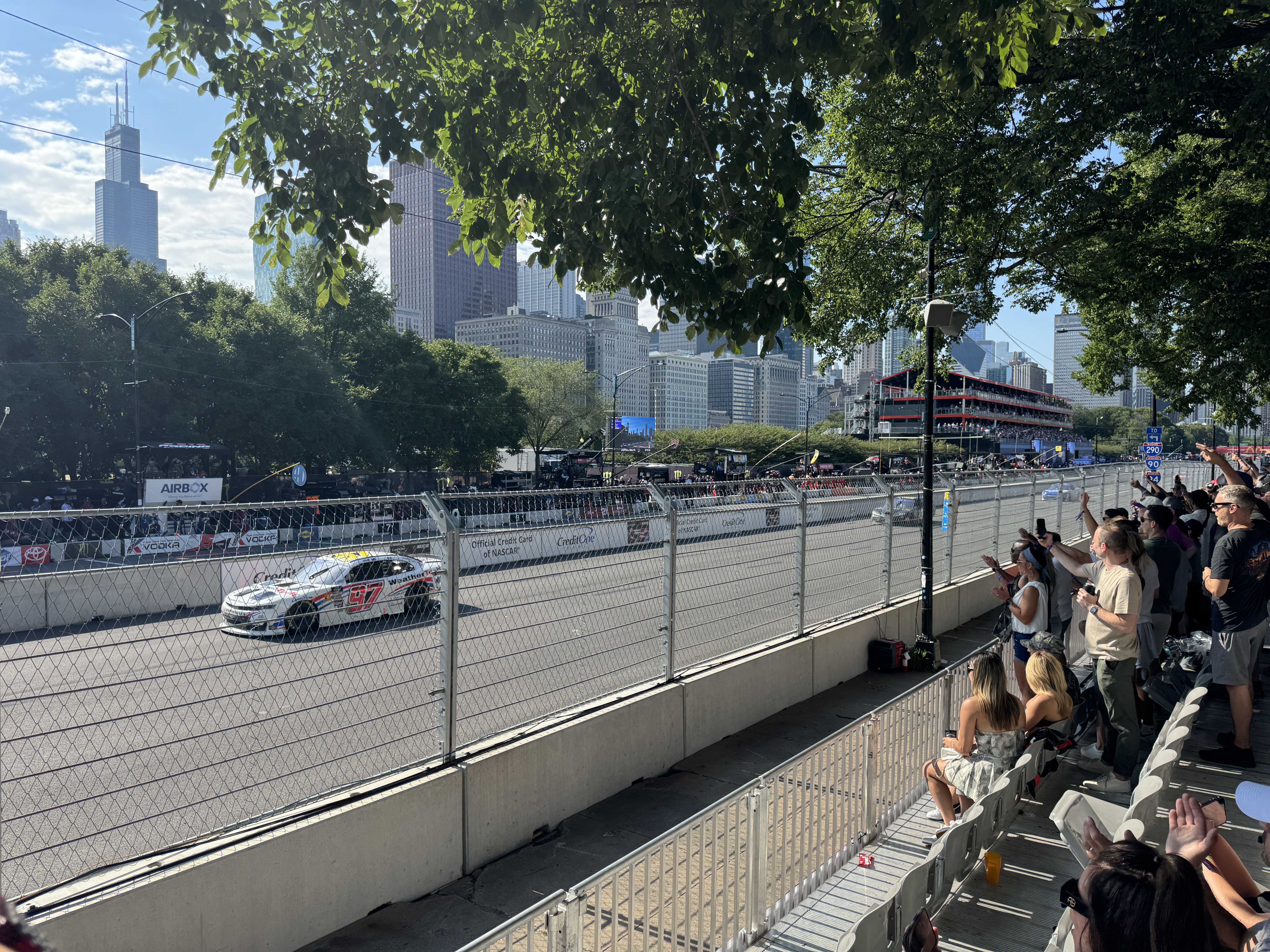
Shane Van Gisbergen (97 car) after crossing the finish line at the Loop 110 NASCAR Xfinity Series Race, Chicago, July 6, 2024

And then Saturday’s race, the Loop 110 NASCAR Xfinity Series Race, began. I can’t explain it. It was such a totally different experience than I had at Phoenix International Raceway. Drivers were not going in a loop, always turning left. They were navigating sharp 90-degree turns after long and short straightaways. Speeds were fast, but not as fast as a regular oval track NASCAR race. The cars went flying by; we followed the progress of the race in our headsets. It was absolutely thrilling. The race was won by Shane van Ginsbergen in his 97 car. If you want to get an idea of what we saw, click here to view the whole race on YouTube.

Cody_Phil_Route_66_NASCAR_2024

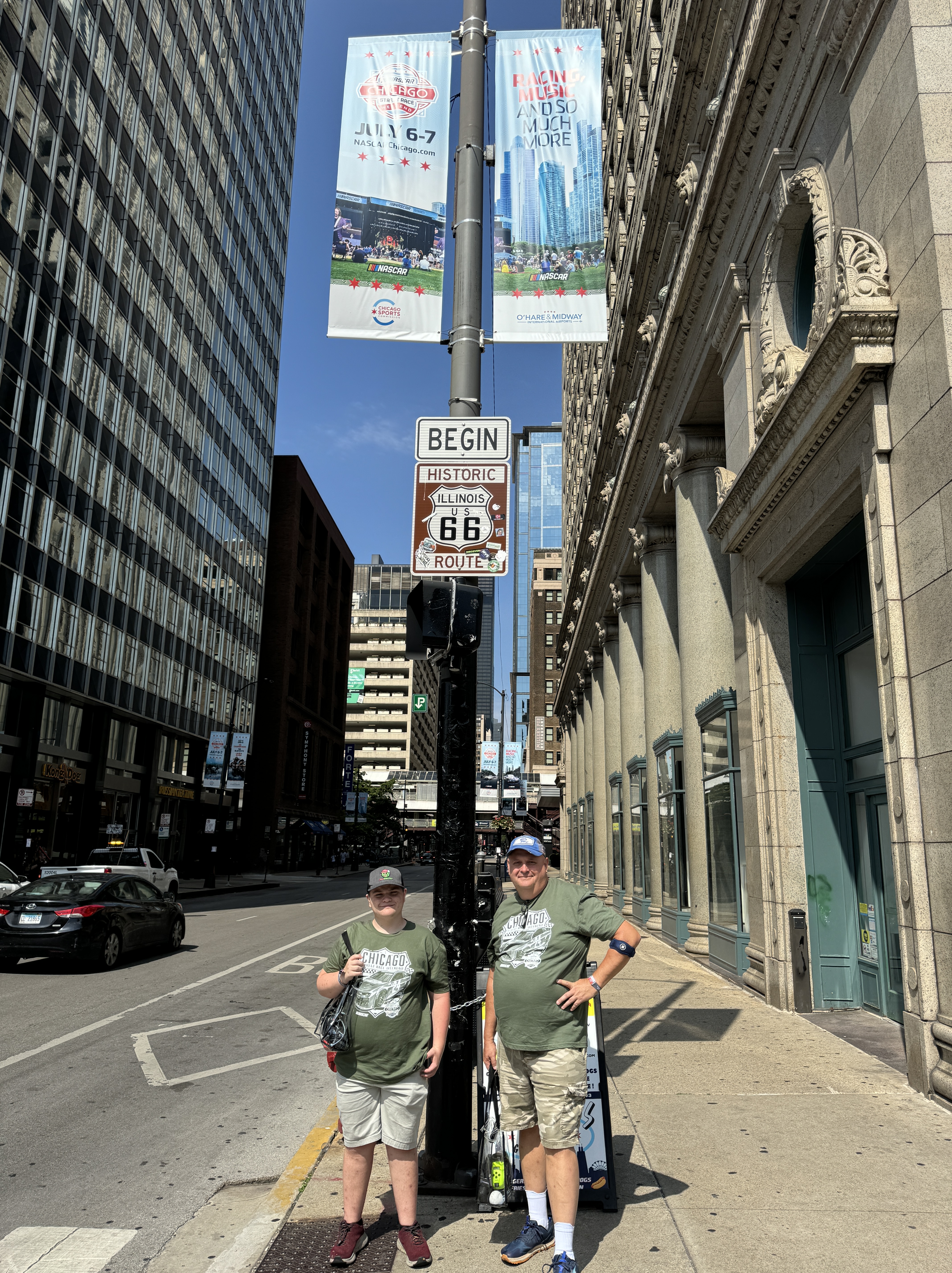
Cody and Phil Spotts at the beginning of historic Route 66 begins, Michigan Avenue, Chicago, July 7, 2024

After the race, we took the train home and after a short night of sleep, we headed back to Chicago for Sunday’s race, the Grant Park 165. When we got downtown, I wanted to show Phil and Cody where historic Route 66 started—at the intersection of Michigan Avenue and East Adams Street, just across from the Art Institute of Chicago. I took this photo (above) while I was STANDING IN THE MIDDLE OF MICHIGAN AVENUE. I had never done THAT before.

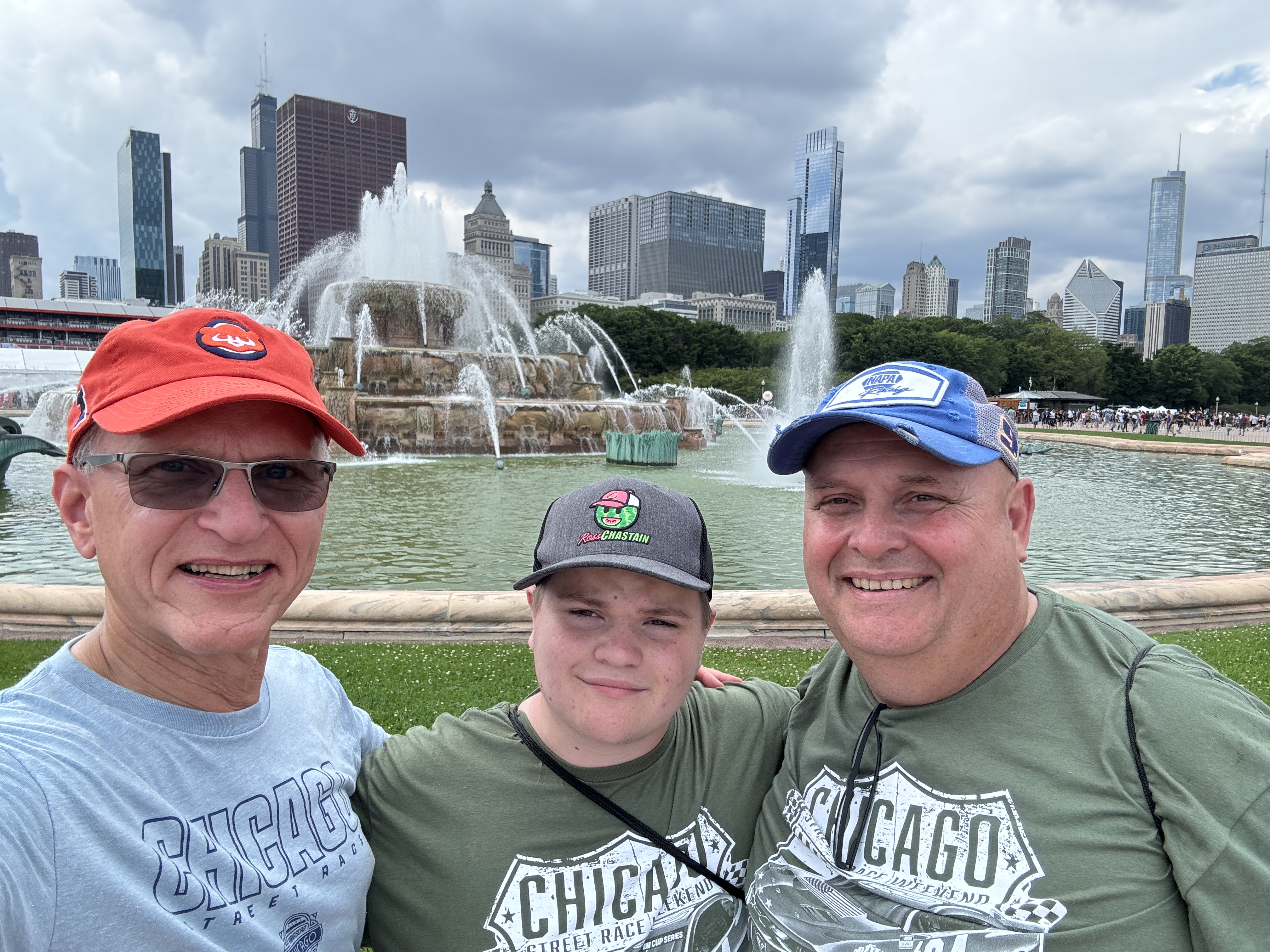
Doug_Cody_Phil_Buckingham_Fountain_day_NASCAR_2024

Douglas Yeo and Cody and Phil Spotts, Buckingham Fountain, Chicago, July 7, 2024

In the center of Chicago’s Grant Park is the Buckingham Fountain. It was a centerpiece of our race days, its fountains providing soft mist to cool off on hot days.

Doug_Cody_Phil_on_the_track_NASCAR_2024

Douglas Yeo and Cody and Phil Spotts, on the NASCAR Chicago Street Race track, E. Balbo Drive, Chicago, July 7, 2024. Note the temporary bridge over E. Balbo Drive.

Once we got in the Park, we had an opportunity to walk ON THE TRACK. This was another thrill, to get up close to the view the drivers had.

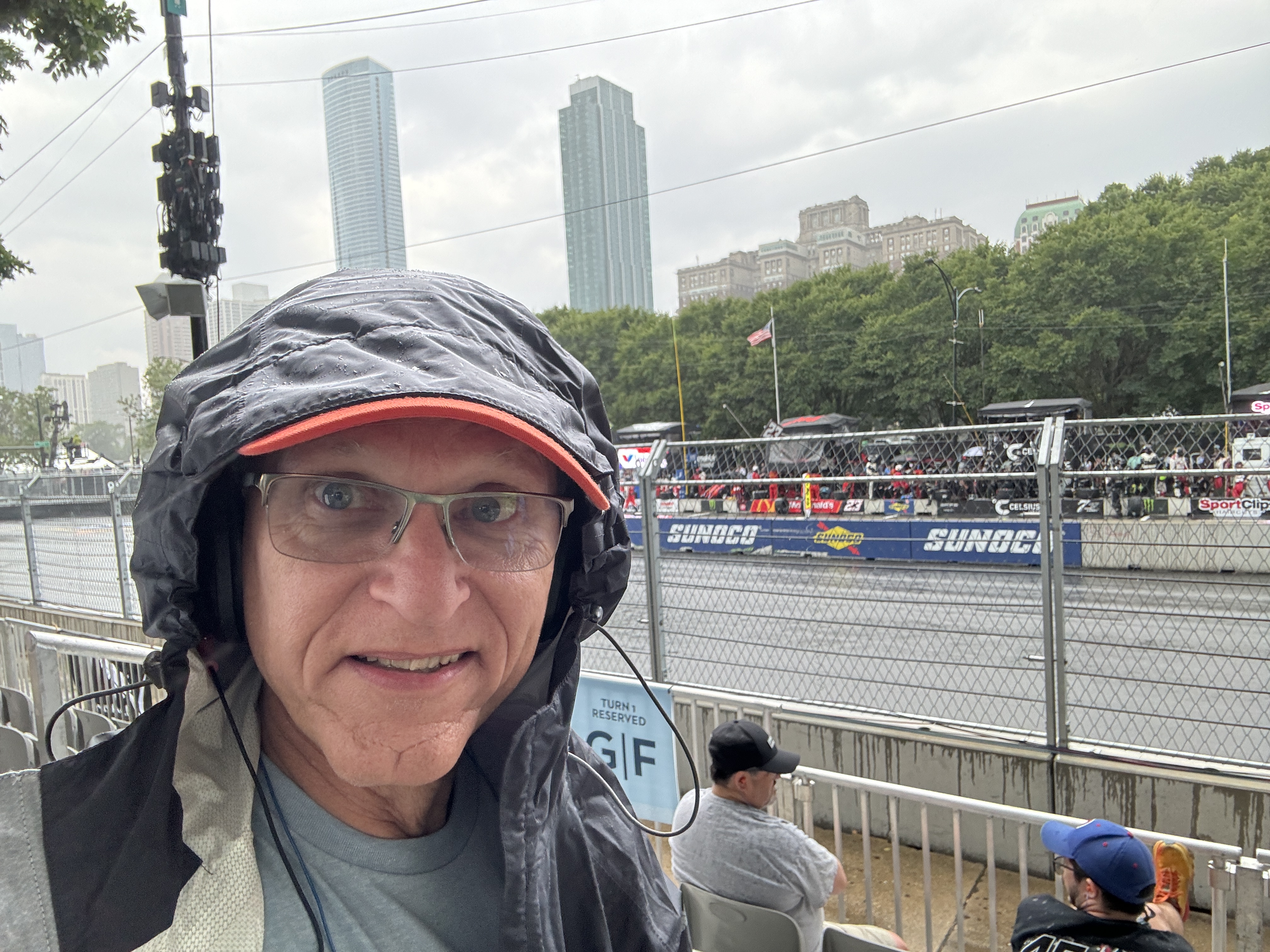
Doug_wet_NASCAR_Sunday_2024

Douglas Yeo in the rain, NASCAR Chicago Street Race, July 7, 2024

While the day—and the race—started off with beautiful sunshine, we knew that rain was in the forecast. And the rain came. It sprinkled. Then it cleared up. Then the skies opened up and it poured. And poured, and poured.

Doug_Cody_Phil_rain_delay_NASCAR_2024

Douglas Yeo and Cody and Phil Spotts during the NASCAR race delay, July 7, 2024

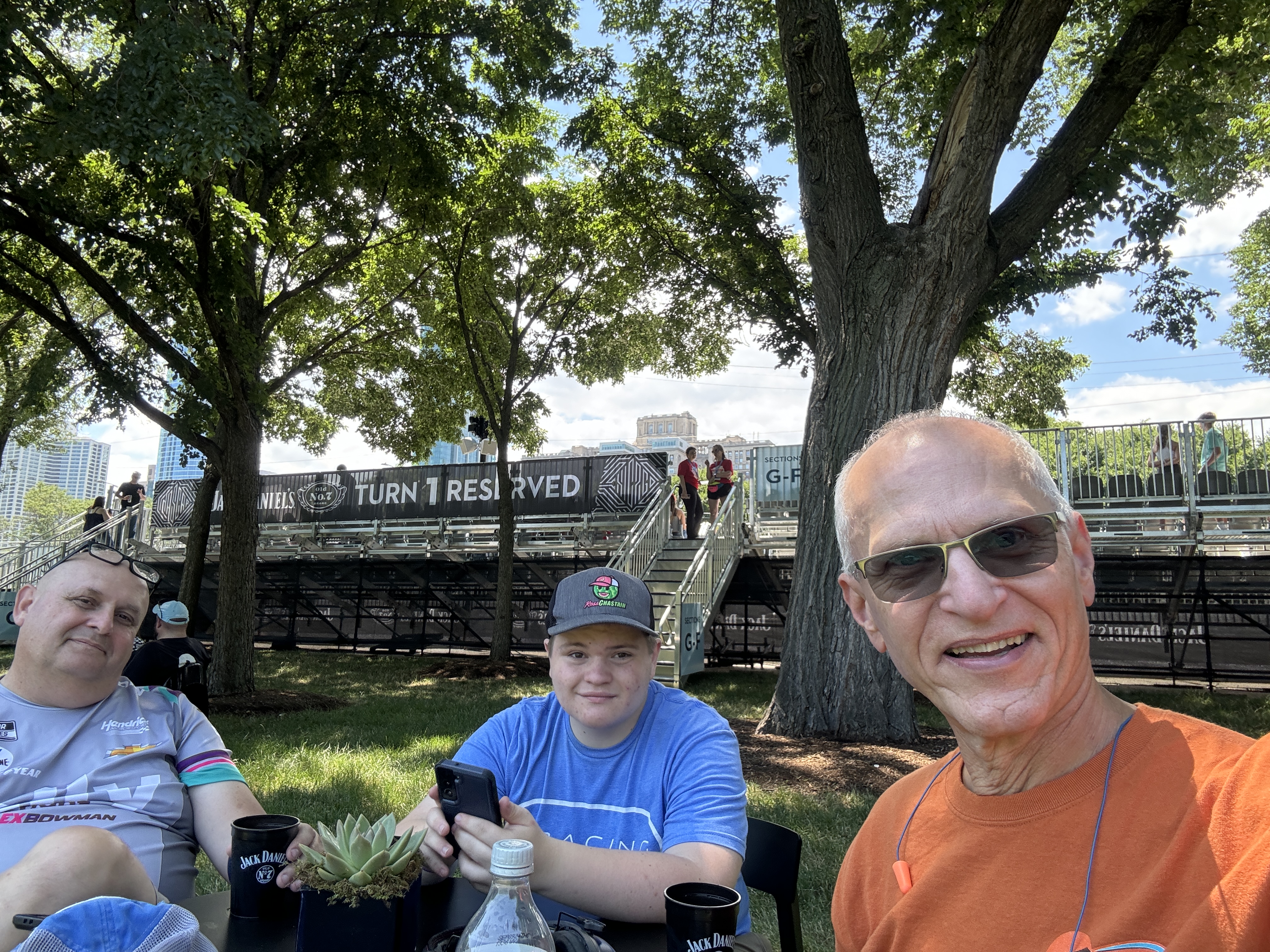
The race continued for awhile in the rain but when it simply got too wet for drivers to race safely, we found ourselves in a rain delay of nearly two hours. We hung out at a picnic table in the Turn 1 Club, under an umbrella. The rain didn’t dampen our spirits. We were still having a great time, grazing on food and drink nonstop, enjoying conversations, talking about the race, the cars, and the drivers. When confronted with a situation you can’t control, you make the best of the situation. As teachers at our grandchildren’s elementary school frequently say, “You got what you get and you don’t throw a fit.” The rain didn’t matter. A lot of fans left but we stayed to watch the race start up, shortened because it was getting dark. Once again, it was a thrill to see the drivers cautiously—at over 100 miles per hour!—navigate the slick race course.

NASCAR_2024_Sunday_race_view

Alex Bowman (48 car) after crossing the finish line at the Grant Park 165 NASCAR Cup Series Race, Chicago, July 7, 2024

The race was won by Alex Bowman in his 48 car, and as he crossed the finish line, the rain stopped, the sun started to come out from behind the clouds even as it was setting, and we finished our days of enjoying racing in downtown Chicago. Click here to view the race on Youtube.

Doug_Cody_Phil_Buckingham_Fountain_NASCAR_2024

Douglas Yeo and Cody and Phil Spotts, Buckingham Fountain, Chicago, July 7, 2024

As we exited Grant Park, we passed by Buckingham Fountain one more time. Its fountains had been turned off for the night but I don’t think I’ve ever seen it look more beautiful than in the twilight of that Sunday night after the race.

Doug_Cody_Phil_Sears_Tower_2024_circle

Douglas Yeo and Cody and Phil Spotts atop the Sears Tower (AKA Willis Tower), Chicago, July 8, 2024. The red circle shows where we sat for the NASCAR Street Race.

We headed home again but our time together was not over. Cody wanted to do something he had never done before: go up a seriously tall building. So we took the train back to Chicago on Monday morning and visited the Sears Tower. From the observation deck, we looked down on the race course. In the photo above, you can see where our seats were in the red circle I drew between Cody and Phil. And yes, I’m wearing a Shane Van Gisbergen t-shirt. I’m a fan.

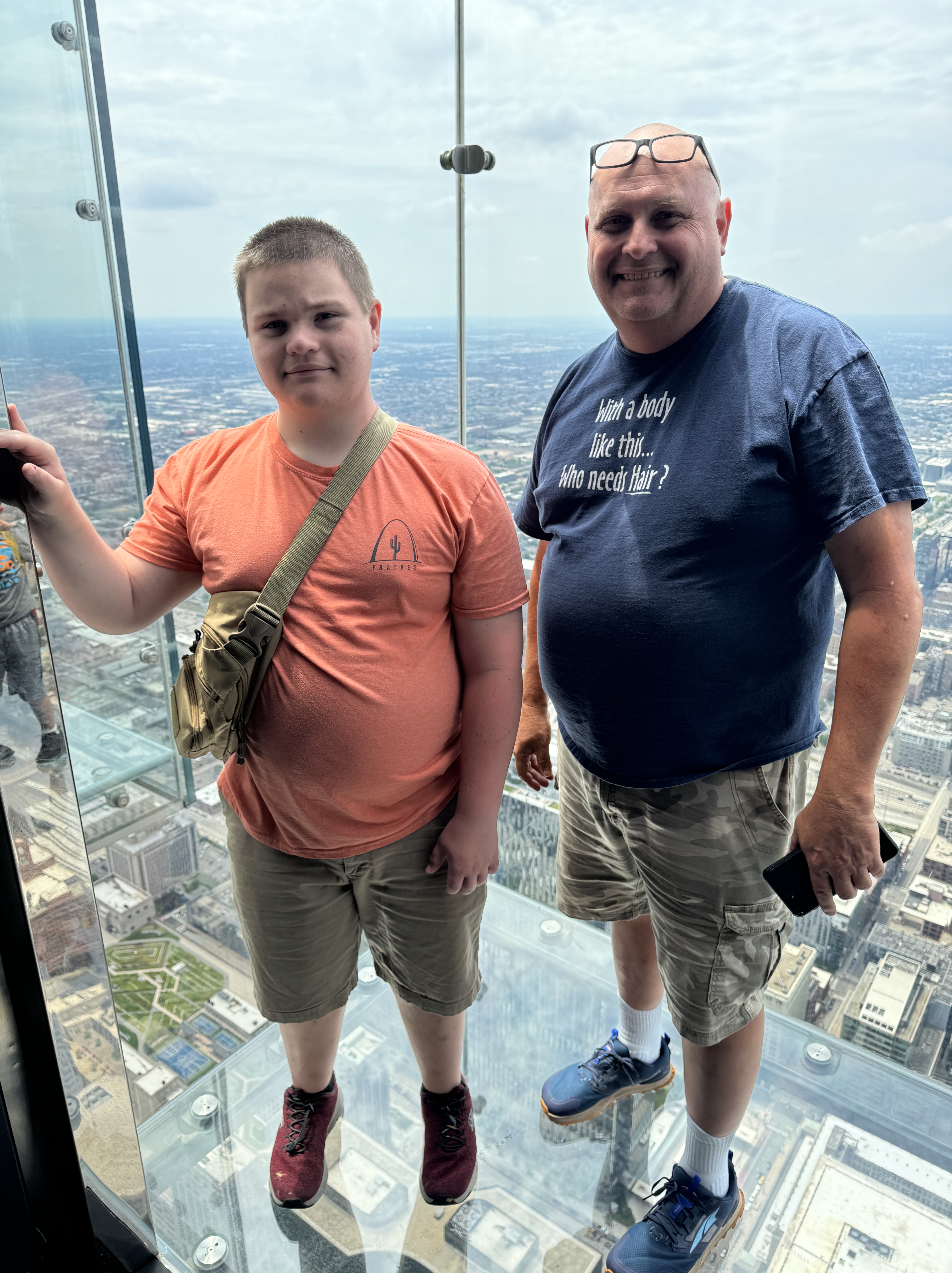
Cody_Phil_Sears_Tower_Ledge

Cody and Phil Spotts on “The Ledge,” Sears Tower (AKA Willis Tower), Chicago, July 8, 2024.

But there was a limit to what I would do. While Cody and Phil happily—and fearlessly—walked out on the Sears Tower’s “The Ledge”—looking straight down 103 floors through glass to the street below—I was happy to be their official photographer, my feet firmly planted on the carpeted floor.

Doug_Cody_trombone_2024\

Douglas Yeo and Cody Spotts, July 8, 2024

When we got back to our house after yet another train ride (Pat had prepared a delicious dinner; as good as the food was at the race, it was nice to be home and have Pat’s wonderful home cooking), Cody and I played trombone duets. I’d never heard Cody play trombone before and it was so great spend some time together with trombones in our hands. The thing that solidified Cody’s and my friendship—the trombone—was shared in a memorable, tangible way.

This is friendship. Being together, talking together, sharing together, enjoying experiences together. Saying “Yes” when a friend asks you to do something you can’t imagine yourself doing. And then appreciating how they stretched you. And saying—and showing—”thank you” when someone gives you a gift—and Phil and Cody gave me a remarkable gift. Not just tickets to a race weekend, but a shared brotherhood that started with our shared faith in Christ. The three of us know and truly understand what the Apostle Paul meant when he wrote, “Therefore encourage one another and build one another up, just as you are doing.” (1 Thessalonians 5:11) Though separated by distance, when Cody asked to come to the Chicago Street Race with his dad and enjoy it with me, we picked up our relationship like we were next door neighbors who had never been apart. That is friendship.

Before I went to the NASCAR Chicago Street Race weekend I did not know what to expect. These friends taught me a lot. We shared something that has bound us together in a new way, and I will treasure the memory. Just as I treasure our friendship. Thank you, friends.

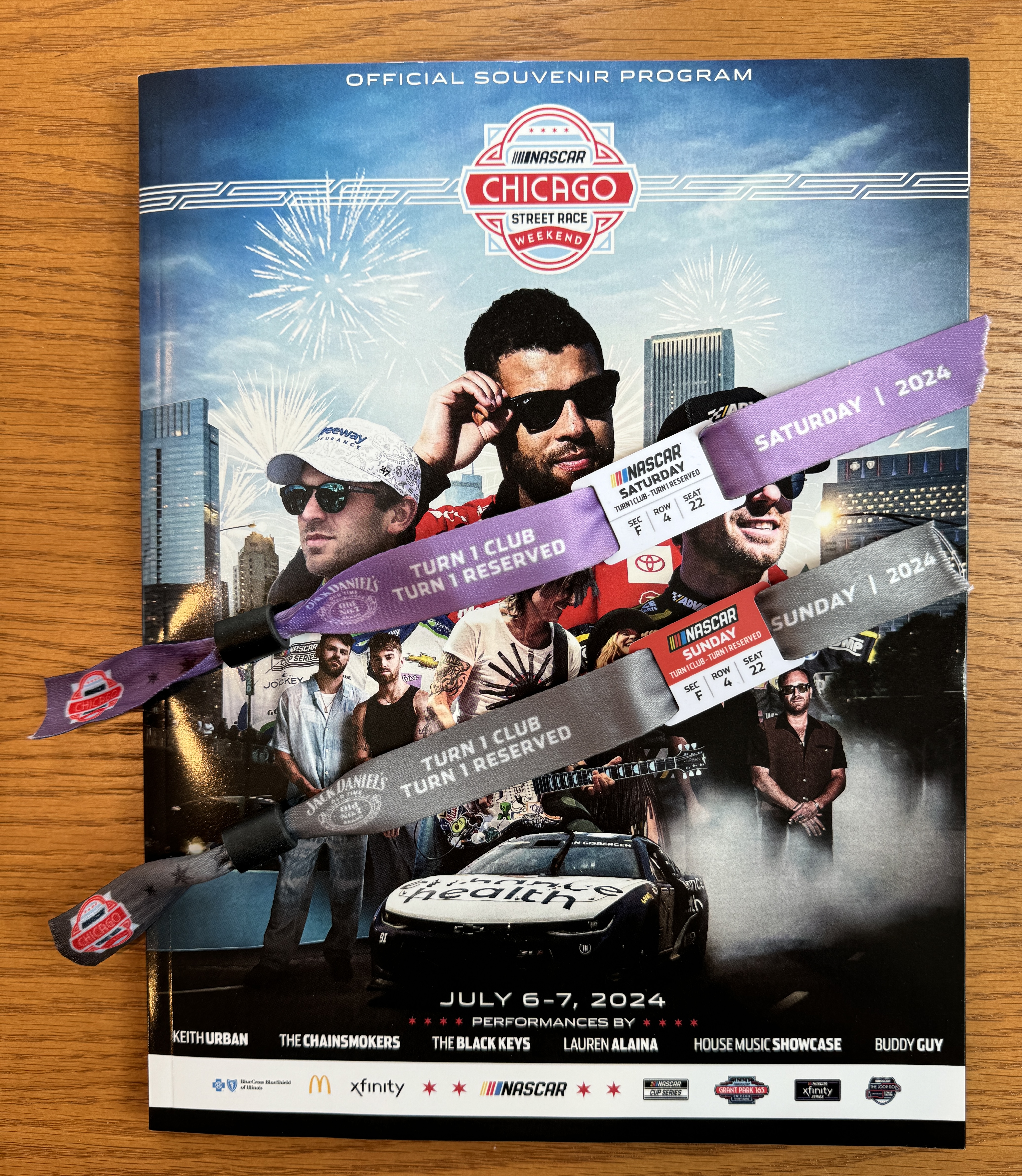
NASCAR_2024_wristbands_program

Official program and my wristbands for the 2024 NASCAR Chicago Street Race Weekend, July 6-7, 2024

It was quite a week: the 2024 International Trombone Festival

It was quite a week: the 2024 International Trombone Festival

by Douglas Yeo (June 6, 2024)

Since the International Trombone Association (ITA) was founded in 1972, it has held an annual gathering of trombonists. In the Association’s early years, the gathering was called the International Trombone Workshop, and in recent years, it’s been the International Trombone Festival (ITF). I have been to eight of these events, in 1982 (Nashville, TN), 1999 (Potsdam, NY), 2004 (Ithaca, NY), 2014 (Rochester, NY), 2017 (Redlands, CA), 2018 (Iowa City, IA), 2022 (Conway, AR), and, last week (Fort Worth, TX). Since the conclusion of the Festival on Saturday, I’ve been reflecting on this extraordinary event and its impact not only on me, but on the world-wide community of trombonists. Here are some of my impressions. . .

THE IDEA

As readers of The Last Trombone know, I have taught trombone on the college level for over 40 years. I’ve worked with hundreds of students, taught thousands of lessons and classes, and I’ve followed the career path of many of the students whose lives intersected with mine in those institutions. I taught at New England Conservatory of Music in Boston from 1985-2012, and there was a period in the late 1980s and early 1990s that brought an exceptional group of students into my orbit.

NEC_Trombones_1990_02_Begnoche

The New England Trombone Choir at New England Conservatory, Spring 1990, Douglas Yeo, conductor. Among the students playing in the ensemble (some are not shown in this frame) are Julie Josephson, R. Douglas Wright, Petur Erickson, Randall Hestand, Brett Shuster, David Begnoche (in the circle, just above me), Jeffrey Hall, Darren Acosta.

Among these students was David Begnoche, a tenor trombonist who graduated from NEC in 1990 with his Bachelor of Music degree. After studying with John Swallow and me at New England Conservatory of Music, David went on to Manhattan School of Music for his master’s degree, then to University of North Texas for his doctorate. Along the way, he had positions playing trombone with the Joffrey Ballet Orchestra (Chicago), the Sarasota (Florida) Opera, the Albany (New York) Symphony, and the Spoleto Orchestra (Italy). David landed at Texas Christian University (TCU) in Fort Worth, Texas, where he serves as Associate Professor of Trombone. David also is Second Vice-President of the International Trombone Association, a position to which he was elected by the Association’s membership.

David and I have been in close contact since he graduated from NEC—long ago, we made the jump from student/teacher to being colleagues—and I have always enjoyed working with him. I’ve taken part in his annual TCU Trombone Summit on two occasions, and we frequently talk about big issues that face the trombone community and the ITA—and the world. In 2020, he reached out to me and said he was considering hosting the International Trombone Festival at some point. From the jump, David wanted the Festival he hosted to be impactful and diverse. He sent me a long document with his dream list of individuals and groups and ideas that might make up such a Festival. More on this below—because it is important to acknowledge where seminal ideas for the 2024 International Trombone Festival came from—but as we started talking about his hopes and dreams for a TCU based International Trombone Festival, I knew I had to be there. And, when the announcement was made that David Begnoche would host the 2024 ITF at Texas Christian University, I made plans to be there.

As things developed, I ended up being involved in a host of activities at the 2024 International Trombone Festival. But first, I had to get there.

THE TRIP

It seemed so simple. Fly from Chicago’s Midway Airport to Dallas/Love Field (DAL). The flight was only a couple of hours long with no time change. The Festival began on Wednesday, May 29, so I made plans to fly to Dallas in the morning of Tuesday, May 28. The weather in Chicago was clear, and while there had been storms in the Dallas/Fort Worth area, I had no idea what was about to unfold. My 8:25 am departure was delayed to 9:00, then 10:00, then 12:00, then 1:00, then 2:00. After three hours of delays while waiting in the terminal, we had another three hours of delays while sitting on the plane. Then, at 2:30 pm, my flight was cancelled. There had been a violent storm in the Dallas/Fort Worth area. Large hail had pummeled Love Field and all of the planes on the ground needed to be inspected for hail damage. Which meant that planes on the ground at Love Field sat at gates waiting for inspection and no new planes could arrive. As I disembarked from my plane and went to the rebooking counter, I learned there would be no more flights going from Chicago to Dallas on that day, or the next day until late at night. I needed to get to Fort Worth in time for the opening ceremony at 10:00 am at Wednesday and my first presentation at 11:30 am. I wasn’t able to fly. So I did the only thing I could: I got my suitcase, put my trombone on my shoulder, walked to my car in the airport parking lot, and started driving.

IMG_9786

The Google Maps display on my iPhone as I began my drive from Chicago’s Midway Airport to the Hyatt Place Fort Worth TCU Hotel, Tuesday, May 28, 2024.

I’ve driven long distances before. But when my GPS said “14 hours, 52 minutes – 948 miles,” I was in new territory. I needed to drive straight through without an overnight stop. An all-nighter was in my future. It was the only way to get to the Festival in time for its opening and my first presentation. There was no other option. I was about to find out how a college senior on a spring break road trip feels. After fortifying myself with many bottles of Diet Coke, bottles of water, food, and a box of No-Doz, I headed down Interstate 55 to Texas. Texas. The words, “I’m driving to Texas,” had never previously been in my lexicon. 

IMG_9787

The Saint Louis Gateway Arch coming into view. Tuesday, May 28, 2024.

At about 8:30 pm, I passed through St. Louis at sunset (photo above). I stopped 10 times along the way, and I pulled into the parking lot at the Hyatt Place Fort Worth/TCU at 7:30 am on Wednesday. 950 miles, 16 hours in the car. I got to my room, took a shower, unpacked, had breakfast, and headed to campus to warm up on the trombone. I made it. Here are some impressions of things I did at the Festival, both planned and spontaneous. These kinds of festivals are so loaded with activities that it was impossible to take in everything I wanted to experience. But for me, the best part of an International Trombone Festival is meeting and talking with PEOPLE: friends, colleagues, former and current students, and individuals I had never met before. Here’s some of what occupied me at TCU.

ITF_2024_program_cover

Cover to the Program for the 2024 International Trombone Festival, Texas Christian University, Fort Worth, Texas. The trombone-playing angel logo was designed by Lennie Peterson; it is based on the bas-reliefs of trumpet-playing angels that flank the front entrance of Bass Performance Hall, Fort Worth.

PRESENTATION—JOANNÈS ROCHUT: MORE THAN BORDOGNI

Yeo_Rochut_ITF_2024_program

Douglas Yeo presentation: Joannès Rochut: More Than Bordogni (2024 International Trombone Festival program). Wednesday, May 29, 2024.

When David Begnoche and I talked about his dreams for hosting an International Trombone Festival, he wanted to have things that were not ordinarily a part of the Festival. Among these was a strong trombone research component. I immediately told him I would like to do a presentation about Joannès Rochut, the celebrated French trombonist who, among many things, was principal trombonist of the Boston Symphony Orchestra from 1925–1930, and published the most famous books of trombone music in the history of the instrument, Melodious Etudes for Trombone Selected From the Vocalises of Marco Bordogni (Carl Fischer, 1928). 
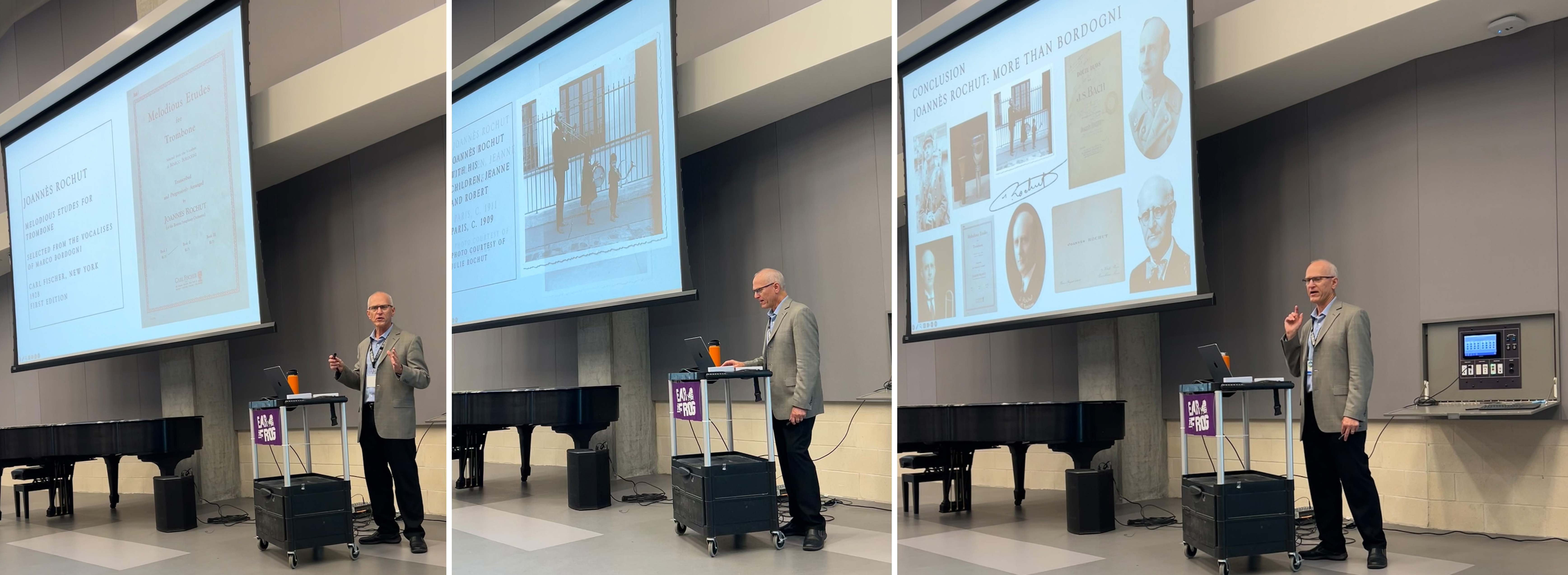
Yeo_Rochut_ITF_2024

Douglas Yeo presentation, Joannès Rochut: More Than Bordogni. Van Cliburn Band Room, 2024 International Trombone Festival, Texas Christian University. Wednesday, May 29, 2024.

I have been researching Joannès Rochut since I joined the Boston Symphony Orchestra in 1985 and this was the time to finally get serious and give a scholarly presentation about him. This presentation was a summary of my research and the full story will be told in my forthcoming article about Joannès Rochut that will appear in the January 2025 International Trombone Association Journal.

Van Cliburn Band Room at TCU was packed for my presentation. I’ve given many scholarly presentations at International Trombone Festivals over the years but this was the first one that was given to a packed room of over 200 people. I was heartened by the strong interest in my lecture, and the Festival was underway.

PERFORMANCE—TCU TROMBONE CHOIR WITH RONALD BARRON
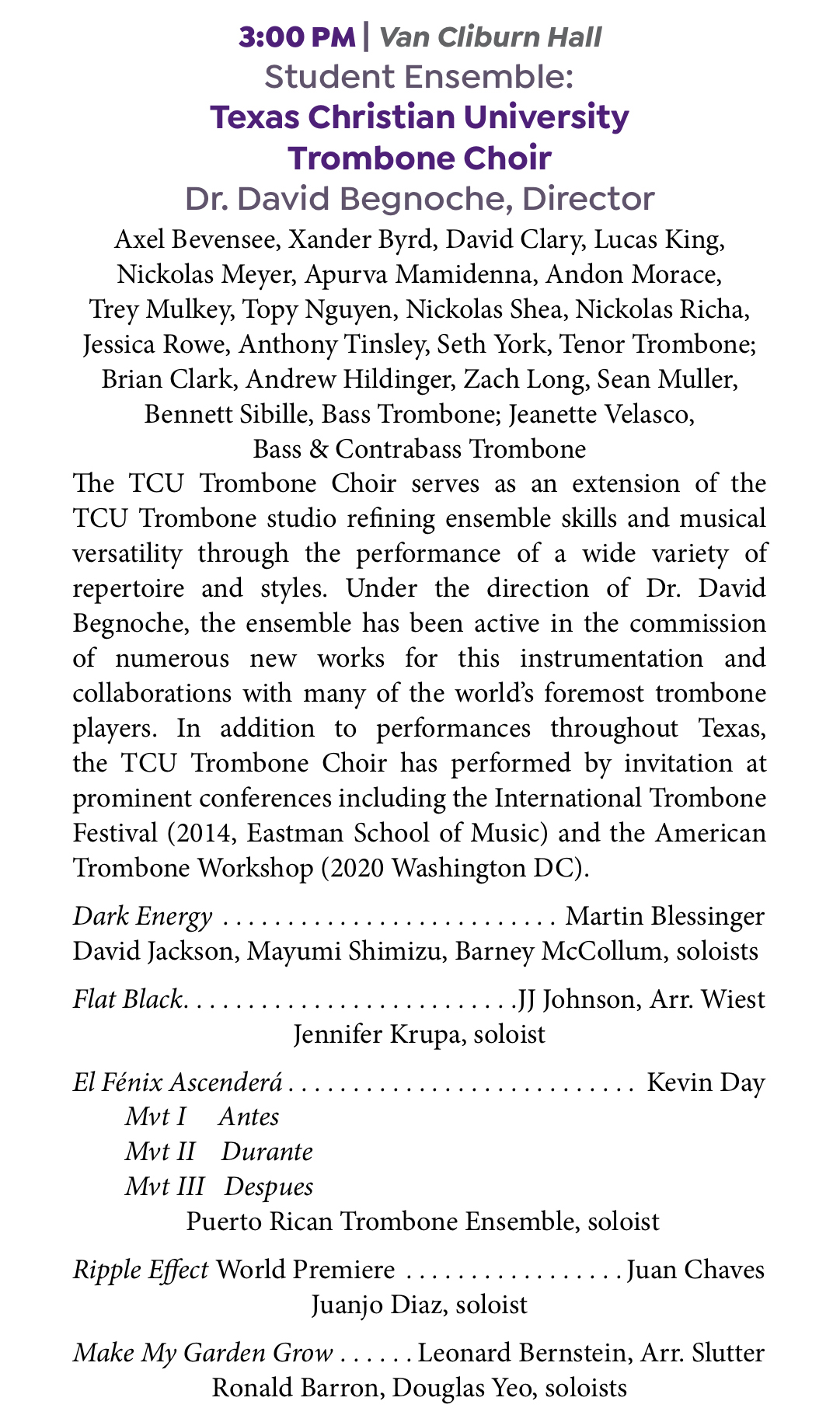
Yeo_TCU_trombone_choir

Texas Christian University Trombone Choir, David Begnoche, conductor (2024 International Trombone Festival program). Wednesday, May 29, 2024.

For my first 23 years as a member of the Boston Symphony Orchestra, our trombone section was Ronald Barron (principal), Norman Bolter (second), and me (bass). David Begnoche asked me if I would be interested in playing a duet with Ron on the TCU trombone choir concert at the Festival. Of course! I had not seen Ron since I retired from the Boston Symphony Orchestra in 2012 (Ron retired from the orchestra in 2008). While we have kept in contact over the years, I was really looking forward to this reunion with Ron.
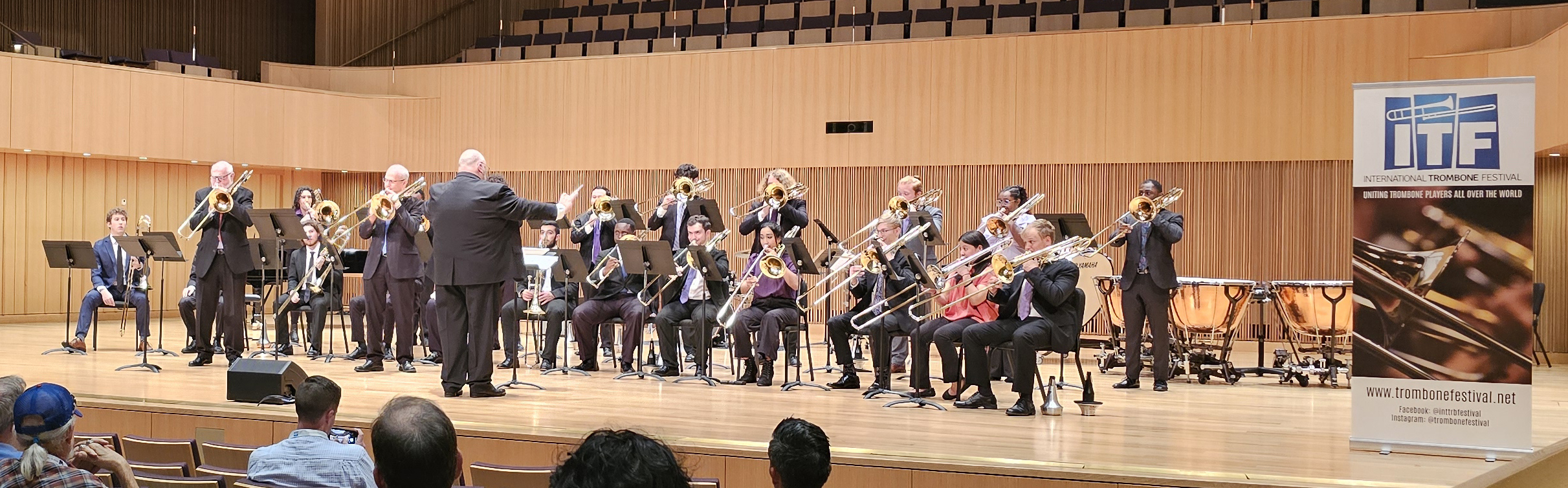
Yeo_Barron_TCU_trombone_choir_2024_ITF

Ronald Barron and Douglas Yeo performing Leonard Bernstein’s “Make Our Garden Grow” from Candide, with the Texas Christian University Trombone Choir, David Begnoche, conductor. Van Cliburn Hall, 2024 International Trombone Festival, Texas Christian University. Wednesday, May 29, 2024.

Barron_Begnoche_Yeo_ITF_2024

Ronald Barron, David Begnoche, and Douglas Yeo. Van Cliburn Hall, 2024 International Trombone Festival, Texas Christian University. Wednesday, May 29, 2024.

David Begnoche asked us if we would play a trombone duet arrangement of Leonard Bernstein’s “Make Our Garden Grow” from Candide. I had played this arrangement before and I love the message of this piece. It contains these lines:

And let us try, before we die,

To make some sense of life.

We’re neither pure, nor wise, nor good,

We’ll do the best we know. . . And make our garden grow.

Ron read these lines to the audience before we played the duet in honor of Dr. Irv Wagner, the long-time professor of trombone at University of Oklahoma and a past President of the ITA, and I will never forget the feeling I had during the performance. There I was, on stage with the TCU trombone choir (I told many people that the TCU trombone studio is like the United Nations, a group of students of diverse genders who are of a host of racial and ethnic groups), playing with a dear friend and colleague with whom I had shared a very long season of life, Ron Barron, and conducted by my former student and now colleague, David Begnoche. Memorable.

AWARD PRESENTATION—THE 2024 INTERNATIONAL TROMBONE ASSOCIATION LIFETIME ACHIEVEMENT AWARD

YEO_ITA_Lifetime_Achievement_Award_ITF_2024_02

The 2024 International Trombone Association Lifetime Achievement Award.

In March, I was informed that I was a recipient of the 2024 International Trombone Association Lifetime Achievement Award; I have previously written about this on The Last Trombone. This is a great honor as I became one of only 17 people in the history of the International Trombone Association to receive both the ITA Award (which I received in 2014) and the ITA Lifetime Achievement Award. Among these individuals are some of my trombone heroes, mentors, and friends, including Edward Kleinhammer, Urbie Green, Allen Ostrander, George Roberts, Denis Wick, Ronald Barron, and Irvin Wagner. Adding to this special moment was the fact that I received the 2024 ITA Lifetime Achievement Award along with my good friend, Benny Sluchin (more on him, below). Dr. Ava Ordman, chair of the ITA’s Standing Committee on Awards, introduced David Begnoche who then made the presentation to me. This was a special moment in my life, to be recognized in this way by my peers in an area of my life that has been so important since I began playing the trombone at the age of nine in 1964. And I hope it is a little premature: I sure hope I have more living to do in this lifetime!

YEO_ITA_Lifetime_Achievement_Award_01

Accepting the International Trombone Association 2024 Lifetime Achievement Award with David Begnoche and Benny Sluchin, Landreth Hall, 2024 International Trombone Festival, Texas Christian University. Wednesday, May 29, 2024.

FRIENDS

My work at the International Trombone Festival had only just begun, but as I mentioned earlier, the most important—the most fun—part of these Festivals is meeting with people. Friends, colleagues, former and current students, and people I had never met previously. Some of these encounters were planned, others were spontaneous.
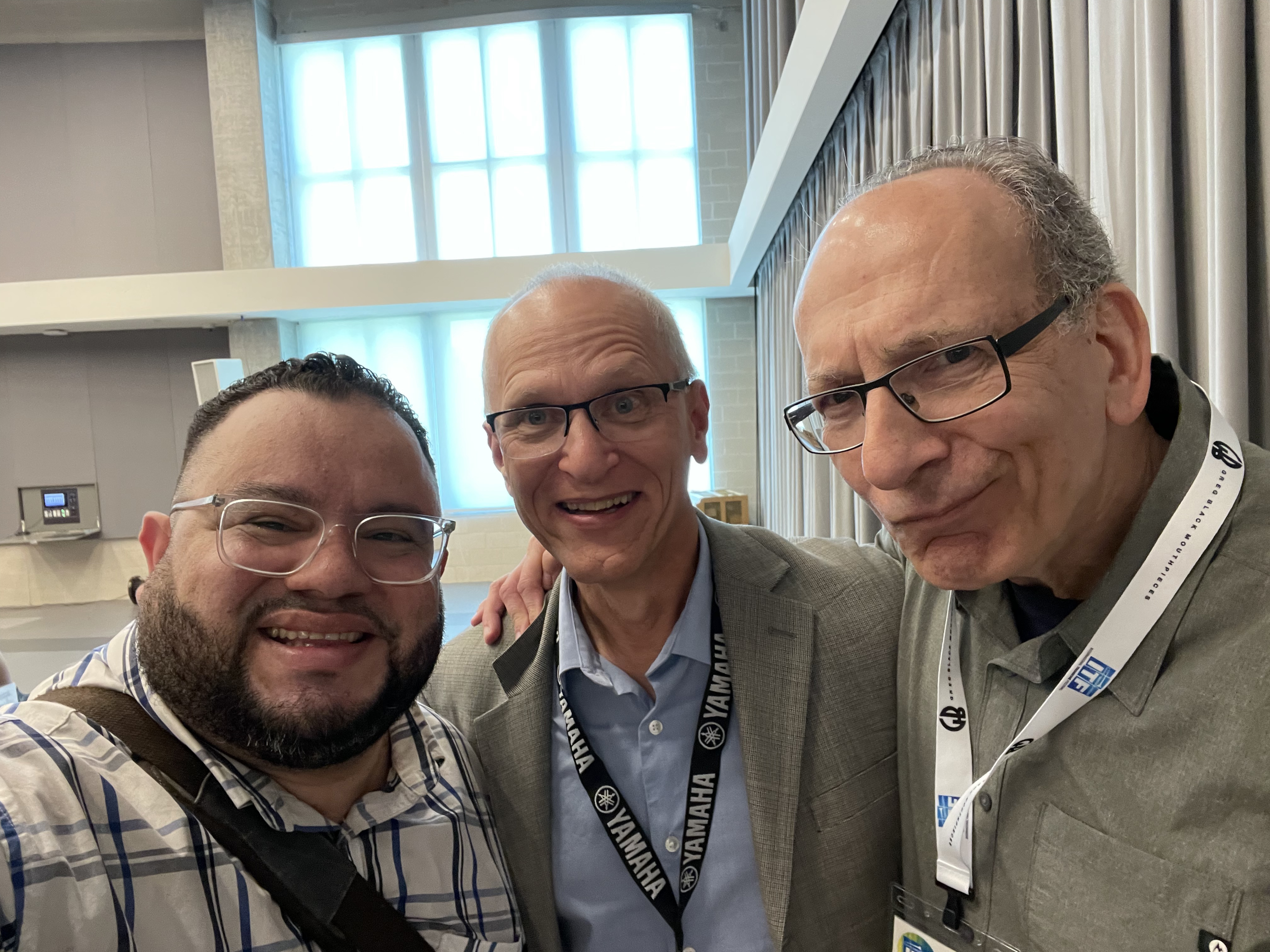
Subero_Yeo_Rojak_ITF_2024

Angel Subero, Douglas Yeo, and John Rojak. 2024 International Trombone Festival, Texas Christian University. Wednesday, May 29, 2024.

I met up with my former student Angel Subero, a superb Boston-based bass trombonist who is equally conversant in salsa, Latin jazz, classical, and new music. Angel studied trombone with me when he was a student at Boston Conservatory of Music and New England Conservatory of Music. I had not seen Angel since I left Boston in 2012 and later in the Festival, we would find ourselves playing together on the same stage (more on that below). John Rojak, bass trombonist of the American Brass Quintet, has been a friend for nearly four decades; it was so good to see him again.
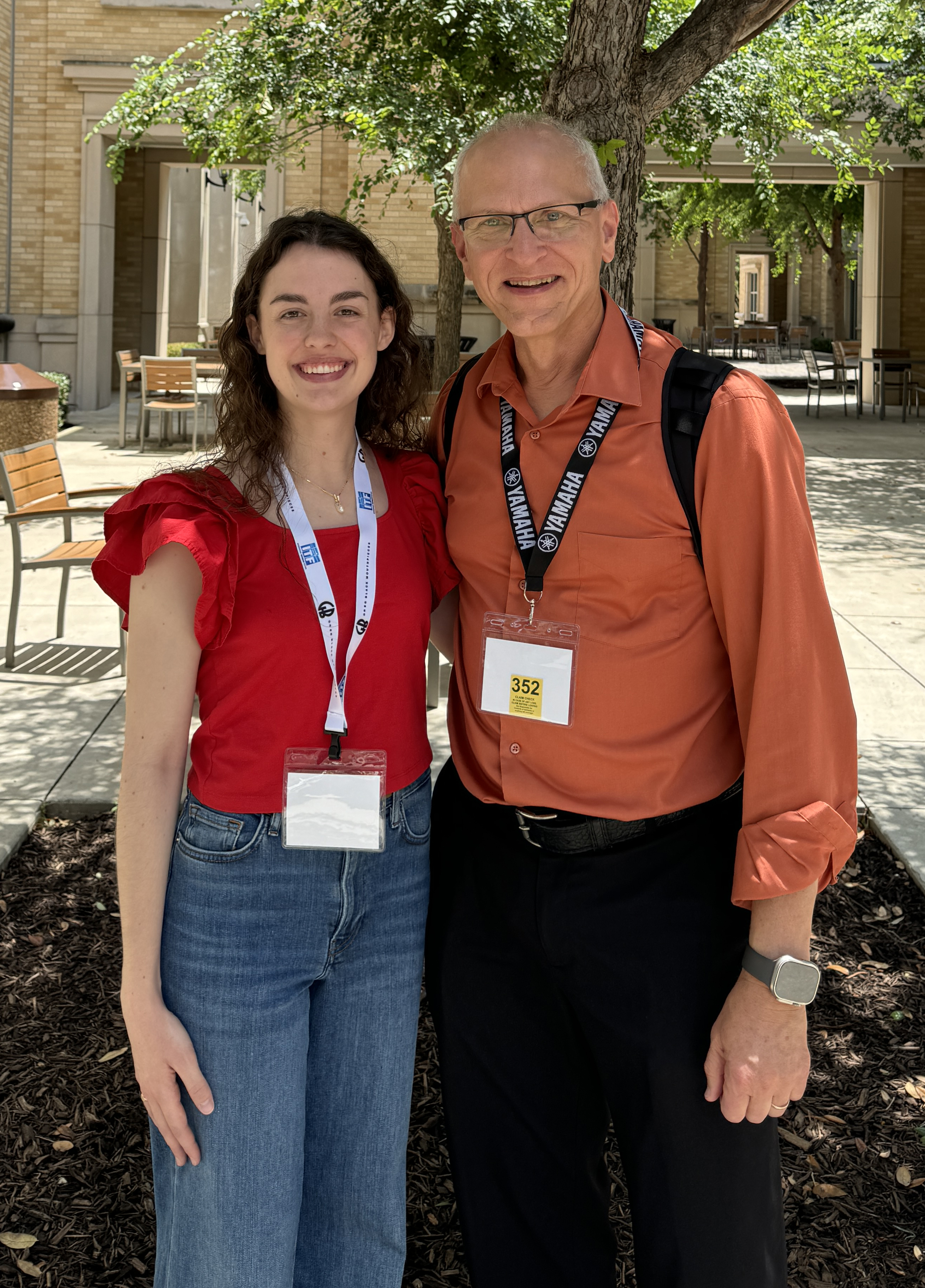
Potter_Yeo_2024_ITF

Gracie Potter and Douglas Yeo, 2024 International Trombone Festival, Texas Christian University. Friday, May 31, 2024.

I was not able to attend the finals of any of the many International Trombone Association competitions. I have always enjoyed going to those, and sometime adjudicating one of them, but my schedule was so busy that it just wasn’t possible this time. So it was serendipitous that when coming back to campus one day after lunch, I ran into Gracie Potter. Gracie took many lessons with me when I was living in Phoenix, Arizona (2012-2018), and she was competing in the Frank Smith Competition. It was so nice to catch up with Gracie who recently graduated from the Colburn School and has accepted a one-year position as principal trombonist with the Richmond (Virginia) Symphony. And Gracie won the Frank Smith competition! The finals piece was the first movement of Derek Bourgeois’ Trombone Concerto. Meeting up with Gracie was a very happy moment for me at the Festival. Brava, Gracie.

Yeo_Rojak_Wharton_Taylor

Douglas Yeo, John Rojak, Jennifer Wharton, and David Taylor, 2024 International Trombone Festival, Texas Christian University. Thursday, May 30, 2024.

Jennifer Wharton, the superb New York City based bass trombonist who plays in big bands, her own band, and Broadway shows, was at the Festival. Her husband, John Fedchock, accepted the 2024 ITA Award during the Festival and I was really happy to spend some time with Jen. She studied with me at New England Conservatory of Music in the 1990s and during the Festival, Jen, David Taylor (more about him, below) and I had lunch together. On our way back to campus, we saw John Rojak, the quintessential New Yorker—jaywalking and talking on his phone at the same time. When he safely got to our side of the street, I snapped this photo, above.

Yacus_2024_ITF

David Yacus at the 2024 International Trombone Festival, Texas Christian University. Friday, May 31, and Saturday, June 1, 2024.

One of the things David Begnoche wanted to have at the International Trombone Festival was an emphasis on early music. This has not regularly been a part of the ITF and early trombone specialist David Yacus gave a presentation, “ITF Antiqua: The Dawn of the Trombone. . . Ancient and Exotic Origins,” and a performance, “ITF Antiqua—17th-century Venice: Beyond the Basilica.” David studied bass trombone with me at New England Conservatory of Music in the 1980s and he is regarded as one of the finest exponents of the early trombone (often but not especially accurately referred to as the “sackbut”). His presentation was of a very high level as he discussed the precursors to the trombone and the various evolutionary theories that gave us the instrument we hold in our hands today. His concert, assisted by early trombonist Bodie Pfost as well as fine artists on violin, organ, and voice, was spectacular. There is a lot more to the trombone than “higher/faster/louder” and David Yacus brought something quite nice—even remarkable—to the Festival that gave all of us a lot to think about. David Yacus’ participation in the Festival along with the trombone research roundtable (discussed below) were part of David Begnoche’s conscious effort to demonstrate alternative career avenues for trombonists beyond obsessing over “winning” auditions. The trombone community is deep and wide and part of the ITF was to expose attendees to a wide swath of trombone-related career and avocational options.
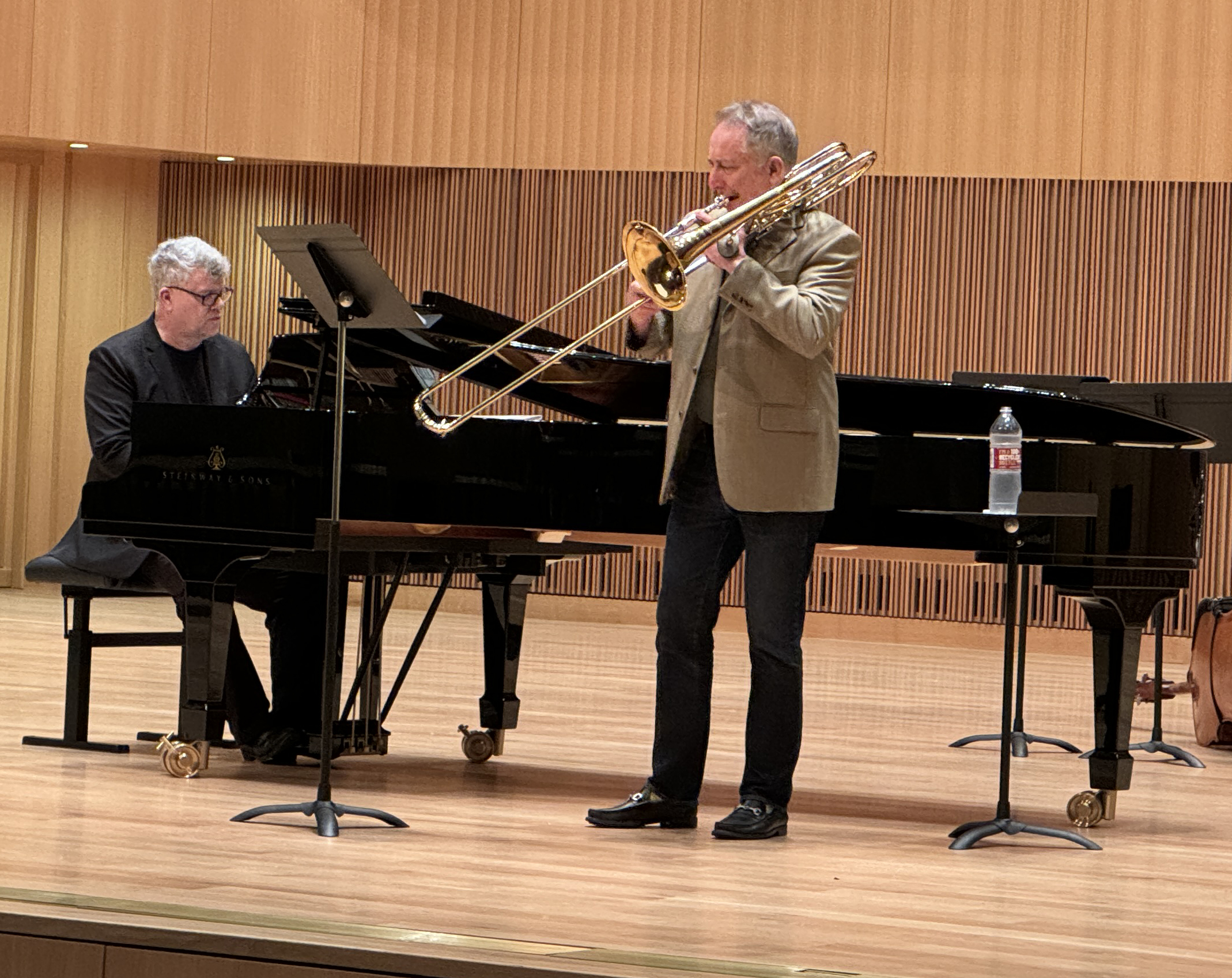
Bubert_2024_ITF

Dennis Bubert, bass trombone, with Shields Collins Bray, piano, Van Cliburn Hall, 2024 International Trombone Festival, Texas Christian University. Saturday, June 1, 2024.

Dennis Bubert and I have been friends for many years. He has been bass trombonist of the Fort Worth Symphony since 1981 (the same year I joined the Baltimore Symphony Orchestra, where I worked until 1985 when I joined the Boston Symphony Orchestra) and he studied with Edward Kleinhammer when he was a student at Illinois Wesleyan University in the 1970s, at the same time I was studying with Mr. Kleinhammer when I was a student at Wheaton College. Dennis played a fine recital at the ITF that included John Stevens’ The Kleinhammer Sonata. Dennis and I shared breakfast together the morning I headed back home from the Festival and it was good to have time face to face which is so much more rewarding than phone calls, text messages, and email that are our regular modes of communication.

Forth_Worth_Sym_2024_ITF

Presentation of the International Trombone Association’s Orchestra Recognition Award to Fort Worth Symphony President and CEO Dr. Keith Cerny with Louis Borges (representing the ITA Standing Committee on Awards) and David Begnoche. Douglas Yeo, Ronald Barron, and Robert Spano. Bass Performance Hall, Fort Worth, Texas. Friday, May 31, 2024.

I also got to see and hear Dennis perform with the Fort Worth Symphony. One of the many things that David Begnoche envisioned for the 2024 International Festival was the premiere of a new work for trombone and orchestra. His advocacy for this project led to the commissioning of Kevin Day’s Departures for trombone, piano and orchestra. Kevin Day is one of today’s leading composers and he is also a TCU graduate. Departures was premiered by the Fort Worth Symphony last week with trombonist Peter Steiner and pianist Constanze Hochwartner; Bass Hall was packed for the performance. Before the concert, the International Trombone Association’s Orchestra Recognition Award was presented to the Fort Worth Symphony, and after the concert (which also included Gustav Mahler’s Symphony No. 5), Ron and I went backstage with Dennis to say hello to Fort Worth Symphony Music Director Robert Spano. Ron and I knew Bob when Bob was an assistant conductor of the Boston Symphony Orchestra in the early 1990s. Dennis snapped a photo of Ron and me with Bob; it was nice to see him again after so many years.

Yeo_Wilborn_2024_ITF

Douglas Yeo and David Wilborn. Van Cliburn Band Room, 2024 International Trombone Festival, Texas Christian University. Friday, May 31, 2024.

The Festival presented many opportunities to meet new friends. Many participants in the Festival came up to talk to me. Some were people I had emailed many years ago or I had helped in some way. Others, like composer David F. Wilborn (professor of performance studies at Texas A&M University), were people whose music I had played but whom I had never met. I played David’s Concertino for Bass Trombone in a faculty recital I gave at Wheaton College in 2022 and when he came up to me after the trombone research roundtable (more on that below), it was so nice to talk with him and move him from an email contact to a friend I had finally met in person.

Yeo_Conant_Taylor_Taylor_Bubert

Breakfast at the Hyatt Place Fort Worth TCU, Sunday June 2, 2024. Douglas Yeo, Abbie Conant, David Taylor, Debra Taylor, Dennis Bubert. Sunday, June 2, 2024.

All of what I’ve just written about meeting with friends at the ITF is just the tip of the iceberg. I enjoyed conversations and meals with players, teachers, and students from Argentina, Brazil, Chile, Latvia, England, Germany, France, Portugal and all over the United States. And countries I’ve already forgotten. Seeing and talking with Michael Dease, Abbie Conant (who received the 2024 ITA Neill Humfeld Excellence in Trombone Teaching Award), Debra Taylor, JoDee Davis, Bradley Palmer, and so many others made this Festival especially rewarding. For me, this Festival—for all of the performances and presentations—is about the PEOPLE who come together with the common bond of the trombone.

A SPECIAL RELATIONSHIP WITH YAMAHA

In 1986, the Boston Symphony Orchestra toured Japan and while there, YAMAHA Corporation invited our trombone section to come to the YAMAHA factory in Hamamatsu to try YAMAHA trombones. We (Ron Barron, Norman Bolter, and me) all agreed to go to the YAMAHA factory and it was at that time that my relationship with YAMAHA began. As a result of that meeting, I began working with YAMAHA on the development of a new bass trombone, the YBL-622 which later became the YBL-822G. Since that time, I’ve been to Japan more times than I can count, during trips with the Boston Symphony Orchestra (many tours conducted by Seiji Ozawa),the Boston Pops Orchestra (two tours conducted by John Williams), and teaching/performing trips to the Hamamatsu International Wind Instrument Academy and Festival. I’ve continued my happy relationship with YAMAHA in Hamamatsu and Tokyo, in Grand Rapids, Michigan, and in New York City and Boston. Testing of new improvements to my Yamaha bass trombone are a regular thing, and this relationship with YAMAHA that has spanned nearly 40 years is a great joy to me.
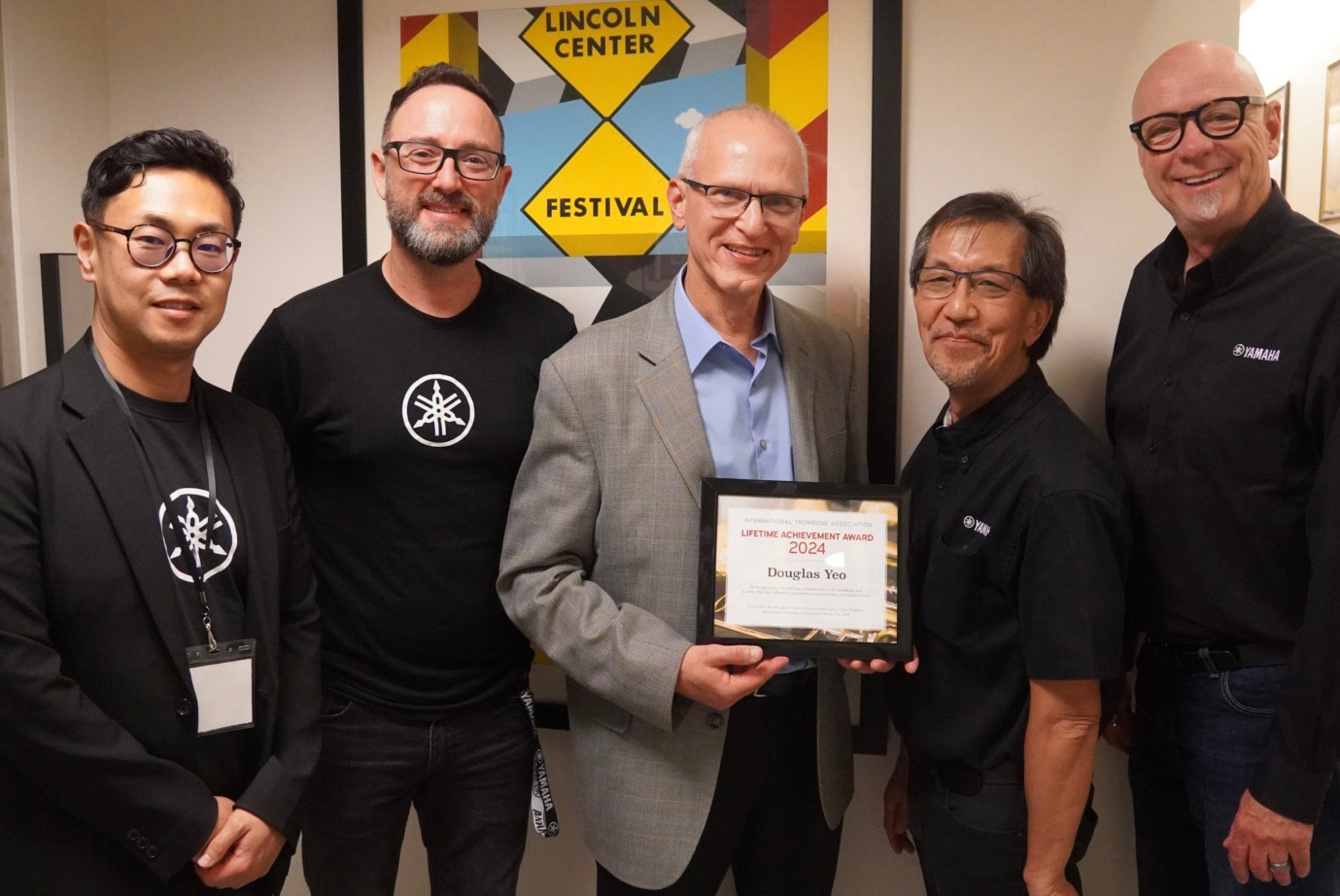
Yeo_YAMAHA_ITA _award

Masashi Nishimura (liaison between YAMAHA Japan and YAMAHA America), Jonathan Goldman, Douglas Yeo, Wayne Tanabe, and John Wittmann. After the International Trombone Association Lifetime Achievement Award Ceremony, 2024 International Trombone Festival, Texas Christian University. Wednesday, May 29, 2024.

In the weeks leading up to the International Trombone Festival, John Wittmann (Associate Vice President, Artist Relations for YAMAHA) told me that he and others would like to get together with me while we were in Fort Worth. I always enjoy seeing my friends at YAMAHA so I happily agreed. I spent some time at the YAMAHA booth in the vendors area of the Festival, and before, during, and on Wednesday evening after I received the ITA’s Lifetime Achievement Award, my friends from YAMAHA were there with me. On Thursday evening, I joined John Wittmann, Jonathan Goldman, Wayne Tanabe, and Chris Manners of YAMAHA for a nice dinner at an iconic Fort Worth restaurant, Reata.

Yeo_YAMAHA_ad_ITF_2024 program

YAMAHA advertisement in the 2024 International Trombone Festival program.

I should have known something was up when I turned to page 11 of the International Trombone Festival program and saw YAMAHA’s full page advertisement that congratulated me on receiving the ITA’s Lifetime Achievement Award. When I first saw the ad, you could have knocked me over with a feather. My friendship and partnership with YAMAHA has been a very big part of my life and I was deeply moved by this generous expression that celebrated our long collaboration. This was an unexpected gift to me but I was totally unprepared for what happened after dinner.
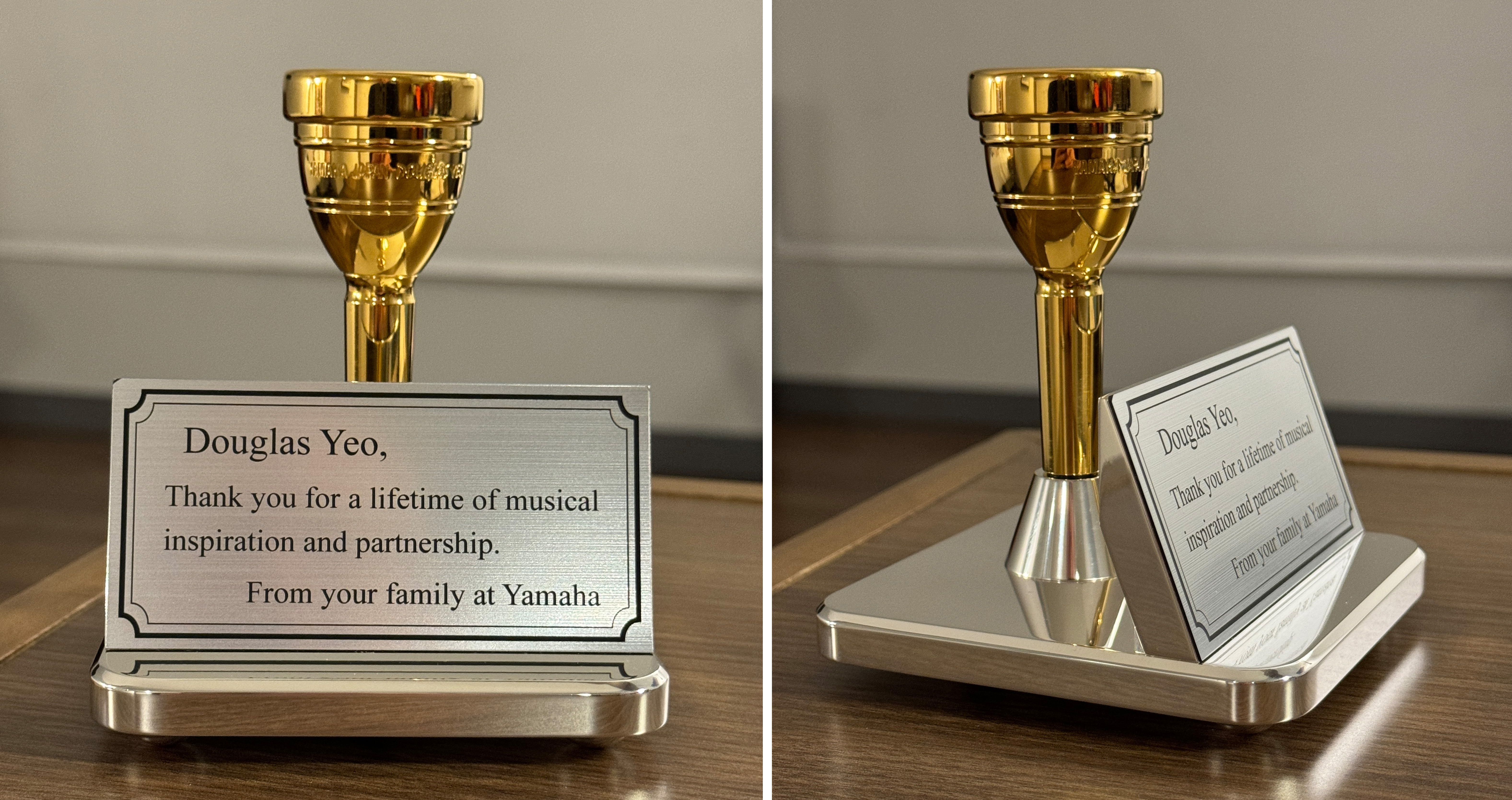
Yeo_Yamaha_gift_ITF_2024

Gift from YAMAHA to Douglas Yeo, International Trombone Festival, 2024, Fort Worth, Texas. Thursday, May 31, 2024.

At the end of our meal at Reata (and it was a fine, fine meal), Jon Goldman said a few words and presented me with a gift from YAMAHA. The design of this very special gift was a collaboration between YAMAHA Corporation Japan and YAMAHA Corporation America. I could hardly speak when I held it in my hand. A gold plated copy of my YAMAHA Douglas Yeo Signature Series mouthpiece was mounted on a highly polished metal base (it is heavy!) with an inscription of friendship. I do not have enough words to express my gratitude to YAMAHA for the relationship we have had over the years which goes much further than simply bass trombone instrument and mouthpiece development. For me, working with YAMAHA has been all about its PEOPLE, whether in Japan, the United States, Canada, or Europe. PEOPLE, not corporations, make things happen, and this dinner with and gift from YAMAHA were emblematic of how everything we do with trombones in our hands happen because of relationships with people that are strong and lasting. Thank you, YAMAHA.

Yeo_Yamaha_Dinner_2024_ITF

Wayne Tanabe, Jonathan Goldman, Douglas Yeo, and John Wittmann after dinner in Fort Worth, Texas. Thursday, May 30, 2024.

ROUNDTABLE DISCUSSION—DIVERSITY CONSIDERATIONS IN PROGRAMMING
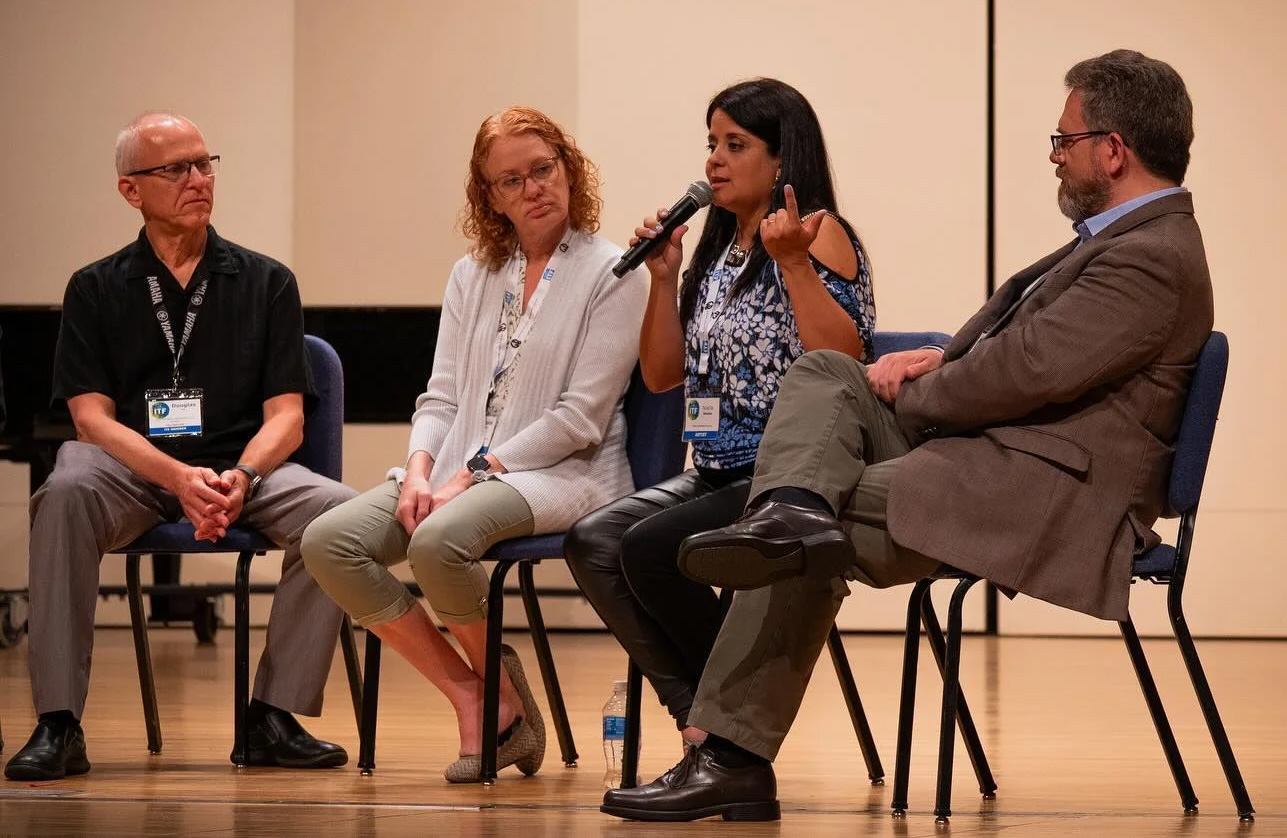
Diversity_roundtable_2024_ITF

Douglas Yeo, Natalie Mannix, Noelia Escalzo, and Rob Deemer (not shown in this photograph are roundtable moderator David Begnoche and David Taylor) at the roundtable discussion, Diversity Considerations in Programming. Landreth Hall, 2024 International Trombone Festival, Texas Christian University. Thursday, May 30, 2024.

David Begnoche wanted the 2024 International Trombone Festival to be the most diverse in the history of the Festival. Among the things that was important to him was that the Festival have a roundtable discussion by individuals who would discuss the importance of diverse programming, of moving our repertoire out of the “standard canon” to include works by composers who have traditionally been underrepresented in trombone recital programming. As one who has written widely about the regrettable use of racist tropes in the marketing of some works for trombone, I was glad to be a part of this discussion that included David Taylor, Natalie Mannix (professor of trombone at University of North Texas and Chair of the ITA’s Advisory Council on Diversity), composer Noelia Escalzo (from Argentina), Rob Deemer (from The Institute for Composer Diversity), and moderator David Begnoche (two others, Tony Baker and Mayumi Shimizu were scheduled to be part of the panel but were unable to attend). This event, while part of the International Trombone Festival, was sponsored by TCU. We need to keep these important conversations going.

ROUNDTABLE DISCUSSION—TROMBONE RESEARCH
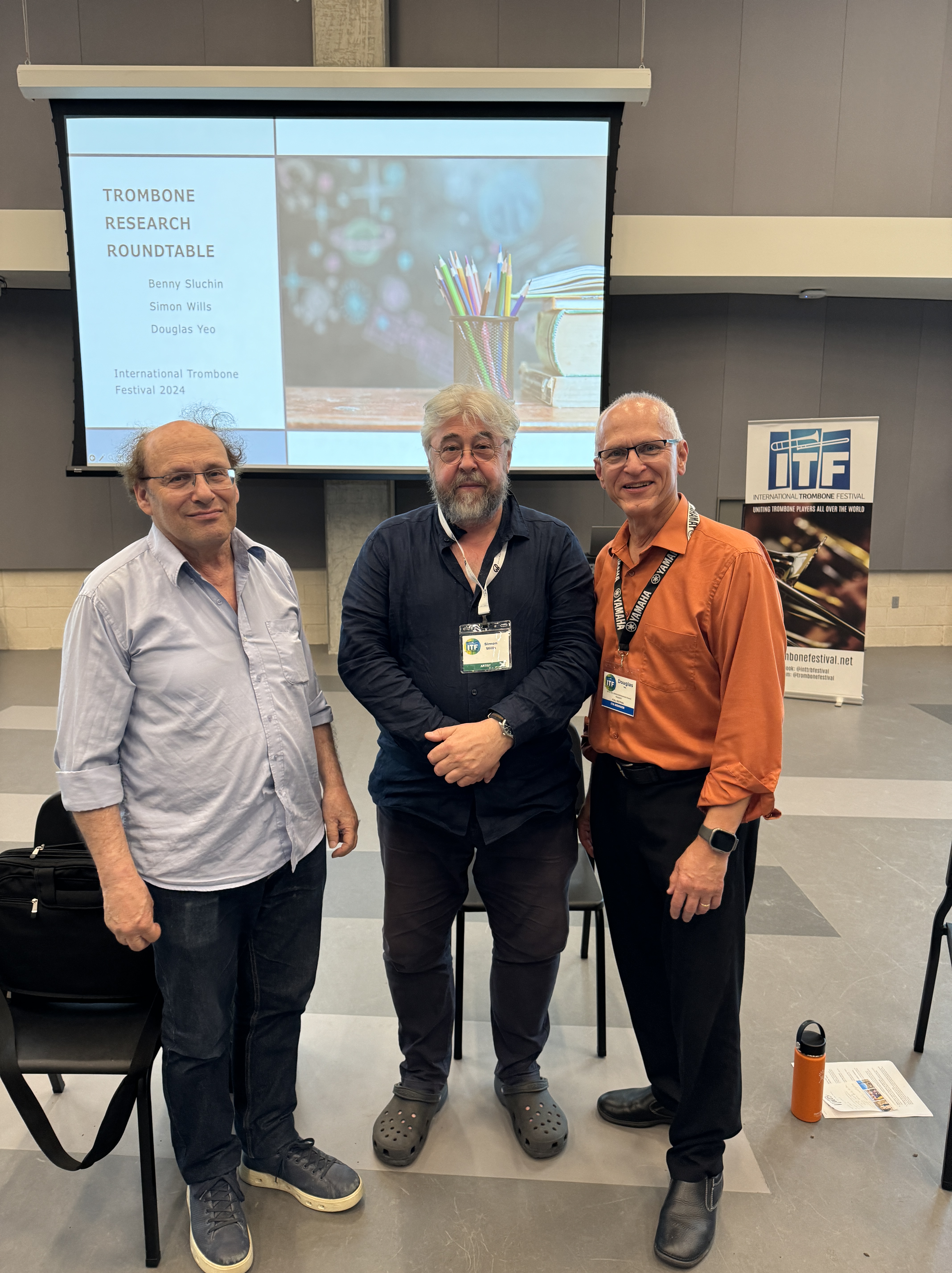
Sluchin_Wills_Yeo_research_roundtable_2024_ITF

Benny Sluchin, Simon Wills, and Douglas Yeo; Trombone Research Roundtable. Van Cliburn Band Room, 2024 International Trombone Festival, Texas Christian University. Friday, May 31, 2024.

As mentioned earlier, another thing that was important to David Begnoche was that the International Trombone Festival include a strong research component. While there are some scholars who are doing excellent research on the trombone—its instruments, music, manufacturing, pedagogy—the sad fact is that most “research” that students undertake is not research at all: it is compilation. We need better research about the trombone. Bringing together Benny Sluchin, Simon Wills, and me provided us with an opportunity to talk about the current state of trombone research and how we can test sources and improve and build our knowledge base about the trombone.

Among the things I did at the roundtable was provide attendees with two documents. The first is a 52 page list compiled by Bill Stanley, long-time trombone professor (now retired) at University of Colorado Boulder. His list includes doctoral projects relating to the trombone from 1941 to the present. You can find that list HERE. Students and other researchers: don’t duplicate these topics! The second document is one that I prepared that lists 50 research topics that are crying out to be investigated. For instance, it is incomprehensible to me that an enterprising doctoral student has never investigated trombone solo recordings before Arthur Pryor’s first recording in 1897. It’s never been done. Why not? You can find my list of research topics HERE.

Benny and Simon’s insights were revelatory—I certainly learned as much from them as anyone in the room—and it was a pleasure to collaborate with them in this roundtable.

RECITAL—TROMBONE CHAMBER MUSIC OF VACLAV NELHYBEL

Yeo_Siler_Nelhybel_recital_2024_ITF

Douglas Yeo and Nathan Siler Recital: Trombone Chamber Music of Vaclav Nelhybel (2024 International Trombone Festival program). Friday, May 31, 2024.

Trombonists of a certain age will remember the band music of Vaclav Nelhybel. The music of this Czech-American composer took the wind band world by storm in the 1960s and 1970s. Noted for its visceral, rhythmic, and dramatic effect, I could not get enough of Nelhybel’s music when I was in high school and college. In 1975, he came to Wheaton College for a residency and I followed him all over campus. As a result, we became friends and he wrote two pieces for me, Counterpoint No. 2 for bass trombone and percussion, and his Concerto for Bass Trombone.

Siler_Yeo_Nelhybel_2024_ITF

Nathan Siler and Douglas Yeo performing Vaclav Nelhybel’s Interplays for two trombones. Van Cliburn Hall Room, 2024 International Trombone Festival, Texas Christian University. Friday, May 31, 2024.

Last year, Nathan Siler, trombone professor at Eastern Kentucky University, asked if I would collaborate in a recital of Vaclav Nelhybel’s music for trombones at the 2023 ITF in Salt Lake City. Nathan had recently released a recording of some of Vaclav’s music for trombones and I had helped him with some insights about Vaclav and his music. But, since I was already attending the 2023 International Tuba Euphonium Conference last summer, I didn’t have time to go to the ITF in 2023 so I asked Nathan to circle back to me about the idea of the recital in 2024. He did, I agreed, and we gave a recital of some of Vaclav’s trombone music at TCU. In this we were assisted by Thomas Nixon, piano; Justin Cook (associate professor of trombone at University of Central Arkansas), trombone and conductor, and Sophia Lo, Nathan Grissett, and Kayla Liptak, percussion.

Siler_Yeo_Nelhybel_group_2024_ITF_cropped

Thomas Nixon (piano), Douglas Yeo, Justin Cook (trombone and conductor), Nathan Siler, and Nathan Grissett, Kayla Liptak, and Sophia Lo, percussion. Van Cliburn Hall, 2024 International Trombone Festival, Texas Christian University. Friday, May 31, 2024.

It was such a joy to play a recital of Vaclav’s music at the ITF. His music is not as well known today as it once was, and this recital was an effort to bring his music back to the attention of trombonists. Nathan played Vaclav’s Suite for Trombone which was composed for Mark McDunn. I played Vaclav’s Concert Piece, a piece for flexible solo instrumentation. We also played his Interludes (duets) and Contrasts (trios, with Justin Cook) that were designed for young players but which present real challenges of intonation and ensemble. Our recital concluded with Concertato for tenor and bass trombone, in a reduction by the composer for piano and three percussion players from the original version for band. If the response of the audience was any indication, Vaclav Nelhybel’s music is once again on the rise, and I feel fortunate to have been a part in reviving his important compositional legacy.

LEARNING SOMETHING—BENNY SLUCHIN

Sluchin_2024_ITF_presentation_recital

Benny Sluchin’s presentation and recital (with Mikhail Malt). Van Cliburn Band Room and Van Cliburn Hall, 2024 International Trombone Festival, Texas Christian University. Thursday, May 30 and Friday, May 31, 2024.

Benny Sluchin and I have been friends for many years and I have the utmost respect for him as a trombonist and scholar who is equally conversant in a wide range of musical styles, from Paris Conservatoire concours solos to electronic music. Benny, who, along with me, received the International Trombone Association 2024 Lifetime Achievement Award, has been helpful to me in many of my research projects, including my current project about Joannès Rochut. 

At the Festival, Benny gave a presentation, “Open Forms in the Age of A.I., the case of Cage’s Solo for Sliding Trombone and Somax2,” and a recital, “The Trombone in the Electronic Era,” that included Jacob Druckman’s Animus I for trombone and tape and Jonathan Harvey’s Ricercare una melodia. Benny has premiered dozens of compositions for trombone with computer and other electronic accompaniment and his presentation and recital were revelatory. With his colleague, Mikhail Malt, at the computer, those in attendance were transfixed by a passionate presentation about the creation of this type of new music. Benny is at the forefront of people who are engaged in the presentation of this fascinating and important type of music. It was absolutely riveting to hear Benny talk about Keren by Iannis Xenakis (a piece that was written for Benny), and perform part of John Cage’s Solo for Sliding Trombone. I came away from Benny’s presentation and recital with a new appreciation for music for trombone and computer.

LEARNING SOMETHING—SIMON WILLS AND THE CRAMER CHOIR

Cramer_Choir_program_2024_ITF

The Cramer Choir conducted by Simon Wills (2024 International Trombone Festival program). Saturday, June 1, 2024.

Simon Wills is a musical everyman. Former trombonist with the Welsh National Opera, London Symphony Orchestra, and the Chamber Orchestra of Europe, he has also played with the Orchestra of the Age of Enlightenment and is one of the most highly respected exponents of contemporary music. Currently professor at the Guildhall School in London, Simon is also a gifted composer and for the 2024 ITF, Simon was the conductor of the Cramer Trombone Choir. This ensemble, formed annually at the International Trombone Festival in honor of longtime Florida State University trombone professor William Cramer, is made up of trombone professors from colleges and universities around the world.

Wills_Cramer_Choir_2024_ITF

Simon Wills conducting the Cramer Choir in his One Is Down. Van Cliburn Hall, 2024 International Trombone Festival, Texas Christian University. Saturday, June 1, 2024.

I have heard many performances by the Cramer choir over the years but I cannot remember a more engaging program, more dynamic leadership, and finer playing than I heard on Saturday afternoon. The decision to engage Simon as conductor was due to David Begnoche’s advocacy. With Simon’s vast experience as a conductor and trombonist, and the fact that he is a composer of many works for trombone ensemble, the choice of Simon to lead the Cramer choir was inspired. The players—24 of them—were superb, and the choir premiered Simon’s One is Down (which was dedicated to David Begnoche) for 24 trombones. I can hardly describe the piece—with its “angel choir” of four alto trombones, a mute group, a large group, and more. The word “engaging” only begins to describe this program, and the concert was met with thunderous applause.

LEARNING SOMETHING—WYCLIFFE GORDON
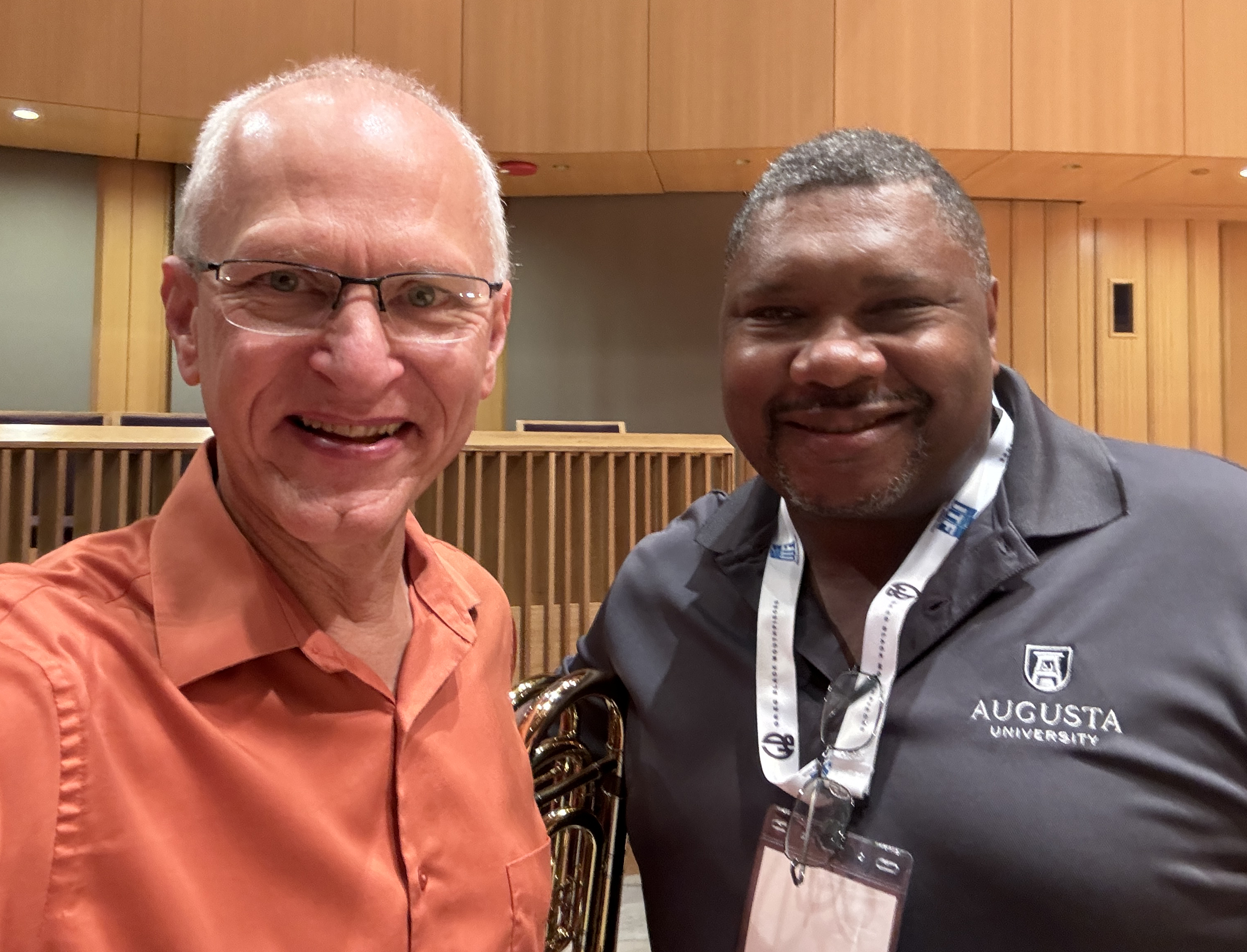
Yeo_Gordon_2024_ITF

Douglas Yeo and Wycliffe Gordon. Van Cliburn Hall, 2024 International Trombone Festival, Texas Christian University. Friday, May 30, 2024.

Jazz trombonist Wycliffe Gordon, and I have been friends for 25 years. I first met Wycliffe when he was a member of the Lincoln Center Jazz Orchestra. The LCJO came to Tanglewood, the summer home of the Boston Symphony Orchestra, and played a combined concert with the Boston Symphony on July 24, 1999. Wycliffe and I became fast friends and we’ve been sharing musical performances and life together ever since. We played together in an all-star big band of YAMAHA artists with Boston Brass at the Midwest Clinic in 2019, we played in the All-American Alumni Band (alumni of the McDonald’s All-American High School Band) for a concert in Columbus, Ohio, and Wycliffe came to Arizona State University to work with my students when I was teaching there. I was thrilled when I heard that David Begnoche wanted to have Wycliffe at the 2024 International Trombone Festival and Wycliffe agreed to come. 

Wycliffe is my brother from another mother. We are very close friends and it is always a delight to be with him. Whether we are playing together or I’m enjoying him perform, Wycliffe always inspires me. 

Wycliffe_Gordon_2024_ITF

Wycliffe Gordon with Paul Lees (piano), Eric Hitt (bass), and Jaelyn Washington (drums). Van Cliburn Hall, 2024 International Trombone Festival, Texas Christian University. Saturday, June 1, 2024.

I’ve heard Wycliffe perform many times—in a jazz band, with a jazz combo, accompanied by a jazz band or a symphony orchestra or a concert band or brass band. But I have to say this: Wycliffe’s performance at the Festival was the finest I have ever heard him play. Van Cliburn Hall was packed; you could not find an empty seat. Before the concert, I went backstage to talk with Wycliffe. From the conversation we had, I knew we were in for something really special. And special it was. Wycliffe played trombone and soprano trombone. He sang. He engaged with the audience. When he sang, “On the Sunny Side of the Street,” he gave all of us a message we needed to hear and, turning to me and pointing while he was singing—with a big smile on his face—he added a few words:

Why don’t you grab your coat, and your hat, baby,

Leave your worries at the doorstep.

Just direct your feet to the sunny side of the street.

Well, can you hear that pitter-pat, when that happy tune is in your step,

Life can be so sweet on that sunny side of the street.

     You see, I used to walk in the shade, all of my blues on parade,

     But now I’m not afraid, this rover crossed over.

     And if I never have a cent, I’ll be as rich as Rockefeller—AND DOUG YEO SITTIN’ OVER THERE!

     With gold dust at my feet, on the sunny side of the street.

The audience laughed, and nobody laughed harder than me. But the message was great. We have choices in life. We can live a life on the shady side and drown ourselves in grievances, slights, and anger. Or we can walk on the sunny side, care about others, and make a positive difference in the world. Wycliffe reminded us of this. And when Wycliffe closed his program with “Just a Closer Walk with Thee” and “When the Saints Go Marchin’ In,” we heard a great jazz artist deliver another great message in a transcendent way.

LEARNING SOMETHING—DAVID TAYLOR

Yeo_Taylor_2024_ITF

Douglas Yeo and David Taylor. Backstage of Van Cliburn Hall, 2024 International Trombone Festival, Texas Christian University. Saturday, June 1, 2024.

In the mid-1980s, I ordered the first copy of bass trombonist David Taylor’s first solo album, David Taylor Trombone. Weeks passed and I didn’t receive the LP so I wrote to David. He apologized for the delay, and said that the manufacturer didn’t get the color/contrast of the cover right and it had to be redone. Eventually I received the album. And that album changed me. That inauspicious introduction to each other led to a vibrant friendship. Dave Taylor is truly a legend in the trombone community. It’s hard to believe he’s 80 years old now—80 years YOUNG in his case—and whenever I’m around him, I feel energized. As David Begnoche said to me, Dave Taylor is “artistic penicillin” that pushes up against unimaginative, bland playing. To be around Dave is to be in the center of an artistic tornado.

ITF_2024_David_Taylor_cropped

World premiere of David Taylor’s Tatanka Lyotanka (Chief Sitting Bull). David Taylor, Jeanette Velasco, Angel Subero, Joran Davenport, Douglas Yeo, David Begnoche (conductor). Van Cliburn Hall, 2024 International Trombone Festival, Texas Christian University. Saturday, June 1, 2024.

David came to the ITF with a mission of creativity. And when he asked if I would take part in the premiere of his new piece, Tatanka Lyotanka (Chief Sitting Bull), for bass trombone solo with four bass trombone accompaniment, I was all in. It’s not possible to describe Dave’s recital at the Festival. His playing defies characterization—it is high, low, soft, loud, fast, slow, manic, calm, thought-provoking, and always consequential. I left David’s recital—that included his arrangement of Franz Schubert’s Der Doppelgänger with the TCU Trombone Choir, Eric Ewazen’s Dagon II for bass trombone solo and eight overdubbed bass trombones (with video), David Taylor’s Dance for bass trombone and talking metronome, and more—with my head spinning. When Dave asked the audience if we had any questions, Abbie Conant replied, after a long silence, “We’re overwhelmed.” Yes, we were. Dave Taylor’s musical tornado affected us all deeply.

After David’s concert, I did not have the energy to hear the final jazz concert of the Festival; I needed to stop and collect my thoughts. Four days at TCU had profoundly changed me.

RETURNING HOME

After breakfast at the hotel with Dennis Bubert on Sunday morning and saying goodbye to several friends in the hotel lobby, I packed up and got back in my car. Fortified with Diet Coke, my trip home was much less eventful than my all-nighter drive to Texas. I split the trip over two days, eight hours of driving each day, and for those long hours, I didn’t listen to the radio and I didn’t listen to music. I used the time to reflect on what I had just experienced.

REFLECTION AND THANKS

An event such as the International Trombone Festival does not just happen. It requires years of planning and many hands to pull it together. The three members of the International Trombone Association’s Standing Committee on the International Trombone Festival, Steven Wolfinbarger, Bradley Palmer, and Carol Jarvis, review applications for potential ITF sites and provide oversight over the Festival. The Festival’s salaried staff, Director Karen Marsten, Festival Manager Justin Cook, and Festival Assistant Manager Chris van Hof (and other ITF salaried staff including the ITF Youth Workshop Director, the ITF Composers Workshop Director, the ITF Digital Director, and the ITF Bookkeeper) along with other non-salaried, appointed ITF staff members, do a great deal of nuts and bolts planning and implementation to help ensure the success of the Festival. We are so very grateful for all of their hard work.

But it must be said that one person is at the heart of each International Trombone Festival: the Festival’s host. It is the host that provides the venue, typically a college or university. Hosts are not paid for their work for the ITF; this is a command performance of epic proportions. The Festival host needs to secure appropriate world-class performance spaces, spaces for presentations (with technology for Powerpoint video presentations and audio), dorm rooms for attendees, rooms for vendors, practice rooms for participants, rehearsal spaces for performers. And much more. All of this is done without financial compensation. This is often tricky business, navigating all of this with University administrators, securing music stands and chairs, arranging for percussion and electronic equipment. Student volunteers—without whom International Trombone Festivals simply could not be mounted—serve tirelessly to staff the information and registration desks, sell ITF gear, ensure that only registered individuals are admitted to performance halls, guide artists to rehearsal and performance spaces, staff the instrument check room, and so much more. They, also, are not paid for their work; they do it for the love of the trombone (and a t-shirt). 

I salute David Begnoche. When we started talking about the possibility of his hosting an International Trombone Festival, his document of dreams was something we talked about frequently. And when we look at the things that happened at this recently concluded Festival at Texas Christian University in Fort Worth, we can thank David Begnoche for his vision. Long before he made his formal application to host the ITF, he was thinking. He wanted this Festival to be diverse. It was. Everyone noticed. He wanted this Festival to include new faces. It did. Everyone noticed. He wanted this Festival to recognize the depth of trombonists and scholars in the world beyond the “familiar faces” that so often appear at Festivals. It did. Everyone noticed. Looking back at David Begnoche’s 2020 ITF dream document, we can see how much of his original vision made it into the 2024 ITF as he passionately advocated for populating the Festival with many particular individuals and groups:

  • Simon Wills
  • Benny Sluchin
  • David Taylor
  • Natalie Cressman
  • Trombones de Costa Rica
  • American Brass Quintet
  • Amanda Stewart
  • Peter Steiner
  • Alex Iles
  • Monarch Brass
  • Hakeem Bilal
  • Ronald Barron
  • Sasha Romero
  • David Yacus

David also wanted to showcase local artists, composers, and ensembles from Texas at the ITF, and they were:

  • Kevin Day
  • Quinn Mason
  • Dallas Asian Winds
  • Center Stage Brass

Of course, there were many people on David Begnoche’s dream list that did not or could not come to the festival for various reasons. You don’t get everything in life. In the years, months, and weeks after he made up his dream list for the International Trombone Festival, he continued advocating for diverse, transformational artists and presentations. He successfully led the effort to commission Kevin Day to write his new concerto for trombone and piano, Diversions, that was premiered by the Fort Worth Symphony with trombonist Peter Steiner and pianist Constanze Hochwartner. David Begnoche—personally—was the lead commissioner for Diversions, and the major portion of the commission was paid for by the Fort Worth Symphony, something that the International Trombone Association, with its limited financial resources, could not have done itself. He advocated for and ensured that the roundtable on diversity considerations in programming happened. It was David who reached out to Amanda Stewart and facilitated her participation in the Festival where she discussed the value of promoting a safe work environment. David brought early music and trombone research to the Festival in a big way. These things—and so much more—did not happen by accident. They came about due to David Begnoche’s vision and advocacy. Others worked alongside David—the ITA’s Standing Committee on the International Trombone Festival, the paid and unpaid  ITF staff—and together, they collaborated mightily to put together the pool of teachers, presenters, and performers that made this the most consequential Festival in the ITF’s history. Gone are the years when the International Trombone Festival was a “good old boy” event. With ensembles and soloists who made up diverse genders, races, and nationalities, as well as players of trombones of every type, size, and shape who played music from the Renaissance up to the present, this International Trombone Festival set a standard for the future. As Abbie Conant said in a Facebook post on Wednesday, June 5, “Everyone had a great time at the ITF and there was a lot of great trombone playing. It was a lot of fun. It was also the most inclusive and diverse ITF ever.” Yes, it was.

And in the midst of some truly dangerous and catastrophic weather events in Fort Worth and the surrounding area—rain, hail, wind, even tornadoes—that knocked out power, damaged personal and institutional property, forced some attendees to cancel or delay their trips, required juggling of schedules—the Festival is already being recognized as one of the most successful and impactful—and perhaps the MOST successful and impactful—in the International Trombone Association’s over 50 year history. 

Begnoche_fortune_cookie

A thought from a fortune cookie, sent by David Begnoche to Douglas Yeo. June 2, 2024.

As I was driving on the final leg of my trip home on Monday, David Begnoche sent me this snapshot of a thought in a fortune cookie. Anyone who was at the ITF and was paying attention—and I think EVERYONE was paying attention—would agree with this statement. New ideas were on display last week at the ITF and we were all changed.

To the ITA’s Standing Committee on the International Trombone Festival, the ITF paid and unpaid staff, the dozens of unpaid student workers, to the ITF’s Platinum Sponsor, S. E. Shires Co.; Gold Sponsor Greg Black Mouthpieces; Silver Sponsors Antoine Courtois and J. P. Rath; and Bronze Sponsors C. Sharpe Editions and YAMAHA Musical Instruments; and especially to Dr. David Begnoche, I extend my thanks for what we all experienced at Texas Christian University in Fort Worth. The approximately 1000 trombonists that attended the Festival and others who followed it through the Festival livestream left Fort Worth challenged, inspired, and energized. 

I don’t know about you, but I’m going to practice now. . .

ITF_2024_poster


For everything there is a season

For everything there is a season

by Douglas Yeo (May 19, 2024)

The Bible gives us answers, and it reminds us of this (Ecclesiastes 3:1-8, English Standard Version):

For everything there is a season, and a time for every matter under heaven:

a time to be born, and a time to die; a time to plant, and a time to pluck up what is planted;

a time to kill, and a time to heal; a time to break down, and a time to build up;

a time to weep, and a time to laugh; a time to mourn, and a time to dance;

a time to cast away stones, and a time to gather stones together; a time to embrace, and a time to refrain from embracing;

a time to seek, and a time to lose; a time to keep, and a time to cast away;

a time to tear, and a time to sew; a time to keep silence, and a time to speak;

a time to love, and a time to hate; a time for war, and a time for peace.

For each of us, our lives are full of seasons, and I have recently turned the page on a very long season of life and a new season is upon me.

Pearce_trombone_Concert_stylings

One of the Bill Pearce solo trombone with piano books that my first trombone student, Lloyd, gave to me in payment for trombone lessons I gave him at Wheaton College in the summer of 1974.

I have been teaching trombone lessons since the summer of 1974. At that time, I was a student at Wheaton College and another student on campus, Lloyd, asked if he could take some lessons with me. Lloyd wasn’t a trombone major; in fact, he was a student at Wheaton College for only that one summer quarter. But I was happy to help him improve his skills. At the end of the lessons, Lloyd told me he didn’t have money to pay me but if I would accept them, he would give me five books of solos for trombone and piano by the great gospel trombonist Bill Pearce. 50 years later, I still have and use those books. After that summer, I began teaching weekly lessons to young players through the College’s Preparatory Department. Doing so helped me get through college without any debt (that job along with other jobs that included working as student manager of the College artist series, working two days a week at a local White Hen Pantry, and shoveling snow for an office park in the winter).

Since that time, I’ve taught regularly in many schools, first as a high school band director, then as trombone teacher/professor of trombone:

STA_My_Fair_Lady_pit_band

St. Thomas Aquinas High School, Edison NJ (1979-1981) — with students in rehearsal for the school’s production of My Fair Lady, 1981.

Peabody_News_1982

Peabody Institute of Johns Hopkins University, Baltimore MD (1982-1985) — Announcement from September 1982  in Peabody News listing faculty members who were members of the Baltimore Symphony Orchestra

NEC_Trombones_1990_01

New England Conservatory of Music (1984-2012) — conducting the New England Trombone Choir at New England Conservatory, 1990

ASU_Desert_Bones_2016

Arizona State University, Tempe AZ (2012-2016) — ASU Trombone Studio with the University’s mascot, Sparky, 2016

Wheaton College, Wheaton IL (2019-2023) — performance of Canzone by Girolamo Frescobaldi, arr. Eddy Koopman, Wheaton College faculty recital, April 23, 2022

UIUC_Illinois_trombone_studio_2024_signed_photo

University of Illinois Urbana-Champaign, IL (2022-2024) — signed photo given to me by members of the University of Illinois Trombone Studio, May 2024

Since I retired from the Boston Symphony Orchestra in 2012 after more than 27 years as a member of that great orchestra, my life has taken many turns. My wife, Patricia, and I moved to Arizona where I immediately flunked retirement and accepted the full time position as professor of trombone at Arizona State University. In 2018, we moved to the Chicago area to be near our grandchildren (grandkids truly make you do crazy things, like move from Arizona to the Midwest) and I flunked retirement again when I was asked to teach at my undergraduate alma mater, Wheaton College. When University of Illinois asked me to take a one year position as professor of trombone for 2022-2023—a position that came to me most unexpectedly and I thoroughly enjoyed—I looked forward to trying this retirement thing again in 2023 when that appointment was up and, at the same time, I decided to step away from teaching at Wheaton College. But as things turned out, one year of teaching at Illinois turned into two years. Happily, the Illinois School of Music recently hired a new full time trombone professor and my appointment at Illinois concluded.

Yeo_UIUC_office_letter

I taught my last trombone lessons at University of Illinois Urbana-Champaign on May 1 and before I headed home, I wrote a letter to my students and colleagues that I posted on the bulletin board next to my office, shown above.

UIUC_Convocation_students_2024

With my graduating students at University of Illinois Urbana-Champaign School of Music Convocation, May 12, 2024. Left to right: Rachel Lin (Bachelor of Music Education), Jerry Min (Bachelor of Music), Lorraine Montana (Master of Music)

I returned to campus on May 12 when  University of Illinois held a Convocation ceremony for the School of Music and I celebrated the graduation of three of my students. In a sense it was a graduation ceremony for me, too, as I closed out two memorable years teaching at University of Illinois, a campus community where I feel a very strong connection. When the ceremony was over, I took off my academic regalia, switched off the lights in my office, and turned in my keys. On the long drive home through the beautiful, newly planted Illinois cornfields, I began to reflect on all that had just happened. A new season had begun.

Illinois_cornfields_May_2024

Newly planted Illinois cornfields along Illinois Route 115, May 12, 2024

Illinois_corn_May_2024

The corn is now just a few inches tall and in late fall it will be, in the words of the song, “Oh, What a Beautiful Mornin'” from the musical Oklahoma!, “as high as an elephant’s eye.”

As I see it, “retirement” is a lousy word. When I decided to retire from the Boston Symphony, many of my colleagues asked me, “So, are you going to take up golf?” Nope. Golf doesn’t interest me. And I never saw “retirement” as a season of life devoted to non-stop self-entertainment. After decades playing in symphony orchestras, I looked forward to new adventures. I wanted to have more time to research and write, to travel with my wife, to enjoy more time with our daughters and their families, and, with open hands, respond to God’s call to His purposes for my life.

Retirement, as it turned out, meant not playing golf or kicking back and “doing nothing,” but, rather that I was busy doing a host of engaging activities.

UIUC_trombone_studio_Lincoln_poster

The poster that hung in my office at University of Illinois for the last two years. It contains a logo my friend, Lennie Peterson, designed for our trombone studio, my five core tenets of teaching, and a quotation from Dr. Robert E. Gray that sums up the ethos of the University of Illinois Trombone Studio.

I’ve spent most of the last 12 years teaching at colleges and universities each week of the academic year: Arizona State, Wheaton College, University of Illinois. Working with those students has been such a big part of my life. But as I near a birthday with a zero on the end of it (it’s not 60; that was a long time ago. . .), I decided, after much thought and prayer, to step aside from weekly trombone teaching and have more time to do other things. This doesn’t mean I’ve taught my last trombone lesson. I love teaching; I still do. But this change in my life means I won’t be doing that teaching every week as a school’s trombone professor. This freedom gives me time to explore and enjoy both new and familiar things.

And there is a lot ahead for me. Later this month, I’ll travel to Texas Christian University (TCU) in Fort Worth, Texas, to take part in the International Trombone Festival. I’ll give a recital, serve on two roundtable discussion panels (one is about diversity considerations in recital programming; the other is about trombone research), give a major presentation about the celebrated trombonist Joannès Rochut, perform with the TCU trombone choir, and accept the International Trombone Association’s Lifetime Achievement Award. This summer my wife and I will take hiking trips to Grand Canyon and Zion National Parks (with our oldest daughter’s family, including our grandchildren), and Sequoia and King’s Canyon National Parks (with our youngest daughter and her husband). In September, I’ll conduct a trombone residency at University of Texas, Austin. In October I’ll play ophicleide in concerts with the San Francisco-based early music group, Philharmonia Baroque. We’ll attend many baseball games this summer (Chicago Cubs, Schaumberg Boomers, Chicago Dogs, Kane County Cougars, Oakland Ballers), and fall will bring us to our seats in Chicago’s Soldier Field for Chicago Bears football. A major American symphony orchestra has asked if I would be willing to substitute with them in the coming season. Research and writing projects are on my plate (watch the July 2024 issue of the International Trombone Association Journal for my article about the history and a chemical analysis of trombone slide oil, and the January 2025 issue for my article about Joannès Rochut; I’m also at work on a new book for Oxford University Press), as are hikes, walks and tandem bicycle rides with Patricia. And serving our church and enjoying life with our grandchildren.

Doug_Pat_Zion_Observation_Point_June_2023

With my wife, Patricia, at Observation Point, Zion National Park, June 2023. We will return to this special place next month; it will be our 19th trip to Zion National Park.

So, as my long season of institutional teaching has turned a page, I look back at those decades with great fondness and gratitude. And I have learned this: I don’t know all of what God has for me going forward.  With open hands, I’m grateful for the opportunities I’ve had to serve, learn, and contribute. I plan to keep doing that in both new and familiar ways as God leads. I look forward to seeing you along the road.