Category: music

Inspired in Japan – the 25th Hamamatsu International Wind Instrument Academy and Festival

Inspired in Japan – the 25th Hamamatsu International Wind Instrument Academy and Festival

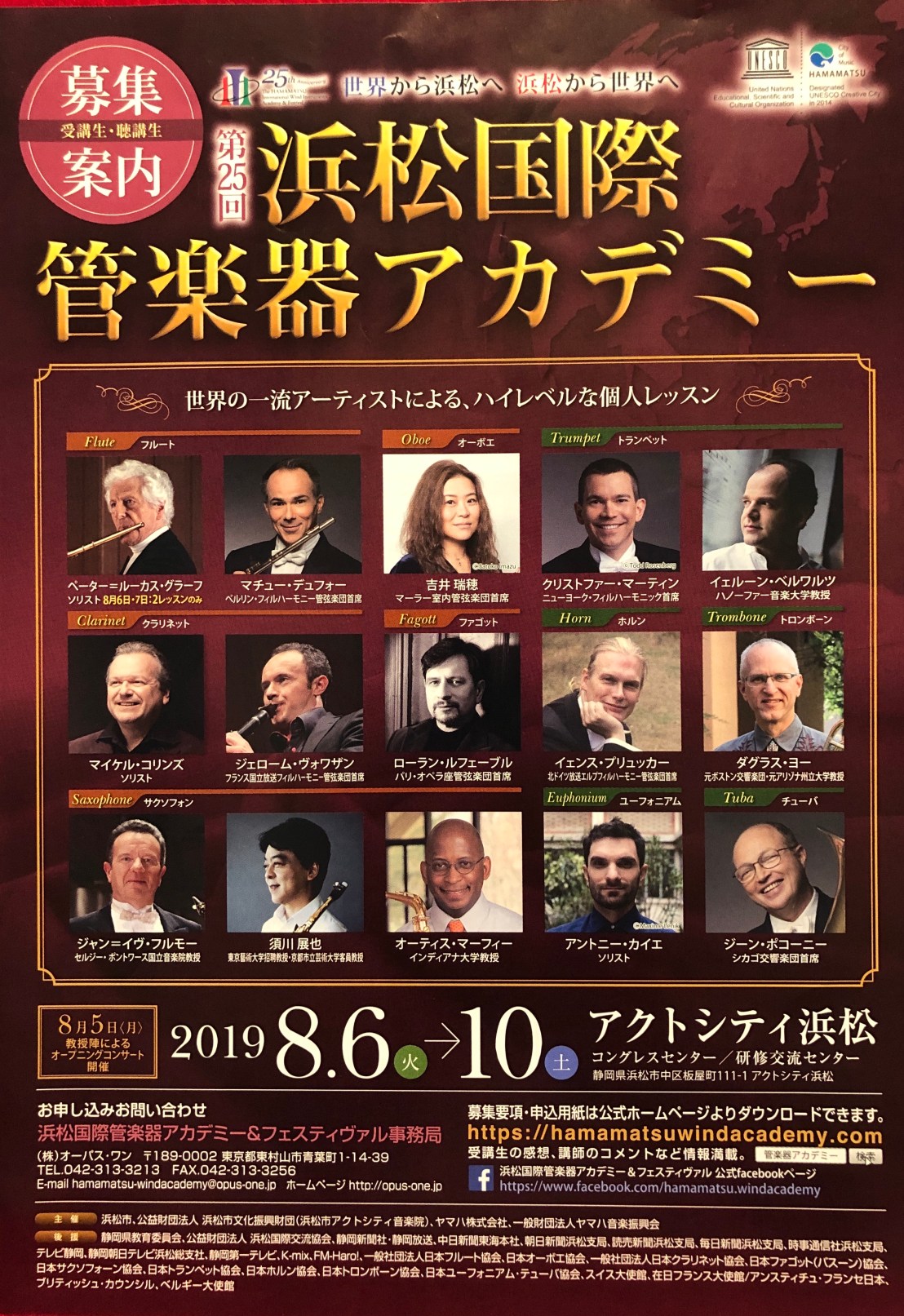
I have been to Japan 14 or 15 times in my life; I’ve lost count. I first travelled to the island nation in 1986, on tour with the Boston Symphony and its music director Seiji Ozawa. More Boston Symphony and Boston Pops Orchestra (with John Williams, conducting) tours followed over the years. I have also been to Japan many times to teach and perform at the Hamamatsu International Wind Instrument Academy and Festival. I was on the faculty of the first Academy in 1995 and this month, I returned to Hamamatsu for the seventh (or eighth?) time to take part in its 25th anniversary event.
Hamamatsu_Academy_brochure_2019

The Hamamatsu International Wind Instrument Academy and Festival has grown to be an event of major importance for wind players. Jointly sponsored by the City of Hamamatsu, the Hamamatsu Cultural Foundation, and YAMAHA Corporation, the Academy and Festival assembles an international faculty of wind instrument teachers and performers. Each teacher chooses a class of eight students from recorded auditions, and students receive four lessons during a week. Lessons are open —they are conducted in large rooms with plenty of seating—and teaching rooms are always full of those who want to learn from the teachers. As such, each lesson is as much a masterclass as it is a private lesson. Before the teaching part of the event begins, the faculty always give an opening concert which, over the years, has taken different forms. Sometimes faculty play solos with piano, sometimes they play chamber music, and sometimes they take part in large ensemble performances.

Hamamatsu_Academy_brass_faculty_2019

I was delighted to be invited to the 2019 Academy and Festival. Of the fifteen faculty members—there were between one and three classes for every wind instrument—there were four Americans: Otis Murphy, saxophone (professor, Indiana University), Chris Martin, trumpet (principal trumpet, New York Philharmonic), Gene Pokorny (principal tuba, Chicago Symphony), and myself. The other brass faculty members were Jeroen Berwaerts, trumpet (professor, Hochschule für Musik in Hannover), Jens Plücker, horn (principal horn, NDF Elbphilharmonie Orchester), and Anthony Caillet, euphonium (international soloist). Apart from Anthony, who I met and worked with for the first time, I knew all of the other brass faculty from our working together at previous Hamamatsu Academies.

Yamaha_Innovation_Road

Before the Academy started, several faculty members were invited to visit the YAMAHA Innovation Road Museum. This is new, a telling of the history of YAMAHA Corporation. The museum was fascinating to me, having been involved with YAMAHA since 1986.

IMG_3866

Among the many interesting things about the Innovation Road Museum is that many of its instruments were available for the public to play. While we were visiting, we saw dozens of children playing pianos, guitars, and other instruments. This is a huge commitment on Yamaha’s part, since these instruments get heavy use and eventually need to be replaced. But this “hands-on” aspect of the exhibit showed how YAMAHA is committed to engaging the public with its work. Gene Pokorny (above) had a moment with a Sousaphone and his single note—played with GREAT enthusiasm—got everyone’s attention.
Yamaha_Yamaba

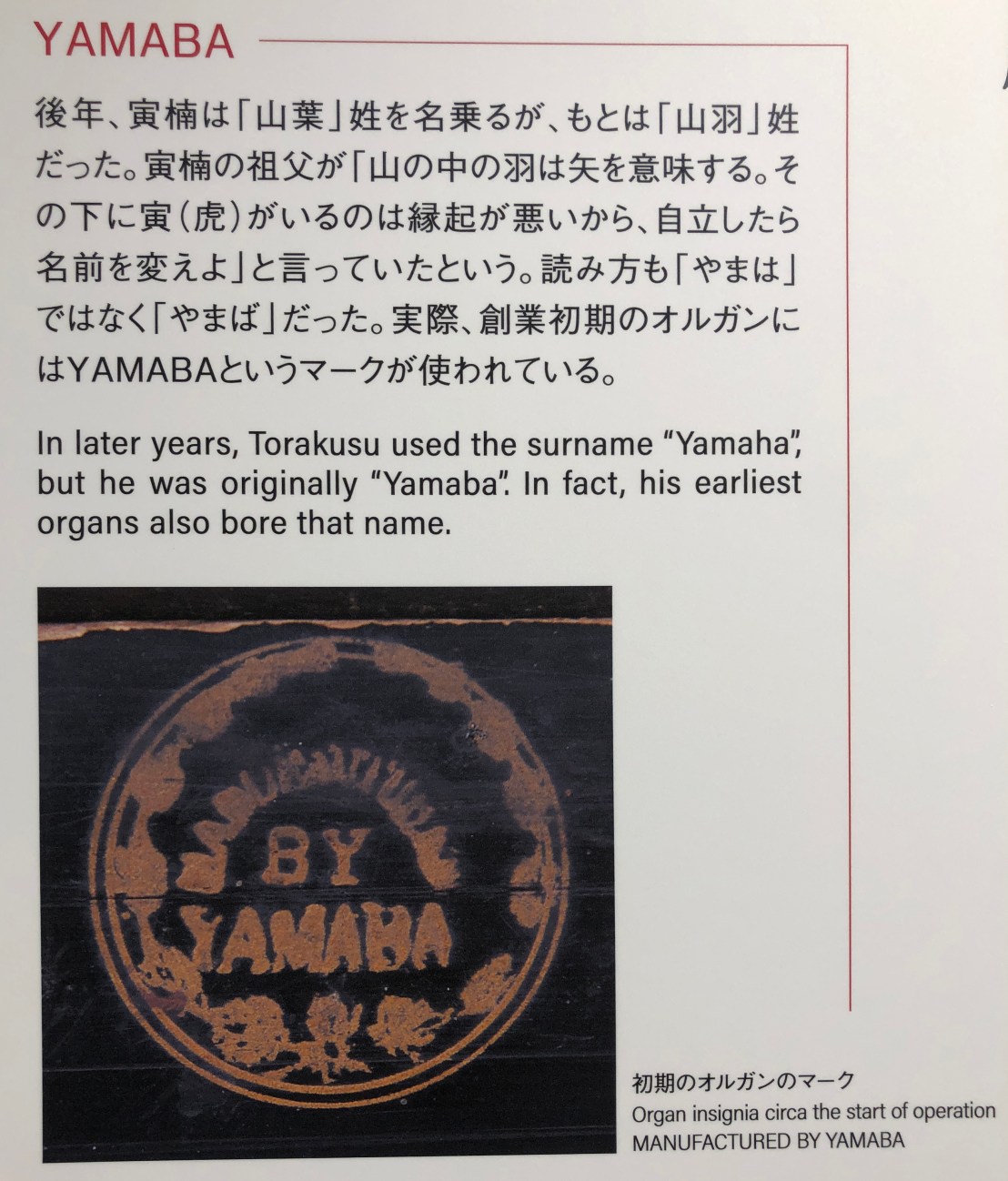
I learned a lot of the company’s history, including the fact that Torakusu Yamaha, the founder of YAMAHA Corporation, was originally named Torakusu Yamaba. He changed his name to Yamaha because he thought that name would be of greater interest to the export market. I learned many new things!

Hamamatsu_Academy_2019_brass_concert_cropped

This year, the opening concert featured a brass ensemble that performed the world premiere of a newly commissioned work by Eric Ewazen, Hamamatsu Overture. The same ensemble played movements of Hans Werner Henze’s Ragtimes and Habaneras. Originally for brass band, it had been arranged for the Concertgebouw Brass. I had previously conducted this piece with a brass band (at the Boston Symphony’s summer home, Tanglewood, with members of the Boston Symphony, Empire Brass, and students from the Tanglewood Music Center—Henze was also in the audience for the performance) and I found this arrangement to be spectacular, and quite faithful to Henze’s original. It was such a pleasure to play in this brass ensemble. Was playing in a group ever easier or more rewarding than this, with such accomplished (and nice!) players? I don’t think so.

OLYMPUS DIGITAL CAMERA

For the second half of the concert, the Festival had assembled a wind ensemble. The 15 faculty members made up the core of the group while it was filled out with other professional Japanese players. This was, for brasses, mostly a “one-on-a-part” band. I had not played in a band since the summer of 1980 when I played my last concert as a member of the Goldman Band in New York City (I was a member of the Goldman Band from 1977-1980) although I have conducted many bands over the years. The program consisted of several classic works for wind ensemble: the Second Suite of Gustav Holst, Darius Milhaud’s Suite Francaise, an arrangement of “Elsa’s Procession to the Cathedral” from Richard Wagner’s Lohengrin, and John Philip Sousa’s march, The Thunderer. Once again, playing in this band while sitting next to Anthony Caillet and Gene Pokorny was a rare and tremendously satisfying experience. The transparency of playing was notable, and the ensemble came together in a beautiful, rare way.

Here is a video of our performance of the Second Suite of Gustav Holst (edited by Ito Yasuhide), which you can also watch on YouTube:

Here is a video of our performance of Elsa’s Procession to the Cathedral of Richard Wagner (arr Hiroshi Hoshina), which you can also watch on YouTube:

And here is a video of our performance of The Thunderer of John Philip Sousa, which you can also watch on YouTube:
Hamamastus_Academy_Yeo_greeting_2019

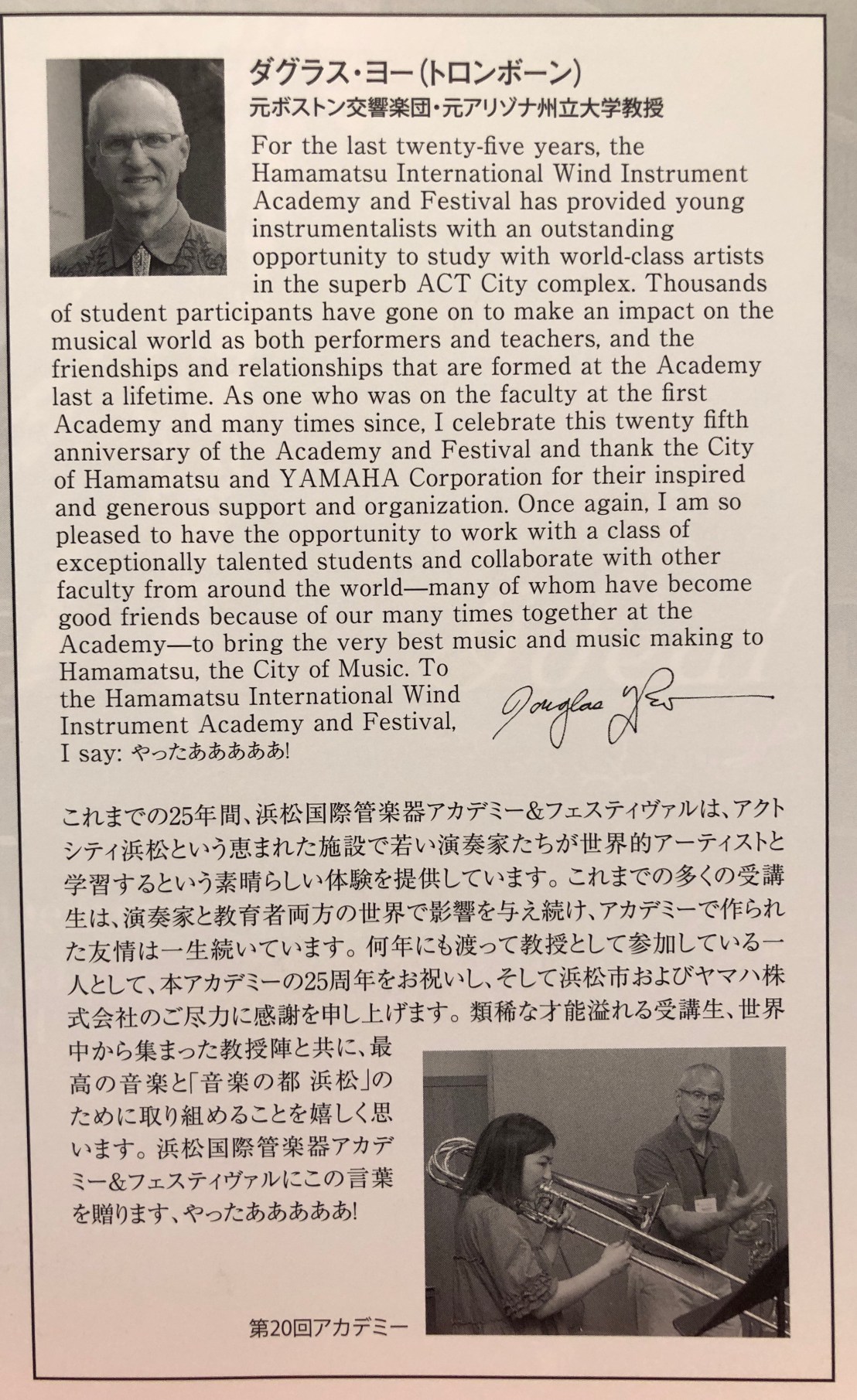
I was also very grateful to have been asked to pen a few words of congratulations to the Festival for inclusion in the opening concert program which you can read above.
OLYMPUS DIGITAL CAMERA

Hamamatsu_Academy_2019_faculty_silly.jpg

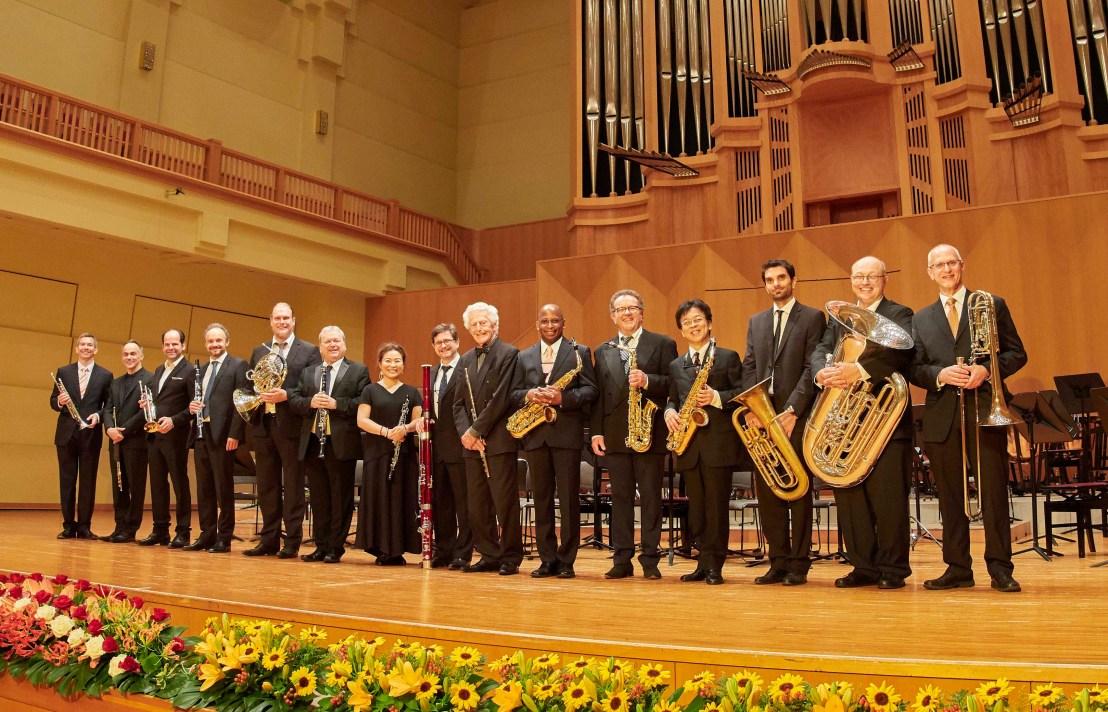
We gathered on stage after the concert for a photo of the Academy professors. Two photos actually, each of which tell part of the story of our very enjoyable shared collaboration.

2019_Hamamatsu_Academy_Yeo_trombone_class

From the opening concert we began our days of teaching. My class had five tenor and three bass trombonists. Five women and three men. Over the years, I have had many different kinds of students. There is no age limit for the Academy, so in the past I have had both young players and professionals. This year, all of my students were young. One was 17, others were in college/university, and a few had recently graduated from college. But, wow, they had such talent! It was a joy to work with them; they were all eager to try, learn, experiment. I chose three phrases as the motto for our class:

Pay attention.

Try everything.

Chase greatness.

If we pay attention to everything around us—not just other trombone players—there is much we can bring to our artistic/musical expression. If we try every option for every decision we face as musicians—where to breathe, what slide position to use, etc.—we can benefit from the improvement we make each day and not become fossilized with ideas that we implemented when we first laid our eyes on a piece of music. And from the Chicago Bears, I brought “chase greatness.” You must first know what greatness IS and when you see it, run after it, hunt it down, embrace it, and make it yours. My students bought into this and worked very hard. All of them —ALL of them!—had major breakthroughs in their playing at each lesson. I cannot remember ever seeing this happen. But this class was special. Very, very special.

Doug_Hitomi_Nozomi_2019

Another nice aspect of this event was the fact that my translator was Nozomi Kasano (on the right in the photo above). I  first met Nozomi at the 10th Hamamatsu Academy and Festival in 2005. She subsequently came to Boston to study with me at New England Conservatory of Music where she earned a graduate diploma and Master’s degree. The then returned to Japan where she won the position of bass trombonist with the Japan Century Orchestra in Osaka. I am so proud of her. This was the third time Nozomi had been my translator in Japan (she did this six years ago at the 20th Academy, and two years ago when I was the guest artist at the Nagoya Trombone Festival). She knows me so well, and translates more than just my words—she translates ME. Also, our class pianist was Hitomi Takara (in the middle in the photo above), a superb artist with whom I had worked with at the Academy in the past. She was my accompanist five years ago at the 21st Academy, both for my class and for me when I gave a recital at the Hamamatsu Museum of Musical Instruments. Having them with me again made the trombone class room a very, very happy place.

Hamamatsu_Musical_Instrument_Museum_Yeo_serpent_video_2019

Speaking of the Musical Instrument Museum, I enjoyed another visit before the Academy started. I was surprised and delighted to find video screens installed throughout the museum where visitors can both hear and see several instruments being played. This is a great addition to the musical instrument museum, and my surprise was even greater when I went to look at the museum’s serpent collection and found a video there of me playing serpent during my recital.

Hamamatsu_Academy_Miho_congratulations_2019

The Academy also features a concert of student performers. Each class holds an audition of all of its students and one player from each studio is chosen by the professor to represent the class on the student concert. The winner that I chose to represent the trombone class on the concert was Miho Ogose, a University senior. She played the first movement of Eric Ewazen’s Concerto for Bass Trombone. Like all of my students, she played with exceptional musicality. All of us in the trombone class were so proud of her and her performance was absolutely great. Look at the photo above, taken right after the concert. The look on Miho’s face—surrounded by other trombone players from our class who were congratulating her on her performance—reflects the joy of music and music making. It was a special moment for all of us.

Hamamatsu_Academy_2019_Farewell_Party_trombones

The Academy and Festival concluded with a farewell party at Mein Schloss, a German beer hall near the ACT City Hamamatsu complex where all of our concerts and teaching took place (we also stayed at the Okura Hotel ACT City). This is always a fun event, with plenty of food and drink, and performances by each class. Some are silly, some are more serious, and when we drew lots to determine the order in which classes would play at the party, the trombone class drew last! So we wrapped up the festivities with performances of my friend Stephen Bulla’s arrangement of Londonderry Air and an arrangement of 76 Trombones that I commissioned from my friend Ken Amis, tubist of the Empire Brass. Fun times.

Japan_2019_plane_farewell

As my plane took off from Tokyo and I watched the Pacific Ocean come into view, I reflected on my days in Japan. I have so many memories from my trips to that fascinating country. I feel fortunate to have had the opportunity to work with so many Japanese students over the years. I have friendships with many players and teachers, as well as many employees of YAMAHA Corporation, with whom I have collaborated for many years to make the bass trombone (YBL822G) and mouthpiece (Douglas Yeo Signature Series Mouthpiece) that I have played for so long. Wonderful food, interesting experiences, deep friendships, students who are eager to learn. It all combined to make for an especially satisfying trip. While it is true that “there’s no place like home,” traveling around the world has opened my eyes to many things and has made a deep imprint on how I think and live. Thank you, Hamamatsu International Wind Instrument Academy and Festival, its organizers (especially Naoki Suzuki of YAMAHA), faculty, translators, pianists, and students. All of you are a big part of my life. Thank you for this time we shared together. I hope to see all of you again soon.
Sunset_over_clouds_Pacific_Ocean_2019

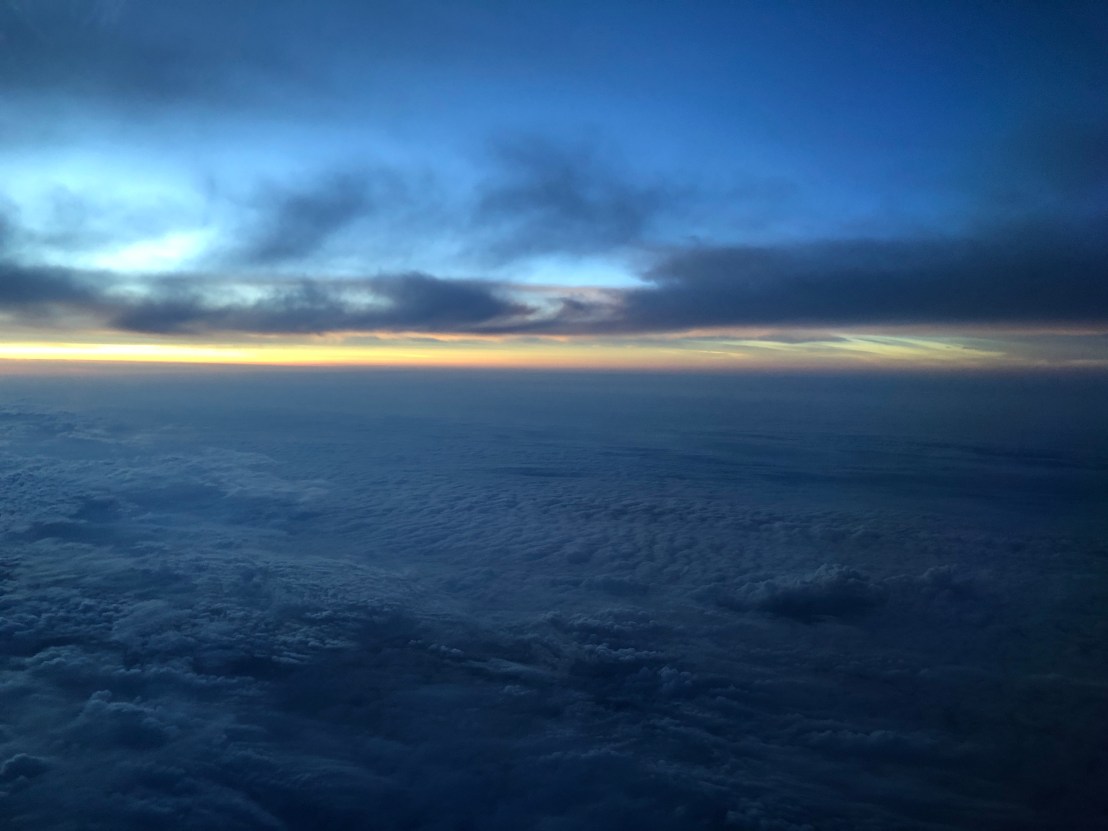
[Photo above: Sunset at 38,000 feet, above the clouds, over the Pacific Ocean. August 11, 2019.]

[Featured photo at the top of this article: Several faculty members of the 25th Hamamatsu International Wind Instrument Academy and Festival after the Opening Concert. Left to right: Otis Murphy, Jean-Yves Fourmeau, Nobuya Sugawa, Anthony Caillet, Gene Pokorny, Douglas Yeo.]

Symphony Hall: Boston’s proud temple of music since 1900

Symphony Hall: Boston’s proud temple of music since 1900

From 1985-2012, I was bass trombonist of the Boston Symphony Orchestra. The orchestra’s home is Symphony Hall, on the corner of Huntington and Massachusetts Avenues in Boston’s Back Bay section (301 Massachusetts Avenue). Opened in 1900 after the orchestra left the Boston Music Hall where it had played concerts since it was founded in 1881, Symphony Hall is considered to be one of the three finest concert halls in the world, with its acclaimed acoustics putting it in the company of the Musikvereinsaal (Vienna) and Concertgebouw (Amsterdam). Before it was destroyed in World War II, the old (alte) Gewandhaus in Leipzig was also similarly acclaimed. Having played concerts in the halls in Vienna and Amsterdam, I can say that in my view, Symphony Hall is simply the finest concert hall in which I have ever performed.

When I joined the Boston Symphony, I was aware of the rich history of both the orchestra itself and its storied home. I’ve read everything I could find about the BSO and Symphony Hall, spent countless hours in the orchestra’s archives (with which I had a hand in formally establishing in 1987), and have been fascinated at all I have found and learned.

Two important books have informed my quest for information about Symphony Hall.

Johnson_Symphony_Hall_Boston_1950

Published in 1950 on the occasion of the 50th anniversary of the opening of Symphony Hall, H. Earle Johnson’s Symphony Hall, Boston (Boston: Little, Brown and Co., 1950)  surveys the orchestra’s first 50 years, discusses programming and personnel, and features commentary on the building and opening of Symphony Hall. Now out of print (but copies can be found on through used book outlets such a abebooks.com), it unfortunately has no illustrations. 

Stebbins_Symphony_Hall_2000


Richard Poate Stebbins’ book, The Making of Symphony Hall: A History with Documents (Boston: Boston Symphony Orchestra, 2000) is a superb volume that documents, in fascinating detail, the planning, construction, and opening of Symphony Hall. It was published on Symphony Hall’s centennial, a year I remember with great fondness for the many historical exhibits in the Hall’s corridors and the many celebrations of the Hall throughout the year. The cover of the book features an early, color rendering of the original design of the hall, with many statues, inscriptions, and decorative cornices. Ultimately, none of these items were incorporated in hall when it was finished. Money ran out, and to this day, even there is no external decoration to the hall. Even the Hall’s  name is not found on its exterior. Yet it is this austerity that is part of Symphony Hall’s charm; somehow it fits in with the Boston way.

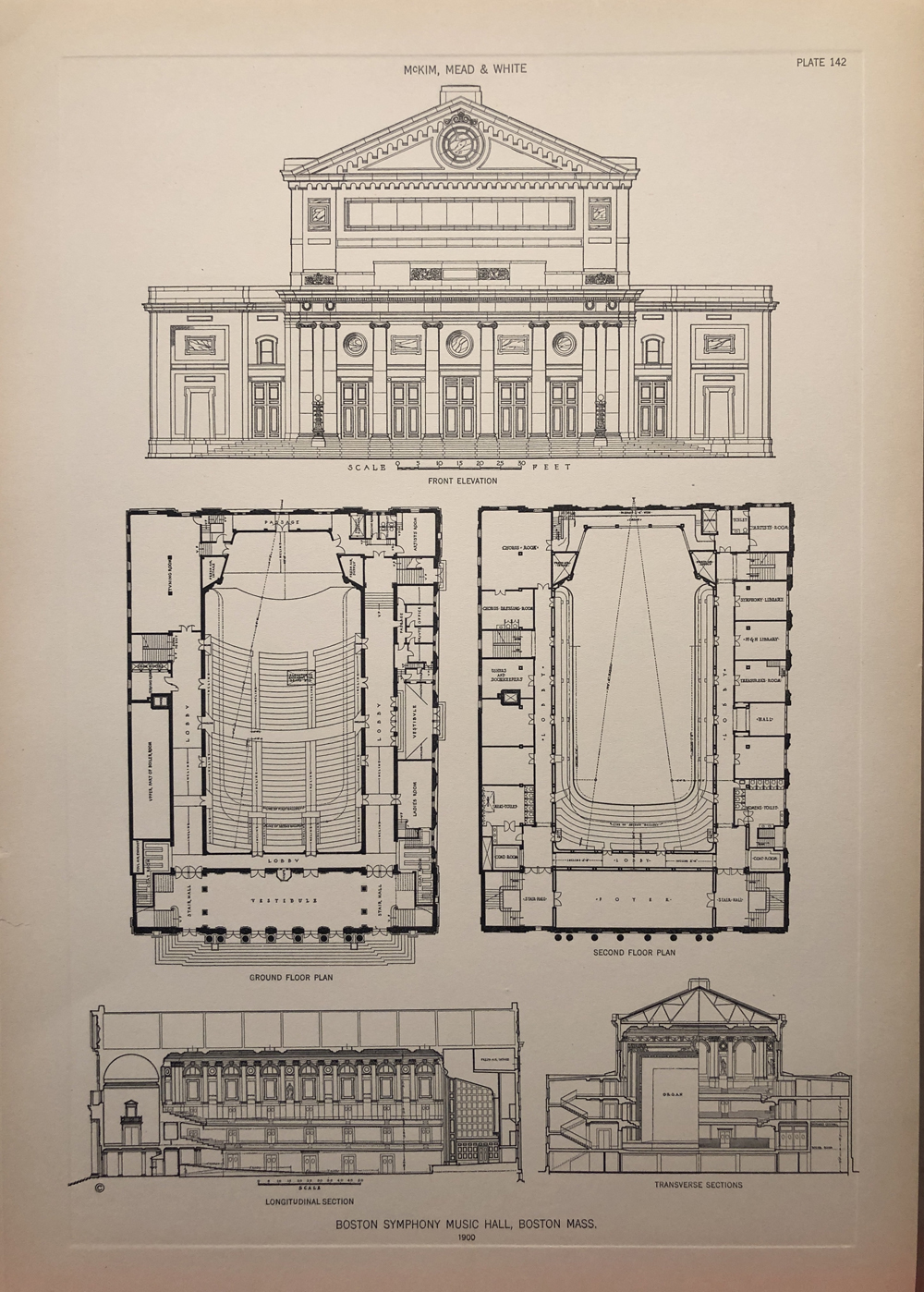
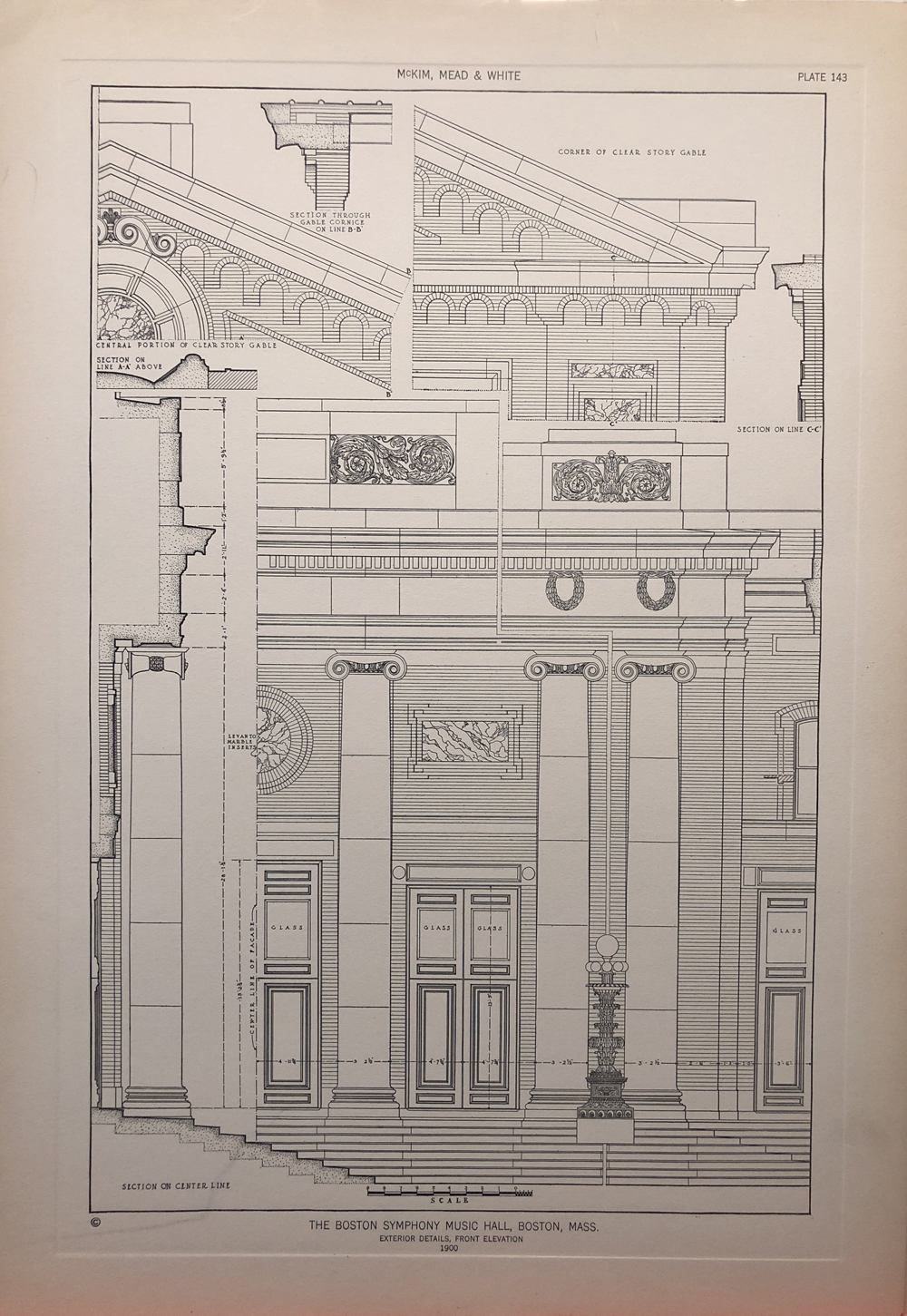
Symphony Hall was designed by  the architectural firm of McKim, Mead & White and an early photo of the completed Hall appeared in A Monograph of the Work of McKim, Mead & White, 1879-1915 (New York: Architectural Book Publishing Co, 1915), below. The publication was a massive four volume set with nearly 400 photographs; each had a simple caption without commentary. It details the breadth of the buildings designed by McKim, Mead & White and it includes three plates that feature Symphony Hall, plates 141, 142, and 143. Several years ago, I was able to obtain original copies of these plates, which are also contained in a modern reproduction of the original four volume set that is still readily and affordably available (McKim, Mead & White, The Architecture of McKim, Mead & White in Photographs, Plans and Elevations (New York: Dover Publications, 1990).  While McKim, Mead & White’s portfolio was published in 1915, the caption reflects the original name for Symphony Hall, The Boston Symphony Music Hall, which was changed to Symphony Hall just before its opening in October, 1900.

Symphony_Hall_plate_141

The other two plates feature some interior and exterior cross sections of Symphony Hall (the aisles on the main floor were changed to a different configuration in the final design), plate 142:

Symphony_Hall_plate_142

And plate 143, that features details of exterior design for the Hall:

Symphony_Hall_plate_143

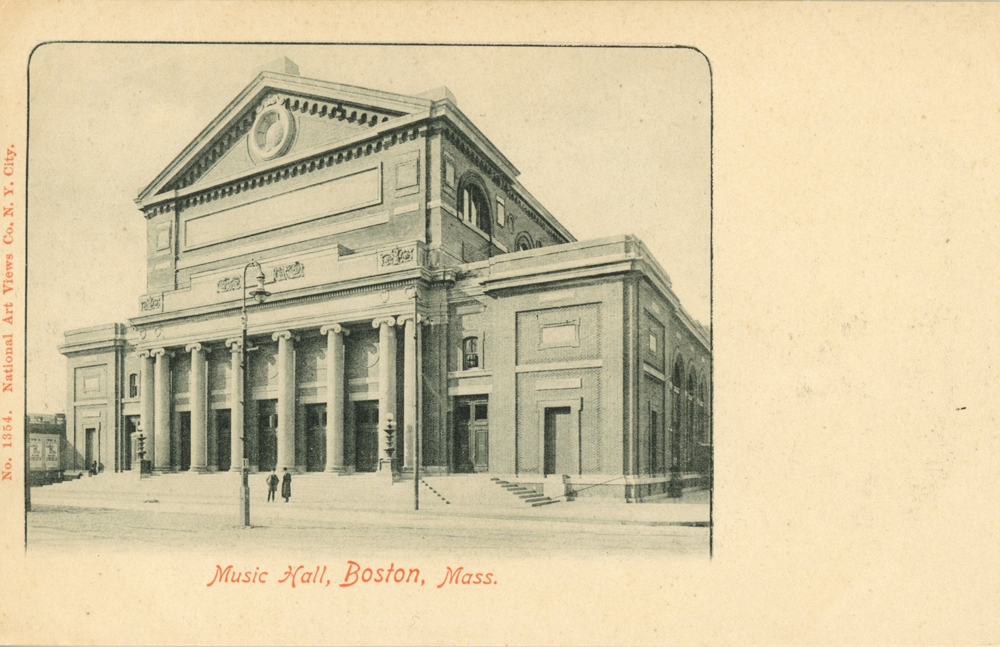
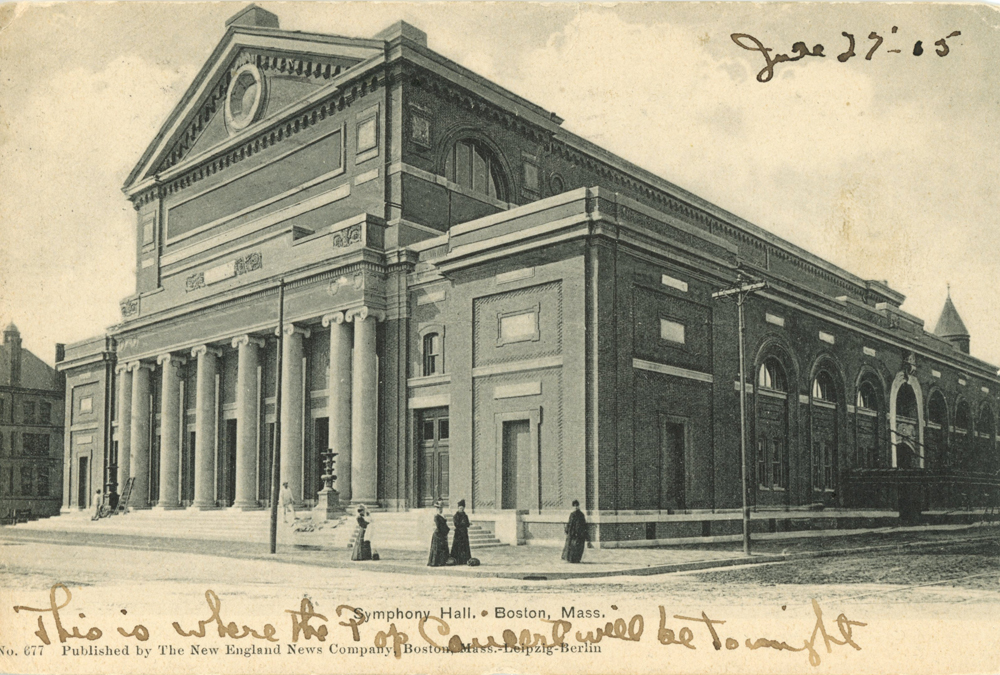
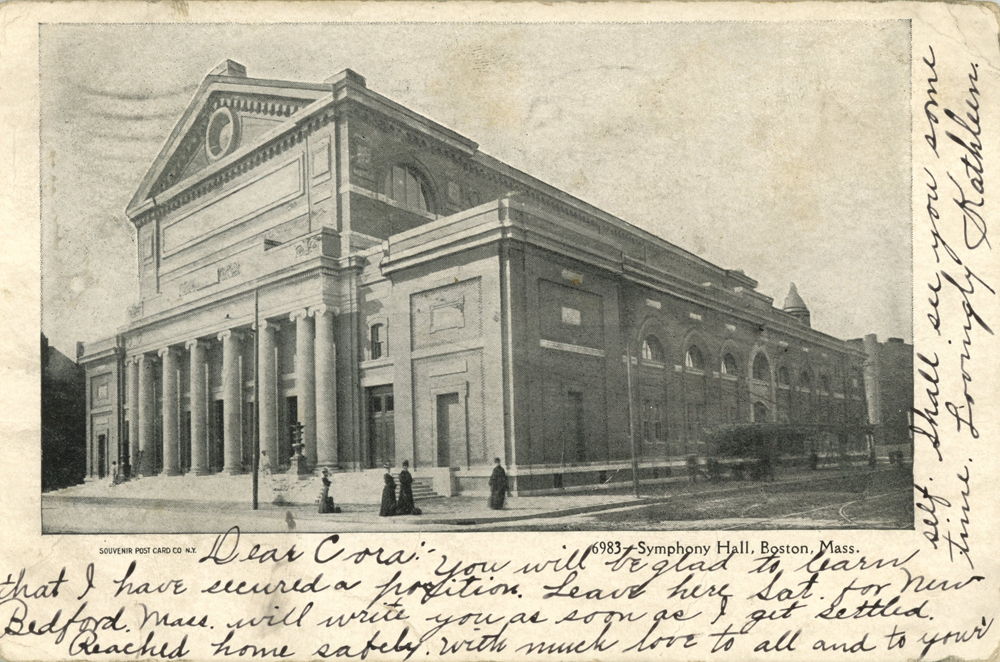
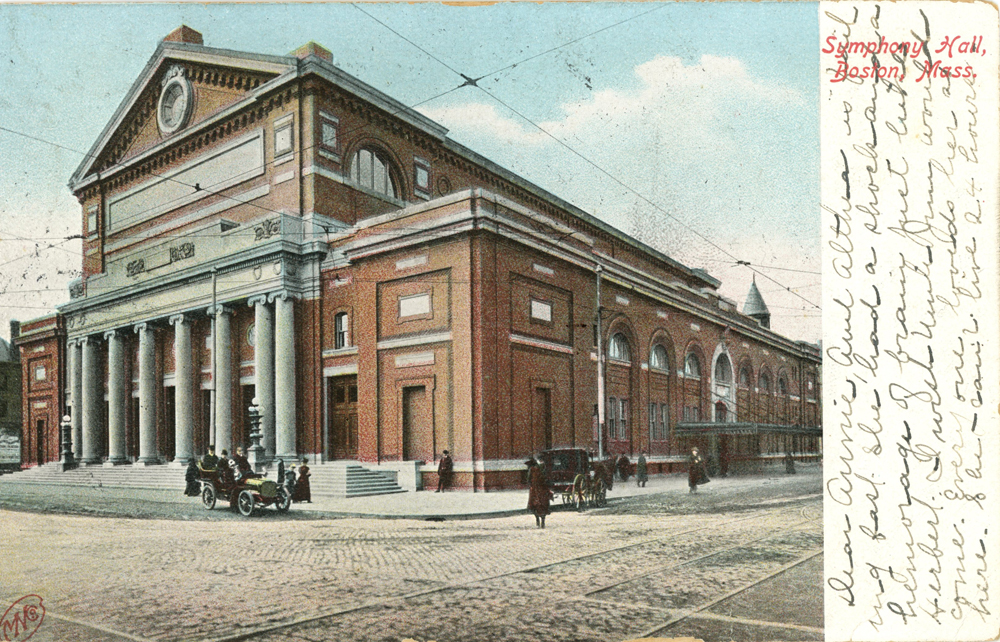
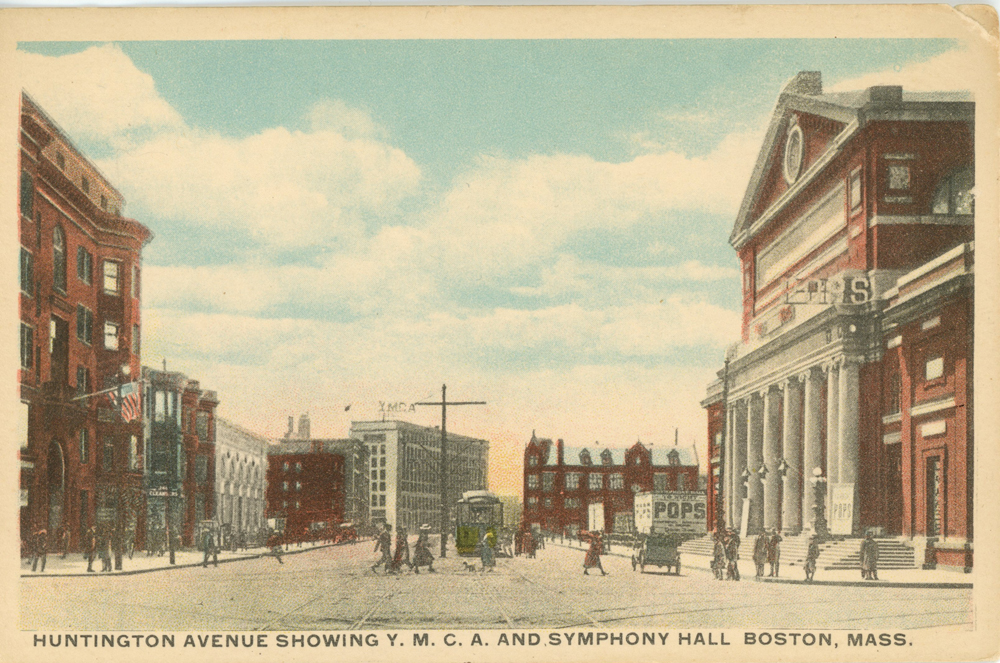
Over the years, I have collected many postcards of Symphony Hall; I usually paid only one or two dollars apiece for a piece of Boston Symphony history. I was fascinated at how many different images of the facade of the Hall had been made over nearly 100 years. In all, I found dozens of different postcards with nearly 30 images of the exterior of the hall. Many were crisp and clean, but the ones that were most interesting were the ones that had been used, with writing, stamps, and postmarks. It is these postcards that helped to document the approximate time when the photo or image of Symphony Hall was made. Early postcards were black and white; later ones were hand tinted before reproduction, and later ones are faithful photographic reproductions. Most postcards do not have copyright dates; I am not an expert at automobile models which could help further pinpoint years photos were taken. Still, these cards tell the story of Symphony Hall in a unique way. I’m presenting them here in rough chronological order with only light commentary; captions appear beneath each card. The images speak for themselves and are a reminder of a very important part of my life and the lives of thousands upon thousands of lovers of music who have walked through the doors of Symphony Hall, Boston’s proud Temple of Music. 

01_Symphony_Hall_Yeo_postcard

01. Music Hall, Boston, Mass. c. 1900. Card produced by National Art Views Co., N. Y. City. One of the earliest photos of the exterior of Symphony Hall, the view is of the original front entrance of Symphony Hall on Huntington Avenue; the Huntington Avenue trolly line power lines have been removed from this image. The Hall’s original name, Music Hall, which was changed to Symphony Hall before the first Boston Symphony concert was performed there on October 15, 1900, is featured in the caption.

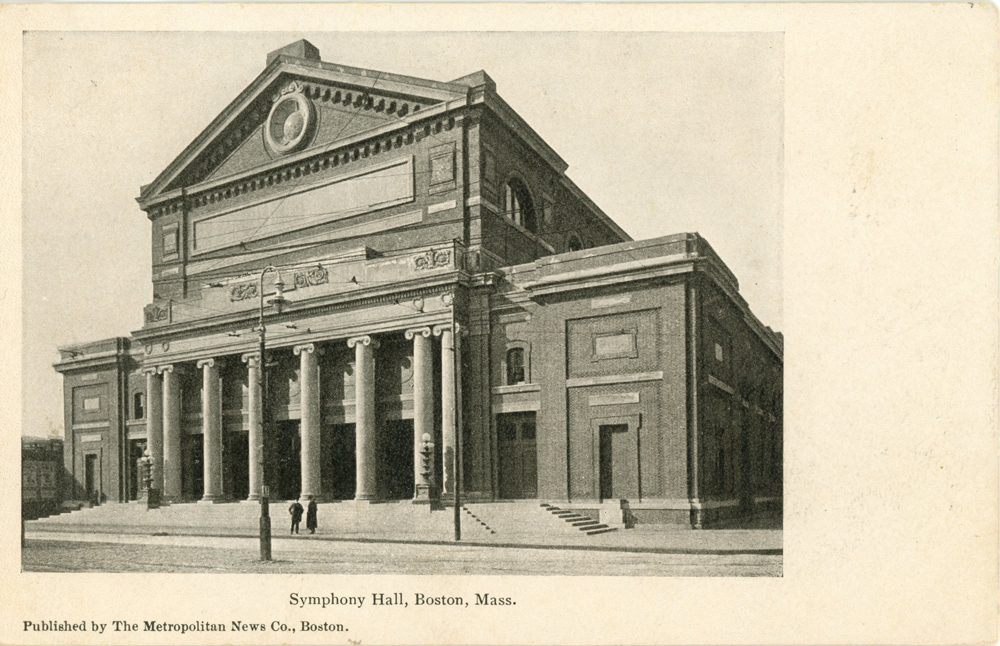
02_Symphony_Hall_Yeo_postcard

02. Symphony Hall, Boston, Mass. c. 1900. Card produced by The Metropolitan News Co., Boston. This is the identical photo seen in the previous card except the trolley power lines have not been removed. Note the name of the Hall has now been changed from Music Hall to Symphony Hall.

03_Symphony_Hall_Yeo_postcard

03. Symphony Hall. c. 1902. This collage of buildings are from Boston’s Back Bay area, including the Horticultural Hall, which is across the street from Symphony Hall on Massachusetts Avenue. The Art Museum on the card is the Museum of Fine Arts, Boston, which moved from its original location in Copley Square (shown on the card) to its present location on Huntington Avenue in 1907.

03a_Symphony_Hall_Yeo_postcard

03a. Symphony Hall, Boston, Mass. c. 1904. Card produced by Detroit Photographic Co. The card is used and is postmarked October 7, 1908, addressed to Miss Mary Merkins, Winsted, Connecticut. The copyright date of the image is given as 1904. Note the woman in the bottom right corner who is holding on to her hat in the gusting wind.

04_Symphony_Hall_Yeo_postcard

04. Symphony Hall, Boston, Mass. c. 1905. Produced by F. von Bardelben, New York & Germany. Made in Germany. Note the presence of a single horse-drawn carriage.

05_Symphony_Hall_Yeo_postcard

05. Symphony Hall, c. 1905. Card produced by Chisholm Bros., Portland, Maine. The card is used and is postmarked September 4, 1905, addressed to Miss Myrtle Kiefer, Homer, Michigan. The view is similar to the card above but several pedestrians are seen standing against the building.

06_Symphony_Hall_Yeo_postcard

06. Symphony Hall, Boston, Mass. c. 1905. Card produced by The New England News Company, Boston, Mass. – Leipzig — Berlin. The card is used and is postmarked June 29, 1905, addressed to Mrs. K. B. Keene of Washington, D.C. In this view, one can see one of the rising-sun  shaped windows in the clerestory; these were boarded up during World War II (a blackout precaution) and were only reopened in the early 2000s at which time natural light once again could shine into the Hall.

07_Symphony_Hall_Yeo_postcard

07. Symphony Hall, Boston, Mass. c. 1905. Card produced by Souvenir Post Card Co., New York. The card is used and is postmarked November 11, 1906, addressed to Mrs. A. L. Turner of Atlantic, Massachusetts. The photo is identical to the one in the card above although it is cropped differently and you can see many people along the Massachusetts Avenue side of Symphony Hall who had been removed in the previous card. I own a second copy of this card that was also used, postmarked March 7, 1907, addressed to Mr. George A. Ohlmsted, Barre, Vermont (c/o Ladd’s Grocery).

07a_Symphony_Hall_Yeo_postcard

07a. Symphony Hall, Boston, Mass. c. 1907. Card produced by Reichner Bros., Boston, München, Prag., Leipzig. Made in Austria. This curious card appears in version with no text on the image side and also as shown here, with the imprint of an event – Welcome to Boston, Old Home Week, July 28-Aug. 3, 1907 – that was probably held in Symphony Hall that had nothing to do with the Boston Symphony. Organizations sometimes issued commemorative cards with their own imprint to celebrate their events. Note the Boston bean pots in the four corners. The photo of Symphony Hall is centered in an artist’s palate. 

08_Symphony_Hall_Yeo_postcard

08. Symphony Hall, Boston, Mass. c. 1908. Card produced by Robbins Bros., Boston, Mass. Made in Germany. The card is used and is postmarked April 6, 1908, addressed to Mrs. Robert Skillings, Danville, Quebec. This card is the earliest I have seen that shows an automobile – on Huntington Avenue around the corner from a horse drawn carriage on Massachusetts Avenue.

09_Symphony_Hall_Yeo_postcard

09. Boston, Mass., Symphony Hall. c. 1911. Card produced by  The Hugh C. Leighton Co., Portland, ME, USA. Made in Germany. The card is used and is postmarked November 10, 1911, addressed to Mr. Georgie Worren, Wilton, New Hampshire. Two things are notable: The card was sold by Poole Piano Company (established in Boston in 1893) which inserted its company name and the hot air balloon with a piano hovering above the hall. This was a common advertising tool in the late nineteenth and early twentieth centuries. Also, note the sign that says “POPS” above the right pair of columns. This sign indicates that the photo was taken during the Boston Pops season. Pops concerts – originally “Promenade concerts” – began in 1885 and continue to this day. Today, this lighted sign is installed each year over the Massachusetts Avenue side of Symphony Hall (see card 24, below).

10_Symphony_Hall_Yeo_postcard

10. Symphony Hall and Horticultural Society Building, Huntington Ave., Boston, Mass. c. 1912. The card is used and is postmarked  December 10, 1912, addressed to Mrs. C. E. Palmer, Bath, Maine. This card looks down Huntington Avenue and shows the proximity of Symphony Hall and the Horticultural Hall (built in 1901); note, too, the three modes of transportation: horse-drawn carriage, automobile, and trolley.

11_Symphony_Hall_Yeo_postcard

11. Boston, Mass., Symphony Hall. c. 1913. Card produced by Raphael Tuck & Sons, Art Publishers to Their Majesties the King & Queen. Printed in Holland.  The card’s caption on the back reads, “SYMPHONY HALL, successor of the old Music Hall, is the home of the Symphony Orchestra, and here the oratorios of Handel and Hayden Society are even. The Hall has a seating capacity of 2,500, and the interior decorations, lighting, etc., are up-to-date as it was erected recently.”

12_Symphony_Hall_Yeo_postcard

12. Symphony Hall, Boston, Mass. c. 1914. Card produced by The Leighton & Valentine Co., N. Y. City. Printed in United States. The card is used, postmarked 1914, addressed to Mrs. C. H. Gateo, Petersham, Massachusetts. The lighted POPS sign is seen again in this card, as are two trollies and a horse-drawn carriage. Notice, too, the large three-sheet advertisements for Boston Pops concerts in the niches on the corners of the building as well as one standing against the Huntington Avenue columns.

13_Symphony_Hall_Yeo_postcard

13. Symphony Hall, Boston, Mass. c. 1914. Published by Tichnor Bros., Inc., Cambridge, Mass. Huntington Avenue is bustling with activity; many signs lean up against the Huntington Avenue columns to advertise upcoming concerts and events. Two styles of automobiles are seen as well as the wheel of a horse-drawn carriage on the far left. Crossing Massachusetts Avenue on the right side of the card is someone with a long case or parcel. Could it be a member of the Boston Symphony heading to a rehearsal?

14_Symphony_Hall_Yeo_postcard

14. Symphony Hall, Boston, Mass. c. 1915. Card produced by  E. H. & F. A. Rugg, Medford, Mass. Visible in this card is one of the shutters — standing open — that could be raised to cover   the rising-sun clerestory windows. 

14a_Symphony_Hall_Yeo_postcard

14a. Symphony Hall and Horticultural Hall, Massachusetts Avenue, Boston, Mass. c. 1927. Card produced by  Tichnor Bros., Inc., at Cambridge, Mass, USA. The postcard is used and is postmarked 1927, addressed to Mrs. Wilber Tasker, Etna, Maine. This view shows Symphony Hall and the Horticultural Hall, with the dome of the mother church of First Church, Christ Scientist (built in 1906) rising in the background. The caption on the back of the postcard refers to Symphony Hall as “Boston’s Temple of Music.”

15_Symphony_Hall_Yeo_postcard

15. Symphony Hall, Boston, Mass. c. 1930s? Card produced by C. T. American Art. 

16_Symphony_Hall_Yeo_postcard

16. Symphony Hall, Boston, Mass. c. 1930s? Card produced by The New England News Company, Boston, Mass. 

17_Symphony_Hall_Yeo_postcard

17. Symphony Hall, Boston, Mass. c. 1930s? Card produced by The Process Photo Studios, Troy at 21st St., Chicago, Ill. The presence of a kiosk in the intersection of Huntington and Massachusetts Avenues with an traffic officer from the Boston Police Department adds a certain kind of frightening charm to this image. I would not have wanted to be in his position.

18_Symphony_Hall_Yeo_postcard

18. Huntington Avenue Showing Y.M.C.A. and Symphony Hall, Boston, Mass. Before 1941. Card produced by M. Abrams, Roxbury, Massachusetts. This view is down Huntington Avenue and shows Symphony Hall on the right (with the POPS lighted sign in place), and the Boston Y.M.C.A. building in the center. To the left of the Y.M.C.A. is New England Conservatory of Music where I taught from 1985-2012; many Boston Symphony musicians teach at NEC owing to its close proximity to Symphony Hall.

19_Symphony_Hall_Yeo_postcard

19. Symphony Hall, Y.M.C.A. and Junction, Mass. Ave. and Huntington Ave., Boston, Mass. Before 1941. Card produced by The New England News Company, Boston, Mass. Similar to the view above, this postcard features later style automobiles, the absence of the POPS advertising, and large American flags on top of the Y.M.C.A.

20_Symphony_Hall_Yeo_postcard

20. Symphony Hall, Boston, Mass. c. 1941. Card produced by United Art Co., Boston, Mass. I do not know if the large American flag on the roof of Symphony Hall was actually a feature of the hall for a time or if it is an artistic addition from around the time of World War II. I have been on the roof of Symphony Hall and do not recall seeing a stand for a flag of that size although it’s quite possible it was there at one time.

21_Symphony_Hall_Yeo_postcard

21. Huntington Avenue at Massachusetts Avenue Showing Symphony Hall, Horticultural Hall and Dome of Christian Science Church. Boston, Mass. c. 1949. Card produced by “COLOURPICTURE” Publications, Cambridge, Mass. USA. The card is used and is postmarked September 7, 1949, addressed to Mrs. Harry Monroe, Fitchburg, Massachusetts. In 1941, the Tremont Street Subway (now the Green Line E spur) was moved from surface level to underground to avoid traffic on Massachusetts Avenue. This made using the original Huntington Avenue entrance of Symphony Hall more difficult since the road was necessarily more narrow. The main entrance of the Hall was switched to the Massachusetts Avenue side. This was a practical decision but it has disrupted the original flow of concert goers into the Hall; they now enter the auditorium from the side rather than from the rear.

22_Symphony_Hall_Yeo_postcard

22. Symphony Hall, Massachusetts and Huntington Avenue, Boston, Mass. c. 1954. Card Produced by United Art Co., 89 Bedford St., Boston, Mass. The postcard is used and is postmarked July 21, 1954, addressed to Mr. & Mrs. Harry Davidson, Lakewood, Ohio. This interesting view shows a long building to the left of Symphony Hall (a sign for a bowling alley is visible). This building, which stretches for the whole block, is now owned by the Boston Symphony which has plans to redevelop the block with a new building. Currently it houses the Orchestra’s Cohen Wing which includes the Symphony Hall gift shop, BSO archives, management offices, the Casadesus Collection of Musical Instruments, and various other businesses that rent space from the Boston Symphony.

23_Symphony_Hall_Yeo_postcard

23. Symphony Hall. c. 1990. Card photo by Lincoln Russell, Stockbridge, MA. Symphony Hall at dusk, in a time-lapse photograph. 

24_Symphony_Hall_Yeo_postcard

24. Symphony Hall. c. 1995. Card photo by Helen Eddy, Cambridge, Massachusetts. This view is of the canopy over the Massachusetts avenue entrance to Symphony Hall, showing decorative bunting and the lighted POPS sign celebrating the spring season of the Boston Pops Orchestra.

25_Symphony_Hall_Yeo_postcard.jpg

25. Seiji Ozawa and the Boston Symphony Orchestra, Symphony Hall. c. 2000. Card photo by Christian Steiner, New York, New York. This photo shows a view of the stage of Symphony Hall near the end of the tenure of Music Director Seiji Ozawa (music director 1973-2002). The trumpets and trombones are seated in the back row of the orchestra in front of librarians and personnel mangers and stage managers who are standing in the center: Thomas Rolfs, Peter Chapman and Charles Schlueter, trumpets; Ronald Barron, Norman Bolter, Douglas Yeo, trombones; Chester Schmitz, tuba. The story of the interior of Symphony Hall is one for another time!


André Previn (and J. J. Johnson)

André Previn (and J. J. Johnson)

Last week, André Previn died at the age of 89. He was known for many things: he was a conductor, composer, and pianist, and his private life was very public (among his five wives were actress Mia Farrow and violinist Anne-Sophie Mutter). During my long career with the Boston Symphony, I played many concerts under Previn’s direction, beginning with the Elgar Symphony No. 1 in August 1985; the last time I worked with him was when he conducted Ravel’s La Valse in August 2009. In all, I played 81 concerts under his baton, including concerts in February 1997 when he led the Boston Symphony Orchestra on a tour to the Canary Islands and Florida.

Previn was born in Berlin in 1929; his name was Andreas Ludwig Prewin. His father was Jewish and in 1938, the family fled the Nazis and moved to Paris and then Los Angeles. He became an American citizen in 1943 and was, to my mind, a thoroughly American musical personality. Previn had a dry wit, a “matter-of-factness” when he addressed the orchestra in rehearsal. His ear was always finely attuned to balance and when, during a rehearsal of Antonin Dvorak’s Symphony 8 he said to an over-enthusiastic brass player, “We don’t need the zenith, apocalyptic fortissimo,” his point was succinctly made. And he had coined a phrase that I and many others have used from time to time.

During that 1997 tour of the Canary Islands, Previn hosted a party for the orchestra. This was a long tradition on Boston Symphony tours, and a generous gesture on the part of the tour’s conductor. Of course, sending the Boston Symphony to the Canary Islands during the teeth of a Boston winter was like letting children loose in a candy story. Many of my colleagues took every opportunity to frolic on the famous beaches and more than a few players came to a concert with severe sunburn. At the party, Previn rose to toast the orchestra. “I’m terribly sorry,” he said as he lifted his glass, “if the concerts are interfering with the tour.” And he sat down. That was Previn. He didn’t need many words to make a point and when he used them, sometimes you just had to smile and muffle a hearty chuckle.

Previn_Johnson_Mack_the_Knife

But I first got acquainted with André Previn long before I joined the Boston Symphony and began playing concerts with him. In 1971, I visited our local public library and noticed a jazz trombone recording by J. J. Johnson. At that time, I had heard few recordings of great trombone players. This one got my attention. Recorded in 1962, it was titled, André Previn and J. J. Johnson play Kurt Weill’s Mack the Knife & Bilbao-Song and Other Music from The Threepenny Opera. That’s a mouthful. But here’s what got my attention: Previn got top billing. Who was he? I quickly found out.

The eight tracks – the combo was rounded out with Red Mitchell, bass, and Frank Capp, drums – were stunning in their creativity. Johnson I knew; he did not disappoint. But Previn was someone new to me, and his piano playing was stellar. Recorded in 1962, the recording had a freshness and vibrancy that spoke to me. And as the record turned, I was particularly interested to hear what these two performers would do with Mack the Knife, one of the most frequently recorded songs. What could they do and say that hadn’t been done and said.

They did and said something new. As you can hear in the link above (or click HERE to listen to the track on YouTube), Previn started Mack the Knife with an innocuous introduction in G-flat. No surprise there. But then Johnson came in. In the key of C. The bitonality was shocking. Truly shocking. Then, on the second verse, Johnson played in G-flat and Previn played in C. My young ears had never heard anything like it before. It remains as shocking and wonderful today as it did when I first heard it nearly 50 years ago.

Johnson_Previn_02

Years later, during a break at a Boston Symphony rehearsal, I asked Previn about that recording session. I wanted to know how they came up with that incredibly creative idea. Previn looked at me and shook his head. “It just happened,” he said. “I vamped an intro and J. J. just started playing in a different key. It all flowed from there. We didn’t talk it through, we didn’t work it out. It just happened.”

Amazing.

Incredibly, this album has been long out of print. It appeared on two CD releases (one was released only in Japan) but they disappeared from the catalog quickly. But used copies can still be found on Discogs and other used record/CD outlets. It’s worth tracking down.

André Previn is remembered by many people for many different things. I’m grateful that I got to play so many concerts with him on the podium. But most of all I’m grateful that I can still be inspired by a jazz album he made with one of the greatest trombonists of all time, and that the creativity exhibited on that disc is still with us.

[Photos of J. J. Johnson and Andre Previn from the back cover of the original issue of André Previn and J. J. Johnson play Kurt Weill’s Mack the Knife & Bilbao-Song and Other Music from The Threepenny Opera, Columbia LP SICP 2384.]


Tubby the Tuba

Tubby the Tuba

Among my many projects that are happily occupying my time is my work on several book projects. One of them is An Illustrated Dictionary for the Modern Trombone, Euphonium, and Tuba Player, to be published by Rowman & Littlefield. This is a very interesting project for me: to come up with about 600 terms (instruments, instrument parts, accessories, composers, companies, players, etc.) that low brass players might want to know more about. It is a dictionary, not an encyclopedia, so my entries are necessarily brief, but an extensive bibliography will help readers know where to go to get more information.

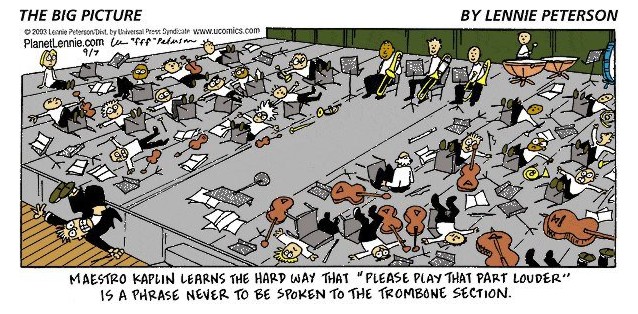
The book will be illustrated by my friend, Lennie Peterson, a trombonist and artist living in Boston but who works around the world. Many readers of The Last Trombone already know Lennie even if they don’t know him: I’d venture to say that any readers who are trombone players have seen Lennie’s most famous cartoon from the many years when his syndicated daily cartoon, “The Big Picture,” was part of newspapers around the country.

Lennie_Peterson_trombone_Kaplin

But Lennie is also a superb fine artist, and his illustrations for my new book will add measurably to help readers understand my words even better.

Over the last few days, I’ve been researching an entry for my book, about the piece,  Tubby the Tuba. Many readers probably know about this charming work for orchestra, narrator, and tuba. But it wasn’t until I actually sat down to research it that I found some very interesting things that I’d like to share with readers.

Tubby the Tuba was written by George Kleinsinger (music) and Paul Tripp (story). Tubist Herbert Jenkel asked Kleinsinger to write him a concerto for tuba and Tubby was the result. Kleinsinger and Tripp began their collaboration for Tubby in 1941 but World War II interrupted their work. They finally finished it in 1945 and it was premiered the following year in a concert by the American Youth Orchestra conducted by Dean Dixon with tubist Herbert Wekselblatt (who went on to be tubist with the Metropolitan Opera Orchestra for many years). The first performance of Tubby by a professional orchestra was given by the Philadelphia Orchestra conducted by Alexander Hilsberg. The concert, on October 19, 1946, was part of the Worcester (Massachusetts) Festival and featured the orchestra’s tubist, Philip A. Donatelli, as soloist. Tubby the Tuba became the first major piece for tuba solo with orchestra, predating Ralph Vaughan Williams’ Tuba Concerto by 10 years.

Tubby_Barzin

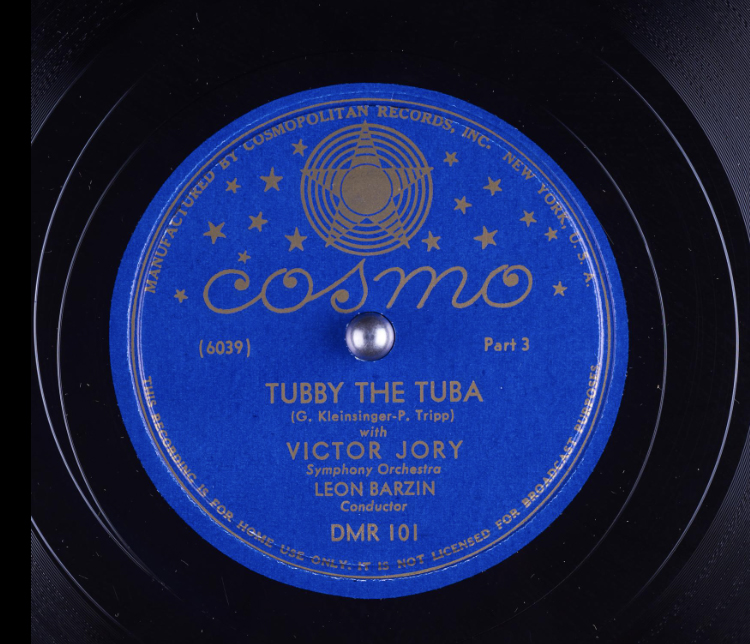
Tubby was first recorded in 1945 (The recording, on Cosmo Records, was released in December of that year) with Herbert Jenkel, tuba. This recording, with an orchestra conducted by Leo Barzin and Victor Jory narrating, may be heard HERE. Unfortunately, Jenkel was not credited on the album.

Tubby_Kaye

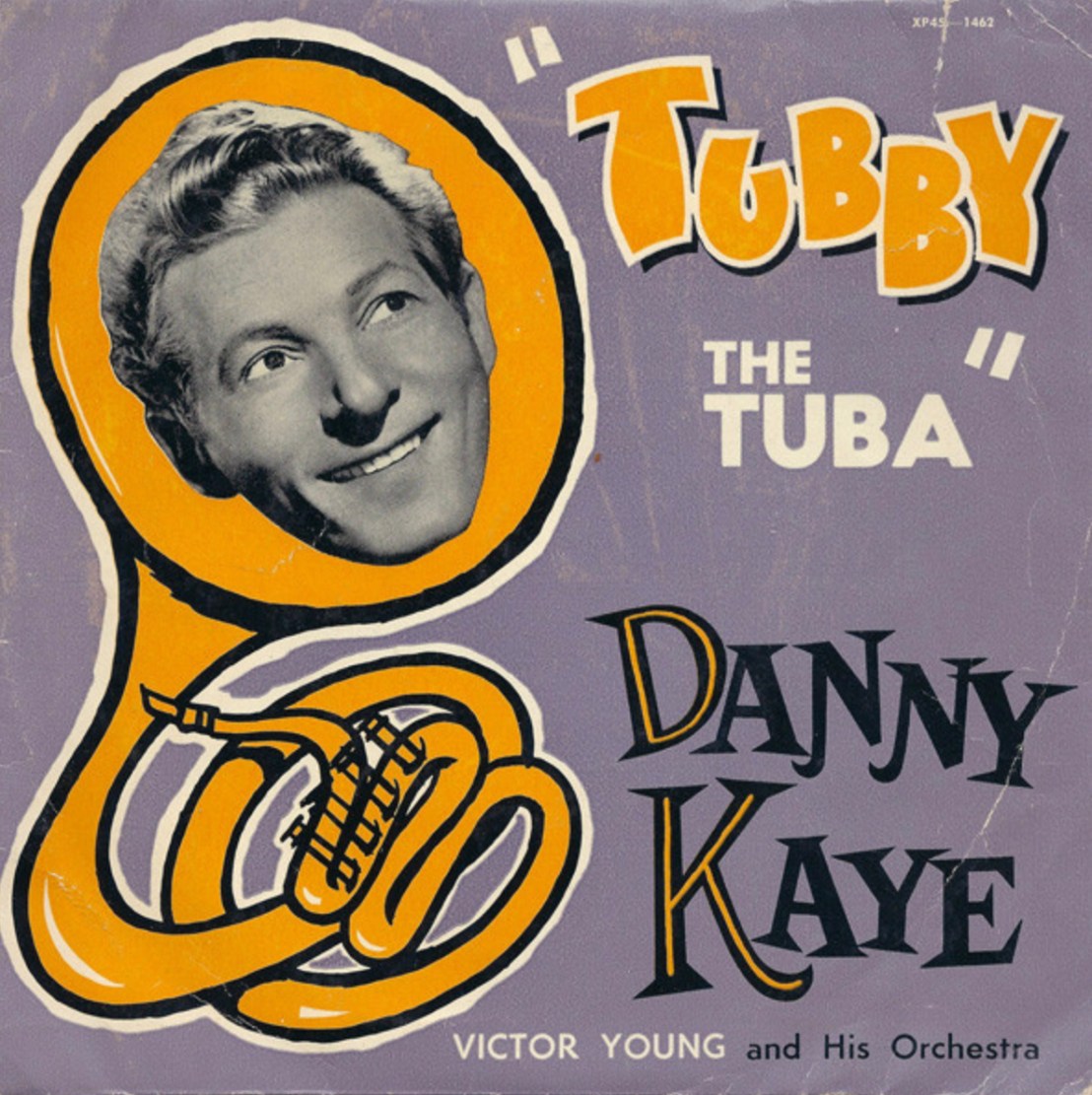
Tubby was then recorded in 1946 by Victor Young and his Concert Orchestra; Danny Kaye was the narrator with an uncredited tuba soloist. That recording may be heard HERE.

That same year, 1946, Tubby the Tuba made it to the big screen, as an animated short. It’s a charming film which received an Oscar nomination for best animated short. The film, a stop-action creation of George Pal and released as one of his Puppetoons productions, is absolutely delightful; unfortunately the tuba soloist is uncredited. If you cannot view the video embedded in this article, you can view it on YouTube by clicking HERE.

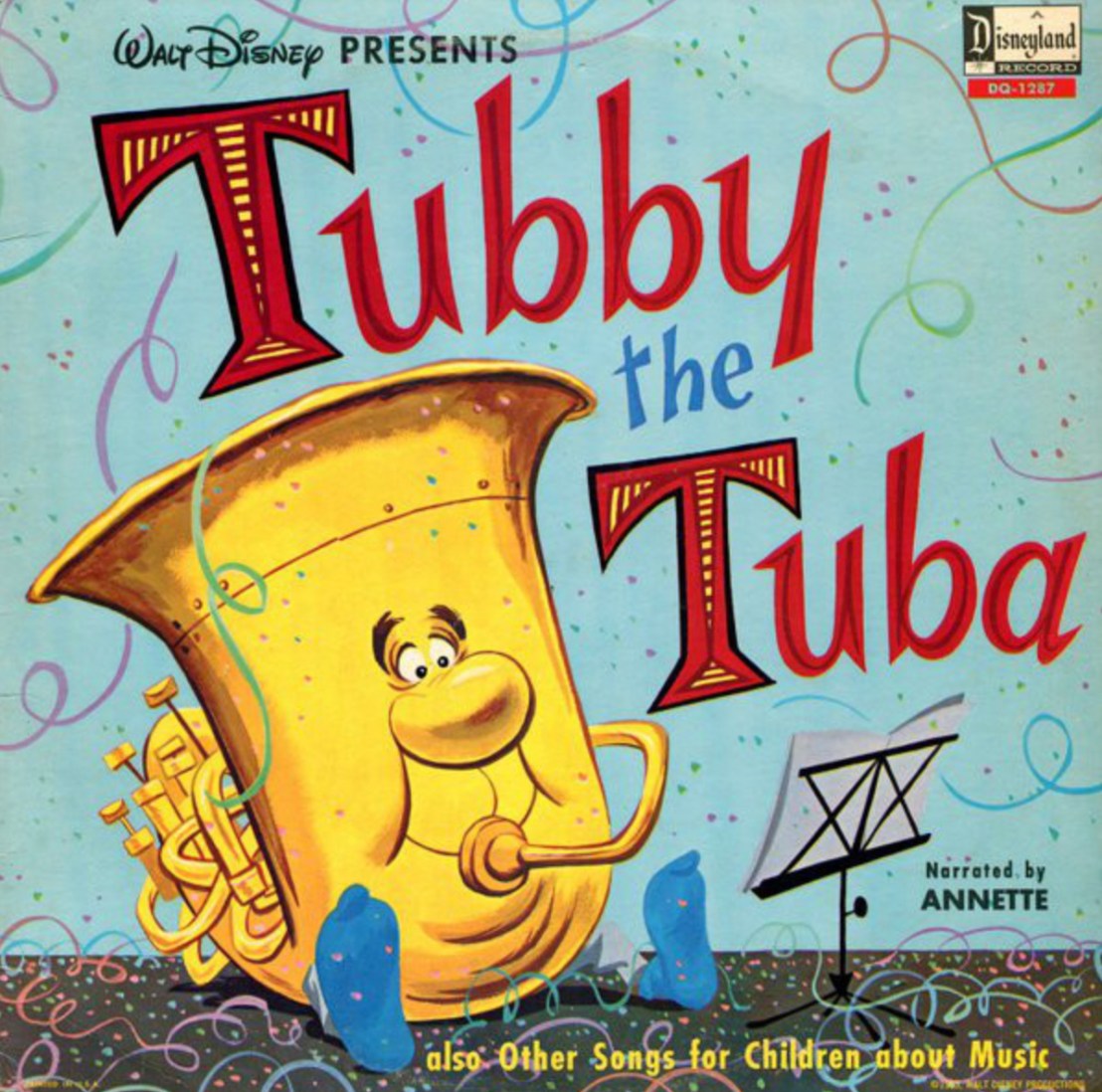
In 1963, Disney released another recording of Tubby the Tuba, with Annette Funicello (she of Mickey Mouse Musketeer fame) narrating with, yet again, an uncredited tuba soloist. That recording may be heard HERE.

Tubby_Annette

Tubby the Tuba found its way to the big screen again in 1975 (not 1977, as the video below indicates), as a full length motion picture starring Dick van Dyke as the voice of Tubby. It was a commercial failure; turning a ten minute piece into a  one hour, twenty minute film simply resulted in a bloated production that lost a lot of its original charm. Here is the familiar refrain: the tuba soloist is uncredited. If you cannot view the video embedded in this article, you may view it on YouTube by clicking HERE.

Tubby_Child_Schmitz

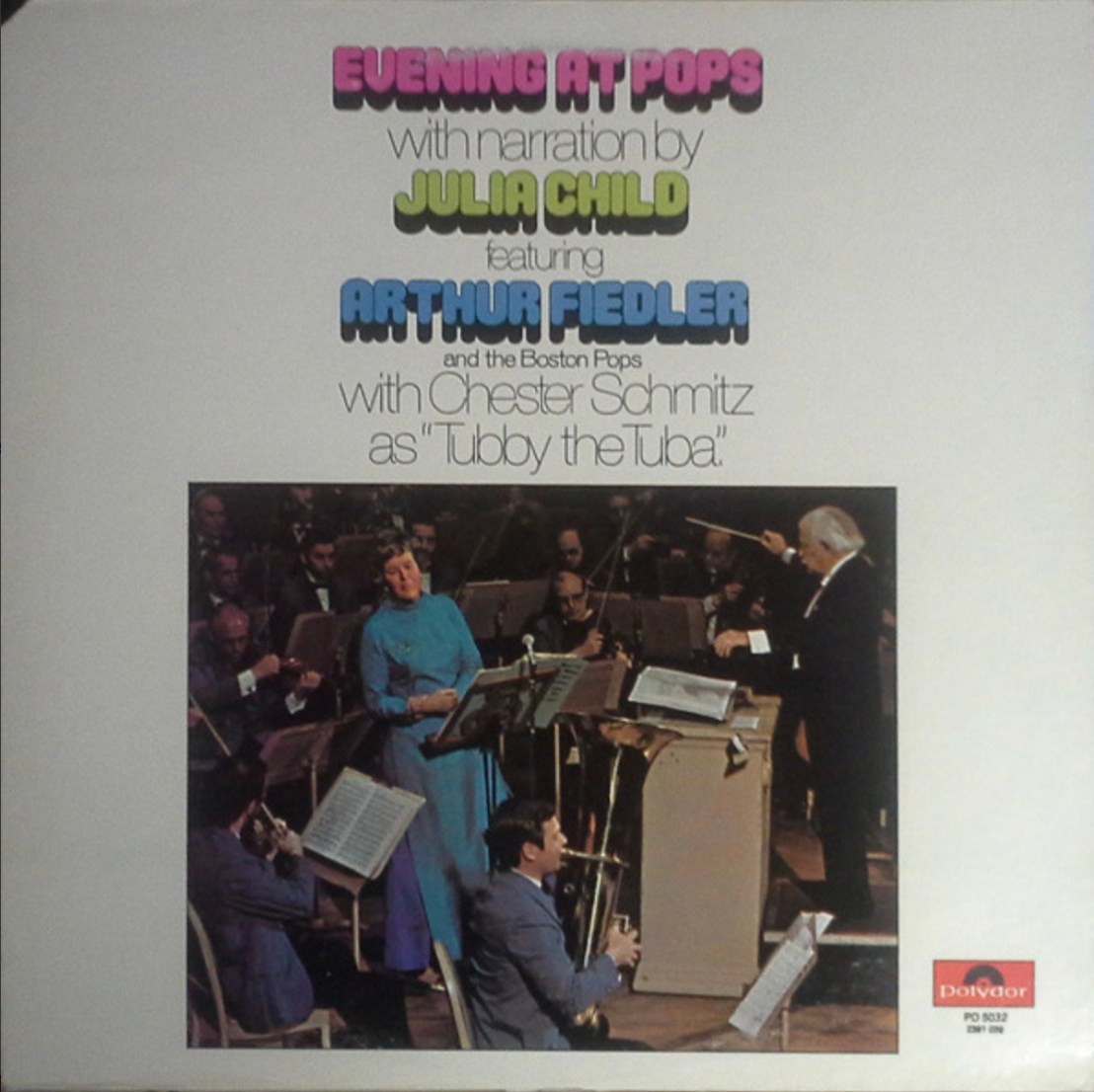
But of all of the versions of Tubby the Tuba, my favorite dates from 1971. Julia Child recorded the piece with the Boston Pops Orchestra conducted by Arthur Fiedler. Not only was this performance issued on LP, but it was recorded live for television broadcast on the PBS show, “Evening at Pops.” The tuba soloist was my Boston Symphony tuba colleague, Chester Schmitz (Chester played in the Boston Symphony from 1966-2001; we sat next to each other from 1985-2001). I have sung Chester’s praises many times before but I never tire of singing them again: he was, to my mind, the finest player of ANY wind instrument that I have ever heard. Chester had a remarkably natural ease to his playing, and his performance of Tubby, recorded in his fifth year with the Boston Symphony Orchestra is absolutely superb. His playing, combined with Julia Child’s wit, make this a performance for the ages. If you cannot view the video embedded in this article, you can see it on YouTube by clicking HERE. Enjoy!

For more information about Tubby the Tuba, read Cary O’Dell’s fine essay that was created for the Library of Congress when Tubby the Tuba was added to the National Registry in 2006. Tubby the Tuba: a delightful, unpretentious little piece with a very big history.