Category: Japan

Inspired in Japan – the 25th Hamamatsu International Wind Instrument Academy and Festival

Inspired in Japan – the 25th Hamamatsu International Wind Instrument Academy and Festival

I have been to Japan 14 or 15 times in my life; I’ve lost count. I first travelled to the island nation in 1986, on tour with the Boston Symphony and its music director Seiji Ozawa. More Boston Symphony and Boston Pops Orchestra (with John Williams, conducting) tours followed over the years. I have also been to Japan many times to teach and perform at the Hamamatsu International Wind Instrument Academy and Festival. I was on the faculty of the first Academy in 1995 and this month, I returned to Hamamatsu for the seventh (or eighth?) time to take part in its 25th anniversary event.
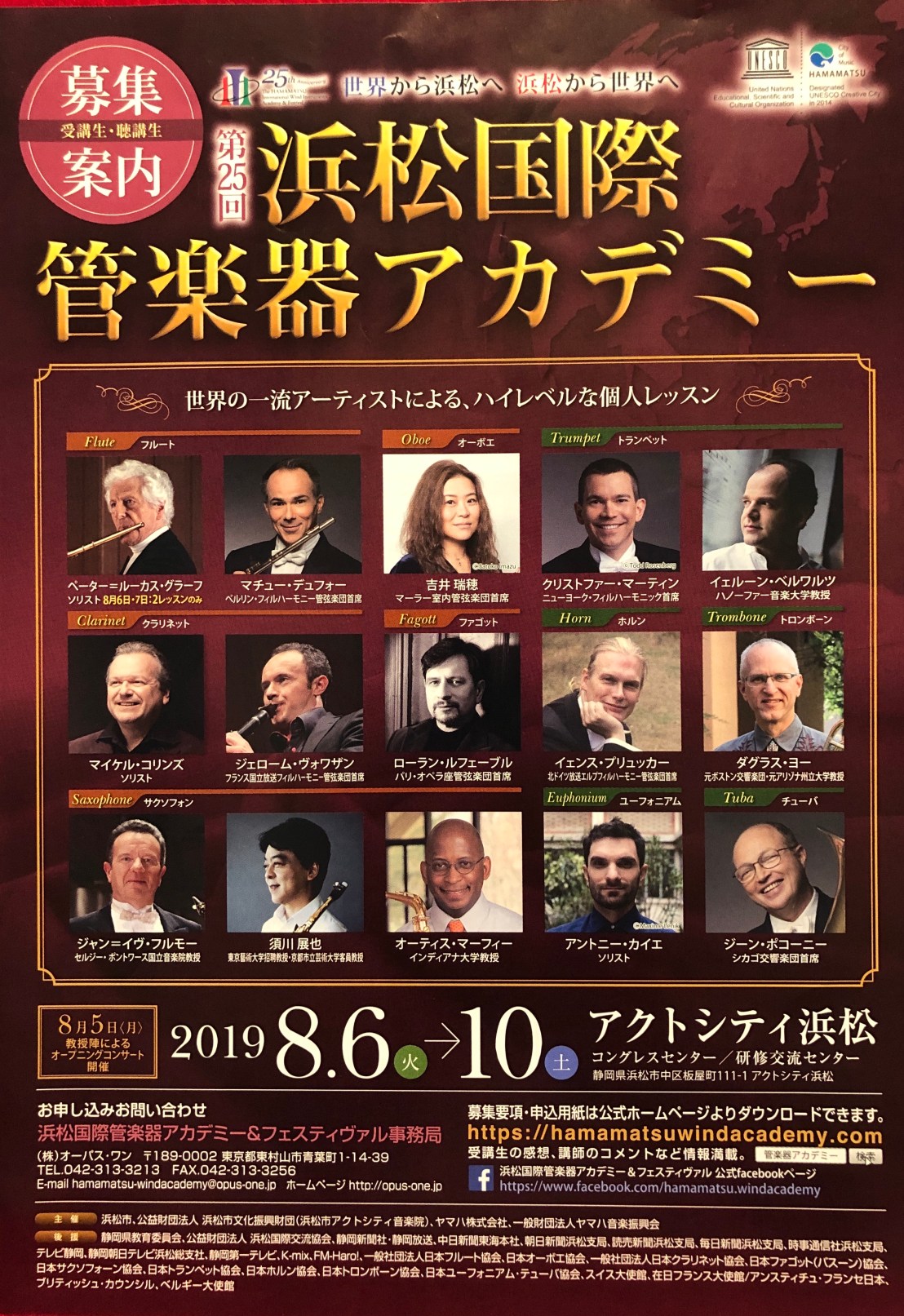
Hamamatsu_Academy_brochure_2019

The Hamamatsu International Wind Instrument Academy and Festival has grown to be an event of major importance for wind players. Jointly sponsored by the City of Hamamatsu, the Hamamatsu Cultural Foundation, and YAMAHA Corporation, the Academy and Festival assembles an international faculty of wind instrument teachers and performers. Each teacher chooses a class of eight students from recorded auditions, and students receive four lessons during a week. Lessons are open —they are conducted in large rooms with plenty of seating—and teaching rooms are always full of those who want to learn from the teachers. As such, each lesson is as much a masterclass as it is a private lesson. Before the teaching part of the event begins, the faculty always give an opening concert which, over the years, has taken different forms. Sometimes faculty play solos with piano, sometimes they play chamber music, and sometimes they take part in large ensemble performances.

Hamamatsu_Academy_brass_faculty_2019

I was delighted to be invited to the 2019 Academy and Festival. Of the fifteen faculty members—there were between one and three classes for every wind instrument—there were four Americans: Otis Murphy, saxophone (professor, Indiana University), Chris Martin, trumpet (principal trumpet, New York Philharmonic), Gene Pokorny (principal tuba, Chicago Symphony), and myself. The other brass faculty members were Jeroen Berwaerts, trumpet (professor, Hochschule für Musik in Hannover), Jens Plücker, horn (principal horn, NDF Elbphilharmonie Orchester), and Anthony Caillet, euphonium (international soloist). Apart from Anthony, who I met and worked with for the first time, I knew all of the other brass faculty from our working together at previous Hamamatsu Academies.

Yamaha_Innovation_Road

Before the Academy started, several faculty members were invited to visit the YAMAHA Innovation Road Museum. This is new, a telling of the history of YAMAHA Corporation. The museum was fascinating to me, having been involved with YAMAHA since 1986.

IMG_3866

Among the many interesting things about the Innovation Road Museum is that many of its instruments were available for the public to play. While we were visiting, we saw dozens of children playing pianos, guitars, and other instruments. This is a huge commitment on Yamaha’s part, since these instruments get heavy use and eventually need to be replaced. But this “hands-on” aspect of the exhibit showed how YAMAHA is committed to engaging the public with its work. Gene Pokorny (above) had a moment with a Sousaphone and his single note—played with GREAT enthusiasm—got everyone’s attention.
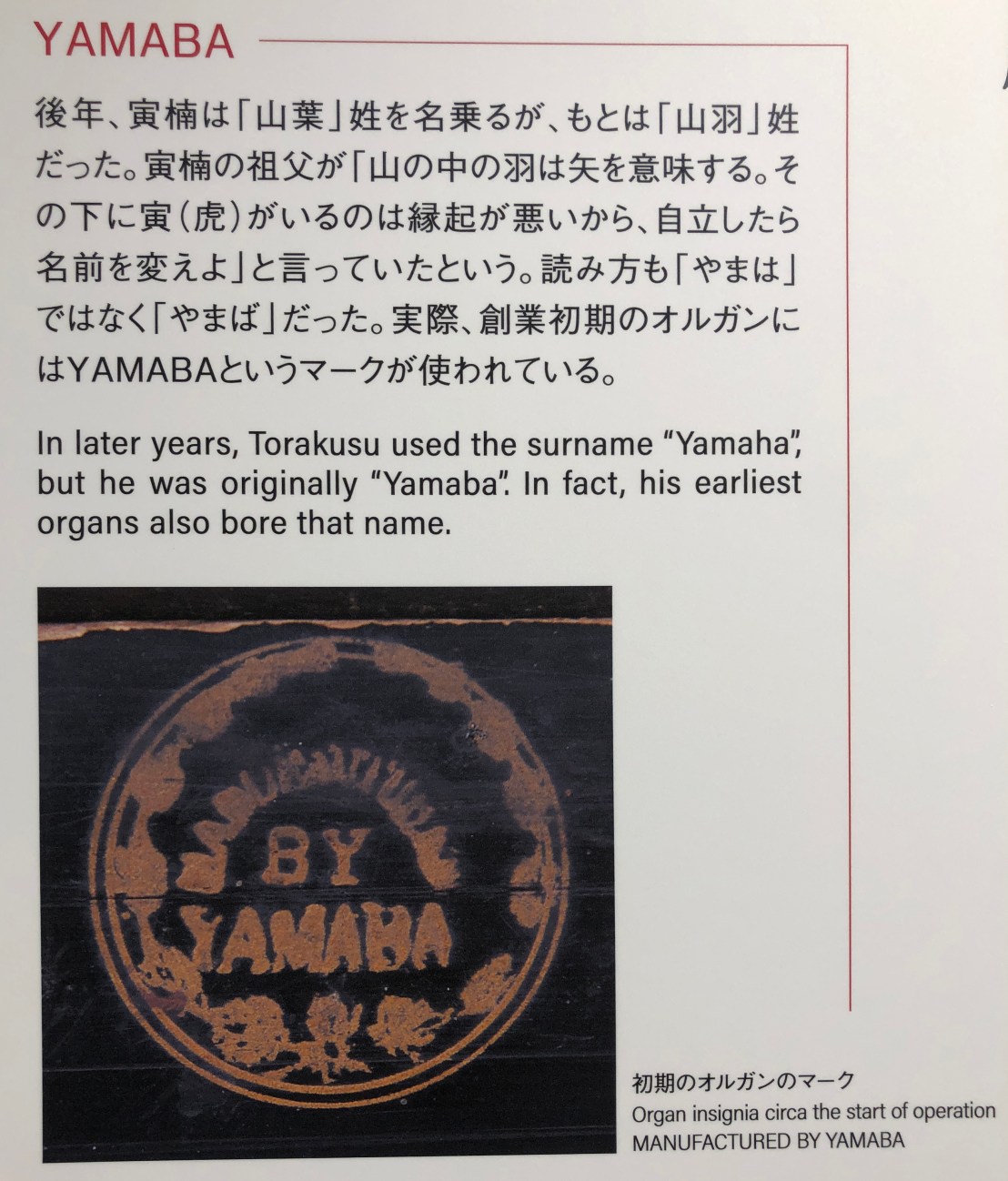
Yamaha_Yamaba

I learned a lot of the company’s history, including the fact that Torakusu Yamaha, the founder of YAMAHA Corporation, was originally named Torakusu Yamaba. He changed his name to Yamaha because he thought that name would be of greater interest to the export market. I learned many new things!

Hamamatsu_Academy_2019_brass_concert_cropped

This year, the opening concert featured a brass ensemble that performed the world premiere of a newly commissioned work by Eric Ewazen, Hamamatsu Overture. The same ensemble played movements of Hans Werner Henze’s Ragtimes and Habaneras. Originally for brass band, it had been arranged for the Concertgebouw Brass. I had previously conducted this piece with a brass band (at the Boston Symphony’s summer home, Tanglewood, with members of the Boston Symphony, Empire Brass, and students from the Tanglewood Music Center—Henze was also in the audience for the performance) and I found this arrangement to be spectacular, and quite faithful to Henze’s original. It was such a pleasure to play in this brass ensemble. Was playing in a group ever easier or more rewarding than this, with such accomplished (and nice!) players? I don’t think so.

OLYMPUS DIGITAL CAMERA

For the second half of the concert, the Festival had assembled a wind ensemble. The 15 faculty members made up the core of the group while it was filled out with other professional Japanese players. This was, for brasses, mostly a “one-on-a-part” band. I had not played in a band since the summer of 1980 when I played my last concert as a member of the Goldman Band in New York City (I was a member of the Goldman Band from 1977-1980) although I have conducted many bands over the years. The program consisted of several classic works for wind ensemble: the Second Suite of Gustav Holst, Darius Milhaud’s Suite Francaise, an arrangement of “Elsa’s Procession to the Cathedral” from Richard Wagner’s Lohengrin, and John Philip Sousa’s march, The Thunderer. Once again, playing in this band while sitting next to Anthony Caillet and Gene Pokorny was a rare and tremendously satisfying experience. The transparency of playing was notable, and the ensemble came together in a beautiful, rare way.

Here is a video of our performance of the Second Suite of Gustav Holst (edited by Ito Yasuhide), which you can also watch on YouTube:

Here is a video of our performance of Elsa’s Procession to the Cathedral of Richard Wagner (arr Hiroshi Hoshina), which you can also watch on YouTube:

And here is a video of our performance of The Thunderer of John Philip Sousa, which you can also watch on YouTube:
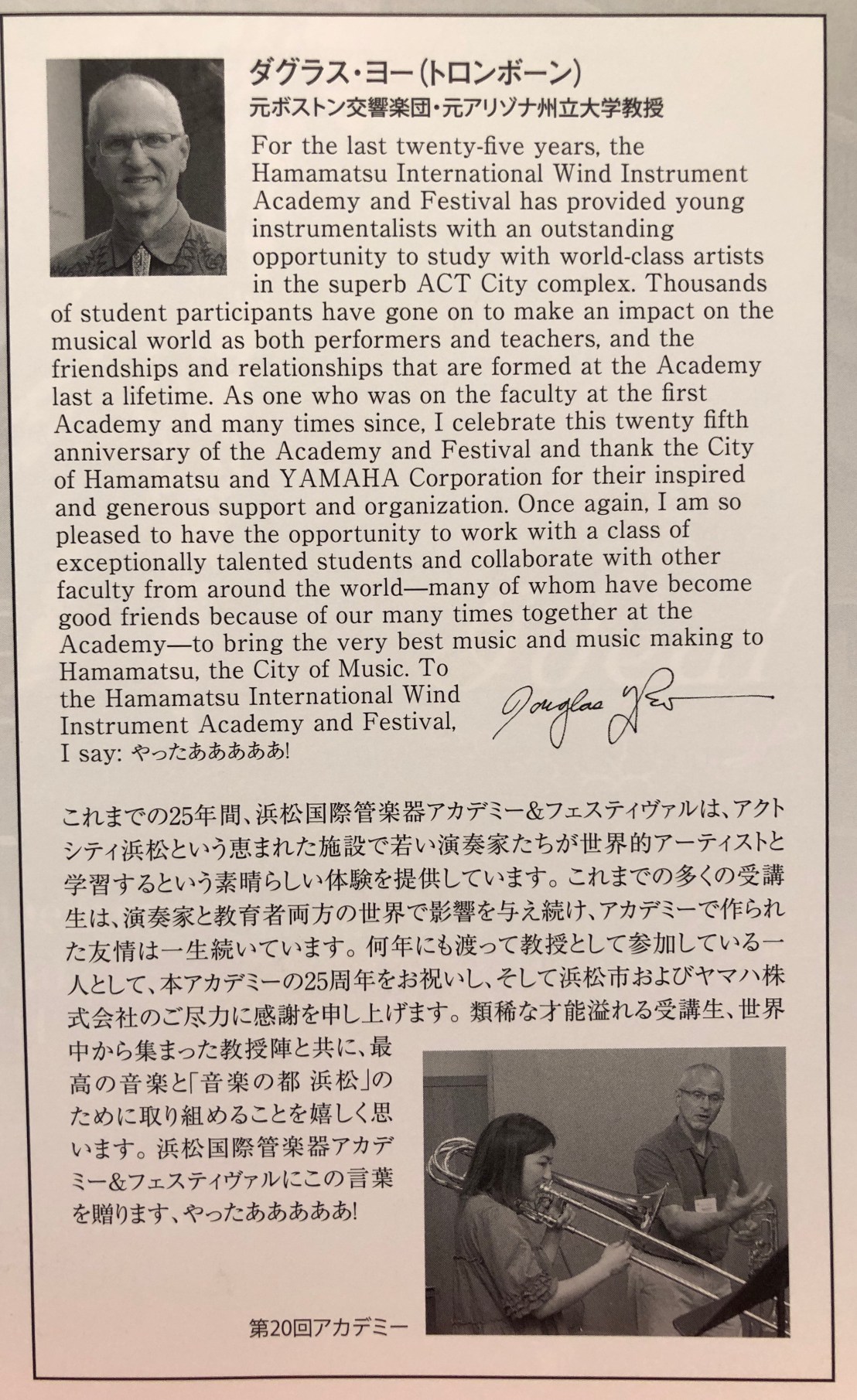
Hamamastus_Academy_Yeo_greeting_2019

I was also very grateful to have been asked to pen a few words of congratulations to the Festival for inclusion in the opening concert program which you can read above.
OLYMPUS DIGITAL CAMERA

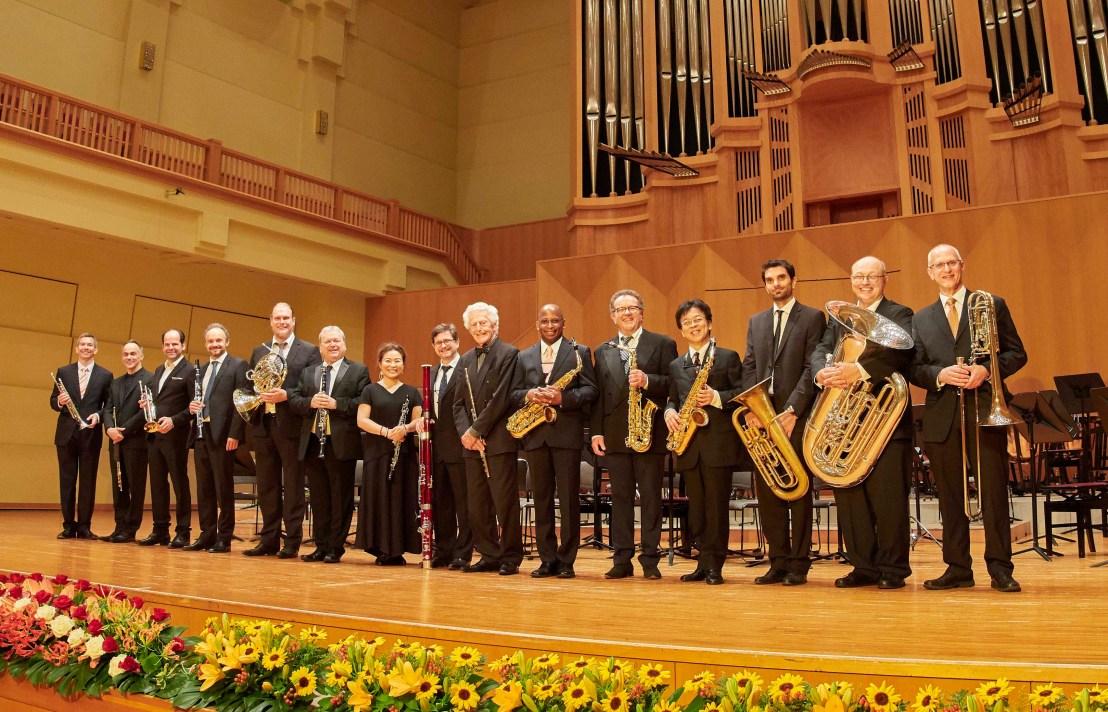
Hamamatsu_Academy_2019_faculty_silly.jpg

We gathered on stage after the concert for a photo of the Academy professors. Two photos actually, each of which tell part of the story of our very enjoyable shared collaboration.

2019_Hamamatsu_Academy_Yeo_trombone_class

From the opening concert we began our days of teaching. My class had five tenor and three bass trombonists. Five women and three men. Over the years, I have had many different kinds of students. There is no age limit for the Academy, so in the past I have had both young players and professionals. This year, all of my students were young. One was 17, others were in college/university, and a few had recently graduated from college. But, wow, they had such talent! It was a joy to work with them; they were all eager to try, learn, experiment. I chose three phrases as the motto for our class:

Pay attention.

Try everything.

Chase greatness.

If we pay attention to everything around us—not just other trombone players—there is much we can bring to our artistic/musical expression. If we try every option for every decision we face as musicians—where to breathe, what slide position to use, etc.—we can benefit from the improvement we make each day and not become fossilized with ideas that we implemented when we first laid our eyes on a piece of music. And from the Chicago Bears, I brought “chase greatness.” You must first know what greatness IS and when you see it, run after it, hunt it down, embrace it, and make it yours. My students bought into this and worked very hard. All of them —ALL of them!—had major breakthroughs in their playing at each lesson. I cannot remember ever seeing this happen. But this class was special. Very, very special.

Doug_Hitomi_Nozomi_2019

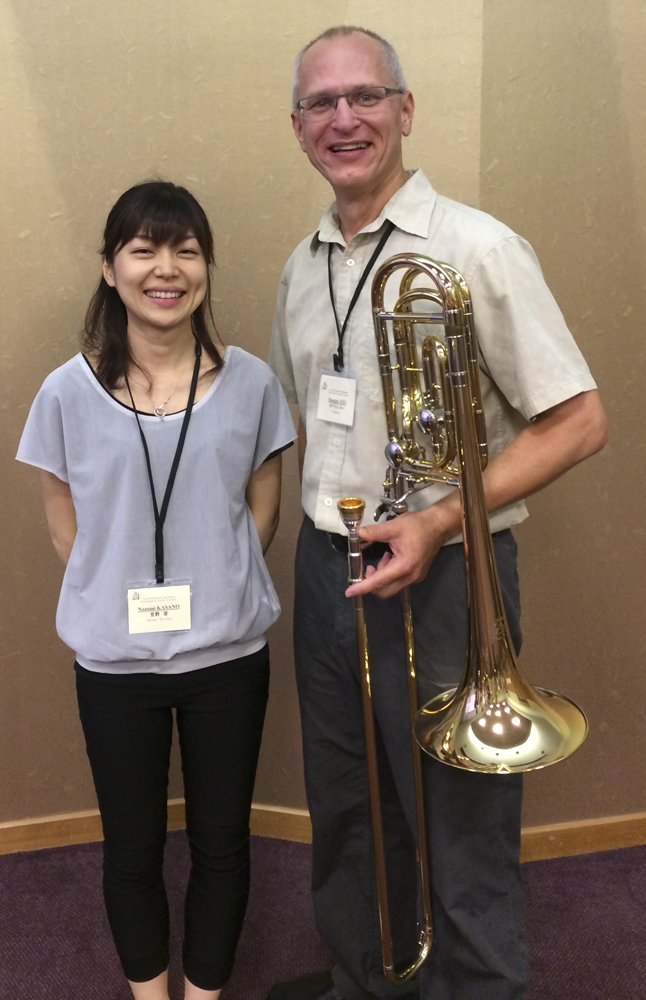
Another nice aspect of this event was the fact that my translator was Nozomi Kasano (on the right in the photo above). I  first met Nozomi at the 10th Hamamatsu Academy and Festival in 2005. She subsequently came to Boston to study with me at New England Conservatory of Music where she earned a graduate diploma and Master’s degree. The then returned to Japan where she won the position of bass trombonist with the Japan Century Orchestra in Osaka. I am so proud of her. This was the third time Nozomi had been my translator in Japan (she did this six years ago at the 20th Academy, and two years ago when I was the guest artist at the Nagoya Trombone Festival). She knows me so well, and translates more than just my words—she translates ME. Also, our class pianist was Hitomi Takara (in the middle in the photo above), a superb artist with whom I had worked with at the Academy in the past. She was my accompanist five years ago at the 21st Academy, both for my class and for me when I gave a recital at the Hamamatsu Museum of Musical Instruments. Having them with me again made the trombone class room a very, very happy place.

Hamamatsu_Musical_Instrument_Museum_Yeo_serpent_video_2019

Speaking of the Musical Instrument Museum, I enjoyed another visit before the Academy started. I was surprised and delighted to find video screens installed throughout the museum where visitors can both hear and see several instruments being played. This is a great addition to the musical instrument museum, and my surprise was even greater when I went to look at the museum’s serpent collection and found a video there of me playing serpent during my recital.

Hamamatsu_Academy_Miho_congratulations_2019

The Academy also features a concert of student performers. Each class holds an audition of all of its students and one player from each studio is chosen by the professor to represent the class on the student concert. The winner that I chose to represent the trombone class on the concert was Miho Ogose, a University senior. She played the first movement of Eric Ewazen’s Concerto for Bass Trombone. Like all of my students, she played with exceptional musicality. All of us in the trombone class were so proud of her and her performance was absolutely great. Look at the photo above, taken right after the concert. The look on Miho’s face—surrounded by other trombone players from our class who were congratulating her on her performance—reflects the joy of music and music making. It was a special moment for all of us.

Hamamatsu_Academy_2019_Farewell_Party_trombones

The Academy and Festival concluded with a farewell party at Mein Schloss, a German beer hall near the ACT City Hamamatsu complex where all of our concerts and teaching took place (we also stayed at the Okura Hotel ACT City). This is always a fun event, with plenty of food and drink, and performances by each class. Some are silly, some are more serious, and when we drew lots to determine the order in which classes would play at the party, the trombone class drew last! So we wrapped up the festivities with performances of my friend Stephen Bulla’s arrangement of Londonderry Air and an arrangement of 76 Trombones that I commissioned from my friend Ken Amis, tubist of the Empire Brass. Fun times.

Japan_2019_plane_farewell

As my plane took off from Tokyo and I watched the Pacific Ocean come into view, I reflected on my days in Japan. I have so many memories from my trips to that fascinating country. I feel fortunate to have had the opportunity to work with so many Japanese students over the years. I have friendships with many players and teachers, as well as many employees of YAMAHA Corporation, with whom I have collaborated for many years to make the bass trombone (YBL822G) and mouthpiece (Douglas Yeo Signature Series Mouthpiece) that I have played for so long. Wonderful food, interesting experiences, deep friendships, students who are eager to learn. It all combined to make for an especially satisfying trip. While it is true that “there’s no place like home,” traveling around the world has opened my eyes to many things and has made a deep imprint on how I think and live. Thank you, Hamamatsu International Wind Instrument Academy and Festival, its organizers (especially Naoki Suzuki of YAMAHA), faculty, translators, pianists, and students. All of you are a big part of my life. Thank you for this time we shared together. I hope to see all of you again soon.
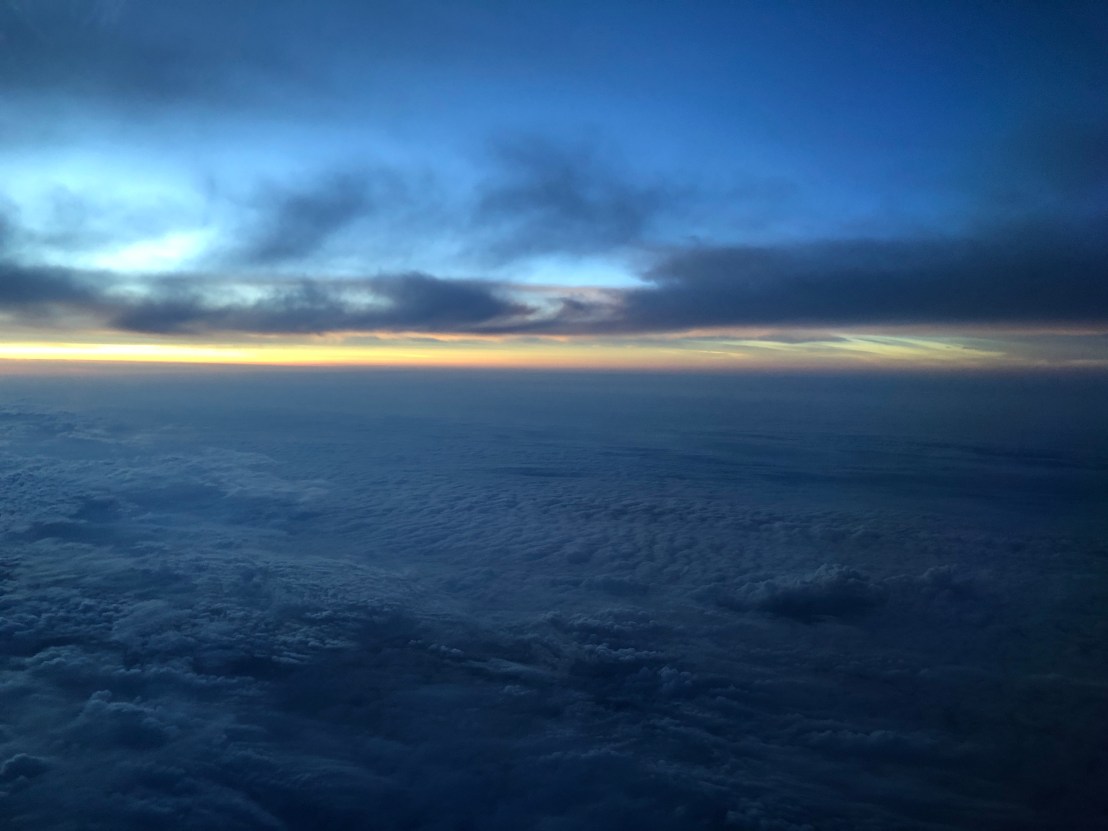
Sunset_over_clouds_Pacific_Ocean_2019

[Photo above: Sunset at 38,000 feet, above the clouds, over the Pacific Ocean. August 11, 2019.]

[Featured photo at the top of this article: Several faculty members of the 25th Hamamatsu International Wind Instrument Academy and Festival after the Opening Concert. Left to right: Otis Murphy, Jean-Yves Fourmeau, Nobuya Sugawa, Anthony Caillet, Gene Pokorny, Douglas Yeo.]
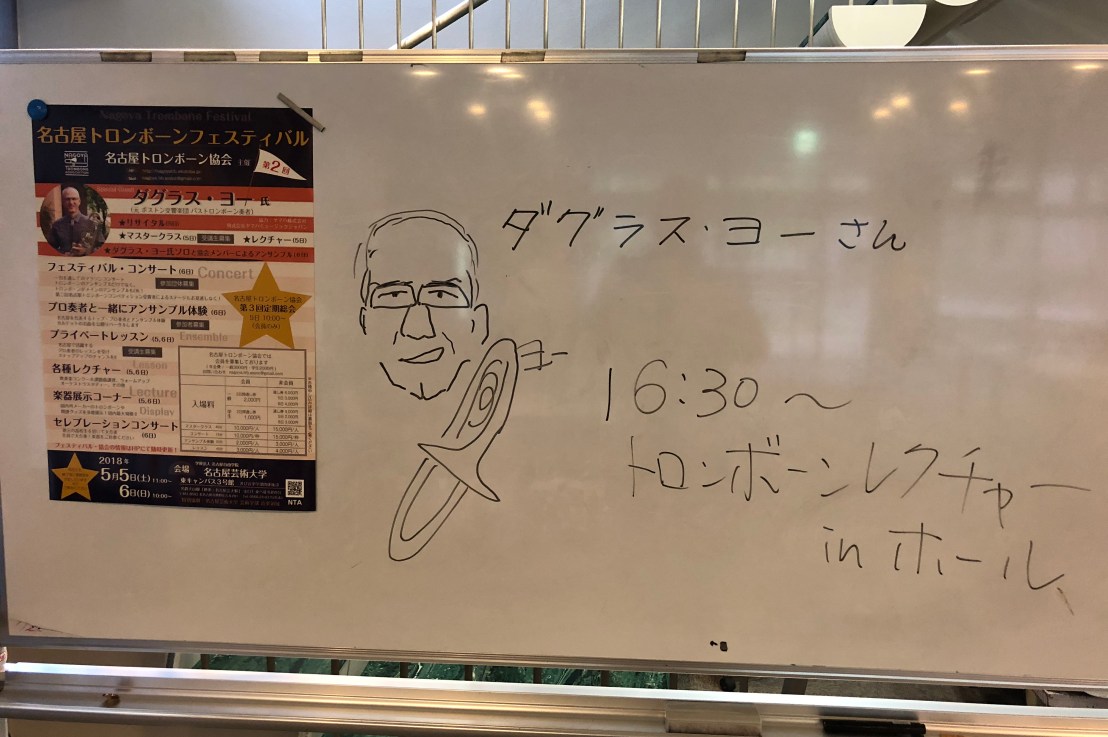
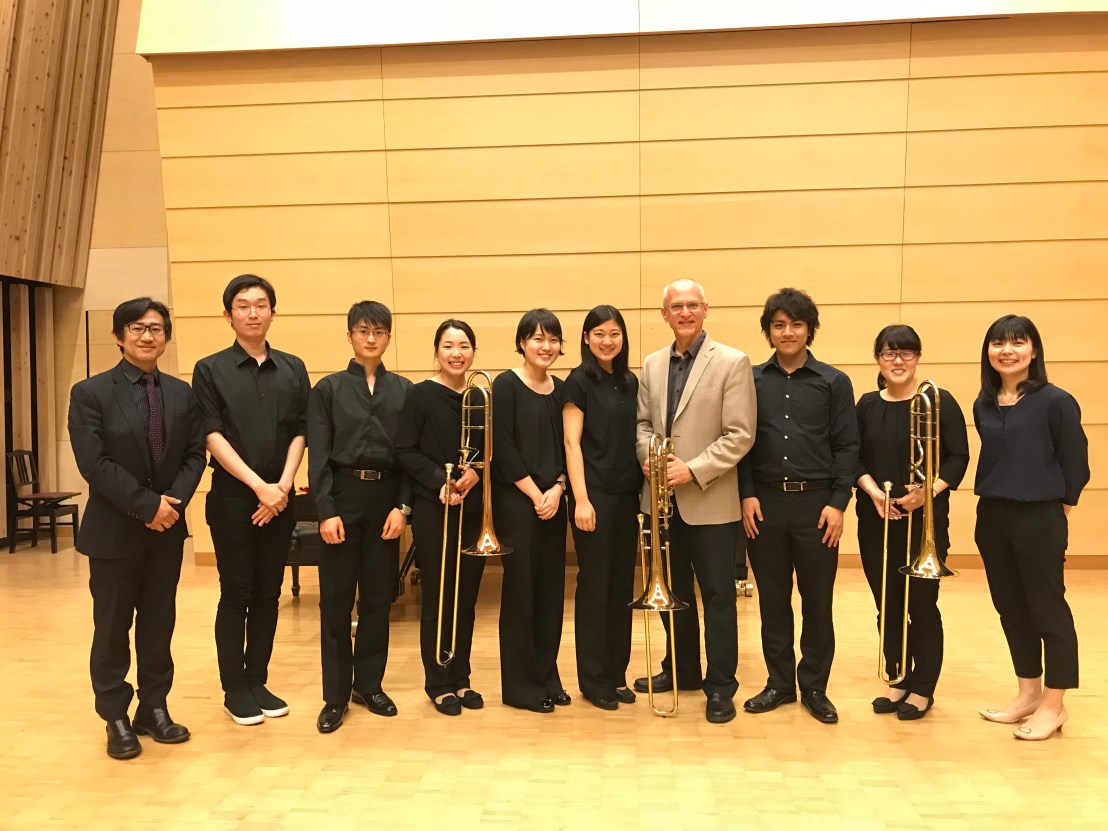
Reflections on the Second Nagoya (Japan) Trombone Festival

Reflections on the Second Nagoya (Japan) Trombone Festival

I don’t think I could possibly count all of the times during my long career when I have traveled to schools, colleges, and universities to do some teaching or performing, or attended trombone festivals or symposiums as a guest artist. It would certainly number in the hundreds throughout the United States, Canada, South American, Europe, Africa, and Asia. I have always enjoyed working with trombone players around the world and I recently returned from a week in Japan where I was the guest artist for the Second Nagoya Trombone Festival.

As I mentioned in my earlier post about the Festival — made before the trip — I have been to Japan twelve or thirteen times. I’ve lost count. Many of these trips were tours with the Boston Symphony (conducted by Seiji Ozawa) or Boston Pops Orchestras (conducted by John Williams), and other times were to teach and perform at the Hamamatsu International Wind Instrument Academy and Festival. The First Nagoya Trombone Festival, hosted by the Nagoya Trombone Association, was held in 2016 and Jörgen van Rijen, principal trombonist of the Royal Concertgebouw Orchestra in Amsterdam, was the guest artist. I was very honored to be asked to come as guest artist for this, the Second Nagoya Trombone Festival, held on May 5-6, 2018..

Here are a few reflections about my time in Nagoya, a time that was very special to me in many ways.

image1-1

Before the Festival began, I spent an afternoon teaching at Aichi Prefectural University in Nagoya. The University’s trombone professor is Hiroshi Kurata (about whom I recently wrote on The Last Trombone), and it is the undergraduate alma mater of Nozomi Kasano Flatt, bass trombonist of the Japan Century Orchestra in Osaka. I met Nozomi in 2004 when she was a student in my class at the Hamamatsu Academy and Festival and she subsequently came to Boston to study with me; she earned a Graduate Diploma and a Master of Music degree at New England Conservatory of Music. It was a special joy for me to have Nozomi as my translator in Nagoya, both during my masterclass at the University and also at the Festival. The photo above shows the students with whom I worked at the University, with Professor Hiroshi Kurata on the left and Nozomi Kasano Flatt on the right.

image2-1

I worked with several students who played solos, and also with an orchestra trombone section. The level of talent at the University was very high as was the level of attention of the audience members. I ended my teaching sessions with a lengthy question and answer period where several students asked engaging questions about a life in music. Kurata San was kind enough to take Nozomi and me to dinner at the finest sushi restaurant I have ever enjoyed – a small restaurant with just a handful of seats and a private chef; it was a memorable experience in so many ways. A few years ago I saw the documentary “Jiro Dreams of Sushi.” Never did I even dream that I would have a culinary experience of the quality shown in that movie. But I did, thanks to Kurata San. The photo above shows a piece of sushi as a work of art. It is impossible to describe but something I will never, ever forget.

IMG_0568

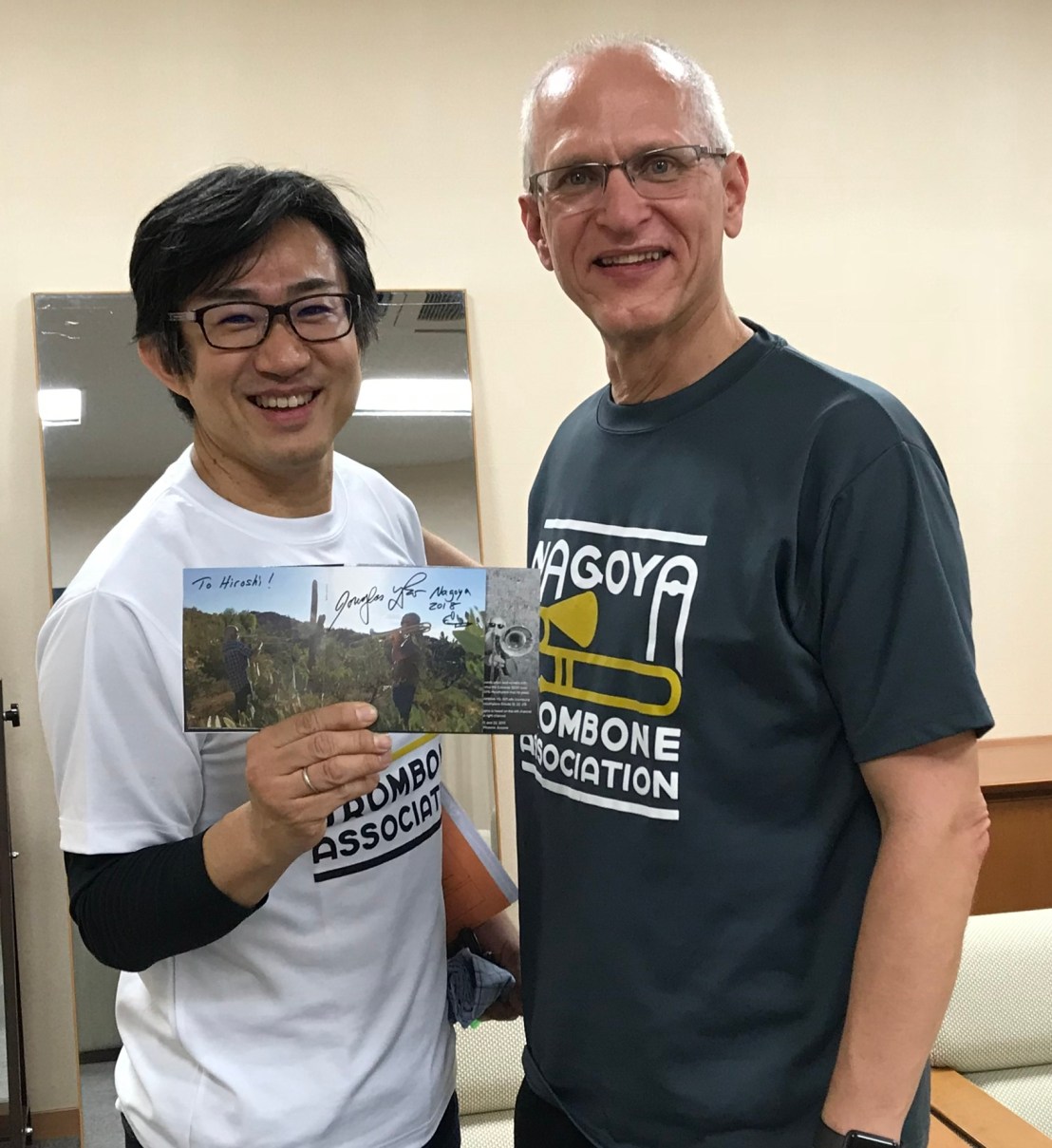
The Nagoya Trombone Association organized the Nagoya Trombone Festival and among the many people who worked hard to put it all together was my host, Hiroshi Tanaka (shown above with me after the Festival’s final concert along with the announcer for the concert).

IMG_9351

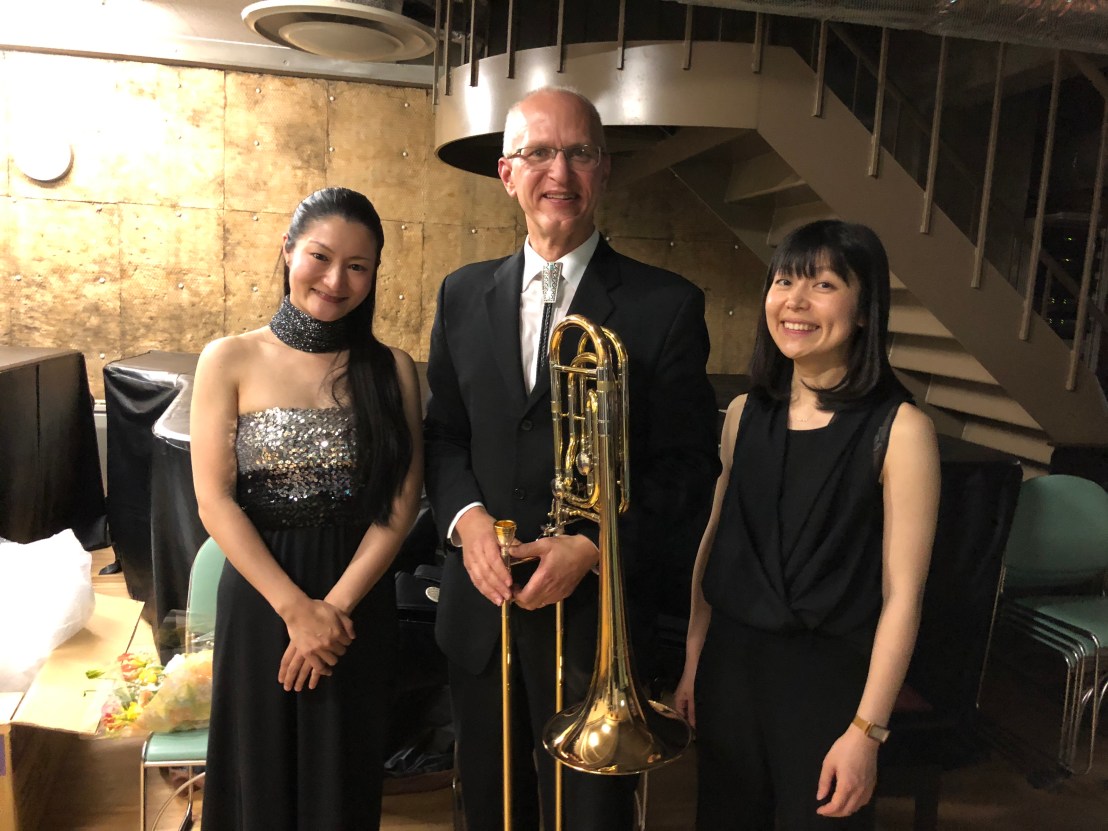
Tanaka San had engaged a superb pianist for my recital, Shoko Gamo (shown above with me after a rehearsal) and we enjoyed a very, very fruitful collaboration. I have rarely worked with a pianist who possessed such tremendous abilities as well as a very deep, emotional side to her musical personality. And a very nice person, too!

IMG_0147

The festival took place over two days. I gave a masterclass on the first day, working again with some very talented students. The photo above shows me working with a student; Nozomi Kasano Flatt is translating for me.

32076799_858622191008010_1195102425665503232_n

In addition, I gave a lecture on the history of the trombone — in 50 minutes! This was a whirlwind for sure, with nearly 100 Powerpoint slides in my presentation and Nozomi working hard to keep up with my pace. She did a great job. One of the great things about her translation skill is that she captures the character of my spoken personality. This does not happen all the time when I need a translator and it really helped those in attendance understand what I was talking about. I have rarely given a lecture for such an attentive, engaged audience. In the photo above, I have just told the audience that I was going to do the impossible — talk about 500 years of the trombone’s history in a very short time. This image from the movie Home Alone captured my feelings about the impossibility of the task!

Takei_Suzuki_Yeo_Ohse_Nagoya

The Festival also had a number of instrument companies present so participants could try out different trombones. It was great for me to see friends from YAMAHA who were present at the Festival. YAMAHA has been so great to me over the years and our relationship goes back over three decades, to 1986. In the photo above are Ken Takei, Naoki Suzuki, me (with my YAMAHA YBL-822G bass trombone), and Michio Ohse.

IMG_9378

Before I headed to the Festival on the second day, I took a long walk to Nagoya Castle, one of the great castles of Japan. I have been to Nagoya once before, on a Boston Pops Orchestra tour, but it was nice to get to the Castle, something I had read about but had never visited previously. It is a very special, majestic, peaceful place.

Day Two of the festival included my giving a recital. My program was an eclectic mix of repertoire:

Widmung — Robert Schumann, transcribed by Douglas Yeo

Sutenaide Kudasai — Jan Kaňka

Sonata No. 6 from 18 Canons Mélodieux — George Philipp Telemann, arr. Douglas Yeo

Sonata for Bass Trombone and Piano — Alec Wilder

Canzone — Girolamo Frescobaldi, arr. Eddie Koopman

Sonata for Alto Horn and Piano — Paul Hindemith

Sång till Lotta — Jan Sandström

Each piece had a particular reason for being on the program.

In recent years, I have always begun recitals with Schumann’s great paean of love to his wife, Clara, Widmung. It always reminds me of my wife, especially when I am far away from home. I also like to give my accompanist a superb piece of art music to play on my recitals and this piece certainly fits the bill. Shoko was very happy to play Schumann’s beautiful song; she told me she often plays it in the arrangement for solo piano by Franz Liszt. Her playing was spectacular.

IMG_0364

Several years ago, I became aware of the work of Czech composer Jan Kaňka. A trombonist himself, I found his Sutenaide Kudasai (the title is in Japanese and is roughly translated, “Please don’t throw it away”) to be very engaging and I thought the Nagoya Trombone Festival was a great place for me to perform it for the first time.

IMG_0275

I was then joined by Nozomi Kasano Flatt for one of Telemann’s remarkable canons, a piece that I had arranged for my book published by G. Schirmer, Trombone Essentials, and that I also recorded with Gerry Pagano on our new compact disc, Fratres. Playing a duet with Nozomi on my recital was very important to me and it was an absolute joy to collaborate with her on my recital.

Russ_Schultz_Douglas_Yeo

I wanted to perform a piece by an American composer and I chose Alec Wilder’s Sonata for Bass Trombone, a piece that for many years was the most frequently performed  piece ever written for bass trombone. Over the years, I have written several articles about the Sonata for the International Trombone Association Journal and in a serendipitous convergence of events, I had just recently happened to meet Russ Schultz, who as a student of Emory Remington at Eastman School of Music gave the world premiere of Wilder’s Sonata on March 24, 1969. The photo above shows Russ and me in a diner in Fort Worth, Texas two weeks before I went to Japan; it was great to finally meet him and then play the Wilder Sonata in Nagoya.

Yeo_Nagoya_Trombone_Festival_buccin

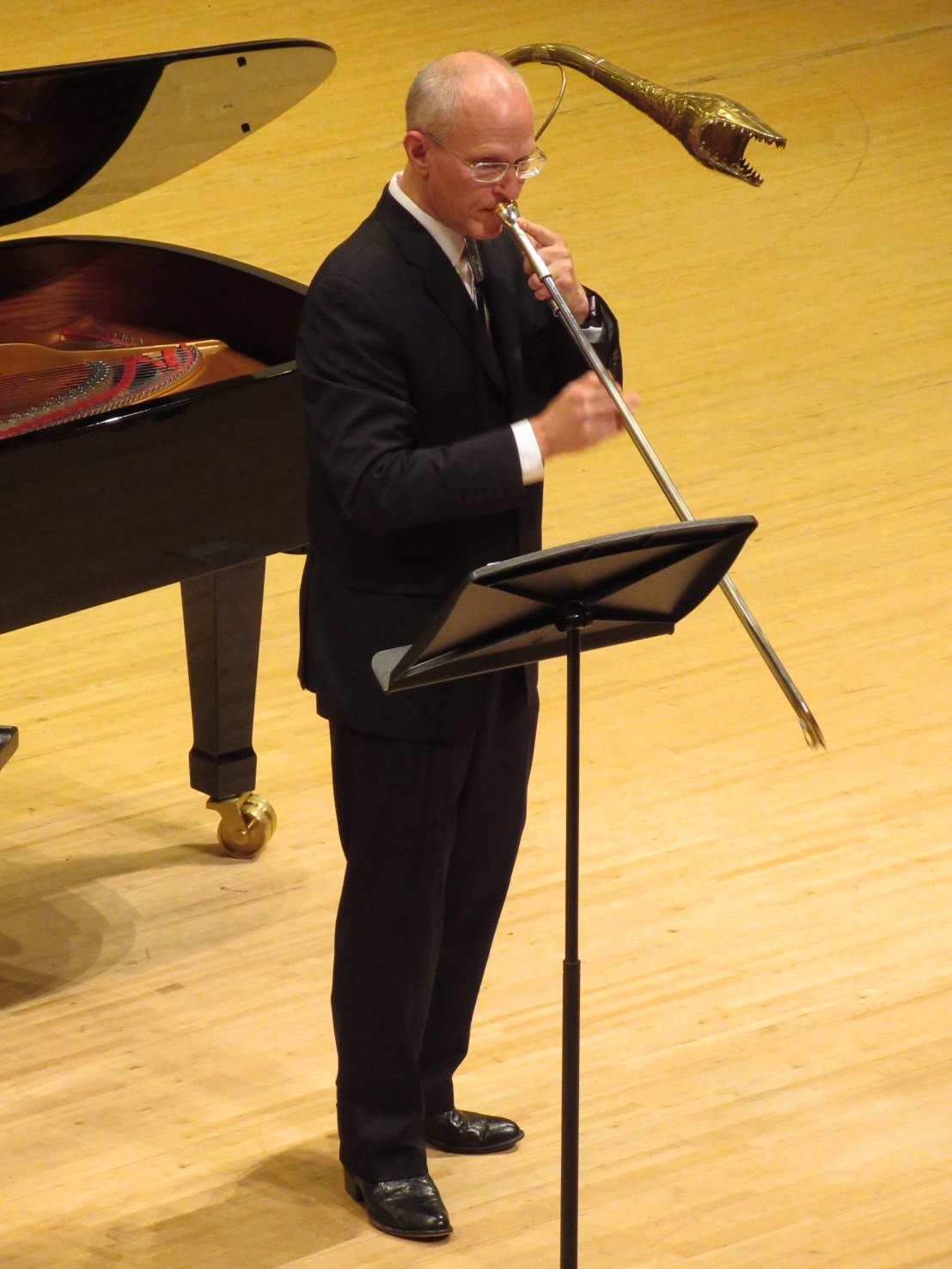
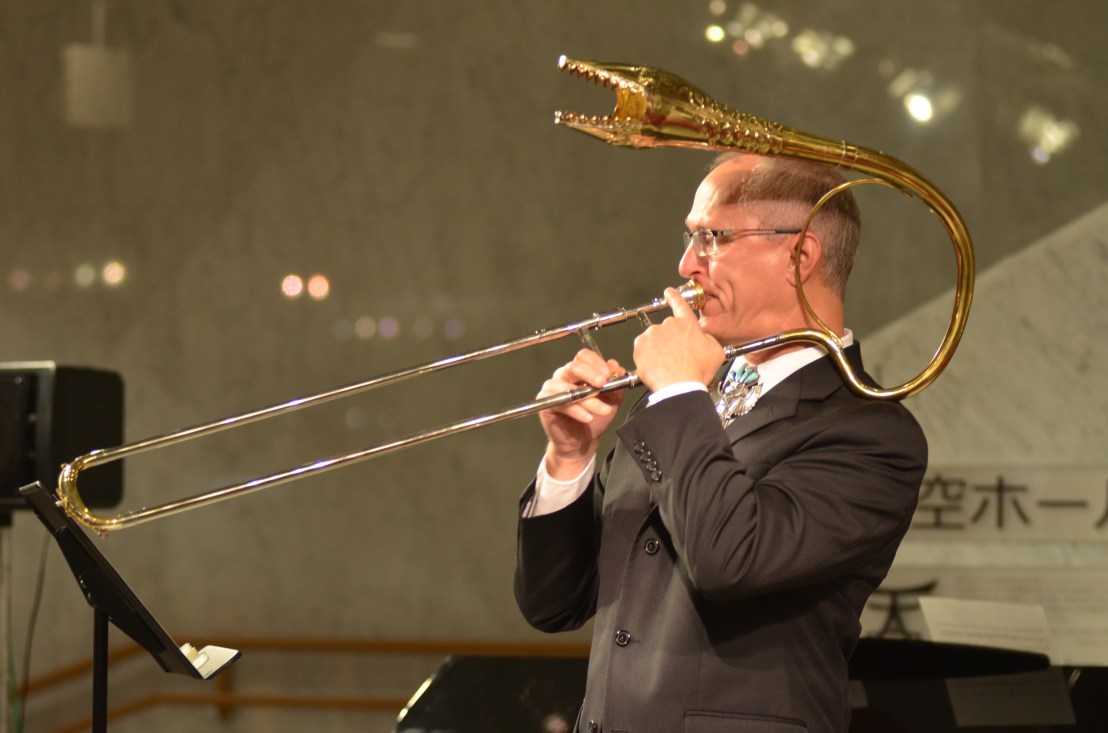
I then turned to Eddie Koopman’s arrangement of the first Canzone by Girolamo Frescobaldi, in a version with pre-recorded accompaniment. For this performance, I used a buccin — a dragon bell trombone used in France and Belgium in the early nineteenth century. I love playing historical instruments and the buccin is the coolest kind of trombone. This particular buccin (photo above) is a one-of-a-kind instrument that was made by YAMAHA; it is a fantastic instrument with a great, unique sound. Eddie Koopman’s techno-pop-Rennaisance accompaniment brought this old piece and instrument right into the twenty-first century.

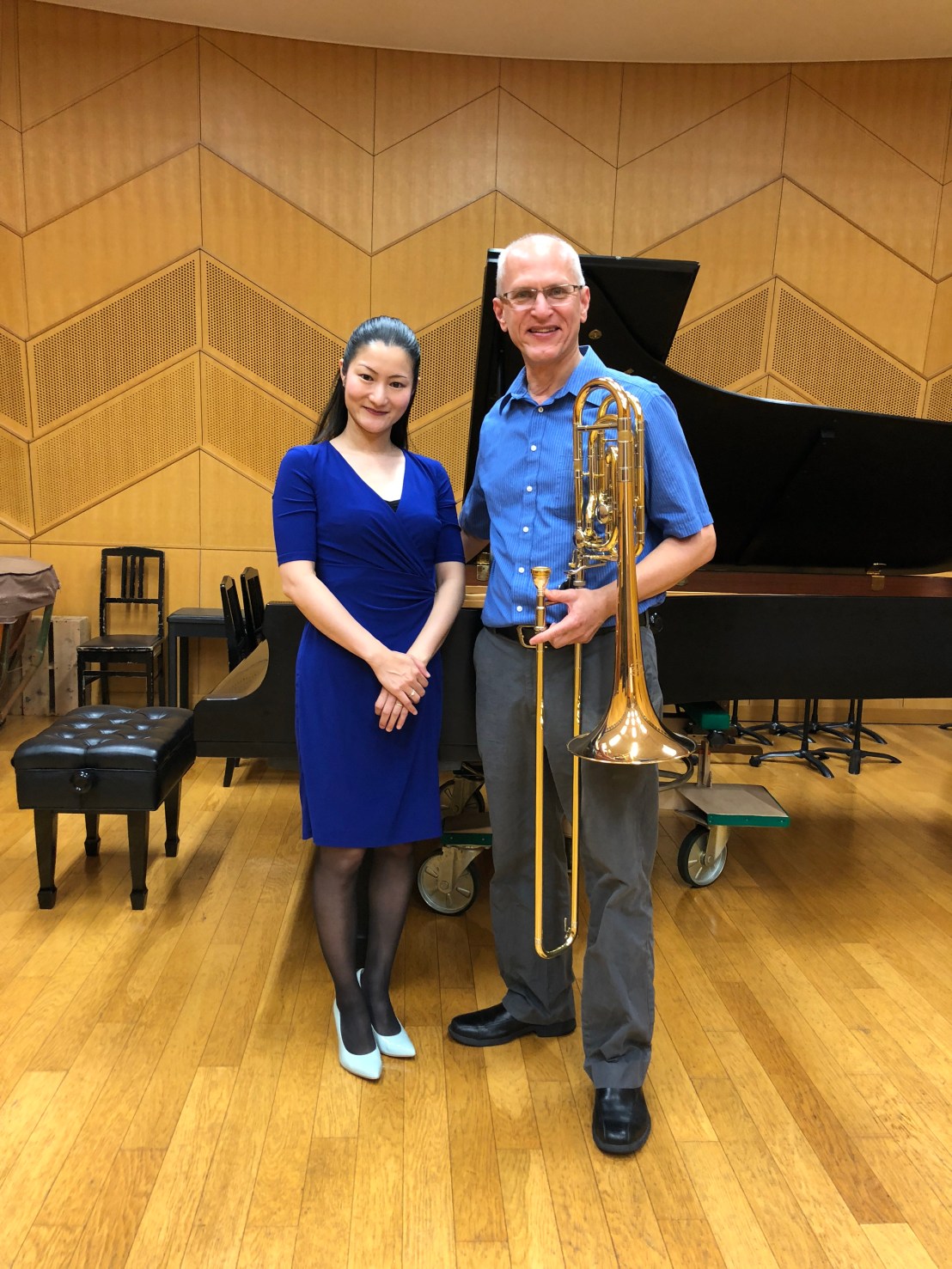
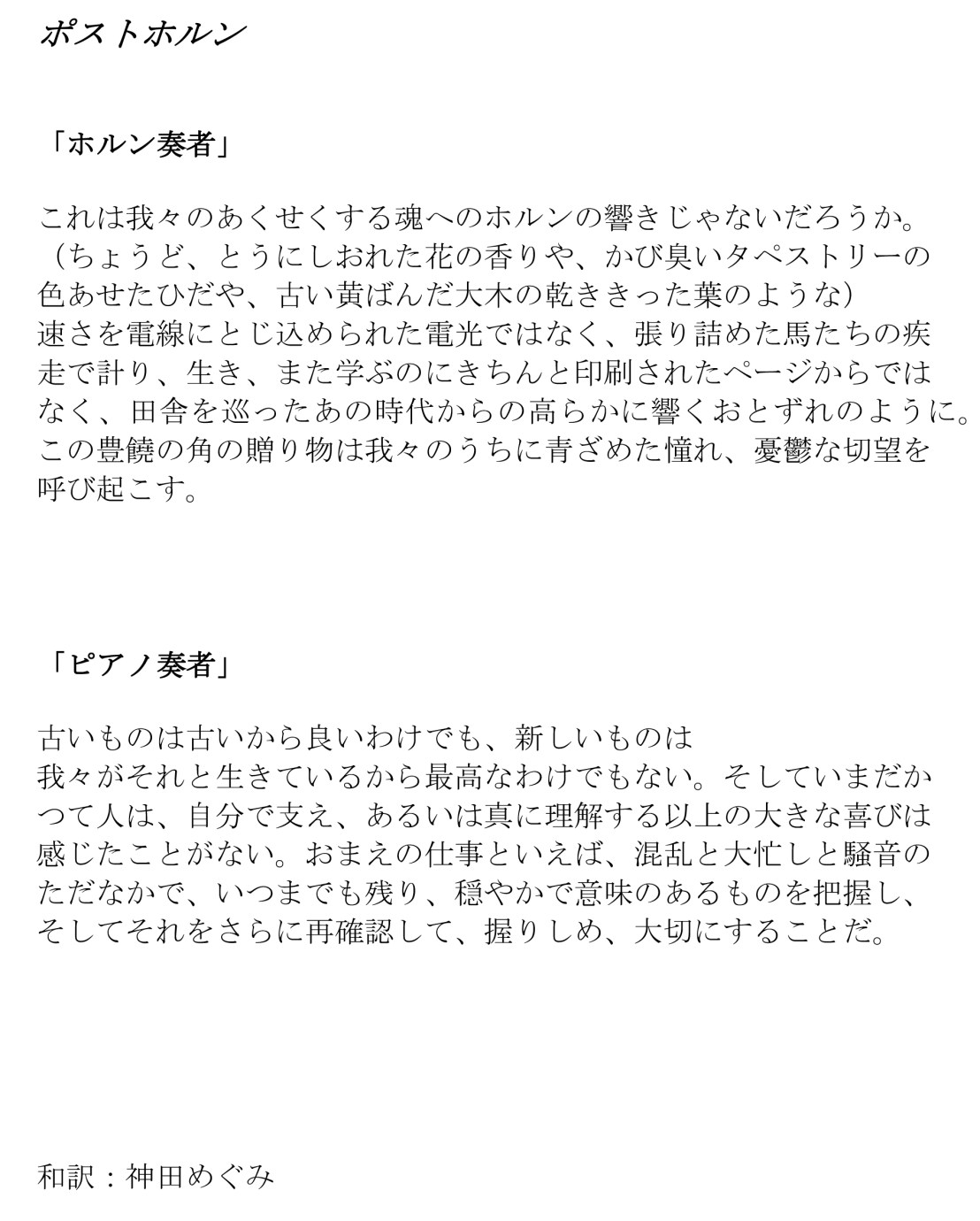
The other major work on the program was Paul Hindemith’s Sonata for Alto Horn and Piano. It is the least performed of Hindemith’s Sonatas and it works very well for bass trombone, transcribed down an octave. Shoko Gamo had a fiendishly difficult part that she performed with superb technique and style. The Sonata also has a poem by Hindemith, The Posthorn, that the composer requires the soloist and accompanist to recite before the last movement. While Hindemith’s poem is in German and English, I wanted to recite it in Japanese. I asked my good friend, Megumi Kanda, principal trombonist of the Milwaukee Symphony, if she would translate it for me so Shoko and I could read it during the recital. I read the first part of the poem and Shoko read the second part. I practiced this very hard! The audience was very supportive in my reciting this in Japanese — people told me they actually understood what I was saying!

Hindemith The Posthorn ポストホルン

Hindemith_The_Posthorn

Finally, I ended with Jan Sandström’s beautiful song, Song for Lotta. For many years I have ended recitals with this beautiful piece, slow and soft, very emotional, and different than the kind of loud piece that people usually play as a final piece. Shoko’s playing was exceptionally sensitive and the audience responded with great enthusiasm and warmth.

IMG_9387

At the end of the recital there were flowers and congratulations all around. But there was more to come.

IMG_9366

One of the great things about the Festival was seeing so many former students who had been part of my class over the years at the Hamamatsu Academy and Festival. Here I am (above) with several of them — and there were others, too. It was great to see them and talk about their progress and successes since we had last met.

IMG_0539

The Festival ended with a gala concert that featured members of the Nagoya Trombone Association’s organizing committee trombone ensemble. I performed as soloist in John Stevens’ The Chief, dedicated to Emory Remington (above),

IMG_0553

and I also conducted the ensemble in Stephen Bulla’s arrangement of Londonderry Air (above).

IMG_0554

The concert concluded with all of the Festival’s participants coming on stage for a performance of two pieces: Steven Verhelst’s A Song for Japan (above), especially arranged for this concert, and Tommy Pederson’s arrangement of 76 Trombones. What a sound! And what great playing from all of the players, from students to players who were older than me.

Here is a video of my performance of The Chief, and also of A Song for Japan. I hope it will give you a sense of the great music making we all heard from so many people at the Festival (to view this video on YouTube, click HERE):

Following the concert, we had a group photo. And then another, with everyone raising a hand and shouting:

Screen Shot 2018-04-28 at 7.47.14 AM

The word isn’t really translatable into English, but it captures the joy of a job well done — with great enthusiasm. It was a word that was used throughout the festival — always with a big smile.

NTF-5

We followed the concert with a reception — food and games and prizes, and each participant went home with a little bag of chocolates that had been designed by Shiori Tanaka, Hiroshi Tanaka’s wife who is also a very fine percussionist. This was the first time I’d ever seen my photo on a piece of chocolate — I guess there is a first time for everything!

IMG_9335

I left Nagoya the following day with a feeling of deep satisfaction. I made many new friends and met many old friends. To Hiroshi Kurata (below),

image10

and Hiroshi Tanaka (below, as we enjoyed some traditional Nagoya kishimen at the airport just before I returned home), you have my deepest, sincerest thanks. Thank you for hosting me at the University and at the Festival, and for becoming new friends. Making music with you and your students and colleagues was a great, great pleasure.

IMG_4683

And to Nozomi Kasano Flatt,

IMG_9390

I cannot say “thank you” enough times. She was a tremendous help to me in so many ways, and I am so proud of her and her success.

The trombone brings people together around the world and I am a very fortunate person to have been to Japan so many times to engage with interested and interesting players and teachers who have taught me far more than I could possibly offer to them. Thank you, Nagoya Trombone Association. I hope we can work together again soon. The International Trombone Festival may be in Japan in 2020 — the Olympic year — and it would be the first time the ITF would be held in Asia. I hope that happens; it would be great for Japan, for Asia, for the trombone.

One thing is very clear to me: Nagoya is a place for the trombone. I am fortunate to have been part of its most recent Trombone Festival, and to feel a new kinship with this great city in Japan.

To my Japanese friends:

ありがとうございました

FullSizeRender


“It is the hope of man translated into a piece of music.”

“It is the hope of man translated into a piece of music.”

by Douglas Yeo

I’m reflecting on my recent trip to Japan, something I will write about more presently.

Among the many new friends I made on my trip to Nagoya, where I was guest artist at the Nagoya Trombone Festival, was Hiroshi Kurata, trombone professor at Aichi Prefectural University. Kurata-San gave me two of his CDs as gifts. They are treasures, and unlike anything I have heard and seen before. That’s because Kurata-San is not only a superb tenor trombonist. He is a tenor. A singer. And his albums, Speranza and Tromvoce, feature him both singing and playing the trombone. It works. It really, really works. This man is a fine, fine trombonist and a fine, fine singer. More than that, he is a fine artist / musician.

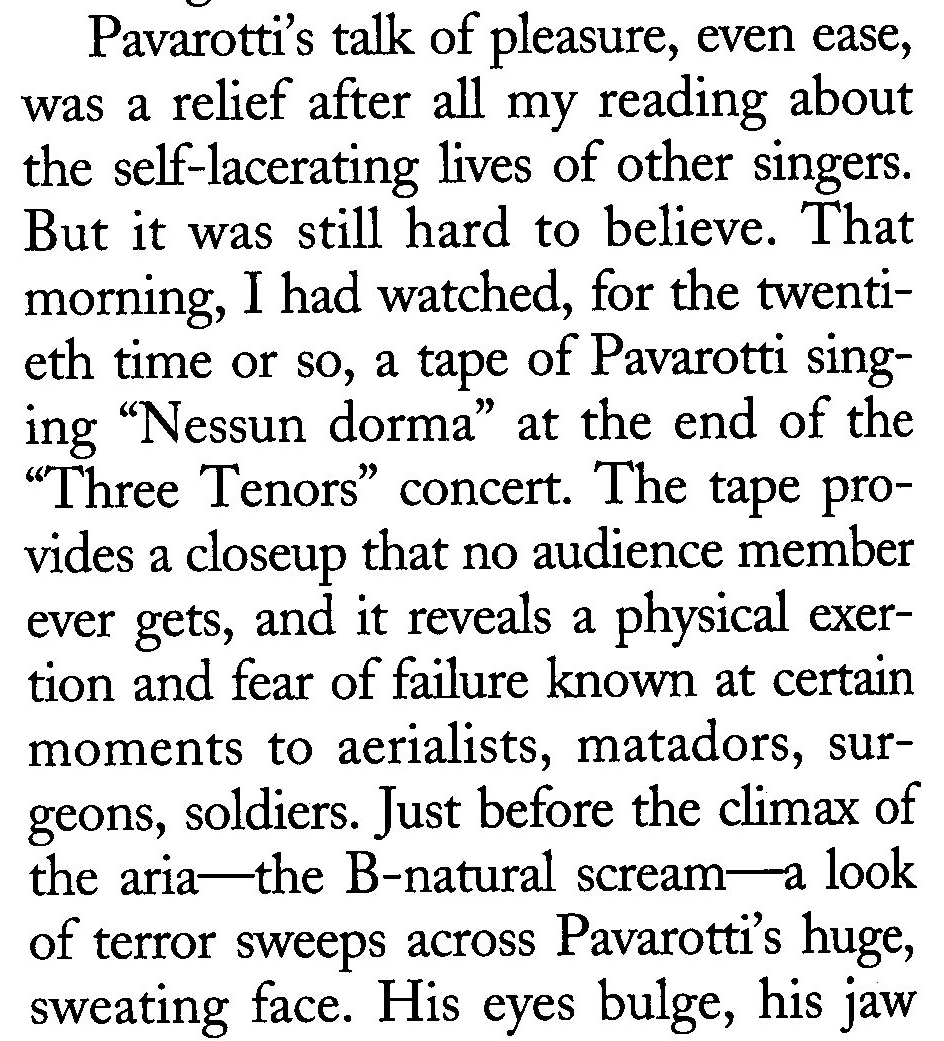
This afternoon, while I was driving home from church, I was listening to Tromvoce. Among the tracks was an arrangement of themes from Giacomo Puccini’s Turandot by K. Ohashi, for trombone and voice titled Turandot Fantasy. When Tanaka-San got to the famous Act III aria, “Nessun dorma,” I pulled off the road so I could pay attention. I have loved this aria as so many others have loved it since Puccini wrote it in 1926. Kurata-San sang the aria magnificently, and when I got home, I got out my copy of the June 21, 1993 issue of The New Yorker that contains an article about the great Italian tenor, Luciano Pavarotti. The article, “The Last Italian Tenor” by David Remnick, is a riveting piece of writing, and in it Pavarotti is remarkably candid. And insightful.

Screen Shot 2018-05-20 at 1.49.36 PM

There were a few paragraphs from the article that I have used in many masterclasses, and I used them again in Japan while working with students. My message was this: What we do with the trombone in our hands is important. What we do as artists / musicians / trombonists is consequential because it makes a difference in people’s lives. I quoted Pavarotti’s comments about “Nessun dorma.”

The end of this aria contains these dramatic words:

Dilegua, o notte!              Vanish, o night!

Tramontate, stelle!          Fade, you stars!

Tramontate, stelle!          Fade, you stars!

All’alba vincerò!              At dawn, I will win!

Vincerò! Vincerò!            I will win! I will win!

Read Pavarotti’s comments below:

Pavarotti_Nessun_dorma_interview_01

Pavarotti_Nessun_dorma_interview_02

To me — and I am not alone in this thinking — this is the essence of music. Communication with an audience of an essential truth that speaks directly to the heart. The emotion of “Nessun dorma” is inescapable and Pavarotti’s comments are very, very insightful. What kind of singer are YOU? One who tries to make your music making “perfect” at all costs or one who, with honest, heartfelt expression, takes chances and wishes to change people’s lives in the process?

Listen for yourself. First, here is a recording of Pavarotti in concert from 1994. His performance, which is recorded live, is very fine. Watch it so you can observe Pavarotti’s face. “In this there is all the hope of a man,” Pavarotti said. Here, he sings it. Observe the look on his face as he sings the final Vincerò! I mean, REALLY look at his face at the final cadence; you will see exactly what Remnick was referencing in his article. This is musical and emotional  involvement of the highest order. [NOTE: due to copyright restrictions, you may not be able to watch the video embedded in my blog but you CAN watch it on YouTube by clicking here.]

Haven’t had enough of “Nessun dorma”? Then click on this link for an article that has links to 10 more performances. Each has something to say.

I end this blog post where I began, with my friend, Hiroshi Kurata. Here is a video of him playing and singing “Nessun dorma.” Any trombone player will appreciate the difficulty of what he is doing here. No overdubbing. This is a live recital. Playing the trombone with great beauty and expression, then immediately singing with tremendous passion. This is a rare accomplishment. [ To view this video on YouTube, click here.]
Thank you, Kurata-San. Thank you, Pavarotti. Thank you, God, for this remarkable gift that we call music that can stir our hearts.

Vincerò!

Screen Shot 2018-05-20 at 1.12.45 PM copy

Returning to Japan

Returning to Japan

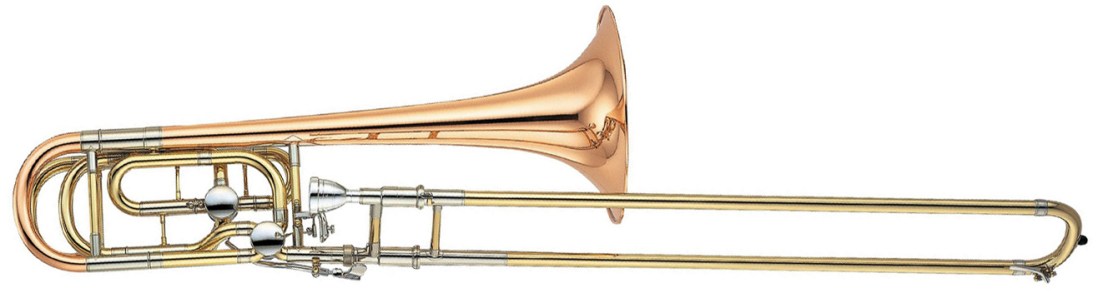
I have been to Japan more times than I can count — maybe 12 or 13 times — and on my many trips, I have always had a trombone in my hand. During my nearly thirty years as bass trombonist of the Boston Symphony, I took part in many Boston Symphony and Boston Pops Orchestra tours to Japan, conducted by Seiji Ozawa and John Williams. The first of these tours, in 1986, led to my introduction to YAMAHA, which resulted in the beginning of my long, productive, and happy relationship with the company and its people. Together we have worked to develop the YAMAHA YBL-822G bass trombone and YAMAHA Douglas Yeo Signature Series Mouthpiece that I have been playing for decades.

822.jpg

I have also traveled to Japan many times to serve on the faculty of the Hamamatsu International Wind Instrument Academy and Festival, an annual event that brings together an international group of teachers and performers to work with talented students. Sponsored by YAMAHA and the City of Hamamatsu, times working at the Academy have been memorable.

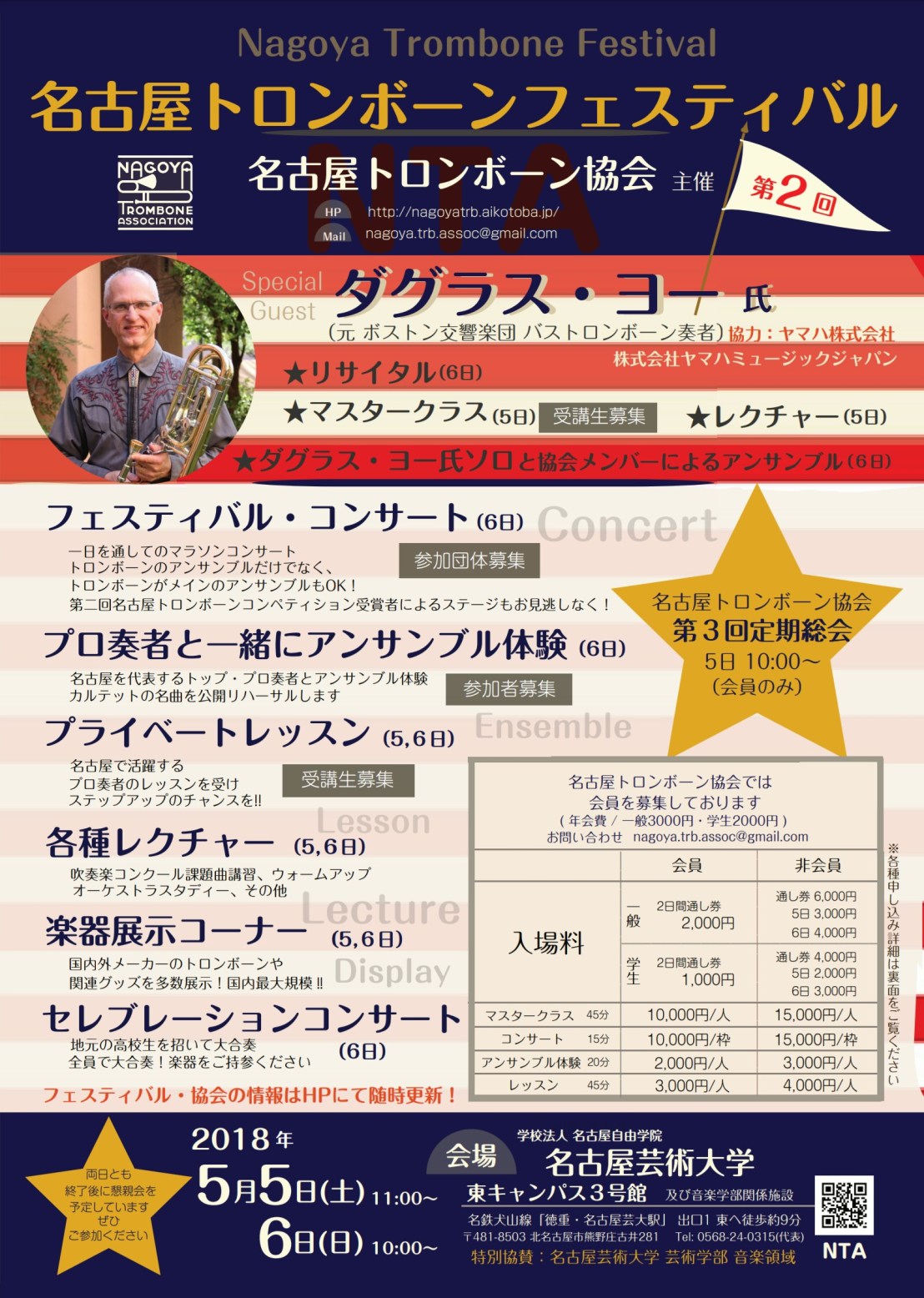
Next week, I will return to Japan once again, as the guest of the Nagoya Trombone Festival, sponsored by the Nagoya Trombone Association. During the two day Festival, I will play a recital (accompanied by a superb pianist, Shoko Gamo), perform as soloist with a trombone ensemble, conduct two trombone ensembles, and give a lecture on the history of the trombone. Here are a few more details:

Yeo_Nagoya_trombone_festival_poster

One of the special joys of this trip will be to see my former student, Nozomi Kasano Flatt, who plays bass trombone in the Japan Century Orchestra in Osaka. I met Nozomi in 2004 at the Hamamatsu Academy where she was a student in my trombone class. She subsequently came to Boston where we worked together for three years and she received her Graduate Diploma and Master of Music Degrees at New England Conservatory. I am exceptionally proud of Nozomi and all of her accomplishments and in 2014, she served as my translator for my class at the Hamamatsu Academy. Next week, she will be my translator once again, and we will also play a duet on my recital.

Kasano_Yeo

One of the pieces I will play on my recital is an arrangement of a Canzone by Frescobaldi by Eddie Koopman. Koopman’s electronic accompaniment gives a new flavor to this piece from the Renaissance and to inject something different into my recital, I will play it on a buccin, a dragon bell trombone. In 2015, I gave a recital at the Hamamatsu Museum of Musical Instruments and played this piece on a buccin made by YAMAHA. It’s a great instrument, made by YAMAHA factory workers in their spare time. It’s very nice of YAMAHA to let me use this instrument once again in Nagoya where I will be able to bring a very different kind of trombone sound to the audience.

DSC_0600

In addition to my work at the Nagoya Trombone Festival, I will also give a masterclass at Aichi Prefectural University. While there, I will work with several talented young trombonists and also have an informal talk with the students about my life in music. Here is a poster with some more information about my time at the University.

Nagoya_poster_2.jpeg

Japan. Nagoya. Trombone. Music. Friends.

Schermafbeelding-2016-12-21-om-11.55.40-2.png

Screen Shot 2018-04-28 at 7.47.14 AM.png