Category: history

Words matter

Words matter

By Douglas Yeo (August 29, 2016; updated December 27, 2023)

I love to read and write. My father was Chairman of our local public library when I was a young boy and I cannot recall a time in my life when a book was fewer than a few feet away from me. Over the years, I have published many articles and book chapters, and am at work at this time on three books for major publishers – Oxford University Press, University of Illinois Press, and Encore Music Publishers. I am a stickler for grammar and punctuation and I take care to craft sentences that clearly express my thoughts.

One of my favorite quotations (note: it is not a quote, it is a quotation) about the importance of words is from Duke Ellington, from a 1944 article about him in The New Yorker magazine. Ellington said:

You can say anything you want on the trombone, but you gotta be careful with words.

Indeed. Words matter. Words can express the most tender emotions of the human soul and words can also start wars. We need to be careful with words.

I have long been familiar with a quotation by Joseph Pulitzer, the newspaper magnate whose name is associated with the Pulitzer Prizes for excellent writing. The quotation is in the image above, taken from the Pulitzer Prize website. It’s a superb quotation that is a real inspiration to writers.  But this quotation has a problem. A big problem.

Pulitzer didn’t say it.

I wanted to use this quotation in a book that I’m writing so I decided to track down its source (note: that’s its, not it’s). This proved difficult to do. If you Google the quotation, you will find it reproduced on countless websites. But never with a citation. And every author knows you need a citation if you’re going to quote something.

After a long search, a good friend of mine located the source. It is in Alleyne Ireland’s 1915 book, Joseph Pulitzer: Reminiscences of a Secretary. It is here that Pulitzer’s famous quotation is found, on pages 68-69:

Screen Shot 2016-08-27 at 10.18.14 AM

And when you read it, you see a very big problem.

Compare the popularized version of the quotation with the actual quotation:

Put it before them briefly so they will read it, clearly so they will appreciate it, picturesquely so they will remember it and, above all, accurately so they will be guided by its light. [Popularized version]

…put it before them briefly so that they will read it, clearly so that they will understand it, forcibly so that they will appreciate it, picturesquely so that they will remember it, and, above all, accurately so that they may be wisely guided by its light. [Original version]

What happened? Two phrases of the original got conflated into one phrase; what originally was “clearly so that they will understand it, forcibly so that they will appreciate it” became “clearly so they will appreciate it.” “That” and “so” got removed from all phrases. But there is more. “Wisely guided by its light” became “guided by its light.” And what is IT, the subject of the whole quotation? IT is not identified in the popularized version. But in the original, IT is identified. IT is “the truth.” Here’s the full quotation with its important subject now in place:

…it’s my duty to see that they get the truth; but that’s not enough, I’ve got to put it before them briefly so that they will read it, clearly so that they will understand it, forcibly so that they will appreciate it, picturesquely so that they will remember it, and, above all, accurately so that they may be wisely guided by its light.

The irony of the mangling of this quotation is obvious. Here are the words of a man that have been twisted to to give meaning that he didn’t intend and to NOT give meaning that he DID intend. And the whole point of the quotation, “above all” as Pulitzer said, is that the truth is given to people “accurately.” In this popularized version of Pulitzer’s words, accuracy has been thrown out the window. Even the Pulitzer Prize website can’t get the words of its famous benefactor right. What a shame.

Words have meaning. Words matter.

Here is an update to this article (December 27, 2023)

I wrote the above article about the mangling of Joseph Pulitzer’s words on the Pulitzer Prize website in 2016. For several months after I wrote my article, I checked in on the Pulitzer Prize website to see if they happened to update Pulitzer’s words. They had not. I wrote to the Pulitzer Prize committee about this error and I never heard back from them. So I went on to other things. Then, this morning, this all came to my mind again, I had another look and, lo and behold, the Pulitzer Prize website has the quotation reproduced correctly. Good on them! I don’t know when they made the change and I’m not going to take credit for the change but. . .

Screenshot 2023-12-27 at 10.45.28 AM

A memorable day out

A memorable day out

It’s hot in Phoenix in the summer. Sure, we know the old joke, found on the postcards in the airport:

dry_heat.jpg

And to an extent it’s true. I’d much rather be in the middle of 110 degrees with 12% humidity than 90 degrees with 90% humidity. No doubt about that from where I sit. This is the tradeoff we get here: five months of hot followed by seven months of amazing weather. And, as I like to say, I don’t have to shovel heat  (like I used to have to shovel snow).  But, still, it’s hot, and in the summer, we look for things to do to get out of the house and out of the heat. Sometimes we travel to cooler places–more on that in future posts–but sometimes there are things nearby that are just waiting to be explored.

Even before we moved to Arizona in 2012 we were fascinated by many aspects of the state. Its geography, arts culture, the Native American story, the flora and fauna and so much more. We moved here for specific reasons, and one of those big reasons was our interest in continuing to learn more about this place that is so very different than the east coast where we spent most of our lives.

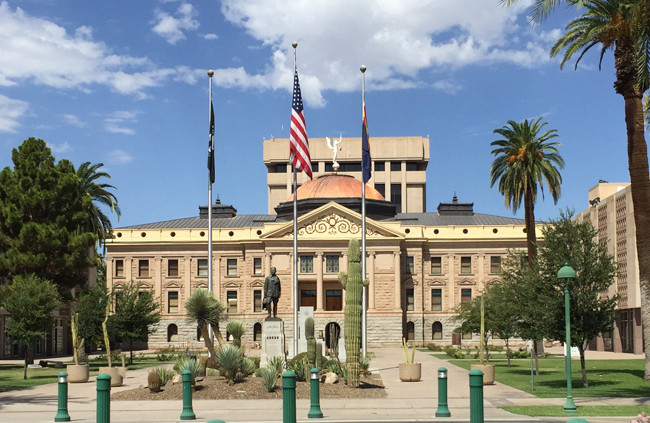
Earlier this week, my wife and I went to visit the Arizona State Capitol in Phoenix. “Big deal,” you might say. Well, it actually IS a big deal here. Arizona’s capitol building was built in 1901 when Arizona was still aTerritory, before it became a State in 1912. State  government has outgrown the old Capitol building so, instead of tearing it down, it is now a museum that pays tribute to the state’s history. It was a nice way to spend a few hours out of the heat.

But there was a bonus. Before going into the Capitol with its copper-toned dome (and if you don’t know why copper is important to Arizona, click this link to find out), we took advantage of the moderate morning temperatures (it was a balmy 91 degrees when we stepped out of the car and a few high clouds helped keep the sun from heating things up) to walk around the  Wesley Bolin Memorial Plaza that adjoins the Capitol building. The Plaza has 30 memorial monuments dedicated to a host of topics including a memorial to the victims of the 9/11 attacks, veterans and fallen heroes from many wars and conflicts and, as its centerpiece, a memorial to the USS Arizona, sunk in Pearl Harbor on December 7, 1941 with the loss of 1,777 lives.

USS_Arizona_anchor_small

The USS Arizona’s anchor has pride of place in the memorial and it is a powerful reminder of the sacrifices that the men and women in our armed forces make every day to ensure our freedoms. Inside the Capitol building, there were more tributes to the USS Arizona, including a large piece of the ship’s hull.

USS_Arizona_hull_small

It’s one thing to read history in a book. It is another to see it right before your eyes. You can touch this twisted piece of metal, look around the room at photos that show where it was before the ship sank. Our trip to the Capitol was full of powerful moments, a welcome distraction from the heat, and an opportunity to celebrate many of the things that make our state such a fascinating place.

Arizona_promised_land_small

As we were leaving the Capital, we went through a room that featured articles about Arizona’s early tourism industry. I smiled when I saw the old postcard, pictured above, with its old spelling of “canyon” as “canon” and its iconic association of the great saguaro cactus with the State. We continue to enjoy exploring Arizona, and days like we had earlier this week are serendipitous reminders of the joys and wonders to discover when you get out of the house. Even on a hot day.

Heed rashness and use perseverance

Heed rashness and use perseverance

Last week I was in San Francisco, and took the opportunity to visit the Asian Art Museum. In my travels I have been to Japan, Taiwan and mainland China and have come to appreciate the cultures and art of these fascinating places. The Asian Art Museum has a special exhibition of items from the National Palace Museum in Taipei and it was quite something to behold. Included in the exhibition is one of the most popular and important pieces of Chinese art, the so-called “meat shaped stone” or “priceless porkbelly”, carved from a piece of jasper during the Qing Dynasty and appearing in the United States now for the first time.

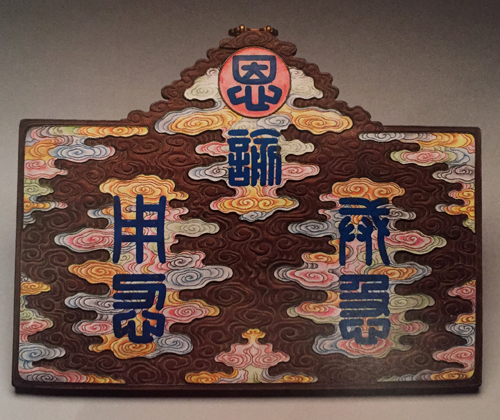
But something else caught my eye and I kept returning to it. It is a sign in lacquer on wood, created for the Emperor Yongzheng who reigned from 1723-1735. Apparently the emperor, when he was a prince, was prone to some habits that displeased his father, Emperor Kongxi. The son took his father’s advice to heart, and had signs made that he put around the palace to remind him of his shortcomings. The photo above shows one of these signs and the message is:

Heed rashness and use perseverance.

In other words, pay attention to your tendency to act rashly and take your time to carefully persevere in tasks.

This is a phrase that has been around since the beginning of time. But this father’s words of wisdom – beautifully portrayed in this sign – are a reminder of the importance of carefully considering what we say and do. We live in an age where it is too easy to “shoot from the hip” – or lip – without thinking through an action. Of course any successful musician has learned the value of the disciplined life, of not acting rashly or looking for quick fixes, but persevering through difficult tasks in order to find success.

When I need advice on how to proceed in a situation, I often turn to the book of Proverbs in the Bible. It has a tremendous amount of wisdom that speaks to every situation you may encounter. On the subjects of rashness, perseverance and heeding advice, it has a great deal to say:

There is one whose rash words are like sword thrusts, but the tongue of the wise brings healing. (Proverbs 12:18)

A wise son hears his father’s instruction, but a scoffer does not listen to rebuke. (Proverbs 13:1)

Whoever loves discipline loves knowledge, but he who hates reproof is stupid. (Proverbs 12:1)

The way of a fool is right in his own eyes, but a wise man listens to advice. (Proverbs 12:15)

And this passage that speaks to the value of perseverance, with a model taken from one of the smallest animals on earth:

Go to the ant, O sluggard; consider her ways, and be wise. Without having any chief, officer, or ruler, she prepares her bread in summer and gathers her food in harvest. How long will you lie there, O sluggard? When will you arise from your sleep? A little sleep, a little slumber, a little folding of the hands to rest, and poverty will come upon you like a robber, and want like an armed man. (Proverbs 6:6-11)

My trombone teacher, Edward Kleinhammer (bass trombonist of the Chicago Symphony Orchestra, 1940-1985) taught me important lessons about perseverance. In the book we wrote together, Mastering the Trombone, Mr. Kleinhammer wrote these important and challenging words:

World class trombone players do not just happen. Their talents are forged by the dual furnaces of determination and diligence.

In this, Edward Kleinhammer was acting like the loving Emperor Kongxi, reminding his son, Emperor Yongzheng, of the importance to “Heed rashness and use perseverance.”

I think I need to go practice now…

The Trombone in Advertising – 1

The Trombone in Advertising – 1

Advertising is a curious thing. When you think about it, advertising is designed to make us unhappy with what we have, and believe that we would be happier with something else. With this in mind, it’s no surprise a lot of people – like me – fast forward through all commercials when you watch a show on your DVR, or mute commercials in live TV, or have an ad blocker on your phone or tablet. I know what I want to purchase and where I want to get it; advertising rarely influences me to do something, especially to do something that I wouldn’t do without the ad.

But advertising is everywhere, even in the trombone world. Of course we’re all familiar with ads that are designed to sell trombones. Sometimes trombone ads use well-known players. Other ads tell you about new features, metal alloys, the latest valve and improvement. I don’t know anyone who buys a trombone just because she’s seen an ad – any sensible player will try before buying – but ads are out there, trying to persuade us that the trombone we’re playing just isn’t good enough for how good you are and, oh, how much better you’ll be if you’ll switch.

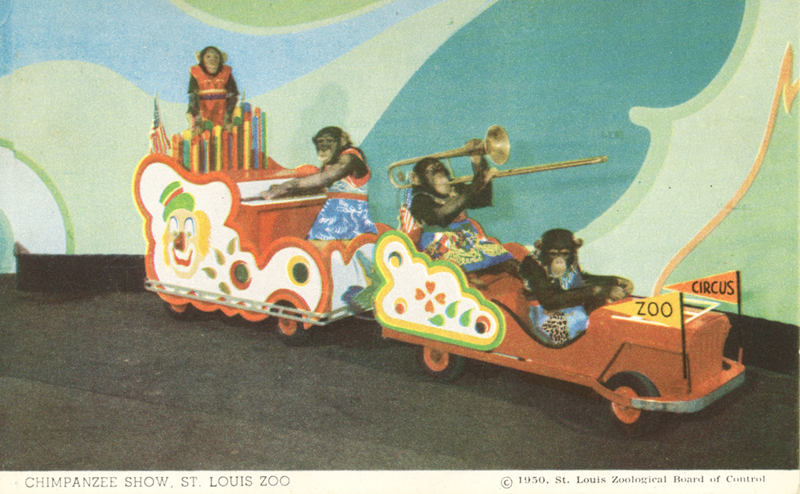
Recently, I’ve gotten interested in trombone advertising. But not advertising to sell trombones. What I have been finding interesting is how many ads have used the trombone to sell OTHER things. I’ve collected so many of these ads that I’m working on an article for the International Trombone Association Journal about them. I’ll be posting a few of them on my blog. Like the postcard above. It’s from the St. Louis Zoo. Great zoo! They make postcards so you’ll buy one, write a note to friend and tell them how great the zoo is, and mail it off. You’re part of the zoo’s advertising plan. So what did they put on this postcard? The elephants? Lions? Tigers? Bears? Nope. Chimpanzees playing musical instruments. Including a trombone.

Now, my students will tell you that sometimes, when I am talking to them about working on their soft playing and how valuable that is as a player, I often start by saying, “Someday they’re going to train a chimpanzee to play the trombone. But the chimp will not be able to play softly. Because the chimp doesn’t have a human soul.” I believe this absolutely to be true. But I did not know, until I bought this postcard, that in 1950, the St. Louis Zoo had trained a chimpanzee to at least hold a trombone and perhaps make a sound from it. A postcard is mute, but I very much doubt that this little chimp band was playing Mozart.

As I work on my article, I’ll be posting a few of these ads that use the trombone. And when you see one, draw your own conclusions. Why does the trombone appear in the advertisement? Is the trombone being used effectively to sell the product? Is the trombone put together and held correctly? And what subliminal messages are going forth from the use of the trombone. I have ads showing the trombone being used to sell clothing, cigarettes, beer, brassieres (yes, bras), tires, cheese, milk, paper products, movies and much more. More to come.