Category: history

The Sackbut, The Psaltery and The Dulcimer – 1954 recording

The Sackbut, The Psaltery and The Dulcimer – 1954 recording

by Douglas Yeo (February 3, 2017)

A few weeks ago, I posted an article on The Last Trombone about Fake News and The Trombone. One of the things that has caused a lot of confusion about the origin of the trombone is the fact that the translators of the King James Bible (1611) translated an Aramaic word for a form of lyre as “sackbut” in Daniel Chapter 3. Sackbut is an early word for the trombone and, faced with an Aramaic word they didn’t understand, the KJV Bible translators substituted a word for something they DID know that sounded similar. Hence, the myth that the trombone dates from ancient times (rather than the 15th century) gained traction. And to be fair, most translations of the Bible since then get it right—the early trombone is no longer credited with being around in Biblical times. Including the New King James Bible.

In my ongoing research on the trombone for several of my book projects, I came across a recording made in 1954 by a doo-wop group, The Collegians, with the Sid Bass Orchestra. I saw the 45rpm record on sale on an auction site and sight unseen, I decided to buy it. The title of the song? The Sackbut, the Psaltery and the Dulcimer.

sackbut_the_collegians

That got my attention. Those are three of the instruments that are found in the King James translation of the Bible, in Daniel, Chapter 3, verse 5:

That at what time ye hear the sound of the cornet, flute, sackbut, psaltery, dulcimer, and all kinds of music, ye fall down and worship the golden image that Nebuchadnezzar the King hath set up.

The connection between the recording and the Bible verse was immediately apparent to me. So I bought the record, not knowing what I was getting. And, wow, I am glad I bought it. I found myself owning a recording of an absolutely charming song. The songwriters – who are only identified as Hoffman-Manning-Sloane – crafted a clever story about six musicians at in ancient Babylon and Egypt who played sackbut, psaltery, dulcimer, harp, cornet and flute. They stuck the harp in for good measure. The Sid Bass Orchestra’s trombone section has a prominent role, of course. It’s well sung and played, and adds something to what we know about how the trombone was used in popular culture.

You can hear this cute song on YouTube by clicking this link or click on the video image below (if you’re reading this message in an email message, you won’t see the video image below):

If you don’t smile when you hear this, you don’t have a pulse. The trombone in Biblical times? No, that’s fake news. But that doesn’t mean we can’t have a little fun with the idea. The Collegians sure did, and we can, too.

sackbut-and-musicians

Wilson Carlile: The Man Behind the Trombone

Wilson Carlile: The Man Behind the Trombone

by Douglas Yeo (January 28, 2017)

Readers of The Last Trombone know that I am at work writing several books, as well as a number of articles for various journals and magazines. I’ve just completed an article for the July 2017 International Trombone Association Journal about jazz trombonist Russell “Big Chief” Moore, a member of the Akimel O’odham (Pima) tribe who was born in Arizona and went on to play with many jazz greats including Louis Armstrong, Sidney Bechet and Charlie Parker. Moore was born in Komatke, Arizona, on the east side of the Sierra Estrella; if you threw a stone from my front porch over the mountains, it would land in Komatke. I’ve also recently completed an article about the Mozart Requiem Tuba mirum trombone solo for the Boston Symphony Orchestra program in April of this year, to coincide with performances of that piece by the orchestra (my good friend, Steve Lange, will be playing the trombone solo). And my new annotated orchestral excerpt book, The One Hundred: Essential Works for the Symphonic Bass Trombonist (Encore Music Publishers) is in the final proofreading process and will be published this spring. More on all of these projects will be coming in future posts on The Last Trombone.

One of the major writing projects that is occupying my time is a biography of Homer Rodeheaver, who was the trombone-playing song leader for evangelist Billy Sunday in the first third of the twentieth century. I am co-authoring this book with my friend Kevin Mungons of Chicago and it will be published by University of Illinois Press. In my research about Rodeheaver, I’ve been studying the use of the trombone by many pastors, evangelists and song leaders.  Many, like the late Cliff Barrows, were inspired by Rodeheaver’s example.

But before Homer Rodeheaver, there was Rev. Wilson Carlile, founder of England’s Church Army. Carlile had a life long ministry to the downtrodden in London and his movement spread around the world. He also used the trombone as a way to gain attention to his ministry, often marching through the streets of London while playing–something that resulted in his being severely beaten on numerous occasions by those who did not want to hear his message of temperance and the saving power of the Christian Gospel.

The photo below appeared as a full page image in the July 22, 1903 issue of The Tatler with the caption:

The Rev. Wilson Carlile, who leads off our series of “Preachers in their Pulpits,” the first newspaper attempt to present the clergy with the genuine actuality that photography can alone provide, is the honorary chief secretary of the Church Army, which he founded in the slums of Westminster in 1882. He is rector of St. Mary-at-Hill, the church which is illustrated in our picture. He is fifty-six years of age.

carlile_full_photo_small

On May 4, 1900, the Chicago Daily Tribune ran an article about Wilson Carlile and his ministry; it is reproduced below. The article is written in a spectacularly evocative style, and is a tremendous tribute to this Godly man who did so much good for so many. The author, who is not credited, certainly found that the trombone made an impression, and his conclusion will bring a smile to anyone who plays the trombone or has known a trombone player:

All this is the work of the man behind the trombone, and for the possibilities that lie in that much maligned instrument let all trombone players be respected. They are not as bad as they look. In the hands of a man truly great, the trombone is more powerful than the sword.

the-man-behind-the-trombone-carlile

Wilson Carlile (1847-1942). The man behind the trombone.

wilson_carlile_trombone_small

The buccin: the coolest trombone

The buccin: the coolest trombone

by Douglas Yeo

I don’t have a lot of things from my childhood. All of my toys and stuffed animals went away a long time ago. Even my first trombone is gone, given away to a young player whose name I don’t remember any more.

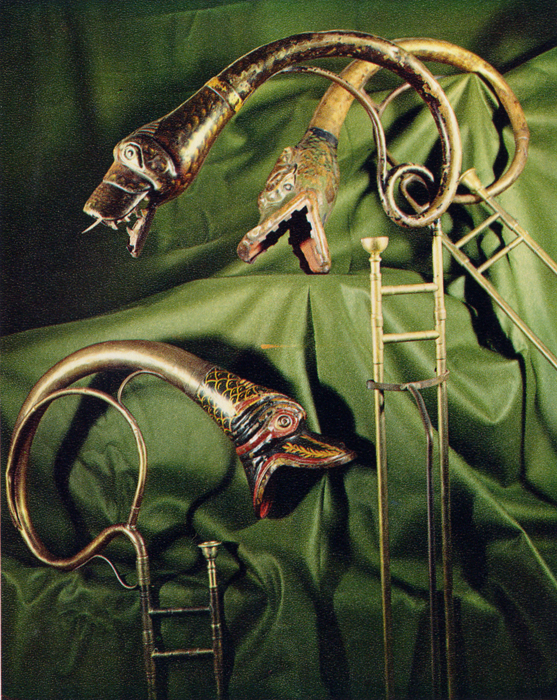
But I do have one thing, a postcard, that I purchased at the Metropolitan Museum of Art in New York City around 1965. I was on a school field trip to the Museum – I grew up in New York City (Queens) and Long Island (Valley Stream) – and my class had just entered the musical instrument gallery. And there, in a display case overlooking the Museum’s collection of suits of armor (another very cool thing, I might add), I saw a display that had these instruments:

met_buccin_01-copy_01

As a young trombone player, I was entranced. What is this!? I learned that this instrument is a form of trombone made in France in the early 19th century. Its name? The buccin. Nobody really knows how to pronounce it. I’ve heard it called “boo-cheen” and “boo-sahn” although most scholars agree on “book-sahn.” But, truly, nobody knows. These instruments were very popular in France in the first half of the 19th century; players of the buccin played trombone parts in bands and in parades, they made a spectacular sight. Buccins were usually painted in gold, red and green and some had a tongue of metal that would wag when it was played. At that moment, when I was all of 10 years old, I knew I had to have one of these remarkable instruments someday. At the time, all I could do was buy the postcard. I’m glad I did, since the Museum no longer has these instruments on display, or at least that was case a few years ago when I last paid the Museum a visit. However, the museum’s musical instrument gallery is closed for renovation at this moment and perhaps these wonderful instruments will be able to be seen once again when it reopens soon.

yeo_becker_buccin

In time, though, I was able to purchase a buccin bell. It’s difficult to find one for sale with a workable slide. So I decided to purchase a bell (made by Sautermeister in Lyon, France) and have it restored, and a new slide constructed. Jim Becker (pictured with me, above) of Osmun Music  in Massachusetts did the restoration and made the slide based on an historical model in the Museum of Fine Arts, Boston. Jim did a fantastic job and the buccin has pride of place in my personal collection of musical instruments; it hangs on the wall in my home studio amidst photos and historical drawings of serpents, sackbuts, trombones, and other instruments, as well as a letter by Hector Berlioz.

yeo_buccin_wall

Historically, there is not much music written specifically for the buccin. As I mentioned, it often doubled the trombone part in bands, particularly military bands. But we do have one piece that was specifically composed for buccin. There is a part for buccin in Hector Berlioz’s Messe solennelle, in the Kyrie. I played the Messe when I was in the Boston Symphony but I was playing the serpent at that time; the buccin part is doubled by the serpent and trombones so with only enough hands to play one instrument and with no buccin at my disposal at that time, the serpent kept my hands full.

yeo_buccin_sh_01

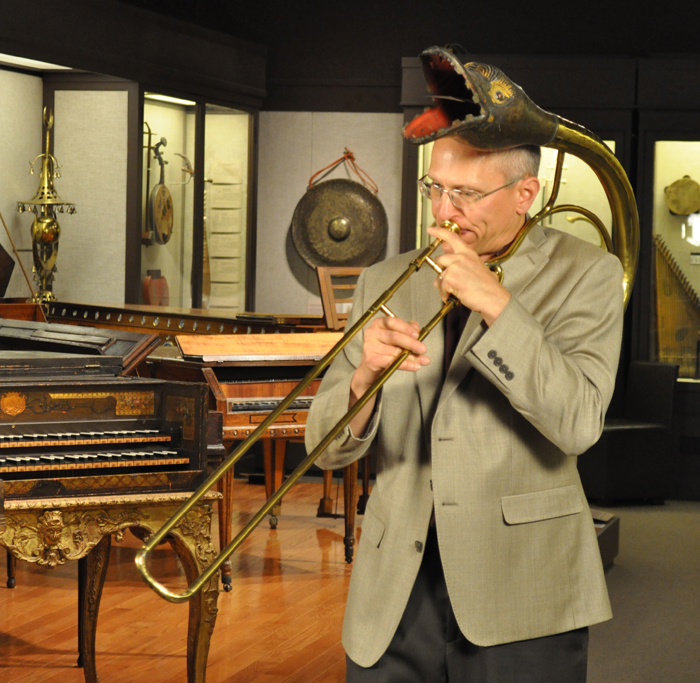
The buccin plays like a normal, modern trombone. Sort of. First of all, the seven positions of the modern trombone are rather flexible on the buccin. The zoomorphic bell does quite a job of disrupting the smooth flow of air through the instrument. So one must make significant adjustments with the slide to get many notes in tune. But then there is this: if you are a trombone player, pick up your trombone and close your eyes. Then play a melody you know. In the key of D major. Having a little trouble finding the right slide positions? Welcome to the world of the buccin. With no bell in front of you to provide a visual guide to slide positions, playing buccin is a bit like playing the trombone in the dark. It’s when you play buccin that you find out how well you REALLY know your trombone. By the way, the photo above was taken at Symphony Hall in Boston, in front of a display case that has several serpents. But that’s another story. . .

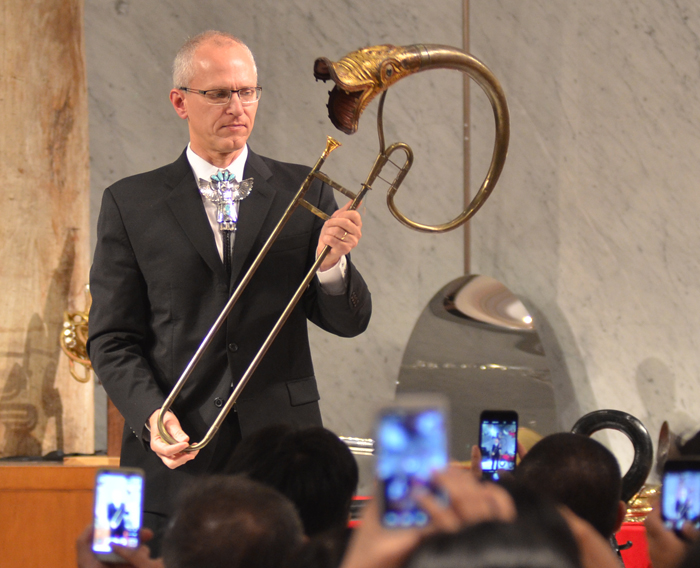
There aren’t many people in the world who play the buccin, so because of my keen interest in the instrument and the research I’ve done to learn more about it, I was asked, a few years ago, to write the entry for the instrument for the new edition of The Grove Dictionary of Musical Instruments. I also wrote most of the Wikipedia entry for the buccin. Two years ago, I gave a recital in the Hamamatsu (Japan) Museum of Musical Instruments and got to demonstrate and talk about the museum’s fine buccin. The photo below tells the story – look at all of the cell phone cameras that went up when I picked up the buccin. The buccin was easily the hit of my recital.

yeo_hamamatsu_buccin_01

 In 2012, I recorded a short video on a buccin owned by the Museum of Fine Arts, Boston. Their buccin was made by Tabard in Lyon around 1830 and still has most of its original paint as well as a metal tongue.

yeo_mfa_buccin_02

The MFA has now posted that video on their YouTube channel and you can view it by clicking HERE (to go to the page in YouTube) or just click the video image below. I am playing the buccin part from Berlioz’s Messe solennelle. It will give you an up close look at the buccin and its sound. And its wagging tongue.

That’s the buccin. The coolest trombone. Ever.

Fake News: The Trombone

Fake News: The Trombone

by Douglas Yeo (January 14, 2017)

Fake news is in the news. Unless you believe it isn’t. Fake news has been around for a very long time. Sometimes it’s a mistake borne out of ignorance, such as the early belief that the earth was flat. If nobody knows it’s round, it’s flat. But it’s not flat; it’s round. So the flat earth assertion is fake news. Sometimes fake news is known to be false but is spread with malicious intent. Say something enough times and people will think it’s true. It’s important to develop a good filter when information comes your way. It may be true; it may be fake.

The trombone has not been immune to its own fake news stories, especially regarding its history. I’ve been doing some research into this for one of the books that I’m writing and thought I’d share several items that have led many people to believe that the trombone was invented in antiquity, in Roman and early Biblical times. These myths – this trombone fake news – continue to the surface now and then as proof of an ancient origin of the trombone. Let’s set the record straight.

Shakespeare: Coriolanus

shakespeare_sackbut

The Trumpets, Sackbuts, Psalteries, and Fifes,

Tabors, and Cymbals, and the shouting Romans,

Make the Sun dance. Hark you. (A shout within)

Men: This is good news!

Above, in the 1623 published edition of Shakespeare’s play and in a transcription in modern English, are several lines from Act V of William Shakespeare’s 1605 play, Coriolanus. The play is based on the life of the legendary–most scholars now believe that he never existed–Roman general, Gaius Marcius Coriolanus.

Here, Shakespeare includes the sackbut, an English name for the early trombone, among the list of instruments that were being played as Volumnia triumphantly enters the city. We know that trombones were part of the stage prop inventory for the “Admiral’s Men,” a theatrical company that was contemporary with Shakespeare. But in Coriolanus, Shakespeare takes an instrument with which he was familiar–the trombone, or sackbut–and places it in ancient Rome. Fake news.

Trombones at Pompeii and Herculaneum

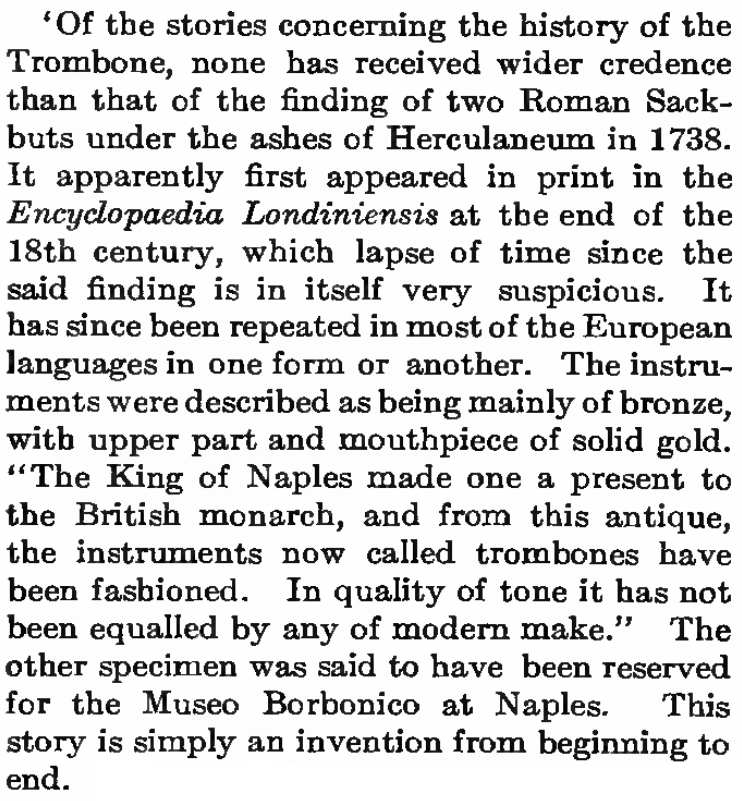
The destruction of Pompeii and Herculaneum due to the explosion of the volcano, Mount Vesuvius in A.D. 79, has led to many legends about what actually was found during the excavation of the cities that began in 1599. One of the most fanciful tales is that “two Roman Sackbuts” were found in the ruins of Herculaneum. This report first circulated in the 1700s but was, fortunately, debunked in the second edition of the Grove Dictionary of Music (1910):
grove_dictionary_1910_trombone_excerpt

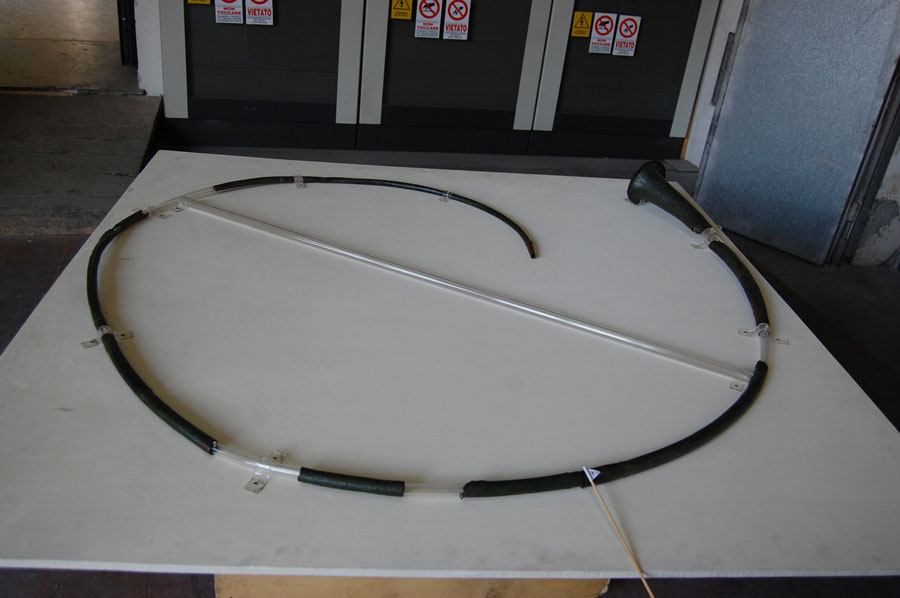
The instruments that actually WERE found in the ruins of Herculaneum were Roman cornu. Here is a photo of one of the Herculaneum cornu and more photos and commentary about these instruments may be found by clicking HERE.
naples_cornu

The trombone in Roman times? Fake news.

Longfellow: Tales of a Wayside Inn

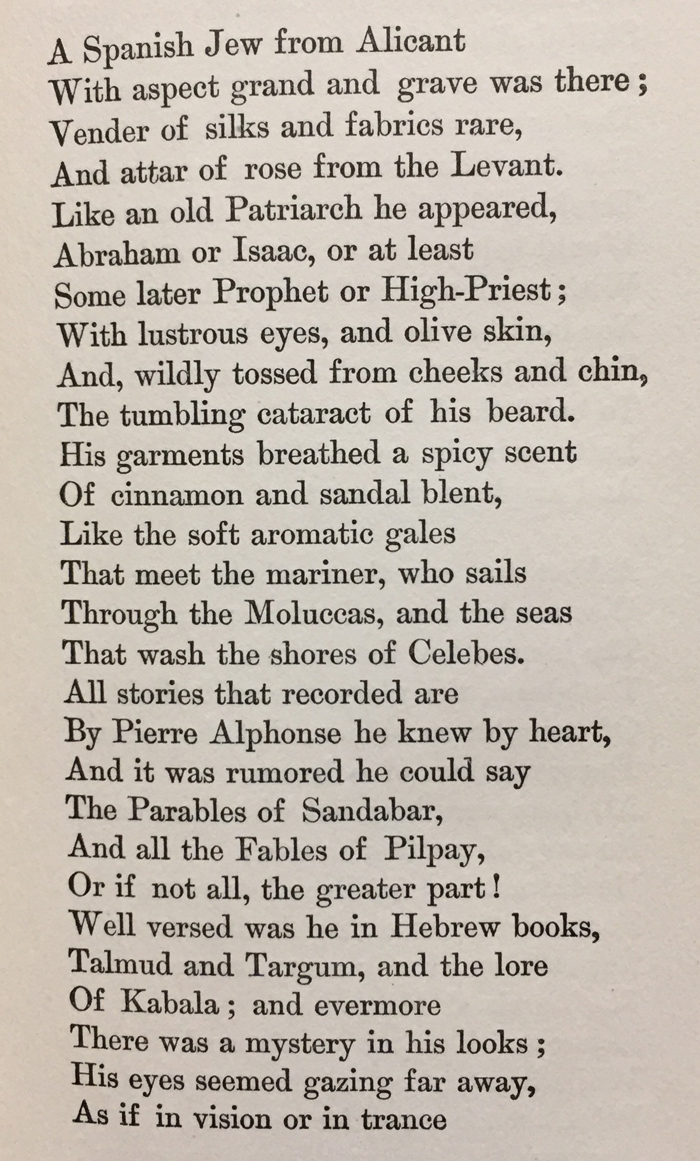
Henry Wadsworth Longfellow’s collection of poems, Tales of a Wayside Inn, is a classic of English literature. Written in 1863, the book relates fictional stories and tall tales told by a group of guests at the Wayside Inn, a real Inn in Sudbury, Massachusetts. Early in the book, Longfellow introduces “A Spanish Jew from Alicant.” As Canon Francis Galpin wrote in his essay, The Sackbut, Its Evolution and History (1906), “Longfellow (Tales of a Wayside Inn, Prelude), has unfortunately added popularity to this idea of the antiquity of the instrument [sackbut/trombone] by the following reference to ancient history.” At which point he quotes the closing lines of this excerpt from Longfellow’s poem (two scanned files since they appear over two pages in my copy of the 1913 edition):

wayside_inn_01wayside_inn_02

Trombones in the ancient Middle East? Fake news.

Sackbut in the Bible: The 1611 King James Version

I have a high view of the authority of the Bible and believe that it is the inspired, inerrant word of God. But there is a problem with the idea of Biblical inerrancy. The Bible was originally – and inerrantly – written in ancient languages, including Hebrew and Aramaic. Those who have translated the Bible into other languages have often had trouble knowing what words in the original languages actually meant/mean.

In the famous 1611 translation of the Bible into English, the so-called “Authorized King James Version,” we find this verse from the Book of Daniel, Chapter 3, verse 5:
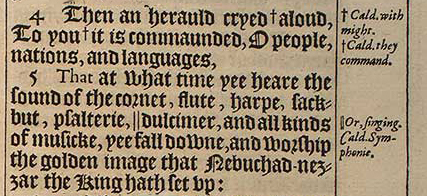
daniel_3_kjv_1611_detail

That at what time yee heare the sound of the cornet, flute, harpe, sackbut, psaltery, dulcimer, and all kinds of music, yee fall down and worship the golden image that Nebuchadnezzar the King hath set up:

This passage goes on to reference the Prophet, Daniel, who, because he would not bow down and worship Nebuchadnezzar’s golden image, was thrown into a den of lions where God preserved his life.

The problem with Nebuchadnezzar’s little band is that the sackbut wasn’t part of the jam session. Translators of the King James Version were stumped. They came across an Aramaic word in the passage and did not know what instrument was being described. Jeremy Montague describes the problem:

The reason for [the sackbut’s] use in the Authorized Version is that the word in the Aramaic is sabb-cha, and King James’s translators had no idea of what it meant but just picked something familiar that sounded similar. The Septuagint has sambyke each time (Vulgate, sambuca), and it is probably that it is the word that the author of Daniel was aiming at. Jeremy Montagu, Musical Instruments of the Bible (London: Scarecrow Press, 2002), p. 98.

So what WAS the instrument, the sambuca, that was rendered as sackbut, that was played in Nebuchadnezzar’s band? It was a type of small harp, a bow harp, that looked something like this example found in the Edinburgh University Collection of Historical Musical Instruments:

0033799c

Since the King James Version was published, Biblical scholars know much more about ancient languages and ancient musical instruments, and the sambuca is now usually translated as psaltery or lyre. In fact, the New King James Version translates it as lyre. Not sackbut. Not trombone.

The trombone in ancient, Biblical times? Fake news.

It is important to keep in mind that apart from the fanciful report of the discovery of trombones in the excavation of Herculaneum, none of these “fake news” reports about the trombone were malicious or intended to deceive. Shakespeare and Longfellow were using poetic license to place the trombone in ancient times, putting an instrument with which they were familiar into an historical setting. They also may just have liked the sound of the name of the instrument and how it rolls off the tongue. The translators of the King James Version did the very best they could with the knowledge they had when they translated sambuca as sackbut. Over time, scholars gained a better understanding of the meaning of the word and they corrected it in subsequent translations of the Bible. The problem occurs when people today don’t understand that these references that place the trombone in ancient times are false. The assertion that the trombone was found in antiquity still comes up in books, articles, and student papers today. The trombone has a long and noble history that dates from the fifteenth century. We continue to learn more about this rich history including when things previously thought to be true are now known to be false. Check your sources when you write about the trombone. You’ll be doing your part to stop trombone fake news.


stop-fake-news-logo-large