Category: history

Rewarded: a new book

Rewarded: a new book

I love to write. Ever since I was a young boy, I have been passionate about writing. Give me a 2,000 word essay on a school exam any day over three math problems. My love of writing was birthed from my love of reading, something imparted to me by my parents. My father was Chairman of our local public library while I was going up, and every week, my brothers and I trekked to the the library to take out another stack of books to read. I was fortunate to attend schools that emphasized reading, whether contemporary literature (a little), the classics (a lot), and the ancients (Edith Hamilton’s Mythology remains a favorite).

I’m at work writing several books at the moment. In the introduction to The Trombone Book, a planned 500 page book I’m writing for Oxford University Press that will cover the history, use, performance, teaching, and care of the instrument (for trombone players who are reading this, think of this book as the successor to the long out of print Trombone Technique by Denis Wick), I’ve written these words:

In a sense, I have been writing this book since I first picked up the trombone in 1964. My parents, Alan and Jeannine Yeo, now gone from this world to the next, taught me to pay attention. From them I received the gift of a disciplined work ethic and the understanding that it was required to succeed in anything. They instilled in me a love of books and reading, and from that it was not a far walk to a love of writing. I grew to appreciate words and how they were put together, and I particularly thank Alfred, Lord Tennyson (Enoch Arden), Henry Wadsworth Longfellow (Evangeline), Herman Melville (Moby Dick), Thomas Hardy (Under the Greenwood Tree and The Choirmaster’s Burial), J. D. Salinger (Catcher in the Rye), William Buckley (The Right Word) and Jacques Barzun (many books, but especially Berlioz and the Romantic Century, From Dawn to Decadence, The Use and Abuse of Art, The Culture We Deserve, and Darwin, Marx, Wagner: Critique of a Heritage) for their exceptional modeling of the possibilities of the English language. An exasperated Abigail Adams was known to say to her husband, John, whose predilection for long narrative introductions before getting to the main point used to annoy her to no end, “John! Do you always have to start at Genesis?” Like our Second President, I confess to being guilty as charged, and also to finding solace in the writing of the Apostle Paul, whose first sentence of his letter to the Romans contains 132 words before the insertion of the punctuation mark we call the period. Stopping a thought is sometimes hard to do.

I love well crafted sentences, the putting together of words, how they flow past the eye and off the lips.

As much as I like writing, I also like what happens before writing: research. I don’t write fiction; I write about music and music making, musical instruments and real people and history. I love the chase, the tracking down of facts both obscure and well known, the hunt for needles in haystacks. It is intense, patient, time-consuming, frustrating, and rewarding work. And I never tire of it.

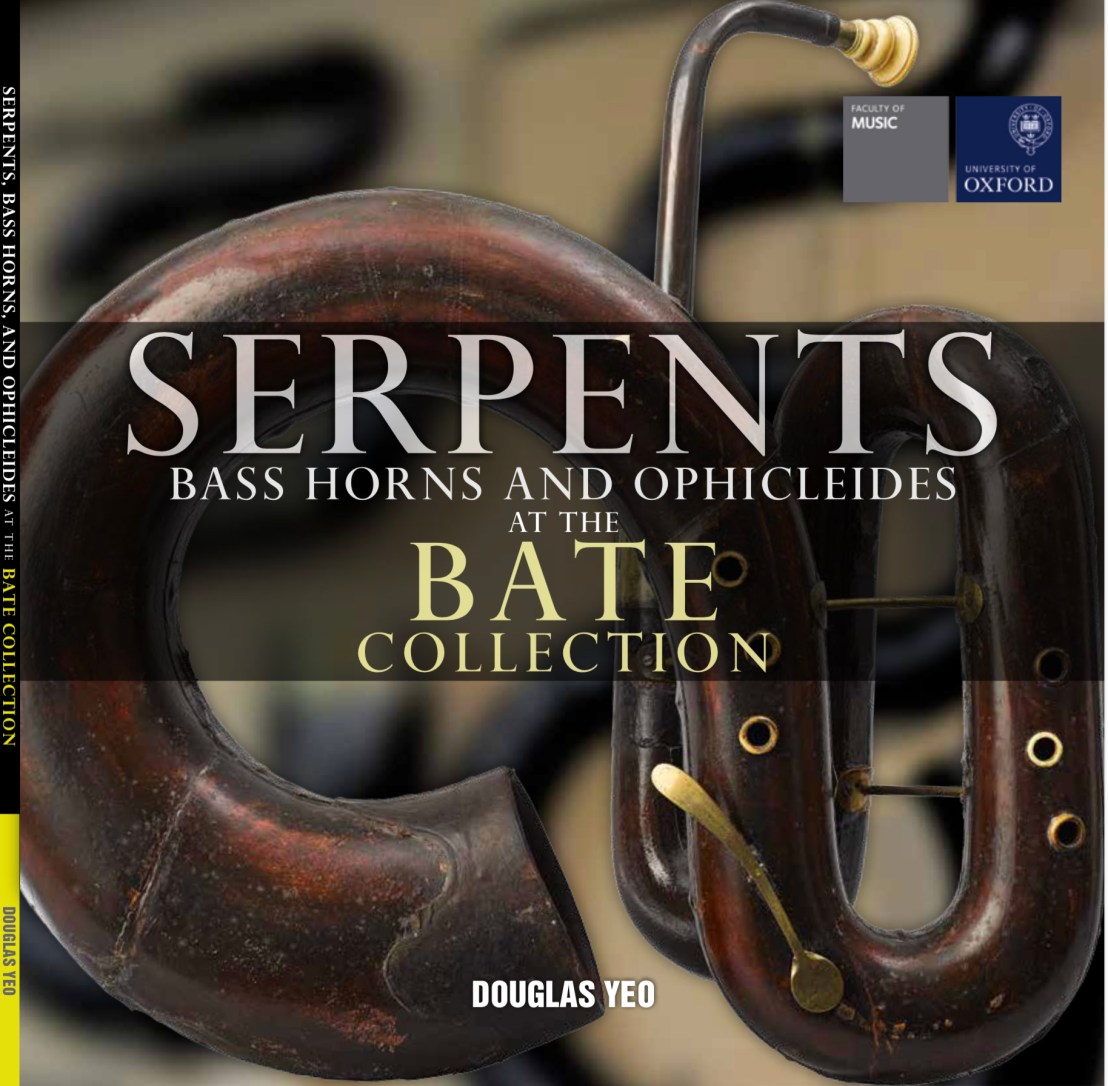
So, today is a particularly happy day for me, as my mailman brought me a most welcome package: several copies of my newest book, Serpents, Bass Horns and Ophicleides at the Bate Collection, just published by the University of Oxford in Oxford, England.

Bate_Yeo_serpents_cover

The Bate Collection in Oxford has a superb collection of musical instruments. I visited there in 2009 and had the opportunity to play several instruments under the watchful eye of my friend, curator Andrew Lamb.

Yeo_Waterloo_serpent

The Collection is a veritable “Ali Baba’s cave” of musical instruments, as you can see from this snapshot of one of the many display cases:

Bate_serpents_situ

In 2011, Andrew Lamb asked if I would be interested in writing a book about The Bate’s collection of serpents and related instruments. It took me all of one second to agree, although the project was delayed for many reasons. It was not as simple as sitting down and getting to work; a great deal of groundwork needed to be laid. And I also needed time to research and write. In 2012, I retired from the Boston Symphony and promptly flunked retirement and took the full time position of Professor of Trombone at Arizona State University. That job, as wonderful as it was, was all-consuming, and with many other writing projects going at the same time, the Bate book had to wait. But there was much to do as well, including collecting detailed information about all of The Bate’s instruments, arranging for high quality photos to be taken of each instrument, as well as research into the instruments themselves. I devised a plan for the structure of the book and last year, I began discussions with Bryn Walls, a superb designer who had been engaged to lay out and put the book together.

Screen Shot 2019-05-13 at 4.37.15 PM

As you can see from the first page of table of contents above, the book is divided into two primary sections. After a Foreward by Craig Kridel (not a Forward – remember that this book is published in England and England and the USA are two countries separated by a common language – my text needed to undergo “Anglicization” so its spelling and punctuation conformed to British publishing style), five chapters of Historical Context appear. In this section, I wrote a brief history of the instruments as seen through those at The Bate.

Screen Shot 2019-05-13 at 4.37.26 PM

The second section of the book is a detailed discussion of the instruments at The Bate. My commentary is greatly enhanced by superb photos of the instruments by Gary Ombler. Following the discussion of the instruments is a brief section of back matter, including a checklist of the instruments, a bibliography so readers and learn more, a bio and photo of moi, and a page with the index and acknowledgements.

Bate_denuded_serpent

Bate_Courtois_ophicleide

Each instrument is afforded its own two page spread, with at least two full views of the instrument (sometimes there are three or four – front, back, and sides), many photographs of detailed elements of the instruments, as well as my commentary.

With this book, serpents, bass horns, and ophicleides at The Bate come alive in a new way. Visitors to the Collection can walk through the gallery with the book in hand as they look at the instruments and learn more than the identifying label next to the instrument itself can tell them. Those who can’t get to The Bate can enjoy the instruments while sitting at home in their favorite (whoops – favourite) chair. 80 pages of photos and commentary about some of the most interesting musical instruments ever conceived and manufactured.

The book is now available through the Bate Collection’s online publications store; click HERE to go there in a new browser window. Or, of course, you can stop by the Bate Collection yourself and pick one up there. I am delighted that this book, the subject a long period of research, writing, layout, and proofreading, is now available. Holding copies in my hand today is a great reward at the end of a long process. I will enjoy this moment, but tomorrow I’ll be happily back to my other writing projects. More on them soon!

Bate_serpents_situ


An Easter reflection

An Easter reflection

Today is Easter. It is a day that remembers an event of monumental importance: the resurrection of Jesus Christ. The story has been told countless times, and Christians around the world celebrated Easter with song, sermons, and the reading of Scripture.

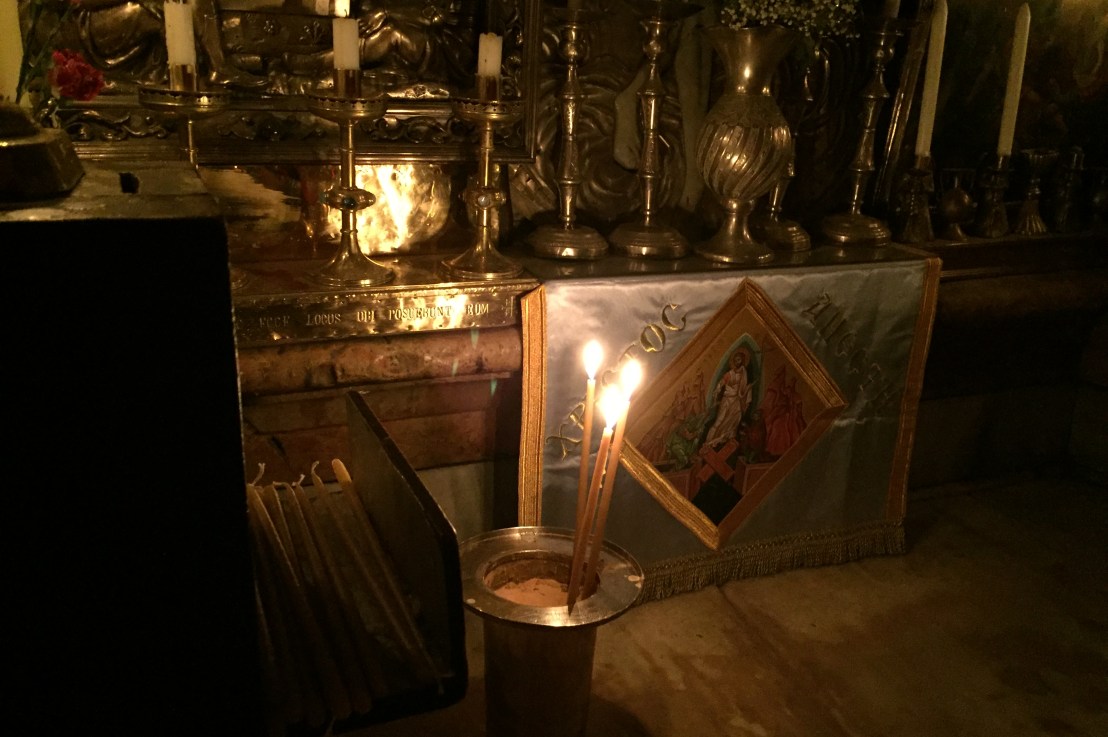
There are four accounts of the death and resurrection of Jesus in the Gospel accounts in the Bible – Matthew, Mark, Luke, and John. Each highlights particular moments in those world-changing days nearly 2000 years ago. In 2016, my wife and I traveled to Israel with a tour group sponsored by our undergraduate alma mater, Wheaton College. The trip was life changing, as we visited many of the traditional sites where pivotal events in the Bible took place. One such site was the Church of the Holy Sepulchre, built over the traditional sites of the crucifixion and burial of Jesus. The photo at the top of this blog entry on The Last Trombone is one I took of the tomb of Jesus in the Church of the Holy Sepulchre. Do we know for sure that he was actually buried there? No, but since at least around 400 AD, Christian pilgrims have venerated this particular place as being the site. I do not engage in debates over whether this or that site is THE site. It enough that I was in the neighborhood.

Artists over the centuries have depicted the resurrection of Jesus as a cataclysmic event, replete with angels and earthquakes, and the moving away of the stone that covered the entrance of the tomb. The Bible tells of this (Matthew 28:1-4):

And behold, there was a great earthquake, for an angel of the Lord descended from heaven and came and rolled back the stone and sat on it. His appearance was like lightning, and his clothing white as snow. And for fear of him the guards trembled and became like dead men.

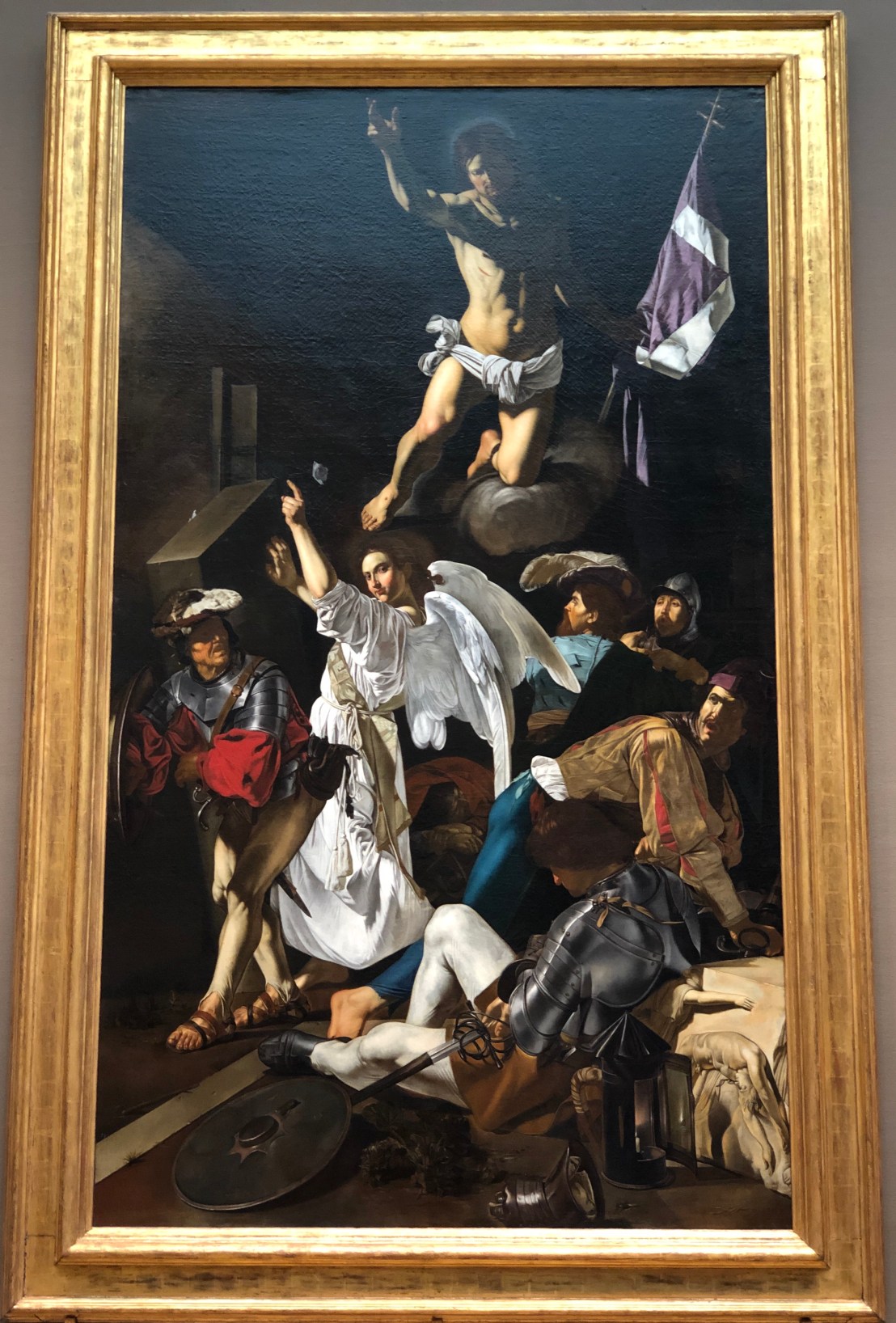
Typical of such artistic representations is the one below that I saw a few days ago at the Art Institute of Chicago.

IMG_2304

The painting is by Cecco del Caravaggio, whose real name was Francesco Buoneri, and it was painted in 1619-1620. Christ appears on top of his tomb, and an angel is dispatching Roman soldiers who were guarding the tomb. Cecco’s use of light and dark is exceptional, and I spent a long time sitting in the museum’s gallery and contemplating the event that it depicts.

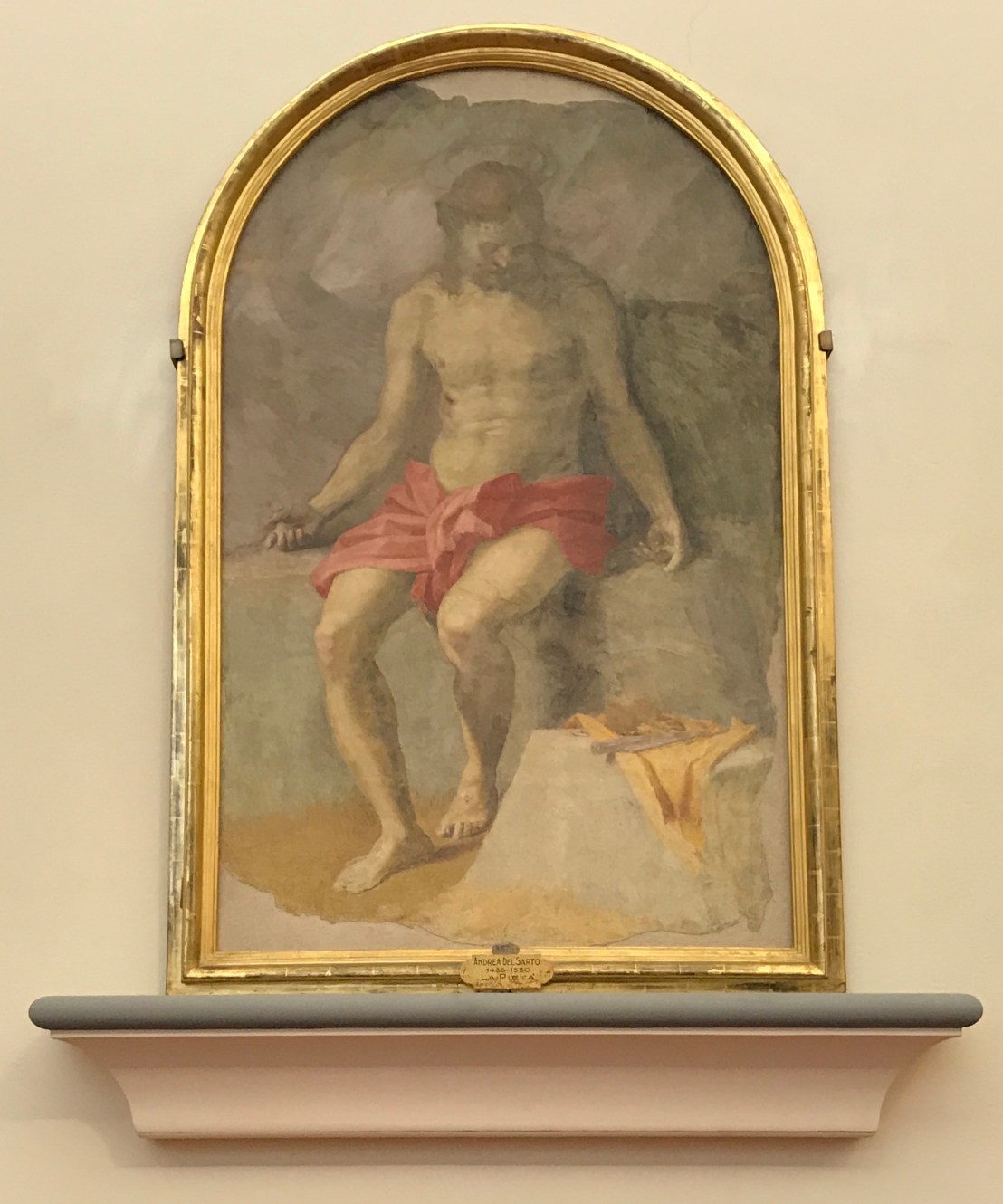
But in 2017, when my wife and I traveled to Italy on another Wheaton College alumni tour — a tour that took us to Florence and Rome — I saw another painting of the resurrection that has stuck in my mind ever since. This painting was in the Galleria dell’ Accademia in Florence, in the same museum that houses Michelangelo’s iconic statue of David. The painting, by Andrea del Sarto, was painted in the early sixteenth century and presents a very different view of the resurrection of Christ.

IMG_2377

Here is a moment before the the earthquake; we see no guards, no angel. It shows Jesus in His tomb at the moment of his resurrection. The wounds from his crucifixion are visible, as are some of his burial cloths. The image is one of quiet contemplation. I am sure I was not alone, when standing before this painting, in asking the question: What was Jesus thinking at this moment?

What I find interesting in all of this is that the Bible is silent about what actually happened inside the tomb at the moment when Christ was raised from the dead. He was dead, buried in the tomb. Then at some point over the next two days, Christ was resurrected, and somehow, in some way, he left the tomb. Two days after his agonizing death on the cross, the tomb was empty. Mary Magdeline was shocked to see the tomb empty when she came to visit it two days after the crucifixion of Jesus, but an angel spoke to her with these earth-shattering words (Matthew 28:6):

He is not here, for he has risen.

I like to meditate on both of these paintings which depict two moments surrounding the resurrection of Jesus. Both speak to the same thing: Jesus was dead, buried, and was raised from the dead. In the days and weeks that followed, He appeared in physical form — not as some kind of ghost or apparition — before hundreds of people. This is documented not only by the Bible, but by other, independent writers. The resurrection of Jesus happened. It was and is true, and it changed the world and the life of every person in it. As the Apostle Paul reminds us (1 Corinthians 15:17-20):

If Christ has not been raised, your faith is futile and you are still in your sins. Then those also who have fallen asleep in Christ have perished. If in Christ we have hope in this life only, we are of all people most to be pitied.

But in fact Christ has been raised from the dead.

C. S. Lewis spoke to this fact in his book, Mere Christianity. I have previously quoted him in my article on The Last Trombone about Christmas, but his words are worth repeating here:

I am trying here to prevent anyone saying the really foolish thing that people often say about [Jesus]: “I’m ready to accept Jesus as a great moral teacher, but I don’t accept his claim to be God.”

That is the one thing we must not say. A man who was merely a man and said the sort of things Jesus said would not be a great moral teacher. He would either be a lunatic — on the level with the man who says he is a poached egg — or else he would be the Devil of Hell. You must make your choice.

Either this man was, and is, the Son of God, or else a madman or something worse. You can shut him up for a fool, you can spit at him and kill him as a demon or you can fall at his feet and call him Lord and God, but let us not come with any patronizing nonsense about his being a great human teacher. He has not left that open to us. He did not intend to.

The death of Jesus Christ. His burial. His resurrection. It happened. And it matters. Happy Easter.

Symphony Hall: Boston’s proud temple of music since 1900

Symphony Hall: Boston’s proud temple of music since 1900

From 1985-2012, I was bass trombonist of the Boston Symphony Orchestra. The orchestra’s home is Symphony Hall, on the corner of Huntington and Massachusetts Avenues in Boston’s Back Bay section (301 Massachusetts Avenue). Opened in 1900 after the orchestra left the Boston Music Hall where it had played concerts since it was founded in 1881, Symphony Hall is considered to be one of the three finest concert halls in the world, with its acclaimed acoustics putting it in the company of the Musikvereinsaal (Vienna) and Concertgebouw (Amsterdam). Before it was destroyed in World War II, the old (alte) Gewandhaus in Leipzig was also similarly acclaimed. Having played concerts in the halls in Vienna and Amsterdam, I can say that in my view, Symphony Hall is simply the finest concert hall in which I have ever performed.

When I joined the Boston Symphony, I was aware of the rich history of both the orchestra itself and its storied home. I’ve read everything I could find about the BSO and Symphony Hall, spent countless hours in the orchestra’s archives (with which I had a hand in formally establishing in 1987), and have been fascinated at all I have found and learned.

Two important books have informed my quest for information about Symphony Hall.

Johnson_Symphony_Hall_Boston_1950

Published in 1950 on the occasion of the 50th anniversary of the opening of Symphony Hall, H. Earle Johnson’s Symphony Hall, Boston (Boston: Little, Brown and Co., 1950)  surveys the orchestra’s first 50 years, discusses programming and personnel, and features commentary on the building and opening of Symphony Hall. Now out of print (but copies can be found on through used book outlets such a abebooks.com), it unfortunately has no illustrations. 

Stebbins_Symphony_Hall_2000


Richard Poate Stebbins’ book, The Making of Symphony Hall: A History with Documents (Boston: Boston Symphony Orchestra, 2000) is a superb volume that documents, in fascinating detail, the planning, construction, and opening of Symphony Hall. It was published on Symphony Hall’s centennial, a year I remember with great fondness for the many historical exhibits in the Hall’s corridors and the many celebrations of the Hall throughout the year. The cover of the book features an early, color rendering of the original design of the hall, with many statues, inscriptions, and decorative cornices. Ultimately, none of these items were incorporated in hall when it was finished. Money ran out, and to this day, even there is no external decoration to the hall. Even the Hall’s  name is not found on its exterior. Yet it is this austerity that is part of Symphony Hall’s charm; somehow it fits in with the Boston way.

Symphony Hall was designed by  the architectural firm of McKim, Mead & White and an early photo of the completed Hall appeared in A Monograph of the Work of McKim, Mead & White, 1879-1915 (New York: Architectural Book Publishing Co, 1915), below. The publication was a massive four volume set with nearly 400 photographs; each had a simple caption without commentary. It details the breadth of the buildings designed by McKim, Mead & White and it includes three plates that feature Symphony Hall, plates 141, 142, and 143. Several years ago, I was able to obtain original copies of these plates, which are also contained in a modern reproduction of the original four volume set that is still readily and affordably available (McKim, Mead & White, The Architecture of McKim, Mead & White in Photographs, Plans and Elevations (New York: Dover Publications, 1990).  While McKim, Mead & White’s portfolio was published in 1915, the caption reflects the original name for Symphony Hall, The Boston Symphony Music Hall, which was changed to Symphony Hall just before its opening in October, 1900.

Symphony_Hall_plate_141

The other two plates feature some interior and exterior cross sections of Symphony Hall (the aisles on the main floor were changed to a different configuration in the final design), plate 142:
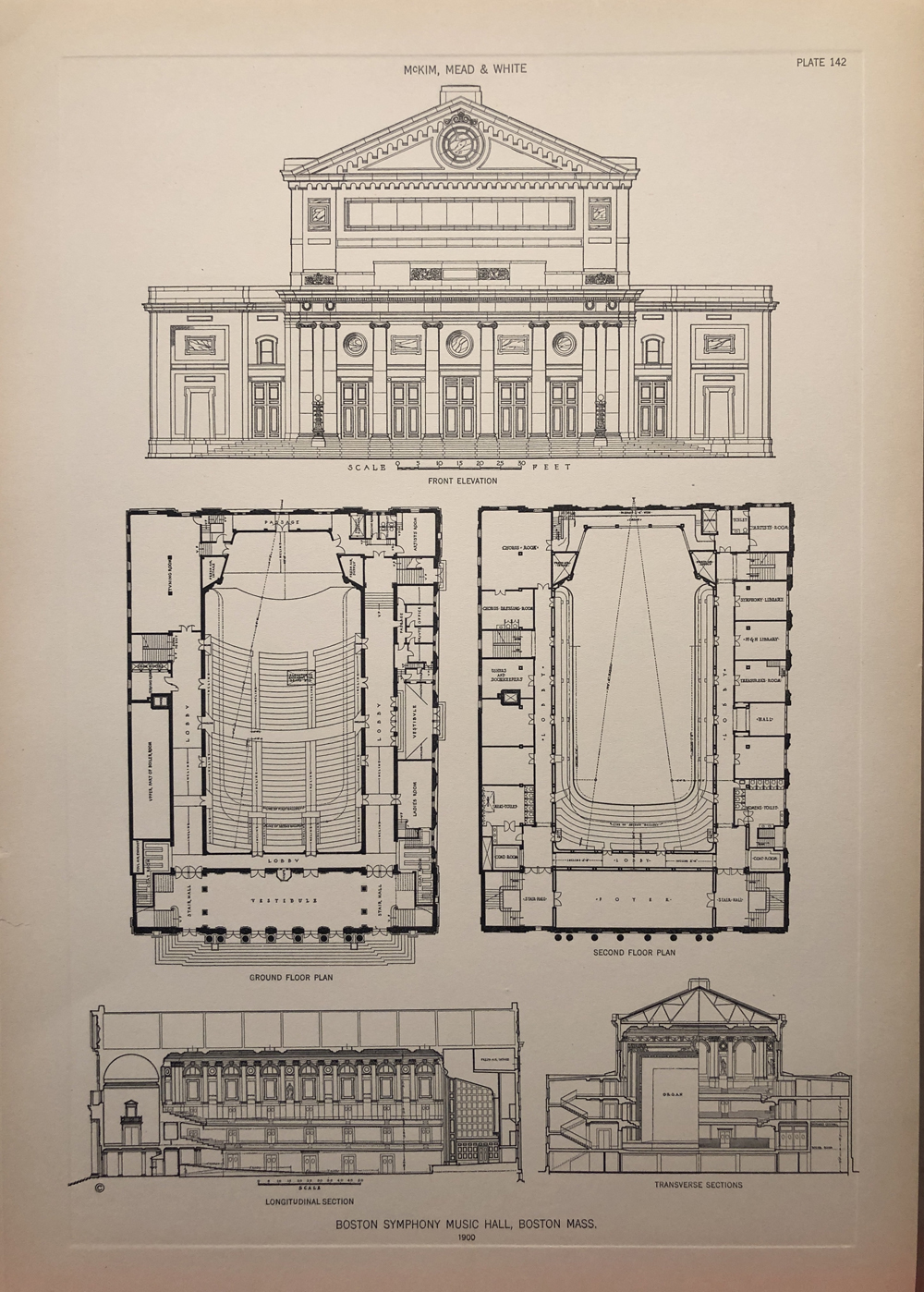
Symphony_Hall_plate_142

And plate 143, that features details of exterior design for the Hall:
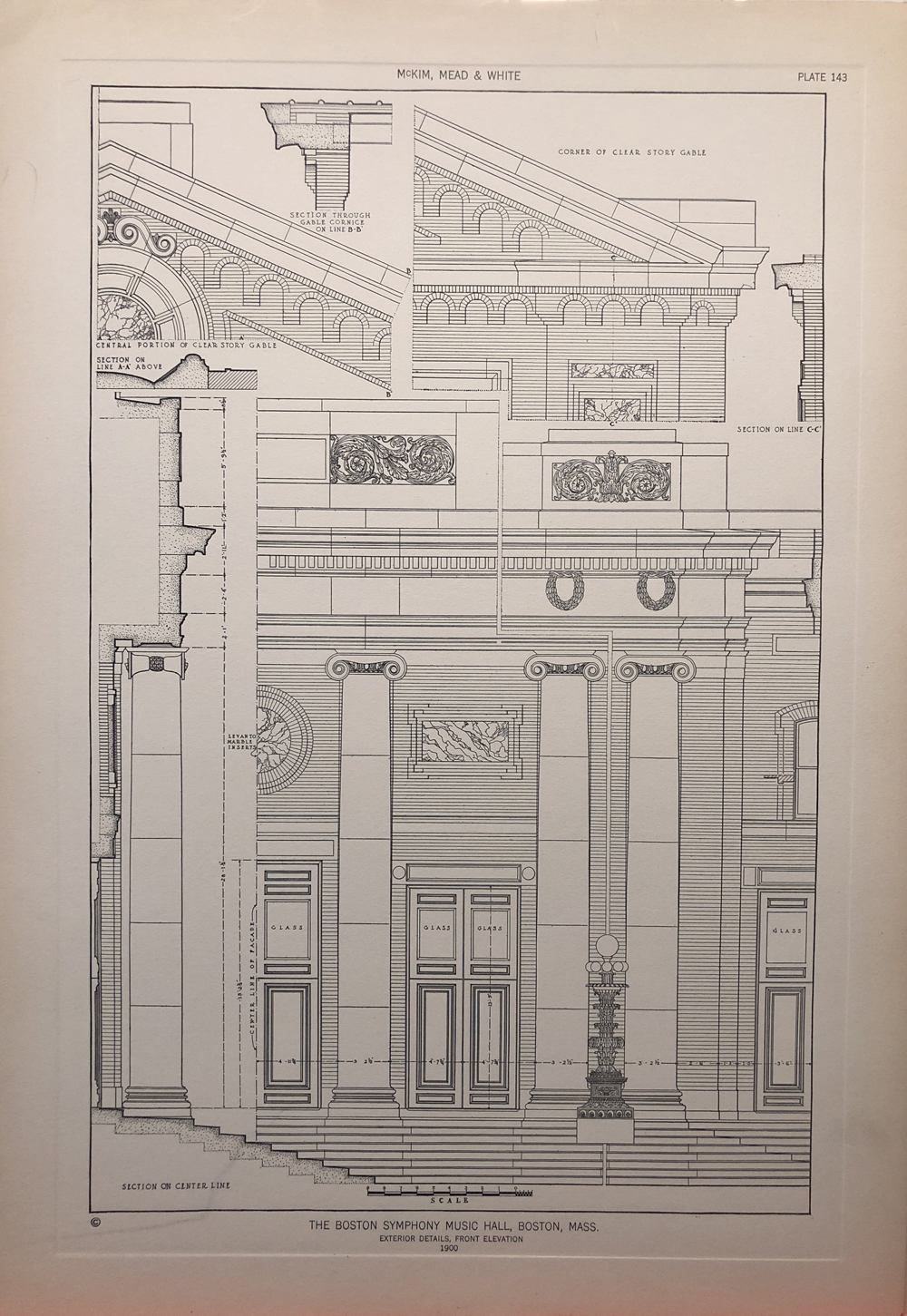
Symphony_Hall_plate_143

Over the years, I have collected many postcards of Symphony Hall; I usually paid only one or two dollars apiece for a piece of Boston Symphony history. I was fascinated at how many different images of the facade of the Hall had been made over nearly 100 years. In all, I found dozens of different postcards with nearly 30 images of the exterior of the hall. Many were crisp and clean, but the ones that were most interesting were the ones that had been used, with writing, stamps, and postmarks. It is these postcards that helped to document the approximate time when the photo or image of Symphony Hall was made. Early postcards were black and white; later ones were hand tinted before reproduction, and later ones are faithful photographic reproductions. Most postcards do not have copyright dates; I am not an expert at automobile models which could help further pinpoint years photos were taken. Still, these cards tell the story of Symphony Hall in a unique way. I’m presenting them here in rough chronological order with only light commentary; captions appear beneath each card. The images speak for themselves and are a reminder of a very important part of my life and the lives of thousands upon thousands of lovers of music who have walked through the doors of Symphony Hall, Boston’s proud Temple of Music. 
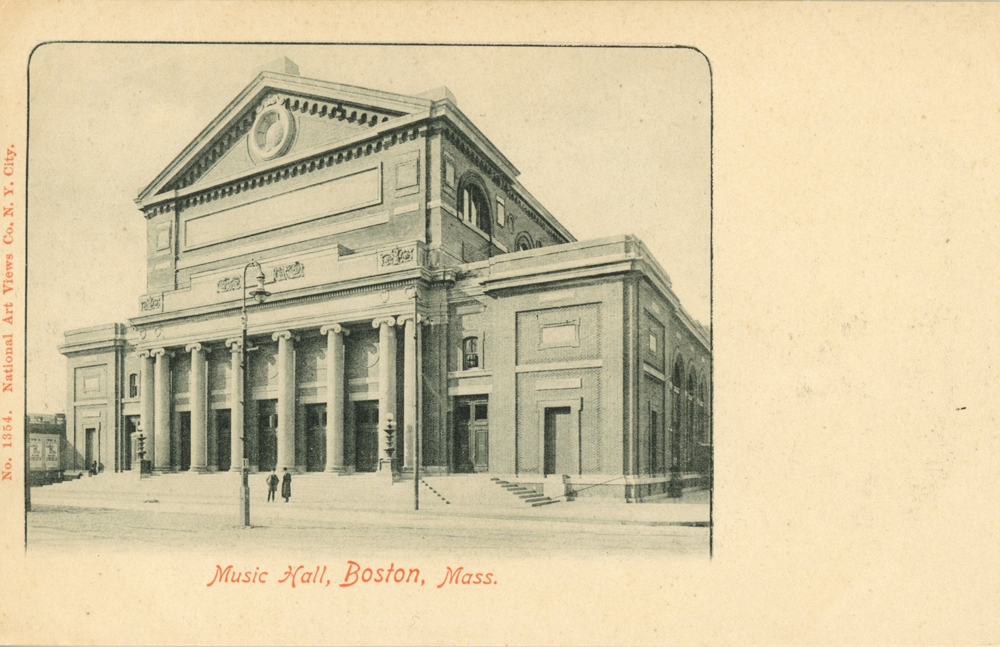
01_Symphony_Hall_Yeo_postcard

01. Music Hall, Boston, Mass. c. 1900. Card produced by National Art Views Co., N. Y. City. One of the earliest photos of the exterior of Symphony Hall, the view is of the original front entrance of Symphony Hall on Huntington Avenue; the Huntington Avenue trolly line power lines have been removed from this image. The Hall’s original name, Music Hall, which was changed to Symphony Hall before the first Boston Symphony concert was performed there on October 15, 1900, is featured in the caption.
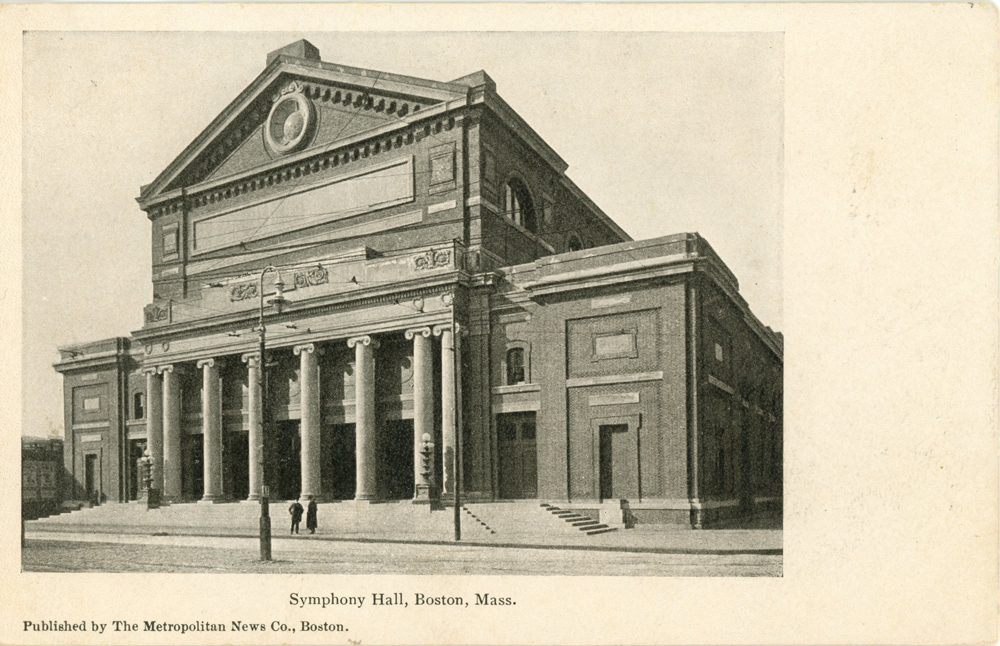
02_Symphony_Hall_Yeo_postcard

02. Symphony Hall, Boston, Mass. c. 1900. Card produced by The Metropolitan News Co., Boston. This is the identical photo seen in the previous card except the trolley power lines have not been removed. Note the name of the Hall has now been changed from Music Hall to Symphony Hall.

03_Symphony_Hall_Yeo_postcard

03. Symphony Hall. c. 1902. This collage of buildings are from Boston’s Back Bay area, including the Horticultural Hall, which is across the street from Symphony Hall on Massachusetts Avenue. The Art Museum on the card is the Museum of Fine Arts, Boston, which moved from its original location in Copley Square (shown on the card) to its present location on Huntington Avenue in 1907.

03a_Symphony_Hall_Yeo_postcard

03a. Symphony Hall, Boston, Mass. c. 1904. Card produced by Detroit Photographic Co. The card is used and is postmarked October 7, 1908, addressed to Miss Mary Merkins, Winsted, Connecticut. The copyright date of the image is given as 1904. Note the woman in the bottom right corner who is holding on to her hat in the gusting wind.

04_Symphony_Hall_Yeo_postcard

04. Symphony Hall, Boston, Mass. c. 1905. Produced by F. von Bardelben, New York & Germany. Made in Germany. Note the presence of a single horse-drawn carriage.

05_Symphony_Hall_Yeo_postcard

05. Symphony Hall, c. 1905. Card produced by Chisholm Bros., Portland, Maine. The card is used and is postmarked September 4, 1905, addressed to Miss Myrtle Kiefer, Homer, Michigan. The view is similar to the card above but several pedestrians are seen standing against the building.
06_Symphony_Hall_Yeo_postcard

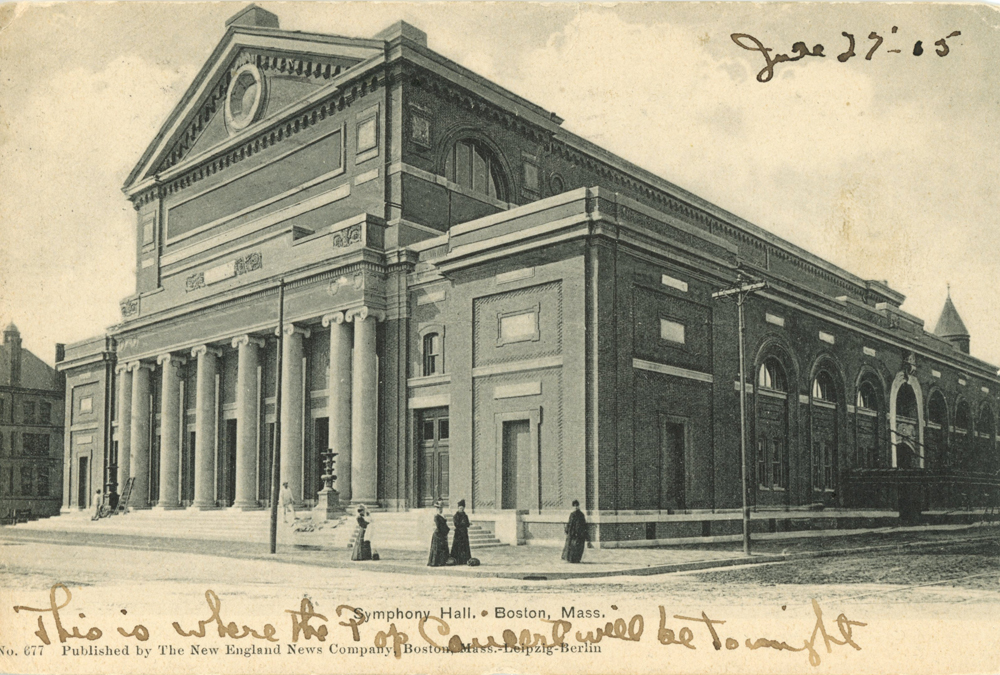
06. Symphony Hall, Boston, Mass. c. 1905. Card produced by The New England News Company, Boston, Mass. – Leipzig — Berlin. The card is used and is postmarked June 29, 1905, addressed to Mrs. K. B. Keene of Washington, D.C. In this view, one can see one of the rising-sun  shaped windows in the clerestory; these were boarded up during World War II (a blackout precaution) and were only reopened in the early 2000s at which time natural light once again could shine into the Hall.
07_Symphony_Hall_Yeo_postcard

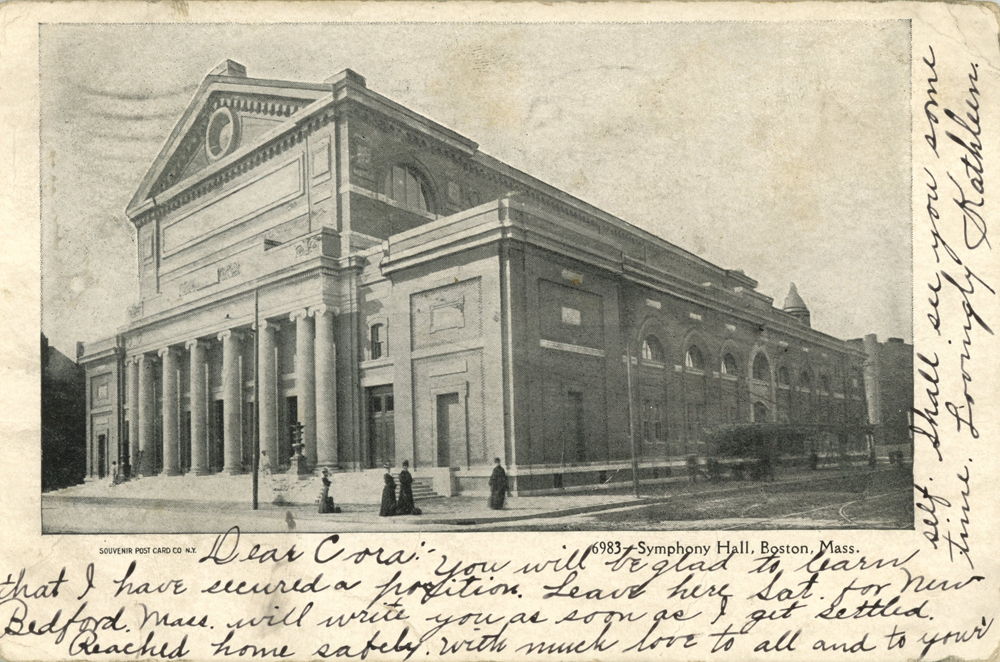
07. Symphony Hall, Boston, Mass. c. 1905. Card produced by Souvenir Post Card Co., New York. The card is used and is postmarked November 11, 1906, addressed to Mrs. A. L. Turner of Atlantic, Massachusetts. The photo is identical to the one in the card above although it is cropped differently and you can see many people along the Massachusetts Avenue side of Symphony Hall who had been removed in the previous card. I own a second copy of this card that was also used, postmarked March 7, 1907, addressed to Mr. George A. Ohlmsted, Barre, Vermont (c/o Ladd’s Grocery).

07a_Symphony_Hall_Yeo_postcard

07a. Symphony Hall, Boston, Mass. c. 1907. Card produced by Reichner Bros., Boston, München, Prag., Leipzig. Made in Austria. This curious card appears in version with no text on the image side and also as shown here, with the imprint of an event – Welcome to Boston, Old Home Week, July 28-Aug. 3, 1907 – that was probably held in Symphony Hall that had nothing to do with the Boston Symphony. Organizations sometimes issued commemorative cards with their own imprint to celebrate their events. Note the Boston bean pots in the four corners. The photo of Symphony Hall is centered in an artist’s palate. 
08_Symphony_Hall_Yeo_postcard

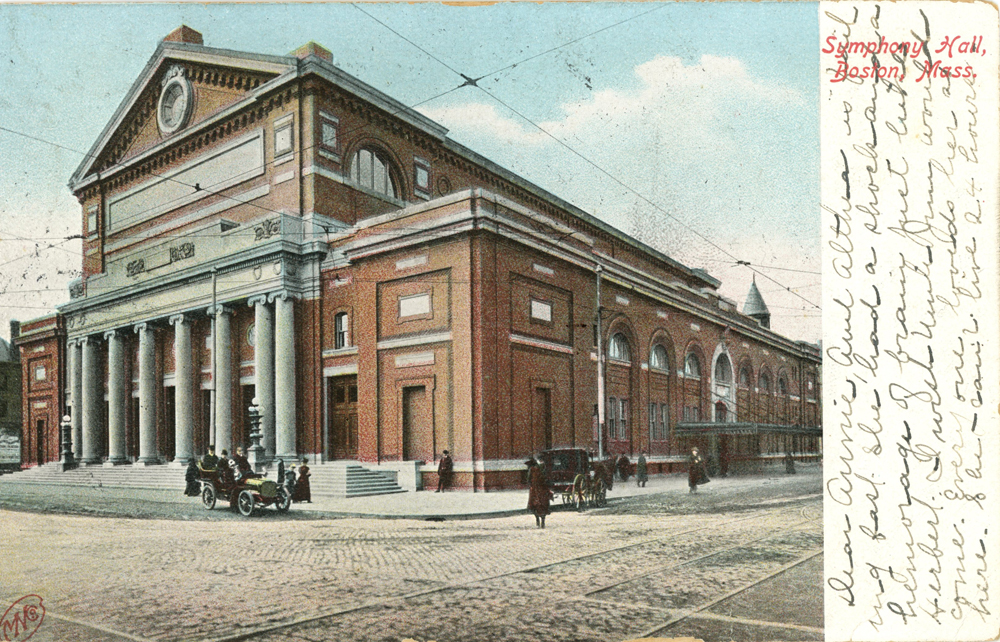
08. Symphony Hall, Boston, Mass. c. 1908. Card produced by Robbins Bros., Boston, Mass. Made in Germany. The card is used and is postmarked April 6, 1908, addressed to Mrs. Robert Skillings, Danville, Quebec. This card is the earliest I have seen that shows an automobile – on Huntington Avenue around the corner from a horse drawn carriage on Massachusetts Avenue.

09_Symphony_Hall_Yeo_postcard

09. Boston, Mass., Symphony Hall. c. 1911. Card produced by  The Hugh C. Leighton Co., Portland, ME, USA. Made in Germany. The card is used and is postmarked November 10, 1911, addressed to Mr. Georgie Worren, Wilton, New Hampshire. Two things are notable: The card was sold by Poole Piano Company (established in Boston in 1893) which inserted its company name and the hot air balloon with a piano hovering above the hall. This was a common advertising tool in the late nineteenth and early twentieth centuries. Also, note the sign that says “POPS” above the right pair of columns. This sign indicates that the photo was taken during the Boston Pops season. Pops concerts – originally “Promenade concerts” – began in 1885 and continue to this day. Today, this lighted sign is installed each year over the Massachusetts Avenue side of Symphony Hall (see card 24, below).

10_Symphony_Hall_Yeo_postcard

10. Symphony Hall and Horticultural Society Building, Huntington Ave., Boston, Mass. c. 1912. The card is used and is postmarked  December 10, 1912, addressed to Mrs. C. E. Palmer, Bath, Maine. This card looks down Huntington Avenue and shows the proximity of Symphony Hall and the Horticultural Hall (built in 1901); note, too, the three modes of transportation: horse-drawn carriage, automobile, and trolley.

11_Symphony_Hall_Yeo_postcard

11. Boston, Mass., Symphony Hall. c. 1913. Card produced by Raphael Tuck & Sons, Art Publishers to Their Majesties the King & Queen. Printed in Holland.  The card’s caption on the back reads, “SYMPHONY HALL, successor of the old Music Hall, is the home of the Symphony Orchestra, and here the oratorios of Handel and Hayden Society are even. The Hall has a seating capacity of 2,500, and the interior decorations, lighting, etc., are up-to-date as it was erected recently.”

12_Symphony_Hall_Yeo_postcard

12. Symphony Hall, Boston, Mass. c. 1914. Card produced by The Leighton & Valentine Co., N. Y. City. Printed in United States. The card is used, postmarked 1914, addressed to Mrs. C. H. Gateo, Petersham, Massachusetts. The lighted POPS sign is seen again in this card, as are two trollies and a horse-drawn carriage. Notice, too, the large three-sheet advertisements for Boston Pops concerts in the niches on the corners of the building as well as one standing against the Huntington Avenue columns.

13_Symphony_Hall_Yeo_postcard

13. Symphony Hall, Boston, Mass. c. 1914. Published by Tichnor Bros., Inc., Cambridge, Mass. Huntington Avenue is bustling with activity; many signs lean up against the Huntington Avenue columns to advertise upcoming concerts and events. Two styles of automobiles are seen as well as the wheel of a horse-drawn carriage on the far left. Crossing Massachusetts Avenue on the right side of the card is someone with a long case or parcel. Could it be a member of the Boston Symphony heading to a rehearsal?

14_Symphony_Hall_Yeo_postcard

14. Symphony Hall, Boston, Mass. c. 1915. Card produced by  E. H. & F. A. Rugg, Medford, Mass. Visible in this card is one of the shutters — standing open — that could be raised to cover   the rising-sun clerestory windows. 

14a_Symphony_Hall_Yeo_postcard

14a. Symphony Hall and Horticultural Hall, Massachusetts Avenue, Boston, Mass. c. 1927. Card produced by  Tichnor Bros., Inc., at Cambridge, Mass, USA. The postcard is used and is postmarked 1927, addressed to Mrs. Wilber Tasker, Etna, Maine. This view shows Symphony Hall and the Horticultural Hall, with the dome of the mother church of First Church, Christ Scientist (built in 1906) rising in the background. The caption on the back of the postcard refers to Symphony Hall as “Boston’s Temple of Music.”

15_Symphony_Hall_Yeo_postcard

15. Symphony Hall, Boston, Mass. c. 1930s? Card produced by C. T. American Art. 

16_Symphony_Hall_Yeo_postcard

16. Symphony Hall, Boston, Mass. c. 1930s? Card produced by The New England News Company, Boston, Mass. 

17_Symphony_Hall_Yeo_postcard

17. Symphony Hall, Boston, Mass. c. 1930s? Card produced by The Process Photo Studios, Troy at 21st St., Chicago, Ill. The presence of a kiosk in the intersection of Huntington and Massachusetts Avenues with an traffic officer from the Boston Police Department adds a certain kind of frightening charm to this image. I would not have wanted to be in his position.
18_Symphony_Hall_Yeo_postcard

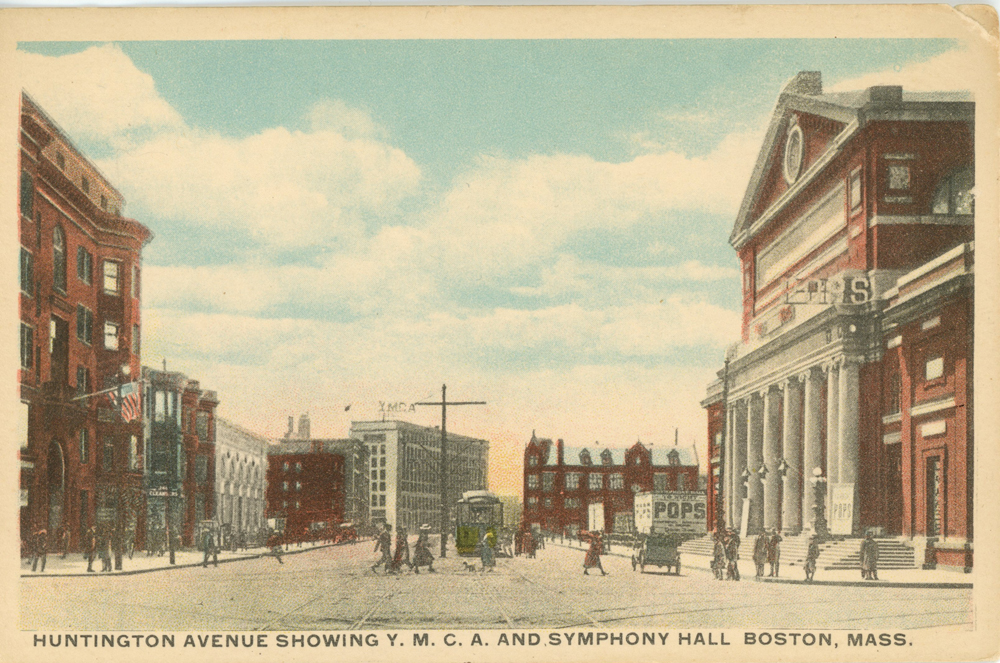
18. Huntington Avenue Showing Y.M.C.A. and Symphony Hall, Boston, Mass. Before 1941. Card produced by M. Abrams, Roxbury, Massachusetts. This view is down Huntington Avenue and shows Symphony Hall on the right (with the POPS lighted sign in place), and the Boston Y.M.C.A. building in the center. To the left of the Y.M.C.A. is New England Conservatory of Music where I taught from 1985-2012; many Boston Symphony musicians teach at NEC owing to its close proximity to Symphony Hall.

19_Symphony_Hall_Yeo_postcard

19. Symphony Hall, Y.M.C.A. and Junction, Mass. Ave. and Huntington Ave., Boston, Mass. Before 1941. Card produced by The New England News Company, Boston, Mass. Similar to the view above, this postcard features later style automobiles, the absence of the POPS advertising, and large American flags on top of the Y.M.C.A.

20_Symphony_Hall_Yeo_postcard

20. Symphony Hall, Boston, Mass. c. 1941. Card produced by United Art Co., Boston, Mass. I do not know if the large American flag on the roof of Symphony Hall was actually a feature of the hall for a time or if it is an artistic addition from around the time of World War II. I have been on the roof of Symphony Hall and do not recall seeing a stand for a flag of that size although it’s quite possible it was there at one time.

21_Symphony_Hall_Yeo_postcard

21. Huntington Avenue at Massachusetts Avenue Showing Symphony Hall, Horticultural Hall and Dome of Christian Science Church. Boston, Mass. c. 1949. Card produced by “COLOURPICTURE” Publications, Cambridge, Mass. USA. The card is used and is postmarked September 7, 1949, addressed to Mrs. Harry Monroe, Fitchburg, Massachusetts. In 1941, the Tremont Street Subway (now the Green Line E spur) was moved from surface level to underground to avoid traffic on Massachusetts Avenue. This made using the original Huntington Avenue entrance of Symphony Hall more difficult since the road was necessarily more narrow. The main entrance of the Hall was switched to the Massachusetts Avenue side. This was a practical decision but it has disrupted the original flow of concert goers into the Hall; they now enter the auditorium from the side rather than from the rear.

22_Symphony_Hall_Yeo_postcard

22. Symphony Hall, Massachusetts and Huntington Avenue, Boston, Mass. c. 1954. Card Produced by United Art Co., 89 Bedford St., Boston, Mass. The postcard is used and is postmarked July 21, 1954, addressed to Mr. & Mrs. Harry Davidson, Lakewood, Ohio. This interesting view shows a long building to the left of Symphony Hall (a sign for a bowling alley is visible). This building, which stretches for the whole block, is now owned by the Boston Symphony which has plans to redevelop the block with a new building. Currently it houses the Orchestra’s Cohen Wing which includes the Symphony Hall gift shop, BSO archives, management offices, the Casadesus Collection of Musical Instruments, and various other businesses that rent space from the Boston Symphony.

23_Symphony_Hall_Yeo_postcard

23. Symphony Hall. c. 1990. Card photo by Lincoln Russell, Stockbridge, MA. Symphony Hall at dusk, in a time-lapse photograph. 

24_Symphony_Hall_Yeo_postcard

24. Symphony Hall. c. 1995. Card photo by Helen Eddy, Cambridge, Massachusetts. This view is of the canopy over the Massachusetts avenue entrance to Symphony Hall, showing decorative bunting and the lighted POPS sign celebrating the spring season of the Boston Pops Orchestra.

25_Symphony_Hall_Yeo_postcard.jpg

25. Seiji Ozawa and the Boston Symphony Orchestra, Symphony Hall. c. 2000. Card photo by Christian Steiner, New York, New York. This photo shows a view of the stage of Symphony Hall near the end of the tenure of Music Director Seiji Ozawa (music director 1973-2002). The trumpets and trombones are seated in the back row of the orchestra in front of librarians and personnel mangers and stage managers who are standing in the center: Thomas Rolfs, Peter Chapman and Charles Schlueter, trumpets; Ronald Barron, Norman Bolter, Douglas Yeo, trombones; Chester Schmitz, tuba. The story of the interior of Symphony Hall is one for another time!


Trombone iconography: confusion abounds (and it shouldn’t be this difficult)

Trombone iconography: confusion abounds (and it shouldn’t be this difficult)

The trombone as we know it has been with us for around 500 years. That is, the familiarly shaped instrument with a U-shaped slide for the right hand that is connected to a bell that sits on the player’s left shoulder. The “as we know it” bit is my disclaimer to leave aside, for the purposes of this article, any discussion of precursors of the trombone -– real or imagined – such as the Renaissance slide trumpet. For this discussion, I’m talking about the trombone as a trombone, that familiar instrument that is instantly recognizable when seen on stage, in parades, and in artwork.

Well, maybe it’s recognizable.

I’ve been working on several books and in the course of my research, I’ve been very interested to see how artists – painters, sculptors, photographers – render the trombone. Because of the instrument’s distinctive shape, one would not think it would be so difficult to draw a trombone correctly, or more fundamentally, put it together correctly. But it apparently is more complicated than I think it should be. This article is a gallery of some images where artists got the trombone wrong. The point of this exercise: to remind us of the dangers of making assumptions about musical instruments from iconography alone. Imagine if a researcher stumbles upon these images 500 years from now. What kinds of assumptions would they make about the trombone and how it is held and played if they base their conclusions on these (and similar) images that are simply wrong in their depiction of the trombone? Abundans cautela non nocet! (Abundant caution does no harm!)

Douglas_Yeo_solo_Boston_Pops copy

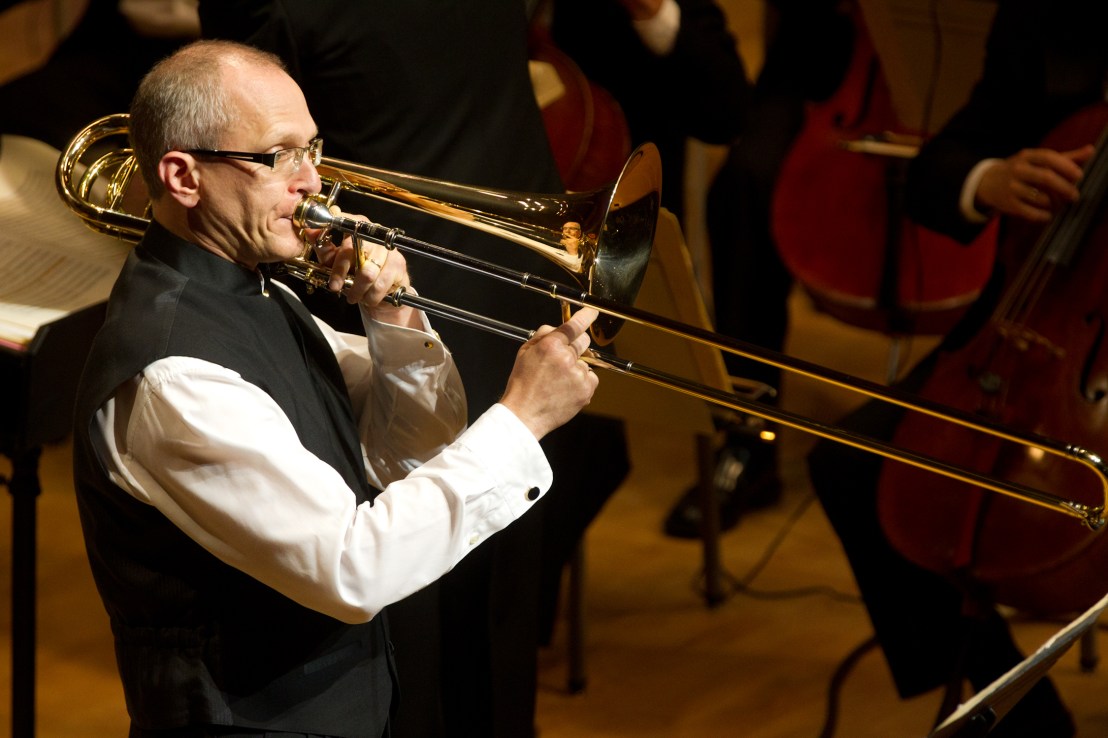
First, here is how most people hold the trombone while playing. That’s me soloing with the Boston Pops Orchestra in Symphony Hall, Boston, a 2011 performance of the Bass Trombone Concerto written by my good friend, Chris Brubeck. The photo was taken by Michael J. Lutch. The instrument’s bell section is positioned on top of my left shoulder with the bell extending in front of my head. The hand slide is held by my right hand and is moved in and out. This said, we must note that in history, there have been trombones where the bell has extended backwards over the player’s left shoulder; these instruments are known as “over-the-shoulder” or OTS instruments. They achieved some popularity in the nineteenth century although they are known to have existed as early as the sixteenth century. At least that’s what some iconography tells us. They were never commonplace. And, yes, there are some trombone players who have put the trombone bell over their RIGHT shoulder moved the hand slide with their LEFT hand – jazz trombonist Locksley Wellington “Slide” Hampton comes to mind. But these instances are rare in the big scheme of things.

IMG_1337

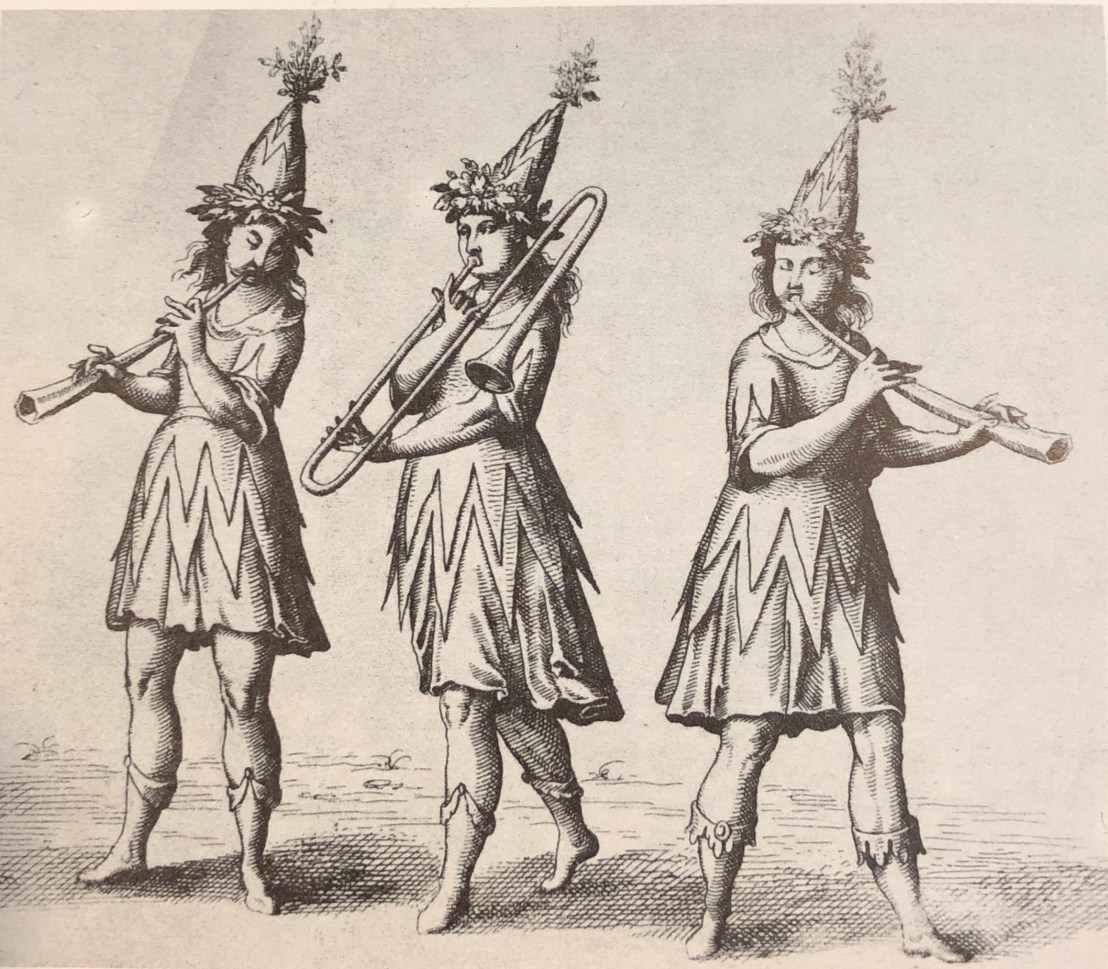
From the beginning of the trombone’s history, artists have had trouble with the concept of the trombone’s slide. This print, above, by Esaias van Husen dates from 1616 and is an example of the problem. At first glance all looks well with the trombone player who is flanked by cornettists. But while the trombone bell is properly shown as resting on the player’s left shoulder, the instrument is being held by the RIGHT hand and the slide moved by the LEFT hand. Further, the player’s left hand is far down the slide; in this position, the player could only move the slide perhaps one or two positions before his arm would be fully extended. Seventh position would remain illusory. Readers will notice that there are no braces on the bell. This in itself is not “wrong” in that we have a few surviving historical trombones from the Renaissance that do not have any bell braces although the lack of braces certainly contributes to an undesirable flexibility of the whole instrument and would make it more difficult to hold.

To be fair, these artists probably drew the trombone from memory. They would remember the bell and the slide, but exactly how it all fit together often had them scratching their collective heads.

We should perhaps forgive our artists from the Renaissance; the trombone was still relatively new and it was not ubiquitous in culture. Still, we must be very careful when we try to draw conclusions about what the trombone looked like in its early history solely on the basis of paintings, drawings, and sculptures.

trombone_wrong_01

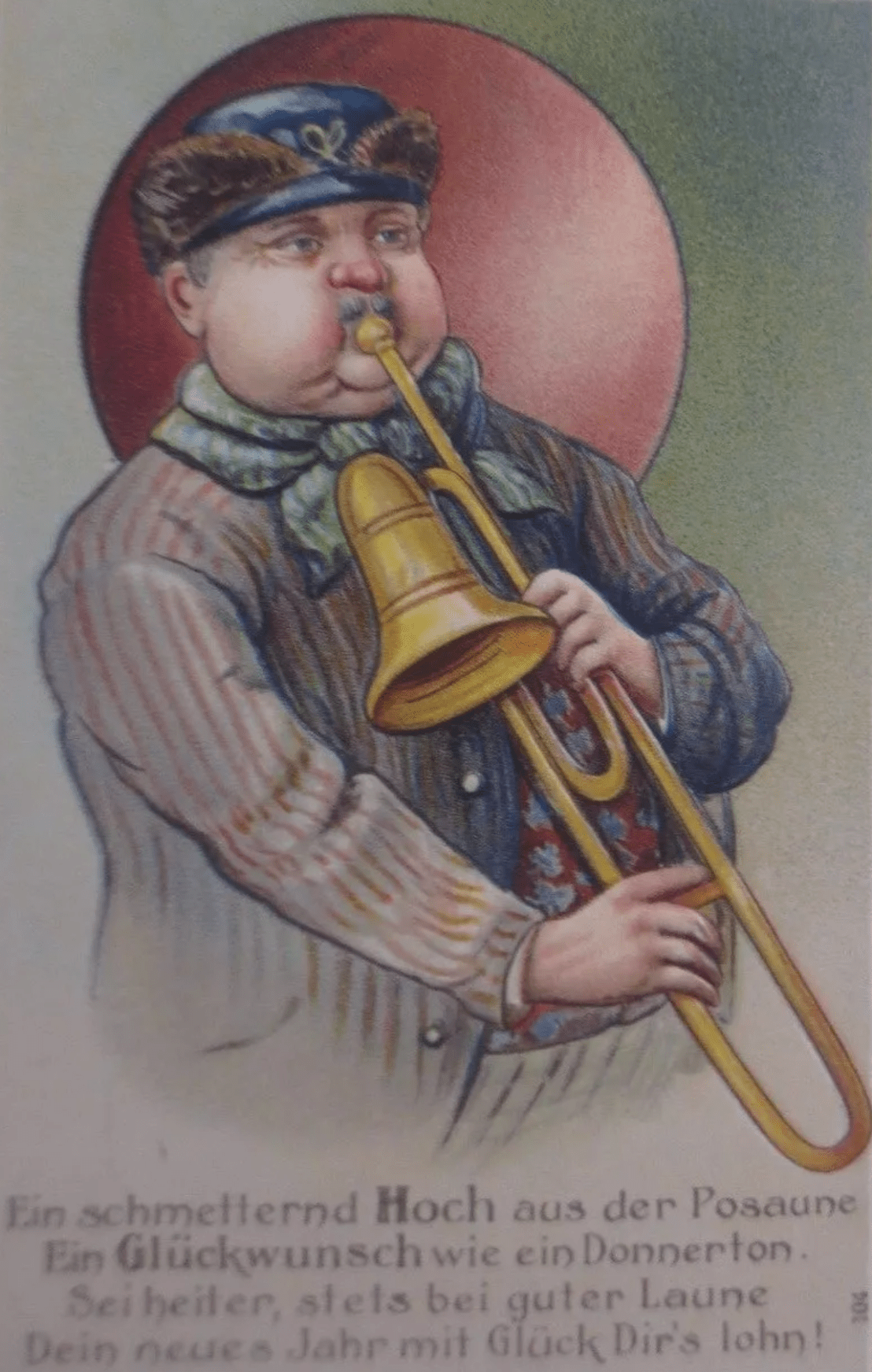
But from the nineteenth century forward, I’m a little less forgiving. I mean, who thought that THIS (above) actually looked like a trombone? Where do we begin with the problems?! This New Year’s card carries the following greeting (a loose translation):

A blaring high note from the trombone,

A greeting like the sound of thunder.

Be cheerful, and in a good mood,

And good luck to you in the new year!

Well, good luck playing that instrument, whatever it is.

trombone_wrong_02

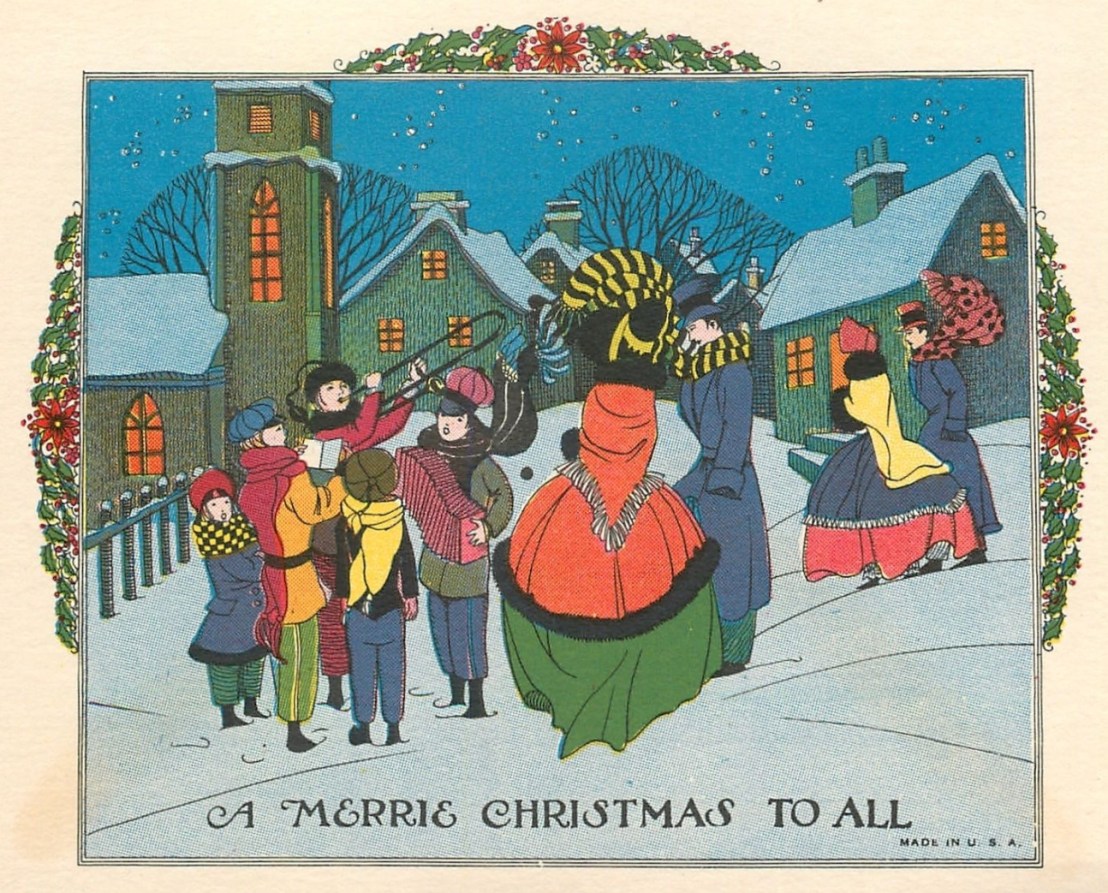
Here we go again. A lovely Christmas card, probably early twentieth century, with a woman playing trombone to accompany some Christmas carolers. But look at the impossibly small size of the trombone bell, and once again, with the bell over the left shoulder, it’s the left hand moving the slide. It ain’t necessarily so.

trombone_wrong_03

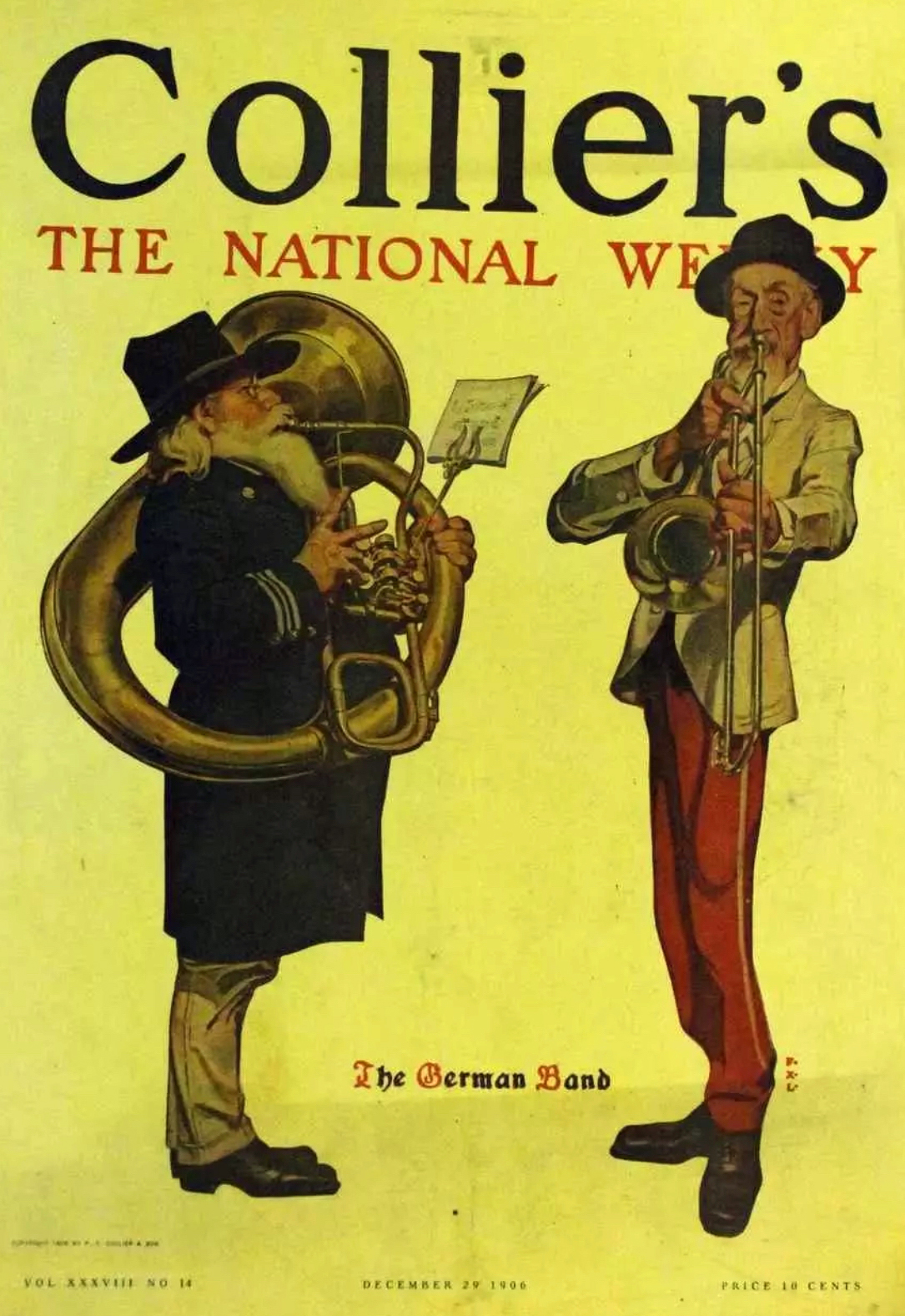
Here is a cover of Collier’s magazine, from December 1906. “The German Band” is shown.  I don’t know any German trombone players who hold the trombone like this. In fact, I don’t know any trombone players of ANY nationality that hold the trombone like this. Once again, we have a left-handed trombone player but, wow, with the bell under his right arm, it sure looks like the trombone is a weapon. I don’t like that look on his face. Better get out of the way!

trombone_wrong_04

Here is the famous poster made in 1894 or 1895 by Louis Anquetin; it features Marguerite Dufay, a well-known entertainer in the late nineteenth and early twentieth centuries in the cafés concerts in Paris. I think we can give Anquetin a mulligan with this portrayal of Dufay. It is a poster that is 100% caricature. Dufay was a woman of ample proportions but did not have arms like this – at all. The trombone is oversized like her personality but the fact that her trombone is held over her RIGHT shoulder by her LEFT hand was noticed by writers in 1898, shortly after the poster appeared. As an aside, this is one of the most famous images of a trombone and I’ve written an article about Marguerite Dufay, “Finding Marguerite Dufay: an iconic trombonist revealed” that will appear in the January issue of the International Trombone Association Journal. Anquetin’s artistic license was part of the success of the poster. But it is still wrong!

Screen Shot 2018-11-13 at 4.19.40 PM.png

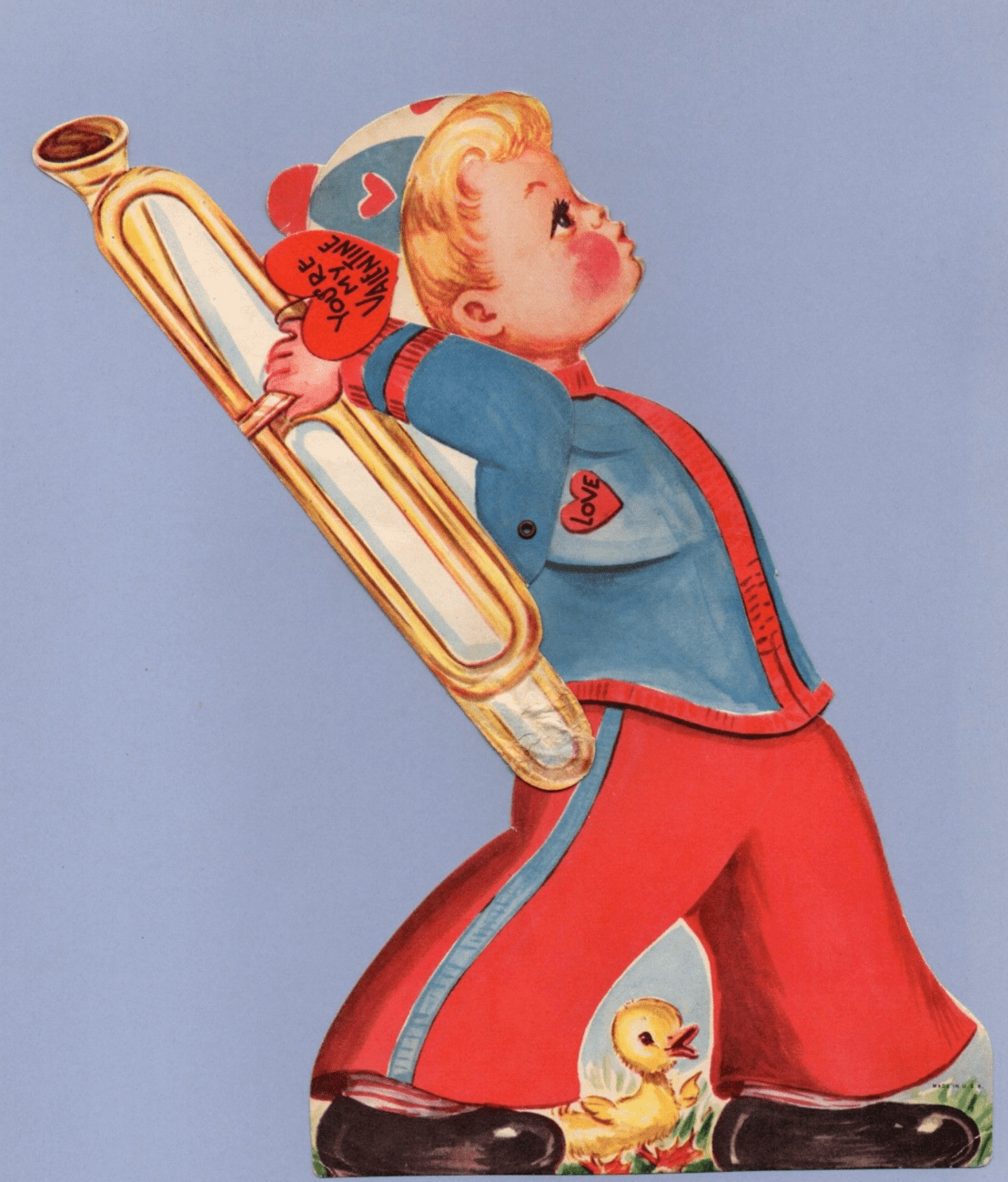
Remember those Valentine’s Day cards you used to give out to classmates in elementary school? OK, maybe you’re not old enough to remember those days where such a thing wouldn’t be met with a lawsuit, but I remember that time well. It was a very 1950s and 1960s thing. We used to give out valentines that had the look of this one, above. But, wow, what in the world is THIS? It’s actually a pretty fancy valentine. The player’s right arm moves; you can see the little hinge pin on his shoulder. Now, I THINK it’s a trombone. At least it has enough pieces to make a trombone. But who thought this instrument could work at all? Is he holding the instrument with his right hand or moving the slide? I thought that perhaps the mechanical aspect of the card might make it right. But. . . noooooo. Here’s what you can do with it:

Screen Shot 2018-11-13 at 4.27.19 PM.png

Yikes. The only thing this boy can do is launch the trombone like a javelin. A new Olympic sport! Play it? No way! Where’s the mouthpiece (among other problems)? I’m always particularly disappointed when the trombone is misrepresented for children. They ought to see the instrument as it really is, and see it in a way that can help them understand what it can actually do. As they say on Monday Night Countdown before each Monday Night Football game, “C’mon, man!”

Screen Shot 2018-11-13 at 4.32.14 PM.png

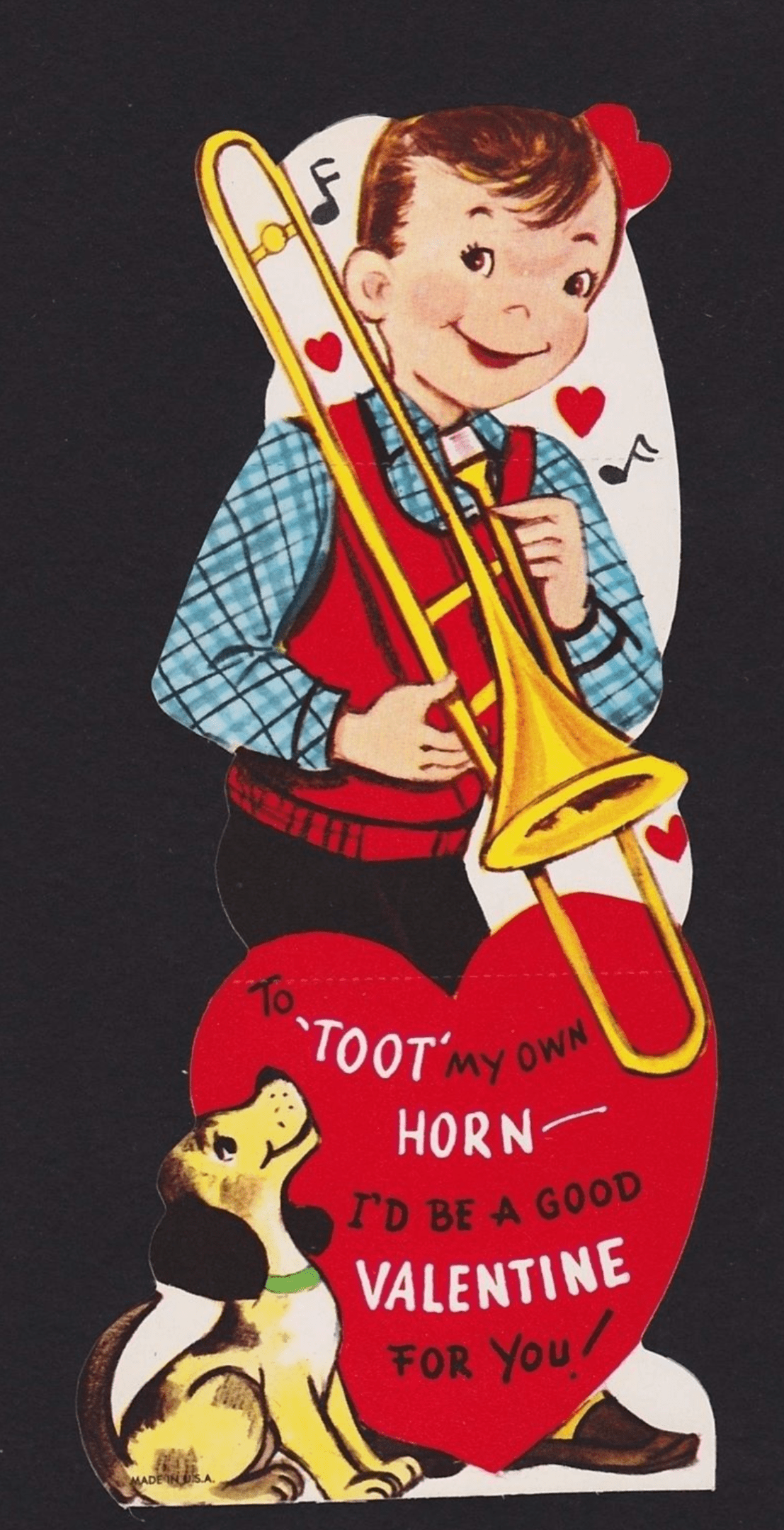
Speaking of valentines, here’s another one. Such a nice young man. But since his trombone is all out of whack – once he toots his horn, I’m not sure he could actually move the slide since the slide tubes are not parallel, among other problems – I’m not sure he’d be such a good valentine after all. Why is it so difficult to get this right?!

Grimace_McDonalds_trombone_mug

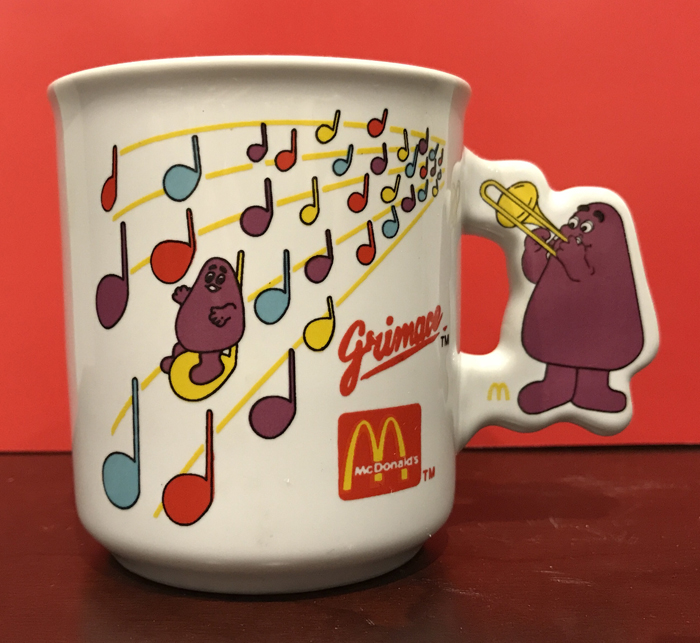
When the trombone intersects with fictional creatures, anything can happen. I picked up this mug at McDonald’s many years ago. It shows the character Grimace playing the trombone. At first glance all looks well but as you look closely, there’s a problem: where is the back end of the trombone bell? It appears to go over his left shoulder. But the bell/slide receiver appears to go right into Grimace’s chest. I don’t know, I can’t figure it out. But it is a cool mug (if you like to hold purple creatures who play the trombone while you’re drinking your coffee).

Smiths_umbrellas_trombone_card_01

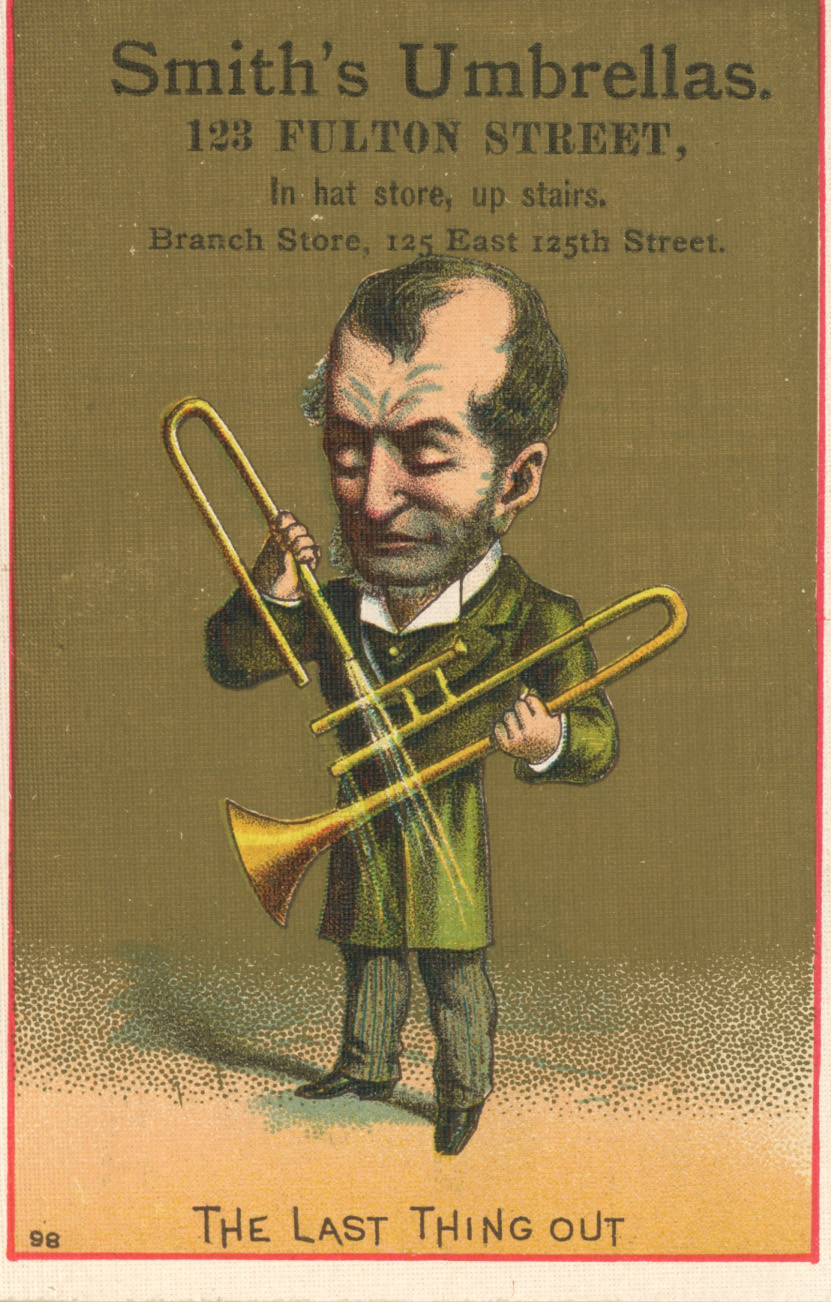
This late nineteenth century advertising card for Smith’s Umbrellas – I have several of these cards, all featuring different merchant names – shows a trombonist solving the proverbial problem of getting condensation out of his slide. But look at the inner slide – it appears to be only a few inches long. I don’t think this player could have gotten past third position before his outer slide came off in his hand. So much for the seven position trombone. . .

Rodeheaver photo with truncated trombone, 1926 - Newspapers.com

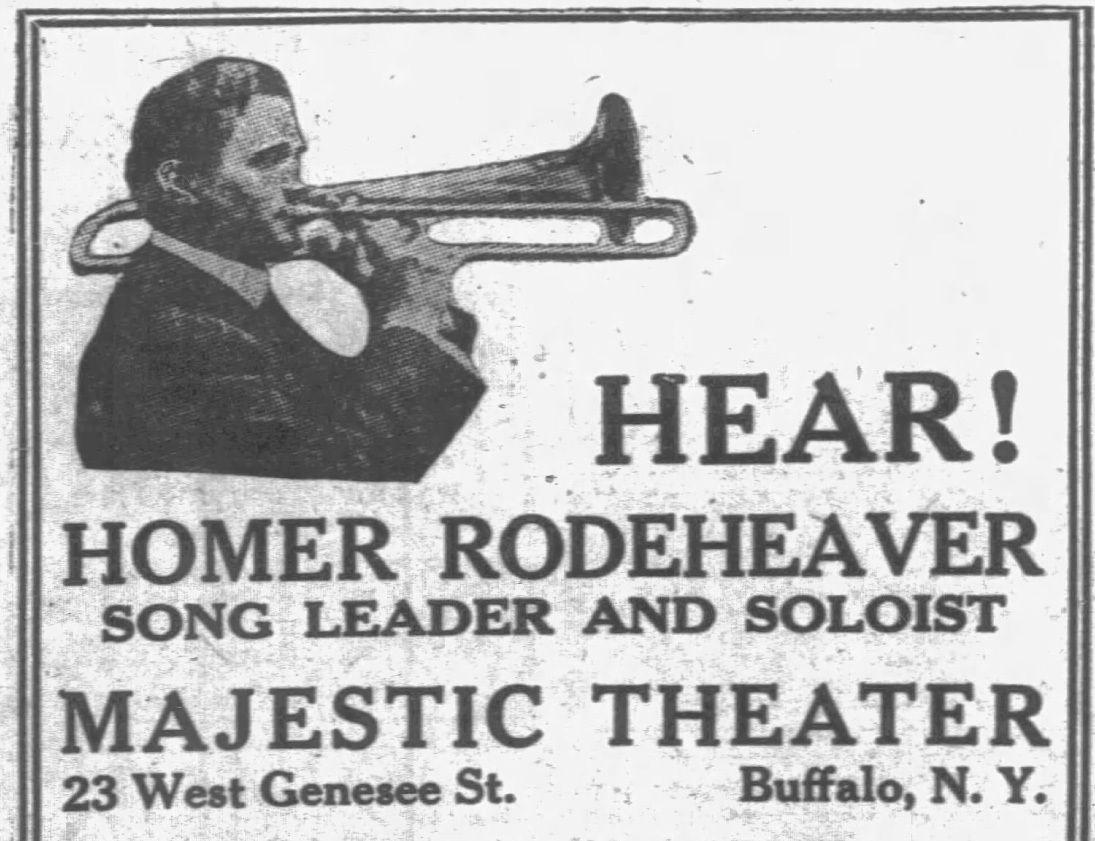
Speaking of trombones with truncated slides, here is an advertisement for an appearance by Homer Rodeheaver in Buffalo, New York, in 1926. Rodeheaver was the trombone-playing song leader for evangelist “Billy” Sunday in the first third of the twentieth century. He is the subject of a biography that I’ve recently co-authored with my friend, Kevin Mungons, that will be published by University of Illinois Press. Rodeheaver’s trombone was part of his personal brand and I’ve come across hundreds of photos of him with his instrument. I assure you, he played a standard seven-position slide trombone. But look at this advertisement; it looks like he’s playing a very short slide. The bell is the right size but the slide – what happened?

Rodeheaver020

It’s not difficult to figure out. Here is the original photo that was used in the ad. As you can see, the end of Rodeheaver’s trombone slide is cut off in the photo. For the advertisement, the copy editor obviously knew the photo was not complete and to use it in the ad, the trombone slide needed to have its bottom crook. So he just added one where the slide ended in the photo, ignoring the fact that the slide was actually much longer. Whoops!

Macys_ad

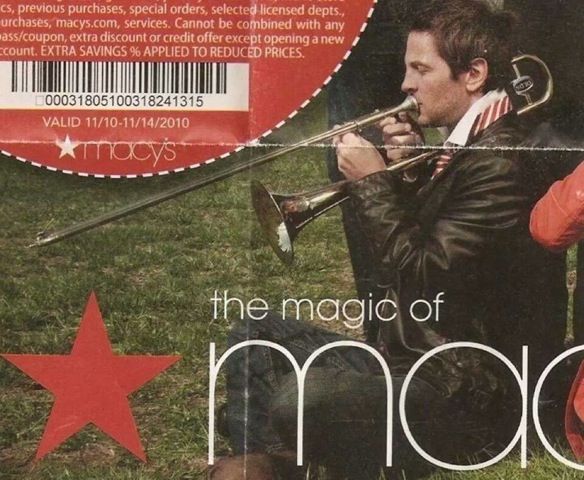
More recently, we find advertisements like this one for Macy’s. Cool looking guy. But I don’t know any trombone player who would buy a leather jacket from Macy’s based on this photo. We’ve got an impossibility here. Just try to think through how far the player’s LEFT hand can go before it slams into the bell. That could get very expensive. And painful. And speaking of money,  lot of it went into this photo shoot. You would have thought they could have gotten the actor to hold the trombone correctly, you think? EPIC FAIL!

trombone macy's

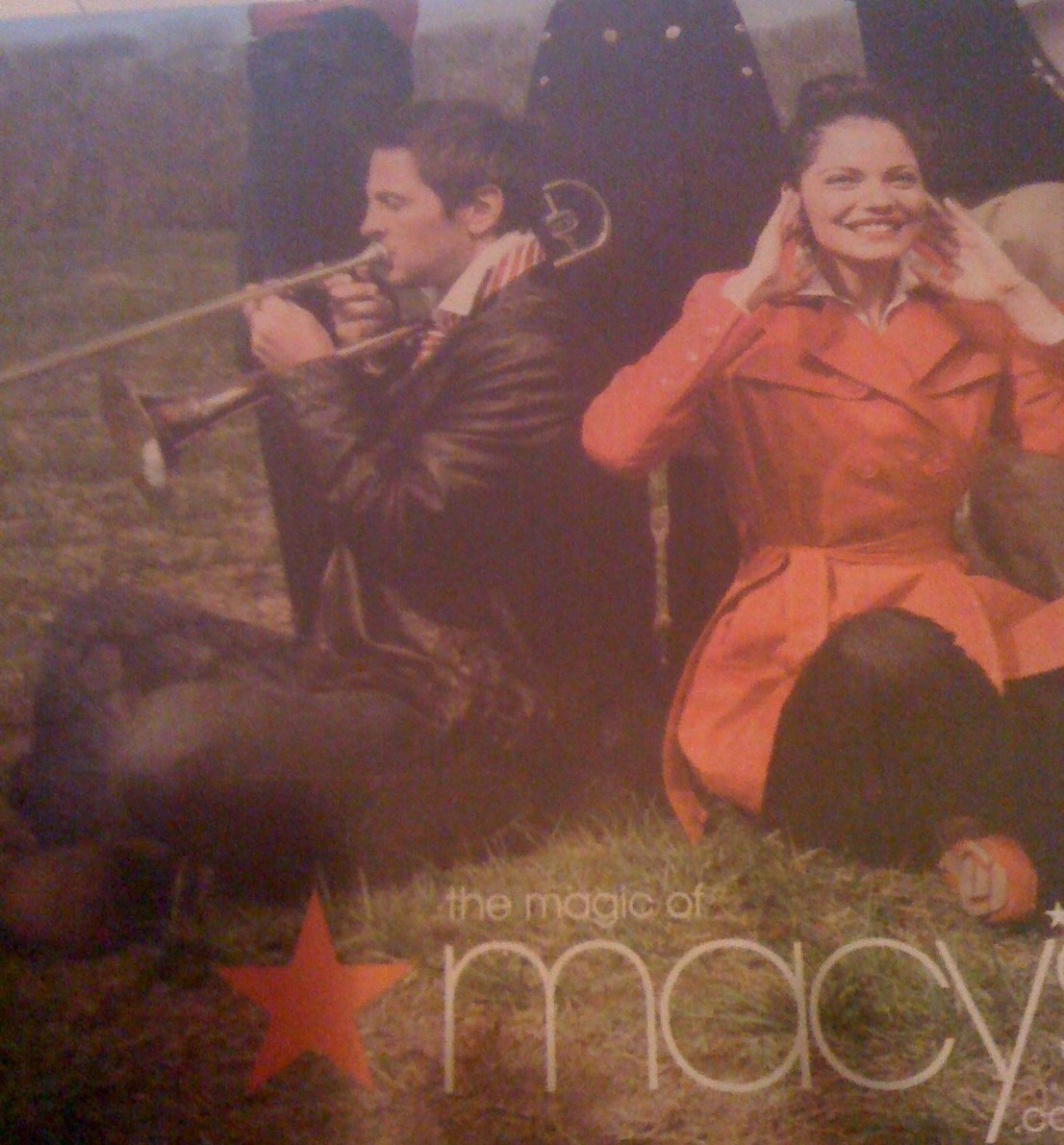
And there’s even more to the Macy’s story. Here’s another, fuller version of the advertisement. This woman may be smiling on the outside, but I have a feeling that when her trombone playing dude goes fast for sixth position, she’ll be calling 911 for an ambulance to come and take care of his broken wrist. Nothing funny about that. What in the world was Macy’s thinking? [ANSWER: Macy’s probably was NOT thinking.]

trombone_wrong_05

Here’s another one, a snapshot of a television advertisement for the GAP that I saw last night while watching a football game. Now, maybe this young woman really IS a left handed trombone player. But I don’t think so. It’s a rare thing when an advertising agency uses an actual musician in an advertisement. Besides, I didn’t hear any trombone playing in the ad’s soundtrack. She sure looks like she’s having a great time. But the trombone put together backwards? Uh-uh.

These kinds of examples are legion, on and on we could go. We can chuckle when we see the trombone portrayed in a goofy, or even impossible configuration. But it really shouldn’t be so difficult to get it right. And it is important. Just beware when you look at iconography for ANYTHING. Artists take their liberties, and we should always check twice before trusting any image!