Category: faith

Christmas 2024

Christmas 2024

by Douglas Yeo (December 24, 2024)

Tomorrow is Christmas, and like millions of people around the world, our family will be celebrating tonight at a Christmas Eve church service. We’ll be at our church, New Covenant Church of Naperville, Illinois. Tomorrow brings together family, food, and the sharing of gifts. For our family and other Christians, the most important thing about Christmas is the celebration of the birth of Jesus Christ who is truly “the reason for the season.” In 2018, I wrote an article on The Last Trombone about Bethlehem, where Jesus was born. Click on this sentence and have a look at that post that tells the Christmas story through photographs of Bethlehem that I took when my wife and I visited there in 2016.

Also at this time of year, music fills the air and family traditions are celebrated yet again. When our family lived in the Boston area during the years I was a member of the Boston Symphony Orchestra, one of our traditions was for all of us to attend a Christmas Pops concert played by the Boston Pops. We held that tradition every year I played in the orchestra (the Boston Pops Orchestra IS the Boston Symphony Orchestra), and we started a new tradition over our last few years in Boston: the annual Christmas Revels. I also conducted the New England Brass Band from 1998-2008, and we performed an annual series of three or four concerts of Christmas music, a tradition that we still remember at this time of year. These musical traditions were fun and inspiring.

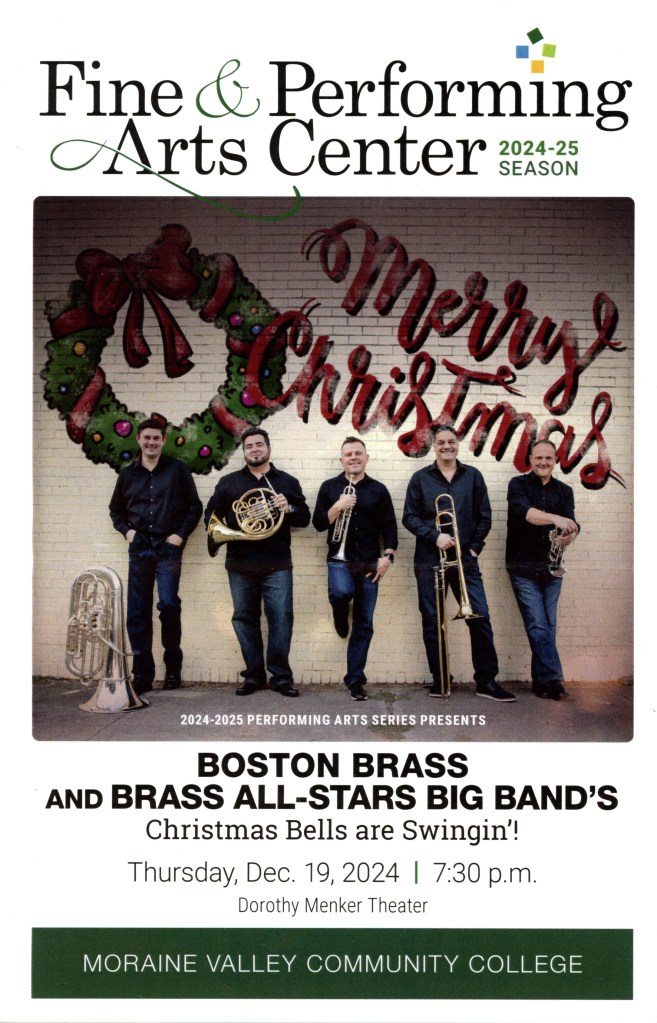
Since we moved to Illinois in 2018, I’ve enjoyed a new tradition: playing Christmas concerts with the great brass quintet, Boston Brass, and the Brass All-Stars Big Band they put together for their concerts each December. This year was the third year I was asked to play Boston Brass’ show, Christmas Bells are Swingin’! With family members in attendance, it was a real joy to bring this music—including a lot of the classic Christmas carol arrangements written by Stan Kenton and Ralph Carmichael—to appreciative audiences.

Boston Brass and the Brass All-Stars Big Band, Palos Hills, Illinois, December 19, 2024. Left to right: Domingo Pagliuca (trombone, Boston Brass), Megan Boutin, Douglas Yeo, William Russell (tuba, Boston Brass), Dan Hostetler (drums), Eric Morong (percussion), David Cutler (piano), Rick DeJonge (conductor), Joey Tartell (trumpet), José Sibaja (trumpet, Boston Brass), Rex Richardson (trumpet), Jeff Conner (trumpet, Boston Brass), Rick Castellanos (horn, Boston Brass), Sandra Donatello (horn), Alex Love (horn). Moraine Valley Community College, Palos Hills, Illinois, December 19, 2024.

Program for the concert with Boston Brass and Brass All-Stars Big Band, Christmas Bells are Swingin’! Moraine Valley Community College, Palos Hills, Illinois, December 19, 2024.

Our trombone section was terrific. Domingo Pagliuca and I have been friends for many years—like brothers. Spending time with Domingo is always a joy. And this was the first time I played in a section with Megan Boutin, assistant professor of trombone at East Texas A&M University. She’s a superb player and our section gelled just right. What fun it is to play with such fine players like Domingo and Megan!

Douglas Yeo, Megan Boutin, Domingo Pagliuca, and David Cutler. December 19, 2024.

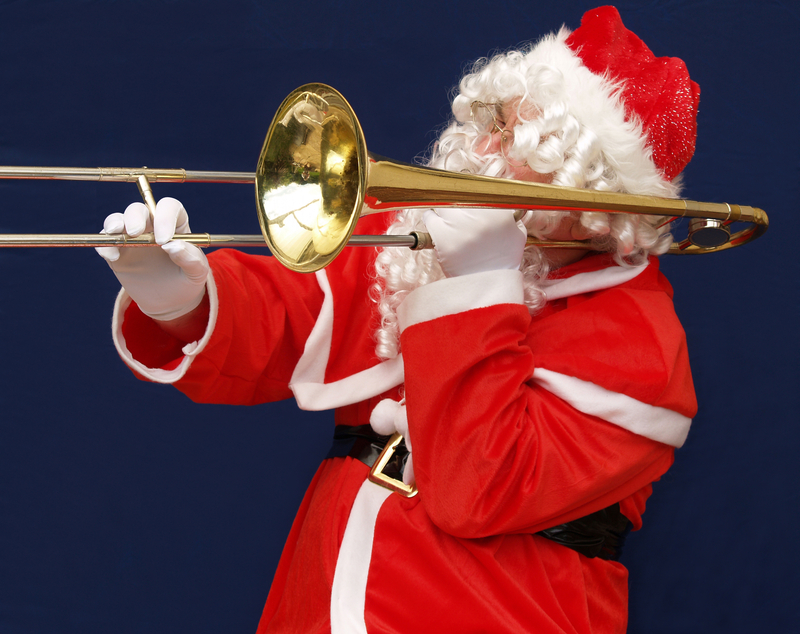
Every year since 2012, I’ve posted a poem at this time of year, A Visit from Santa Claus to a College Trombone Player. I wrote this for my students at Arizona State University, during the first year I taught there (from 2012-2016). If you’re new to The Last Trombone, you’re a trombone player, or you know a trombone player, I hope this makes you smile. Yes, Santa plays trombone. There’s even a song about that

Merry Christmas, friends.

A Visit From Santa Claus to a College Trombone Player

T’was the night before Christmas and all through my home,
All the horns were in cases, including trombones.
For after the finals and juries and tests,
It was time for some shut-eye; I needed some rest.

I was dreaming of straight mutes and pBones and more,
When I woke to a sound that I’d not heard before.
And what should I see on my roof up on high?
A Moravian choir, with trombones playing fine.

Alessi and Lindberg, Kleinhammer and Yeo,
Were all playing their horns, their heads covered with snow.
And who should be leading this heavenly band?
But old Santa himself, a trombone in his hand!

“On JJ! On Jörgen! On Tommy, and George!”
This band was so sweet, I sure did thank the Lord!
“On Norman and Pryor, Jen, Melba, and Frank!”
Some others played, too, but my mind drew a blank.

I grabbed my trombone and I lubed up the slide,
With no time for a warm-up, I hurried outside.
The gang was all playing some mighty nice tunes,
And we jammed some cool charts by light of the moon.

I invited them in just to warm up their chops,
But they just kept on playing, man, this sure was tops!
Saint Nick put his horn down to fill up my stocking,
With valve oil, and slide cream, CDs – so inspiring!

In time, things wound down and they packed up their horns,
And the sleigh got revved up and was heavenly borne.
But Santa looked back, and he said with a smile,

“Merry Christmas to all, and don’t forget to keep practicing even though you’re on vacation!”

— Douglas Yeo (with apologies to Clement Clarke Moore)

A message of hope and good news—told with a trombone

A message of hope and good news—told with a trombone

by Douglas Yeo (December 17, 2024)

When I was at work on my book about Homer Rodeheaver (Kevin Mungons and Douglas Yeo, Homer Rodeheaver and the Rise of the Gospel Music Industry, Urbana: University of Illinois Press, 2021)— Rodeheaver was the trombone-playing song leader for the Christian evangelist Billy Sunday in the first third of the 20th century—a side aspect to my research was an investigation into the work of many other trombonists who used their trombones to play sacred music and share the good news of the Gospel. There have been many of them. For instance, Cliff Barrows, who knew Rodeheaver well and who was the song leader for Billy Graham for many years, played the trombone:

Barrows_Graham_trombone

Cliff and Billie Barrows with Billy Graham, c. 1948. Wheaton College Archives and Special Collections.

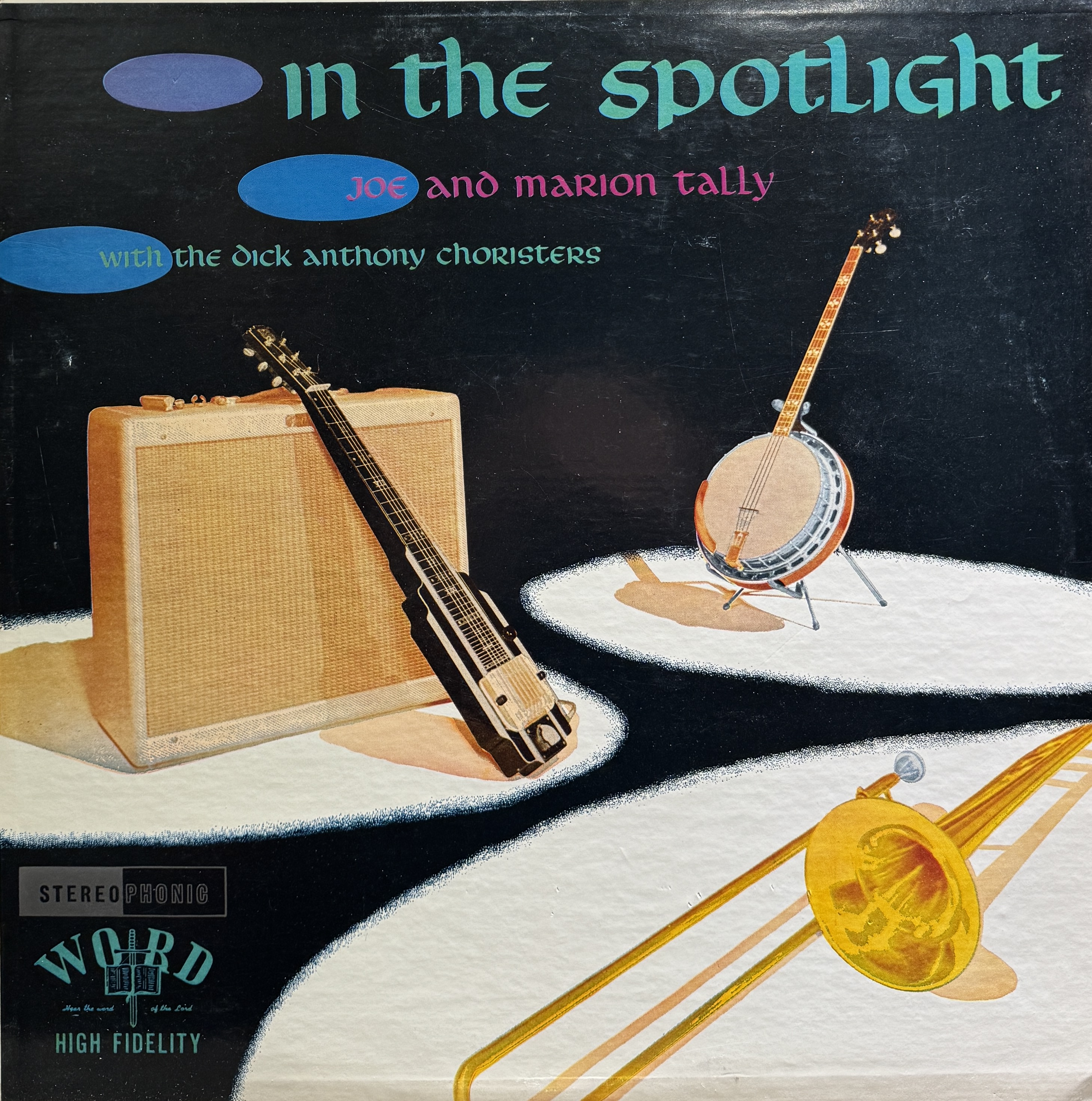
Others made recordings of gospel music with a trombone in  hand, including Joe and Marion Talley (their name is misspelled on the cover of this album, below):

Joe and Marion Tally LP

Joe and Marion Talley, In the Spotlight. WORD WST-8037 (1960)

. . . Marcy Tigner:

Marcy Tigner LP

Marcy Tigner, Marcy Tigner Trombone, Christian Faith Recordings 351 (1961)

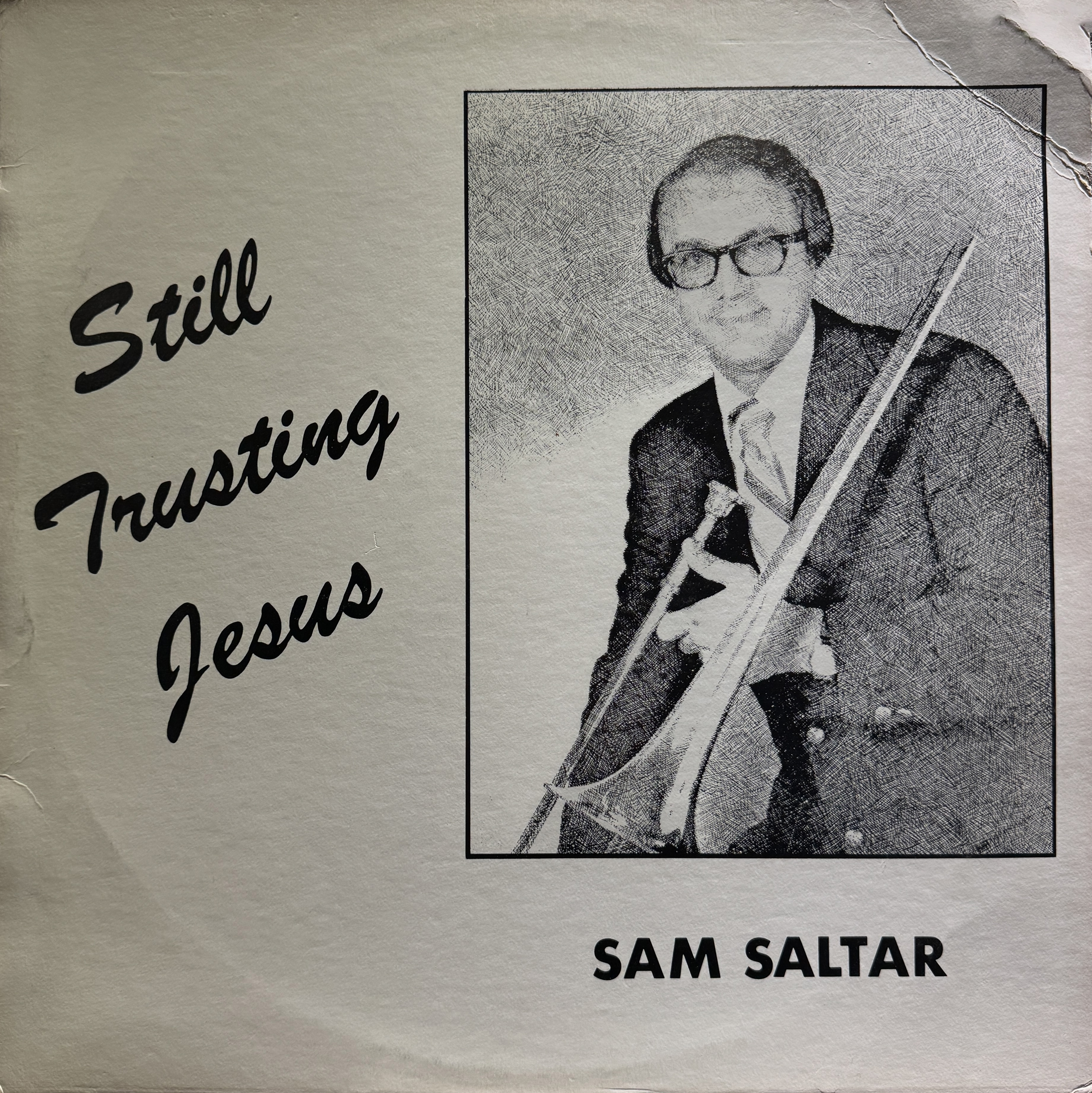
. . . Sam Salter:

Sam Saltar LP

Sam Saltar, Still Trusting Jesus, Glory Records GL-151

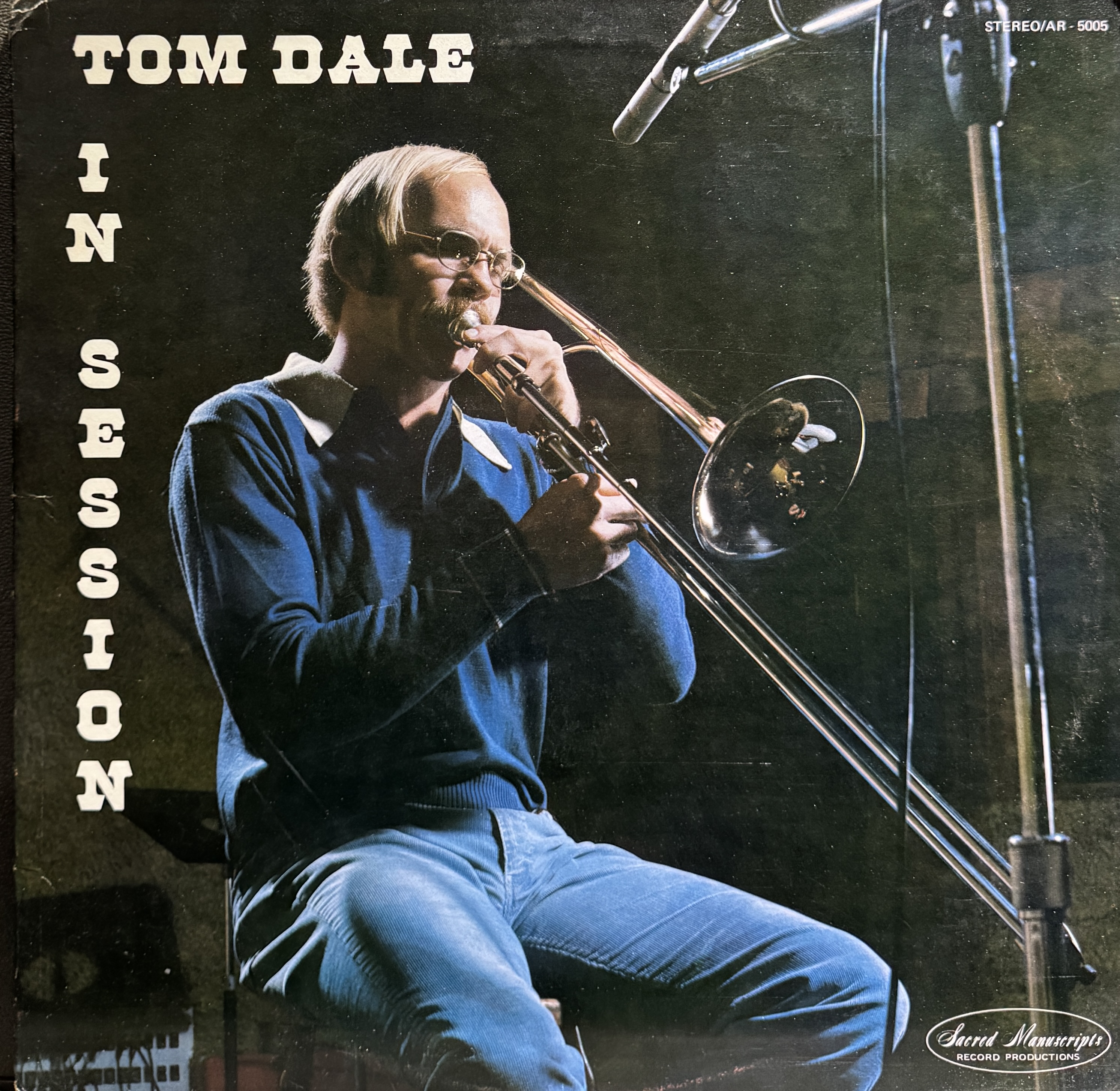
. . . Tom Dale:

Tom_Dale_LP

Tom Dale, In Session, Sacred Manuscripts Record Productions AR-5005

and Bill Pearce:

Bill Pearce LP

Bill Pearce, The Remarkable Trombone of Bill Pearce, WORD WST-8312 (1964)

There are also many superb recordings with enthusiastic playing of the trombone shout bands that rose in the United House of Prayer for All People:

Tigers Dancing With Daddy G

The Tigers Trombone Shout Band, Dancing with Daddy G, Fire Ant 1004 (1993)

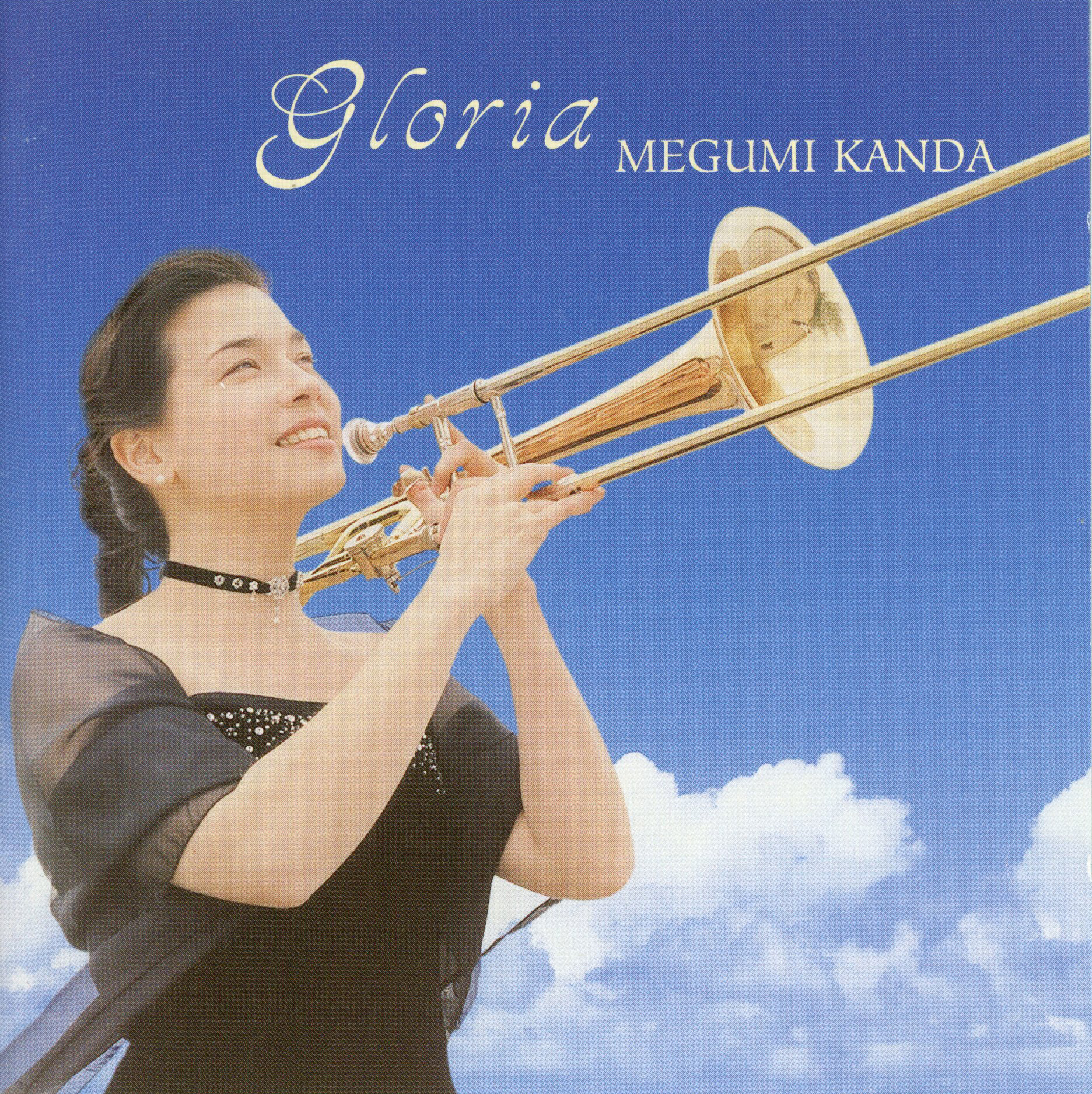
In recent years, Megumi Kanda (principal trombonist of the Milwaukee Symphony):

Kanda_Amazing_Grace

Megumi Kanda, Amazing Grace, Victor VICC-60316 (2002)

Kanda_Gloria

Megumi Kanda, Gloria, Albany Records TROY694 (2004)

. . . Wycliffe Gordon

Gordon_Gospel_Truth

Wycliffe Gordon, The Gospel Truth, Criss Cross Jazz 1192 (2000)

. . . and I have released albums of hymns, gospel songs, and spirituals.

Yeo_Cornerstone

Douglas Yeo, Cornerstone, Die letzte Posaune CD93175 (2000)

I’m at work on an article about “The Gospel Trombonist,” but with several other writing projects in the pipeline, that article won’t appear for a while. But the subject is on my mind because Christmas is around the corner, and the ubiquitous sound of Salvation Army bell ringers and brass players fills the air at shopping centers, supermarkets, and malls. The work of the Salvation Army to preach the Gospel and help the less fortunate—what Jesus Christ referred to as, “the least of these” (Matthew 25:45)—is well known. The Salvation Army’s motto is, “Doing the most good.” We should also remember that in addition to its religious and humanitarian work, the Salvation Army was also influential in the rise and influence of the brass band movement in England and around the world.

A little history: In 1878, William Booth’s Christian Revival Society—founded in the East End of London in 1865 and later called the Christian Mission—changed its name to The Salvation Army. In that same year, a brass quartet of two cornets, valve trombone and euphonium formed by itinerant preacher Charles Fry and his three sons began supporting outdoor meetings of the Salvation Army in Salisbury, England. Booth, who had long harbored ambivalence toward musical groups accompanying singing, quickly realized the value of an ensemble of brass instruments in helping to attract a crowd, and others would learn from this example. By the following year, organized brass bands had become an integral part of Salvation Army worship and evangelistic efforts.[1]

The Salvation Army has also published a tremendous amount of music for brass band, brass ensemble, and solo brass instruments, and it has released many recordings of its music, including the popular series with a jazz trombone ensemble, Spiritual to the Bone:

Spiritual to the Bone

Spiritual to the Bone, Salvation Army USA South CRD018 (1993)

But there was someone who was first among the many high-profile, trombone-playing representatives of the Gospel message, and we do right to remember him.

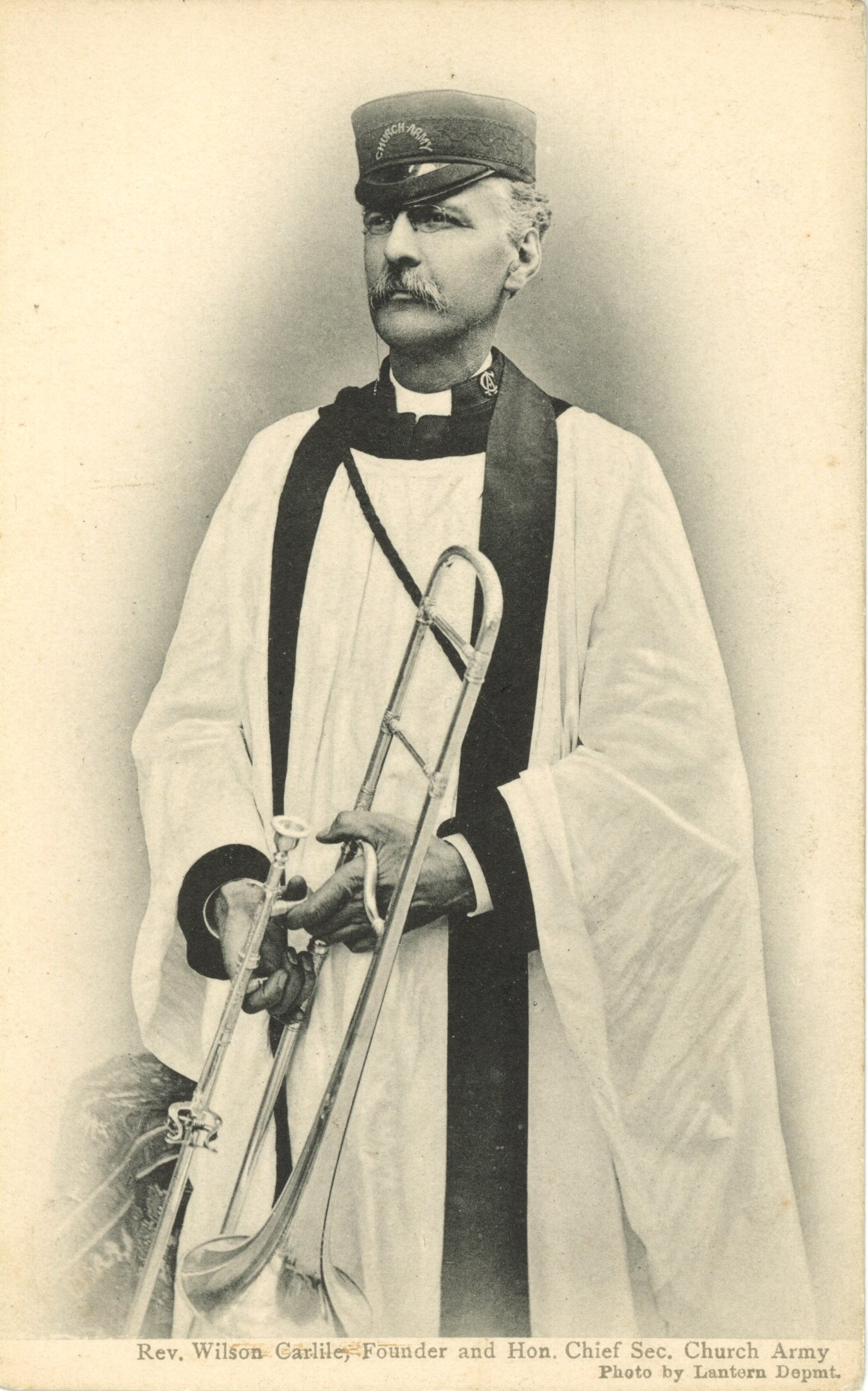
Wilson_Carlile_postcard_1900

Rev. Wilson Carlile, c. 1900

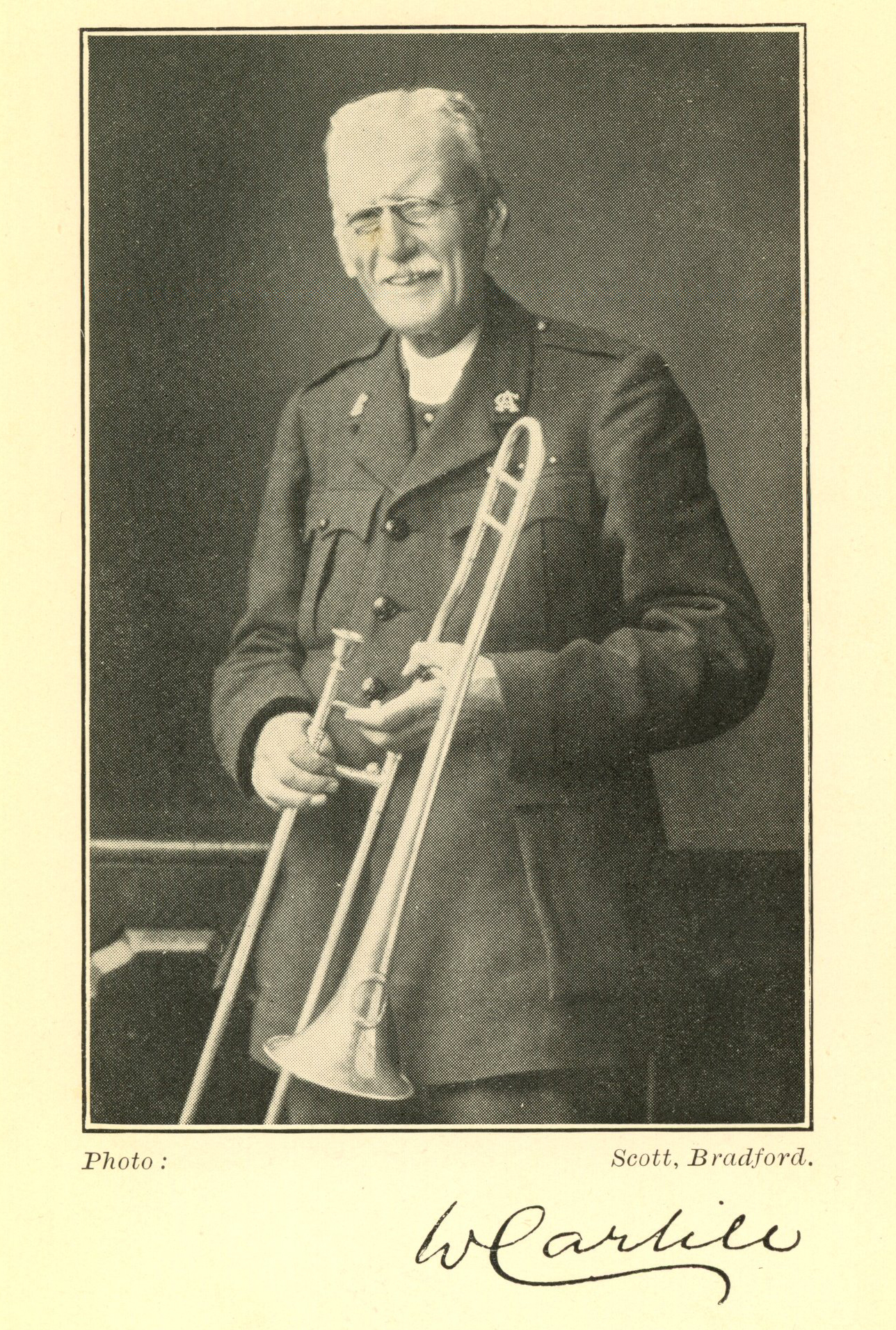
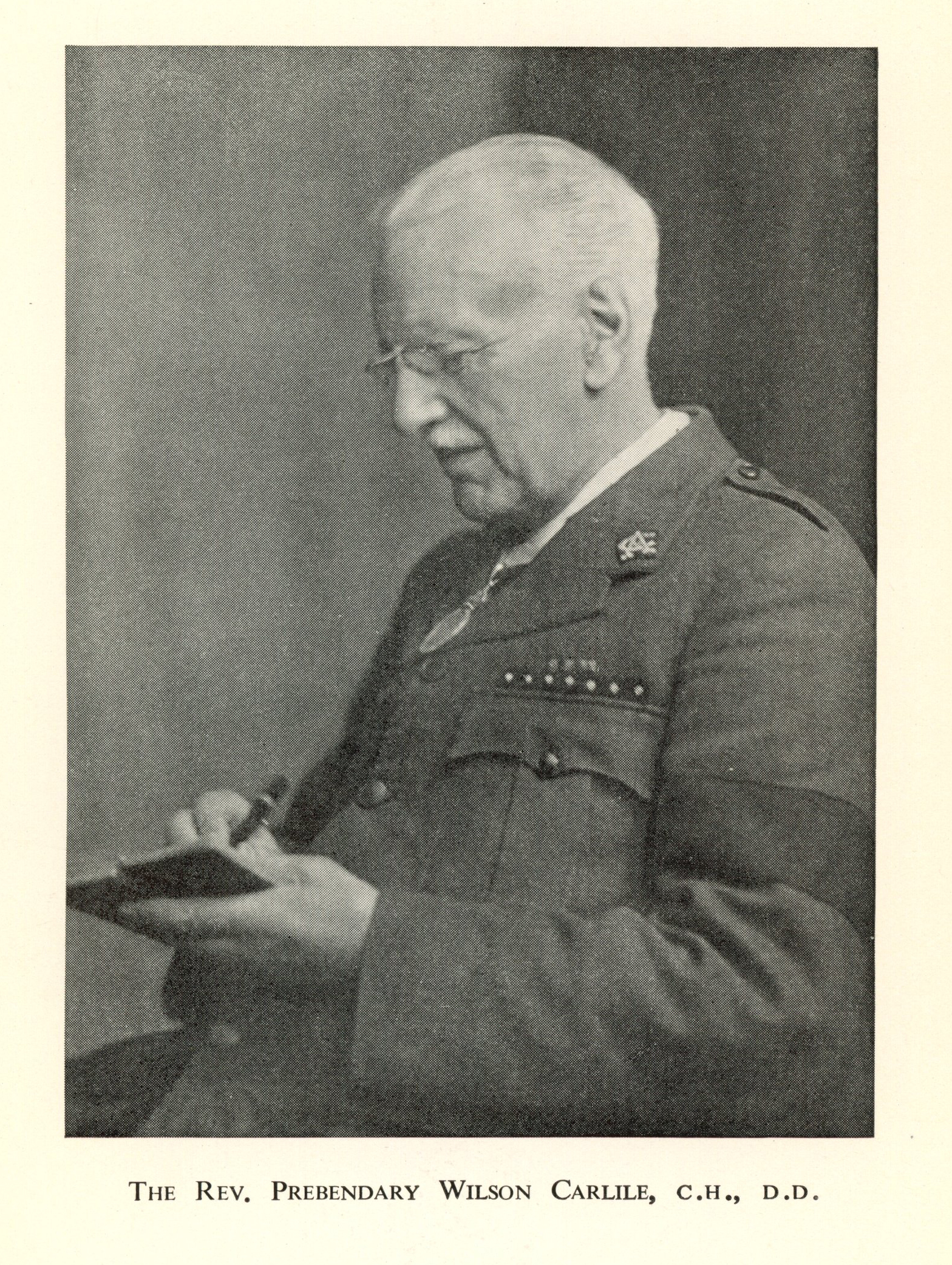
Into the environment of brass playing that was popularized by William Booth in England came Wilson Carlile (1847–1942).[2] Carlile was ordained a deacon in the Church of England in 1880 and served as a curate to the Vicar of Kensington. He began holding open-air evangelistic meetings in an effort to reach people who otherwise might not enter a church. Unlike William Booth–who broke from the Methodist Church to set up his own denomination–Carlile worked within the Church of England to overcome denominational resistance to his desire to be a missionary to the slums of London. In 1882, Carlile resigned his formal position with the Church of England and formed The Church Army, with himself at its head while he and The Church Army maintained close ties with the Church of England.

As a child, Carlile’s first musical instrument was a toy drum that he later put down in favor of the trombone. He admitted his trombone playing was less than accomplished, as when he related a story of an argument over his drum with one of his sisters that resulted in the instrument breaking and inflicting a deep wound on his hand:

I’m afraid that some of my friends today, persecuted by the trombone, wish my early musical talent had received an even sharper lesson.[2]

While the Salvation Army fully embraced the presence of brass instruments during their worship services, and by 1879 brass bands were being organized in many churches [3], Wilson Carlile was, at first, somewhat of an enigma to the Church of England. In an article from 1900 that was headlined, “Newest and Strangest Ally of the Dignified Old Church of England,” Curtis Brown reported the strange occurrence of a trombone in the pulpit in “the haughty old Church of England”:

That most dignified, serious and conservative of institutions, the Church of England, has taken into alliance a man with a trombone, who horrified the stately Bishops at first by carrying his instrument into his pulpit and playing it right lustily, too. . . .The man with the trombone typifies this queer army which is beginning to attract general attention. He has played that trombone in the streets, in saloons and in dance halls, and has had it pretty badly battered in many an encounter with toughs. He was laid up six months after one such fight, and he and his trombone had to be patched before they could get into line again.[4]

“Preachers in their Pulpits: The Rev. Wilson Carlile of the Church Army.” The Tatler, No. 109 (July 22, 1903)

The sight of Wilson Carlile marching around London in his clerical frock while playing his trombone achieved its desired effect. The parade of curiosity seekers that followed Carlile to St. Mary-at-Hill on London’s Love Lane experienced a church service like no other. As Homer Rodeheaver was to do later, Carlile adopted the “magic lantern,” an early form of projector that displayed large images on a large white sheet above the church’s altar. These projections were, in the main, of Biblical characters and scenes, but Carlile also engaged in social commentary, showing the contrast between slum life and the “palaces of the rich.” Carlile also employed a large phonograph during services, a “monsterphone,” from which which emanated sermons by other preachers including the Archbishop of Canterbury as well as an occasional Sousa march.[5]  “This,” Carlile’s biographer wrote, “had the effect of driving away all orthodox people in horror, and attracting the loafers from the street, who warmly supported the new form of service long before it received a friendly smile from the Bishops.”[6] Carlile’s message of the Gospel changed lives.

Carlile_trombone_1926

Wilson Carlile. From: Edgar Rowan, Wilson Carlile and the Church Army (London: The Church Army Bookroom, 3rd edition, 1926)

Newspapers across the United States ran articles about Carlile and his unconventional evangelistic outreach. The Louisville Courier-Journal devoted an entire page to the “Man with the Trombone and His Great Army: Newest and Strangest Ally of the Dignified Old Church of England.” [7] The Chicago Daily Tribune painted a vivid picture of Carlile’s use of the trombone as a tool for reaching audiences with his evangelistic message:

The real power of the man behind the trombone is illustrated in the career of the Rev. Wilson Carlile of England, the head of the Church Army. He began his career with a broken-winded harmonium, but he soon found that to reach the masses he must have a trombone. For eight years he has blown that trombone. He has blown it in streets, saloons, and dance halls, and has horrified the stately Bishops by sounding its sonorous blasts in the pulpit. Occasionally the roughs of London have objected to his music, and then he and his trombone have been laid up for repairs, both badly battered. . . . The man with the trombone is an indefatigable worker. . . . He plays on his trombone. He exhorts. He sings. He makes things generally lively in the pulpit. He gathers his audience for the night service by marshaling his band and choir, which he heads with his trusty trombone, and makes a procession through the streets near his church, blowing lustily. The crowd follows him. At each saloon the march halts, while the trombone man drags out three or four habitués who join the procession. When he gets back and sounds the first blast in his pulpit, the church is packed. . . .

All this is the work of the man behind the trombone, and for the possibilities that lie in that much-maligned instrument let all trombone players be respected. They are not as bad as they look. In the hands of a man truly great the trombone is more powerful than the sword.[7]

Carlile_c1938

Wilson Carlile. From: A. E. Reffold: The Audacity to Live: A Résumé of the Life and Work of Wilson Carlile (London: Marshall, Morgan, & Scott, 1936)

Now, as Christmas approaches and the sound of brass instruments is in the air, we look at Wilson Carlile—and many others—who joyfully brought—and bring—the Gospel message of hope and good news to a hurting world with a trombone in hand, a message that came to us 2000 years ago in a manger in Bethlehem, to change lives and bring true, lasting peace (Luke 2:14).

• • •

NOTE: Here follows the full text of the article about Wilson Carlile that was referenced above, “The Man Behind the Trombone,” from the Chicago Daily Tribune, March 4, 1900. Notes for this blog post about are found at the end of the Chicago Daily Tribune article.

Carlile - The Man Behind the Trombone- Chicago Tribune_4 Mar 1900

[1] Ronald W. Holz, Brass Bands of the Salvation Army: Their Mission and Music. Volume 1 (Stotfold, Herts.: Street Publishers, 2006), 63–74.

[2] Edgar Rowan, Wilson Carlile and the Church Army, 3rd ed. (London: Church Army Bookroom, 1926), 5.

[3] Ronald W. Holz, Brass Bands of the Salvation Army: Their Mission and Music. Volume 1, 69.

[4] Curtis Brown, “Man With the Trombone and His Great Army: Newest and Strangest Ally of the Dignified Old Church of England,” The Courier-Journal (Louisville, Kentucky), February 25, 1900.

[5] Stephen Bottomore, “Projecting for the Lord: The Work of Wilson Carlile,” Film History, Vol. 14, No. 2, Film and Religion (2002), 199-200.

[6] Edgar Rowan, Wilson Carlile and The Church Army, 60.

[7] “The Man Behind the Trombone,” Chicago Daily Tribune, March 4, 1900.

Fast cars and the value of friendship

Fast cars and the value of friendship

by Douglas Yeo (August 2, 2024)

Life is full of surprises, unexpected moments that lead to bigger things. Try something that’s a little outside your box—your comfort zone—and you’ll probably learn something. If you’re open to learning. Our friends, Phil and Laura Spotts, taught us something about this.

My wife, Patricia, and I met Phil and Laura at our church in 2012. We had just moved to Arizona after I retired from my long career as a member of the Boston Symphony Orchestra. Phil struck me right away as a gregarious, “can do” kind of guy. The kind of person who is always volunteering to do something, make things happen. Phil’s an engineer but not one of those stuffy, geeky, academic types. He’s real, has a great sense of humor, and is always thinking about how to help others. Laura is a gifted pianist who played piano from time to time at our church services, another truly wonderful person. When we met them, they had a son, Cody, and in time, they became Superheroes and adopted two more children, Gage and Annaliese. There was something about this family that made Pat and me smile. We spent time together, went over to each other’s houses for dinner (Phil is a terrific cook, and we still use his fantastic leg of lamb recipe several times a year), we shared life. And our friendship grew even as we were very different people in some ways. For instance, they liked—no, they LOVED—something that was a mystery to me: NASCAR. I’m not gonna lie: before I met Phil and Laura, my life had no place for NASCAR. Growing up in and around New York City and living in Boston for nearly three decades, I fell into the east coast snobbery when it comes to things like NASCAR. “Go fast, turn left.” Doesn’t sound very interesting. Also, fast cars are loud and I work hard to protect my hearing. Big hair, beer, southern accents—those are some of the many stereotypes you bring to something like NASCAR when you’re in a cocoon in some parts of the elitist northeast.

Phil_Laura_PIR_March_2014

Phil and Laura Spotts at Phoenix International Raceway, March 2, 2014

So, when Phil and Laura invited Pat and me to go to a NASCAR race at Phoenix International Raceway (November 2013), my mind quickly buzzed around through all of my NASCAR stereotypes before I said, in a confident voice, “Sure. Let’s go!” And we did. Because this was important to our friends.

PIR_NASCAR_panorama_2013_03_02

Panoramic view of Phoenix International Raceway, March 2, 2014

The experience of going to a NASCAR race is unlike anything I’ve done in my life. I love football, and I enjoy baseball. I know what it is to cheer my team at a game, to engage with other fans around me. But NASCAR was something different all together. First, it was BIG. A lot of people go to races. A. Lot. Some come in campers and motor homes, driving from race to race and living in temporary camps that surround a racetrack, a camp that usually has a popup supermarket, bank, and urgent care center. For race weekend, a NASCAR track becomes a small city.

Phil and Laura had headsets for us that were both excellent hearing protection—I have to say, though, as I looked around from my seat, I was stunned to see so many people who were not wearing any kind of hearing protection, wow—and were connected to Phil’s radio scanner that gave us the race feed. Before the race I kept asking questions. I realized quickly that there was a lot more to NASCAR than the stereotypes I had carried with me for so long. This is a high-tech sport. There is a LOT of money involved. It’s really dangerous for the drivers. Fans are passionate about their drivers and their cars. Sponsorship is really, REALLY important. Pit crews—the crew of technicians who service cars before and during the race—work incredibly hard and fast, like a well-oiled machine. And there is a whole lot of strategy.

Doug_Pat_PIR_2013_11_10

Douglas and Patricia Yeo, Phoenix International Raceway, November 10, 2013

There were other things. At the race, I didn’t have any skin in the game; I didn’t know any drivers, so I asked Phil and Laura who there favorite drivers were. OK, they were now my favorite drivers. But when cars are racing around the track at 180 miles an hour at 130dB (that is loud, like a jet engine ready for takeoff on a runway), there’s no point in cheering during the race. Your driver can’t hear you. Other fans can’t hear you. Heck, you can’t even hear yourself. When the cars were roaring around the track, I didn’t dare take off my headset and expose my ears, so if I wanted to say something to Pat, Phil, or Laura, I pulled out my phone and typed a text message and showed it to them.

PIR_March_2014

Phoenix International Raceway, March 2, 2014

Before the race there was the National Anthem, then a flyover and a prayer, and then we were—literally—off to the races. And somehow, what enfolded in front of me captivated me in a way I didn’t expect. As I saw it with my own eyes, as I gave it a chance, as I tried to understand it, I found myself pulled into it. The old stereotypes fell away; I was learning something new. And I liked it. And that experience would not have happened were it not for friends that asked us to do something that they loved and wanted to share with us. I learned a very important lesson on that day. Several, actually. When, a year later (March 2014), Phil and Laura asked us to go to another race at Phoenix International Raceway, we did.

Then Phil took a new job and their family moved to Tennessee. Pat and I moved to the Chicago area so we could live near our grandchildren. While Phil and I weren’t seeing each other regularly any more—something we did a lot when we both lived in the Phoenix area, especially meeting for lunch at our favorite sushi place, Ah-Hai in Goodyear (yes, there really and truly is amazing sushi in the desert!)—we kept in touch, texting and talking on the phone. Then Phil called one day to tell me Cody started playing the trombone—Phil said that Cody picked the trombone because he had heard me play trombone in our church.

Cody_Spotts_E-Hamilton_HS_trombone

Poster of Cody Spotts, trombonist at East Hamilton High School, Tennessee

Then, last October, Phil texted me. Cody was graduating from high school in a few months and Phil wanted to take him to a NASCAR race as a graduation present. Any race, anywhere. And Cody said, “I want to go to the Chicago Street Race with Mr. Yeo.” Phil and Cody were coming to Chicago and  they asked me to go to another NASCAR race. Of course I said “yes.” I was excited. July 6 and 7, 2024 couldn’t come soon enough.
Doug_Phil_Cody_Portillos_NASCAR_2024

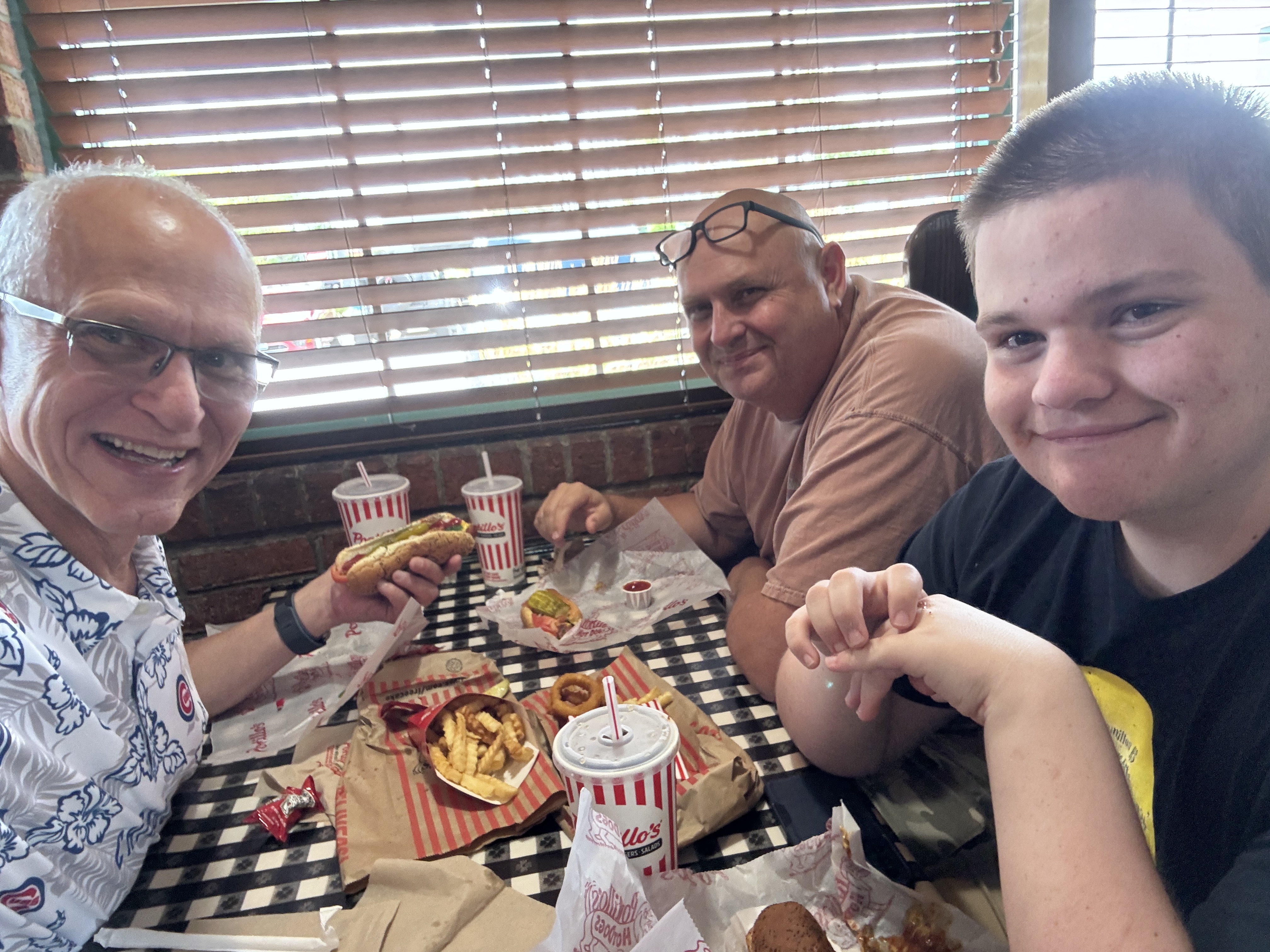
Douglas Yeo and, Phil and Cody Spotts, Portillo’s, July 5, 2024

I picked up Phil and Cody at Chicago’s O’Hare airport and because Cody had never been to Chicago, they wanted to immerse themselves in “the full Chicago experience.” We started with lunch at that iconic Chicago hot dog restaurant, Portillo’s. A Vienna Beef hotdog on a sesame seed bun, tomatoes, mustard, relish, dill pickle, raw onions, sport (hot) peppers, celery salt—but NO KETSUP! There’s nothing like it and Portillo’s is the place to get the real deal.

Doug_Cody_Phil_Giordanos_NASCAR_2024

Douglas Yeo and Cody and Phil Spotts, Giordano’s, July 5, 2024

Dinner that night was at Giordano’s where Cody experienced his first Chicago style deep dish pizza. Pat and I don’t eat at Portillo’s and Giordano’s very often—our low fat diet doesn’t have a lot of room for zillion calorie, high fat meals—but, hey, now and then, you gotta live a little.

NASCAR_Chicago_2024_map

Course map for NASCAR 2024 Chicago Street Race

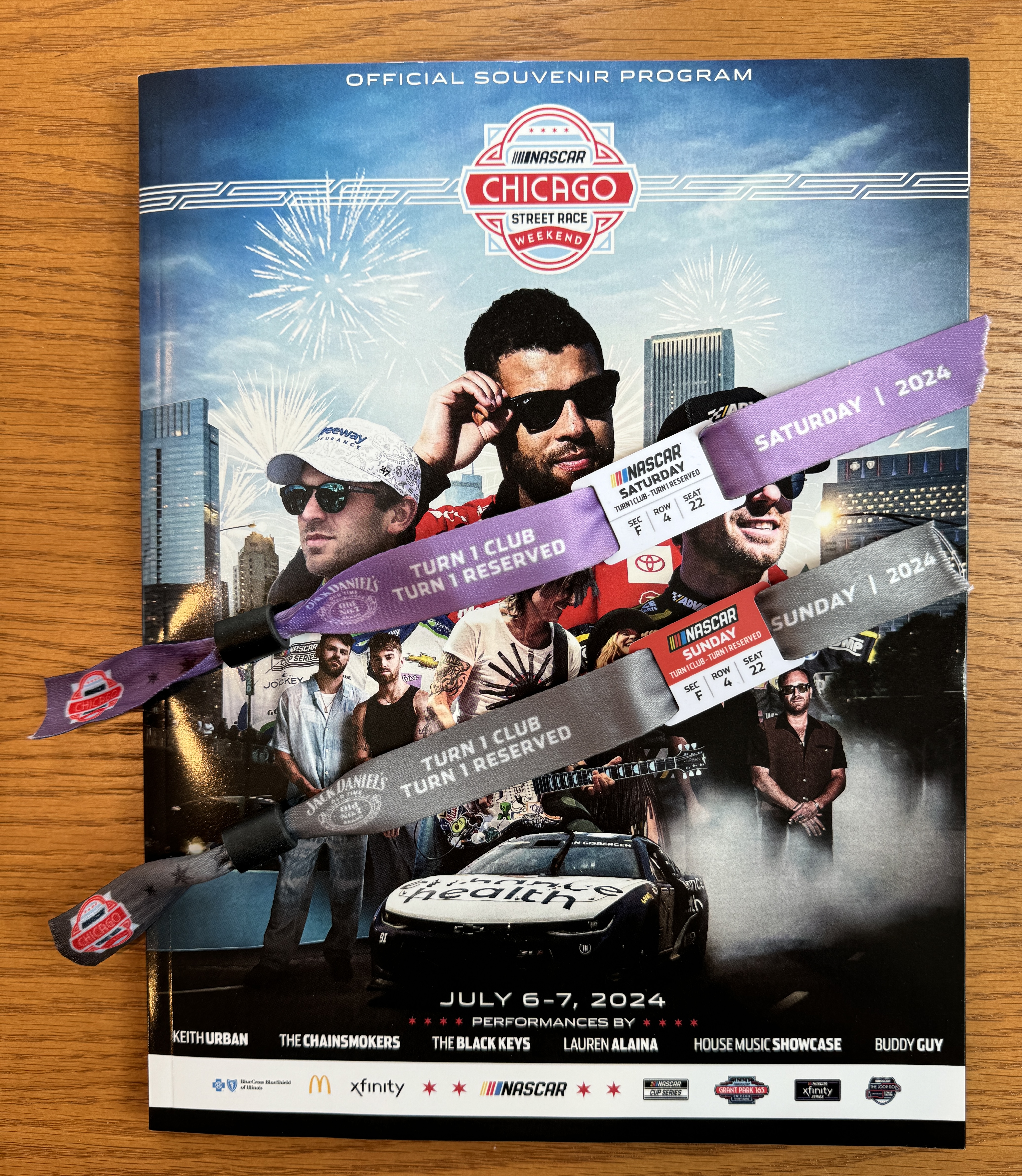
The Chicago Street Race is a unique NASCAR event. It’s a race (two races, actually) that—literally—goes through streets of downtown Chicago. Instead of a long oval track, the Chicago race track is a modified figure-8, a course that snakes through the heart of the city, along Lake Shore Drive, Michigan Avenue, and South Columbus Drive. Phil had gotten Turn 1 Reserved tickets for the three of us in the Jack Daniels Turn 1 Club. I didn’t know what that meant but I found out soon enough.

Cody_Phil_The_Bean_NASCAR_2024

Cody and Phil Spotts at “The Bean” (officially called Cloudgate), Millenium Park, Chicago, July 6, 2024

We took the train from College Avenue Station in Wheaton, Illinois, to downtown Chicago and walked toward Millenium Park near Chicago’s waterfront. There, we walked around as I showed Phil and Cody some of the iconic things in the Park, like “The Bean.” In the photo above, you can see me in my orange Phoenix International Raceway shirt, reflected in this remarkable public art installation, taking this snapshot of Cody and Phil.

Doug_Cody_Phil_NASCAR_2024_sign

Douglas Yeo and Cody and Phil Spotts, Millenium Park, Chicago, July 6, 2024

Once we got through the turnstiles with our wristbands, we made our way to our seats to get a look at our view. It was stunning. As one who knows Chicago pretty well, it was truly remarkable to see the race course laid out on roads and in view of iconic buildings that I had seen in completely different contexts.
NASCAR_2024_view_turn_1_club

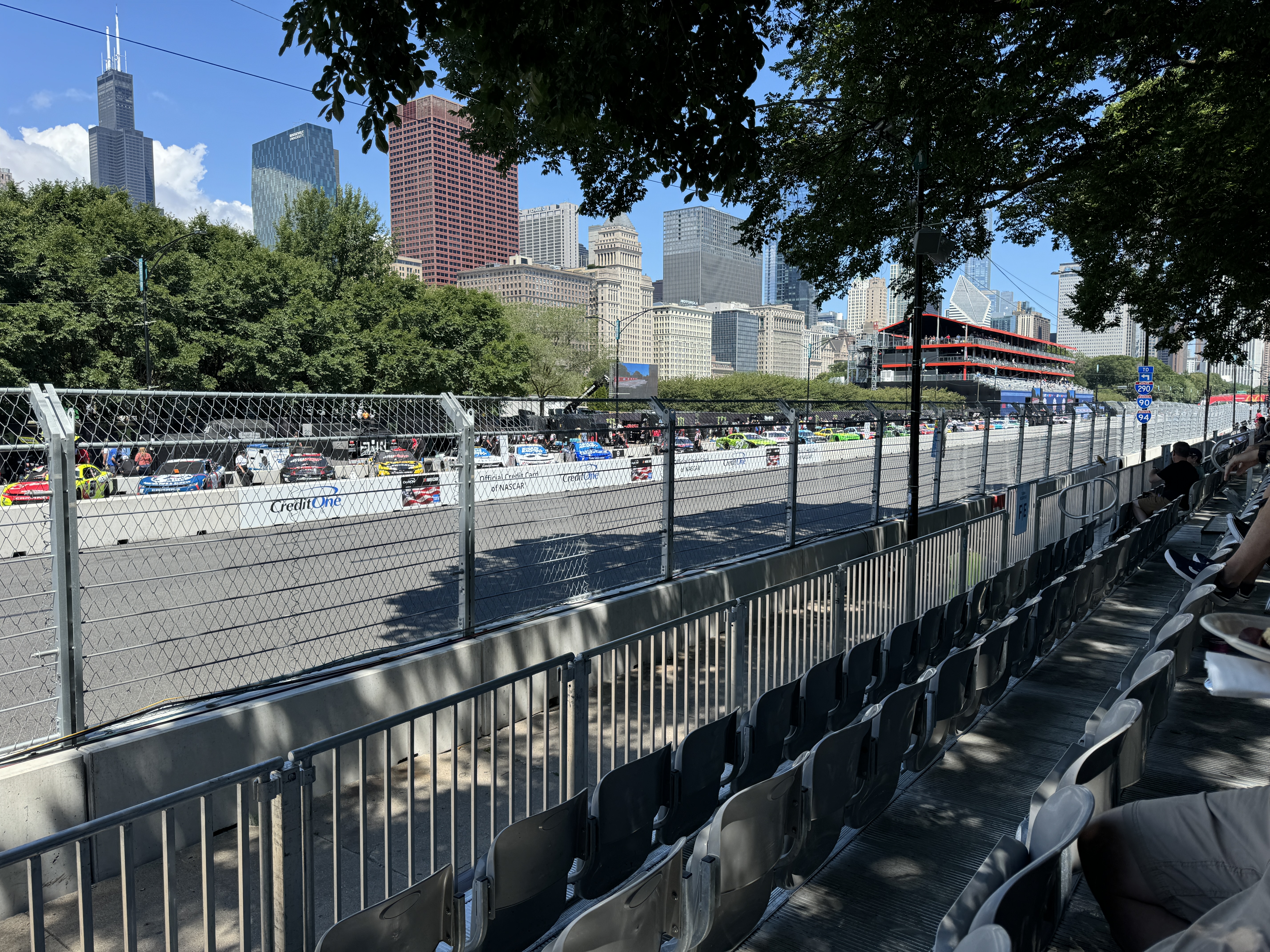
The view from our seats for the NASCAR Chicago Street Race Weekend, Jack Daniels Turn 1 Club, July 6, 2024. The start/finish line was down South Columbus Drive by the grandstand in the right of this photo. The Sears Tower (AKA Willis Tower) is the tall building on the left of the photo, with white antennas on top.

I mean, there we were, seated on South Columbus Drive, with the Sears Tower (OK, I know it’s been called the Willis Tower since 2009, but no Chicagoan calls it by that name) and the hotels of Michigan Avenue in view. I have driven down South Columbus Drive many times on the way home from Chicago Bears games at Soldier Field but traffic is always going north. For the race, the cars would be going south. It took some time for me to get my arms around that. It was surreal to see the city transformed into a racetrack.
Phil_Cody_Doug_club_NASCAR_2024

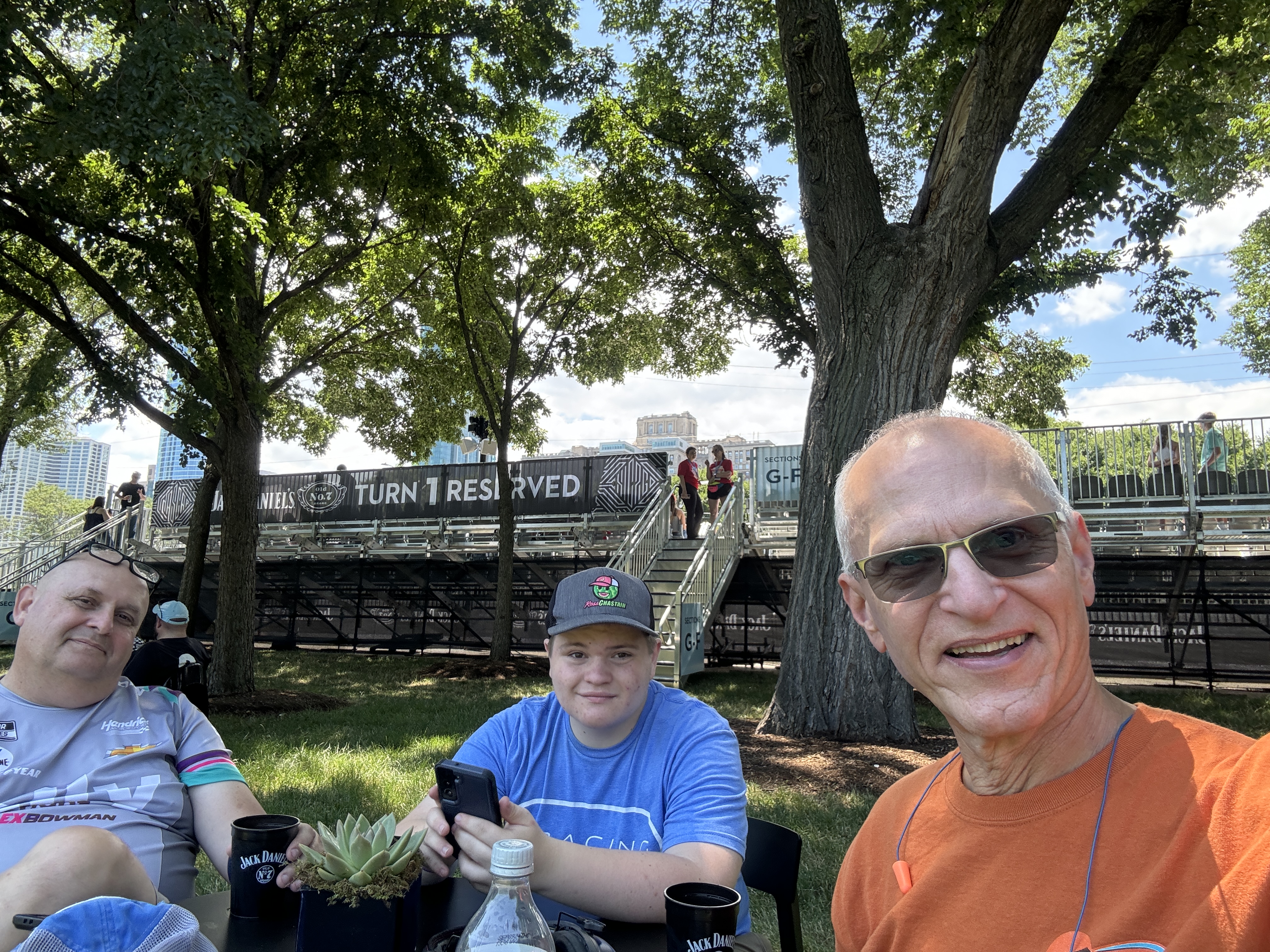
Phil and Cody Spotts and Douglas Yeo, Jack Daniels Turn 1 Club, July 6, 2024

Phil really outdid himself with tickets in the Turn 1 club; it was a lavish gift. We had terrific reserved seats, a nice, shaded area where we could relax, and UNLIMITED amazing food and drink. During the whole race, the three of us grazed on fantastic food. It was always there for us, all day long. What a special experience it was to sit in such remarkable seats with these amenities. And it happened because of friendship.
MONSTER_drink_cyclists_NASCAR_2024b

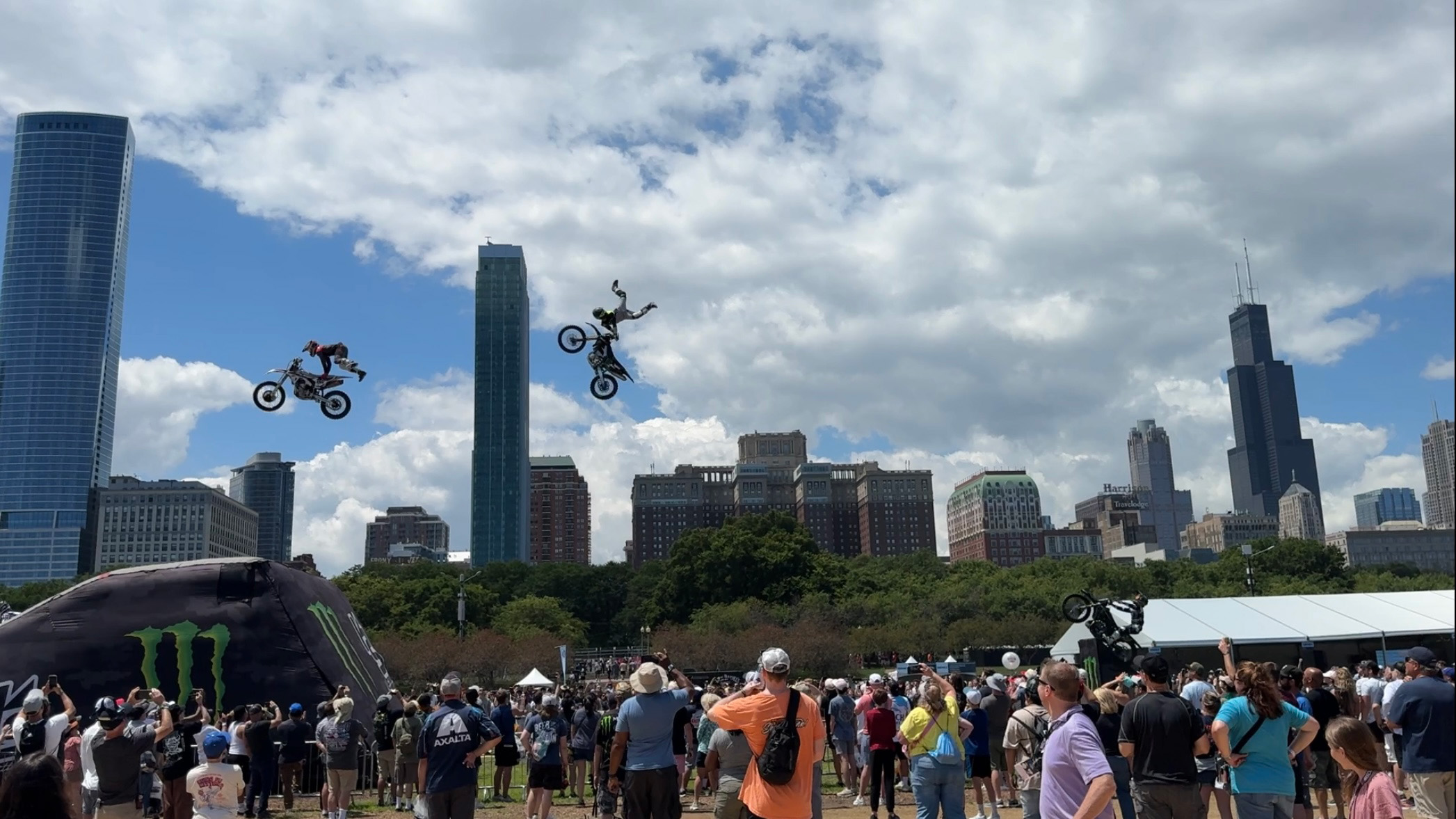
MONSTER Energy Drink acrobatic motorcyclists, Chicago, July 6, 2024

Before the race, we walked around to all of the sponsor tents, the NASCAR shop, and the wide open area where concerts were going on all day. The MONSTER Energy Drink acrobatic motorcyclists did their show; it was breathtaking.
Race_view_finish_Saturday_NASCAR_2024

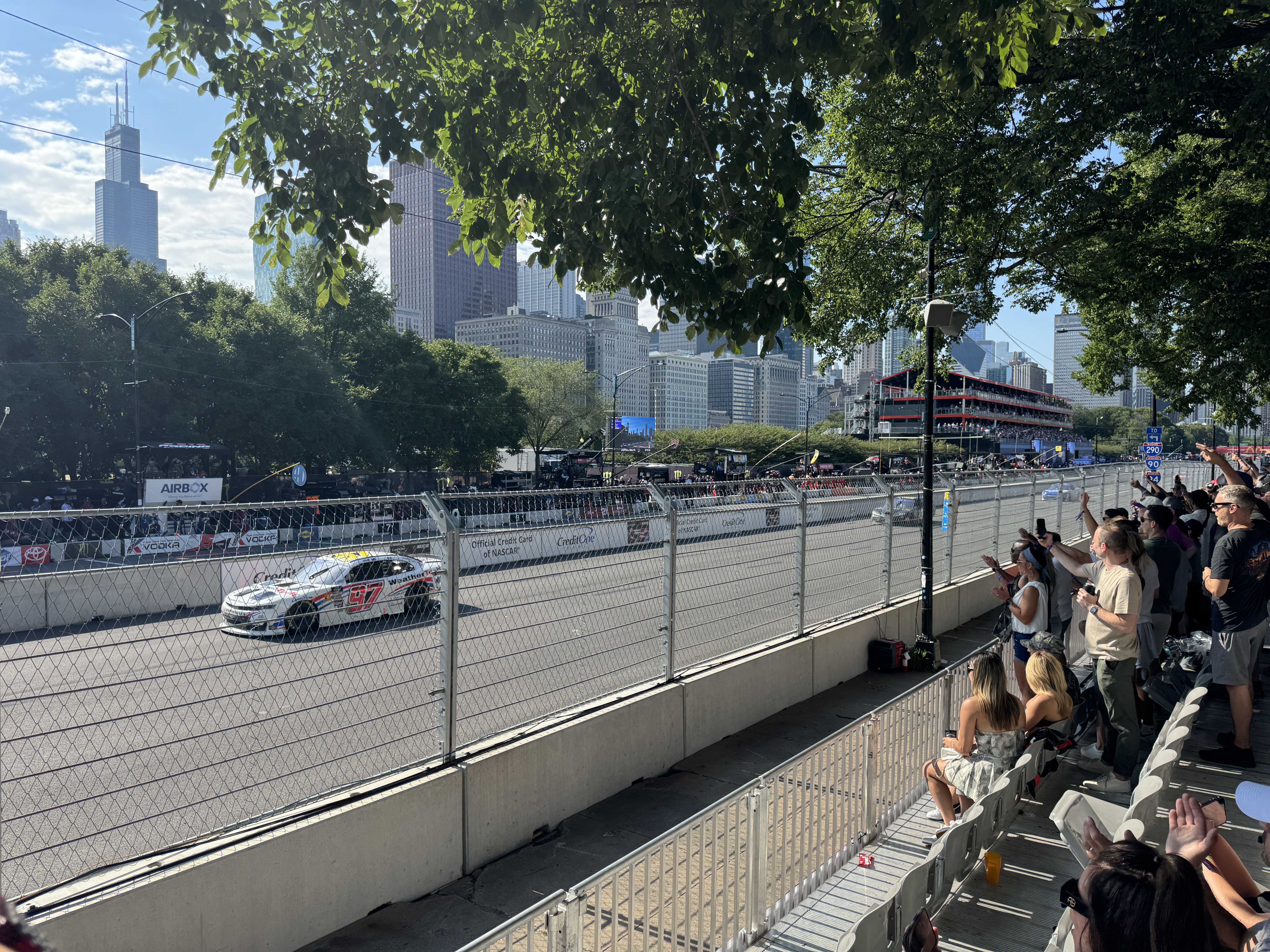
Shane Van Gisbergen (97 car) after crossing the finish line at the Loop 110 NASCAR Xfinity Series Race, Chicago, July 6, 2024

And then Saturday’s race, the Loop 110 NASCAR Xfinity Series Race, began. I can’t explain it. It was such a totally different experience than I had at Phoenix International Raceway. Drivers were not going in a loop, always turning left. They were navigating sharp 90-degree turns after long and short straightaways. Speeds were fast, but not as fast as a regular oval track NASCAR race. The cars went flying by; we followed the progress of the race in our headsets. It was absolutely thrilling. The race was won by Shane van Ginsbergen in his 97 car. If you want to get an idea of what we saw, click here to view the whole race on YouTube.
Cody_Phil_Route_66_NASCAR_2024

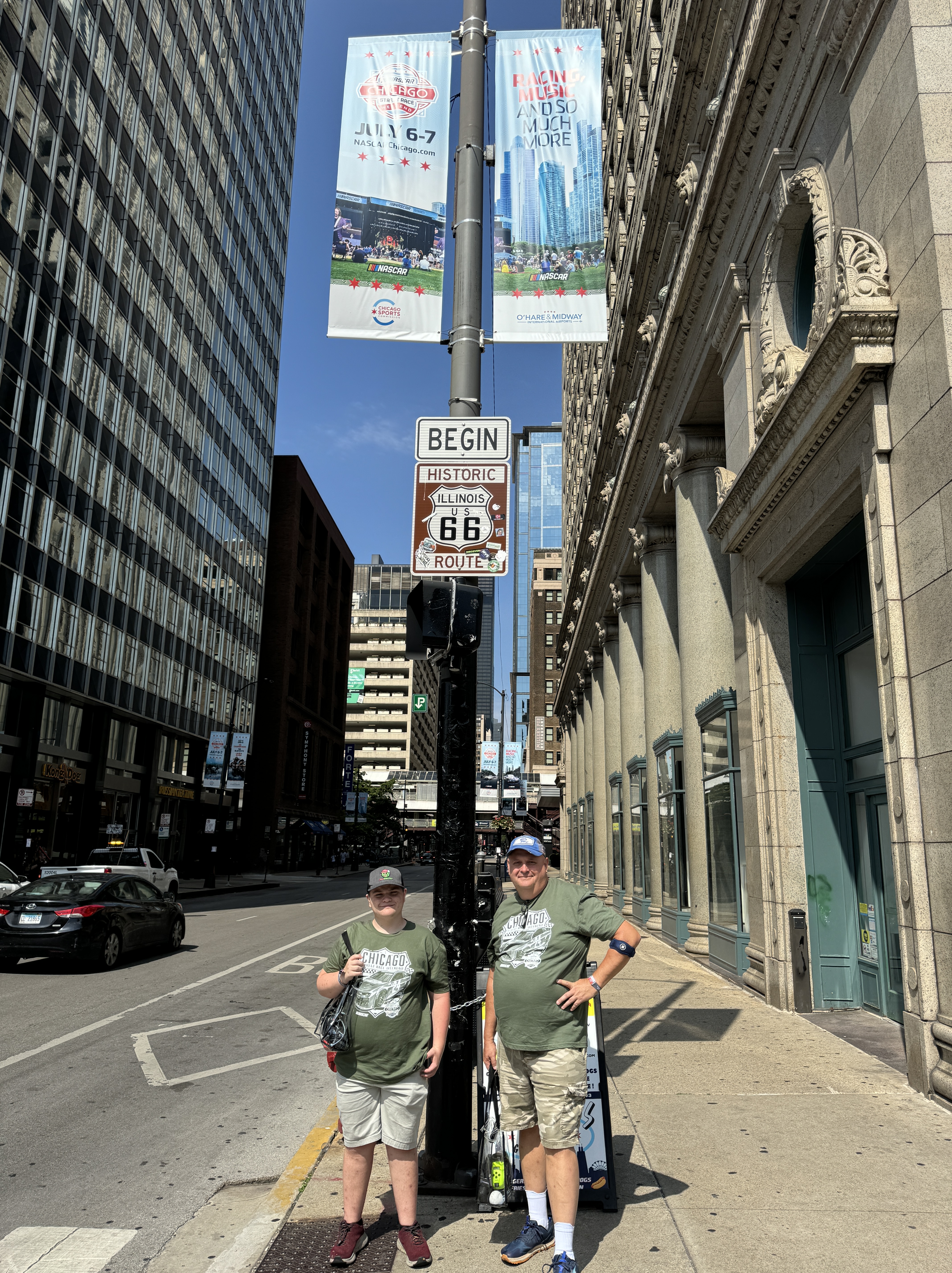
Cody and Phil Spotts at the beginning of historic Route 66 begins, Michigan Avenue, Chicago, July 7, 2024

After the race, we took the train home and after a short night of sleep, we headed back to Chicago for Sunday’s race, the Grant Park 165. When we got downtown, I wanted to show Phil and Cody where historic Route 66 started—at the intersection of Michigan Avenue and East Adams Street, just across from the Art Institute of Chicago. I took this photo (above) while I was STANDING IN THE MIDDLE OF MICHIGAN AVENUE. I had never done THAT before.
Doug_Cody_Phil_Buckingham_Fountain_day_NASCAR_2024

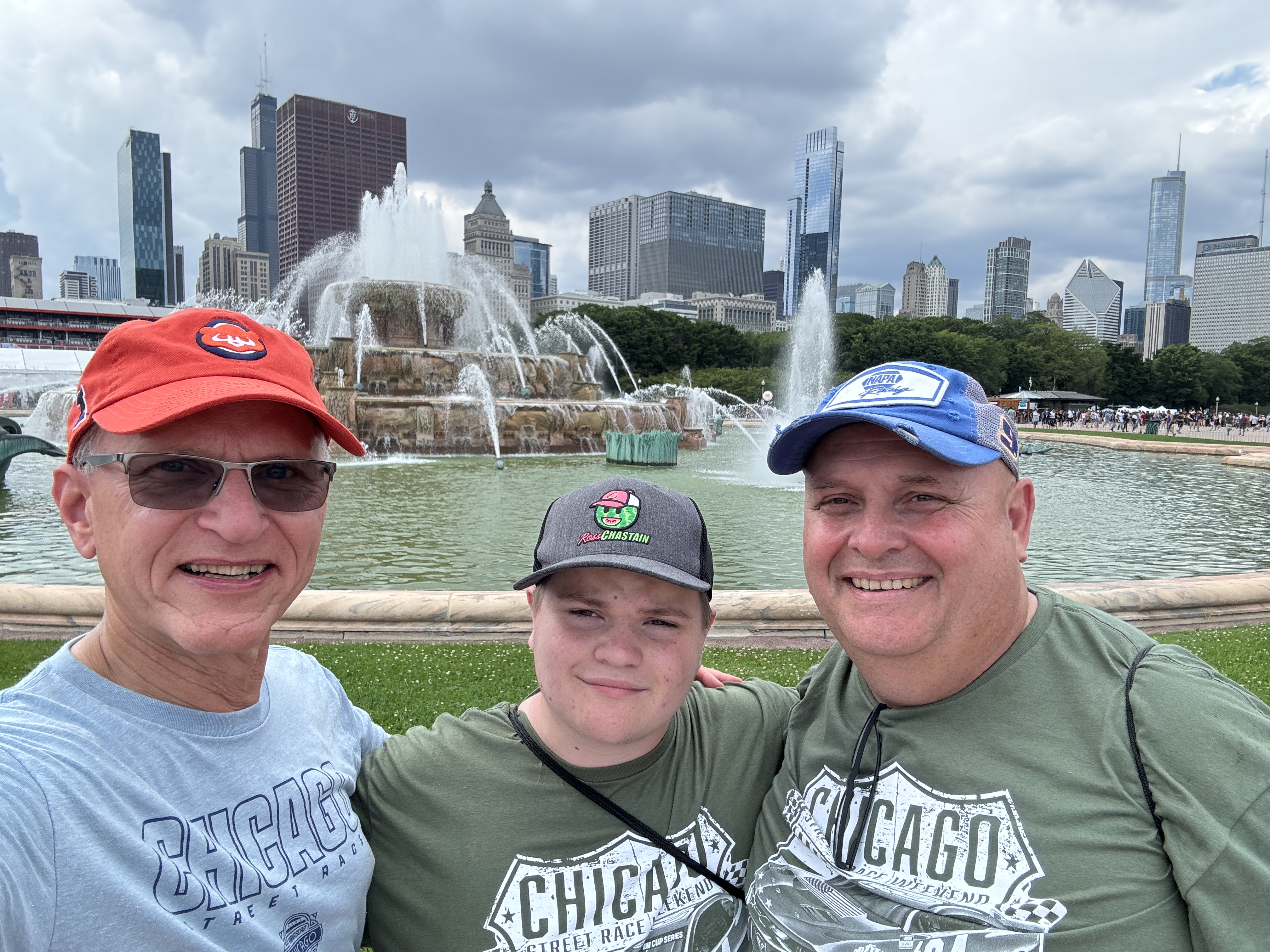
Douglas Yeo and Cody and Phil Spotts, Buckingham Fountain, Chicago, July 7, 2024

In the center of Chicago’s Grant Park is the Buckingham Fountain. It was a centerpiece of our race days, its fountains providing soft mist to cool off on hot days.

Doug_Cody_Phil_on_the_track_NASCAR_2024

Douglas Yeo and Cody and Phil Spotts, on the NASCAR Chicago Street Race track, E. Balbo Drive, Chicago, July 7, 2024. Note the temporary bridge over E. Balbo Drive.

Once we got in the Park, we had an opportunity to walk ON THE TRACK. This was another thrill, to get up close to the view the drivers had.
Doug_wet_NASCAR_Sunday_2024

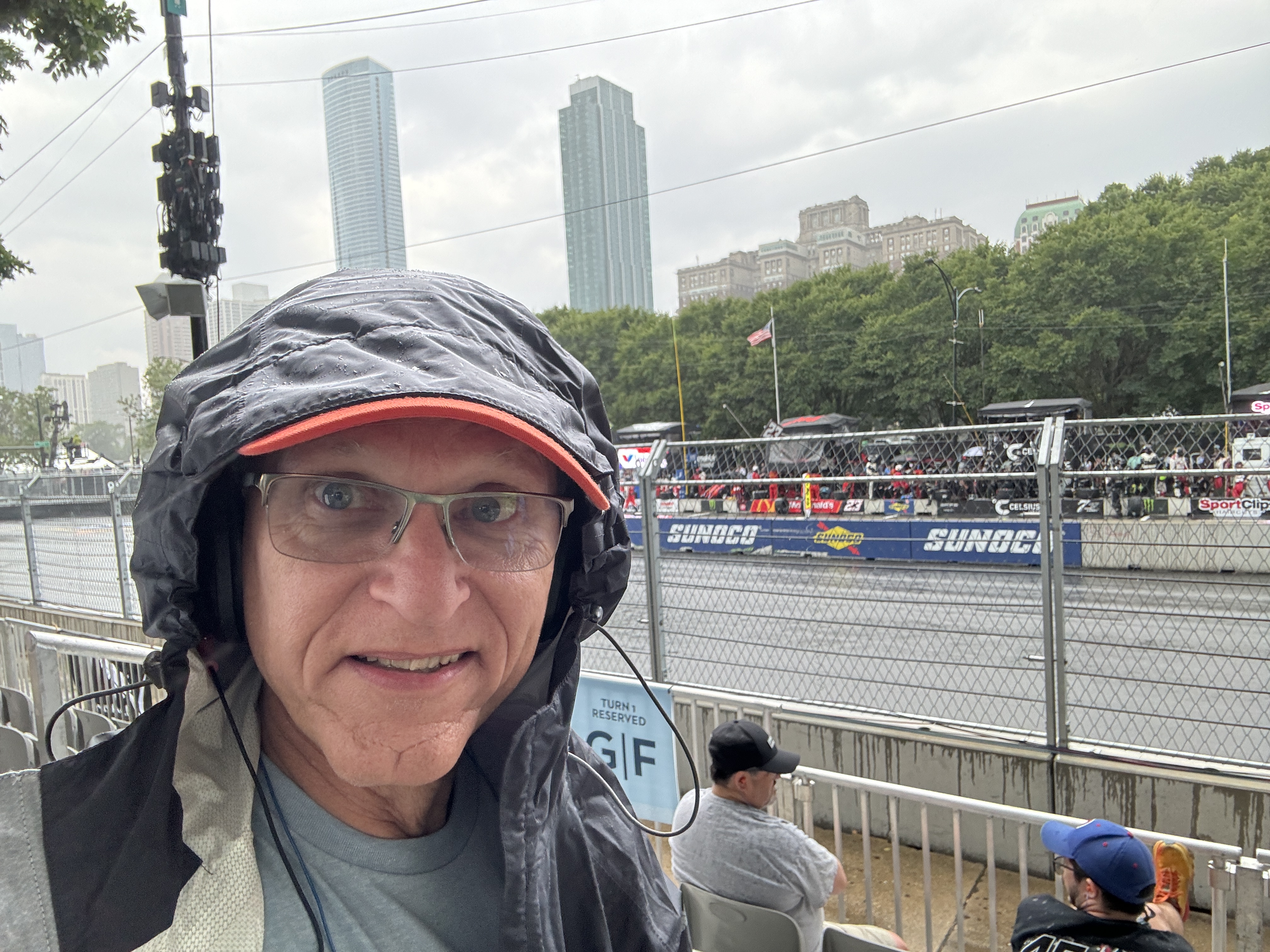
Douglas Yeo in the rain, NASCAR Chicago Street Race, July 7, 2024

While the day—and the race—started off with beautiful sunshine, we knew that rain was in the forecast. And the rain came. It sprinkled. Then it cleared up. Then the skies opened up and it poured. And poured, and poured.

Doug_Cody_Phil_rain_delay_NASCAR_2024

Douglas Yeo and Cody and Phil Spotts during the NASCAR race delay, July 7, 2024

The race continued for awhile in the rain but when it simply got too wet for drivers to race safely, we found ourselves in a rain delay of nearly two hours. We hung out at a picnic table in the Turn 1 Club, under an umbrella. The rain didn’t dampen our spirits. We were still having a great time, grazing on food and drink nonstop, enjoying conversations, talking about the race, the cars, and the drivers. When confronted with a situation you can’t control, you make the best of the situation. As teachers at our grandchildren’s elementary school frequently say, “You got what you get and you don’t throw a fit.” The rain didn’t matter. A lot of fans left but we stayed to watch the race start up, shortened because it was getting dark. Once again, it was a thrill to see the drivers cautiously—at over 100 miles per hour!—navigate the slick race course.

NASCAR_2024_Sunday_race_view

Alex Bowman (48 car) after crossing the finish line at the Grant Park 165 NASCAR Cup Series Race, Chicago, July 7, 2024

The race was won by Alex Bowman in his 48 car, and as he crossed the finish line, the rain stopped, the sun started to come out from behind the clouds even as it was setting, and we finished our days of enjoying racing in downtown Chicago. Click here to view the race on Youtube.

Doug_Cody_Phil_Buckingham_Fountain_NASCAR_2024

Douglas Yeo and Cody and Phil Spotts, Buckingham Fountain, Chicago, July 7, 2024

As we exited Grant Park, we passed by Buckingham Fountain one more time. Its fountains had been turned off for the night but I don’t think I’ve ever seen it look more beautiful than in the twilight of that Sunday night after the race.

Doug_Cody_Phil_Sears_Tower_2024_circle

Douglas Yeo and Cody and Phil Spotts atop the Sears Tower (AKA Willis Tower), Chicago, July 8, 2024. The red circle shows where we sat for the NASCAR Street Race.

We headed home again but our time together was not over. Cody wanted to do something he had never done before: go up a seriously tall building. So we took the train back to Chicago on Monday morning and visited the Sears Tower. From the observation deck, we looked down on the race course. In the photo above, you can see where our seats were in the red circle I drew between Cody and Phil. And yes, I’m wearing a Shane Van Gisbergen t-shirt. I’m a fan.
Cody_Phil_Sears_Tower_Ledge

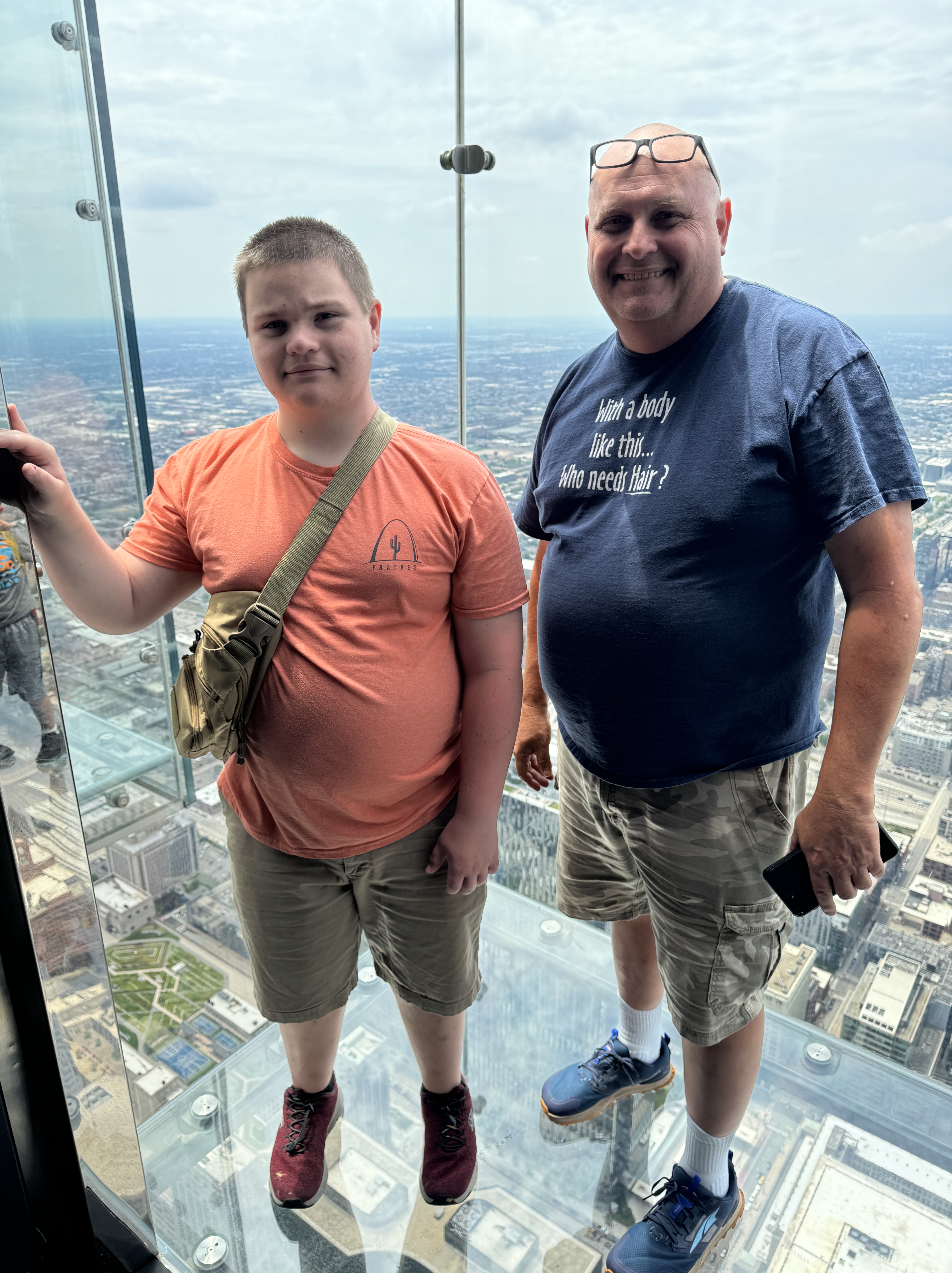
Cody and Phil Spotts on “The Ledge,” Sears Tower (AKA Willis Tower), Chicago, July 8, 2024.

But there was a limit to what I would do. While Cody and Phil happily—and fearlessly—walked out on the Sears Tower’s “The Ledge”—looking straight down 103 floors through glass to the street below—I was happy to be their official photographer, my feet firmly planted on the carpeted floor.

Doug_Cody_trombone_2024\

Douglas Yeo and Cody Spotts, July 8, 2024

When we got back to our house after yet another train ride (Pat had prepared a delicious dinner; as good as the food was at the race, it was nice to be home and have Pat’s wonderful home cooking), Cody and I played trombone duets. I’d never heard Cody play trombone before and it was so great spend some time together with trombones in our hands. The thing that solidified Cody’s and my friendship—the trombone—was shared in a memorable, tangible way.

This is friendship. Being together, talking together, sharing together, enjoying experiences together. Saying “Yes” when a friend asks you to do something you can’t imagine yourself doing. And then appreciating how they stretched you. And saying—and showing—”thank you” when someone gives you a gift—and Phil and Cody gave me a remarkable gift. Not just tickets to a race weekend, but a shared brotherhood that started with our shared faith in Christ. The three of us know and truly understand what the Apostle Paul meant when he wrote, “Therefore encourage one another and build one another up, just as you are doing.” (1 Thessalonians 5:11) Though separated by distance, when Cody asked to come to the Chicago Street Race with his dad and enjoy it with me, we picked up our relationship like we were next door neighbors who had never been apart. That is friendship.

Before I went to the NASCAR Chicago Street Race weekend I did not know what to expect. These friends taught me a lot. We shared something that has bound us together in a new way, and I will treasure the memory. Just as I treasure our friendship. Thank you, friends.
NASCAR_2024_wristbands_program

Official program and my wristbands for the 2024 NASCAR Chicago Street Race Weekend, July 6-7, 2024
For everything there is a season

For everything there is a season

by Douglas Yeo (May 19, 2024)

The Bible gives us answers, and it reminds us of this (Ecclesiastes 3:1-8, English Standard Version):

For everything there is a season, and a time for every matter under heaven:

a time to be born, and a time to die; a time to plant, and a time to pluck up what is planted;

a time to kill, and a time to heal; a time to break down, and a time to build up;

a time to weep, and a time to laugh; a time to mourn, and a time to dance;

a time to cast away stones, and a time to gather stones together; a time to embrace, and a time to refrain from embracing;

a time to seek, and a time to lose; a time to keep, and a time to cast away;

a time to tear, and a time to sew; a time to keep silence, and a time to speak;

a time to love, and a time to hate; a time for war, and a time for peace.

For each of us, our lives are full of seasons, and I have recently turned the page on a very long season of life and a new season is upon me.

Pearce_trombone_Concert_stylings

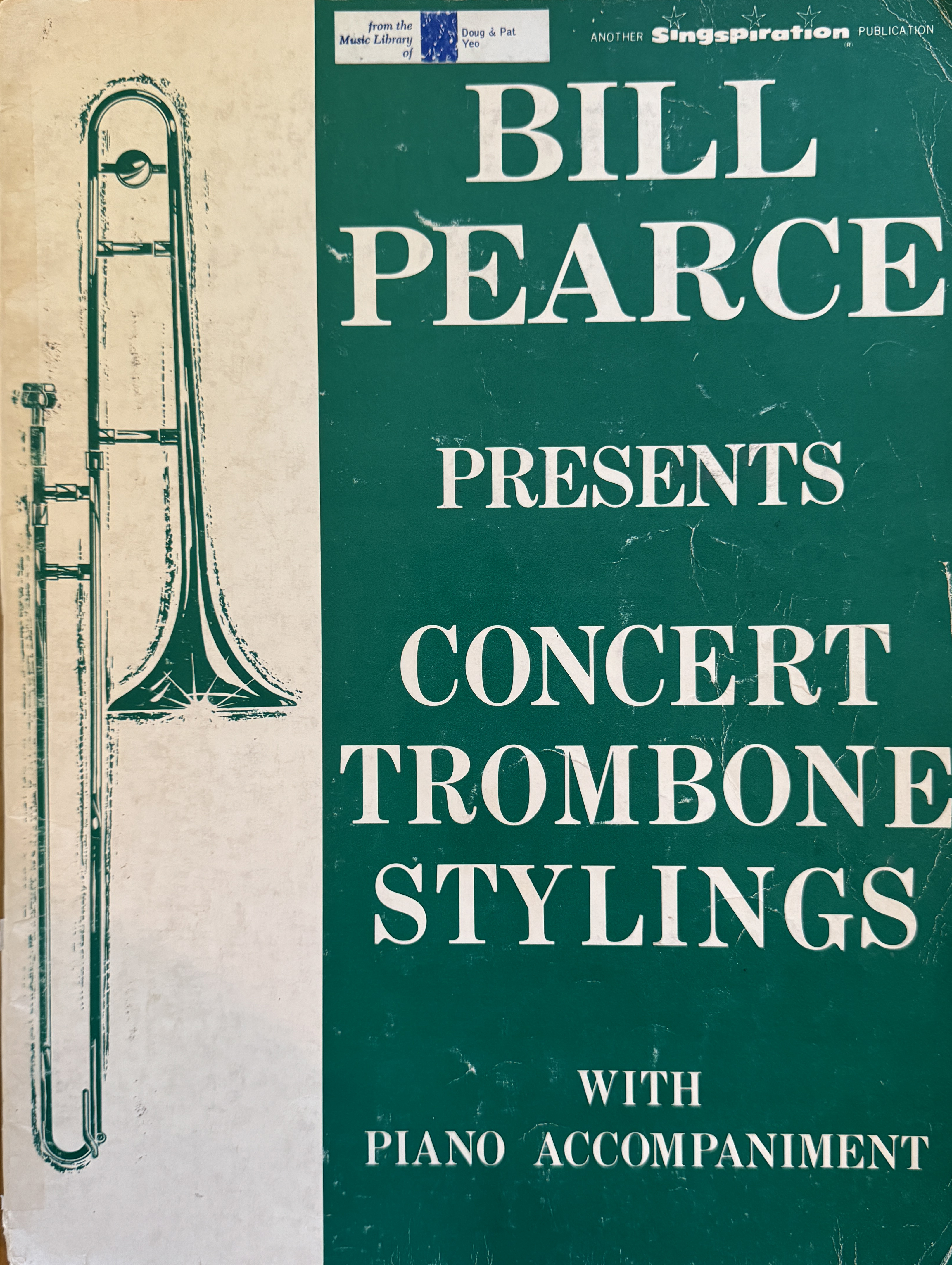
One of the Bill Pearce solo trombone with piano books that my first trombone student, Lloyd, gave to me in payment for trombone lessons I gave him at Wheaton College in the summer of 1974.

I have been teaching trombone lessons since the summer of 1974. At that time, I was a student at Wheaton College and another student on campus, Lloyd, asked if he could take some lessons with me. Lloyd wasn’t a trombone major; in fact, he was a student at Wheaton College for only that one summer quarter. But I was happy to help him improve his skills. At the end of the lessons, Lloyd told me he didn’t have money to pay me but if I would accept them, he would give me five books of solos for trombone and piano by the great gospel trombonist Bill Pearce. 50 years later, I still have and use those books. After that summer, I began teaching weekly lessons to young players through the College’s Preparatory Department. Doing so helped me get through college without any debt (that job along with other jobs that included working as student manager of the College artist series, working two days a week at a local White Hen Pantry, and shoveling snow for an office park in the winter).

Since that time, I’ve taught regularly in many schools, first as a high school band director, then as trombone teacher/professor of trombone:

STA_My_Fair_Lady_pit_band

St. Thomas Aquinas High School, Edison NJ (1979-1981) — with students in rehearsal for the school’s production of My Fair Lady, 1981.

Peabody_News_1982

Peabody Institute of Johns Hopkins University, Baltimore MD (1982-1985) — Announcement from September 1982  in Peabody News listing faculty members who were members of the Baltimore Symphony Orchestra

NEC_Trombones_1990_01

New England Conservatory of Music (1984-2012) — conducting the New England Trombone Choir at New England Conservatory, 1990

ASU_Desert_Bones_2016

Arizona State University, Tempe AZ (2012-2016) — ASU Trombone Studio with the University’s mascot, Sparky, 2016

Wheaton College, Wheaton IL (2019-2023) — performance of Canzone by Girolamo Frescobaldi, arr. Eddy Koopman, Wheaton College faculty recital, April 23, 2022

UIUC_Illinois_trombone_studio_2024_signed_photo

University of Illinois Urbana-Champaign, IL (2022-2024) — signed photo given to me by members of the University of Illinois Trombone Studio, May 2024

Since I retired from the Boston Symphony Orchestra in 2012 after more than 27 years as a member of that great orchestra, my life has taken many turns. My wife, Patricia, and I moved to Arizona where I immediately flunked retirement and accepted the full time position as professor of trombone at Arizona State University. In 2018, we moved to the Chicago area to be near our grandchildren (grandkids truly make you do crazy things, like move from Arizona to the Midwest) and I flunked retirement again when I was asked to teach at my undergraduate alma mater, Wheaton College. When University of Illinois asked me to take a one year position as professor of trombone for 2022-2023—a position that came to me most unexpectedly and I thoroughly enjoyed—I looked forward to trying this retirement thing again in 2023 when that appointment was up and, at the same time, I decided to step away from teaching at Wheaton College. But as things turned out, one year of teaching at Illinois turned into two years. Happily, the Illinois School of Music recently hired a new full time trombone professor and my appointment at Illinois concluded.

Yeo_UIUC_office_letter

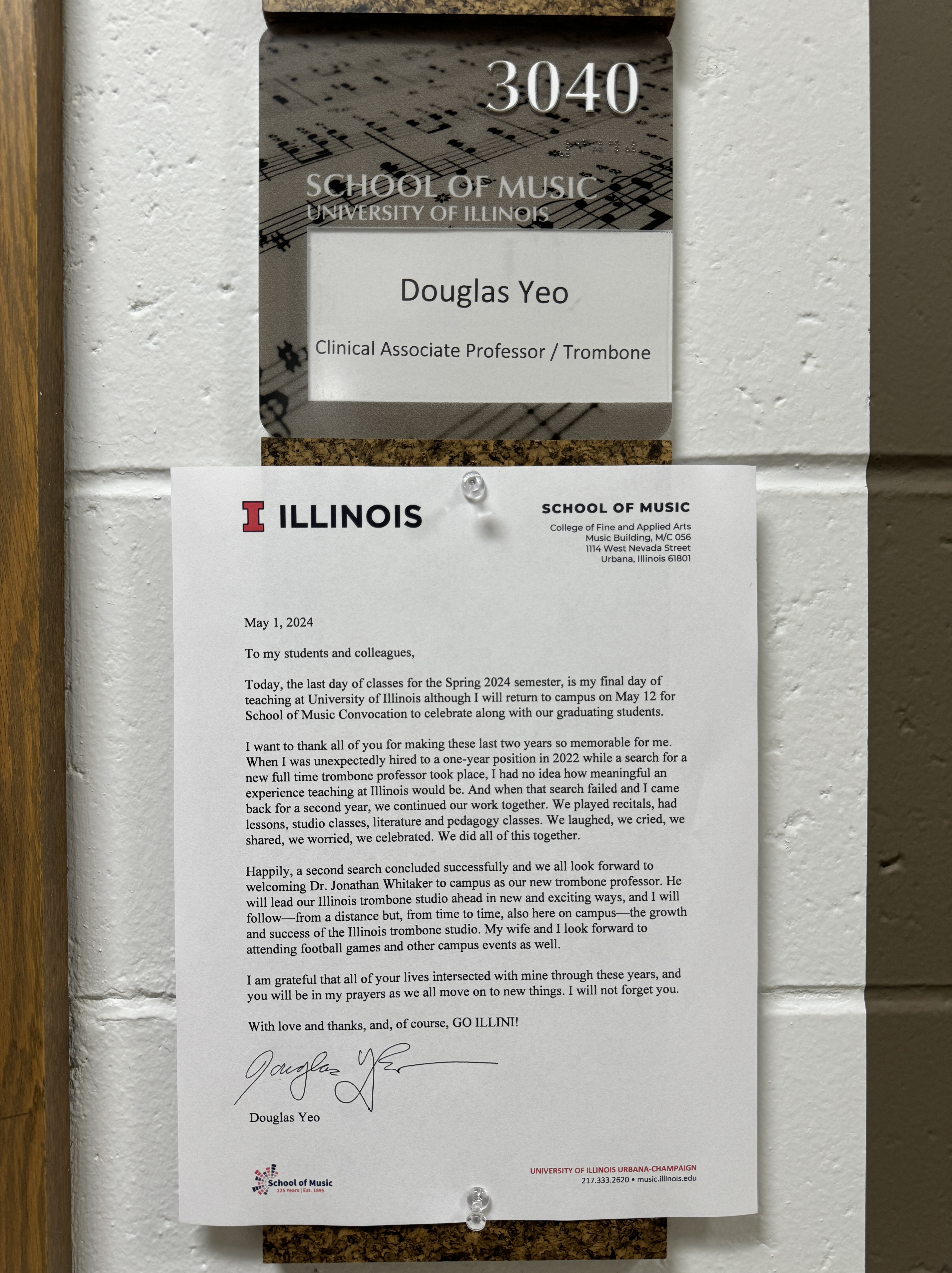
I taught my last trombone lessons at University of Illinois Urbana-Champaign on May 1 and before I headed home, I wrote a letter to my students and colleagues that I posted on the bulletin board next to my office, shown above.

UIUC_Convocation_students_2024

With my graduating students at University of Illinois Urbana-Champaign School of Music Convocation, May 12, 2024. Left to right: Rachel Lin (Bachelor of Music Education), Jerry Min (Bachelor of Music), Lorraine Montana (Master of Music)

I returned to campus on May 12 when  University of Illinois held a Convocation ceremony for the School of Music and I celebrated the graduation of three of my students. In a sense it was a graduation ceremony for me, too, as I closed out two memorable years teaching at University of Illinois, a campus community where I feel a very strong connection. When the ceremony was over, I took off my academic regalia, switched off the lights in my office, and turned in my keys. On the long drive home through the beautiful, newly planted Illinois cornfields, I began to reflect on all that had just happened. A new season had begun.

Illinois_cornfields_May_2024

Newly planted Illinois cornfields along Illinois Route 115, May 12, 2024

Illinois_corn_May_2024

The corn is now just a few inches tall and in late fall it will be, in the words of the song, “Oh, What a Beautiful Mornin'” from the musical Oklahoma!, “as high as an elephant’s eye.”

As I see it, “retirement” is a lousy word. When I decided to retire from the Boston Symphony, many of my colleagues asked me, “So, are you going to take up golf?” Nope. Golf doesn’t interest me. And I never saw “retirement” as a season of life devoted to non-stop self-entertainment. After decades playing in symphony orchestras, I looked forward to new adventures. I wanted to have more time to research and write, to travel with my wife, to enjoy more time with our daughters and their families, and, with open hands, respond to God’s call to His purposes for my life.

Retirement, as it turned out, meant not playing golf or kicking back and “doing nothing,” but, rather that I was busy doing a host of engaging activities.

UIUC_trombone_studio_Lincoln_poster

The poster that hung in my office at University of Illinois for the last two years. It contains a logo my friend, Lennie Peterson, designed for our trombone studio, my five core tenets of teaching, and a quotation from Dr. Robert E. Gray that sums up the ethos of the University of Illinois Trombone Studio.

I’ve spent most of the last 12 years teaching at colleges and universities each week of the academic year: Arizona State, Wheaton College, University of Illinois. Working with those students has been such a big part of my life. But as I near a birthday with a zero on the end of it (it’s not 60; that was a long time ago. . .), I decided, after much thought and prayer, to step aside from weekly trombone teaching and have more time to do other things. This doesn’t mean I’ve taught my last trombone lesson. I love teaching; I still do. But this change in my life means I won’t be doing that teaching every week as a school’s trombone professor. This freedom gives me time to explore and enjoy both new and familiar things.

And there is a lot ahead for me. Later this month, I’ll travel to Texas Christian University (TCU) in Fort Worth, Texas, to take part in the International Trombone Festival. I’ll give a recital, serve on two roundtable discussion panels (one is about diversity considerations in recital programming; the other is about trombone research), give a major presentation about the celebrated trombonist Joannès Rochut, perform with the TCU trombone choir, and accept the International Trombone Association’s Lifetime Achievement Award. This summer my wife and I will take hiking trips to Grand Canyon and Zion National Parks (with our oldest daughter’s family, including our grandchildren), and Sequoia and King’s Canyon National Parks (with our youngest daughter and her husband). In September, I’ll conduct a trombone residency at University of Texas, Austin. In October I’ll play ophicleide in concerts with the San Francisco-based early music group, Philharmonia Baroque. We’ll attend many baseball games this summer (Chicago Cubs, Schaumberg Boomers, Chicago Dogs, Kane County Cougars, Oakland Ballers), and fall will bring us to our seats in Chicago’s Soldier Field for Chicago Bears football. A major American symphony orchestra has asked if I would be willing to substitute with them in the coming season. Research and writing projects are on my plate (watch the July 2024 issue of the International Trombone Association Journal for my article about the history and a chemical analysis of trombone slide oil, and the January 2025 issue for my article about Joannès Rochut; I’m also at work on a new book for Oxford University Press), as are hikes, walks and tandem bicycle rides with Patricia. And serving our church and enjoying life with our grandchildren.

Doug_Pat_Zion_Observation_Point_June_2023

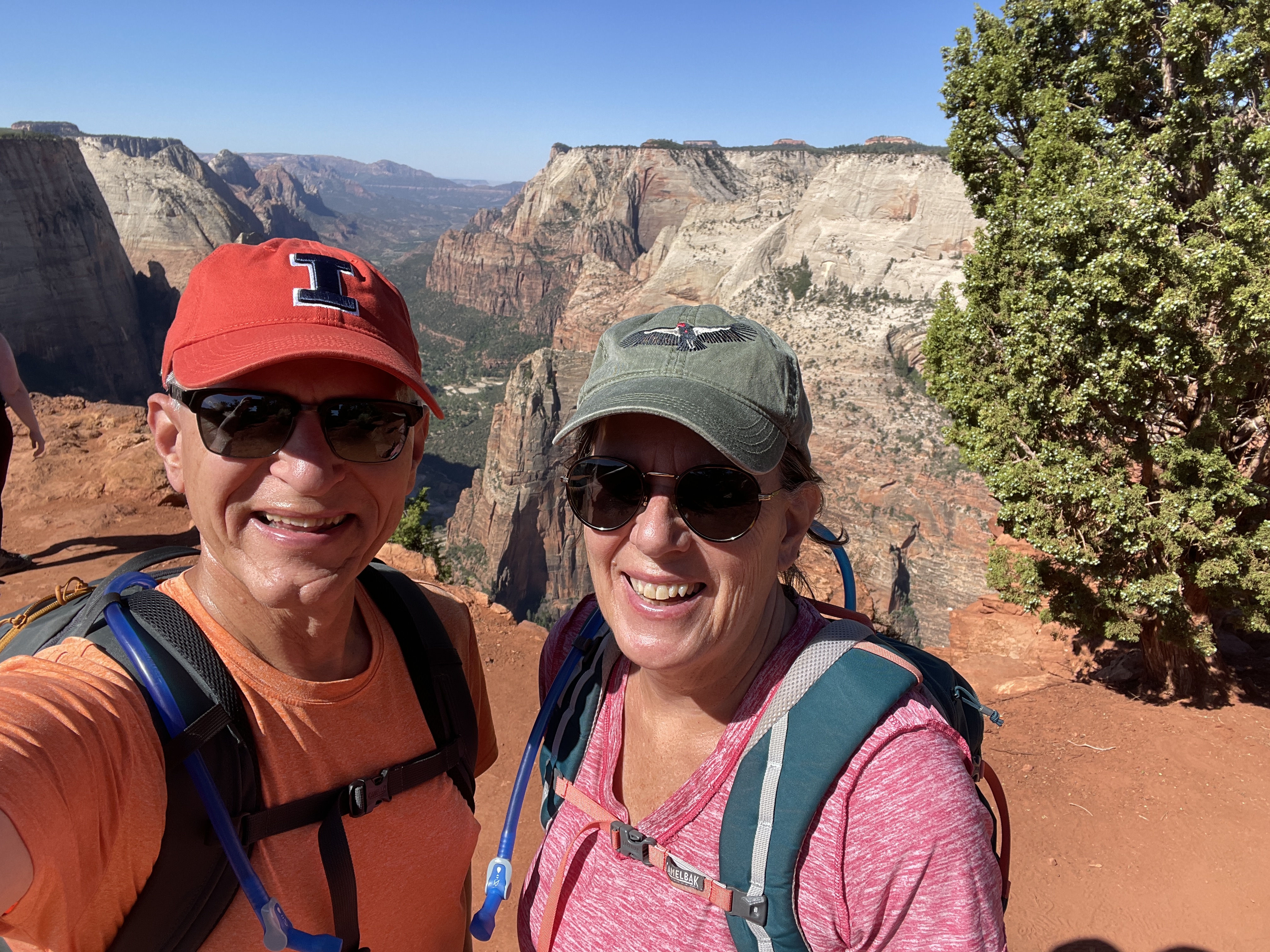
With my wife, Patricia, at Observation Point, Zion National Park, June 2023. We will return to this special place next month; it will be our 19th trip to Zion National Park.

So, as my long season of institutional teaching has turned a page, I look back at those decades with great fondness and gratitude. And I have learned this: I don’t know all of what God has for me going forward.  With open hands, I’m grateful for the opportunities I’ve had to serve, learn, and contribute. I plan to keep doing that in both new and familiar ways as God leads. I look forward to seeing you along the road.