
by Douglas Yeo (June 6, 2024)
Since the International Trombone Association (ITA) was founded in 1972, it has held an annual gathering of trombonists. In the Association’s early years, the gathering was called the International Trombone Workshop, and in recent years, it’s been the International Trombone Festival (ITF). I have been to eight of these events, in 1982 (Nashville, TN), 1999 (Potsdam, NY), 2004 (Ithaca, NY), 2014 (Rochester, NY), 2017 (Redlands, CA), 2018 (Iowa City, IA), 2022 (Conway, AR), and, last week (Fort Worth, TX). Since the conclusion of the Festival on Saturday, I’ve been reflecting on this extraordinary event and its impact not only on me, but on the world-wide community of trombonists. Here are some of my impressions. . .
THE IDEA
As readers of The Last Trombone know, I have taught trombone on the college level for over 40 years. I’ve worked with hundreds of students, taught thousands of lessons and classes, and I’ve followed the career path of many of the students whose lives intersected with mine in those institutions. I taught at New England Conservatory of Music in Boston from 1985-2012, and there was a period in the late 1980s and early 1990s that brought an exceptional group of students into my orbit.

The New England Trombone Choir at New England Conservatory, Spring 1990, Douglas Yeo, conductor. Among the students playing in the ensemble (some are not shown in this frame) are Julie Josephson, R. Douglas Wright, Petur Erickson, Randall Hestand, Brett Shuster, David Begnoche (in the circle, just above me), Jeffrey Hall, Darren Acosta.
Among these students was David Begnoche, a tenor trombonist who graduated from NEC in 1990 with his Bachelor of Music degree. After studying with John Swallow and me at New England Conservatory of Music, David went on to Manhattan School of Music for his master’s degree, then to University of North Texas for his doctorate. Along the way, he had positions playing trombone with the Joffrey Ballet Orchestra (Chicago), the Sarasota (Florida) Opera, the Albany (New York) Symphony, and the Spoleto Orchestra (Italy). David landed at Texas Christian University (TCU) in Fort Worth, Texas, where he serves as Associate Professor of Trombone. David also is Second Vice-President of the International Trombone Association, a position to which he was elected by the Association’s membership.
David and I have been in close contact since he graduated from NEC—long ago, we made the jump from student/teacher to being colleagues—and I have always enjoyed working with him. I’ve taken part in his annual TCU Trombone Summit on two occasions, and we frequently talk about big issues that face the trombone community and the ITA—and the world. In 2020, he reached out to me and said he was considering hosting the International Trombone Festival at some point. From the jump, David wanted the Festival he hosted to be impactful and diverse. He sent me a long document with his dream list of individuals and groups and ideas that might make up such a Festival. More on this below—because it is important to acknowledge where seminal ideas for the 2024 International Trombone Festival came from—but as we started talking about his hopes and dreams for a TCU based International Trombone Festival, I knew I had to be there. And, when the announcement was made that David Begnoche would host the 2024 ITF at Texas Christian University, I made plans to be there.
As things developed, I ended up being involved in a host of activities at the 2024 International Trombone Festival. But first, I had to get there.
THE TRIP
It seemed so simple. Fly from Chicago’s Midway Airport to Dallas/Love Field (DAL). The flight was only a couple of hours long with no time change. The Festival began on Wednesday, May 29, so I made plans to fly to Dallas in the morning of Tuesday, May 28. The weather in Chicago was clear, and while there had been storms in the Dallas/Fort Worth area, I had no idea what was about to unfold. My 8:25 am departure was delayed to 9:00, then 10:00, then 12:00, then 1:00, then 2:00. After three hours of delays while waiting in the terminal, we had another three hours of delays while sitting on the plane. Then, at 2:30 pm, my flight was cancelled. There had been a violent storm in the Dallas/Fort Worth area. Large hail had pummeled Love Field and all of the planes on the ground needed to be inspected for hail damage. Which meant that planes on the ground at Love Field sat at gates waiting for inspection and no new planes could arrive. As I disembarked from my plane and went to the rebooking counter, I learned there would be no more flights going from Chicago to Dallas on that day, or the next day until late at night. I needed to get to Fort Worth in time for the opening ceremony at 10:00 am at Wednesday and my first presentation at 11:30 am. I wasn’t able to fly. So I did the only thing I could: I got my suitcase, put my trombone on my shoulder, walked to my car in the airport parking lot, and started driving.

The Google Maps display on my iPhone as I began my drive from Chicago’s Midway Airport to the Hyatt Place Fort Worth TCU Hotel, Tuesday, May 28, 2024.
I’ve driven long distances before. But when my GPS said “14 hours, 52 minutes – 948 miles,” I was in new territory. I needed to drive straight through without an overnight stop. An all-nighter was in my future. It was the only way to get to the Festival in time for its opening and my first presentation. There was no other option. I was about to find out how a college senior on a spring break road trip feels. After fortifying myself with many bottles of Diet Coke, bottles of water, food, and a box of No-Doz, I headed down Interstate 55 to Texas. Texas. The words, “I’m driving to Texas,” had never previously been in my lexicon.

The Saint Louis Gateway Arch coming into view. Tuesday, May 28, 2024.
At about 8:30 pm, I passed through St. Louis at sunset (photo above). I stopped 10 times along the way, and I pulled into the parking lot at the Hyatt Place Fort Worth/TCU at 7:30 am on Wednesday. 950 miles, 16 hours in the car. I got to my room, took a shower, unpacked, had breakfast, and headed to campus to warm up on the trombone. I made it. Here are some impressions of things I did at the Festival, both planned and spontaneous. These kinds of festivals are so loaded with activities that it was impossible to take in everything I wanted to experience. But for me, the best part of an International Trombone Festival is meeting and talking with PEOPLE: friends, colleagues, former and current students, and individuals I had never met before. Here’s some of what occupied me at TCU.

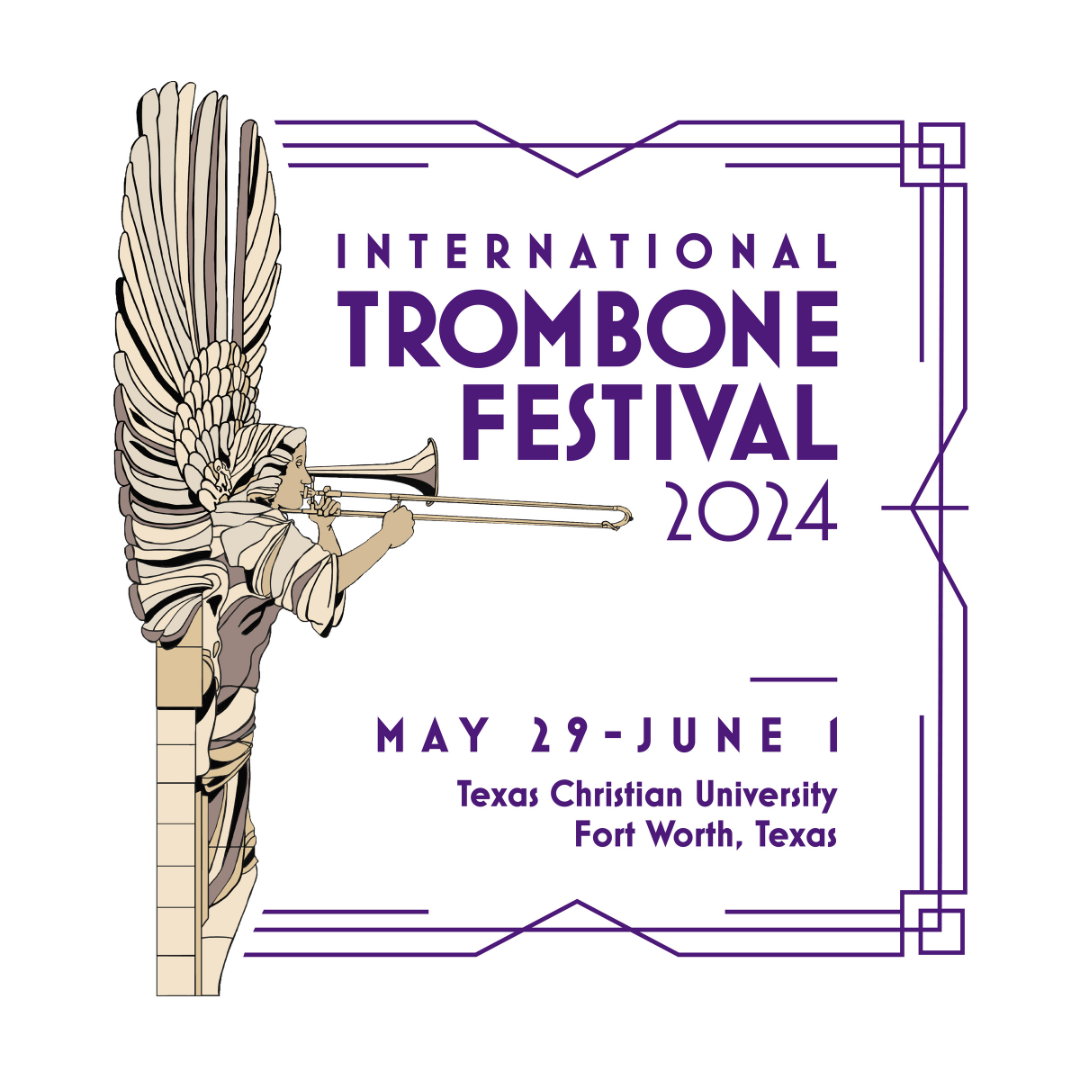
Cover to the Program for the 2024 International Trombone Festival, Texas Christian University, Fort Worth, Texas. The trombone-playing angel logo was designed by Lennie Peterson; it is based on the bas-reliefs of trumpet-playing angels that flank the front entrance of Bass Performance Hall, Fort Worth.
PRESENTATION—JOANNÈS ROCHUT: MORE THAN BORDOGNI

Douglas Yeo presentation: Joannès Rochut: More Than Bordogni (2024 International Trombone Festival program). Wednesday, May 29, 2024.
When David Begnoche and I talked about his dreams for hosting an International Trombone Festival, he wanted to have things that were not ordinarily a part of the Festival. Among these was a strong trombone research component. I immediately told him I would like to do a presentation about Joannès Rochut, the celebrated French trombonist who, among many things, was principal trombonist of the Boston Symphony Orchestra from 1925–1930, and published the most famous books of trombone music in the history of the instrument, Melodious Etudes for Trombone Selected From the Vocalises of Marco Bordogni (Carl Fischer, 1928).
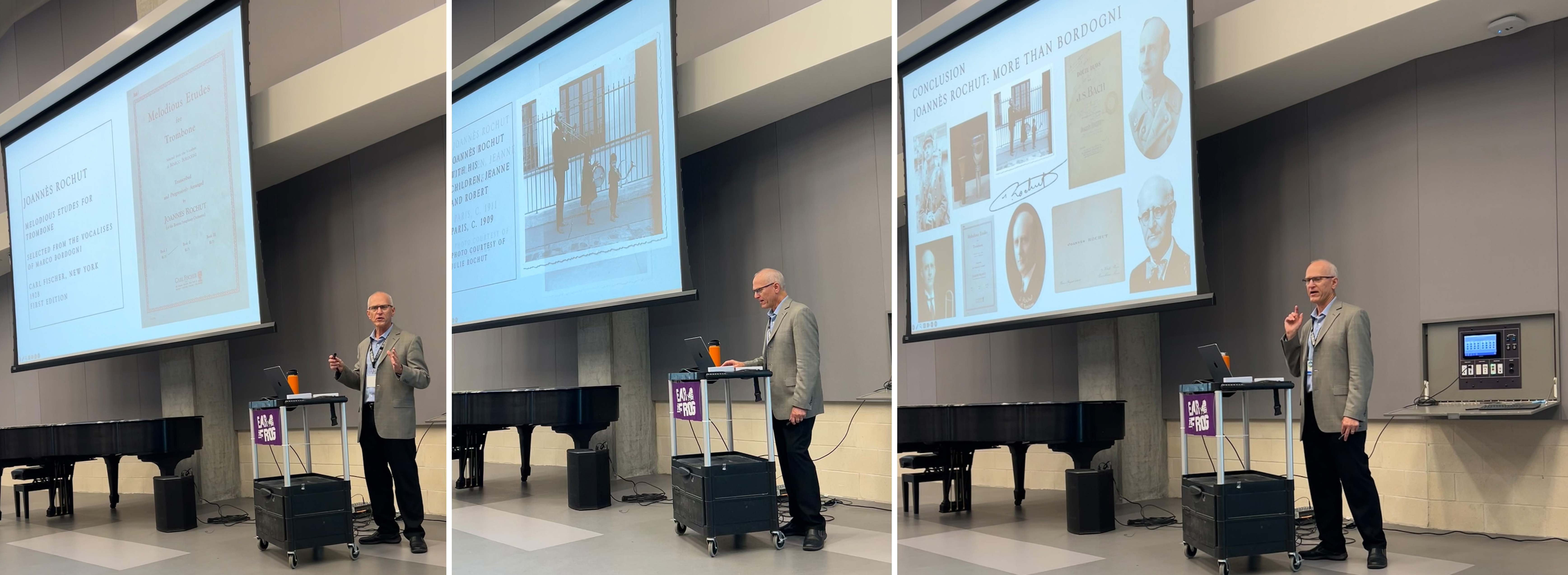
Douglas Yeo presentation, Joannès Rochut: More Than Bordogni. Van Cliburn Band Room, 2024 International Trombone Festival, Texas Christian University. Wednesday, May 29, 2024.
I have been researching Joannès Rochut since I joined the Boston Symphony Orchestra in 1985 and this was the time to finally get serious and give a scholarly presentation about him. This presentation was a summary of my research and the full story will be told in my forthcoming article about Joannès Rochut that will appear in the January 2025 International Trombone Association Journal.
Van Cliburn Band Room at TCU was packed for my presentation. I’ve given many scholarly presentations at International Trombone Festivals over the years but this was the first one that was given to a packed room of over 200 people. I was heartened by the strong interest in my lecture, and the Festival was underway.
PERFORMANCE—TCU TROMBONE CHOIR WITH RONALD BARRON
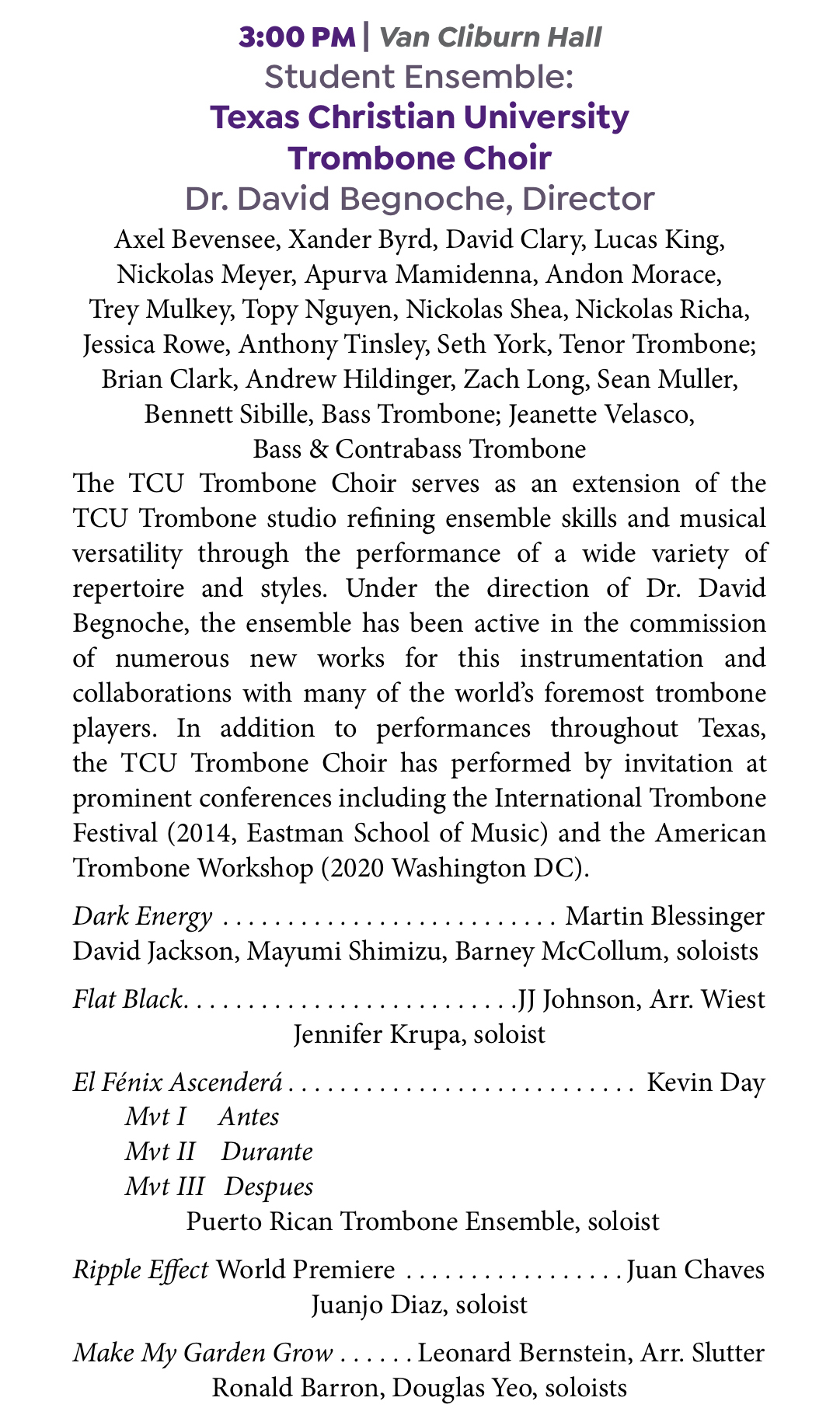
Texas Christian University Trombone Choir, David Begnoche, conductor (2024 International Trombone Festival program). Wednesday, May 29, 2024.
For my first 23 years as a member of the Boston Symphony Orchestra, our trombone section was Ronald Barron (principal), Norman Bolter (second), and me (bass). David Begnoche asked me if I would be interested in playing a duet with Ron on the TCU trombone choir concert at the Festival. Of course! I had not seen Ron since I retired from the Boston Symphony Orchestra in 2012 (Ron retired from the orchestra in 2008). While we have kept in contact over the years, I was really looking forward to this reunion with Ron.
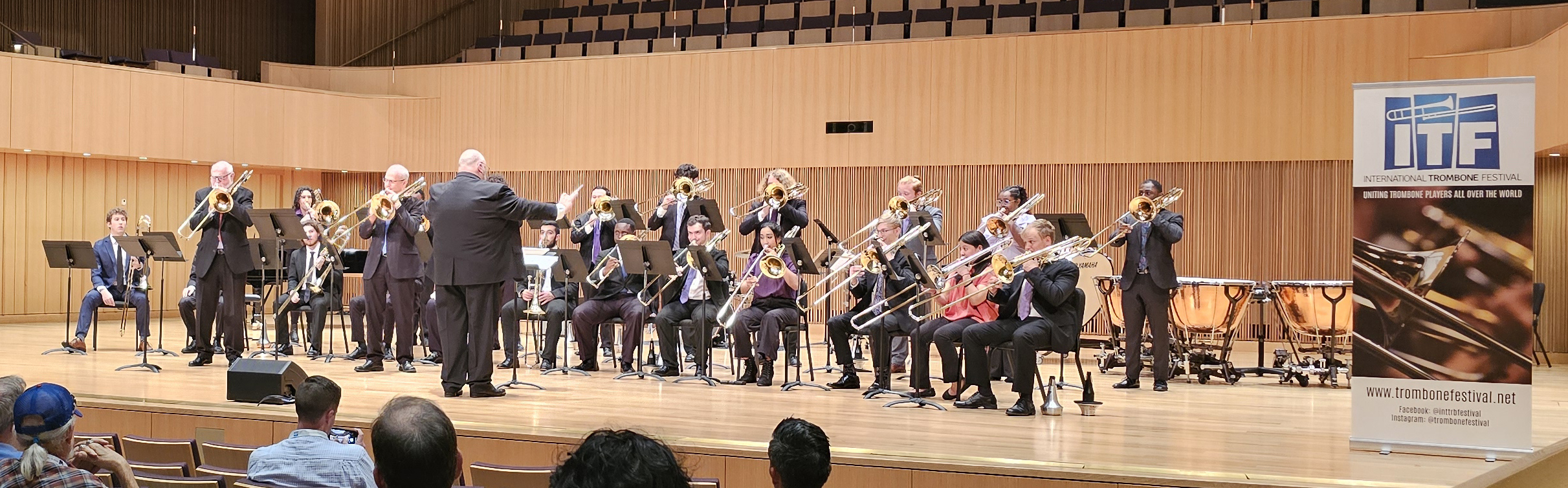
Ronald Barron and Douglas Yeo performing Leonard Bernstein’s “Make Our Garden Grow” from Candide, with the Texas Christian University Trombone Choir, David Begnoche, conductor. Van Cliburn Hall, 2024 International Trombone Festival, Texas Christian University. Wednesday, May 29, 2024.

Ronald Barron, David Begnoche, and Douglas Yeo. Van Cliburn Hall, 2024 International Trombone Festival, Texas Christian University. Wednesday, May 29, 2024.
David Begnoche asked us if we would play a trombone duet arrangement of Leonard Bernstein’s “Make Our Garden Grow” from Candide. I had played this arrangement before and I love the message of this piece. It contains these lines:
And let us try, before we die,
To make some sense of life.
We’re neither pure, nor wise, nor good,
We’ll do the best we know. . . And make our garden grow.
Ron read these lines to the audience before we played the duet in honor of Dr. Irv Wagner, the long-time professor of trombone at University of Oklahoma and a past President of the ITA, and I will never forget the feeling I had during the performance. There I was, on stage with the TCU trombone choir (I told many people that the TCU trombone studio is like the United Nations, a group of students of diverse genders who are of a host of racial and ethnic groups), playing with a dear friend and colleague with whom I had shared a very long season of life, Ron Barron, and conducted by my former student and now colleague, David Begnoche. Memorable.
AWARD PRESENTATION—THE 2024 INTERNATIONAL TROMBONE ASSOCIATION LIFETIME ACHIEVEMENT AWARD

The 2024 International Trombone Association Lifetime Achievement Award.
In March, I was informed that I was a recipient of the 2024 International Trombone Association Lifetime Achievement Award; I have previously written about this on The Last Trombone. This is a great honor as I became one of only 17 people in the history of the International Trombone Association to receive both the ITA Award (which I received in 2014) and the ITA Lifetime Achievement Award. Among these individuals are some of my trombone heroes, mentors, and friends, including Edward Kleinhammer, Urbie Green, Allen Ostrander, George Roberts, Denis Wick, Ronald Barron, and Irvin Wagner. Adding to this special moment was the fact that I received the 2024 ITA Lifetime Achievement Award along with my good friend, Benny Sluchin (more on him, below). Dr. Ava Ordman, chair of the ITA’s Standing Committee on Awards, introduced David Begnoche who then made the presentation to me. This was a special moment in my life, to be recognized in this way by my peers in an area of my life that has been so important since I began playing the trombone at the age of nine in 1964. And I hope it is a little premature: I sure hope I have more living to do in this lifetime!

Accepting the International Trombone Association 2024 Lifetime Achievement Award with David Begnoche and Benny Sluchin, Landreth Hall, 2024 International Trombone Festival, Texas Christian University. Wednesday, May 29, 2024.
FRIENDS
My work at the International Trombone Festival had only just begun, but as I mentioned earlier, the most important—the most fun—part of these Festivals is meeting with people. Friends, colleagues, former and current students, and people I had never met previously. Some of these encounters were planned, others were spontaneous.
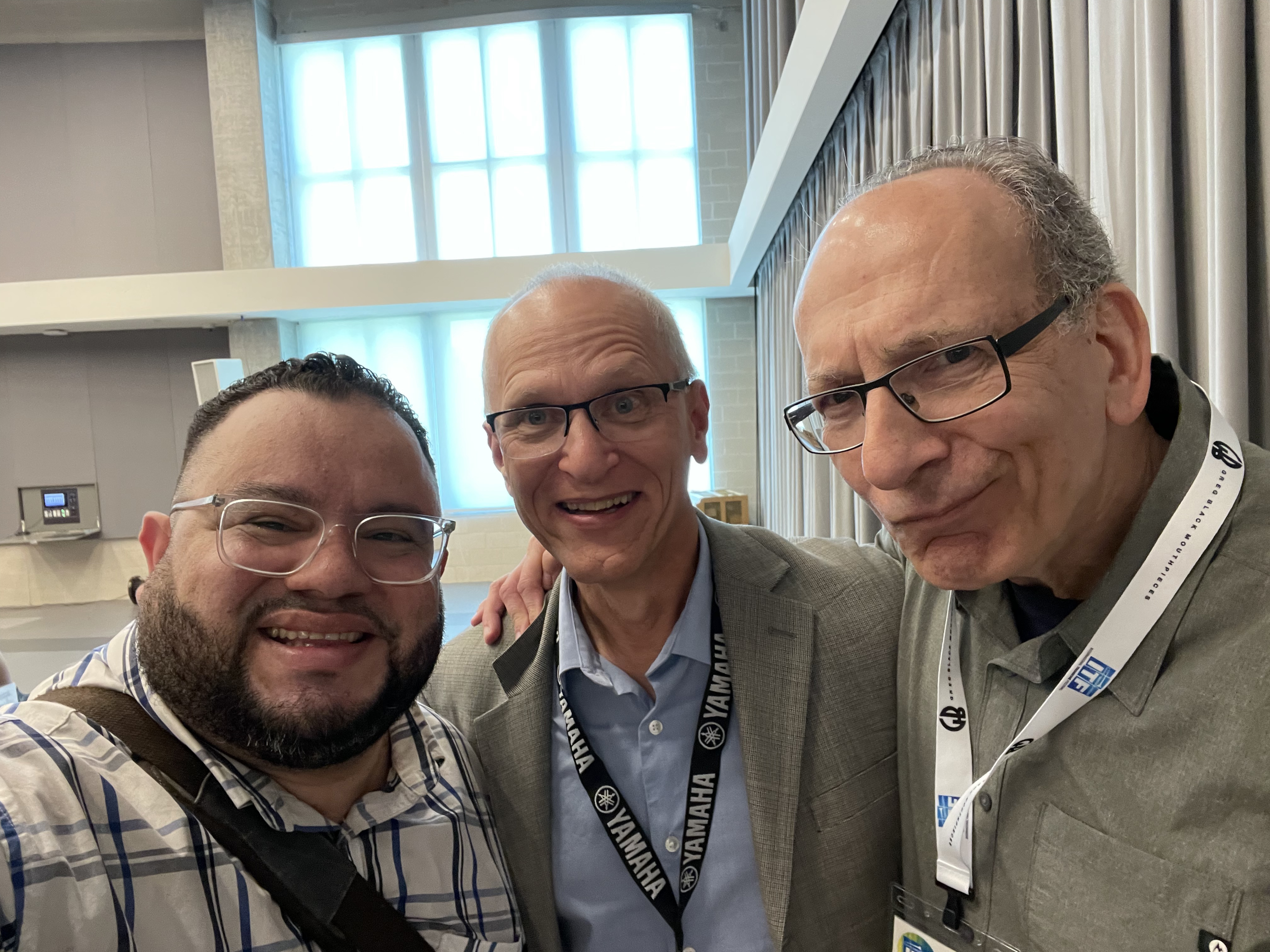
Angel Subero, Douglas Yeo, and John Rojak. 2024 International Trombone Festival, Texas Christian University. Wednesday, May 29, 2024.
I met up with my former student Angel Subero, a superb Boston-based bass trombonist who is equally conversant in salsa, Latin jazz, classical, and new music. Angel studied trombone with me when he was a student at Boston Conservatory of Music and New England Conservatory of Music. I had not seen Angel since I left Boston in 2012 and later in the Festival, we would find ourselves playing together on the same stage (more on that below). John Rojak, bass trombonist of the American Brass Quintet, has been a friend for nearly four decades; it was so good to see him again.
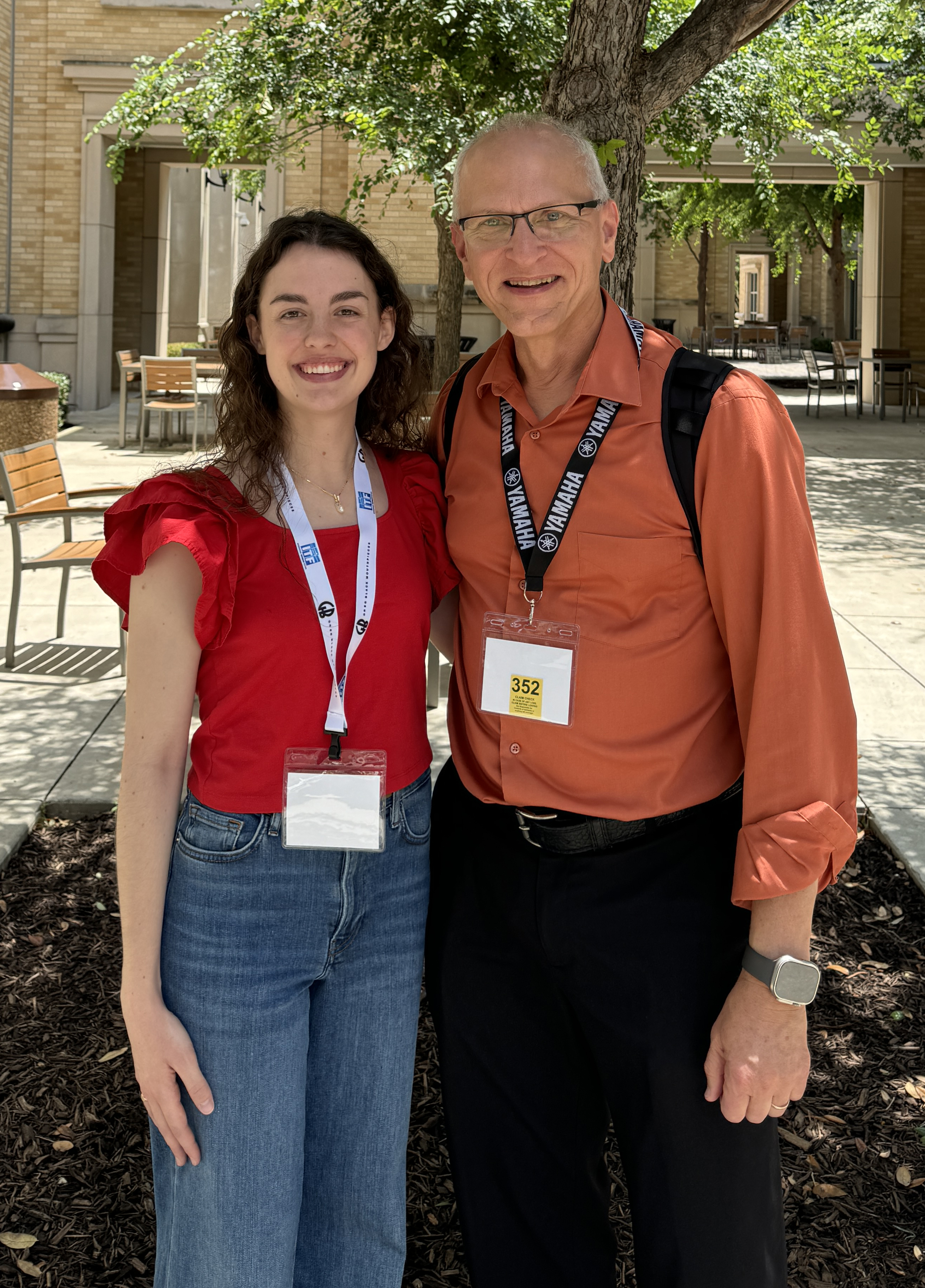
Gracie Potter and Douglas Yeo, 2024 International Trombone Festival, Texas Christian University. Friday, May 31, 2024.
I was not able to attend the finals of any of the many International Trombone Association competitions. I have always enjoyed going to those, and sometime adjudicating one of them, but my schedule was so busy that it just wasn’t possible this time. So it was serendipitous that when coming back to campus one day after lunch, I ran into Gracie Potter. Gracie took many lessons with me when I was living in Phoenix, Arizona (2012-2018), and she was competing in the Frank Smith Competition. It was so nice to catch up with Gracie who recently graduated from the Colburn School and has accepted a one-year position as principal trombonist with the Richmond (Virginia) Symphony. And Gracie won the Frank Smith competition! The finals piece was the first movement of Derek Bourgeois’ Trombone Concerto. Meeting up with Gracie was a very happy moment for me at the Festival. Brava, Gracie.

Douglas Yeo, John Rojak, Jennifer Wharton, and David Taylor, 2024 International Trombone Festival, Texas Christian University. Thursday, May 30, 2024.
Jennifer Wharton, the superb New York City based bass trombonist who plays in big bands, her own band, and Broadway shows, was at the Festival. Her husband, John Fedchock, accepted the 2024 ITA Award during the Festival and I was really happy to spend some time with Jen. She studied with me at New England Conservatory of Music in the 1990s and during the Festival, Jen, David Taylor (more about him, below) and I had lunch together. On our way back to campus, we saw John Rojak, the quintessential New Yorker—jaywalking and talking on his phone at the same time. When he safely got to our side of the street, I snapped this photo, above.

David Yacus at the 2024 International Trombone Festival, Texas Christian University. Friday, May 31, and Saturday, June 1, 2024.
One of the things David Begnoche wanted to have at the International Trombone Festival was an emphasis on early music. This has not regularly been a part of the ITF and early trombone specialist David Yacus gave a presentation, “ITF Antiqua: The Dawn of the Trombone. . . Ancient and Exotic Origins,” and a performance, “ITF Antiqua—17th-century Venice: Beyond the Basilica.” David studied bass trombone with me at New England Conservatory of Music in the 1980s and he is regarded as one of the finest exponents of the early trombone (often but not especially accurately referred to as the “sackbut”). His presentation was of a very high level as he discussed the precursors to the trombone and the various evolutionary theories that gave us the instrument we hold in our hands today. His concert, assisted by early trombonist Bodie Pfost as well as fine artists on violin, organ, and voice, was spectacular. There is a lot more to the trombone than “higher/faster/louder” and David Yacus brought something quite nice—even remarkable—to the Festival that gave all of us a lot to think about. David Yacus’ participation in the Festival along with the trombone research roundtable (discussed below) were part of David Begnoche’s conscious effort to demonstrate alternative career avenues for trombonists beyond obsessing over “winning” auditions. The trombone community is deep and wide and part of the ITF was to expose attendees to a wide swath of trombone-related career and avocational options.
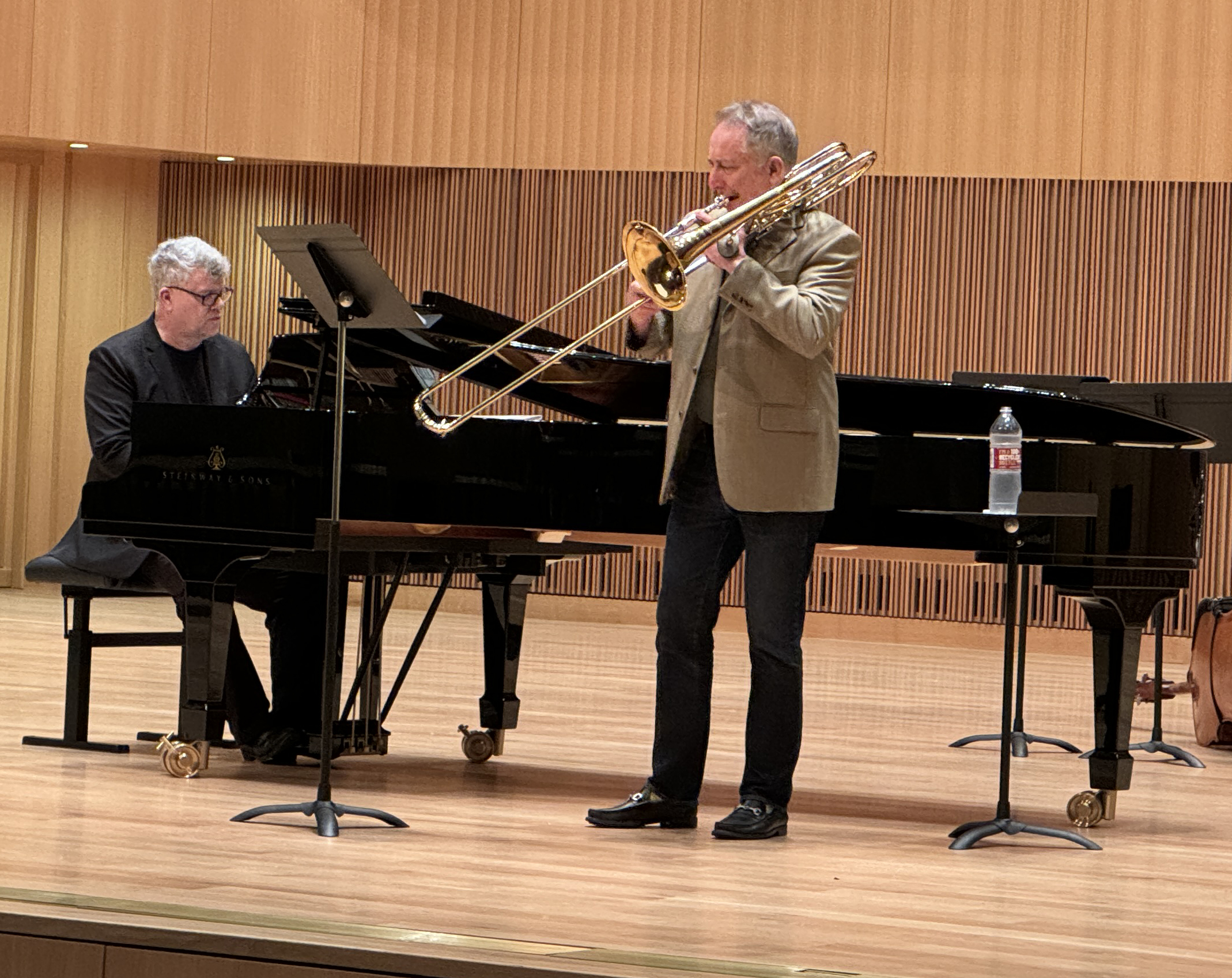
Dennis Bubert, bass trombone, with Shields Collins Bray, piano, Van Cliburn Hall, 2024 International Trombone Festival, Texas Christian University. Saturday, June 1, 2024.
Dennis Bubert and I have been friends for many years. He has been bass trombonist of the Fort Worth Symphony since 1981 (the same year I joined the Baltimore Symphony Orchestra, where I worked until 1985 when I joined the Boston Symphony Orchestra) and he studied with Edward Kleinhammer when he was a student at Illinois Wesleyan University in the 1970s, at the same time I was studying with Mr. Kleinhammer when I was a student at Wheaton College. Dennis played a fine recital at the ITF that included John Stevens’ The Kleinhammer Sonata. Dennis and I shared breakfast together the morning I headed back home from the Festival and it was good to have time face to face which is so much more rewarding than phone calls, text messages, and email that are our regular modes of communication.

Presentation of the International Trombone Association’s Orchestra Recognition Award to Fort Worth Symphony President and CEO Dr. Keith Cerny with Louis Borges (representing the ITA Standing Committee on Awards) and David Begnoche. Douglas Yeo, Ronald Barron, and Robert Spano. Bass Performance Hall, Fort Worth, Texas. Friday, May 31, 2024.
I also got to see and hear Dennis perform with the Fort Worth Symphony. One of the many things that David Begnoche envisioned for the 2024 International Festival was the premiere of a new work for trombone and orchestra. His advocacy for this project led to the commissioning of Kevin Day’s Departures for trombone, piano and orchestra. Kevin Day is one of today’s leading composers and he is also a TCU graduate. Departures was premiered by the Fort Worth Symphony last week with trombonist Peter Steiner and pianist Constanze Hochwartner; Bass Hall was packed for the performance. Before the concert, the International Trombone Association’s Orchestra Recognition Award was presented to the Fort Worth Symphony, and after the concert (which also included Gustav Mahler’s Symphony No. 5), Ron and I went backstage with Dennis to say hello to Fort Worth Symphony Music Director Robert Spano. Ron and I knew Bob when Bob was an assistant conductor of the Boston Symphony Orchestra in the early 1990s. Dennis snapped a photo of Ron and me with Bob; it was nice to see him again after so many years.

Douglas Yeo and David Wilborn. Van Cliburn Band Room, 2024 International Trombone Festival, Texas Christian University. Friday, May 31, 2024.
The Festival presented many opportunities to meet new friends. Many participants in the Festival came up to talk to me. Some were people I had emailed many years ago or I had helped in some way. Others, like composer David F. Wilborn (professor of performance studies at Texas A&M University), were people whose music I had played but whom I had never met. I played David’s Concertino for Bass Trombone in a faculty recital I gave at Wheaton College in 2022 and when he came up to me after the trombone research roundtable (more on that below), it was so nice to talk with him and move him from an email contact to a friend I had finally met in person.

Breakfast at the Hyatt Place Fort Worth TCU, Sunday June 2, 2024. Douglas Yeo, Abbie Conant, David Taylor, Debra Taylor, Dennis Bubert. Sunday, June 2, 2024.
All of what I’ve just written about meeting with friends at the ITF is just the tip of the iceberg. I enjoyed conversations and meals with players, teachers, and students from Argentina, Brazil, Chile, Latvia, England, Germany, France, Portugal and all over the United States. And countries I’ve already forgotten. Seeing and talking with Michael Dease, Abbie Conant (who received the 2024 ITA Neill Humfeld Excellence in Trombone Teaching Award), Debra Taylor, JoDee Davis, Bradley Palmer, and so many others made this Festival especially rewarding. For me, this Festival—for all of the performances and presentations—is about the PEOPLE who come together with the common bond of the trombone.
A SPECIAL RELATIONSHIP WITH YAMAHA
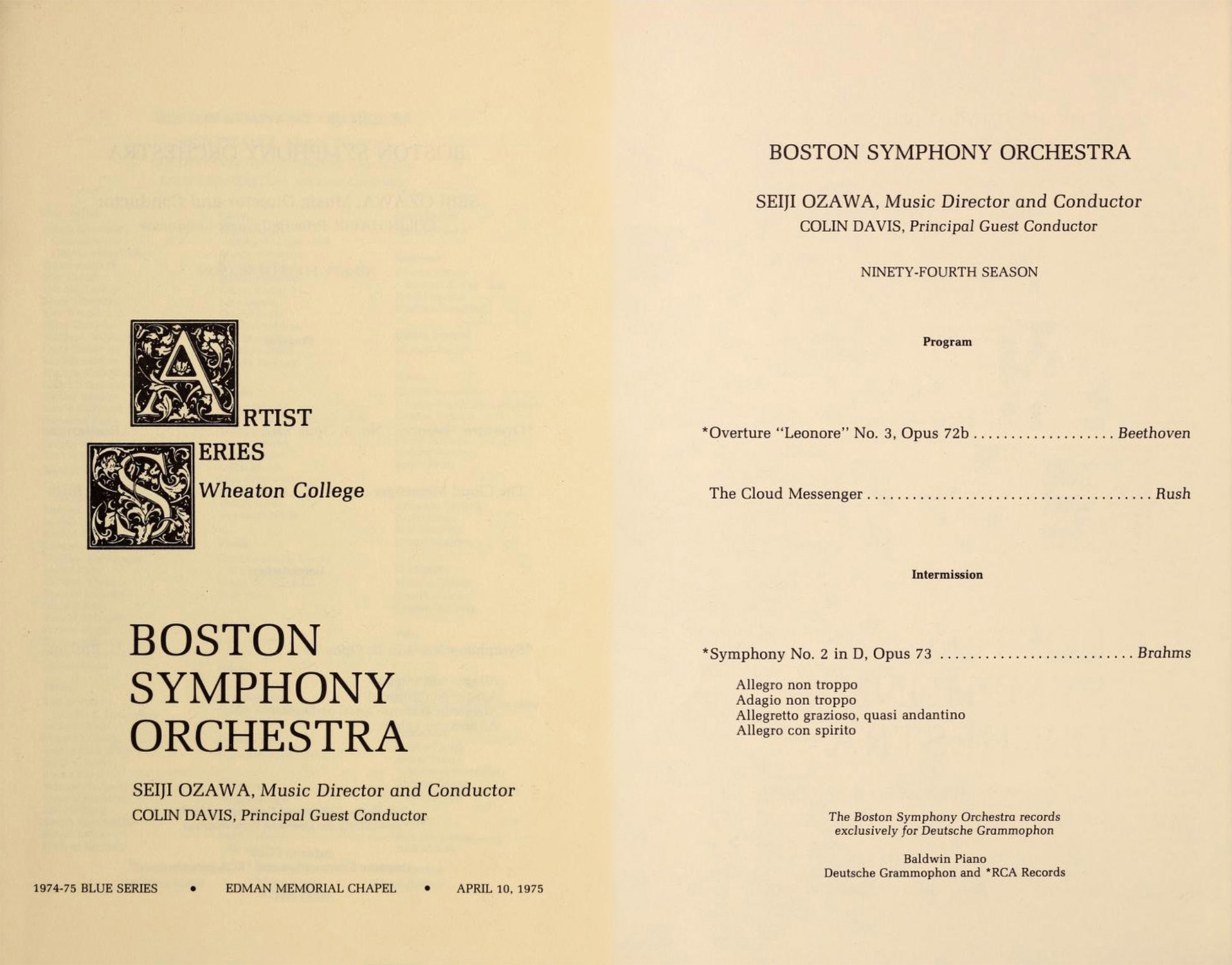
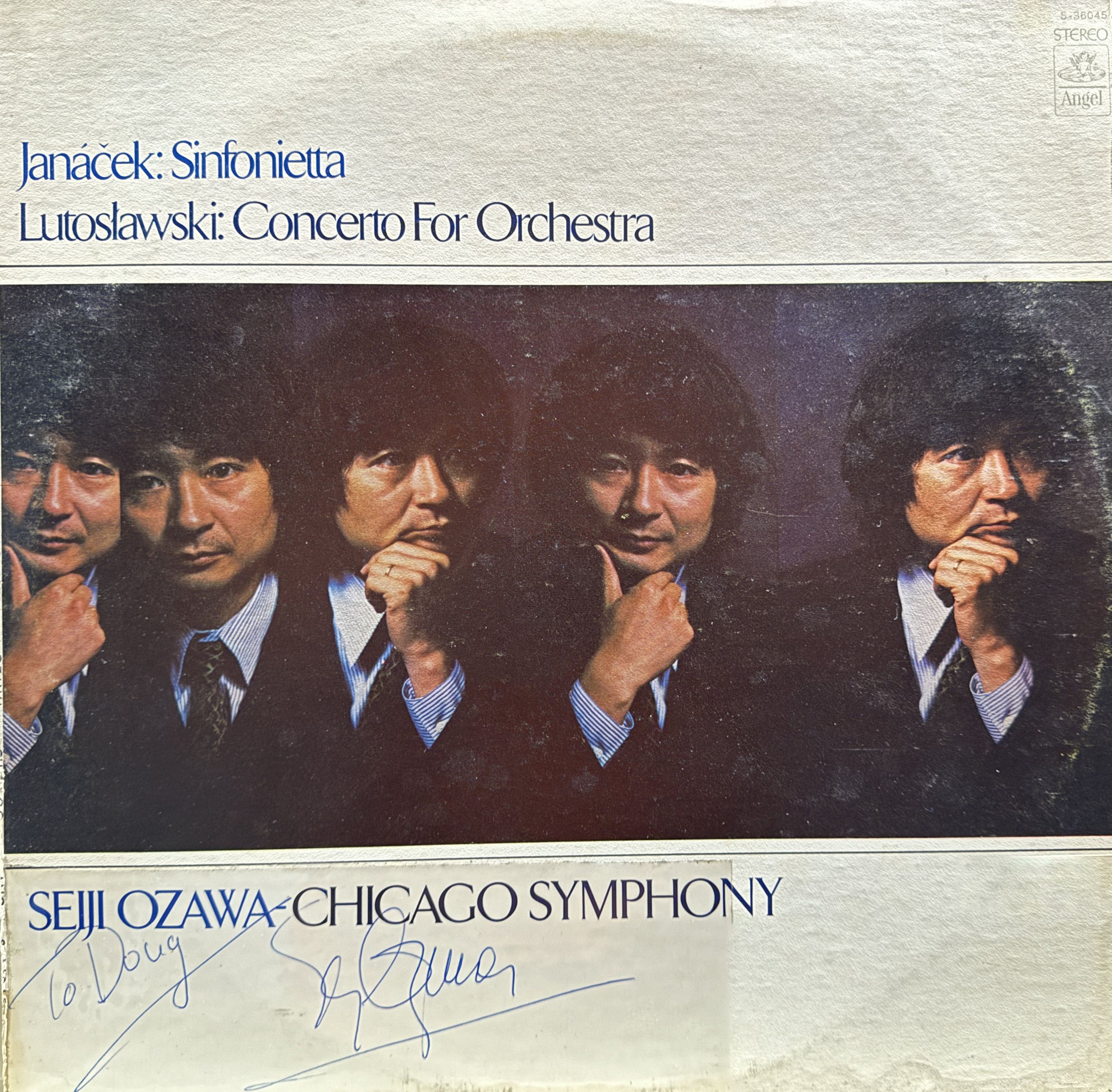
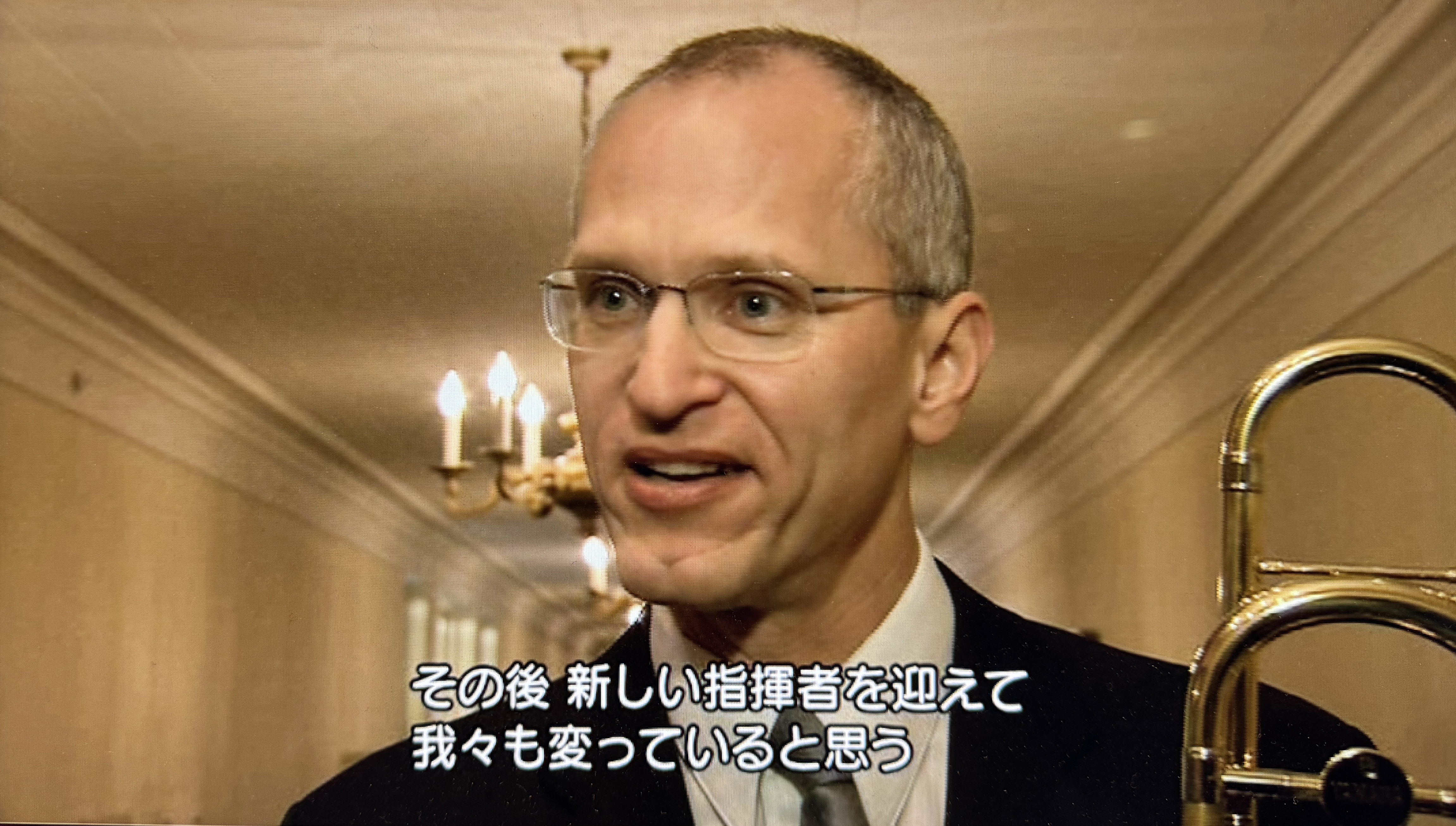
In 1986, the Boston Symphony Orchestra toured Japan and while there, YAMAHA Corporation invited our trombone section to come to the YAMAHA factory in Hamamatsu to try YAMAHA trombones. We (Ron Barron, Norman Bolter, and me) all agreed to go to the YAMAHA factory and it was at that time that my relationship with YAMAHA began. As a result of that meeting, I began working with YAMAHA on the development of a new bass trombone, the YBL-622 which later became the YBL-822G. Since that time, I’ve been to Japan more times than I can count, during trips with the Boston Symphony Orchestra (many tours conducted by Seiji Ozawa),the Boston Pops Orchestra (two tours conducted by John Williams), and teaching/performing trips to the Hamamatsu International Wind Instrument Academy and Festival. I’ve continued my happy relationship with YAMAHA in Hamamatsu and Tokyo, in Grand Rapids, Michigan, and in New York City and Boston. Testing of new improvements to my Yamaha bass trombone are a regular thing, and this relationship with YAMAHA that has spanned nearly 40 years is a great joy to me.
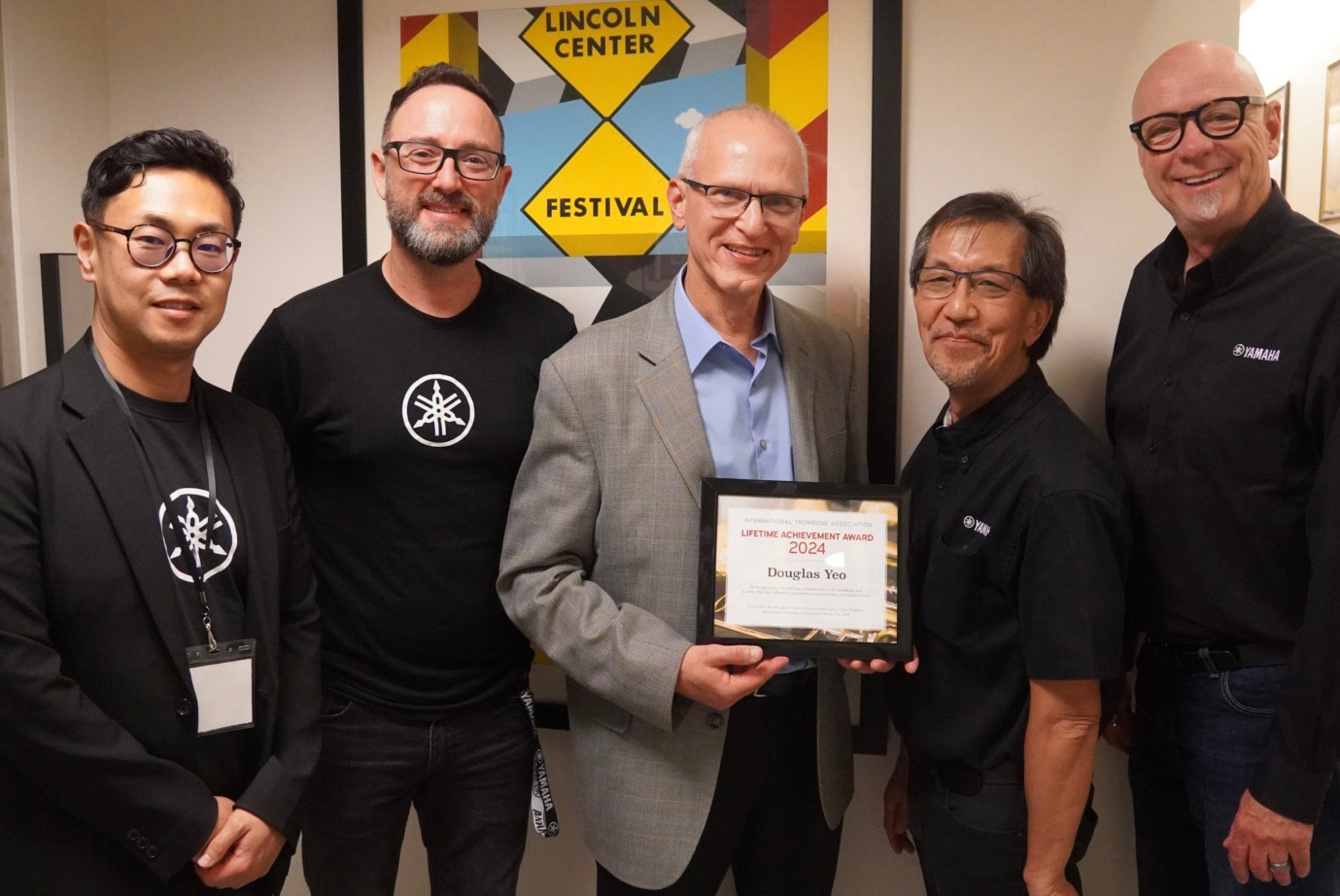
Masashi Nishimura (liaison between YAMAHA Japan and YAMAHA America), Jonathan Goldman, Douglas Yeo, Wayne Tanabe, and John Wittmann. After the International Trombone Association Lifetime Achievement Award Ceremony, 2024 International Trombone Festival, Texas Christian University. Wednesday, May 29, 2024.
In the weeks leading up to the International Trombone Festival, John Wittmann (Associate Vice President, Artist Relations for YAMAHA) told me that he and others would like to get together with me while we were in Fort Worth. I always enjoy seeing my friends at YAMAHA so I happily agreed. I spent some time at the YAMAHA booth in the vendors area of the Festival, and before, during, and on Wednesday evening after I received the ITA’s Lifetime Achievement Award, my friends from YAMAHA were there with me. On Thursday evening, I joined John Wittmann, Jonathan Goldman, Wayne Tanabe, and Chris Manners of YAMAHA for a nice dinner at an iconic Fort Worth restaurant, Reata.

YAMAHA advertisement in the 2024 International Trombone Festival program.
I should have known something was up when I turned to page 11 of the International Trombone Festival program and saw YAMAHA’s full page advertisement that congratulated me on receiving the ITA’s Lifetime Achievement Award. When I first saw the ad, you could have knocked me over with a feather. My friendship and partnership with YAMAHA has been a very big part of my life and I was deeply moved by this generous expression that celebrated our long collaboration. This was an unexpected gift to me but I was totally unprepared for what happened after dinner.
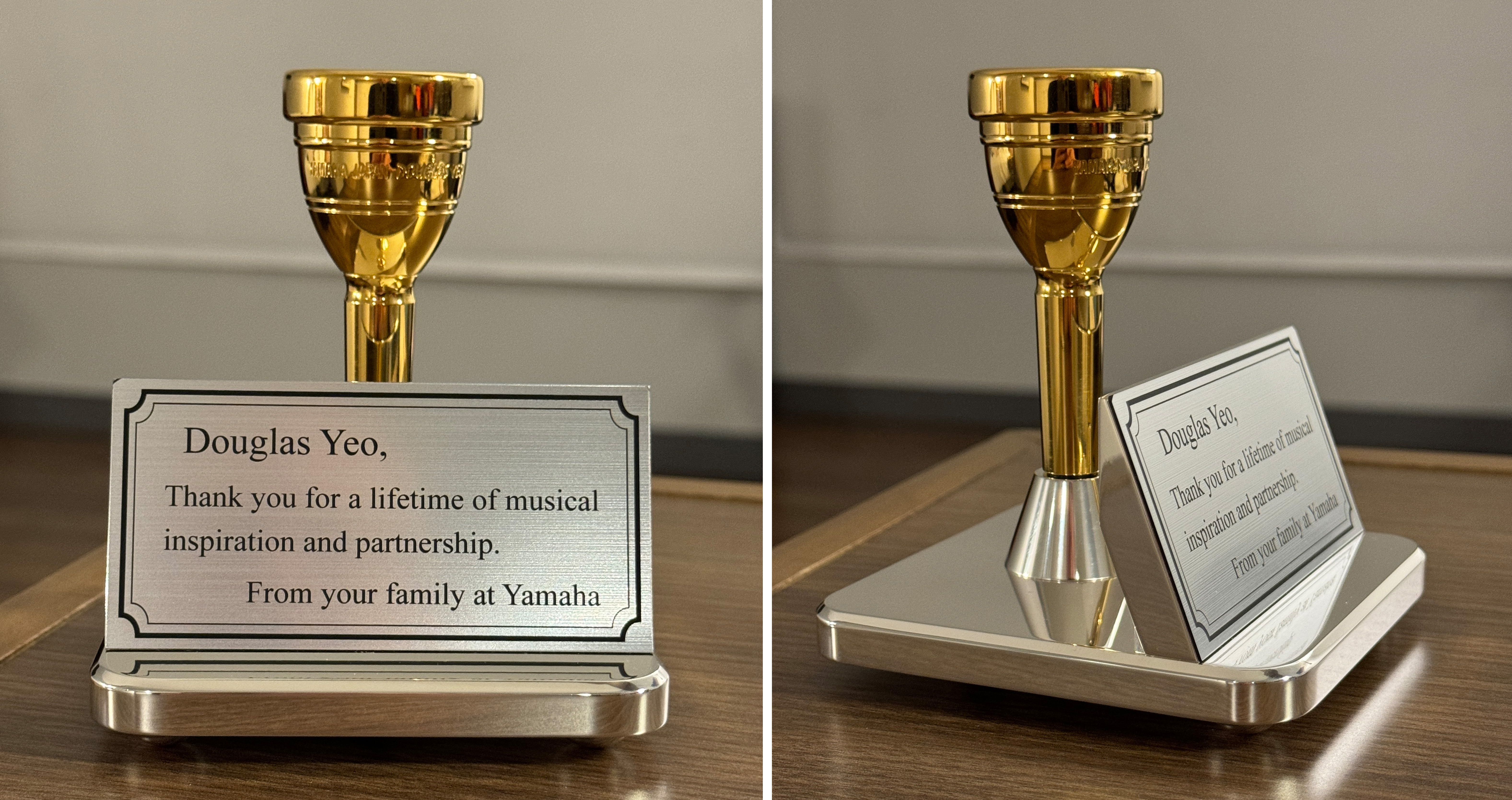
Gift from YAMAHA to Douglas Yeo, International Trombone Festival, 2024, Fort Worth, Texas. Thursday, May 31, 2024.
At the end of our meal at Reata (and it was a fine, fine meal), Jon Goldman said a few words and presented me with a gift from YAMAHA. The design of this very special gift was a collaboration between YAMAHA Corporation Japan and YAMAHA Corporation America. I could hardly speak when I held it in my hand. A gold plated copy of my YAMAHA Douglas Yeo Signature Series mouthpiece was mounted on a highly polished metal base (it is heavy!) with an inscription of friendship. I do not have enough words to express my gratitude to YAMAHA for the relationship we have had over the years which goes much further than simply bass trombone instrument and mouthpiece development. For me, working with YAMAHA has been all about its PEOPLE, whether in Japan, the United States, Canada, or Europe. PEOPLE, not corporations, make things happen, and this dinner with and gift from YAMAHA were emblematic of how everything we do with trombones in our hands happen because of relationships with people that are strong and lasting. Thank you, YAMAHA.

Wayne Tanabe, Jonathan Goldman, Douglas Yeo, and John Wittmann after dinner in Fort Worth, Texas. Thursday, May 30, 2024.
ROUNDTABLE DISCUSSION—DIVERSITY CONSIDERATIONS IN PROGRAMMING
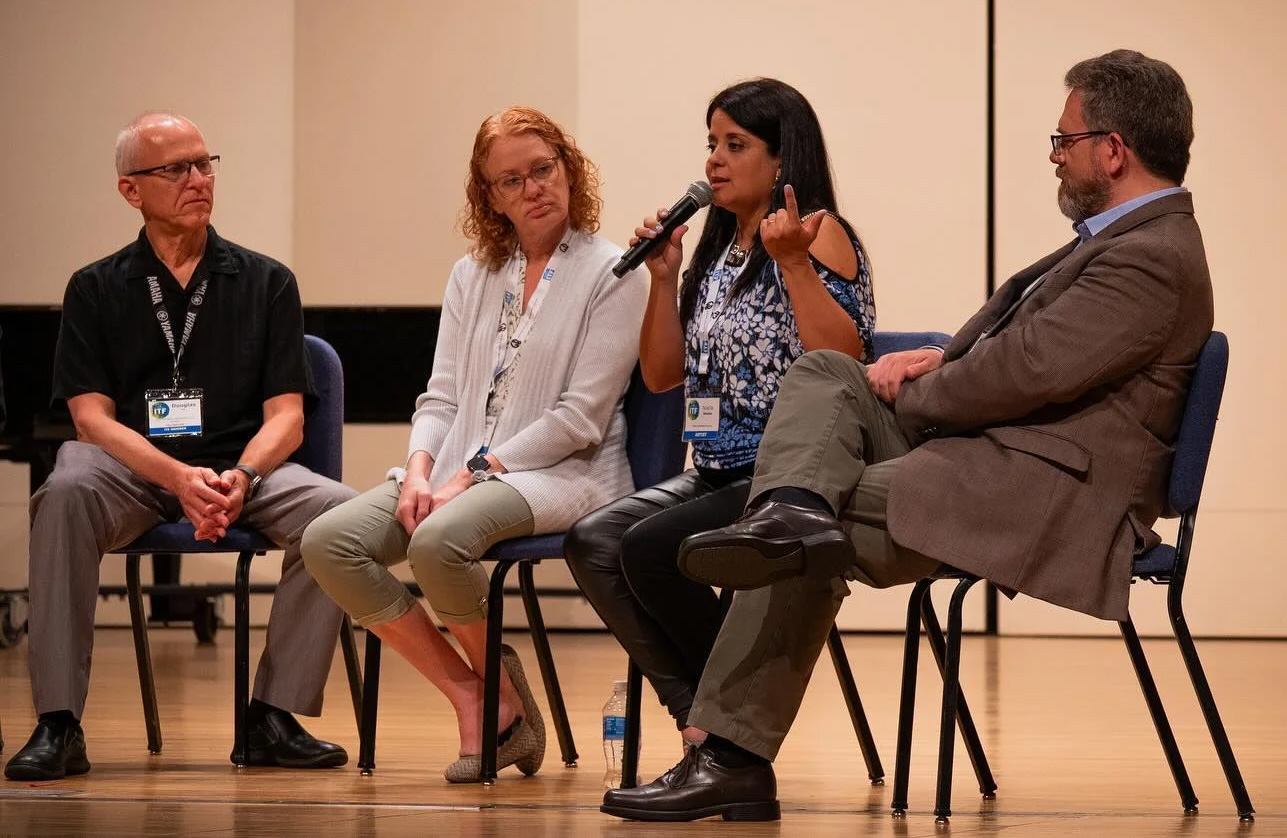
Douglas Yeo, Natalie Mannix, Noelia Escalzo, and Rob Deemer (not shown in this photograph are roundtable moderator David Begnoche and David Taylor) at the roundtable discussion, Diversity Considerations in Programming. Landreth Hall, 2024 International Trombone Festival, Texas Christian University. Thursday, May 30, 2024.
David Begnoche wanted the 2024 International Trombone Festival to be the most diverse in the history of the Festival. Among the things that was important to him was that the Festival have a roundtable discussion by individuals who would discuss the importance of diverse programming, of moving our repertoire out of the “standard canon” to include works by composers who have traditionally been underrepresented in trombone recital programming. As one who has written widely about the regrettable use of racist tropes in the marketing of some works for trombone, I was glad to be a part of this discussion that included David Taylor, Natalie Mannix (professor of trombone at University of North Texas and Chair of the ITA’s Advisory Council on Diversity), composer Noelia Escalzo (from Argentina), Rob Deemer (from The Institute for Composer Diversity), and moderator David Begnoche (two others, Tony Baker and Mayumi Shimizu were scheduled to be part of the panel but were unable to attend). This event, while part of the International Trombone Festival, was sponsored by TCU. We need to keep these important conversations going.
ROUNDTABLE DISCUSSION—TROMBONE RESEARCH
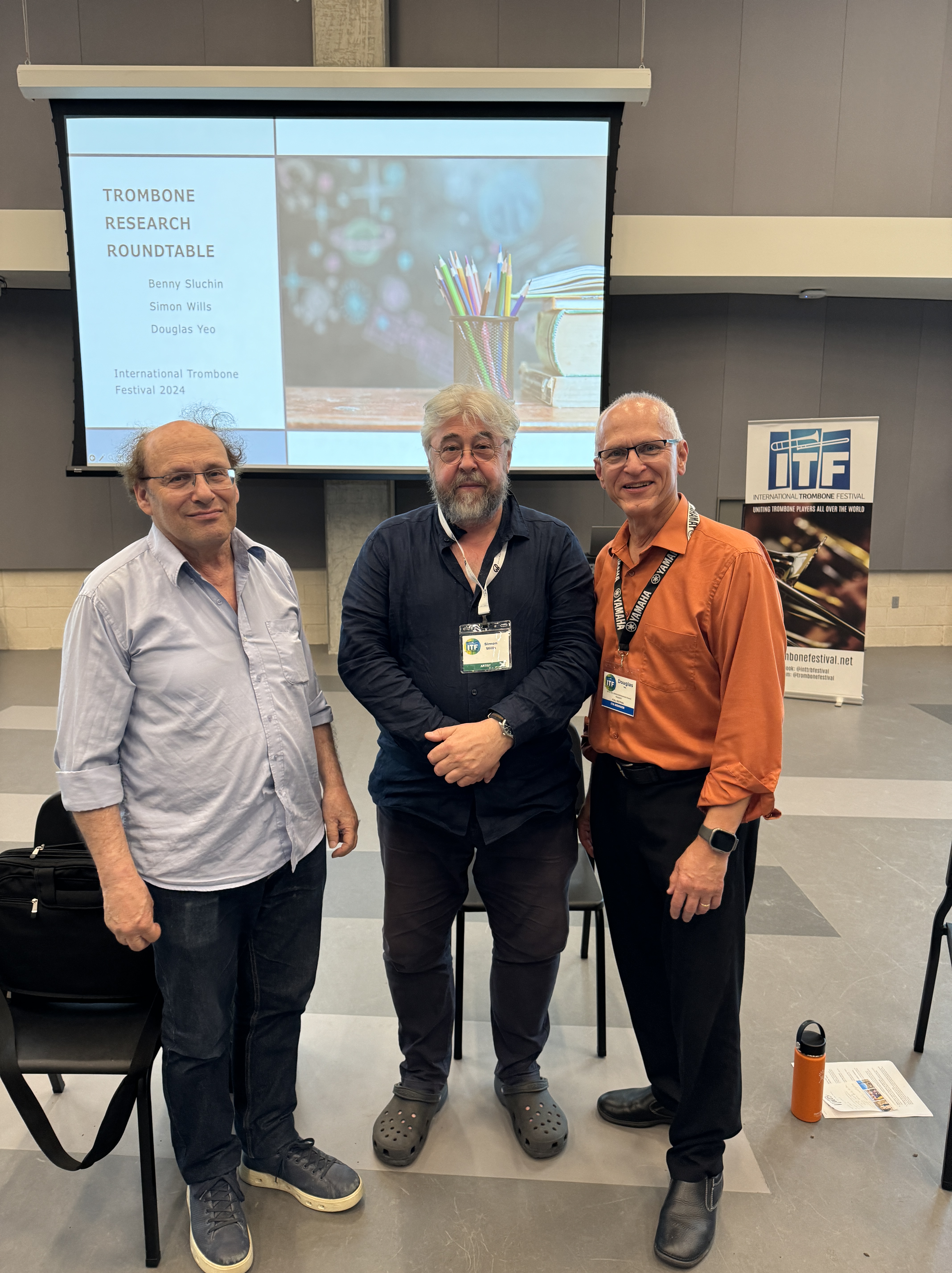
Benny Sluchin, Simon Wills, and Douglas Yeo; Trombone Research Roundtable. Van Cliburn Band Room, 2024 International Trombone Festival, Texas Christian University. Friday, May 31, 2024.
As mentioned earlier, another thing that was important to David Begnoche was that the International Trombone Festival include a strong research component. While there are some scholars who are doing excellent research on the trombone—its instruments, music, manufacturing, pedagogy—the sad fact is that most “research” that students undertake is not research at all: it is compilation. We need better research about the trombone. Bringing together Benny Sluchin, Simon Wills, and me provided us with an opportunity to talk about the current state of trombone research and how we can test sources and improve and build our knowledge base about the trombone.
Among the things I did at the roundtable was provide attendees with two documents. The first is a 52 page list compiled by Bill Stanley, long-time trombone professor (now retired) at University of Colorado Boulder. His list includes doctoral projects relating to the trombone from 1941 to the present. You can find that list HERE. Students and other researchers: don’t duplicate these topics! The second document is one that I prepared that lists 50 research topics that are crying out to be investigated. For instance, it is incomprehensible to me that an enterprising doctoral student has never investigated trombone solo recordings before Arthur Pryor’s first recording in 1897. It’s never been done. Why not? You can find my list of research topics HERE.
Benny and Simon’s insights were revelatory—I certainly learned as much from them as anyone in the room—and it was a pleasure to collaborate with them in this roundtable.
RECITAL—TROMBONE CHAMBER MUSIC OF VACLAV NELHYBEL

Douglas Yeo and Nathan Siler Recital: Trombone Chamber Music of Vaclav Nelhybel (2024 International Trombone Festival program). Friday, May 31, 2024.
Trombonists of a certain age will remember the band music of Vaclav Nelhybel. The music of this Czech-American composer took the wind band world by storm in the 1960s and 1970s. Noted for its visceral, rhythmic, and dramatic effect, I could not get enough of Nelhybel’s music when I was in high school and college. In 1975, he came to Wheaton College for a residency and I followed him all over campus. As a result, we became friends and he wrote two pieces for me, Counterpoint No. 2 for bass trombone and percussion, and his Concerto for Bass Trombone.

Nathan Siler and Douglas Yeo performing Vaclav Nelhybel’s Interplays for two trombones. Van Cliburn Hall Room, 2024 International Trombone Festival, Texas Christian University. Friday, May 31, 2024.
Last year, Nathan Siler, trombone professor at Eastern Kentucky University, asked if I would collaborate in a recital of Vaclav Nelhybel’s music for trombones at the 2023 ITF in Salt Lake City. Nathan had recently released a recording of some of Vaclav’s music for trombones and I had helped him with some insights about Vaclav and his music. But, since I was already attending the 2023 International Tuba Euphonium Conference last summer, I didn’t have time to go to the ITF in 2023 so I asked Nathan to circle back to me about the idea of the recital in 2024. He did, I agreed, and we gave a recital of some of Vaclav’s trombone music at TCU. In this we were assisted by Thomas Nixon, piano; Justin Cook (associate professor of trombone at University of Central Arkansas), trombone and conductor, and Sophia Lo, Nathan Grissett, and Kayla Liptak, percussion.

Thomas Nixon (piano), Douglas Yeo, Justin Cook (trombone and conductor), Nathan Siler, and Nathan Grissett, Kayla Liptak, and Sophia Lo, percussion. Van Cliburn Hall, 2024 International Trombone Festival, Texas Christian University. Friday, May 31, 2024.
It was such a joy to play a recital of Vaclav’s music at the ITF. His music is not as well known today as it once was, and this recital was an effort to bring his music back to the attention of trombonists. Nathan played Vaclav’s Suite for Trombone which was composed for Mark McDunn. I played Vaclav’s Concert Piece, a piece for flexible solo instrumentation. We also played his Interludes (duets) and Contrasts (trios, with Justin Cook) that were designed for young players but which present real challenges of intonation and ensemble. Our recital concluded with Concertato for tenor and bass trombone, in a reduction by the composer for piano and three percussion players from the original version for band. If the response of the audience was any indication, Vaclav Nelhybel’s music is once again on the rise, and I feel fortunate to have been a part in reviving his important compositional legacy.
LEARNING SOMETHING—BENNY SLUCHIN

Benny Sluchin’s presentation and recital (with Mikhail Malt). Van Cliburn Band Room and Van Cliburn Hall, 2024 International Trombone Festival, Texas Christian University. Thursday, May 30 and Friday, May 31, 2024.
Benny Sluchin and I have been friends for many years and I have the utmost respect for him as a trombonist and scholar who is equally conversant in a wide range of musical styles, from Paris Conservatoire concours solos to electronic music. Benny, who, along with me, received the International Trombone Association 2024 Lifetime Achievement Award, has been helpful to me in many of my research projects, including my current project about Joannès Rochut.
At the Festival, Benny gave a presentation, “Open Forms in the Age of A.I., the case of Cage’s Solo for Sliding Trombone and Somax2,” and a recital, “The Trombone in the Electronic Era,” that included Jacob Druckman’s Animus I for trombone and tape and Jonathan Harvey’s Ricercare una melodia. Benny has premiered dozens of compositions for trombone with computer and other electronic accompaniment and his presentation and recital were revelatory. With his colleague, Mikhail Malt, at the computer, those in attendance were transfixed by a passionate presentation about the creation of this type of new music. Benny is at the forefront of people who are engaged in the presentation of this fascinating and important type of music. It was absolutely riveting to hear Benny talk about Keren by Iannis Xenakis (a piece that was written for Benny), and perform part of John Cage’s Solo for Sliding Trombone. I came away from Benny’s presentation and recital with a new appreciation for music for trombone and computer.
LEARNING SOMETHING—SIMON WILLS AND THE CRAMER CHOIR

The Cramer Choir conducted by Simon Wills (2024 International Trombone Festival program). Saturday, June 1, 2024.
Simon Wills is a musical everyman. Former trombonist with the Welsh National Opera, London Symphony Orchestra, and the Chamber Orchestra of Europe, he has also played with the Orchestra of the Age of Enlightenment and is one of the most highly respected exponents of contemporary music. Currently professor at the Guildhall School in London, Simon is also a gifted composer and for the 2024 ITF, Simon was the conductor of the Cramer Trombone Choir. This ensemble, formed annually at the International Trombone Festival in honor of longtime Florida State University trombone professor William Cramer, is made up of trombone professors from colleges and universities around the world.

Simon Wills conducting the Cramer Choir in his One Is Down. Van Cliburn Hall, 2024 International Trombone Festival, Texas Christian University. Saturday, June 1, 2024.
I have heard many performances by the Cramer choir over the years but I cannot remember a more engaging program, more dynamic leadership, and finer playing than I heard on Saturday afternoon. The decision to engage Simon as conductor was due to David Begnoche’s advocacy. With Simon’s vast experience as a conductor and trombonist, and the fact that he is a composer of many works for trombone ensemble, the choice of Simon to lead the Cramer choir was inspired. The players—24 of them—were superb, and the choir premiered Simon’s One is Down (which was dedicated to David Begnoche) for 24 trombones. I can hardly describe the piece—with its “angel choir” of four alto trombones, a mute group, a large group, and more. The word “engaging” only begins to describe this program, and the concert was met with thunderous applause.
LEARNING SOMETHING—WYCLIFFE GORDON
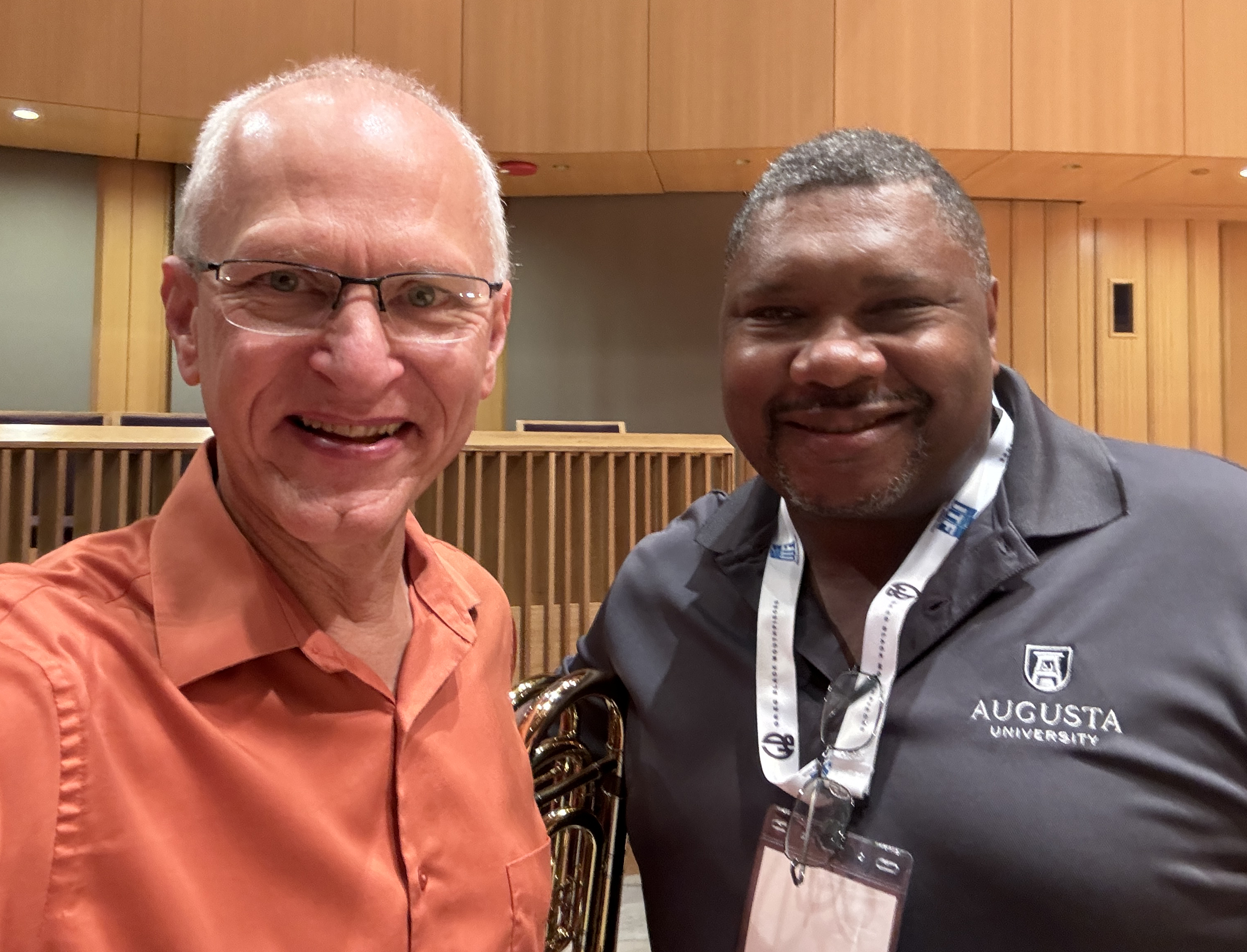
Douglas Yeo and Wycliffe Gordon. Van Cliburn Hall, 2024 International Trombone Festival, Texas Christian University. Friday, May 30, 2024.
Jazz trombonist Wycliffe Gordon, and I have been friends for 25 years. I first met Wycliffe when he was a member of the Lincoln Center Jazz Orchestra. The LCJO came to Tanglewood, the summer home of the Boston Symphony Orchestra, and played a combined concert with the Boston Symphony on July 24, 1999. Wycliffe and I became fast friends and we’ve been sharing musical performances and life together ever since. We played together in an all-star big band of YAMAHA artists with Boston Brass at the Midwest Clinic in 2019, we played in the All-American Alumni Band (alumni of the McDonald’s All-American High School Band) for a concert in Columbus, Ohio, and Wycliffe came to Arizona State University to work with my students when I was teaching there. I was thrilled when I heard that David Begnoche wanted to have Wycliffe at the 2024 International Trombone Festival and Wycliffe agreed to come.
Wycliffe is my brother from another mother. We are very close friends and it is always a delight to be with him. Whether we are playing together or I’m enjoying him perform, Wycliffe always inspires me.

Wycliffe Gordon with Paul Lees (piano), Eric Hitt (bass), and Jaelyn Washington (drums). Van Cliburn Hall, 2024 International Trombone Festival, Texas Christian University. Saturday, June 1, 2024.
I’ve heard Wycliffe perform many times—in a jazz band, with a jazz combo, accompanied by a jazz band or a symphony orchestra or a concert band or brass band. But I have to say this: Wycliffe’s performance at the Festival was the finest I have ever heard him play. Van Cliburn Hall was packed; you could not find an empty seat. Before the concert, I went backstage to talk with Wycliffe. From the conversation we had, I knew we were in for something really special. And special it was. Wycliffe played trombone and soprano trombone. He sang. He engaged with the audience. When he sang, “On the Sunny Side of the Street,” he gave all of us a message we needed to hear and, turning to me and pointing while he was singing—with a big smile on his face—he added a few words:
Why don’t you grab your coat, and your hat, baby,
Leave your worries at the doorstep.
Just direct your feet to the sunny side of the street.
Well, can you hear that pitter-pat, when that happy tune is in your step,
Life can be so sweet on that sunny side of the street.
You see, I used to walk in the shade, all of my blues on parade,
But now I’m not afraid, this rover crossed over.
And if I never have a cent, I’ll be as rich as Rockefeller—AND DOUG YEO SITTIN’ OVER THERE!
With gold dust at my feet, on the sunny side of the street.
The audience laughed, and nobody laughed harder than me. But the message was great. We have choices in life. We can live a life on the shady side and drown ourselves in grievances, slights, and anger. Or we can walk on the sunny side, care about others, and make a positive difference in the world. Wycliffe reminded us of this. And when Wycliffe closed his program with “Just a Closer Walk with Thee” and “When the Saints Go Marchin’ In,” we heard a great jazz artist deliver another great message in a transcendent way.
LEARNING SOMETHING—DAVID TAYLOR

Douglas Yeo and David Taylor. Backstage of Van Cliburn Hall, 2024 International Trombone Festival, Texas Christian University. Saturday, June 1, 2024.
In the mid-1980s, I ordered the first copy of bass trombonist David Taylor’s first solo album, David Taylor Trombone. Weeks passed and I didn’t receive the LP so I wrote to David. He apologized for the delay, and said that the manufacturer didn’t get the color/contrast of the cover right and it had to be redone. Eventually I received the album. And that album changed me. That inauspicious introduction to each other led to a vibrant friendship. Dave Taylor is truly a legend in the trombone community. It’s hard to believe he’s 80 years old now—80 years YOUNG in his case—and whenever I’m around him, I feel energized. As David Begnoche said to me, Dave Taylor is “artistic penicillin” that pushes up against unimaginative, bland playing. To be around Dave is to be in the center of an artistic tornado.

World premiere of David Taylor’s Tatanka Lyotanka (Chief Sitting Bull). David Taylor, Jeanette Velasco, Angel Subero, Joran Davenport, Douglas Yeo, David Begnoche (conductor). Van Cliburn Hall, 2024 International Trombone Festival, Texas Christian University. Saturday, June 1, 2024.
David came to the ITF with a mission of creativity. And when he asked if I would take part in the premiere of his new piece, Tatanka Lyotanka (Chief Sitting Bull), for bass trombone solo with four bass trombone accompaniment, I was all in. It’s not possible to describe Dave’s recital at the Festival. His playing defies characterization—it is high, low, soft, loud, fast, slow, manic, calm, thought-provoking, and always consequential. I left David’s recital—that included his arrangement of Franz Schubert’s Der Doppelgänger with the TCU Trombone Choir, Eric Ewazen’s Dagon II for bass trombone solo and eight overdubbed bass trombones (with video), David Taylor’s Dance for bass trombone and talking metronome, and more—with my head spinning. When Dave asked the audience if we had any questions, Abbie Conant replied, after a long silence, “We’re overwhelmed.” Yes, we were. Dave Taylor’s musical tornado affected us all deeply.
After David’s concert, I did not have the energy to hear the final jazz concert of the Festival; I needed to stop and collect my thoughts. Four days at TCU had profoundly changed me.
RETURNING HOME
After breakfast at the hotel with Dennis Bubert on Sunday morning and saying goodbye to several friends in the hotel lobby, I packed up and got back in my car. Fortified with Diet Coke, my trip home was much less eventful than my all-nighter drive to Texas. I split the trip over two days, eight hours of driving each day, and for those long hours, I didn’t listen to the radio and I didn’t listen to music. I used the time to reflect on what I had just experienced.
REFLECTION AND THANKS
An event such as the International Trombone Festival does not just happen. It requires years of planning and many hands to pull it together. The three members of the International Trombone Association’s Standing Committee on the International Trombone Festival, Steven Wolfinbarger, Bradley Palmer, and Carol Jarvis, review applications for potential ITF sites and provide oversight over the Festival. The Festival’s salaried staff, Director Karen Marsten, Festival Manager Justin Cook, and Festival Assistant Manager Chris van Hof (and other ITF salaried staff including the ITF Youth Workshop Director, the ITF Composers Workshop Director, the ITF Digital Director, and the ITF Bookkeeper) along with other non-salaried, appointed ITF staff members, do a great deal of nuts and bolts planning and implementation to help ensure the success of the Festival. We are so very grateful for all of their hard work.
But it must be said that one person is at the heart of each International Trombone Festival: the Festival’s host. It is the host that provides the venue, typically a college or university. Hosts are not paid for their work for the ITF; this is a command performance of epic proportions. The Festival host needs to secure appropriate world-class performance spaces, spaces for presentations (with technology for Powerpoint video presentations and audio), dorm rooms for attendees, rooms for vendors, practice rooms for participants, rehearsal spaces for performers. And much more. All of this is done without financial compensation. This is often tricky business, navigating all of this with University administrators, securing music stands and chairs, arranging for percussion and electronic equipment. Student volunteers—without whom International Trombone Festivals simply could not be mounted—serve tirelessly to staff the information and registration desks, sell ITF gear, ensure that only registered individuals are admitted to performance halls, guide artists to rehearsal and performance spaces, staff the instrument check room, and so much more. They, also, are not paid for their work; they do it for the love of the trombone (and a t-shirt).
I salute David Begnoche. When we started talking about the possibility of his hosting an International Trombone Festival, his document of dreams was something we talked about frequently. And when we look at the things that happened at this recently concluded Festival at Texas Christian University in Fort Worth, we can thank David Begnoche for his vision. Long before he made his formal application to host the ITF, he was thinking. He wanted this Festival to be diverse. It was. Everyone noticed. He wanted this Festival to include new faces. It did. Everyone noticed. He wanted this Festival to recognize the depth of trombonists and scholars in the world beyond the “familiar faces” that so often appear at Festivals. It did. Everyone noticed. Looking back at David Begnoche’s 2020 ITF dream document, we can see how much of his original vision made it into the 2024 ITF as he passionately advocated for populating the Festival with many particular individuals and groups:
- Simon Wills
- Benny Sluchin
- David Taylor
- Natalie Cressman
- Trombones de Costa Rica
- American Brass Quintet
- Amanda Stewart
- Peter Steiner
- Alex Iles
- Monarch Brass
- Hakeem Bilal
- Ronald Barron
- Sasha Romero
- David Yacus
David also wanted to showcase local artists, composers, and ensembles from Texas at the ITF, and they were:
- Kevin Day
- Quinn Mason
- Dallas Asian Winds
- Center Stage Brass
Of course, there were many people on David Begnoche’s dream list that did not or could not come to the festival for various reasons. You don’t get everything in life. In the years, months, and weeks after he made up his dream list for the International Trombone Festival, he continued advocating for diverse, transformational artists and presentations. He successfully led the effort to commission Kevin Day to write his new concerto for trombone and piano, Diversions, that was premiered by the Fort Worth Symphony with trombonist Peter Steiner and pianist Constanze Hochwartner. David Begnoche—personally—was the lead commissioner for Diversions, and the major portion of the commission was paid for by the Fort Worth Symphony, something that the International Trombone Association, with its limited financial resources, could not have done itself. He advocated for and ensured that the roundtable on diversity considerations in programming happened. It was David who reached out to Amanda Stewart and facilitated her participation in the Festival where she discussed the value of promoting a safe work environment. David brought early music and trombone research to the Festival in a big way. These things—and so much more—did not happen by accident. They came about due to David Begnoche’s vision and advocacy. Others worked alongside David—the ITA’s Standing Committee on the International Trombone Festival, the paid and unpaid ITF staff—and together, they collaborated mightily to put together the pool of teachers, presenters, and performers that made this the most consequential Festival in the ITF’s history. Gone are the years when the International Trombone Festival was a “good old boy” event. With ensembles and soloists who made up diverse genders, races, and nationalities, as well as players of trombones of every type, size, and shape who played music from the Renaissance up to the present, this International Trombone Festival set a standard for the future. As Abbie Conant said in a Facebook post on Wednesday, June 5, “Everyone had a great time at the ITF and there was a lot of great trombone playing. It was a lot of fun. It was also the most inclusive and diverse ITF ever.” Yes, it was.
And in the midst of some truly dangerous and catastrophic weather events in Fort Worth and the surrounding area—rain, hail, wind, even tornadoes—that knocked out power, damaged personal and institutional property, forced some attendees to cancel or delay their trips, required juggling of schedules—the Festival is already being recognized as one of the most successful and impactful—and perhaps the MOST successful and impactful—in the International Trombone Association’s over 50 year history.

A thought from a fortune cookie, sent by David Begnoche to Douglas Yeo. June 2, 2024.
As I was driving on the final leg of my trip home on Monday, David Begnoche sent me this snapshot of a thought in a fortune cookie. Anyone who was at the ITF and was paying attention—and I think EVERYONE was paying attention—would agree with this statement. New ideas were on display last week at the ITF and we were all changed.
To the ITA’s Standing Committee on the International Trombone Festival, the ITF paid and unpaid staff, the dozens of unpaid student workers, to the ITF’s Platinum Sponsor, S. E. Shires Co.; Gold Sponsor Greg Black Mouthpieces; Silver Sponsors Antoine Courtois and J. P. Rath; and Bronze Sponsors C. Sharpe Editions and YAMAHA Musical Instruments; and especially to Dr. David Begnoche, I extend my thanks for what we all experienced at Texas Christian University in Fort Worth. The approximately 1000 trombonists that attended the Festival and others who followed it through the Festival livestream left Fort Worth challenged, inspired, and energized.
I don’t know about you, but I’m going to practice now. . .



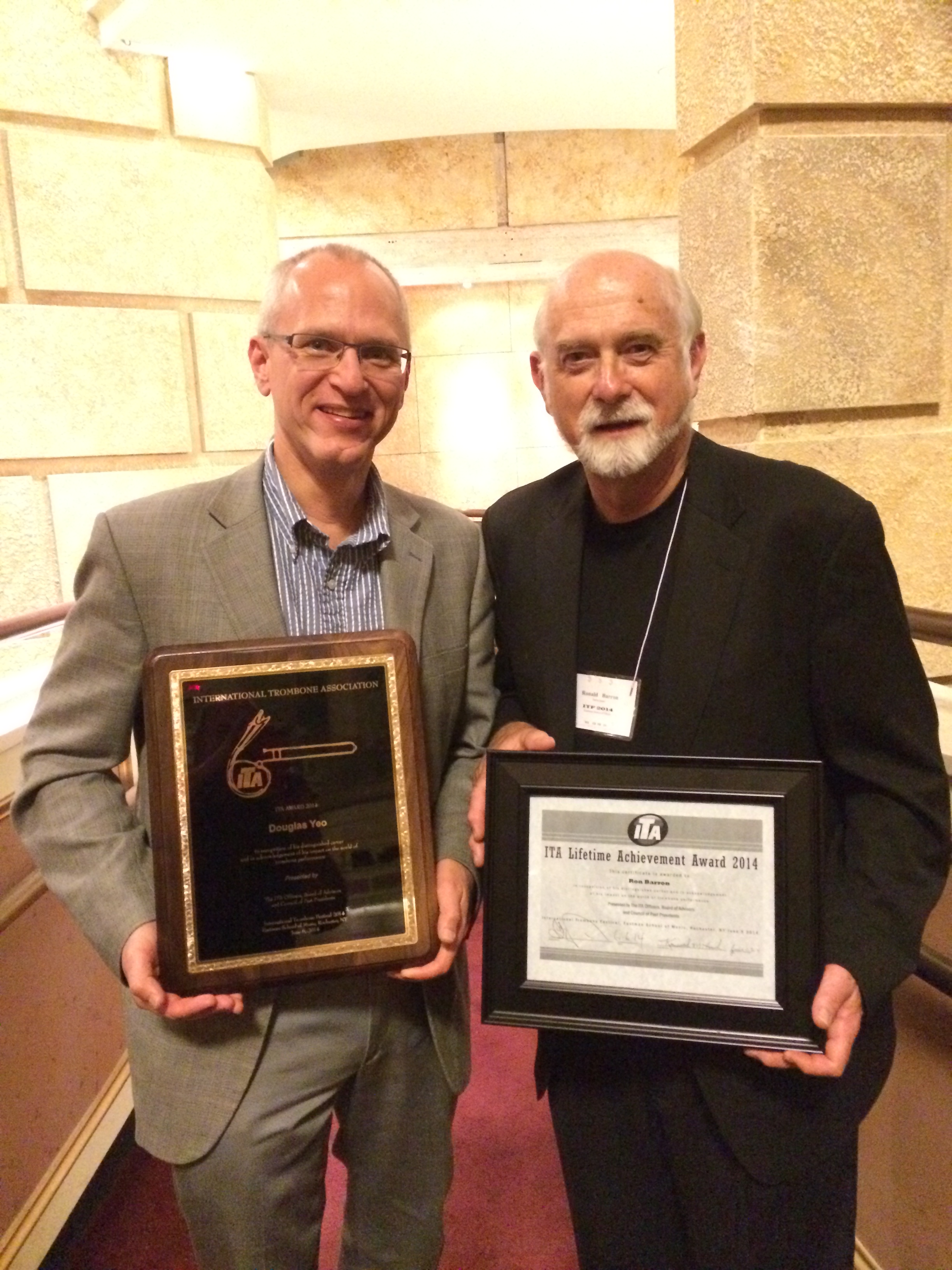
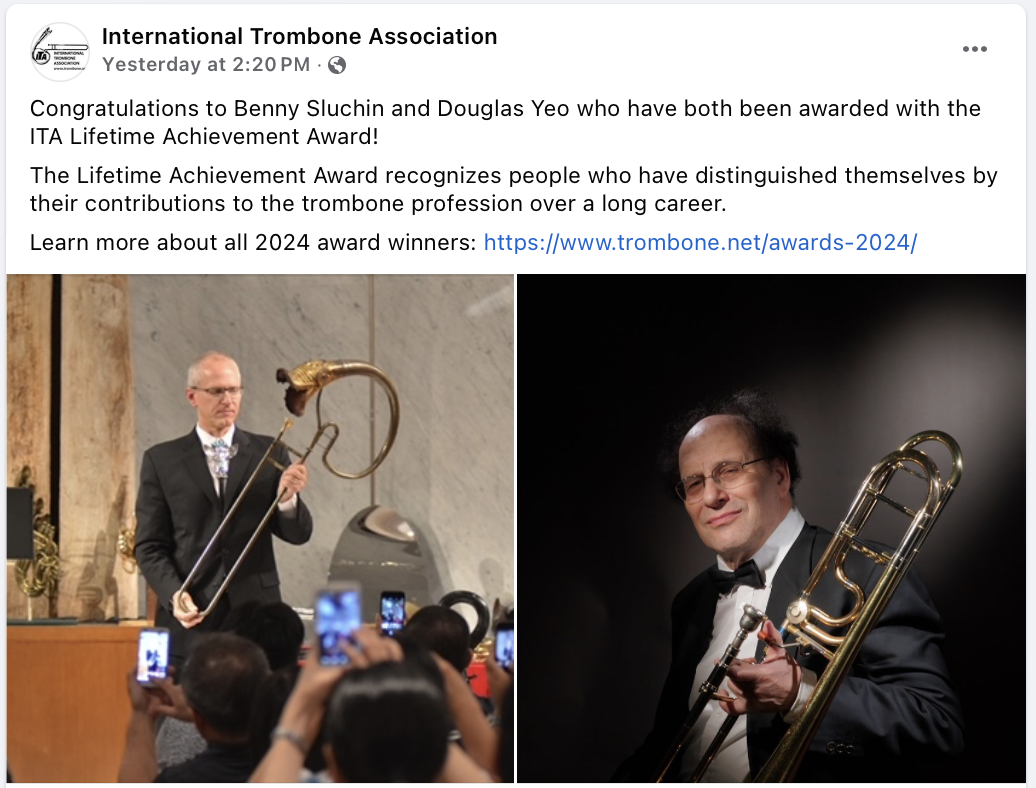

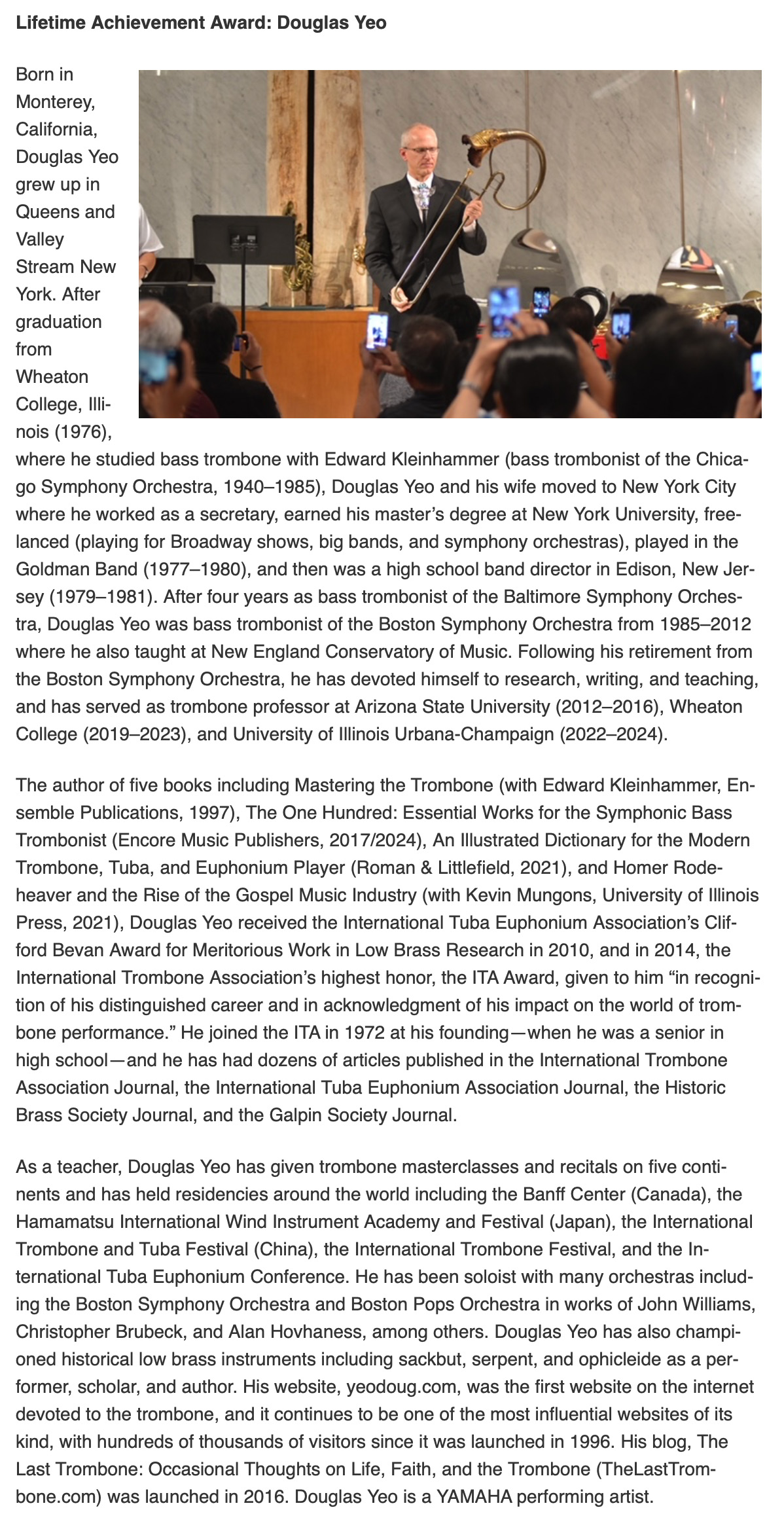 Biography of Douglas Yeo from the International Trombone Association website, April 2024. In the photo that accompanies this bio and the ITA Facebook announcement of 2024 Lifetime Achievement Award recipients, I am holding a buccin (dragon bell trombone, made in the 19th century) during a recital I gave at the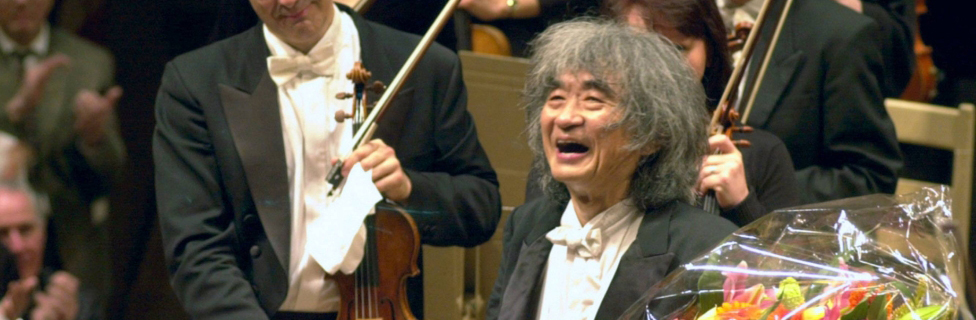






 The Last Trombone – Douglas Yeo