Category: composers, conductors, performers

Celebrating the bass trombone

Celebrating the bass trombone

I’ve been playing the trombone since I was a young boy, and the bass trombone in particular since I was 18 years old. I’ve been fortunate to have made several solo recordings that are now in the hands of thousands of people around the world – you can see a list of my recordings by clicking here. Many other fine bass trombonists have also made superb solo recordings of diverse repertoire and recently, my good friend Gerry Pagano, bass trombonist of the Saint Louis Symphony, has released a new recording.

I met Gerry in 1987, early in my tenure as a member of the Boston Symphony Orchestra. He was a Fellow at the Tanglewood Music Center that summer and we spent a lot of time together playing and talking. A few months after the Tanglewood season ended, Gerry won the St. Louis Symphony position. Gerry is not only an excellent player but a great person – vivacious, creative, positive. I count it a real privilege to call him my friend.

Gerry’s new recording features works for bass trombone that are accessible to talented players. It doesn’t include works that are only playable by just a handful of super professionals. As always, Gerry’s new album, Horizon, features his beautiful sound and impressive technique. Most of all, his musical artistry comes through.

I’m particularly pleased that Gerry has recorded, along with tenor trombonist Bradley Palmer, my arrangement of Eric Ewazen’s Pastorale, which I made with Eric’s permission for inclusion on my own CD, Two of a Mind, with tenor trombonist Nick Hudson. Gerry and Brad’s performance is quite beautiful and I’m very grateful for the inclusion of this lovely piece on the album.

You can obtain Gerry’s album for free. Yes. For free. Here is the link to download the tracks:

Download Gerry Pagano’s new album, Horizon.

Of course this album wasn’t free on Gerry’s end. He had to record and produce it, and has to pay royalties to composers. So if you download the album and feel like it’s worthwhile, please take the opportunity to click the link at the bottom of the download page and send a few dollars Gerry’s way to help defray his expenses. He made this album of music that he loves and his playing is truly inspirational.

In 2014, I asked Gerry to come to Arizona State University to give a master class. The class was terrific; he is such a natural communicator and his time was extremely helpful to my students. After the class, we sat down in my office and made a video of our playing Tommy Pederson’s great duet for two bass trombones, The Crimson Collop. I posted our recording – done in one take –  on YouTube and much to my surprise, it’s had over 15,000 views. Seriously? Well, we’re just happy that people have enjoyed it. Perhaps you’ll enjoy it too. Watch the video below to see two friends having a nice time together making music, celebrating the bass trombone. Enjoy.
The Olympic Games

The Olympic Games

The games of the XXXI Olympiad get underway today with the opening ceremony in Rio de Janeiro, Brazil.  As a young boy, I was thrilled by the games – the spectacle, the competition, and as ABC television aptly put it, “the thrill of victory and the agony of defeat.” In recent years the Olympics have suffered a bit with world-wide scandals involving the use of performance enhancing drugs. But, still, there is something about the big stage of the Olympics, the celebration of success and what one hopes is a healthy kind of nationalism as we are proud of our country being represented by excellent athletes.

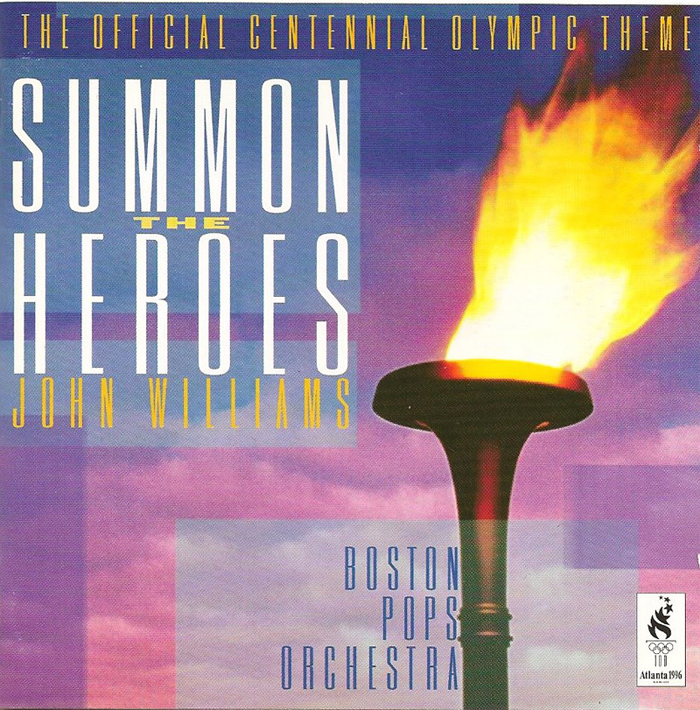
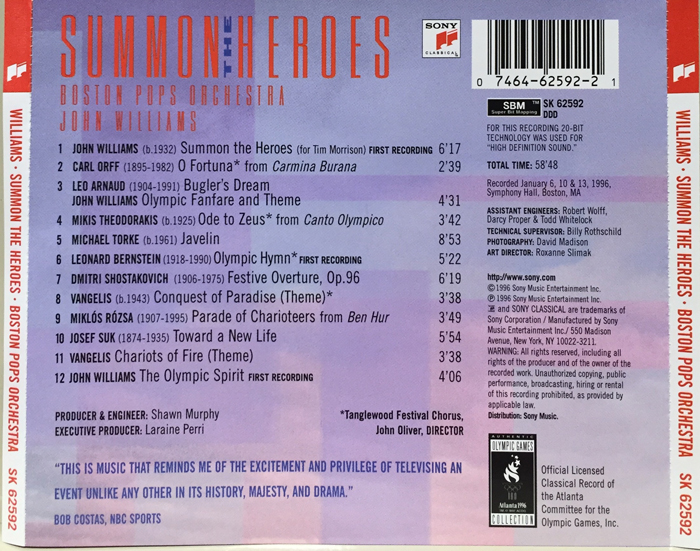
I’ve never been to an Olympic event but I got close. Musically. In 1996, the Olympics were held in Atlanta, Georgia, USA. As a member of the Boston Symphony Orchestra at the time – and membership in the BSO brought with it membership in the Boston Pops Orchestra – I played on the official soundtrack album of the Atlanta 1996 Olympic games, “Summon the Heroes.” Conducted by John Williams, the Boston Pops Orchestra had recording sessions on January  6, 10 and 13, 1996 of a playlist that included well known Olympic game themes (by John Williams) and other heroic, brass-centric, noble works that are often associated with the Olympics. Here is the tray card with the full track list:

Summon_Heroes_playlistThe recording sessions came in the midst of a grueling week of Boston Symphony Orchestra rehearsals and concerts that included Richard Strauss “Eine Alpensinfonie” and we brass players were stretched to our limits. Still, it remains a memorable moment in time for me, my closest personal association with the Olympic games, and “Summon the Heroes” remains one of my favorite recordings from my nearly three decades as a member of the Boston Symphony/Boston Pops Orchestra. “Summon the Heroes” is still available, as a CD or mp3 download.   And you can see a performance of that great fanfare with John Williams conducting the Boston Pops Orchestra on the YouTUBE link, below. The low brass section consists of Norman Bolter, Darren Acosta, Phil Swanson and myself on trombone, Chester Schmitz on tuba, and trumpets Tim Morrison, Tom Rolfs, Peter Chapman and Bruce Hall.  There are offstage trumpets and trombones as well. Enjoy. To our Olympians: Citius – Altius – Fortius – the motto of the modern Olympic games, swifter – higher – stronger.

Important discoveries for brass players – with big implications

Important discoveries for brass players – with big implications

Players of brass instruments spend a lot of time thinking about their tongue, and how it factors in tone production, tonal range and articulation. Many books have been written on the subject but the truth is that since we can’t SEE inside our mouth while we’re playing and it’s very difficult to feel where the tongue actually IS while playing, a lot of what has been said on the subject is just theoretical.

Until now.

In what is proving to be a fascinating study with significant implications, Dr. Peter Iltis (Professor of Kinesiology at Gordon College) and Eli Epstein (former 2nd horn of the Cleveland Orchestra, now teaching at the Boston Conservatory at Berklee and New England Conservatory of Music) are announcing research involving the filming of elite horn players by way of MRI technology. This allows us to see inside the oral cavity of a group of superb players and begin to draw conclusions about the placement of their tongue while playing. Iltis and Epstein have created a Youtube channel to present some of their findings. These findings are applicable to all brass players, not just horn players. For convenience, here are two of the videos. They are each about 20 minutes long but if you are a brass player, they will definitely get your attention and get you thinking about tonguing in a completely new way:

Their second video continues the discussion:

But wait, there’s more! My friend, Dr. John Ericson, horn professor at Arizona State University, has three video podcasts in which he has further conversations with Dr. Peter Iltis about the MRI horn insights. You can see them here:

John Ericson and Peter Iltis, discussion 1

John Ericson and Peter Iltis, discussion 2

John Ericson and Peter Iltis, discussion 3

If you’ve stuck with this so far, then you will want to read this article by Peter Iltis, Jens Frahm, Dirk Voit, Arun Joseph, Erwin Schoonderwalds and Eckart Altenmüller (click the title below to read or download the article – it’s free):

Divergent oral cavity motor strategies between healthy elite and dystonic horn players

This article discusses the comparison between group of elite horn players and a group of players who are experiencing a form of “focal dystonia,” and how tongue placement is an important aspect of healthy brass playing. The article is technical but readable and understandable. And a real revelation.

I think we are just now at the beginning of a new era of understanding about this very important aspect of brass playing. I tip my hat to John Ericson for letting me know about this. I don’t know about you, but after looking at all of this, I think I need to go and practice.


Heed rashness and use perseverance

Heed rashness and use perseverance

Last week I was in San Francisco, and took the opportunity to visit the Asian Art Museum. In my travels I have been to Japan, Taiwan and mainland China and have come to appreciate the cultures and art of these fascinating places. The Asian Art Museum has a special exhibition of items from the National Palace Museum in Taipei and it was quite something to behold. Included in the exhibition is one of the most popular and important pieces of Chinese art, the so-called “meat shaped stone” or “priceless porkbelly”, carved from a piece of jasper during the Qing Dynasty and appearing in the United States now for the first time.

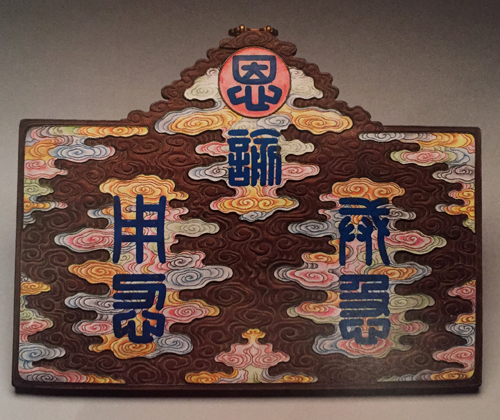
But something else caught my eye and I kept returning to it. It is a sign in lacquer on wood, created for the Emperor Yongzheng who reigned from 1723-1735. Apparently the emperor, when he was a prince, was prone to some habits that displeased his father, Emperor Kongxi. The son took his father’s advice to heart, and had signs made that he put around the palace to remind him of his shortcomings. The photo above shows one of these signs and the message is:

Heed rashness and use perseverance.

In other words, pay attention to your tendency to act rashly and take your time to carefully persevere in tasks.

This is a phrase that has been around since the beginning of time. But this father’s words of wisdom – beautifully portrayed in this sign – are a reminder of the importance of carefully considering what we say and do. We live in an age where it is too easy to “shoot from the hip” – or lip – without thinking through an action. Of course any successful musician has learned the value of the disciplined life, of not acting rashly or looking for quick fixes, but persevering through difficult tasks in order to find success.

When I need advice on how to proceed in a situation, I often turn to the book of Proverbs in the Bible. It has a tremendous amount of wisdom that speaks to every situation you may encounter. On the subjects of rashness, perseverance and heeding advice, it has a great deal to say:

There is one whose rash words are like sword thrusts, but the tongue of the wise brings healing. (Proverbs 12:18)

A wise son hears his father’s instruction, but a scoffer does not listen to rebuke. (Proverbs 13:1)

Whoever loves discipline loves knowledge, but he who hates reproof is stupid. (Proverbs 12:1)

The way of a fool is right in his own eyes, but a wise man listens to advice. (Proverbs 12:15)

And this passage that speaks to the value of perseverance, with a model taken from one of the smallest animals on earth:

Go to the ant, O sluggard; consider her ways, and be wise. Without having any chief, officer, or ruler, she prepares her bread in summer and gathers her food in harvest. How long will you lie there, O sluggard? When will you arise from your sleep? A little sleep, a little slumber, a little folding of the hands to rest, and poverty will come upon you like a robber, and want like an armed man. (Proverbs 6:6-11)

My trombone teacher, Edward Kleinhammer (bass trombonist of the Chicago Symphony Orchestra, 1940-1985) taught me important lessons about perseverance. In the book we wrote together, Mastering the Trombone, Mr. Kleinhammer wrote these important and challenging words:

World class trombone players do not just happen. Their talents are forged by the dual furnaces of determination and diligence.

In this, Edward Kleinhammer was acting like the loving Emperor Kongxi, reminding his son, Emperor Yongzheng, of the importance to “Heed rashness and use perseverance.”

I think I need to go practice now…