Category: composers, conductors, performers

A statement from Wycliffe Gordon: Will Things Change This Time?

A statement from Wycliffe Gordon: Will Things Change This Time?

In the four days since I published my article, Trombone players: It’s time to bury Henry Fillmore’s “Lassus Trombone,” more than 60,000 people have read it on thelasttrombone.com. In addition, my article has been republished on several websites and blogs, including Classical Minnesota Public Radio and Ernest Stackhouse’s blog, Block Us Up!  My article has been shared hundreds of times by people all around the world on Facebook, Instagram, and Twitter, and it is the subject of vigorous discussion on many fora and message boards. And many well-known trombonists, conductors, and teachers have issued statements relating to the premise of my article and I am greatly heartened that it has provoked so much interest.

Henry_Fillmore_Jazz_Trombonist_1919

Next week, I will be publishing another article here on thelasttrombone.com, an assessment of the response to my article about “Lassus Trombone” and Henry Fillmore’s The Trombone Family. There is much to tell. But today, I want to acknowledge a statement by my friend, trombonist Wycliffe Gordon, who has just posted a heartfelt piece on his website and Facebook page, Will Things Change This Time? Wycliffe —one of the finest people I have ever met and have the privilege to call my friend, one of the finest and most respected trombonists in the world, and recipient of the International Trombone Association’s highest honor, the ITA Award—has penned a thought-provoking essay written in light of the current conversation on race and racism.

I ask that you take a few minutes to read Wycliffe’s powerful statement, and if it resonates with you, please pass it on to others so this important conversation—and needed action—can continue. Thank you, Wycliffe. You asked an important question. Now we each have to answer it for ourselves.

Read Wycliffe Gordon’s Will Things Change This Time? on his website, wycliffe gordon.com.

Read Wycliffe Gordon’s Will Things Change This Time? on his Facebook page.

Click HERE to download a PDF of Wycliffe Gordon’s Will Things Change This Time?

[Photo of Douglas Yeo and Wycliffe Gordon, Midwest Clinic, Chicago, December 2019]


Trombone players: It’s time to bury Henry Fillmore’s “Lassus Trombone.”

Trombone players: It’s time to bury Henry Fillmore’s “Lassus Trombone.”

by Douglas Yeo (June 28, 2020)

NOTE: This article contains offensive material of an historical nature that is presented in an effort to inform the trombone community of a regrettable vestige of racism that continues to be a part of the trombone’s concert repertoire since it first came to light over 100 years ago. It is my hope that this article will lead trombonists around the world to make important, needed changes in the repertoire we choose for our recitals, and rid our concerts of music that is rooted in racial stereotyping and racist portrayals of African Americans.

UPDATE (July 6, 2020): Over 64,000 people have read this article since I wrote and published it a week ago. Today, I wrote a followup article, A path forward from Henry Fillmore’s “Lassus Trombone.” When you finish reading this article, please click HERE to read my response to the conversation that has been going on over the last week.

UPDATE (March 5, 2024): Since this article was posted on The Last Trombone, it has been viewed by over 1 million people, including those who have read it when it was reprinted in over a dozen music journals. The conversation continues.

In 1908, American composer Henry Fillmore (1881-1956) composed Miss Trombone for solo trombone and piano; it was published by his family’s company, Fillmore Music House of Cincinnati. Miss Trombone was a novelty piece in ragtime style and it featured slide glissandos, or what were also referred to at the time as “trombone smears.” The glissando is a signature feature of the trombone and Miss Trombone capitalized on the technique. By 1919, trombone glissandos were known by a new name: jazzes; the technique was called jazzing. Around that time, three method books were published that taught trombone players how to add  jazzing to their playing of popular music. These books were Mayhew L. Lake’s The Wizard Trombone Jazzer (Carl Fischer, 1919), Henry Fillmore’s Jazz Trombonist (Fillmore Music House, 1919), and Fortunato Sordillo’s Art of Jazzing for the Trombone (Oliver Ditson, 1920).

Miss Trombone was so successful that Fillmore followed it with more trombone solos in the same style, all with glissandos that ripped up and down the horn. The pieces had names that tied them together. Miss Trombone was followed by Teddy Trombone, and 13 others were added, and by 1929, the series was complete with the publication of Ham Trombone. Together, they were marketed as a set, The Trombone Family.

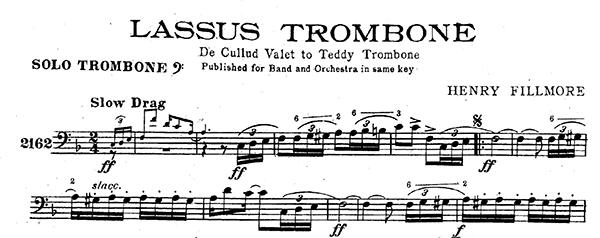
Trombone players have been playing these pieces for over 100 years. The most popular member of Fillmore’s Trombone Family has always been Lassus Trombone. It’s a piece that has appeared on countless trombone solo recitals, and trombone ensemble, band and orchestra concerts. YouTube features 8000 recordings of the piece.

But there is an uncomfortable truth about Henry Fillmore’s The Trombone Family. It was born and marketed in a crucible of racial stereotyping, minstrelsy, racism, and Jim Crow. It is time to put these pieces to rest, to bury them, to remove them from our concert programs, and do better when selecting music in the future. For those who are unaware of the racist background of Fillmore’s signature works, or who may respond by saying, “It’s not such a big deal,” here is the story. It matters.

The trombone glissando first appeared in classical music in Alexander Glazanov’s symphonic fantasy, The Sea, a work for orchestra that was composed in 1889. In time, it found its way into other classical works including Edward Elgar’s The Dream of Gerontius (1899) and Arnold Schoenberg’s Pelleas und Melisande (1902). For an excellent discussion of the trombone glissando in both classical and popular idioms, I refer readers to Trevor Herbert’s excellent article, “Trombone Glissando: A Case Study in Continuity and Change in Brass Instrument Performance Idioms” (Historic Brass Society Journal, Vol. 22, 2010, 1-18). The trombone glissando came into popular music by the turn of the century. Arthur Pryor recorded Trombone Sneeze: A Humoresque Cakewalk by Chris Sorensen Jr. with John Philip Sousa’s band in 1902 (Victor 1223); the piece is full of trombone smears. Have a listen below (to hear this piece on YouTube, click HERE):

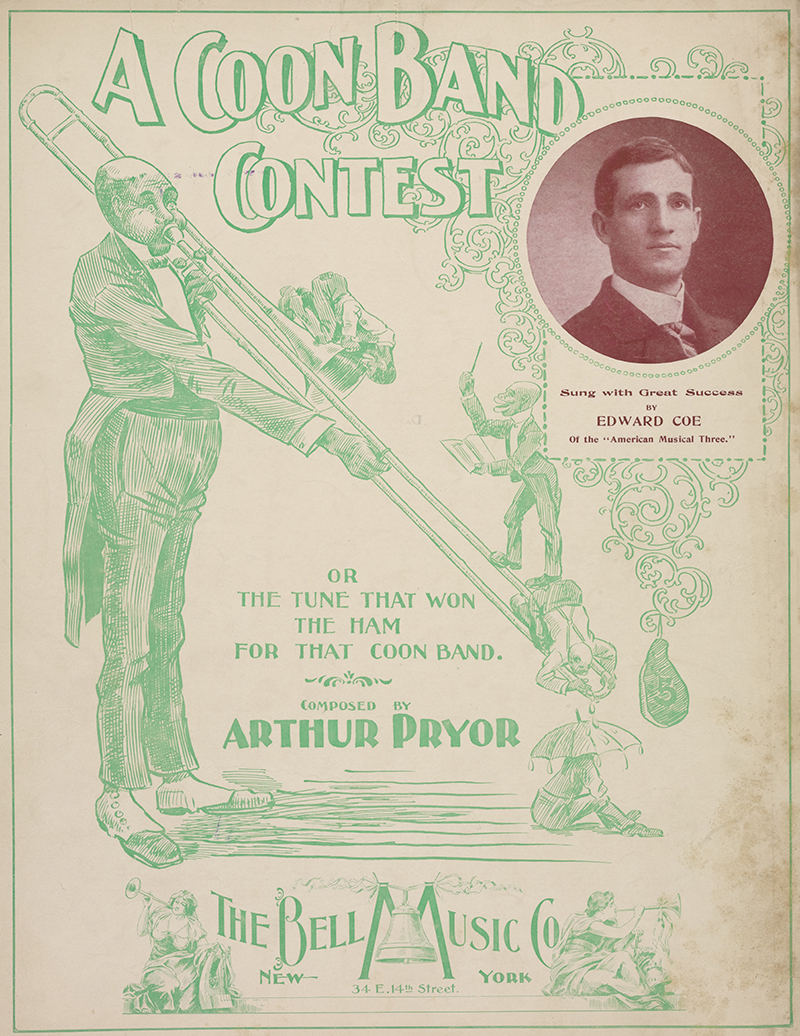
It was not long before the trombone glissando began to be strongly associated with music that was a part of minstrel shows. These were entertainments that featured caricatures of African Americans, with both white performers in blackface and black performers made up to look like white performers in blackface. The shows were mostly presented for the benefit of white audiences, and the caricature of black culture that the shows embodied was a product of white, racist thought that saw African Americans as bumbling and unintelligent. Music that reinforced these stereotypes  was a a part of the Jim Crow era and it proved to be very popular among many whites. Arthur Pryor’s song (yes, THAT Arthur Pryor, the most famous trombone player in all history), A Coon Band Contest or The Tune That Won the Ham for That Coon Band, was published in 1899 and recorded by his band in 1906. It’s a typical example of the genre of music that used racial stereotyping as a marketing tool. The cover of A Coon Band Contest (see below) featured a caricature of a bulging-eyed African American trombonist with several stereotypical depictions of other blacks who were listening to and conducting the trombonist (including a large lipped conductor and a suspender clad man emptying the trombone’s water key onto another person who protects him/herself with an umbrella). The publisher of the song, The Bell Music Company, probably thought the cover was cute. It wasn’t. Racism is never cute.

Pryor_A_Coon_Band_Contest_cover_sm

Into this environment of demeaning portrayals of African Americans walked Henry Fillmore. By the time Miss Trombone was published in 1908, the cakewalk had given way to ragtime which was beginning to morph to what was first referred to as “jass” and then jazz. There was no reason that Fillmore’s Trombone Family had to caricature an African American family except for one simple fact: placing Miss Trombone and her family members into the environment of minstrelsy and racial stereotyping sold music to whites and their audiences.

All of the pieces in Fillmore’s Trombone Family featured trombone smears and they were given subtitles to frame them in the context of his fictional black family, what he called a “cullu’d fambly.” A look at all of the titles takes us into uncomfortable territory.

Miss Trombone (1908): A Slippery Rag

Teddy Trombone (1911): A Brother to Miss Trombone

Lassus Trombone (1915): De Cullud Valet to Miss Trombone

Pahson [Parson] Trombone (1916): Lassus Trombone’s ‘Ole Man

Sally Trombone (1917): Pahson Trombone’s Eldest Gal – Some Crow!

Slim Trombone (1917): Sally Trombone’s City Cousin – the Jazzin’ One Step Kid

Mose Trombone (1919): He’s Slim Trombone’s Buddy

Shoutin’ Liza Trombone (1920): Mose Trombone’s Ah-finity

Hot Trombone (1921): He’s Jes a Fren’ ob Shoutin’ Liza Trombone

Bones Trombone (1922): He’s Jes as Warm as Hot Trombone

Dusty Trombone (1923): He’s de Next Door Neighbor to Bones Trombone

Bull Trombone (1924): A Cullud Toreador

Lucky Trombone (1926): He’s de Thirteenth Member uv de Fambly

Boss Trombone (1929): He’s de Head Man

Ham Trombone (1929): A Cullud Bahbaque

Many of the subtitles are given in a caricatured African American dialect, something that, when done by whites, has always been racist. Fillmore, when asked about the title, “Lassus Trombone,” had a standard answer: “Why, molasses, of course. I really don’t know why except I thought of molasses on bread for breakfast, dinner, and supper.” However, as J. Stanley Lemons pointed out in his important article, “Black Stereotypes as Reflected in Popular Culture, 1880-1920” (American Quarterly, Spring 1977, Vol. 29, No. 1), the minstrel-era character of Jim Crow “spent his time sleeping’, fishing’, hunting’ ‘possums, or shuffling’ along slower than molasses.” Molasses was one of many stereotypical tropes used to represent “the slow-thinking, slow-moving country and plantation darkey.”  It’s worth noting that Shoutin’ Liza Trombone was originally titled Hallelujah Trombone. But Fillmore’s father, James Henry Fillmore Sr. (1849-1936), a prolific composer of hymns and a publisher of hymnals, disapproved of the piece’s appropriation of the opening measures of Georg Frideric Handel’s Hallelujah Chorus from Messiah. In deference to his father, Henry Fillmore changed the piece’s title. Unfortunately, Henry’s father didn’t disapprove of his son’s racist portrayals in The Trombone Family—the pieces were all published during his lifetime. Offending Handel was off limits. But offending African Americans? It was par for the course.

Fillmore’s marketing of The Trombone Family with its stereotyping of blacks would be offensive enough. But it is for his advertising campaign for the music that Fillmore reserved his most outrageous insults.

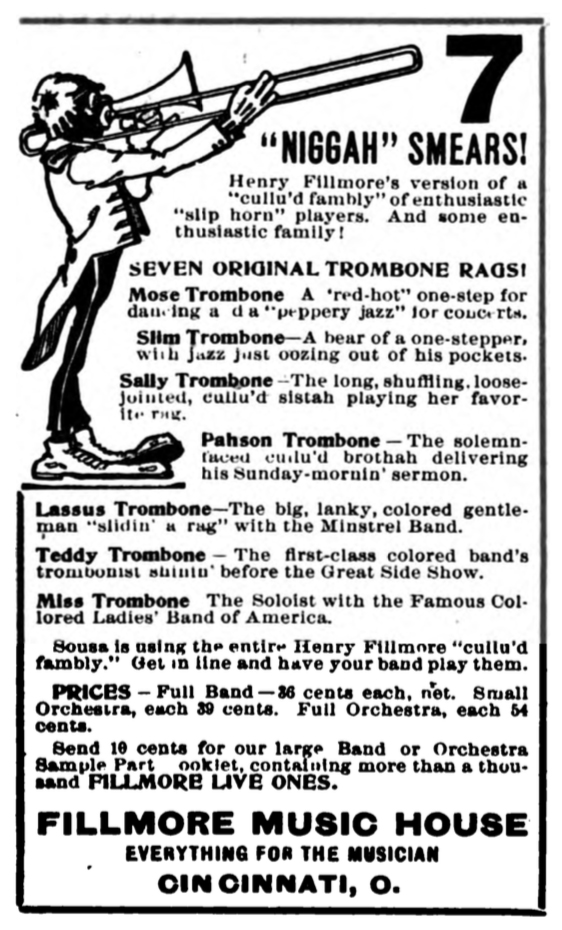
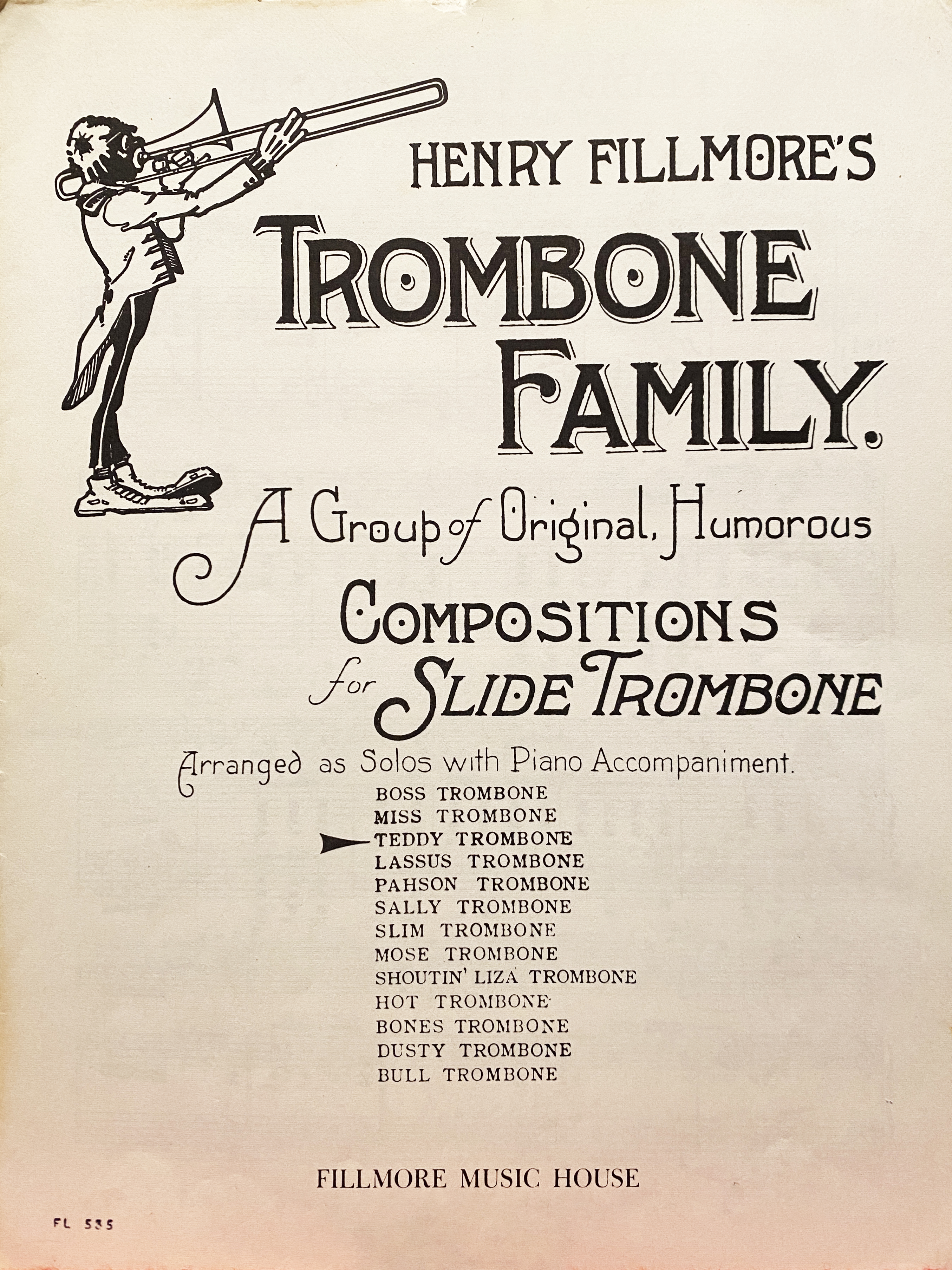
The first ad reproduced below appeared in February 1919 in The Musical Messenger, “a monthly band and orchestra journal” published by Fillmore Music House. The second one was published in Jacobs Orchestra Monthly in September 1918. These racist ads were at the heart of Fillmore’s advertising for The Trombone Family. The cartoon of Slim Trombone in the Jacobs Orchestra Monthly ad is taken directly from advertising by Harvey’s Greater Minstrels for its trombonist, Slim Jim Austin. There can be no doubt that Fillmore’s Slim Trombone was given its title to capitalize on the popularity of Austin on the minstrel show circuit. And the image of the floppy shoed  trombone player in blackface in the ad from The Musical Messenger appeared on the cover of the sheet music for each of the pieces. The language of the ads needs no explanation. It is disgusting stuff.

Fillmore_Trombone_Family_ad_1919.1

Fillmore_Trombone_Family_ad_1919.2

Fillmore_Trombone_Family_cover

Had enough? Yet in the face of all of this, some may protest. “But Fillmore was just a product of his time. Minstrelsy and blackface were socially acceptable and he was just playing to the market.” This kind of apology just won’t do. It is revisionist history, a fiction promulgated by white “scholars” and others who try to make a distinction between “good minstrelsy” and “bad minstrelsy,” between “good blackface” and “bad blackface.” The truth of the matter is that there never was good minstrelsy or good blackface. It has always been offensive. Always. And the use of the “n-word” by whites was always offensive. Always. It was offensive in the nineteenth century, it was offensive in the twentieth century, and it is offensive today. Minstrelsy did not originate in or reflect the true black experience and true black cultural practices. It was a racist caricature of black life that was based in racial ridicule. It was always offensive, it was always racist, and it was always wrong. Henry Fillmore’s The Trombone Family promoted the racial stereotypes promulgated by the minstrel show era,  promoted white domination of blacks, and reinforced harmful, hurtful stereotypes that are still, regrettably, with us today.

So, what to do about Lassus Trombone?

In his message to Congress on December 1, 1862, Abraham Lincoln said, “Fellow citizens, we cannot erase history.” That is true. History is history; it happened; we can’t change it. When we view history, we need clear eyes. And clear eyes lead me to only one conclusion: It is time to bury Henry Fillmore’s Lassus Trombone and The Trombone Family. They were born of racism and a racist culture. They padded the pockets of the Fillmore Music House and, later, Carl Fischer Co. which took over the copyright from The Trombone Family, and in recent years, since the works went out of copyright, a host of publishers around the world. Fillmore’s racist portrayals of African Americans sold. Racism was good business.

It is time for this to stop.

First, we need to inform our trombone community about the story behind these pieces that have been such a part of the fabric of the trombone’s performance history of the last 100 years. For instance, several years ago, I was invited to be guest artist at a major American university, to give a masterclass, solo with the university’s trombone choir, and conduct a massed trombone choir of high school and college students. The school’s trombone professor—a very good friend of mine—and I engaged in a conversation about what piece I might choose to conduct. He said he had a really nice arrangement of Lassus Trombone for trombone ensemble that he had used on many occasions; he thought it might be a good closer for the concert. I told him I would not conduct Lassus Trombone, and I shared with him the story behind the piece that I have laid out in this article. He was horrified; he didn’t know. He had no idea of the racist roots of Lassus Trombone. And he was so grateful that I told him. Lassus Trombone quickly disappeared from his trombone choir’s library. I conducted Simon Wills’ Tinguely’s Fountain instead.

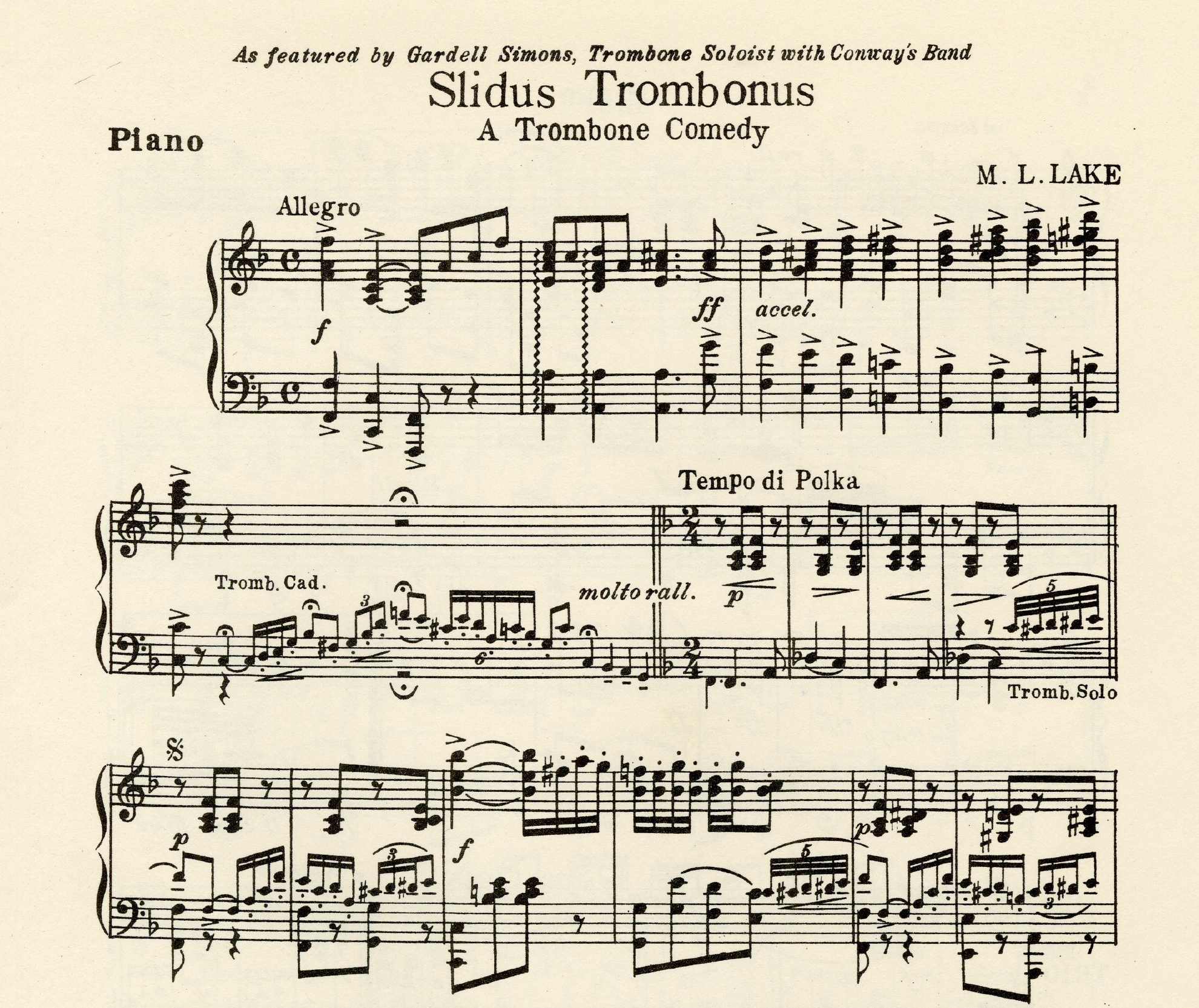
Second, it is time for us to bury Lassus Trombone and the other members of Fillmore’s Trombone Family.  We don’t need them. We don’t need to play music that is rooted in racism and racial stereotypes. We don’t need to play music that makes fun of any person. There are other pieces in the trombone glissando “jazzing” tradition that would make for a fine substitute for Lassus Trombone on a recital program. Why not try Mayhew L. Lake’s Slidus Trombonus? Composed in 1915—the same year Lassus Trombone was written—it was written for Gardell Simons. He was the celebrated soloist with Patrick Conway’s Band who also played principal trombone with the Philadelphia Orchestra from 1915-1930, and the piece was recorded by Conway’s band in 1916. You can hear Conway’s recording of Slidus Trombonus on the Library of Congress website by clicking HERE. And I have scanned my copy of Slidus Trombonus (which is in the public domain) and made it available for free on my website. You can download the trombone and piano music to Lake’s humorous piece by clicking HERE.

Lake Slidus Trombonus

“We cannot escape history.” But we can learn from it. We must learn from it. For over 100 years, trombone players have been complicit in continuing and fostering harmful racial stereotypes by performing Henry Fillmore’s Lassus Trombone and other pieces from The Trombone Family. We can do better. We must do better. And we will do better.

[UPDATE: One way to do better is to consider alternative programming. See my second article about this issue, “A Path Forward From Henry Fillmore’s ‘Lassus Trombone'”, where I discuss the trombone glissando rags of African-American composer Nathaniel Cleophas Davis, whose five rags were composed around the same time as Henry Fillmore’s The Trombone Family. These are excellent works that are available for band and have also been newly arranged for trombone and piano. And they do not carry the baggage of racial stereotyping.]

This is not a matter of political correctness or of censorship. This is a matter of righting a wrong and doing the right thing.

And here is something else. There is someone else who is doing the right thing with this. I began writing this article yesterday, June 27, 2020. I woke up very early this morning and went right to my computer to complete it. Between proofreading sessions, I went to look at my email “in” box and found a message from my friend, Gordon Cherry, founder and owner of Cherry Classics, one of the largest publishers of music for brass instruments in the world. Gordon is the retired principal trombonist of the Vancouver Symphony and his Cherry Classics catalog is very deep and wide. Gordon and I are in contact about various issues from time to time and he had something important he wanted to share with me. Gordon said that he had come to the realization—a realization that had been hiding in plain sight but that he just didn’t put all together until last week—that he was profiting by selling two arrangements of Lassus Trombone. Gordon told me that he plans to remove those arrangements from his catalog—something he will do tonight—and send a message to his email list of 6000 subscribers to tell them why he is removing this piece that has its origin in racial stereotyping. Gordon wanted to let me know about his thinking about this and he wanted to know what I thought about it. We just finished a FaceTime call where we both marveled that the two of us, friends separated by 2,000 miles, were thinking about the same issue in the very same way at the very same time, and that both of us had decided to do something about it. Thank you, Gordon, for doing the right thing. He has set a model for all publishers. Sometimes doing the right thing is more important than making another dollar. This is one of those times.

If you’d like to join me in removing Lassus Trombone and The Trombone Family from today’s trombone repertoire conversations, please feel free to share this article on social media and other types of platforms. Let’s get the message out. Ending racial stereotypes matters. Thank you for doing your part in this.

NOTE: Now that you have read this article, please click HERE to read my followup article, “A path forward from Henry Fillmore’s “Lassus Trombone.”

NOTE: I also welcome you to read my article, “Lassus Trombone: Now That You Know, What Do You Do? A conversation about music, marketing, hurt, and healing,” that appeared in Vol. 51, No. 3 (July 2023) issue of the International Trombone Association Journal. The article contains more historical perspective on the subject of music and minstrelsy and it answers the argument, “Well, it was acceptable at the time so. . .” You can read/download that article HERE.

© 2020, Douglas Yeo. All rights reserved.

Memorial Day, Saving Private Ryan, Abraham Lincoln, and the trombone

Memorial Day, Saving Private Ryan, Abraham Lincoln, and the trombone

In the United States, yesterday was Memorial Day. A national holiday, it is a day of remembrance to honor and mourn those who died while in the service of the United States Military. It is often observed with parades, speeches, cemetery visits, and non-related things like family picnics and cookouts that celebrate Memorial Day as the unofficial beginning of summer. This year, the coronavirus pandemic curtailed many of those traditional events but the significance of Memorial Day remains undiminished. We owe a great debt of gratitude to those who died serving our country. That gratitude can never be overstated and it can never be repaid.

Yesterday, my wife and I watched the Steven Spielberg motion picture, Saving Private Ryan, for the first time. Released in 1998, the movie is considered to be one of the most significant movies of all time. It took me 22 years to decide to watch it because I am not a person who likes/enjoys/wants to see graphic portrayals of violence. I had heard about the movie’s intense opening 30 minute scene of the beginning of the D-Day invasion. My heart wanted to see the movie but my stomach was not sure.

But yesterday, on Memorial Day 2020, it was time. We watched Saving Private Ryan in our home (Blu-Ray) and found the movie to be a powerful, moving reminder of sacrifice and service. Yes, some scenes were very intense. Very, very intense. But even the most intense scene could only communicate a fraction—a very small fraction—of what those who served in war actually experienced. I’m glad we watched it, and I will watch it again.

I had another reason for wanting to watch Saving Private Ryan. I played on the movie’s soundtrack.

02.Yeo_Williams_Fanfare_for_Fenway_2012

As readers of The Last Trombone know, I was bass trombonist of the Boston Symphony Orchestra from 1985-2012. During the early years of my tenure in the orchestra, John Williams was the conductor of the Boston Pops and after he left that position, he continued a fruitful relationship with the Boston Symphony and Boston Pops that continues to this day. My respect for him is enormous, and I was very fortunate to record many Boston Pops albums under his direction, and also be the first bass trombonist to perform his Tuba Concerto (on bass trombone, in May 1991) with the Boston Pops with John conducting. The photo above shows John and me in Symphony Hall, Boston, taken at a recording session in 2012 for his Fanfare for Fenway, that celebrated the 100th anniversary of Boston’s Fenway Park, the home of the Boston Red Sox.

Saving_Pravate_Ryan_soundtrack_cover

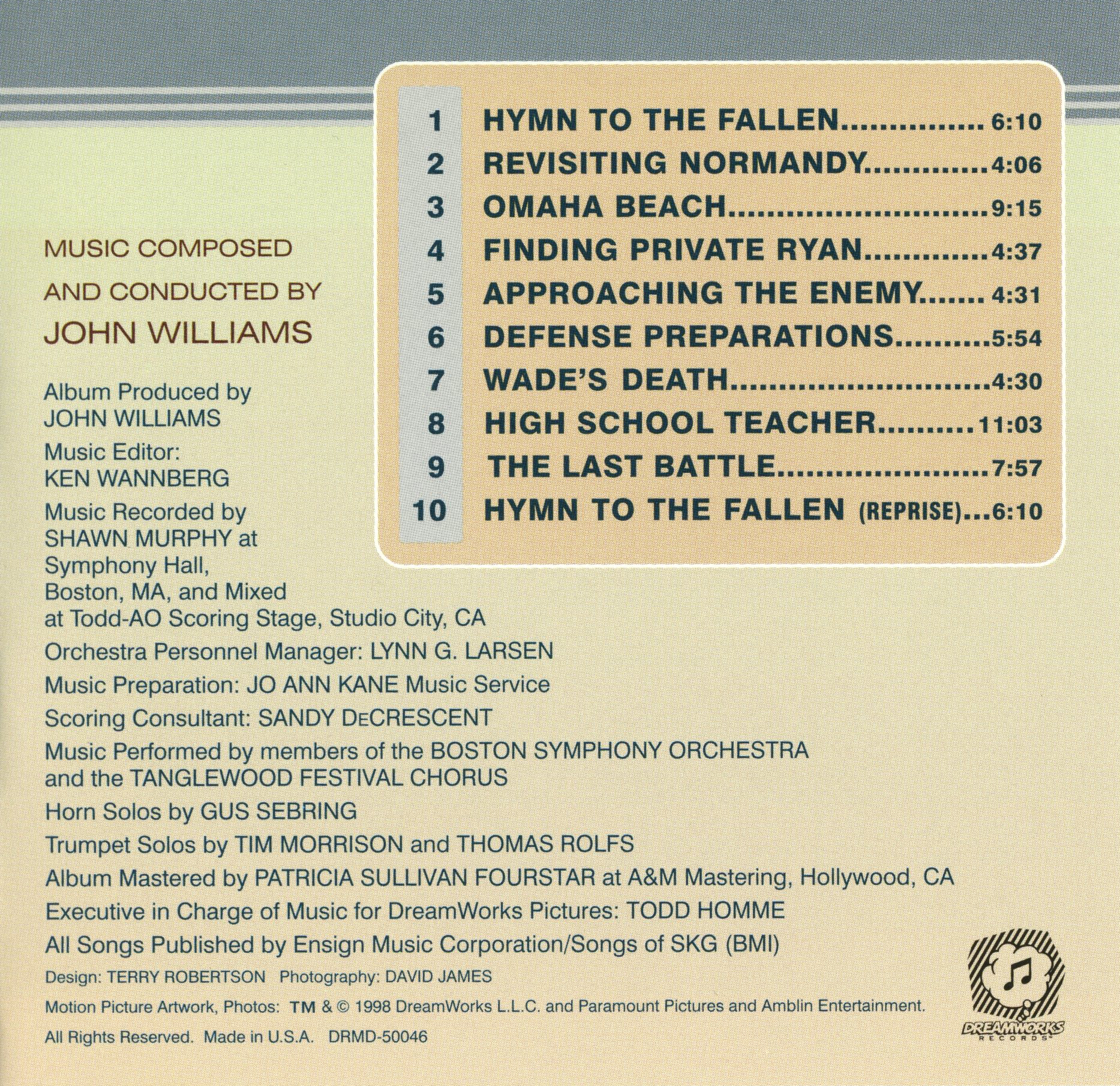
Saving Private Ryan was the second John Williams film score that I recorded as a member of the Boston Symphony Orchestra, following on the recording sessions for Schindler’s List in 1993. The soundtrack for Saving Private Ryan was recorded over three days in February 1998 in Symphony Hall. I recall Steven Spielberg being there for all of the sessions, and Tom Hanks (who had the role of Captain John H. Miller in the movie) being in attendance at the first session. The music is very unconventional for a war movie: there is no loud music. Instead, Williams used music mostly to guide the audience in both anticipation and contemplation of combat. There is no music during battle scenes.

The movie’s longest musical segment occurs at the end of the film, over the credits. That music, titled “Hymn to the Fallen,” features a long brass chorale that still, 22 years later, moves me to tears. You can hear the recording of “Hymn to the Fallen” for the Saving Private Ryan soundtrack by clicking below or you can hear it on YouTube by clicking HERE.

This is not a movie with loud trombone playing like Star Wars or Raiders of the Lost Ark. What you’ll hear are trombones in a supporting role, adding depth and texture to strings, and stepping forward from time to time in chorales, soft but intense rhythmic punctuations, and contemplative warmth.

Saving_Private_Ryan_credits

Seeing the movie yesterday for the first time brought back a flood of memories about those recording sessions. Tim Morrison and Tom Rolfs played the beautiful, haunting trumpet solos and duets, and Richard “Gus” Sebring did the same on french horn. Ronald Barron, Norman Bolter, and I were the trombone section and Gary Ofenloch and Chris Hall played tuba, substituting for Chester Schmitz. Spielberg and Williams wanted to record with the Boston Symphony in Symphony Hall rather than with a studio orchestra because they wanted to “hear the air” of the hall in the music, and work with a group of players who played together everyday and understood Williams so well.

Then Boston Globe music critic Steven Dyer wrote a long article about the recording sessions that describes some of the back room scenes and work of those days in February, 1998. You can read that article HERE.

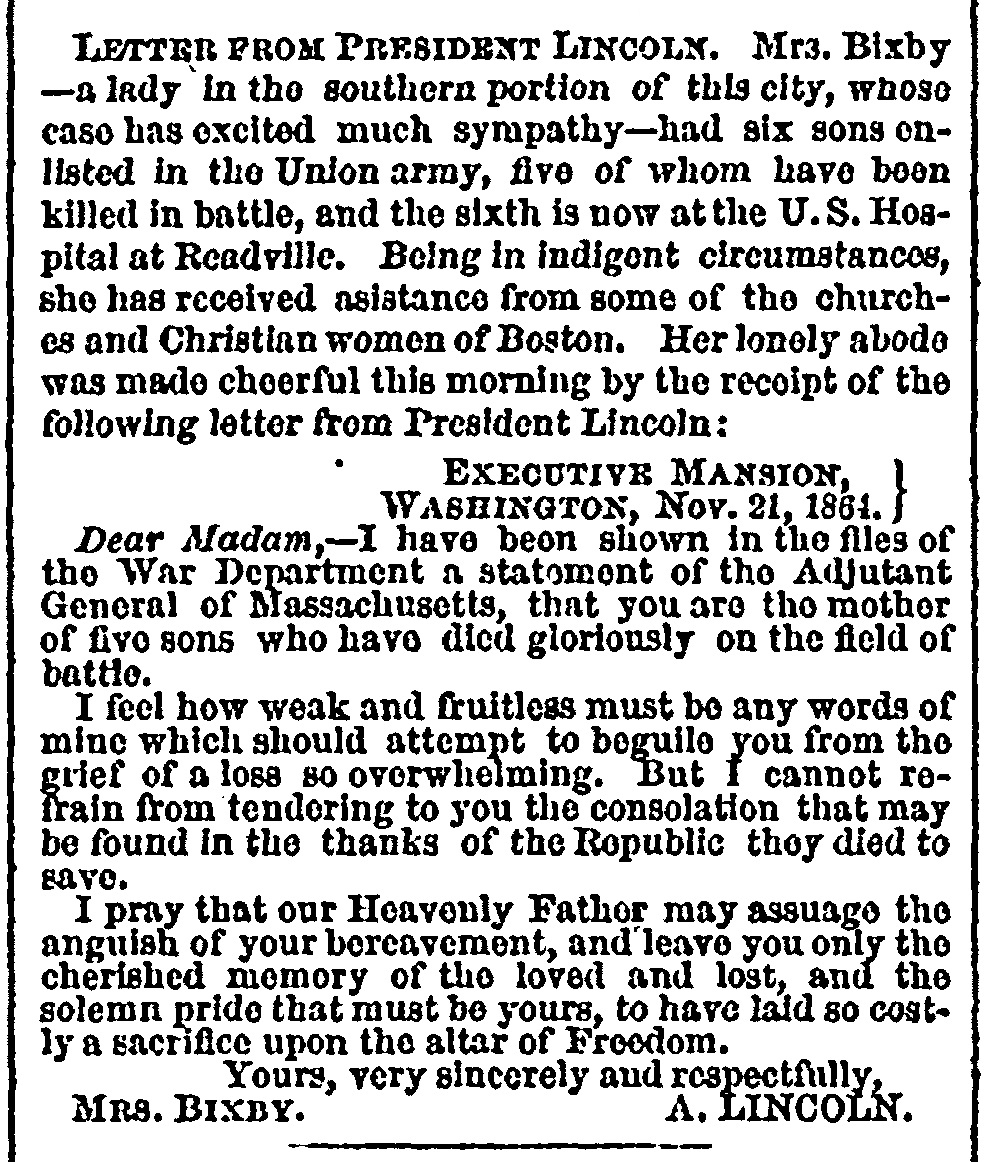
Also, at the beginning of the first recording session, Tom Hanks read the letter from President Abraham Lincoln to Mrs. Lydia Parker Bixby who had lost five sons in the Civil War. Written on November 21, 1864, it was first published in the Boston Evening Transcript four days later. It remains one of the most poignant consolations I have ever read, and the letter figures both in the plot and the narrative of Saving Private Ryan. Here is the letter as first published in the Boston Evening Transcript:

Bixby_Letter_newspaper

If you’ve seen Saving Private Ryan, you have your own thoughts about the movie. If you haven’t seen it, I encourage you to do so if you feel you can handle intense depictions of the brutality of war. If you can’t—like I felt I couldn’t for the last 22 years—you might want to pick up the soundtrack album. The movie is a strong reminder of the sacrifice and heroism that we  gratefully recognize on Memorial Day. The music is haunting, moving, powerful, and contemplative. I often turn to Hymn to the Fallen when I need music to help me think about or remember something important. It has become a kind of Adagio for Strings (of Samuel Barber) for our time.

Memorial Day. Saving Private Ryan. Abraham Lincoln. And the trombone. They’re all tied up in my memory.

100 years ago today: Edward Marck Kleinhammer (1919-2013)

100 years ago today: Edward Marck Kleinhammer (1919-2013)

100 years ago today—on August 31, 1919—Edward Marck Kleinhammer was born (that is not a typo, his middle name was spelled Marck). He had a  long and especially distinguished career as bass trombonist of the Chicago Symphony Orchestra from 1940-1985. His influence on bass trombone performance and pedagogy is incalculable, even today, years after his death in 2013.

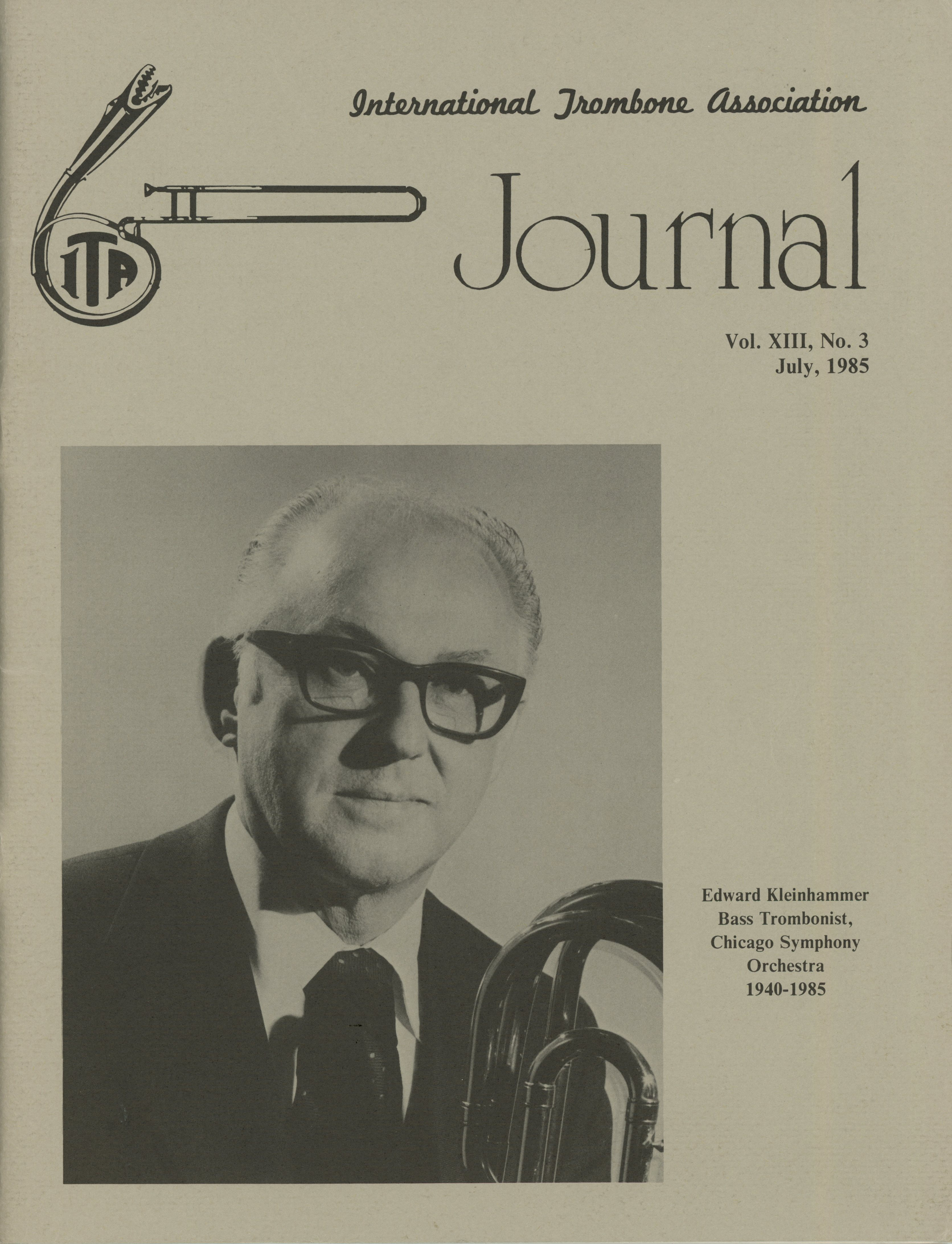
This was a man who changed my life. He was my trombone teacher during my years as an undergraduate at Wheaton College, Illinois (1974-1976). In the years that followed, the teacher/student relationship changed into a deep, abiding friendship, and I count myself very blessed that God brought our lives together. The story of his accomplishments and his influence on me and so many others is something I told in two articles I wrote about him for the International Trombone Association Journal. On both occasions, his photo graced the cover of the Journal. I wrote the first on the occasion of his retirement from the Chicago Symphony, in 1985. You can read it by clicking HERE.
Yeo_Kleinhammer_ITAJ_1985.jpg

I wrote the second in 2014, shortly after his death. You can read it by clicking HERE.
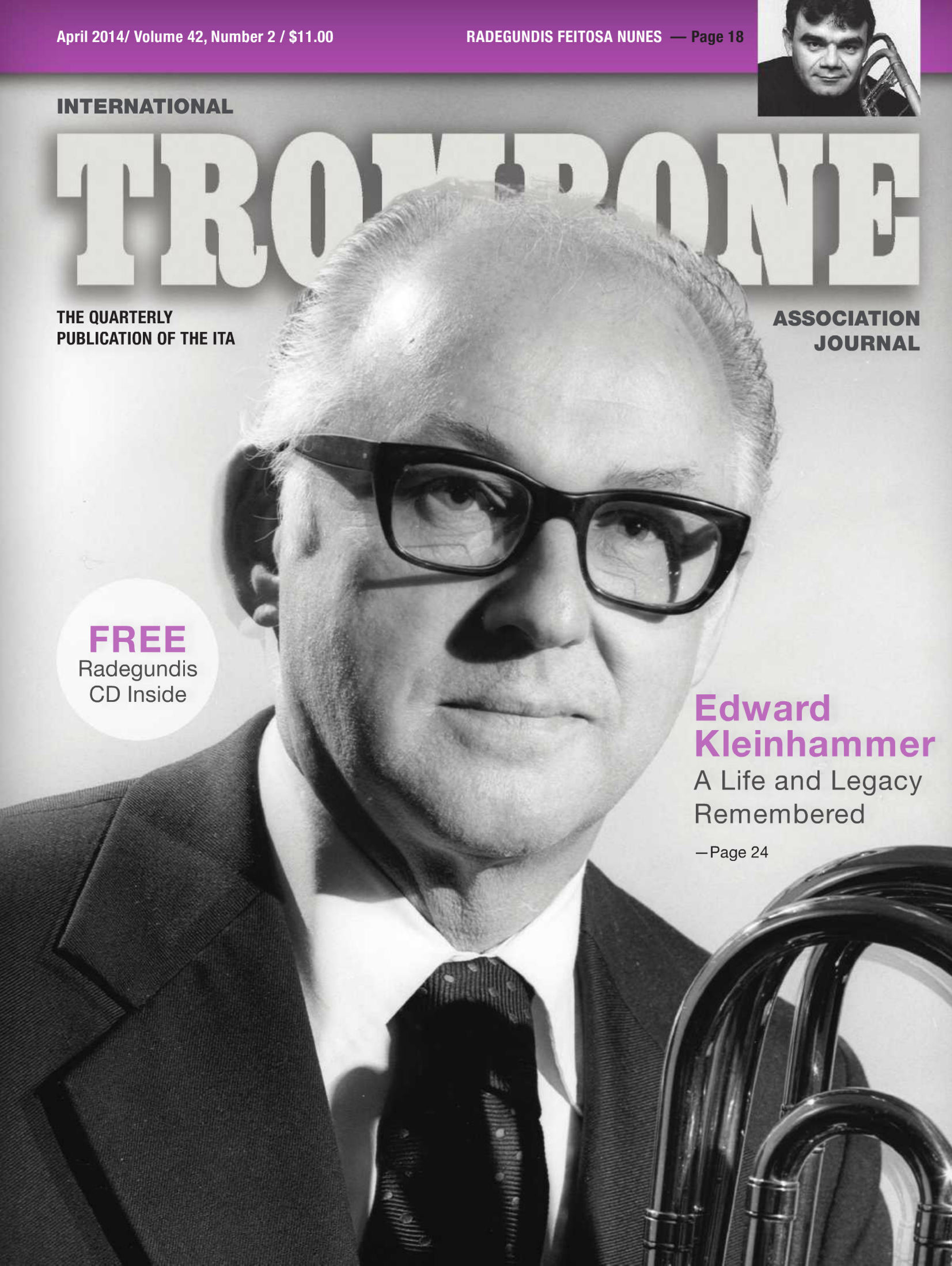
Yeo_ITAJ_April_2014_Kleinhammer_tribute

The photo on both of these International Trombone Association Journal covers dates from 1976, and first appeared in a book published by the Chicago Symphony in that year, Reflections: A collection of personality sketches of the Chicago Symphony Orchestra.

Kleinhammer_CSO_Reflections_1976

Both of my articles are personal tributes to a great man and contain much information about his life, work, and influence. Today, on what would have been his 100th birthday, I don’t need to say many more words about Mr. Kleinhammer. He was a superb bass trombonist, a caring, challenging, effective, and tremendously inspiring teacher, and one who loved God and lived his life with the Bible as his guide. But a picture, it has been said, tells a thousand words. Here are some photos of him that tell more of his story. Many have never been published before. Several were given to me by Ed Kleinhammer himself; others were given to me by his widow, Dessie, after his death, and still others come from my own collection. Edward Kleinhammer: a life well lived, and a life remembered by all who knew and were influenced by him. Captions are above each photo.

[Below] Ed Kleinhammer played trombone in Leopold Stokowski’s All-American Youth Orchestra in 1940, during the summer before he joined the Chicago Symphony. This photo shows the orchestra on stage at the Boardwalk Hall in Atlantic City before their tour of South America:
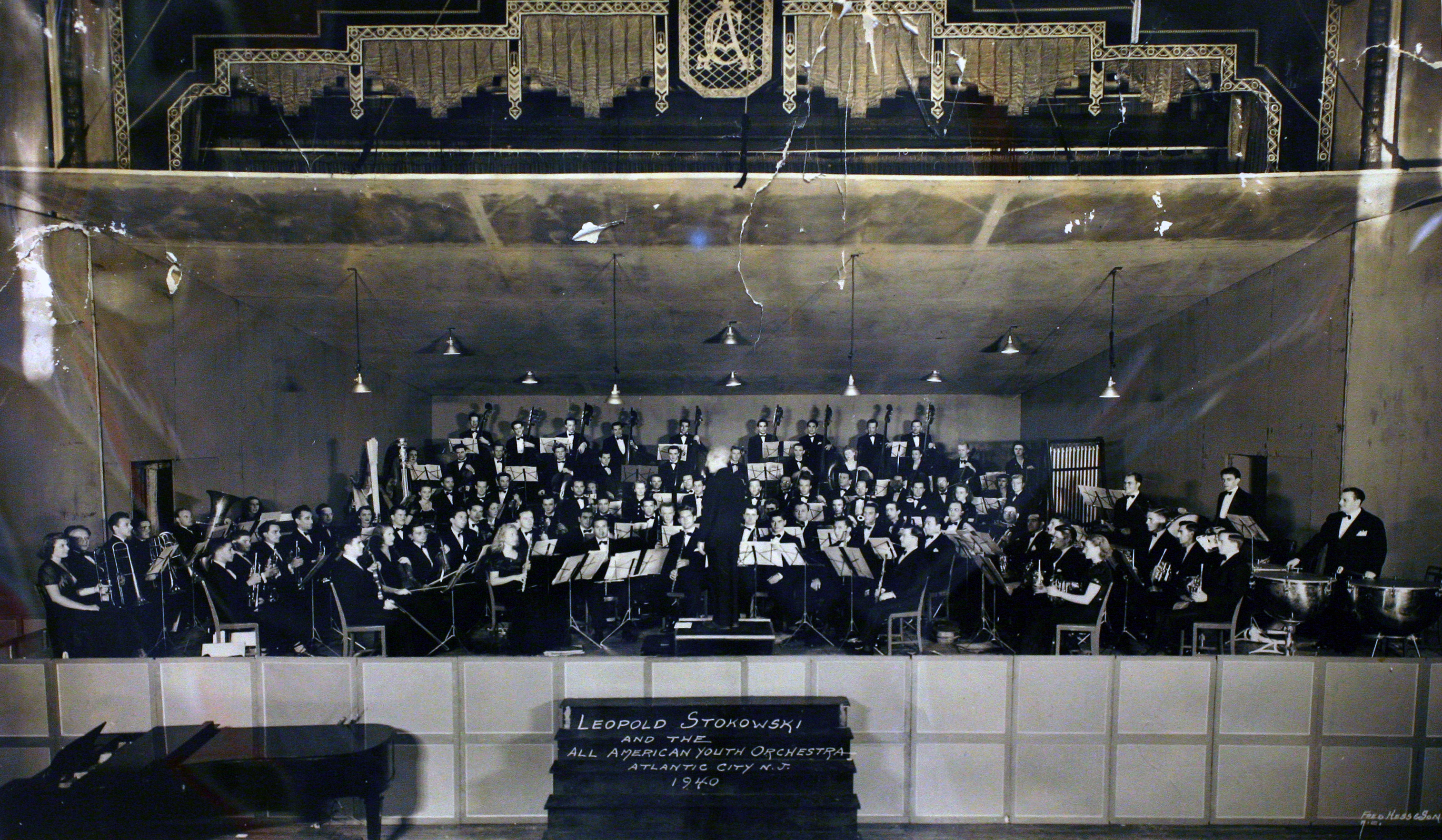
1940_AAYO

[Below] This is a closeup of the low brass section of the orchestra, cropped from the above photo. From the left (front) are Dorothy Zeigler, Charles Gusikoff (who was principal trombonist of the Philadelphia Orchestra at the time—Stokowski engaged several members of the PO to play alongside the younger players in the orchestra), Edward Kleinhammer, Howard Cole, and Philip Silverman, tuba:
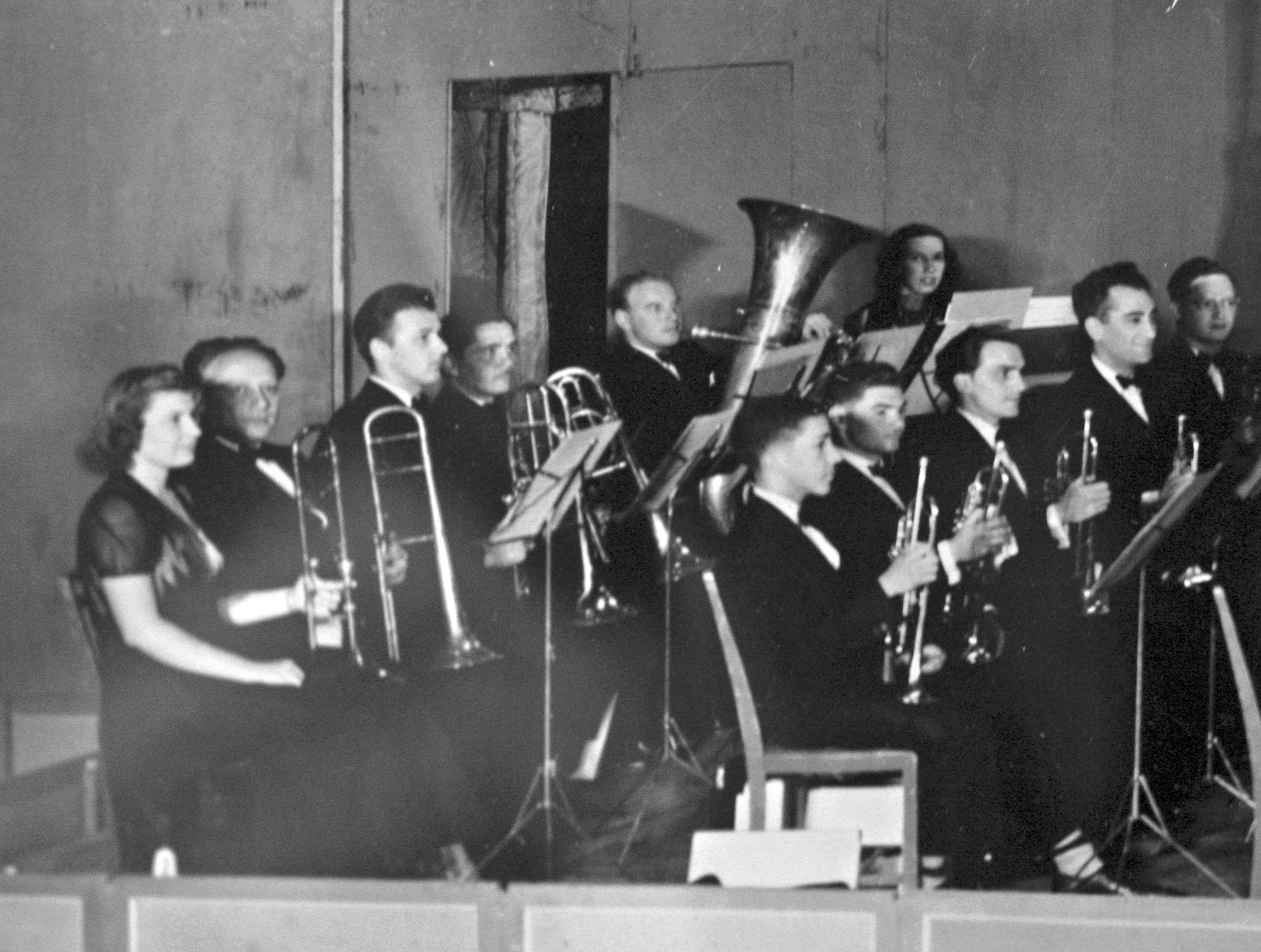
1940_AAYO_low_brass_Kleinhammer

[Below] Edward Kleinhammer and an unidentified All-American Youth Orchestra member  outside the Atlantic City Boardwalk Hall, 1940:
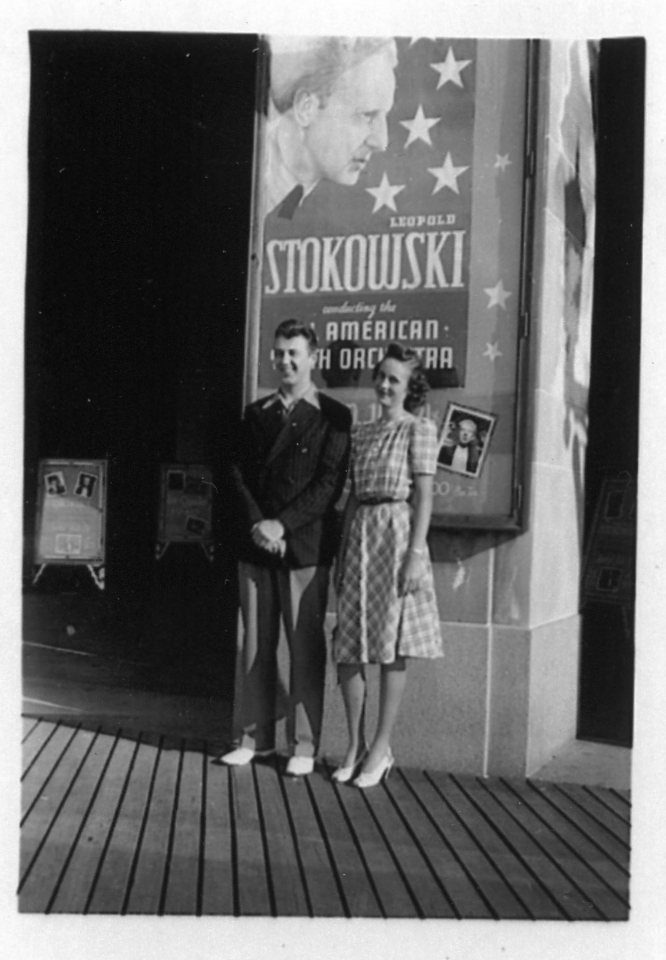
1940_AAYO_Kleinhammer_Zeigler

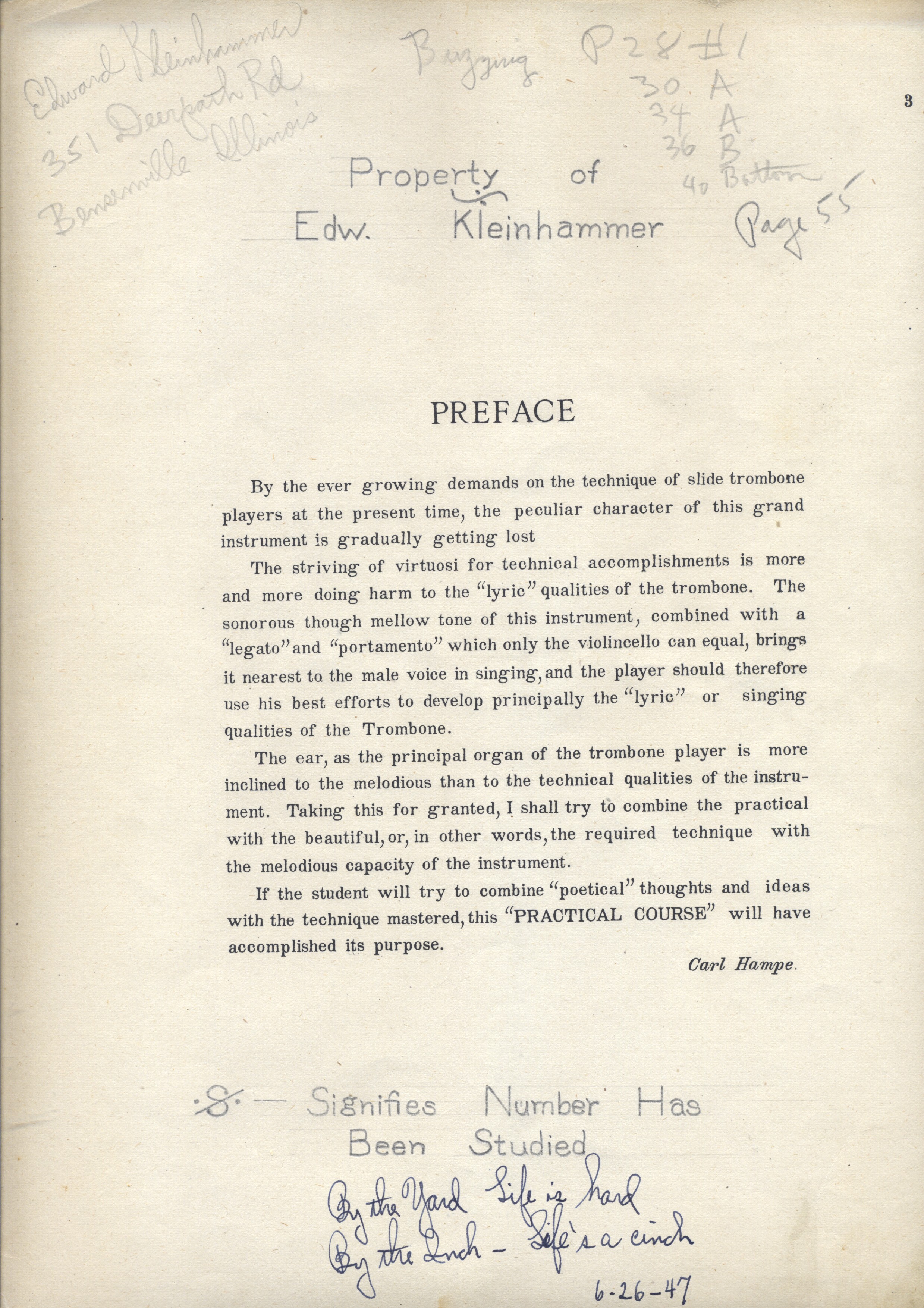
[Below] After I joined the Boston Symphony Orchestra in 1985, Edward Kleinhammer sent me his copy of the Method for trombone by Carl Hampe, who had been principal trombonist with the BSO in the early 20th century. It was one of his earliest trombone study books but it was one he turned to even after he joined the Chicago Symphony. When I opened it, I found many of his markings inside including those on these two pages. This one has an aphorism that he penned in 1947, and is a good reminder of how discipline and “slow and steady wins the race” were themes of his life:
Hampe_Method_01_Kleinhammer

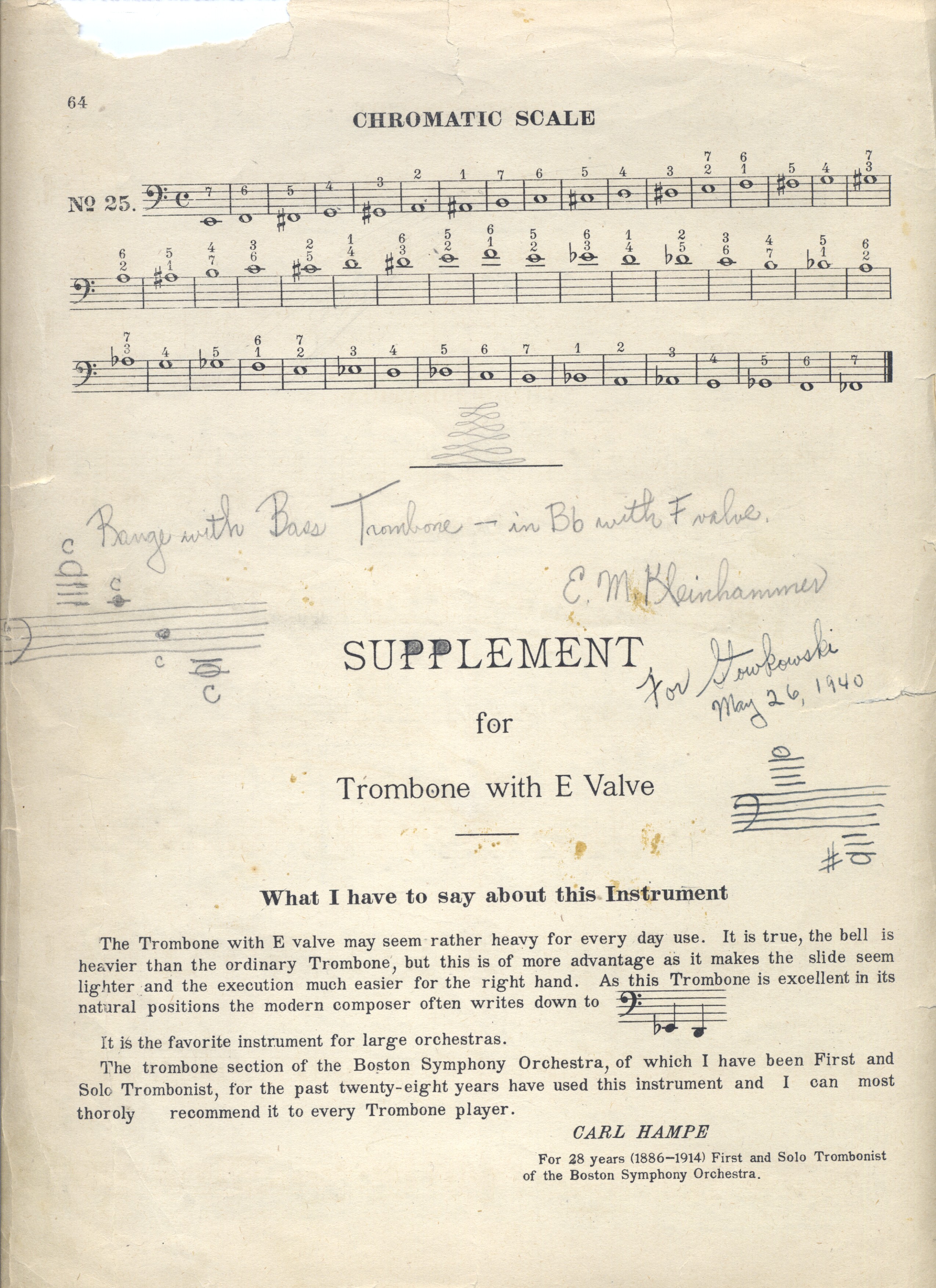
[Below] This page, below, made me smile. Evidently, Leopold Stokowski had asked Mr. Kleinhammer to demonstrate his range on the trombone. His note to himself speaks for itself:
Hampe_Method_02_Kleinhammer

[Below] Here is the Chicago Symphony, October 8, 1940. This is a scan of half of a photo of the orchestra; I only have this scan of this portion of the photo which was given to me by Edward Kleinhammer.
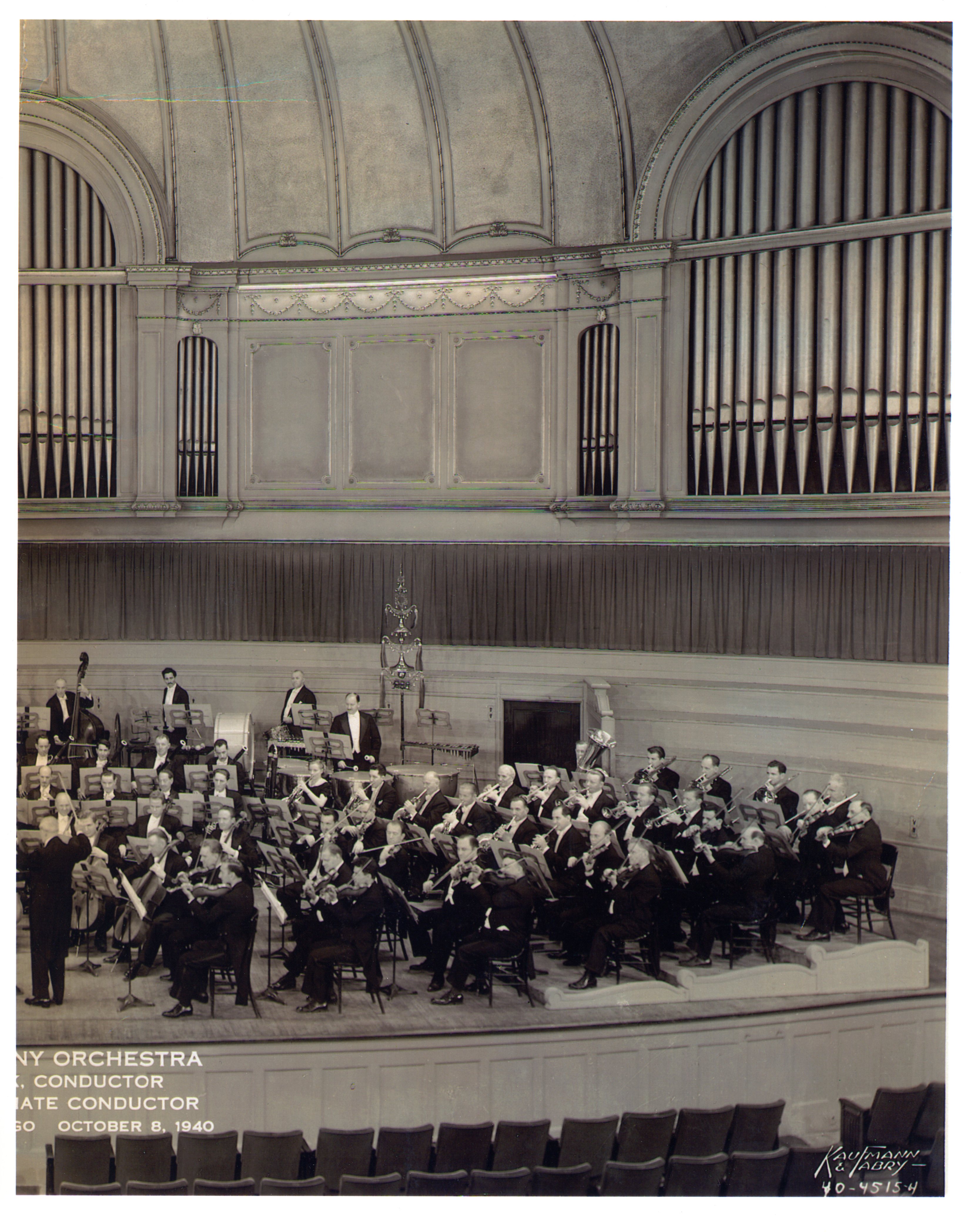
CSO_1940[Below] Here is the low brass section of the Chicago Symphony Orchestra, fall 1940, cropped from the larger photo shown above of the CSO with Frederick Stock, conductor, at the beginning of Edward Kleinhammer’s tenure in the orchestra. Left to right: George Washington Hamburg, tuba; Edward Kleinhammer, bass trombone; David Anderson, second trombone; Frank Crisafulli, principal trombone; Edward Geffert, assistant principal trombone.

CSO_trombones_Kleinhammer_1940

[Below] From 1942—1945, Edward Kleinhammer was in a U.S. Army band, stationed at Fort Leonard Wood, Missouri. In this photo, he is in the top row, second from the right, next to a Sousaphone player:

Kleinhammer_Army_Band_c1942_01

[Below] Ed Kleinhammer in uniform, c. 1944:

Kleinhammer_Army_c.1944

[Below] The caption on the back of this photo is in Edward Kleinhammer’s handwriting and reads, “Stage Band, Independence, Kansas. Early 1940s.” He drew a small “X” on the photo to show where he was sitting in the back row of the Army band:

Kleinhammer_Army_Stage_Band_c.1944

[Below] The caption on the back of this photo, reads (in his wife, Dorothy’s handwriting), “Ed is practicing near our cabin.” In his handwriting, it reads, “Calling ‘Moose'” (Moose was Ed Kleinhammer’s nickname in the CSO). The photo looks to date from the late 1950s.

Kleinhammer_1950s_woods

[Below] This photo is from the Ravinia Festival, taken around 1960. From left to right: Rudolph “Rudy” Nashan, trumpet; Adolph “Bud” Herseth, principal trumpet; Robert Lambert, principal trombone, Frank Crisafulli, second trombone; Edward Kleinhammer, bass trombone; Arnold Jacobs, tuba.

CSO_brass_players_Ravinia_c1960

[Below] This is a Chicago Symphony Orchestra brass quartet, around 1970. David Babcock, horn; Charles Geyer, trumpet; Edward Kleinhammer, bass trombone (playing his single valve Bach 50-B bass trombone); James Gilbertson, tenor trombone.

CSO_Brass_Quartet_c1970

[Below] The caption on the back of this photo, in Edward Kleinhammer’s handwriting, reads, “Trombone Section CSO Circa 1970.” Back to camera: Edward Kleinhammer, Frank Crisafulli; facing camera, James Gilbertson, Jay Friedman.

CSO_trombone_section_c_1970

[Below] Chicago Symphony brass players, May 1972. Back row, from left to right: Adolph “Bud” Herseth, principal trumpet; James Gilbertson, assistant principal trombone; Jay Friedman, euphonium (principal trombone); Frank Crisafulli, second trombone; Edward Kleinhammer, bass trombone; Arnold Jacobs, tuba.

CSO_low_brass_May_1972

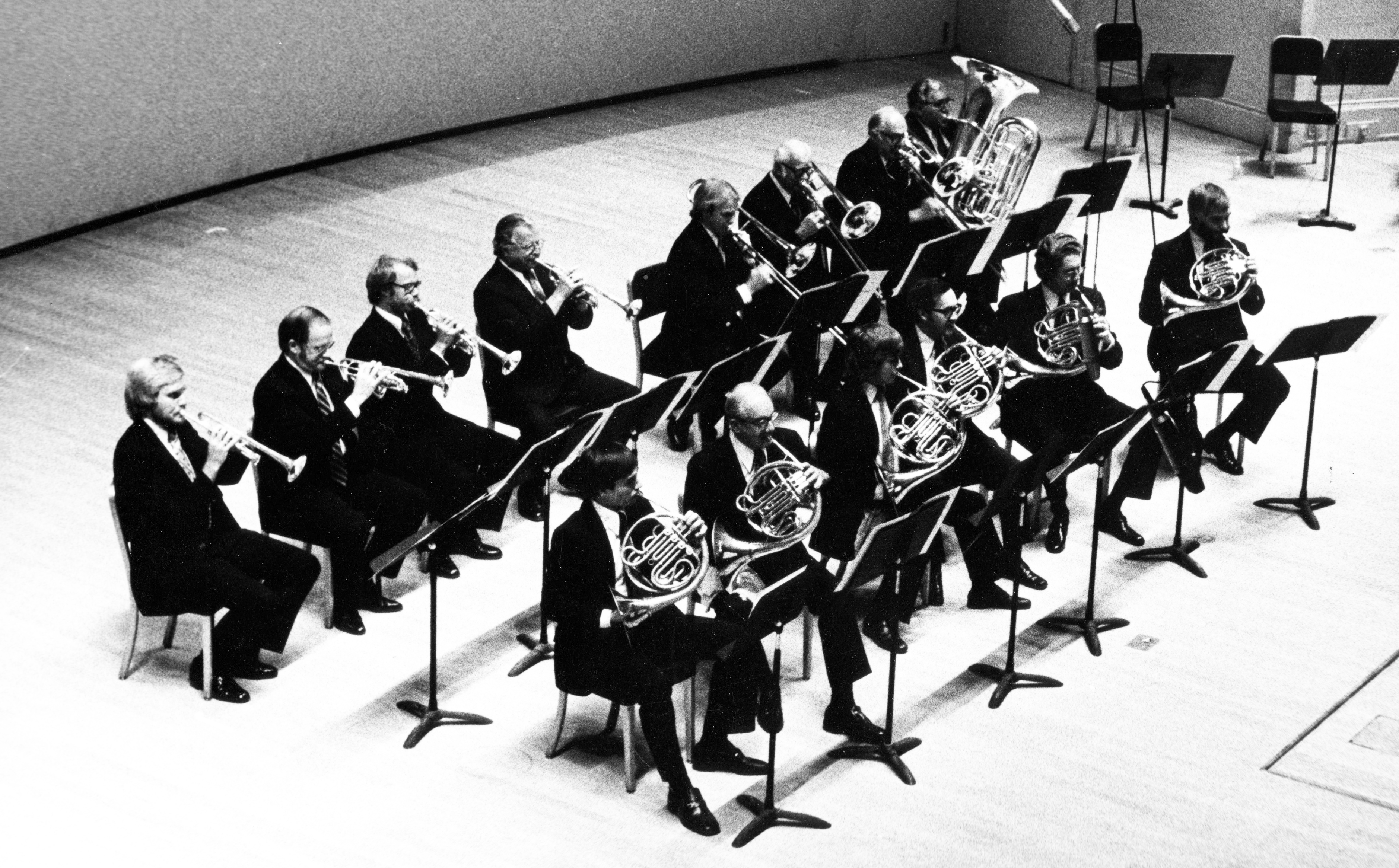
[Below] Members of the Chicago Symphony brass section, around 1975. Back row, left to right: Philip Smith, fourth trumpet; William Scarlett, third trumpet; Charles Geyer, second trumpet; Adolph “Bud” Herseth, principal trumpet; James Gilbertson, assistant principal trombone; Frank Crisafulli, second trombone; Edward Kleinhammer, bass trombone; Arnold Jacobs, tuba.
CSO_Brass_c1975

[Below] This photo was taken by my wife after my last lesson with Edward Kleinhammer, just before my graduation from Wheaton College, May 1976. The location is his studio in the Fine Arts Building on Michigan Avenue, Chicago. He is holding his bass trombone made by Schilke with a bell by Earl Williams.

Kleinhammer_Yeo_1976

[Below] The caption on the back of this photo, in Edward Kleinhammer’s handwriting, reads, “Ravinia 1976.”

Kleinhammer_Ravinia_1976

[Below] Edward Kleinhammer and Arnold Jacobs, c. 1984:

Kleinhammer_Jacobs_c_1984

[Below] Edward Kleinhammer’s final concert with the Chicago Symphony in Orchestra Hall was in May 1985. These three photos (below) were taken during that concert and hung in his home office for many years after.

Edward_Kleinhammer_May_1985_01

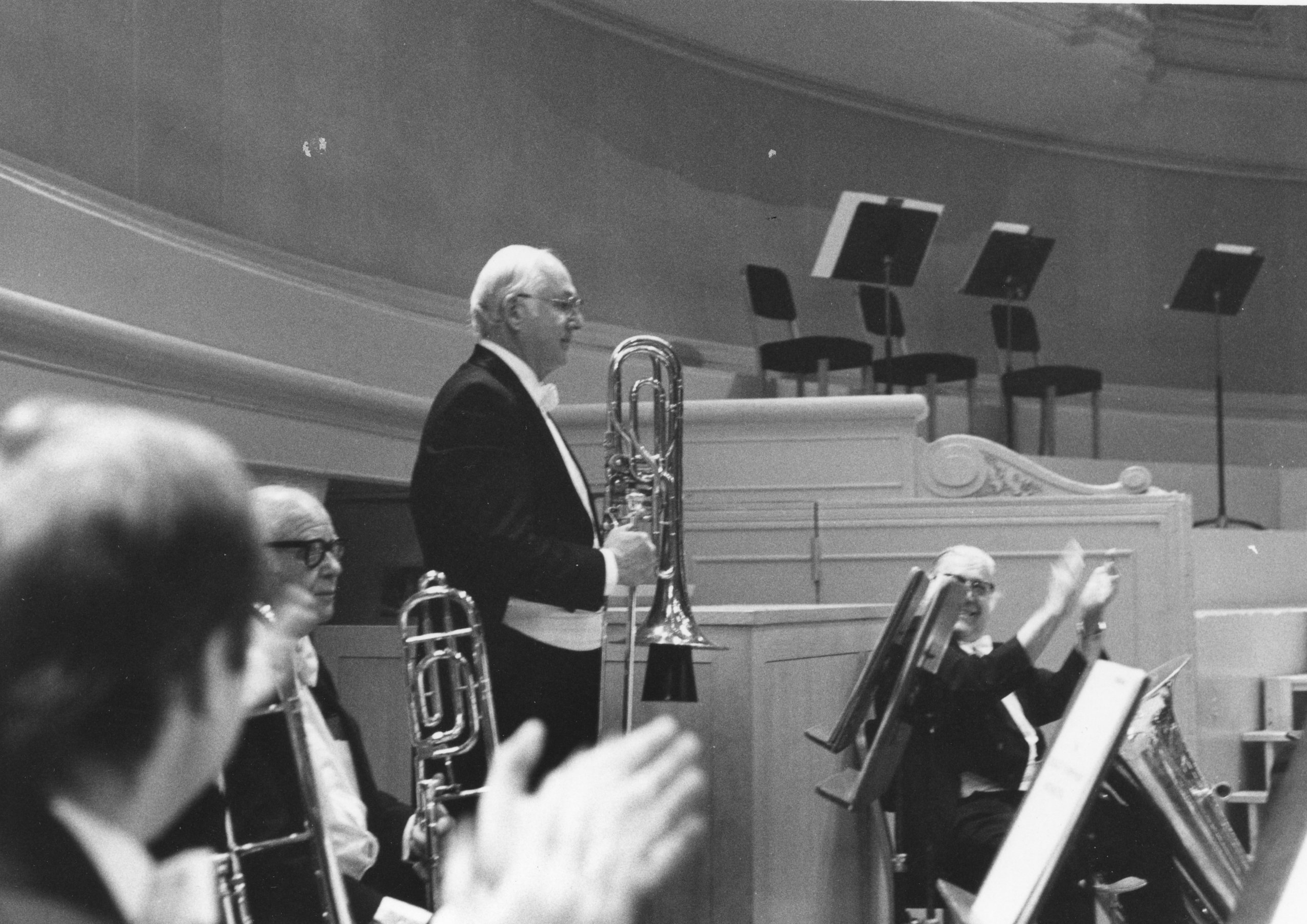
[Below] Edward Kleinhammer’s final bow at his chair in Orchestra Hall, May 1985. Also seen are Frank Crisafulli, second trombone, and Arnold Jacobs, tuba:
Edward_Kleinhammer_May_1985_02

[Below] Edward Kleinhammer’s final concert in Orchestra Hall, May 1985. Here he is at the podium, being presented with the Chicago Symphony’s Theodore Thomas Medallion by guest conductor Michael Tilson Thomas:

Edward_Kleinhammer_May_1985_03


[Below] Edward Kleinhammer’s Theodore Thomas Medallion, presented to him by the Chicago Symphony Orchestra on the occasion of his retirement from the Orchestra:

Chicago Symphony Orchestra

The Theodore Thomas Medallion for Distinguished Service

Presented to Edward Kleinhammer

1940-1985

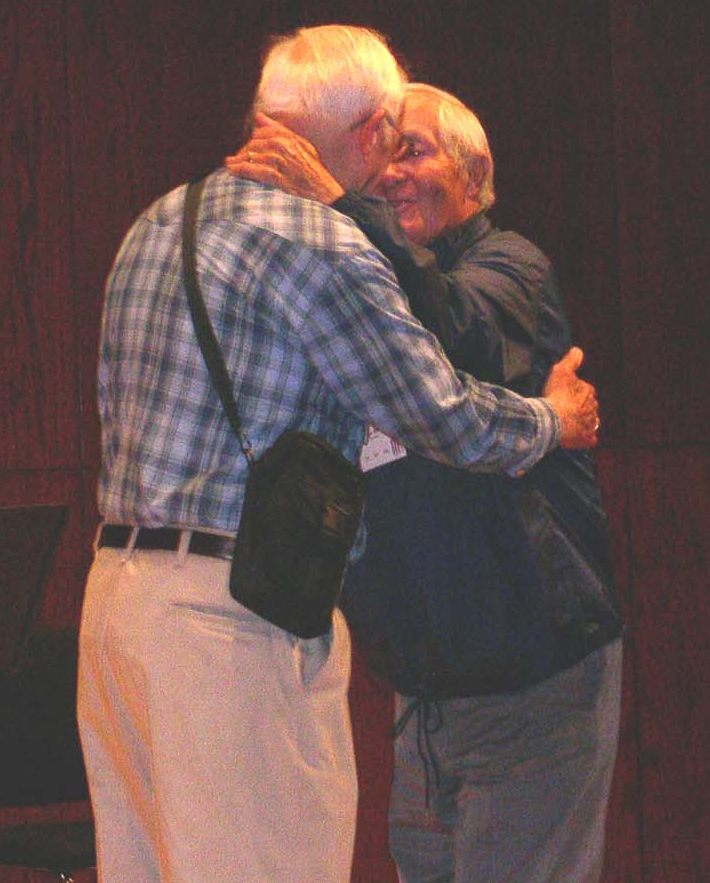
[Below] At the 2004 International Trombone Festival in Ithaca, New York, Edward Kleinhammer and George “Mr. Bass Trombone” Roberts met for the first time. It was a very special moment to see these two giants of the bass trombone from very different parts of the musical universe (classical and commercial) meet on stage together after Mr. Kleinhammer’s master class. George, ever effusive, came up to Ed and gave him a big hug and a kiss on the cheek. At the moment this interaction occurred, I was sitting in the audience with Ed’s wife, Dessie.
Kleinhammer_Roberts_2004

[Below] Edward Kleinhammer at home in Hayward, Wisconsin, around 2000 (photo by David Wilson). The mouthpiece in this Bach 50B3 is my YAMAHA Douglas Yeo Signature Series Mouthpiece that I had given to him several years earlier.

Edward Kleinhammer_c2005

[Below] I kept in close contact with Mr. Kleinhammer over the years; I have several hundred hand written letters from him, even more emails, and we spoke by phone frequently. He always called me on August 31—his birthday— to wish my wife and me a happy anniversary. My wife and I were married on August 31, 1976, and every year, without fail, before I could pick up the phone to wish him a happy birthday, my phone rang and it was him, to wish us well. The last time I saw him was at his home in Hayward in 2009. This is how I will always remember him:

08.Yeo_Kleinhammer_2009

I last spoke to Ed a few days before he died. Nothing in his voice gave a clue that a week later, he would pass from this world to the next while taking a nap in his favorite chair. I am a better person and trombonist because of the influence of Edward Kleinhammer, and I know many others can say the same thing. Today, on what would have been his 100th birthday, we honor this man who did so much for so many.