Category: Boston Symphony Orchestra

Loud, Louder, Loudest: How Classical Music Started to Roar (New York Times)

Loud, Louder, Loudest: How Classical Music Started to Roar (New York Times)

Last night, The New York Times published an article by Corinna da Fonseca-Wollheim, “Loud, Louder, Loudest: How Classical Music Started to Roar.” She reached out to me a little over a year ago, asking if she could interview me for a planned story about the trend toward excessively loud dynamics in symphony orchestras. You will find several quotations from me in her article.

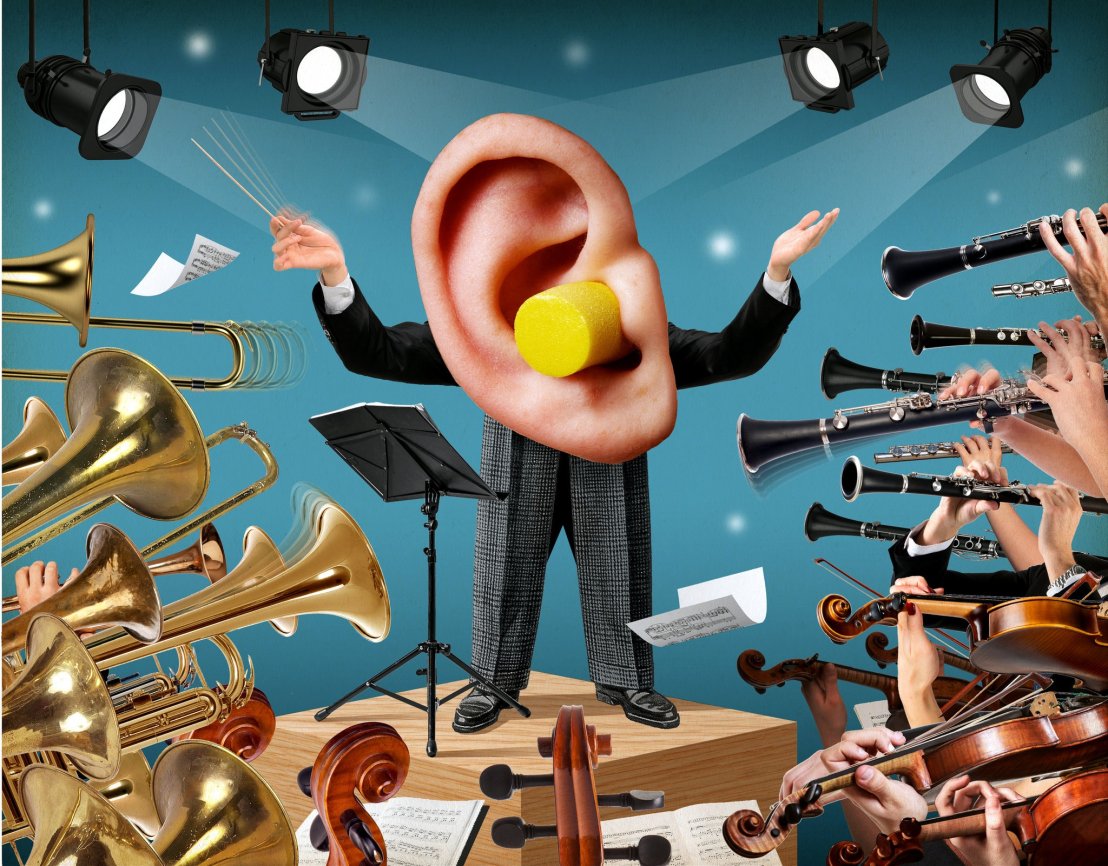
The subject has interested me for many years and I was pleased to speak with Corinna; I think her article is insightful and thought provoking. And I must say that I think that Michael Waraska’s illustration that accompanies Corinna’s article is absolutely superb.

Loudness_NY_Times_Michael_Waraksa

[Above: illustration for The New York Times by Michael Waraksa, 2020.]

Waraksa’s image is in the spirit of a much earlier one that addressed the same issue of loud dynamic levels at classical music concerts. In 1845, Jean-Ignace-Isidore Gérard, who was known by the pseudonym Grandville, published a caricature of French composer Hector Berlioz. A year later, German caricaturist Anton Elfinger, known as Cajetan, adopted (and colorized) Grandville’s drawing; it was published in Allgemeine Theaterzeitzung (Jahrgang 39, No. 81, Vienna, April 4, 1846). This issue has been before us for a very long time, as Corinna da Fonseca-Wollheim describes in her superb article.

Berlioz_Grandville_1846

[Above: illustration for Allgemeine Theaterzeitzung, “Satirical Concert; a Concert in 1846!”, by Anton Elfinger after Grandville, 1846.]

To read Corinna da Fonseca-Wollheim’s article, click its title under Michael Waraska’s graphic below, or click HERE.

I have written several essays on this subject that appear on my website. The first, Me, Myself, and I: Are Brass Players Losing the Concept of Being Team Players?, was first published in the International Trombone Association Journal in 1997. It was subsequently reprinted in the T.U.B.A. Journal (now the Journal of the International Tuba Euphonium Association) later that year. My friend, Gene Pokorny, tubist of the Chicago Symphony, wrote an encouraging response to my article that also appeared in the T.U.B.A. Journal. You can read both my article and Gene Pokorny’s response by clicking HERE.

Then, later in 1997, I wrote another article which appears on the FAQ section of my website. I wrote an article that addressed this question:

I’ve been reading about problems with people complaining about excessive “noise” levels on stage in orchestras and bands, leading some players who sit near brass players to complain of hearing loss. What insights do you have on this situation?

The impetus to write this article came when a member of the Boston Symphony Orchestra—of which I was bass trombonist from 1985-2012—filed a complaint with the Unites States Occupational Safety and Health Administration (OSHA) about excessive noise levels on stage during rehearsals and concerts in Symphony Hall. That report and my commentary on the issue be viewed by clicking HERE.

My articles have generated a huge amount of discussion in the nearly 25 years since I first wrote them. They have been reprinted in dozens of blogs and they appear on many websites. I’m very happy that this important discussion is ongoing, and I salute Corinna da Fonseca-Wollheim for her superb contribution to the conversation.


Hope.

Hope.

We are living through an extraordinary crisis. Words fail. Everyone has a story; no one is immune from the implications of COVID-19. Every part of every life is impacted on every level.

As I, like everyone on our planet, work to navigate the challenges before us, I am reminded that there is one thing we cannot do: we cannot give up hope. Everyone hopes in something. My hope is in God. I do not doubt God’s wisdom or rightness; God is Sovereign—God is in, around, above, before, behind, under all things. In this present crisis, as always, I have some questions for God. But I know God  hears my prayers every day. I trust God even in the midst of the storm; God is teaching us something in all of this.

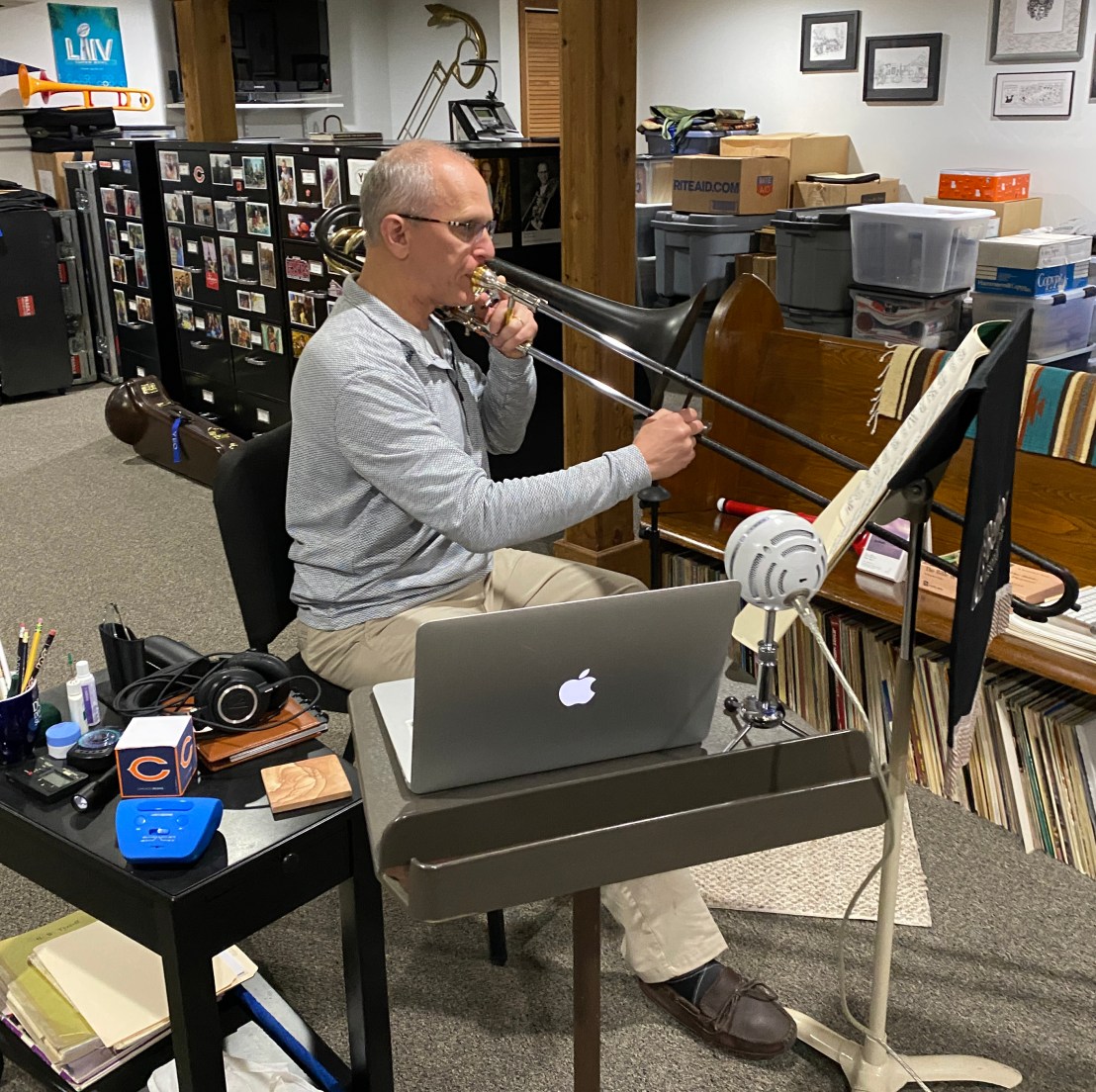
With life now sideways and our feet treading in quicksand, I spent a few hours yesterday cleaning up our basement where I practice trombone and have most of my music, books, recordings, and files. It is there where tomorrow, I will begin teaching remote lessons to my students at Wheaton College (Illinois).

Yeo_remote_teaching

Sometimes when you go looking for something, you find something else. While filing away some documents yesterday, I came across the Boston Symphony Orchestra program for opening night, September 24, 2008, four years before I retired from the orchestra in 2012. It was the fifth year of James Levine’s tenure as music director of the orchestra, and the program included Pictures at an Exhibition of Modeste Mussorgsky, orchestrated by Maurice Ravel. The concert remains memorable to me, but the reason I saved that program is because of its beautiful cover image. It shows the center of the ceiling of Symphony Hall, Boston, where the middle of three crosses on the ceiling is illuminated by a chandelier. I spent many hours looking at that ceiling and its three crosses, which always reminded me of three crosses on a hill called Golgotha outside Jerusalem 2000 years ago where my Hope, Jesus Christ, lived, died and rose again, and gave me the Hope I hold. And now, looking at this beautiful, artistic photograph, I am reminded again of my Hope. Light in darkness. Good in the midst of evil. The solid rock in the midst of sinking sand.

Symphon_Hall_Boston_ceiling_Low_res

In the midst of this storm, the only hope we have is in God. Pray for deliverance from this pestilence. Pray for safety. Pray for wisdom in how we can help others. Pray for others who have greater challenges than we have. Pray that when this ordeal is over, we will act in new ways in light of the lessons we are learning today. This we pray. Amen.

So we do not lose heart. Though our outer self is wasting away, our inner self is being renewed day by day. For this light, momentary affliction is preparing for us an eternal weight of glory beyond all comparison, as we look not to the things that are seen but to the things that are unseen. For the things that are seen are transient, but the things that are unseen are eternal. (2 Corinthians 4:16-18)

[Header image: Sunrise over the Sierra Estrella, Goodyear, Arizona, 2012. I took this photo from the front porch of our home where we lived from 2012-2018. Sunrise. A new day. Hope.]

A musical miscellany

A musical miscellany

I was trained as a classical musician although I am very grateful my musical life did not fit narrowly into that single stylistic box. I am a firm believer in the value of the pluralistic musical life, whether as a performer or listener. During my long career as bass trombonist of the Boston Symphony Orchestra (1985-2012), I was very fortunate to play much of the important canon of western orchestral music that contained trombones: Beethoven (Symphonies 5 and 9), Mozart (he didn’t score for trombones in his symphonies, but I played his Requiem and several operas), all of the symphonies of Brahms, Schumann, Mahler, Tchaikovsky, and Bruckner, the tone poems of Richard Strauss, and so much more. And this I was blessed to do with some of the finest conductors of the twentieth and twenty first centuries—including Leonard Bernstein, Bernard Haitink, Seiji Ozawa, James Levine, Simon Rattle, Sir Colin Davis, and many others—and great soloists—including Mstislav Rostropovich, Anne-Sophie Mutter, Yo-Yo Ma, Jesseye Norman, Evgeny Kissin, Thomas Quasthoff, Gil Shaham, and many others—who inspired me in countless ways.

Yeo_Haitink_Sym_Hall_final_bow_2012

[Above: My final bow at Symphony Hall as a member of the Boston Symphony Orchestra, May 2012. Behind me, standing, are concertmaster Malcolm Lowe and conductor Bernard Haitink following a performance of Beethoven Symphony No. 9.]

After graduation from Wheaton College (IL) in 1976—where I studied trombone with Edward Kleinhammer (bass trombonist of the Chicago Symphony from 1940-1985) and I have now come full circle as the College’s trombone professor since fall 2019—my wife and I moved to New York City. There I had a remarkably diverse performing life, playing concerts with the Mostly Mozart Festival Orchestra and American Symphony, Broadway shows (many performance of “The King and I” starring Yul Brynner), studio jingles and record sessions, jazz bands (including the Gerry Mulligan Big Band, the Elgart Band, and the Dave Chesky Band), and the Goldman Band, with which I played many concerts under the batons of Richard Franko Goldman and Ainslee Cox.

Douglas_Yeo_Goldman_Band_1977

[Photo above: That’s me, warming up before a concert by the Goldman Band, summer of 1977, at the Guggenheim Bandshell next to the Metropolitan Opera House, Lincoln Center. That summer, by the way, was when the New York City blackout of 1977 occurred on June 13, 1977. I was playing a concert with the Goldman Band at Lincoln Center at the moment the blackout struck. Seriously. But that’s another story. In this photo, sitting next to me, which his back to the camera, is trombonist Fred Braverman. Other members of the band at that time included William Arrowsmith, then principal oboist of the Metropolitan Opera, Abraham Perlstein, who had been the second trombonist of the NBC Symphony, and Bill Barber, tuba, who had played with Miles Davis in the seminal “Birth of the Cool” recording sessions and concerts. I learned a lot from my time playing in the Goldman Band. A. Lot.]

In all of this musical activity in New York City I was a free lancer, and a substitute in groups (apart from the Goldman band where I was a full member for four summer seasons, 1977-1980—six concerts a week for six weeks each summer). From day to day, I didn’t know what kind of music I might playing. The phone would ring, I would accept an engagement, gather up my trombone and bag of mutes, and head off to play. This plurality of musical styles served me well when I joined the Baltimore and then the Boston Symphony Orchestras, where “pops” concerts required me to play credibly in a host of styles.

Yeo_Brubeck_Concerto_Boston_Pops_Lockhart_2011

Some of the richest fruit of my early experience in the jazz and commercial worlds came when I performed the two Bass Trombone Concertos written by my friend, Chris Brubeck, with the Boston Pops Orchestra. Working with Chris was pure joy, as was meeting his father, Dave Brubeck. I played Chris’ first Bass Trombone Concerto several times with the Boston Pops, including a performance of the third movement, “James Brown in the Twilight Zone,” on national television as part of the “Evening at Pops” television show. The photo above shows me performing the Concerto with the Boston Pops in 2011, with Keith Lockhart, conductor (photo by Michael J. Lutch). Susan Stempleski reviewed the concert for classicalsource.com and wrote, in part:

Lockhart introduced Douglas Yeo, bass trombonist of the Boston Symphony and Boston Pops orchestras, who delivered a wonderful and lively rendition of “James Brown in the Twilight Zone”, a movement from Chris Brubeck’s jazz-flavored Concerto for Bass Trombone and Orchestra. Yeo’s virtuosic performance electrified the audience. Brubeck was in the audience.

Yeo_buccin_Hamamatsu_2015

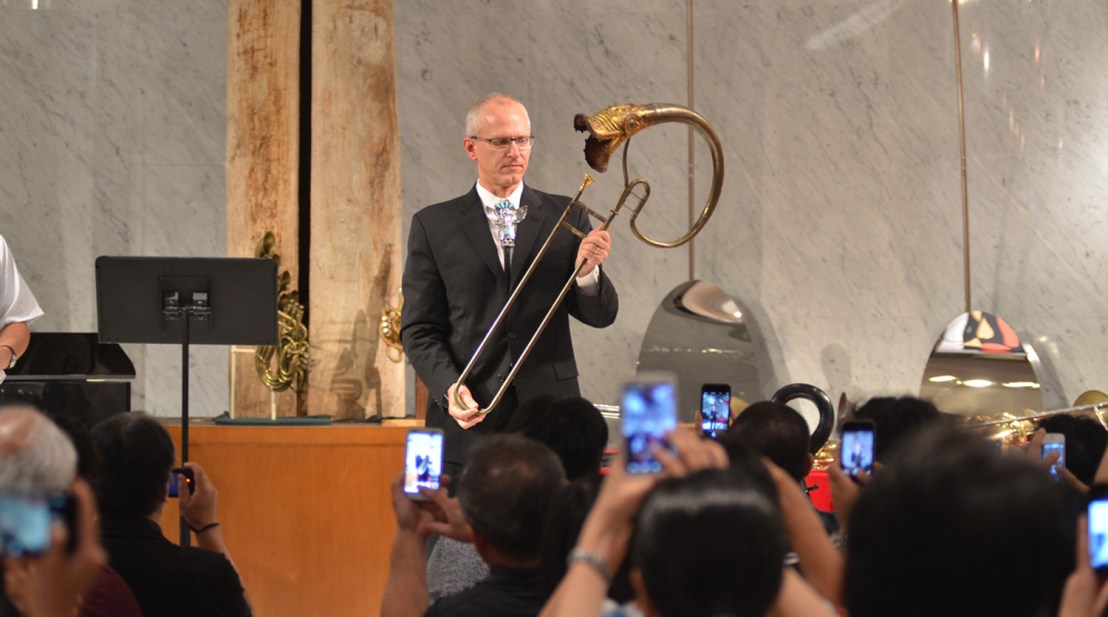
In 1996, I began my exploration into early music, first with serpent, then ophicleide, then the early trombone (often referred to as “sackbut”), buccin (dragon bell trombone), and six-valve trombone. This opened another musical world to me, where I have taken part in performances of music that I would not have ever played on bass trombone. I’ve played serpent on a host of pieces with orchestras (both modern orchestras and early music groups) including Hector Berlioz’s Messe solennelle and Symphonie fantastique, Mendelssohn’s Symphony No. 5 (Reformation) and Meerestille und glückliche Fahrt overture (Calm Seas and Prosperous Voyage), ophicleide on Berlioz’s Damnation of Faust and Mendelssohn’s A Midsummer Night’s Dream, and early trombone on Monteverdi’s Vespers of 1610 and L’Orfeo. And I’ve given many recitals that feature serpent, ophicleide, six-valve trombone, and buccin, such as when I gave a concert on nine different instruments in 2015 at the Hamamatsu Museum of Musical Instruments in Hamamatsu, Japan, shown in the photo above.

Today, in this season of life since I retired from the Boston Symphony in 2012, I feel exceptionally blessed to continue to explore playing music in a host of styles, genres, and types of ensembles. Recent months have brought a number of rewarding musical experiences into my orbit. I do not take this for granted, and I am grateful that I continue to get invitations to do interesting things with a trombone (or another instrument) in my hand.

Elijah_Austin_2019

In December 2019, I was in Austin, Texas, taking part in performances of Felix Mendelssohn’s oratorio, Elijah. The concerts were organized by George Dupere, Chief Musician of Redeemeer Presbyterian Church (PCA) in Austin. I have played this piece many times, both the bass trombone and ophicleide parts, and I never tire of it. Never. The piece is so masterfully composed, and it contains such tremendous drama. This time, I played ophicleide with a fine orchestra including some of our brass section, above (left to right): Jamey Van Zandt, Nathaniel Brickens, and Owen Homayoun, trombones, and Chris Carol and Shelby Lewis, natural trumpets.

Gordon_Pagliuca_Yeo_Midwest_2019

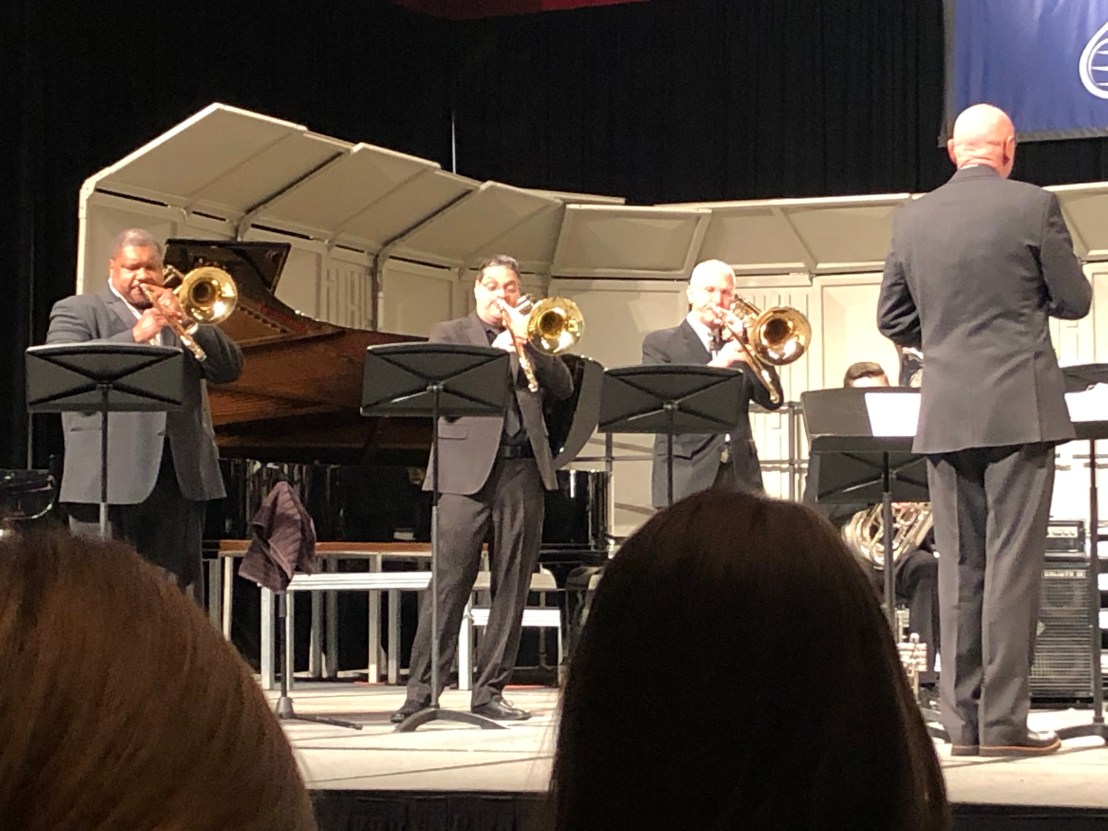
Just a few days later, I switched musical gears into the jazz world. I was delighted to be asked to be part of an “all star” brass jazz ensemble that was put together by YAMAHA for the Midwest Clinic, an annual convention held in Chicago. The Clinic features classes and performances over several days, and is one of the largest (the largest?) such events in the world. Our concert featured some terrific Christmas music, including carols arranged for trumpets, horns, trombones, tuba, and rhythm section by Stan Kenton, Ralph Carmichael, Sam Pilafian, JD Shaw, Jose Sibaja, and others. Boston Brass made up the core of the group and our trombone section (shown in performance above) consisted of Wycliffe Gordon, Domingo Pagliuca (of Boston Brass) and me. Great guys; great players. John Wittman conducted (shown in the photo on the right).

Yeo_trumpets_Midwest_2019

The trumpet section? Not a bad lineup, actually. Ha! Actually, this was a remarkable group of some of the greatest trumpet players in the world, shown backstage with me before the concert: Jose Sibaja (Boston Brass), Allen Vizzutti, Wayne Bergeron, (me), Jeff Conner (Boston Brass), Rex Richardson, and Jens Lindeman. Any questions?

Yeo_Gordon_Midwest_2019

It was such a pleasure to work with Wycliffe Gordon once again. He needs no introduction and it’s no secret to say he is one of the finest jazz trombonists of our time, for a long time member of the Lincoln Center Jazz Orchestra (I first met him at a joint concert between the LCJO and the Boston Symphony Orchestra), and now leader of his own combo. He has more albums out than I can count, and we are simpatico in so many ways. For years I’ve referred to Wycliffe as “my brother from another mother.”

In 2015, Arizona State University hosted Wycliffe for some masterclasses; this happened  while I was Professor of Trombone at ASU. I included his trombone ensemble piece, Dear Lord, I Love Thee on our April 2015 concert. Have a look and listen, above (to open this video in YouTube, click HERE). It was really, really great to see and work with Wycliffe again at the Midwest Clinic.

Kanda_Yeo_SLLBC_2020

February 2020 brought more fun in a different musical world. My good friend Megumi Kanda—principal trombonist of the Milwaukee Symphony— and I travelled to St. Louis to give a joint recital and masterclass, sponsored by the St. Louis Low Brass Collective (STLLBC). Megumi is a superb player and wonderful person (I often refer to her as “my sister from another mother”), and we have done a number of joint events over the years. We also are authors of books about trombone orchestral excerpts and performance. Published by Encore Music Publishers, the annotated orchestral excerpt books, The One Hundred: Essential Works for the Symphonic Trombonist and The One Hundred: Essential Works for the Symphonic Bass Trombonist. To all of you who are reading this who have made our books part of your library: Thank you! And if you’re interested in the books, just click the links on the titles, above.

We began our masterclass with a duet, a movement of Philipp Telemann’s Canonic Sonata No. 3 that I arranged for inclusion in my book, Trombone Essentials, published by G. Schirmer.

Megumi_Kanda_SLLBC_2020

Yeo_SLLBC_2020

We continued the class by each speaking to the assembled audience and then working with several young players. As you can see from the photos above, Megumi and I tend to be  similarly demonstrative when we teach. How about a caption contest?! By the way, I should mention that Megumi is the recipient of the International Trombone Association’s 2020 ITA Award, the Association’s highest honor. She is so deserving of this honor, and it’s a pleasure for me—the 2014 recipient of the ITA Award—to welcome her into this special group of trombonists who have been so honored. I am at work on an article about her to be published later this year in the ITA Journal. Stay tuned; she has quite a story to tell!

Kanda_Yeo_Recital_program_St_Louis_2020

Kanda_Yeo_St_Louis_2020

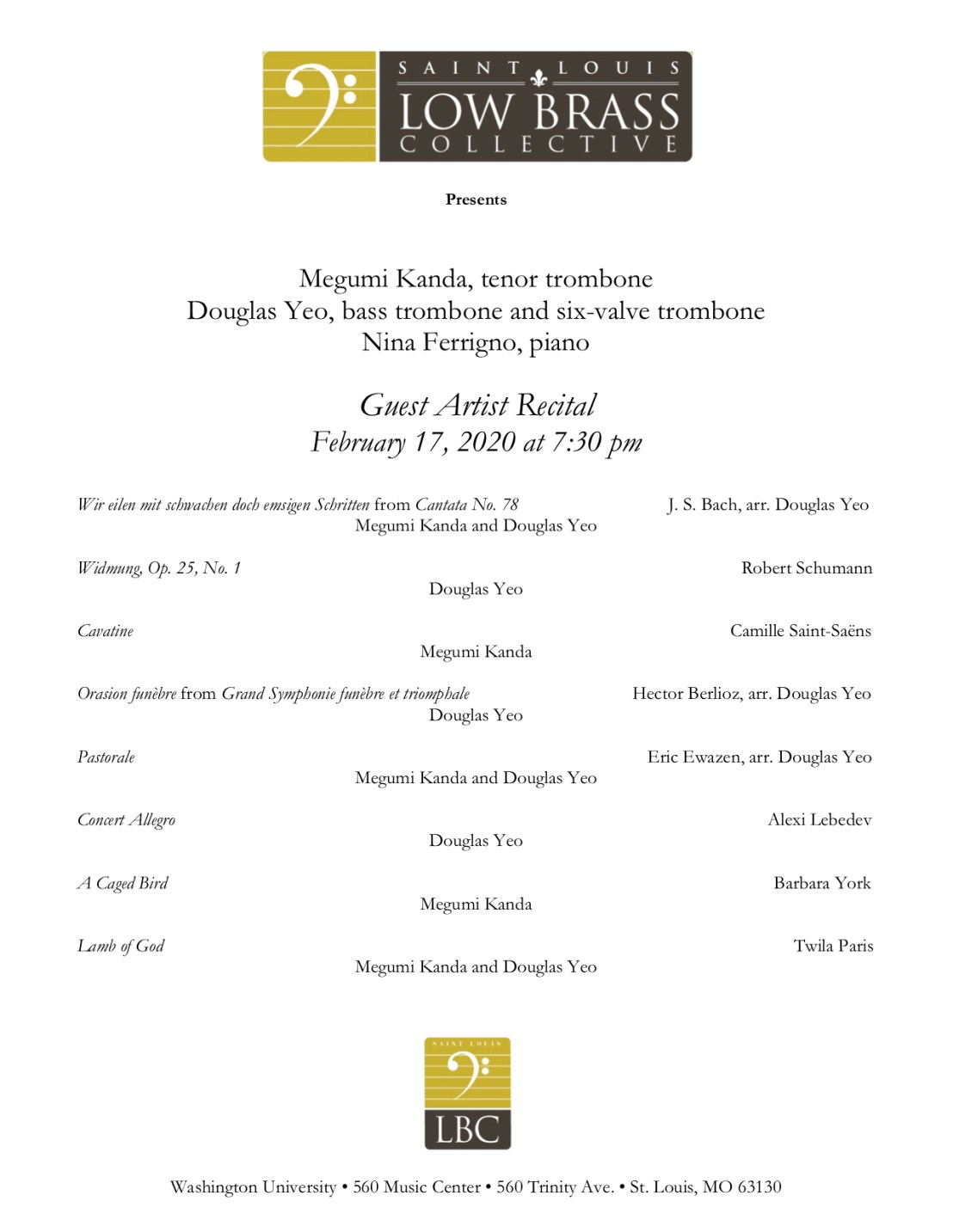
Our recital on February 17 featured us playing solos and duets. I even used my six-valve trombone to perform Hector Berlioz’s Orasion funèbre from his Grand symphonie funèbre et triumphale. I want to send a shout out and big thank you to my good friend, Gerry Pagano (bass trombonist of the St. Louis Symphony) and all of those in the STLLBC who made this trip possible.

Gaudete_Yeo_Wheaton_College_selfie_2020

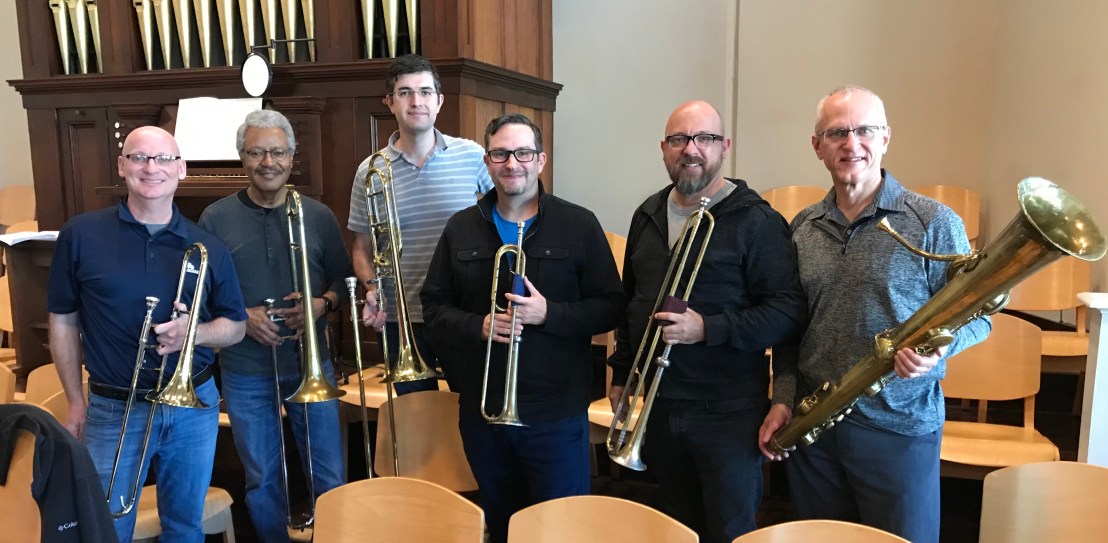
From a solo and duet recital in St. Louis I came back home to the Chicago area to play chamber music. On February 21, the Wheaton College Artist Series presented a concert that featured the Chicago-based brass quintet, Gaudete Brass, as well as organist Nicole Simental and the combined Wheaton College choral groups, conducted by Jerry Blackstone. The centerpiece of the concert was a performance of Morton Lauridsen’s Lux Aeterna. On the first half of the concert, Gaudete Brass performed Ingolf Dahl’s Music for Brass Instruments; Dahl was Lauridsen’s composition teacher at University of Southern California and the piece requires six players. I joined Gaudete Brass as its second trombonist (selfie of me with Gaudete Brass after a rehearsal in Edman Chapel, above).

Gaudete_Yeo_Wheaton_College_2020

[Photo above: Gaudete Brass in Adams Art Gallery on the campus of Wheaton College after our performance. (Left to right) Bill Baxtresser (trumpet), Joanna Schulz (horn), Charles Russell Roberts (trumpet), me, Paul Von Hoff (trombone), and Scott Tegge (tuba)

I have played Dahl’s piece on numerous occasions with groups in performances around the world. But I have to say that this collaboration was, to me, particularly special. First, Gaudete Brass is a superb group of musicians. They play at the highest level and it was a joy to work with them; I hope we will do more things together. Nice people, too! Also, the concert was held in Edman Memorial Chapel at Wheaton College, where, as a student there from 1974-1976, I took part in many concerts on that stage. Many memories came flooding back as I played in Edman Chapel with Gaudete Brass. And there was this. . .

Fine_Arts_Building_Chicago

In December, Gaudete Brass and I had a rehearsal in the Fine Arts Building, on Michigan Avenue in downtown Chicago. That building has very special meaning for me: it was there, on the ninth floor, that I had my weekly trombone lesson with Edward Kleinhammer (bass trombonist of the Chicago Symphony Orchestra from 1940-1985) while I was a student at Wheaton College. I had not been in that building since my last lesson with him in May 1976. Walking through the front doors brought back a flood of memories.

Hallway_ninth_floor_Fine_Arts_Building_Chicago

Kleinhammer_Studio_Fine_Arts_Building_2020

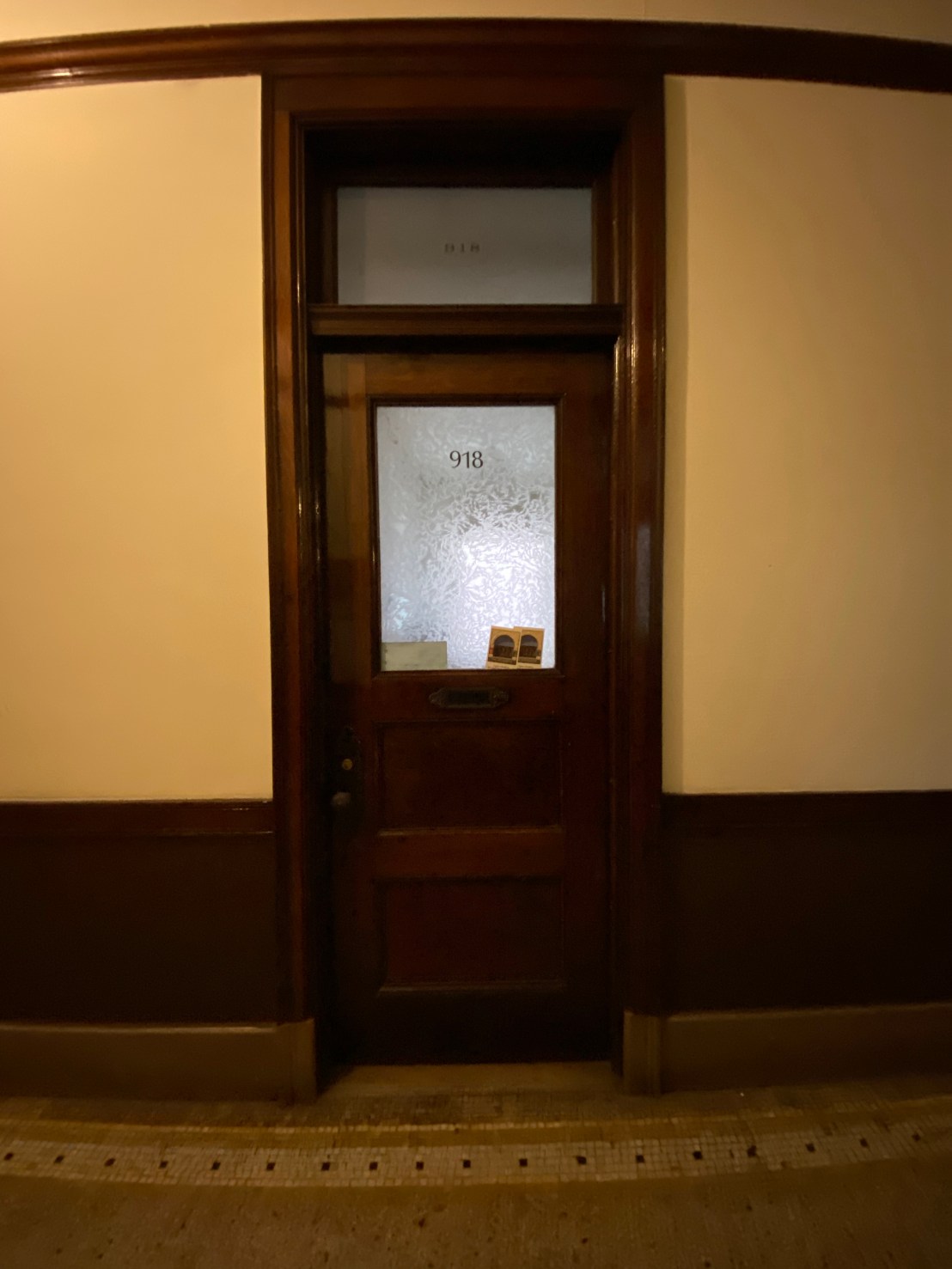
After the rehearsal with Gaudete Brass, I climbed the stairs up to the ninth floor, to once again walk down that long hallway (which has not changed a bit since 1976) and stand in front of room 918 where Mr. Kleinhammer had his studio. As I stood there, I reflected on how those lessons impacted me in so many ways. I could not go in the room this time, but I remember every detail of that small space: two chairs, two music stands, a table for music, and a sink (the bathroom is down the hall). This photo, below, shows the two of us after my last lesson in room 918 in 1976:

Kleinhammer_Yeo_1976

In that room my life was changed.  If you did not see it earlier, click HERE to read the photo essay/tribute I wrote about him last year on what would have been his 100th birthday. He was a remarkable man.

And there is more to come. While my planned trip to Seattle to be guest soloist this weekend at the Northwest Band Festival was cancelled due to the coronavirus outbreak in Seattle, my calendar is full of other events in the coming months, including masterclasses at Interlochen Arts Academy and the Csehy Summer School of Music, performances with the Finnish National Radio Orchestra in Helsinki and Japan (unless the coronavirus has something to say about that trip), teaching at the Pokorny Seminar—hosted by Chicago Symphony tubist, Gene Pokorny—and teaching at the Wheaton College Summer Music Camp. Details may be found on the schedule page on my website, yeodoug.com.

[Header photo: Boston Symphony Orchestra, Bernard Haitink, conductor. My final performance in Symphony Hall as a member of the Boston Symphony, May 9, 2012; Beethoven Symphony No. 9. Photo by Stu Rosner; courtesy the Boston Symphony Orchestra.]

Symphony Hall: Boston’s proud temple of music since 1900

Symphony Hall: Boston’s proud temple of music since 1900

From 1985-2012, I was bass trombonist of the Boston Symphony Orchestra. The orchestra’s home is Symphony Hall, on the corner of Huntington and Massachusetts Avenues in Boston’s Back Bay section (301 Massachusetts Avenue). Opened in 1900 after the orchestra left the Boston Music Hall where it had played concerts since it was founded in 1881, Symphony Hall is considered to be one of the three finest concert halls in the world, with its acclaimed acoustics putting it in the company of the Musikvereinsaal (Vienna) and Concertgebouw (Amsterdam). Before it was destroyed in World War II, the old (alte) Gewandhaus in Leipzig was also similarly acclaimed. Having played concerts in the halls in Vienna and Amsterdam, I can say that in my view, Symphony Hall is simply the finest concert hall in which I have ever performed.

When I joined the Boston Symphony, I was aware of the rich history of both the orchestra itself and its storied home. I’ve read everything I could find about the BSO and Symphony Hall, spent countless hours in the orchestra’s archives (with which I had a hand in formally establishing in 1987), and have been fascinated at all I have found and learned.

Two important books have informed my quest for information about Symphony Hall.

Johnson_Symphony_Hall_Boston_1950

Published in 1950 on the occasion of the 50th anniversary of the opening of Symphony Hall, H. Earle Johnson’s Symphony Hall, Boston (Boston: Little, Brown and Co., 1950)  surveys the orchestra’s first 50 years, discusses programming and personnel, and features commentary on the building and opening of Symphony Hall. Now out of print (but copies can be found on through used book outlets such a abebooks.com), it unfortunately has no illustrations. 

Stebbins_Symphony_Hall_2000


Richard Poate Stebbins’ book, The Making of Symphony Hall: A History with Documents (Boston: Boston Symphony Orchestra, 2000) is a superb volume that documents, in fascinating detail, the planning, construction, and opening of Symphony Hall. It was published on Symphony Hall’s centennial, a year I remember with great fondness for the many historical exhibits in the Hall’s corridors and the many celebrations of the Hall throughout the year. The cover of the book features an early, color rendering of the original design of the hall, with many statues, inscriptions, and decorative cornices. Ultimately, none of these items were incorporated in hall when it was finished. Money ran out, and to this day, even there is no external decoration to the hall. Even the Hall’s  name is not found on its exterior. Yet it is this austerity that is part of Symphony Hall’s charm; somehow it fits in with the Boston way.

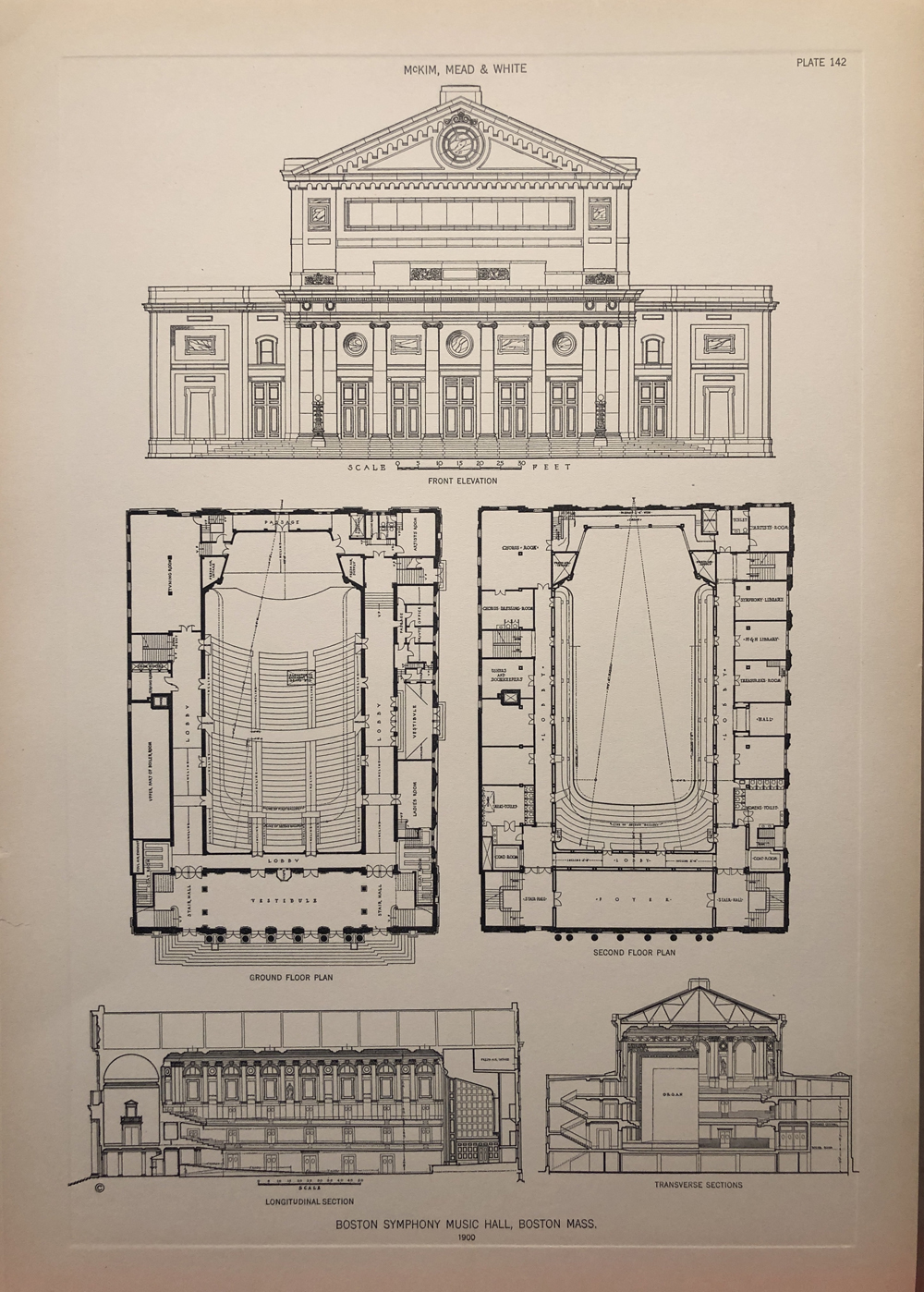
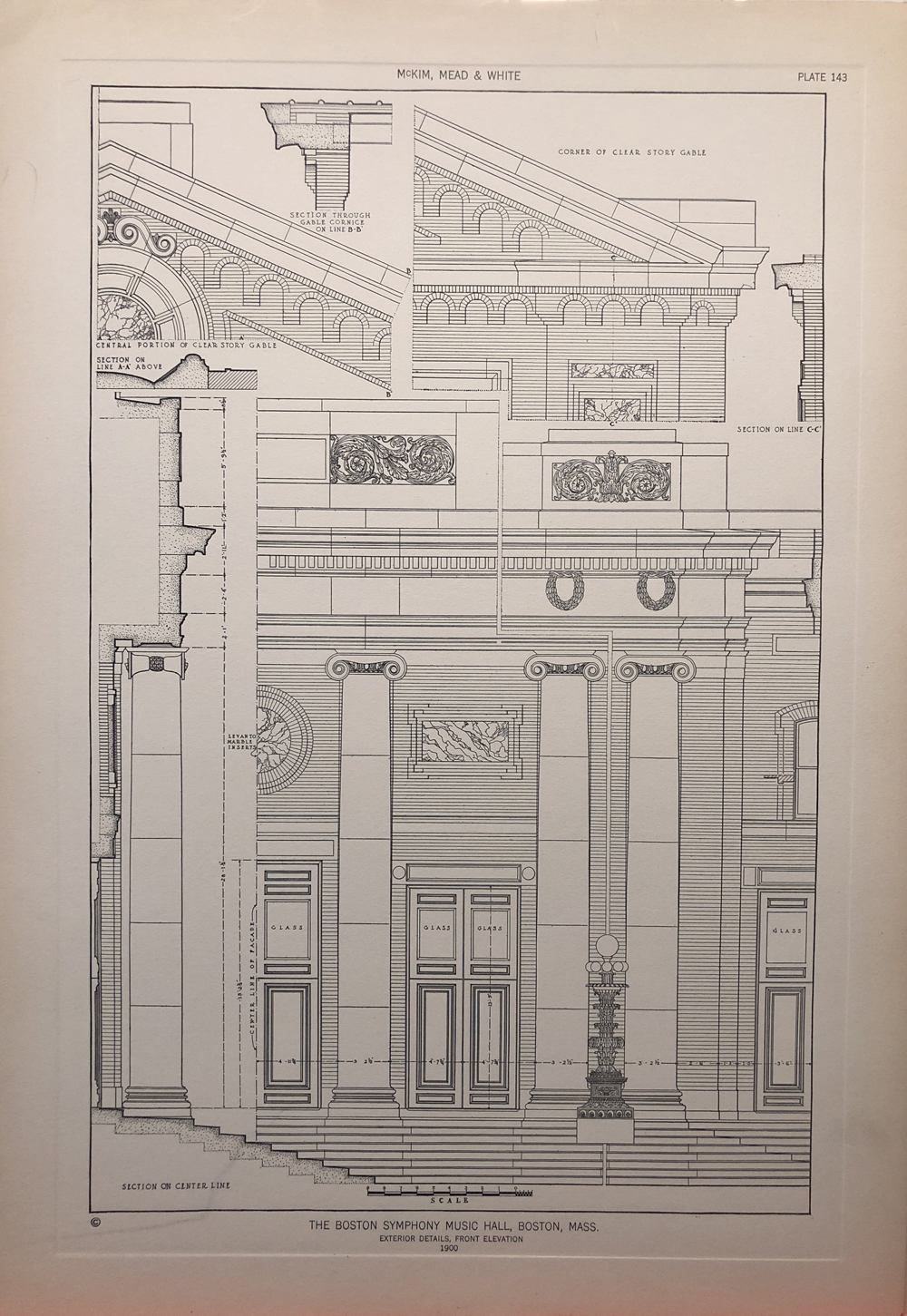
Symphony Hall was designed by  the architectural firm of McKim, Mead & White and an early photo of the completed Hall appeared in A Monograph of the Work of McKim, Mead & White, 1879-1915 (New York: Architectural Book Publishing Co, 1915), below. The publication was a massive four volume set with nearly 400 photographs; each had a simple caption without commentary. It details the breadth of the buildings designed by McKim, Mead & White and it includes three plates that feature Symphony Hall, plates 141, 142, and 143. Several years ago, I was able to obtain original copies of these plates, which are also contained in a modern reproduction of the original four volume set that is still readily and affordably available (McKim, Mead & White, The Architecture of McKim, Mead & White in Photographs, Plans and Elevations (New York: Dover Publications, 1990).  While McKim, Mead & White’s portfolio was published in 1915, the caption reflects the original name for Symphony Hall, The Boston Symphony Music Hall, which was changed to Symphony Hall just before its opening in October, 1900.

Symphony_Hall_plate_141

The other two plates feature some interior and exterior cross sections of Symphony Hall (the aisles on the main floor were changed to a different configuration in the final design), plate 142:
Symphony_Hall_plate_142

And plate 143, that features details of exterior design for the Hall:
Symphony_Hall_plate_143

Over the years, I have collected many postcards of Symphony Hall; I usually paid only one or two dollars apiece for a piece of Boston Symphony history. I was fascinated at how many different images of the facade of the Hall had been made over nearly 100 years. In all, I found dozens of different postcards with nearly 30 images of the exterior of the hall. Many were crisp and clean, but the ones that were most interesting were the ones that had been used, with writing, stamps, and postmarks. It is these postcards that helped to document the approximate time when the photo or image of Symphony Hall was made. Early postcards were black and white; later ones were hand tinted before reproduction, and later ones are faithful photographic reproductions. Most postcards do not have copyright dates; I am not an expert at automobile models which could help further pinpoint years photos were taken. Still, these cards tell the story of Symphony Hall in a unique way. I’m presenting them here in rough chronological order with only light commentary; captions appear beneath each card. The images speak for themselves and are a reminder of a very important part of my life and the lives of thousands upon thousands of lovers of music who have walked through the doors of Symphony Hall, Boston’s proud Temple of Music. 
01_Symphony_Hall_Yeo_postcard

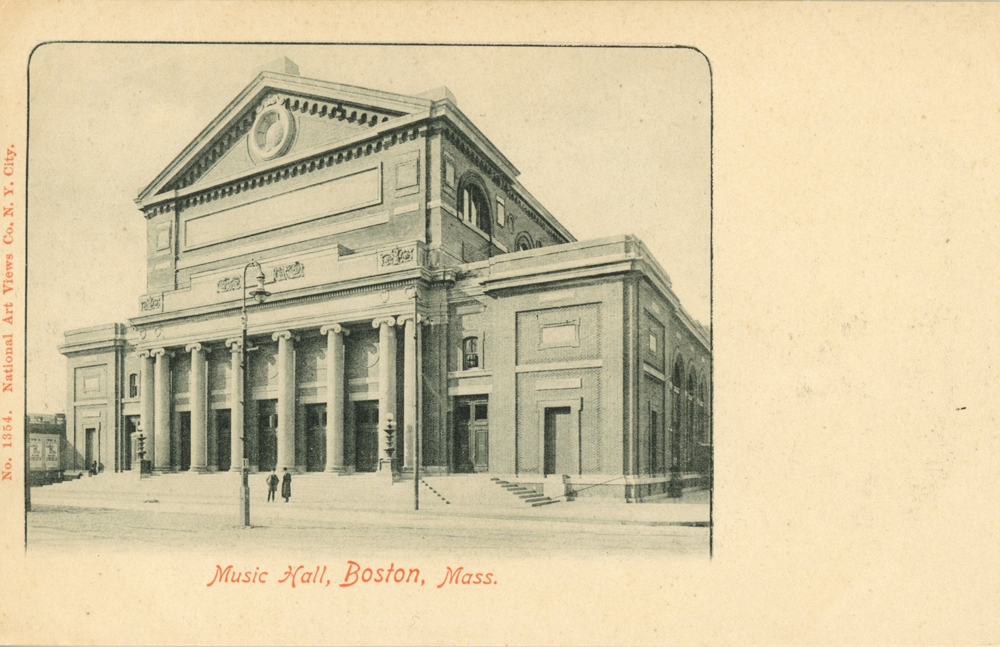
01. Music Hall, Boston, Mass. c. 1900. Card produced by National Art Views Co., N. Y. City. One of the earliest photos of the exterior of Symphony Hall, the view is of the original front entrance of Symphony Hall on Huntington Avenue; the Huntington Avenue trolly line power lines have been removed from this image. The Hall’s original name, Music Hall, which was changed to Symphony Hall before the first Boston Symphony concert was performed there on October 15, 1900, is featured in the caption.
02_Symphony_Hall_Yeo_postcard

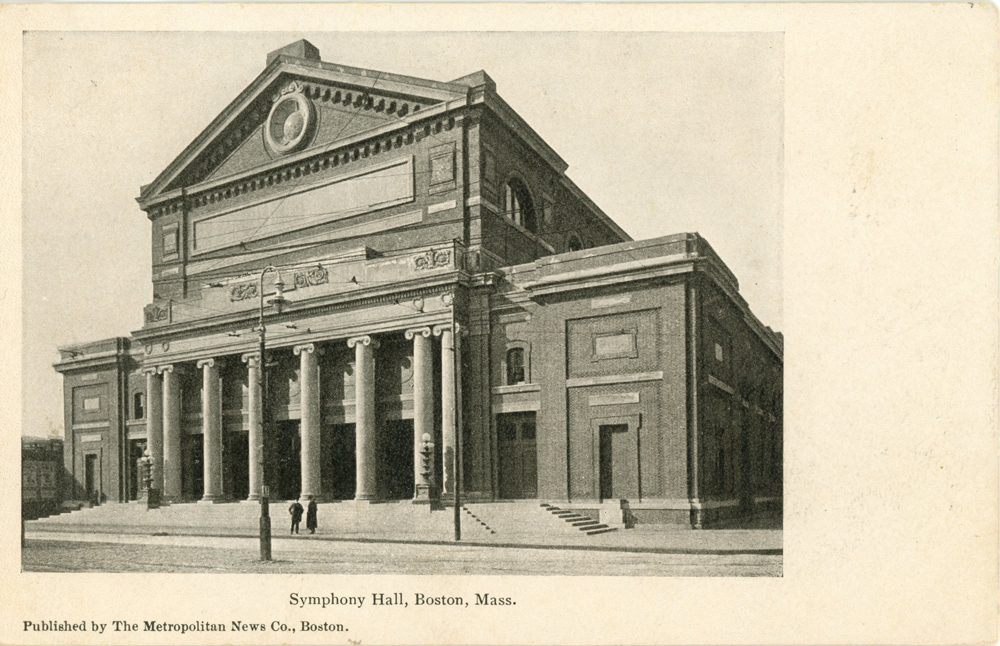
02. Symphony Hall, Boston, Mass. c. 1900. Card produced by The Metropolitan News Co., Boston. This is the identical photo seen in the previous card except the trolley power lines have not been removed. Note the name of the Hall has now been changed from Music Hall to Symphony Hall.

03_Symphony_Hall_Yeo_postcard

03. Symphony Hall. c. 1902. This collage of buildings are from Boston’s Back Bay area, including the Horticultural Hall, which is across the street from Symphony Hall on Massachusetts Avenue. The Art Museum on the card is the Museum of Fine Arts, Boston, which moved from its original location in Copley Square (shown on the card) to its present location on Huntington Avenue in 1907.

03a_Symphony_Hall_Yeo_postcard

03a. Symphony Hall, Boston, Mass. c. 1904. Card produced by Detroit Photographic Co. The card is used and is postmarked October 7, 1908, addressed to Miss Mary Merkins, Winsted, Connecticut. The copyright date of the image is given as 1904. Note the woman in the bottom right corner who is holding on to her hat in the gusting wind.

04_Symphony_Hall_Yeo_postcard

04. Symphony Hall, Boston, Mass. c. 1905. Produced by F. von Bardelben, New York & Germany. Made in Germany. Note the presence of a single horse-drawn carriage.

05_Symphony_Hall_Yeo_postcard

05. Symphony Hall, c. 1905. Card produced by Chisholm Bros., Portland, Maine. The card is used and is postmarked September 4, 1905, addressed to Miss Myrtle Kiefer, Homer, Michigan. The view is similar to the card above but several pedestrians are seen standing against the building.
06_Symphony_Hall_Yeo_postcard

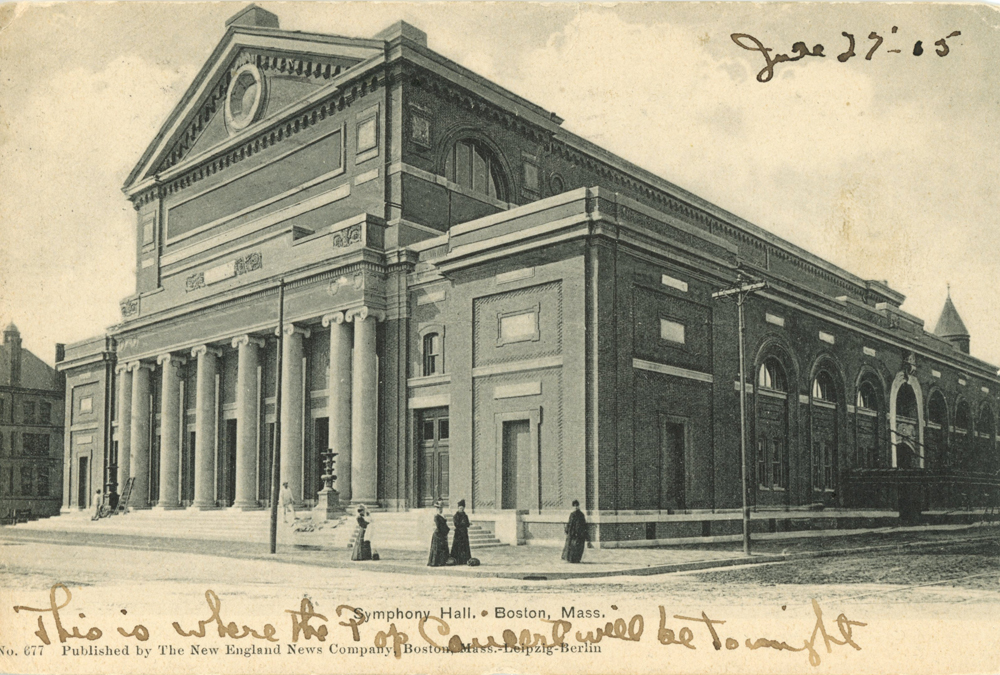
06. Symphony Hall, Boston, Mass. c. 1905. Card produced by The New England News Company, Boston, Mass. – Leipzig — Berlin. The card is used and is postmarked June 29, 1905, addressed to Mrs. K. B. Keene of Washington, D.C. In this view, one can see one of the rising-sun  shaped windows in the clerestory; these were boarded up during World War II (a blackout precaution) and were only reopened in the early 2000s at which time natural light once again could shine into the Hall.
07_Symphony_Hall_Yeo_postcard

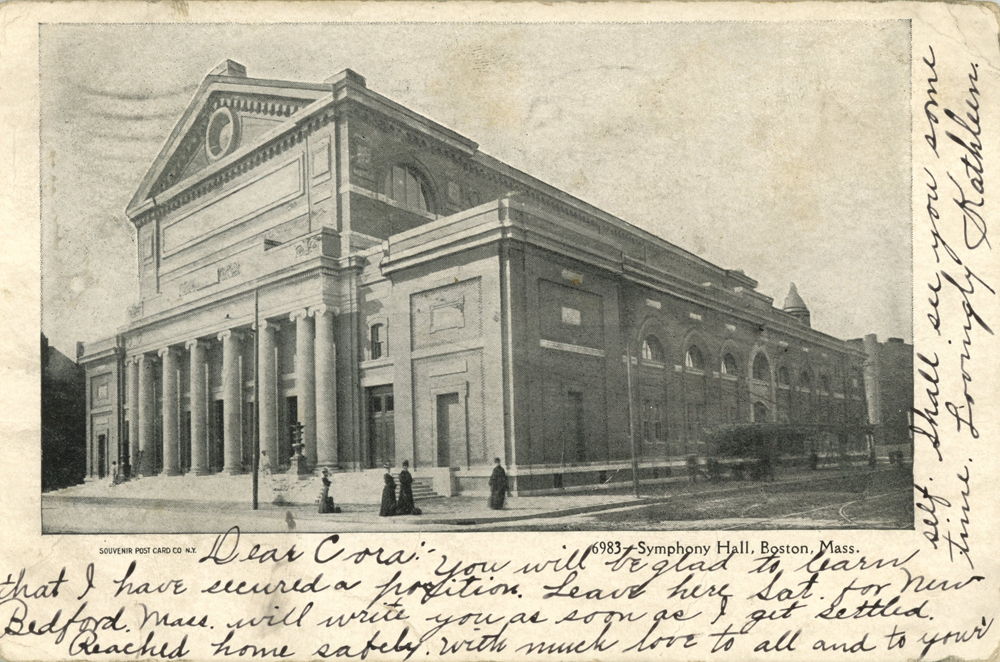
07. Symphony Hall, Boston, Mass. c. 1905. Card produced by Souvenir Post Card Co., New York. The card is used and is postmarked November 11, 1906, addressed to Mrs. A. L. Turner of Atlantic, Massachusetts. The photo is identical to the one in the card above although it is cropped differently and you can see many people along the Massachusetts Avenue side of Symphony Hall who had been removed in the previous card. I own a second copy of this card that was also used, postmarked March 7, 1907, addressed to Mr. George A. Ohlmsted, Barre, Vermont (c/o Ladd’s Grocery).

07a_Symphony_Hall_Yeo_postcard

07a. Symphony Hall, Boston, Mass. c. 1907. Card produced by Reichner Bros., Boston, München, Prag., Leipzig. Made in Austria. This curious card appears in version with no text on the image side and also as shown here, with the imprint of an event – Welcome to Boston, Old Home Week, July 28-Aug. 3, 1907 – that was probably held in Symphony Hall that had nothing to do with the Boston Symphony. Organizations sometimes issued commemorative cards with their own imprint to celebrate their events. Note the Boston bean pots in the four corners. The photo of Symphony Hall is centered in an artist’s palate. 
08_Symphony_Hall_Yeo_postcard

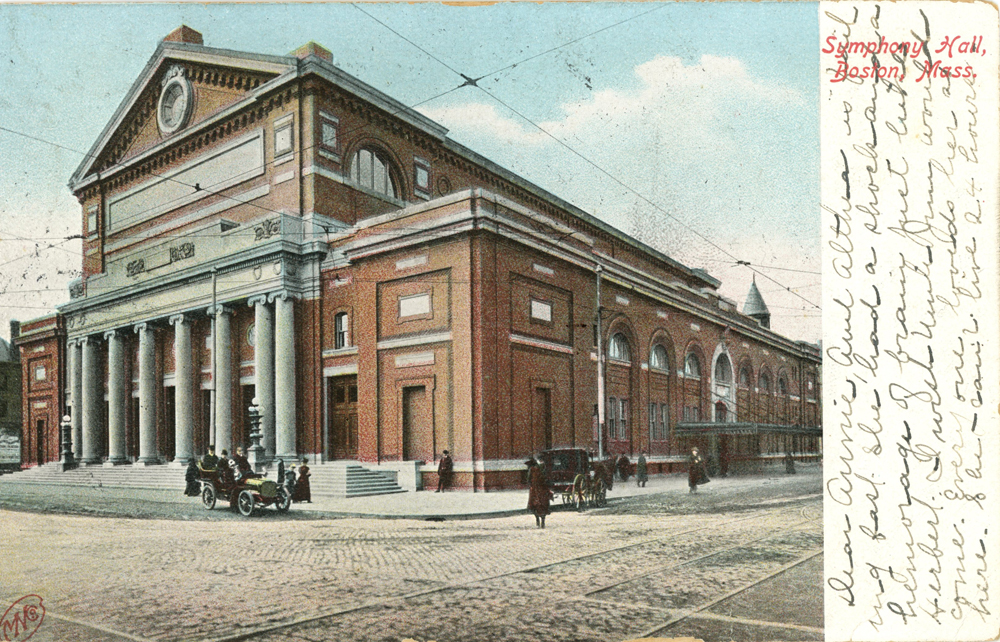
08. Symphony Hall, Boston, Mass. c. 1908. Card produced by Robbins Bros., Boston, Mass. Made in Germany. The card is used and is postmarked April 6, 1908, addressed to Mrs. Robert Skillings, Danville, Quebec. This card is the earliest I have seen that shows an automobile – on Huntington Avenue around the corner from a horse drawn carriage on Massachusetts Avenue.

09_Symphony_Hall_Yeo_postcard

09. Boston, Mass., Symphony Hall. c. 1911. Card produced by  The Hugh C. Leighton Co., Portland, ME, USA. Made in Germany. The card is used and is postmarked November 10, 1911, addressed to Mr. Georgie Worren, Wilton, New Hampshire. Two things are notable: The card was sold by Poole Piano Company (established in Boston in 1893) which inserted its company name and the hot air balloon with a piano hovering above the hall. This was a common advertising tool in the late nineteenth and early twentieth centuries. Also, note the sign that says “POPS” above the right pair of columns. This sign indicates that the photo was taken during the Boston Pops season. Pops concerts – originally “Promenade concerts” – began in 1885 and continue to this day. Today, this lighted sign is installed each year over the Massachusetts Avenue side of Symphony Hall (see card 24, below).

10_Symphony_Hall_Yeo_postcard

10. Symphony Hall and Horticultural Society Building, Huntington Ave., Boston, Mass. c. 1912. The card is used and is postmarked  December 10, 1912, addressed to Mrs. C. E. Palmer, Bath, Maine. This card looks down Huntington Avenue and shows the proximity of Symphony Hall and the Horticultural Hall (built in 1901); note, too, the three modes of transportation: horse-drawn carriage, automobile, and trolley.

11_Symphony_Hall_Yeo_postcard

11. Boston, Mass., Symphony Hall. c. 1913. Card produced by Raphael Tuck & Sons, Art Publishers to Their Majesties the King & Queen. Printed in Holland.  The card’s caption on the back reads, “SYMPHONY HALL, successor of the old Music Hall, is the home of the Symphony Orchestra, and here the oratorios of Handel and Hayden Society are even. The Hall has a seating capacity of 2,500, and the interior decorations, lighting, etc., are up-to-date as it was erected recently.”

12_Symphony_Hall_Yeo_postcard

12. Symphony Hall, Boston, Mass. c. 1914. Card produced by The Leighton & Valentine Co., N. Y. City. Printed in United States. The card is used, postmarked 1914, addressed to Mrs. C. H. Gateo, Petersham, Massachusetts. The lighted POPS sign is seen again in this card, as are two trollies and a horse-drawn carriage. Notice, too, the large three-sheet advertisements for Boston Pops concerts in the niches on the corners of the building as well as one standing against the Huntington Avenue columns.

13_Symphony_Hall_Yeo_postcard

13. Symphony Hall, Boston, Mass. c. 1914. Published by Tichnor Bros., Inc., Cambridge, Mass. Huntington Avenue is bustling with activity; many signs lean up against the Huntington Avenue columns to advertise upcoming concerts and events. Two styles of automobiles are seen as well as the wheel of a horse-drawn carriage on the far left. Crossing Massachusetts Avenue on the right side of the card is someone with a long case or parcel. Could it be a member of the Boston Symphony heading to a rehearsal?

14_Symphony_Hall_Yeo_postcard

14. Symphony Hall, Boston, Mass. c. 1915. Card produced by  E. H. & F. A. Rugg, Medford, Mass. Visible in this card is one of the shutters — standing open — that could be raised to cover   the rising-sun clerestory windows. 

14a_Symphony_Hall_Yeo_postcard

14a. Symphony Hall and Horticultural Hall, Massachusetts Avenue, Boston, Mass. c. 1927. Card produced by  Tichnor Bros., Inc., at Cambridge, Mass, USA. The postcard is used and is postmarked 1927, addressed to Mrs. Wilber Tasker, Etna, Maine. This view shows Symphony Hall and the Horticultural Hall, with the dome of the mother church of First Church, Christ Scientist (built in 1906) rising in the background. The caption on the back of the postcard refers to Symphony Hall as “Boston’s Temple of Music.”

15_Symphony_Hall_Yeo_postcard

15. Symphony Hall, Boston, Mass. c. 1930s? Card produced by C. T. American Art. 

16_Symphony_Hall_Yeo_postcard

16. Symphony Hall, Boston, Mass. c. 1930s? Card produced by The New England News Company, Boston, Mass. 

17_Symphony_Hall_Yeo_postcard

17. Symphony Hall, Boston, Mass. c. 1930s? Card produced by The Process Photo Studios, Troy at 21st St., Chicago, Ill. The presence of a kiosk in the intersection of Huntington and Massachusetts Avenues with an traffic officer from the Boston Police Department adds a certain kind of frightening charm to this image. I would not have wanted to be in his position.
18_Symphony_Hall_Yeo_postcard

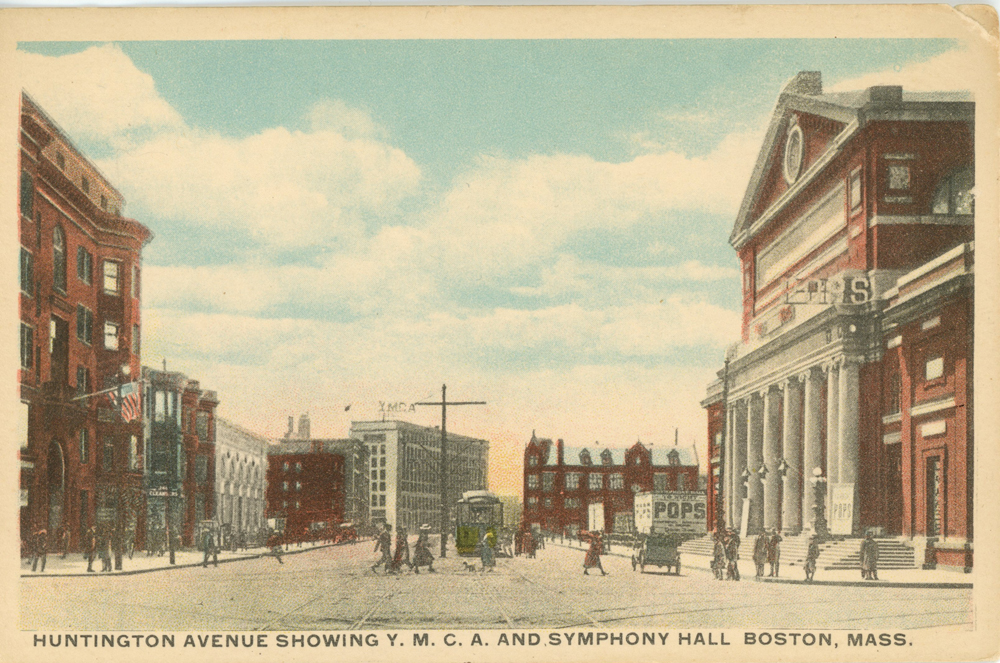
18. Huntington Avenue Showing Y.M.C.A. and Symphony Hall, Boston, Mass. Before 1941. Card produced by M. Abrams, Roxbury, Massachusetts. This view is down Huntington Avenue and shows Symphony Hall on the right (with the POPS lighted sign in place), and the Boston Y.M.C.A. building in the center. To the left of the Y.M.C.A. is New England Conservatory of Music where I taught from 1985-2012; many Boston Symphony musicians teach at NEC owing to its close proximity to Symphony Hall.

19_Symphony_Hall_Yeo_postcard

19. Symphony Hall, Y.M.C.A. and Junction, Mass. Ave. and Huntington Ave., Boston, Mass. Before 1941. Card produced by The New England News Company, Boston, Mass. Similar to the view above, this postcard features later style automobiles, the absence of the POPS advertising, and large American flags on top of the Y.M.C.A.

20_Symphony_Hall_Yeo_postcard

20. Symphony Hall, Boston, Mass. c. 1941. Card produced by United Art Co., Boston, Mass. I do not know if the large American flag on the roof of Symphony Hall was actually a feature of the hall for a time or if it is an artistic addition from around the time of World War II. I have been on the roof of Symphony Hall and do not recall seeing a stand for a flag of that size although it’s quite possible it was there at one time.

21_Symphony_Hall_Yeo_postcard

21. Huntington Avenue at Massachusetts Avenue Showing Symphony Hall, Horticultural Hall and Dome of Christian Science Church. Boston, Mass. c. 1949. Card produced by “COLOURPICTURE” Publications, Cambridge, Mass. USA. The card is used and is postmarked September 7, 1949, addressed to Mrs. Harry Monroe, Fitchburg, Massachusetts. In 1941, the Tremont Street Subway (now the Green Line E spur) was moved from surface level to underground to avoid traffic on Massachusetts Avenue. This made using the original Huntington Avenue entrance of Symphony Hall more difficult since the road was necessarily more narrow. The main entrance of the Hall was switched to the Massachusetts Avenue side. This was a practical decision but it has disrupted the original flow of concert goers into the Hall; they now enter the auditorium from the side rather than from the rear.

22_Symphony_Hall_Yeo_postcard

22. Symphony Hall, Massachusetts and Huntington Avenue, Boston, Mass. c. 1954. Card Produced by United Art Co., 89 Bedford St., Boston, Mass. The postcard is used and is postmarked July 21, 1954, addressed to Mr. & Mrs. Harry Davidson, Lakewood, Ohio. This interesting view shows a long building to the left of Symphony Hall (a sign for a bowling alley is visible). This building, which stretches for the whole block, is now owned by the Boston Symphony which has plans to redevelop the block with a new building. Currently it houses the Orchestra’s Cohen Wing which includes the Symphony Hall gift shop, BSO archives, management offices, the Casadesus Collection of Musical Instruments, and various other businesses that rent space from the Boston Symphony.

23_Symphony_Hall_Yeo_postcard

23. Symphony Hall. c. 1990. Card photo by Lincoln Russell, Stockbridge, MA. Symphony Hall at dusk, in a time-lapse photograph. 

24_Symphony_Hall_Yeo_postcard

24. Symphony Hall. c. 1995. Card photo by Helen Eddy, Cambridge, Massachusetts. This view is of the canopy over the Massachusetts avenue entrance to Symphony Hall, showing decorative bunting and the lighted POPS sign celebrating the spring season of the Boston Pops Orchestra.

25_Symphony_Hall_Yeo_postcard.jpg

25. Seiji Ozawa and the Boston Symphony Orchestra, Symphony Hall. c. 2000. Card photo by Christian Steiner, New York, New York. This photo shows a view of the stage of Symphony Hall near the end of the tenure of Music Director Seiji Ozawa (music director 1973-2002). The trumpets and trombones are seated in the back row of the orchestra in front of librarians and personnel mangers and stage managers who are standing in the center: Thomas Rolfs, Peter Chapman and Charles Schlueter, trumpets; Ronald Barron, Norman Bolter, Douglas Yeo, trombones; Chester Schmitz, tuba. The story of the interior of Symphony Hall is one for another time!