Category: Boston Symphony Orchestra

Two orchestras, 31 years, 11 colleagues

Two orchestras, 31 years, 11 colleagues

I’ve written many articles for many journals and magazines, but I’ve written the most for the International Trombone Association Journal. I joined the Association in 1973 during its first year of existence—the ITA was incorporated in September, 1972—while I was still in high school. I honestly don’t recall how many articles I’ve written for the ITA Journal; dozens, for sure, as well as many reviews. These articles have included tributes to great players and teachers (click on the links highlighted below and you can read the articles) including Edward Kleinhammer (bass trombonist of the Chicago Symphony, 1940-1985, and my teacher during my years as a student at Wheaton College, Illinois), Keith Brown (long time trombone teacher at Indiana University, former member of the Philadelphia and Metropolitan Opera Orchestras, and my teacher during my freshman year when I was at IU), and Russell “Big Chief” Moore (an outstanding Native American jazz trombonist who played with Louis Armstrong’s “All Stars” and many other great jazz artists). Other articles have been historical in nature, such as my photo essay about trombone players in the Boston Symphony from 1887-1986, and my article about the history of the double-valve bass trombone. I’ve also done interviews with well known players such as bass trombonists David Taylor and Denson Paul Pollard.

There have also been occasions when I’ve been interviewed for articles that others have written. A few weeks ago, my friend, Megumi Kanda, principal trombonist of the Milwaukee Symphony who, along with Matt Walley, edits the ITA Journal’s Orchestral Sectional column, asked if I would join with four other low brass players in answering some questions about what it is like to work day in and day out in a symphony orchestra low brass section. Megumi asked some good questions that got me thinking about the colleagues with whom I’ve worked over the years. At this season of life, looking back at those relationships and friendships and collaborations brings back a lot of memories of the times we shared together. After I hit “send” and the answers to Megumi’s questions were on the way to her (I don’t know when they will be published in the ITA Journal but I expect it will be sometime in 2021), I decided to write this article, a tribute to the players with whom I spent so much time making music over the years.  While I no longer play full time in a major symphony orchestra—something I did for over 31 years in two orchestras—I continue to enjoy envigorating  artistic collaborations with many people. I’m not done yet! But working with these eleven players in two orchestras changed and shaped me and helped bring me to where I am today. 

Baltimore Symphony Orchestra (1981-1985)

Balto_Sym_trombones_summer_1981

Baltimore Symphony Orchestra trombone section, Harborplace, Baltimore, summer 1981. Left to right: James Olin, co-principal trombone; David Fetter, co-principal trombone; Eric Carlson, second trombone; Douglas Yeo, bass trombone. 

I joined the Baltimore Symphony Orchestra in May, 1981, after two years as the band director at St. Thomas Aquinas High School in Edison, New Jersey. When I joined the BSO—as it was and is still called, although a few years later, I would join another BSO, the Boston Symphony Orchestra—the low brass section consisted of David Fetter and James Olin, co-principal trombone, Eric Carlson, second trombone, and Daniel Brown, tuba. Dan left at the end of my second season and David Fedderly come on as our tubist. While just a few weeks after I joined the orchestra we were locked out in a labor dispute with the orchestra’s management—we settled our contract in January 1982; that was a very long lockout—I enjoyed a very special four years in Baltimore. David Fetter was a name I knew well from his many arrangements with Ensemble Publications. Before coming to Baltimore, he had been assistant principal trombonist in the Cleveland Orchestra. Jim Olin and I were the same age, and he had studied with Frank Crisafulli at Northwestern University at the same time I was studying with Edward Kleinhammer. Eric Carlson and I had been classmates at Wheaton College together where we played together in the orchestra, band, and a trombone quartet. When I graduated from Wheaton in 1976, Eric went on to play second trombone with the North Carolina Symphony. He joined the Baltimore Symphony in 1980 and a year later, I was sitting next to him again.
Baltimore_Symphony_program_1982

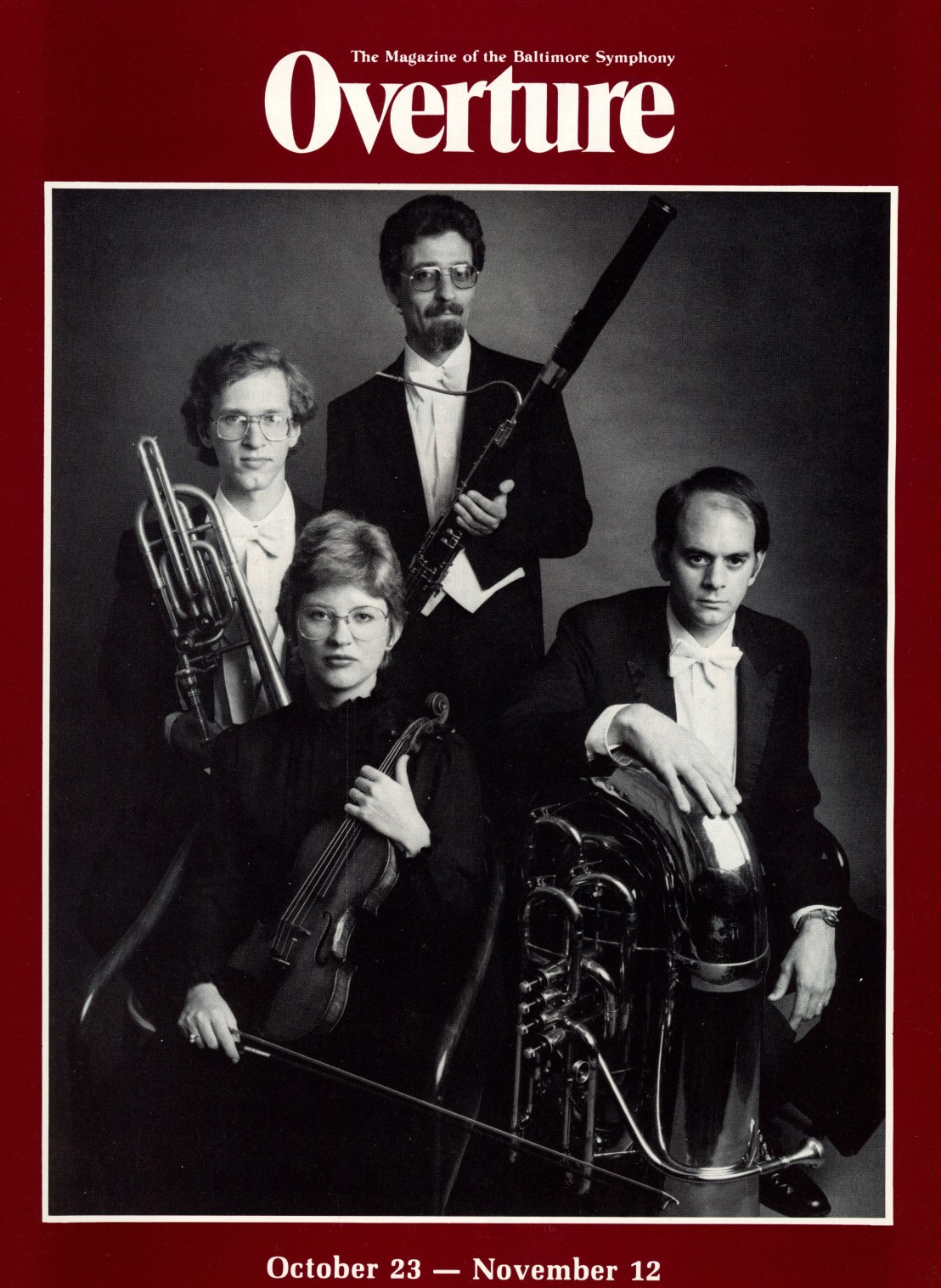
Overture Magazine (program of the Baltimore Symphony Orchestra), October 23-November 12, 1982. Clockwise from top: Phillip Kolker, principal bassoon; W. Daniel Brown, tuba; Paula Sisson Francis, first violin, Douglas Yeo, bass trombone.

It was in Baltimore that I made my first recording with a symphony orchestra (the Concerto for the Left Hand of Maurice Ravel, with Leon Fleischer, piano soloist); it was where I first played a solo in front of a symphony orchestra (Patrick McCarty’s Sonata); and our second daughter was born there. During my second season, the orchestra opened its new concert hall, Meyerhoff Hall. Those were four very good years, but in May of my fourth season, after a concert in Carnegie Hall, I left Baltimore and headed up Interstate 95 to join the other BSO – the Boston Symphony Orchestra. And, as an aside, a year later, Eric Carlson left the Baltimore Symphony for the Philadelphia Orchestra from which he has just announced his retirement earlier this month.

Boston Symphony Orchestra (1985-2001)
Boston_Symphony_brass_section_1988

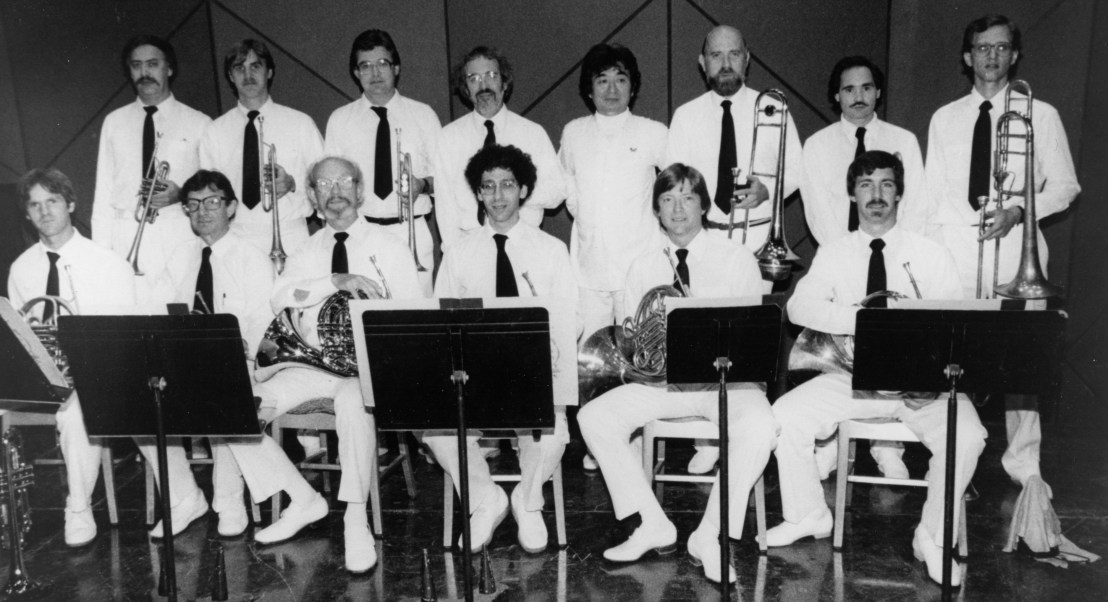
Boston Symphony brass section, Tanglewood, summer 1987. From center, left to right: Seiji Ozawa, music director; Ronald Barron, principal trombone; Norman Bolter, second trombone; Douglas Yeo, bass trombone. (Not pictured: Chester Schmitz, tuba)

Boston_Symphony_low_brass_section_Barron_Bolter_Yeo_Schmitz_2001_standing

Boston Symphony low brass section, Symphony Hall, Boston, 2001. Left to right: Ronald Barron, principal trombone; Norman Bolter, second trombone;  Douglas Yeo, bass trombone; Chester Schmitz, tuba.

I joined the Boston Symphony Orchestra in May 1985, in the middle of that year’s spring Boston Pops season. The Boston Pops Orchestra is drawn from members of the Boston Symphony, so the Pops was just part of my job as bass trombonist of the BSO. I recall that my first service—a concert—was recorded for television broadcast, the PBS show, “Evening at Pops.” I had no rehearsal. Before the concert, I introduced myself to the conductor of the Boston Pops, John Williams, and within the first minute of talking he asked me, “Have you heard from Spanky?” I right away knew who he was taking about. He was asking about George Roberts, the great Los Angeles based bass trombonist, known to generations of players as “Mr. Bass Trombone.” George and I had been friends for a long time and John had worked with George on many of his film sessions.

George_Roberts_Yeo_2004

George Roberts and Douglas Yeo, International Trombone Festival, Ithaca College, New York, 2004. That was George, always hugging and smiling.

As things were, I had recently talked with George—”Spanky” as John called him—and I could give John a report on how he was doing. But I made a note to myself: Whenever John Williams was coming to Boston for a run of concerts, I always made sure I called George first so I’d have something to pass on to John. And George always ended our conversations with, “And give John a kiss, and tell him I love him.” If you knew George Roberts, you’ll be smiling right now. George always said something like that. He was always about hugging and loving and caring about people. George died in 2014. I miss him.

Yeo_Williams_Concerto_1991_05_24_ed

Douglas Yeo performing John Williams’ Tuba Concerto, Symphony Hall, Boston, May 24, 1991. Boston Pops Orchestra, John Williams Conductor. Photo by Chester Schmitz.

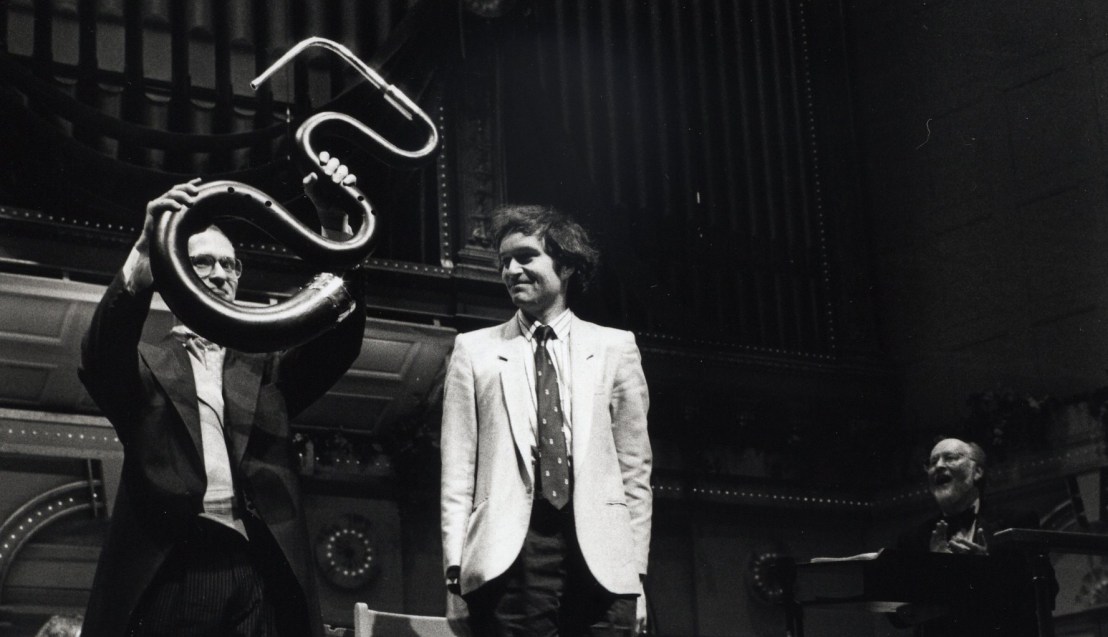
At that time (1985), principal players of the Boston Symphony didn’t play in the Boston Pops Orchestra. Instead, they formed the Boston Symphony Chamber Players and assistant principal or second players in the BSO moved up to play principal during the Pops season. Norman Bolter, second trombonist of the BSO, played principal in Pops and we had several players work with us over the year to fill the second trombone chair, including Larry Isaacson, Douglas Wright, Darren Acosta, John Faieta, Hans Bohn, Alexi Doohovskoy, and Jim Nova. Oh, wow, we had fun. We made so many recordings with John Williams, and also with Keith Lockhart (and one with Leonard Bernstein), we recorded countless television shows, and we toured Japan twice with John Williams conducting. I performed several concertos with the Boston Pops during my years including the first performances of John Williams’ Tuba Concerto on bass trombone (the piece had been written in 1985 on a commission from the Boston Symphony and it was dedicated to the orchestra’s tuba player, Chester Schmitz), many performances of Chris Brubeck’s Concerto for Bass Trombone conducted by Keith Lockhart, performances of Chris’ second bass trombone concerto, the Prague Concerto, Gerald Steichen, conducting, and also performances of Simon Proctor’s Serpent Concerto with John conducting. Fun times.
Yeo_Proctor_Williams_Serpent_Concerto_1997

Douglas Yeo (left) after performing Simon Proctor’s Serpent Concerto, Symphony Hall, Boston, May 29, 1997. Boston Pops Orchestra, John Williams, conductor (right) with Simon Proctor (center). 

From 1985 to 2001, our Boston Symphony low brass section was Ronald Barron, principal, Norman Bolter, second, Chester Schmitz, tuba, and me on bass trombone. That’s 17 years we spent together and we did it all. For 17 years, I was the new guy in the section. We recorded all of the Mahler Symphonies with Seiji Ozawa and all of the Brahms Symphonies with Bernard Haitink. And dozens of other recordings of music from Bach to Gubaidulina. We took an international tour during most seasons, traveling across the United States, to South America, all over Europe, the Canary Islands off the coast of Africa, and to Japan and Hong Kong many times. Unforgettable experiences. Working together with the same people for so long allowed us to develop understandings among us. After several years, we didn’t have to talk much about how we were going to approach certain pieces; we just knew. I knew exactly how Norman would breath in, say, a Schumann symphony, or when Chester was going to circular breathe in a Bruckner symphony. Ours was a collaboration of understanding. I learned so much from Ron, Norman, and Chester. So much. Little did I imagine that an event in 2001 would set off a chain reaction of change in the BSO low brass section that would take over a decade to settle. 

Boston Symphony Orchestra (2001-2003)

A career in a symphony orchestra is not a straight line.

Following a September 2001 performance of Brahms Symphony No. 2 in the Amsterdam Concertgebouw conducted by Bernard Haitink (just a few days before the 9/11 attacks), Chester Schmitz retired. He had joined the BSO in 1966, fresh out of the United States Army Band (“Pershing’s Own”) in Washington D.C. It was the end of an era for the BSO low brass section. After being together for 17 years, our low brass section was changing. We held two auditions for Chester’s position but did not hire anyone. I know how frustrating it is for people to prepare for and come to an audition and have it end without someone being hired. “They don’t know what they want!” is a familiar cry. But the truth is we DID know what we wanted; we just didn’t hear it at those auditions. We knew that replacing Chester Schmitz was impossible. But Chester was the standard for tuba playing we all had in our mind. From 2001-2003, we had a succession of substitute tuba players that worked alongside Ron, Norman, and me. 

Boston Symphony Orchestra (2003-2008)

Barron_Bolter_Yeo_Roylance_Levine_2007

Boston Symphony Low Brass Section, Symphony Hall, Boston, 2007. Left to right: Ronald Barron, principal trombone; Norman Bolter, second trombone; James Levine, music director; Douglas Yeo, bass trombone; Mike Roylance, tuba.

After a third tuba audition, Mike Roylance joined the BSO 2003. He was the first new member of the low brass section in 19 years. Mike arrived during an interim period between two music directors, Seiji Ozawa (1973-2002) and James Levine (2004-2011). Our section was complete once again. But not for long.

Boston Symphony Orchestra (2008-2010)

Barron_Bolter_Yeo_2007

Boston Symphony Orchestra Trombone Section, 2008. Left to right: Ronald Barron, principal trombone; Norman Bolter, second trombone; Douglas Yeo; bass trombone.

Ron Barron joined the Boston Symphony in 1970 as second trombonist, and then won the principal trombone position in 1975 upon the retirement of William Gibson. In that same year, 1975, Norman Bolter won the second trombone position that Ron had just vacated. Incredibly, both Norman and Ron decided to retire from the BSO in the same year, 2008. Their final season was bittersweet for me. Suddenly, the trombone section that I had known for the previous 23 years was gone. With two vacancies in the section, the decision was made to hold an audition for a new principal trombonist and after that player received tenure, then schedule an audition for a new second trombonist. That way, the new principal player could serve on the audition committee for the new second player. It made sense but it set up two years when we did not have a full section. For two years, we had substitute players fill the second trombone chair.
Oft_Yeo_2008

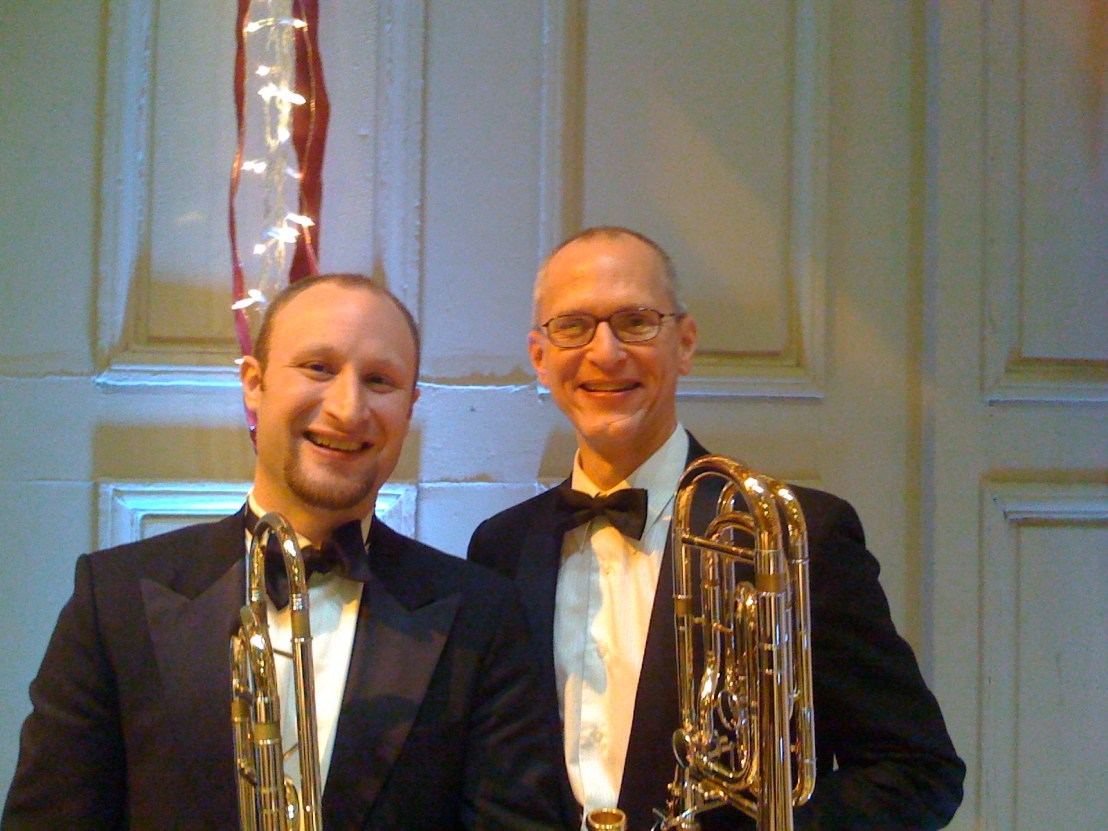
Toby Oft and Douglas Yeo, Symphony Hall, Boston, December 24, 2008.

Toby Oft, former principal trombonist of the San Diego Symphony, was hired as our new principal trombonist and he began with the BSO at the start of the 2008 season. I went on sabbatical from the orchestra for six months beginning in January 2009—something that had been planned two years earlier, before Norman and Ron announced their retirement—Toby received tenure in the summer of 2009, and we then held an audition for a new second trombonist. 

Boston Symphony Orchestra (2010-2012)

Lange_Yeo_Oft_2012

Boston Symphony Orchestra Trombone Section, basement of Symphony Hall, Boston, 2012. Left to right: Stephen Lange, second trombone; Douglas Yeo, bass trombone; Toby Oft; principal trombone. Photo by Randall Hawes.

In 2010, we hired Stephen Lange as second trombonist. Steve, who had played for the previous 10 years with the Saint Louis Symphony, completed our low brass section that had been in flux since Norman and Ron’s retirement in 2008. But yet another change was on the horizon. I decided to retire from the BSO in 2012, after over 27 years of occupying the bass trombone chair. But my final two seasons were very special to me as the oldest, most experienced member of my new section, and a carrier of the flame of the BSO’s long performance traditions.

Yeo_Haitink_Sym_Hall_final_bow_2012

My final bow on stage at Symphony Hall, Boston, May 2012. Behind me are BSO concertmaster Malcolm Lowe and conductor Bernard Haitink.

During my last season with the BSO (click HERE to read an interview I gave for the Boston Symphony Program Book in 2011 where I looked back on my long career in the orchestra)—my final concert in Symphony Hall in May 2012 was Beethoven Symphony No. 9 conducted by Bernard Haitink.

Yeo_Final_Bow_Tanglewood_BSO_2012

My final bow on stage at Tanglewood, the summer home of the BSO—my last concert with the Boston Symphony Orchestra—August 5, 2012. 

When I played my final concert with the orchestra at Tanglewood in August 2012—Berlioz Symphonie fantastique conducted by Loren Maazel—a page was turned in the history of BSO low brass playing. The last vestige of the Boston Symphony trombone section that came together when I joined the orchestra in 1985 was no more. When James Markey began as the BSO’s bass trombonist the day after I retired, a new tradition with an entirely new section was born. Toby Oft, Steve Lange, Jim Markey, and Mike Roylance are making their own mark as the BSO’s low brass section. Already they have been at it for eight years. Will the four of them play together for 17 years as Ron, Norman, Chester, and I did? Will the trombone section stay together for 23 years as Ron, Norman, and I did? Time will tell.

But there is this: All of us—Ron, Norman, Chester; Toby, Steve, Jim, Mike, and I—are part of a long stream of low brass players that goes back to the Boston Symphony’s founding in 1881. From George Stewart to Leroy Kenfield to Joannès Rochut to Eugene Adam to Kilton Vinal Smith to Jacob Raichman to Kauko Kahila to William Gibson, all of us were touched by those who came before us. And the same can be said for my colleagues in the Baltimore Symphony; David, Jim, Eric, Dan, David, and I  were part of a long stream of low brass players that came through that orchestra, including John Melick Jr., Ted Griffith, Philip Donatelli, John Marcellus, Douglas Edelman, Charles Vernon, and John Engelkes. Touched, influenced, inspired, changed. I’m glad that Megumi Kanda asked me those questions about working in an orchestral trombone section. It gave me the opportunity to dig out some old photos, recall some old memories, and offer gratitude to God for the life in music that He has given me, a life shared with many others. Thirty one years in two orchestras, sitting amidst 11 colleagues. Thank you, all of you.

[Header photo: Boston Symphony Low Brass Section, Symphony Hall, Boston, February 1992 (performance of Dvorak Symphony No. 9, “From the New World”). Left to right: Ronald Barron, principal trombone; Norman Bolter, second trombone; Douglas Yeo, bass trombone; Chester Schmitz, tuba.]

A few famous trombone players—Holton catalog, c.1920

A few famous trombone players—Holton catalog, c.1920

We live in an age where endorsements are a big part of advertising. For all kinds of products. When you pick up an issue of the International Trombone Association Journal, you see many endorsements of trombones and trombone-related products. A look through the April 2020 issue of the ITA Journal finds advertisements that feature endorsements by many well-known trombonists: Denson Paul Pollard (Courtois trombones), Steve Turre (YAMAHA trombones), Peter Ellefson, Joseph Alessi, and Jay Friedman (ChopSaver), John Fedchock, and Megumi Kanda (Greenhoe trombones. Go back to the January 2020 issue and you find Nathan Siler (Courtois trombones), and me (YAMAHA trombones) added to the Journal endorsement mix.

The products advertised in the ITA Journal and the people that endorsed them have changed over time. The ITA Journal was an annual publication from 1973 (Volume 1) to 1981. In 1982, the Journal began to be published quarterly. During those early years of the ITA when the Journal was published only once a year, the ITA Newsletter, which was published two to four times a year, was also published. It was in the May 1976 issue (Vol. 3, No. 2) of the ITA Newsletter that advertisements first appeared in an ITA publication. In its pages you found endorsements by  Ashley Alexander (Holton Superbone), George Roberts (Olds trombones), and Phil Wilson (Conn trombones).

Now, everyone knows that using ChopSaver won’t make you play like Joe Alessi any more than playing a YAMAHA trombone will make you sound like me or playing a Holton Superbone will make you sound like Ashley Alexander (I sure wish it did; Alexander was a truly remarkable player on the Superbone and euphonium). But celebrity endorsements have been with us for a long time and if that endorsement is credible—if the person actually uses the product that’s being advertised—that’s all the better for the manufacturer.

A few years ago, I acquired an original copy of a trombone catalog issued by the Frank Holton Company around 1920. The catalog is full of celebrity trombone endorsements. Holton and C. G. Conn ruled the world of trombone endorsements in the early twentieth century; that was an indication of their place as the leading American trombone makers of the time. Frank Holton was an accomplished trombonist himself; he was the trombone soloist in John Philip Sousa’s Band in 1892 and 1893. Then a young kid named Arthur Pryor joined the band and Holton, deeply impressed with the young player’s talent, told Sousa that Pryor should be the band’s soloist. Holton subsequently left the band (under good terms with Sousa) and Pryor went on to be one of the greatest trombone soloists of all time.

Here are a few pages from the Holton c.1920 trombone catalog with a little commentary about some of its famous players.

Holton_1920_Sousa_trombones_01

An endorsement from members of John Philip Sousa’s band carried weight. Holton’s c. 1920 catalog shows he scored a major coup: six members of Sousa’s trombone section with Holton trombones.

Holton_1920_Sousa_trombones_02

One page later, the Sousa band’s trombone players are named (dates of service with Sousa are taken from Paul Bierley’s fine book, The Incredible Band of John Philip Sousa (Urbana: University of Illinois Press, 2006):

Ralph H. Corey. He succeeded Leo Zimmerman as the band’s principal trombonist. Corey played with Sousa between 1906 and 1920.

Louis Schmidt. He played with Sousa between 1916 and 1917, and later in radio broadcasts the band gave in 1929 and 1931.

Ernest E. Gentile. He played with Sousa between 1916 and 1917.

Marcus Charles “Marc” Lyon. He played with Sousa from 1892 through 1917.

Athol John “A. J.” Garing. Garing played euphonium with Sousa from 1909 through 1917, but also sometimes played trombone with the band.

Edward A. Williams. He played bass trombone with Sousa from 1891 through 1917.

As we look at the dates when each of these six players were members of Sousa’s band, it’s clear that the only time that they all played together was between 1916 and 1917. So, while Holton’s catalog dates from around 1920, he was all too happy to hold on to the photo from a few years earlier that shows the Sousa band trombone section playing his trombones.

Holton_1920_Kuss

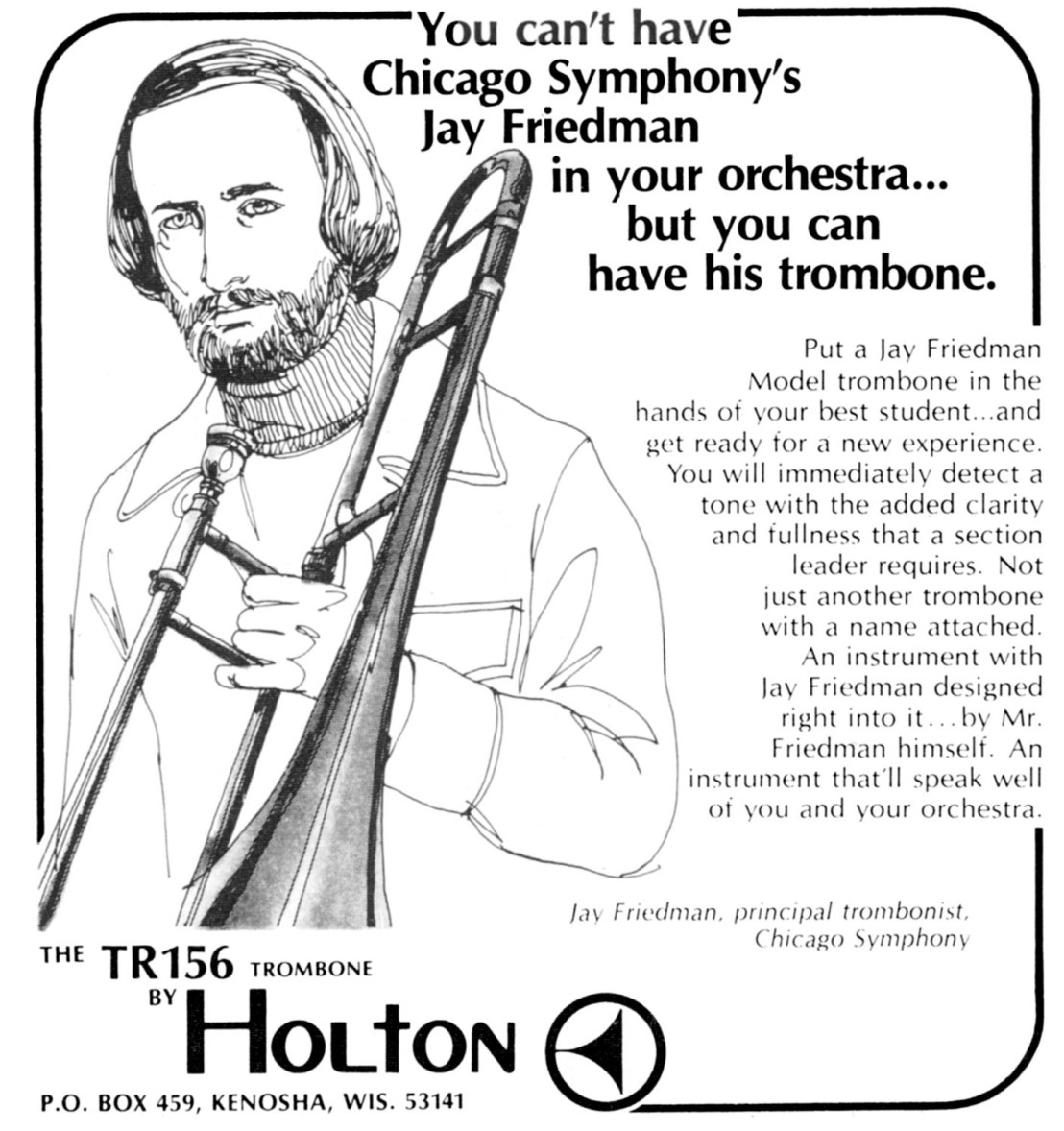
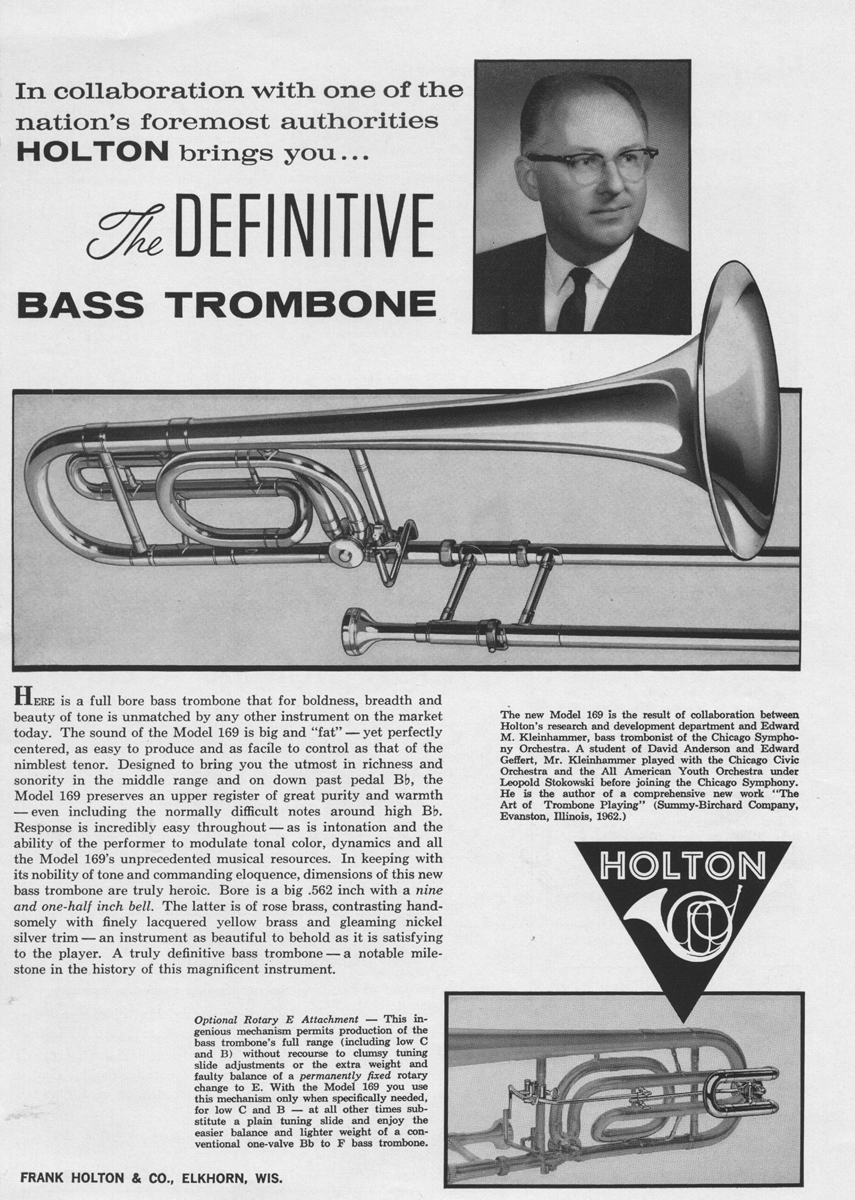
In the center of this page of endorsements (above) is a photo of Richard Kuss. He played bass trombone in the Chicago Symphony from 1912 to 1918. It’s interesting to note that several later trombonists of the Chicago Symphony, including Jay Friedman, Frank Crisafulli, and Edward Kleinhammer, all played and endorsed Holton trombones for a time in the 1960s and 1970s.

Instruments & Equipment

Jay Friedman Holton trombone advertisement, 1974


Kleinhammer_Holton_ad_1962

Edward Kleinhammer, Holton bass trombone advertisement, 1962


Now, back to Holton’s c.1920 trombone catalog. . .

Holton_1920_Hampe

Carl Hampe played principal trombone with the Boston Symphony from 1886-1891, 1892-1914, and 1920-1925. In 1916, Holton also published Hampe’s Hampe Method for the Slide Trombone With an Appendix for the Trombone with E Valve. The cover of the Method features Hampe with his Holton trombone; it’s the same photo of him that’s in the Holton trombone catalog.

Hampe_Trombone_Method_Holton_1916

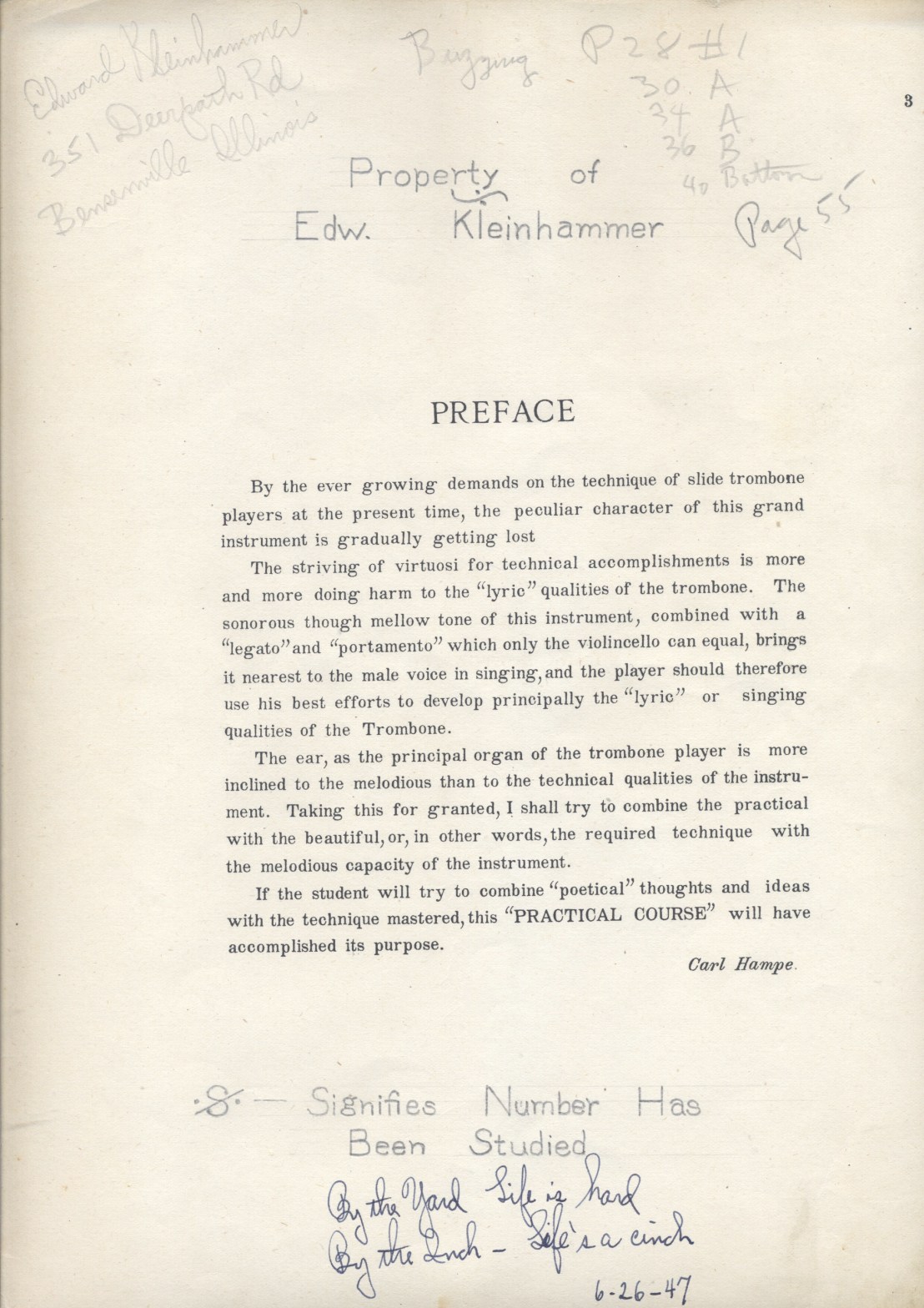
As an aside, my copy of Hampe’s Method was given to me by my teacher, Edward Kleinhammer. Have a look at this page from the book, below, with Mr. Kleinhammer’s hand-written aphorism at the bottom of the page. And look at the date: June 26, 1947. By that time, he had been a member of the Chicago Symphony for seven years. He was a supremely accomplished player. But in his Hampe Method, a book he told me he used every day for many years, he wrote a reminder of the value of the disciplined life, of how slow and steady wins the race:

By the Yard • Life is hard

By the Inch • Life’s a cinch

Hampe_Method_01_Kleinhammer

Carl Hampe was not the only principal trombonist from the Boston Symphony to be featured in Holton’s c.1920 trombone catalog. Fortunato Sordillo (below) played principal trombone in the BSO from 1918 to 1920. He was fired during an ill-fated strike and Carl Hampe came back to the orchestra to fill the principal trombone position for five more years. Sordillo also played euphonium and trombone with Sousa’s band in 1912 and 1913.

Holton_1920_Rochut_Sordillo

It’s notable that on the page with Sordillo is another person who would play principal trombone with the Boston Symphony: Joannès Rochut. Yes, THAT Rochut, the one whose name is on the book of Melodious Etudes for Trombone Selected from the Vocalises of Marco Bordogni that, if you’re a trombone player, is probably sitting on your music stand right now. [By the way, if you haven’t read my article about the first etude in Rochut’s Bordogni Vocalise book, you might find it interesting. Click HERE to read it.] Rochut played principal trombone with the BSO from 1925 to 1930, but in this photo, he is shown in his uniform of the band of the Garde républicaine. How Rochut came to play a Holton trombone when he was living and working in France is not known to me, but it’s interesting that when he joined the Boston Symphony Orchestra, he brought with him—and played in the orchestra—two trombones by the French maker Lefevre, and when he left Boston to return to France in 1930, he left his Lefevre trombones in Boston and took with him Bach trombone serial number 6. I will be writing more about Rochut and his time in Boston here on thelasttrombone.com very soon.

And here’s something else. Sordillo published a book in 1920 titled Art of Jazzing for the Trombone (Boston: Oliver Ditson Company). This was a treatise about the slide glissando, and how to employ it—trombone glisses at the time were known as “smears” or “jazzes,” and the technique was called “jazzing”—in ragtime and early jazz music. Here are three interesting things about Sordillo and his book. First, shortly after the book was published, Sordillo was fired from the Boston Symphony. Second, the photo of Sordillo on the cover of his method book shows him wearing his Sousa band uniform. Finally, the trombone on the cover of the method is put together backwards. Alas.

Sordillo_Art_of_Jazzing_cover_1920

One final thought on this. Holton’s trombone catalog is undated but I’ve been saying it was published around 1920. Why? Look at the endorsement by Hampe. It says he was “For 28 years first trombone player of the Boston Symphony.” Then look at Sordillo’s endorsement. It says he was “Formerly First Trombone” of the BSO. Sordillo was fired in 1920. Hampe played principal trombone in the BSO for 28 years (1886-1891 and 1892-1914) before replacing Sordillo and playing a further five years from 1920-1925. From connecting these dots, it seems that Holton’s catalog was probably published in mid-1920, after Sordillo was fired (March 1920) and before Hampe began his final stint as principal trombonist with the Boston Symphony (fall 1920).


Memorial Day, Saving Private Ryan, Abraham Lincoln, and the trombone

Memorial Day, Saving Private Ryan, Abraham Lincoln, and the trombone

In the United States, yesterday was Memorial Day. A national holiday, it is a day of remembrance to honor and mourn those who died while in the service of the United States Military. It is often observed with parades, speeches, cemetery visits, and non-related things like family picnics and cookouts that celebrate Memorial Day as the unofficial beginning of summer. This year, the coronavirus pandemic curtailed many of those traditional events but the significance of Memorial Day remains undiminished. We owe a great debt of gratitude to those who died serving our country. That gratitude can never be overstated and it can never be repaid.

Yesterday, my wife and I watched the Steven Spielberg motion picture, Saving Private Ryan, for the first time. Released in 1998, the movie is considered to be one of the most significant movies of all time. It took me 22 years to decide to watch it because I am not a person who likes/enjoys/wants to see graphic portrayals of violence. I had heard about the movie’s intense opening 30 minute scene of the beginning of the D-Day invasion. My heart wanted to see the movie but my stomach was not sure.

But yesterday, on Memorial Day 2020, it was time. We watched Saving Private Ryan in our home (Blu-Ray) and found the movie to be a powerful, moving reminder of sacrifice and service. Yes, some scenes were very intense. Very, very intense. But even the most intense scene could only communicate a fraction—a very small fraction—of what those who served in war actually experienced. I’m glad we watched it, and I will watch it again.

I had another reason for wanting to watch Saving Private Ryan. I played on the movie’s soundtrack.

02.Yeo_Williams_Fanfare_for_Fenway_2012

As readers of The Last Trombone know, I was bass trombonist of the Boston Symphony Orchestra from 1985-2012. During the early years of my tenure in the orchestra, John Williams was the conductor of the Boston Pops and after he left that position, he continued a fruitful relationship with the Boston Symphony and Boston Pops that continues to this day. My respect for him is enormous, and I was very fortunate to record many Boston Pops albums under his direction, and also be the first bass trombonist to perform his Tuba Concerto (on bass trombone, in May 1991) with the Boston Pops with John conducting. The photo above shows John and me in Symphony Hall, Boston, taken at a recording session in 2012 for his Fanfare for Fenway, that celebrated the 100th anniversary of Boston’s Fenway Park, the home of the Boston Red Sox.

Saving_Pravate_Ryan_soundtrack_cover

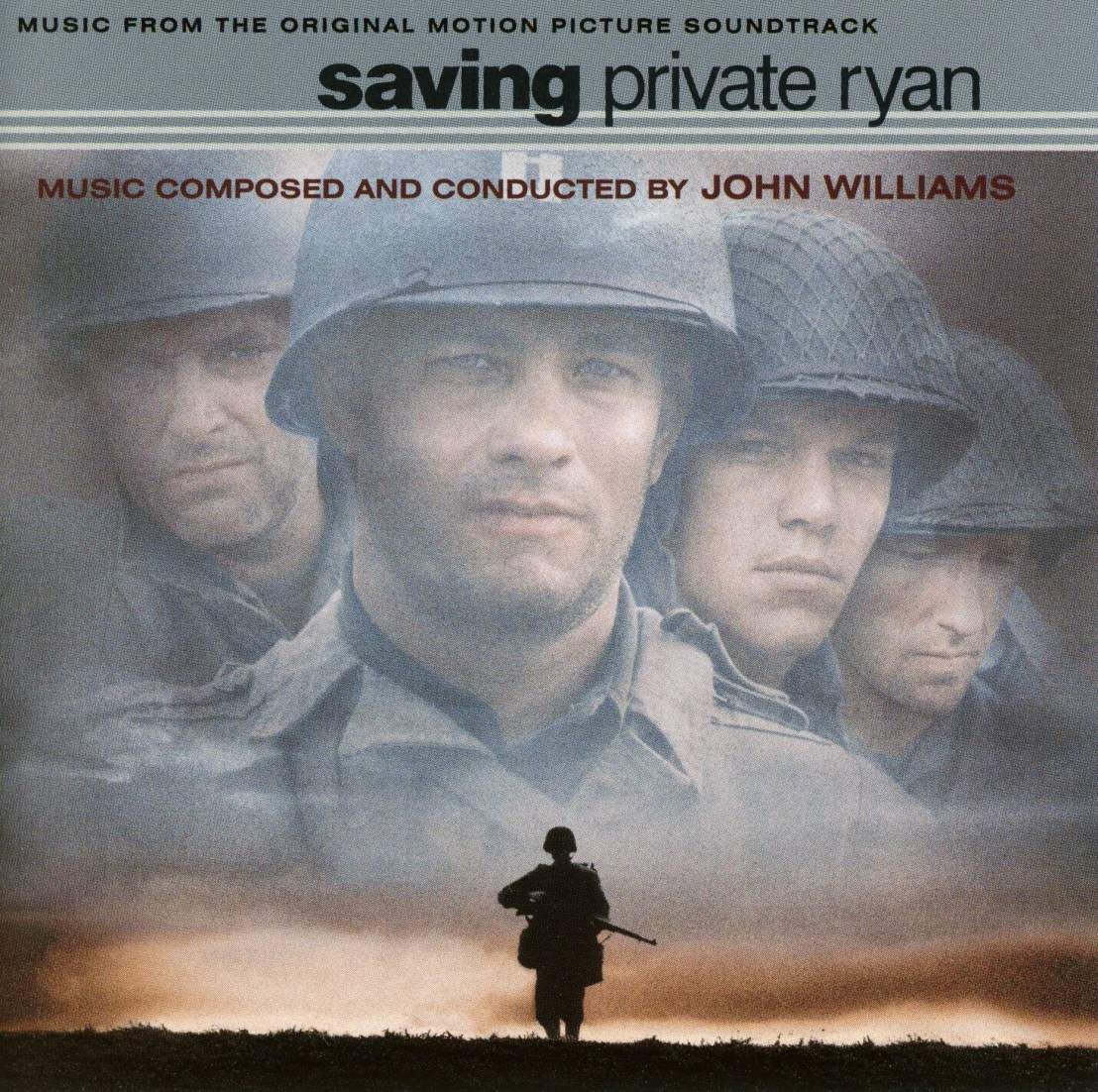
Saving Private Ryan was the second John Williams film score that I recorded as a member of the Boston Symphony Orchestra, following on the recording sessions for Schindler’s List in 1993. The soundtrack for Saving Private Ryan was recorded over three days in February 1998 in Symphony Hall. I recall Steven Spielberg being there for all of the sessions, and Tom Hanks (who had the role of Captain John H. Miller in the movie) being in attendance at the first session. The music is very unconventional for a war movie: there is no loud music. Instead, Williams used music mostly to guide the audience in both anticipation and contemplation of combat. There is no music during battle scenes.

The movie’s longest musical segment occurs at the end of the film, over the credits. That music, titled “Hymn to the Fallen,” features a long brass chorale that still, 22 years later, moves me to tears. You can hear the recording of “Hymn to the Fallen” for the Saving Private Ryan soundtrack by clicking below or you can hear it on YouTube by clicking HERE.

This is not a movie with loud trombone playing like Star Wars or Raiders of the Lost Ark. What you’ll hear are trombones in a supporting role, adding depth and texture to strings, and stepping forward from time to time in chorales, soft but intense rhythmic punctuations, and contemplative warmth.

Saving_Private_Ryan_credits

Seeing the movie yesterday for the first time brought back a flood of memories about those recording sessions. Tim Morrison and Tom Rolfs played the beautiful, haunting trumpet solos and duets, and Richard “Gus” Sebring did the same on french horn. Ronald Barron, Norman Bolter, and I were the trombone section and Gary Ofenloch and Chris Hall played tuba, substituting for Chester Schmitz. Spielberg and Williams wanted to record with the Boston Symphony in Symphony Hall rather than with a studio orchestra because they wanted to “hear the air” of the hall in the music, and work with a group of players who played together everyday and understood Williams so well.

Then Boston Globe music critic Steven Dyer wrote a long article about the recording sessions that describes some of the back room scenes and work of those days in February, 1998. You can read that article HERE.

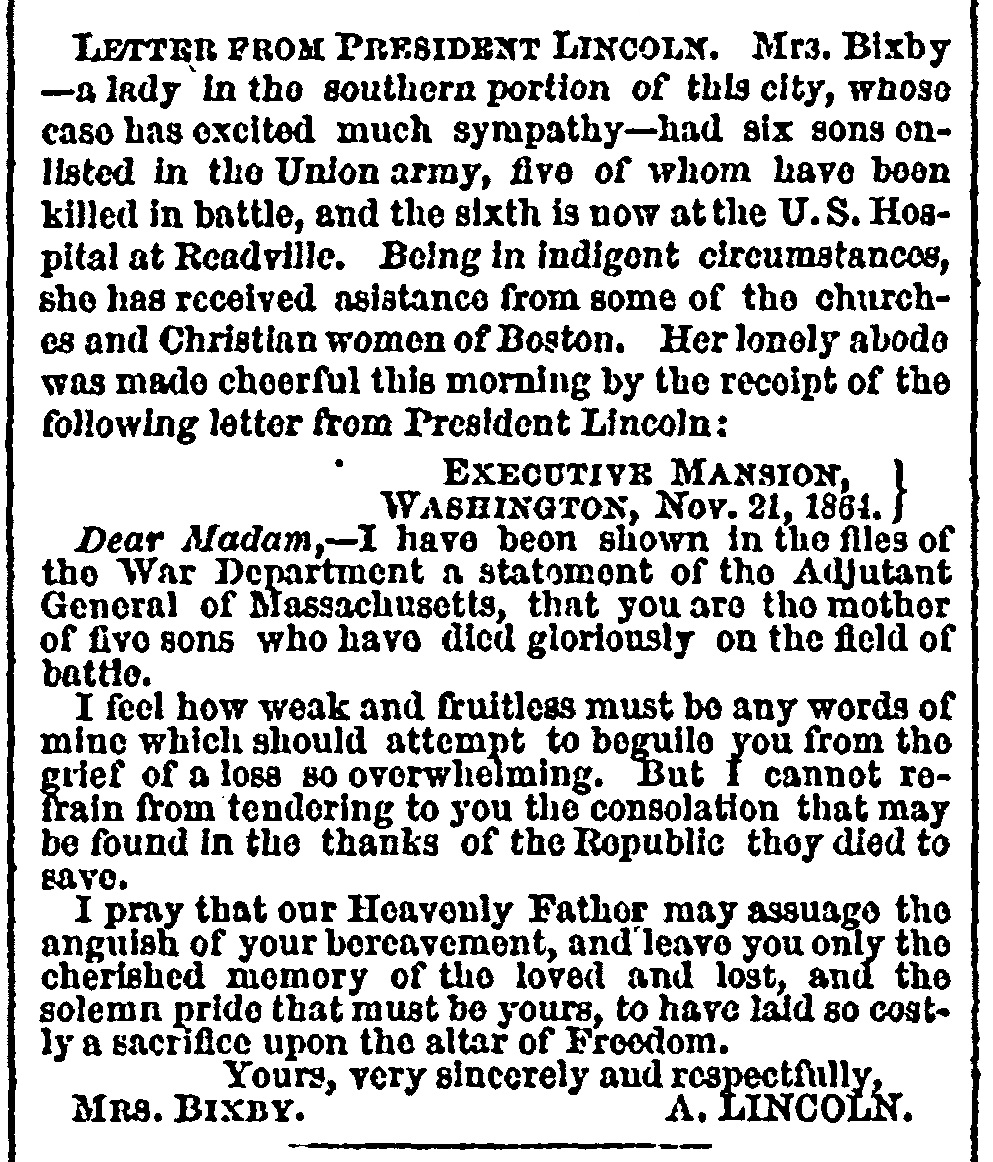
Also, at the beginning of the first recording session, Tom Hanks read the letter from President Abraham Lincoln to Mrs. Lydia Parker Bixby who had lost five sons in the Civil War. Written on November 21, 1864, it was first published in the Boston Evening Transcript four days later. It remains one of the most poignant consolations I have ever read, and the letter figures both in the plot and the narrative of Saving Private Ryan. Here is the letter as first published in the Boston Evening Transcript:

Bixby_Letter_newspaper

If you’ve seen Saving Private Ryan, you have your own thoughts about the movie. If you haven’t seen it, I encourage you to do so if you feel you can handle intense depictions of the brutality of war. If you can’t—like I felt I couldn’t for the last 22 years—you might want to pick up the soundtrack album. The movie is a strong reminder of the sacrifice and heroism that we  gratefully recognize on Memorial Day. The music is haunting, moving, powerful, and contemplative. I often turn to Hymn to the Fallen when I need music to help me think about or remember something important. It has become a kind of Adagio for Strings (of Samuel Barber) for our time.

Memorial Day. Saving Private Ryan. Abraham Lincoln. And the trombone. They’re all tied up in my memory.

Making and sharing music in a challenging time

Making and sharing music in a challenging time

The coronavirus pandemic has shuttered concert halls and theaters, opera houses and nightclubs. Live music with multiple performers working together in a collaboration just can’t be done in public in most places these days.

Yet musicians are finding creative ways to bring music to a world that seems to need it now more than ever. A day doesn’t go by when someone doesn’t forward me a video of some group of performers who put together a music video with a number of “socially distanced” players who have recorded a track individually and then put it together to make a group performance. I’m involved in a project with some friends as well; more on that once we get it done. Some of these projects are not very well done or are just not that interesting to me, but others make me smile, cry, laugh, and celebrate. Here are a few I’ve enjoyed recently. I hope you enjoy them, too.

The Milwaukee Symphony has recorded Edward Elgar’s “Nimrod” from his Enigma Variations. I find this performance very moving on a lot of levels, especially because the music itself is so compelling. Among those members of the orchestra who are performing are my friends, second hornist Dietrich Hemann and his wife, principal trombonist Megumi Kanda, who share a screen. To view this video on YouTube, click HERE.

In 1996, the Boston Pops Orchestra recorded an album of music to celebrate the 1996 Summer Olympic Games in Atlanta. Conducted by John Williams, it included many works that had been written for previous Olympic games, as well as Summon the Heroes, a fanfare which Williams wrote for the Atlanta games. I was a member of the Boston Symphony at that time (1985-2012) and I count recording that album as one of the most memorable events of my musical career. Recently, 50 members of the Boston Pops Orchestra recorded Summon the Heroes once again, conducted by Boston Pops conductor, Keith Lockhart. Tom Rolfs plays the trumpet solo and the low brass section is Toby Oft, Steve Lange, Jim Markey (bass trombone), and Mike Roylance (tuba). To view this video on YouTube, click HERE.

I’ve played many concerts – playing serpent, ophicleide, and bass sackbut – with Boston’s Handel & Haydn Society, an early music group based in Boston. Here’s a fun video by H&H principal flutist Emi Ferguson who makes a do-it-yourself baroque flute. Seriously! And it sounds great (and Emi sounds great, too). Try it! To view this video on YouTube, click HERE.

Here is a new piece, All Day Long (The Coronavirus Song), written by my friend, Paul Langford, and his 14 year old daughter, Chloe. Paul has been a singer and arranger for the acapella group GLAD for many years and I think this original song and Chloe’s performance are absolutely terrific and inspiring inspiring. And there’s euphonium and trombone content, too! For more about the piece and how it came about, see this article from Chicago’s WBZ; click HERE to read it. To view this video on YouTube, click HERE.

Terry Everson is professor of trumpet at Boston University, and a good friend of our family since he and his family moved to Boston in 1999. Terry served as principal cornet of the New England Brass band for most of my tenure as the band’s music director, and he is a super trumpet player (and teacher), pianist, and arranger. In this video of John Dykes’ Holy, Holy, Holy, Terry is joined by his wife, Lori, on violin, and their son, Peter, who just graduated with a degree in trumpet performance from Boston University. To view this video on YouTube, click HERE.

Mashups of classical and popular music don’t usually work for me, but this performance of J. S. Bach’s Brandenburg Concerto No. 3 and Paul Simon’s American Tune does. The group is The Knights, joined by vocalist Christina Courtin. American Tune is my favorite pop song; it has been since it was first released on Simon’s solo album, There Goes Rhymin’ Simon, in 1973. The music is adapted from a tune by Hans Leo Hassler, adapted by J. S. Bach in his Saint Matthew Passion as, O Haupt voll Blut und Wunden (O Sacred Head, Now Wounded). The group gives a superb performance of Bach’s Concerto, and Courtin’s take on American Tune is honest, heartfelt, and moving. Paul Simon’s text never felt more relevant to me than in this challenging time; he could have written it yesterday. To view this video on YouTube, click HERE.

Our youngest daughter, Robin, is Director of Public Relations for San Francisco Symphony. She recently shared this fine performance of Paul Dukas’ Fanfare from La Peri, featuring members of the San Francisco Symphony brass section. And while you have the San Francisco Symphony on your mind, take the time to view the orchestra’s excellent video series, Keeping Score, where music director Michael Tilson Thomas and the orchestra provide an in-depth look at some of classical music’s greatest works including compositions by Aaron Copland, Charles Ives, Ludwig van Beethoven, Hector Berlioz, and many others. To view this video on YouTube, click HERE.

I’ve played the ophicleide for many years, a bass instrument in the brass family that was invented in France in the early nineteenth century and was a predecessor to the tuba on a long evolutionary path. In recent years, the ophicleide has gotten the attention of many superb, young players, including Francesco Gibellini. Of the many overdubbed recordings people are making these days, I think this one is one of the best. I have no idea how he did it but I think this will make you smile. To view this video on YouTube, click HERE.

The coronavirus pandemic is challenging for all of us. But in the midst of the storm, we can hold on to the promise of God: He is faithful. Stevener Gaskin, who is Intercultural Arts Associate at Wheaton College where I teach trombone, has contributed an inspiring video – Faithful Promise –  in his unique performance style. I have heard Stevener in person several times and I’ve never failed to be moved by his work. This video was filmed in part on the front campus of Wheaton College; you will see the College’s first building, historic Blanchard Hall, in the background. I return to this video over and over again to be encouraged to persevere through this storm, knowing that God is faithful and He will bring us through this, even as we pray that we will also learn the important lessons God would have us see and understand that are already unfolding before us. To view this video on YouTube, click HERE.

[Header image of coronavirus in headphones from Variety.]