Category: Boston and New England

Joannès Rochut, the Boston Symphony, and his trombone

Joannès Rochut, the Boston Symphony, and his trombone

by Douglas Yeo

When we look at the long history of the trombone, many notable trombonists come to mind. It’s not possible to say who was the most famous. A case can be made for Arthur Pryor, the celebrated trombone soloist in John Philip Sousa’s band and his own band, who made many recordings, and dazzled audiences around the world. While his name is not so well known today, Homer Rodeheaver, the trombone-playing song leader for evangelist Billy Sunday in the first third of the twentieth century, played trombone for over 100 million people during his lifetime, although his trombone playing skills paled next to the great soloists of his time including Pryor, Simone Mantia, and Gardell Simons.

However, there is one trombonist whose name is known to trombonists all over, although most are probably not aware of many details of his life. But this we know: Joannès Rochut (1881-1952) edited three volumes of vocalises, what he called Melodious Etudes, from the works of Marco Bordogni. These books, published in 1928 by Carl Fischer (New York), have become a standard part of trombone teaching and practicing since they were first issued. For sheer name recognition, it would be hard to argue that Rochut is not one of the most famous trombonists of all time. His contribution to trombone pedagogy is incalculable. What trombonist does not have a copy of at least Volume 1 of “The Rochut Book” (even though there is not a note by Rochut in the books)? [NB: I wrote an article about exercise No. 1 in Volume 1 of Rochut’s Melodious Etudes, an etude that does not appear in Bordogni’s oeuvre and which some people have postulated was written by Rochut himself. It was not. You can read that article HERE.] 

Rochut_Bordogni_book_1_cover

Cover of the first edition of Joannès Rochut’s Melodious Etudes for Trombone Selected from the Vocalises of Marco Bordogni (New York: Carl Fischer, 1928)

This article is a brief introduction to Joannès Rochut with a special emphasis on one of the trombones he played. I intend to write a more in-depth article about Rochut for the International Trombone Association Journal, drawing from my own research and the extensive archive of Rochut related materials collected and recently given to me by my friend, David Fetter (long time trombonist with the Cleveland Orchestra and Baltimore Symphony; we were colleagues together when I played in the Baltimore Symphony from 1981-1985).

Born in Paris, Rochut’s father died when he was seven years old and he was placed in an orphanage where he learned to play the trombone. After volunteering for the French military when he was eighteen—he served as a bandsman for three years—Joannès Rochut enrolled in the Paris Conservatoire in 1902 where he studied trombone with Louis Allard (1852-1940).

Le Temps (Paris. 1861)

Announcement of brass instrument prize winners in the 1905 Paris Conservatoire Concours. Rochut received Premier prix (first prize) in the trombone class; his name appears near the bottom of the clipping. Le Temps, Paris, July 30, 1905.
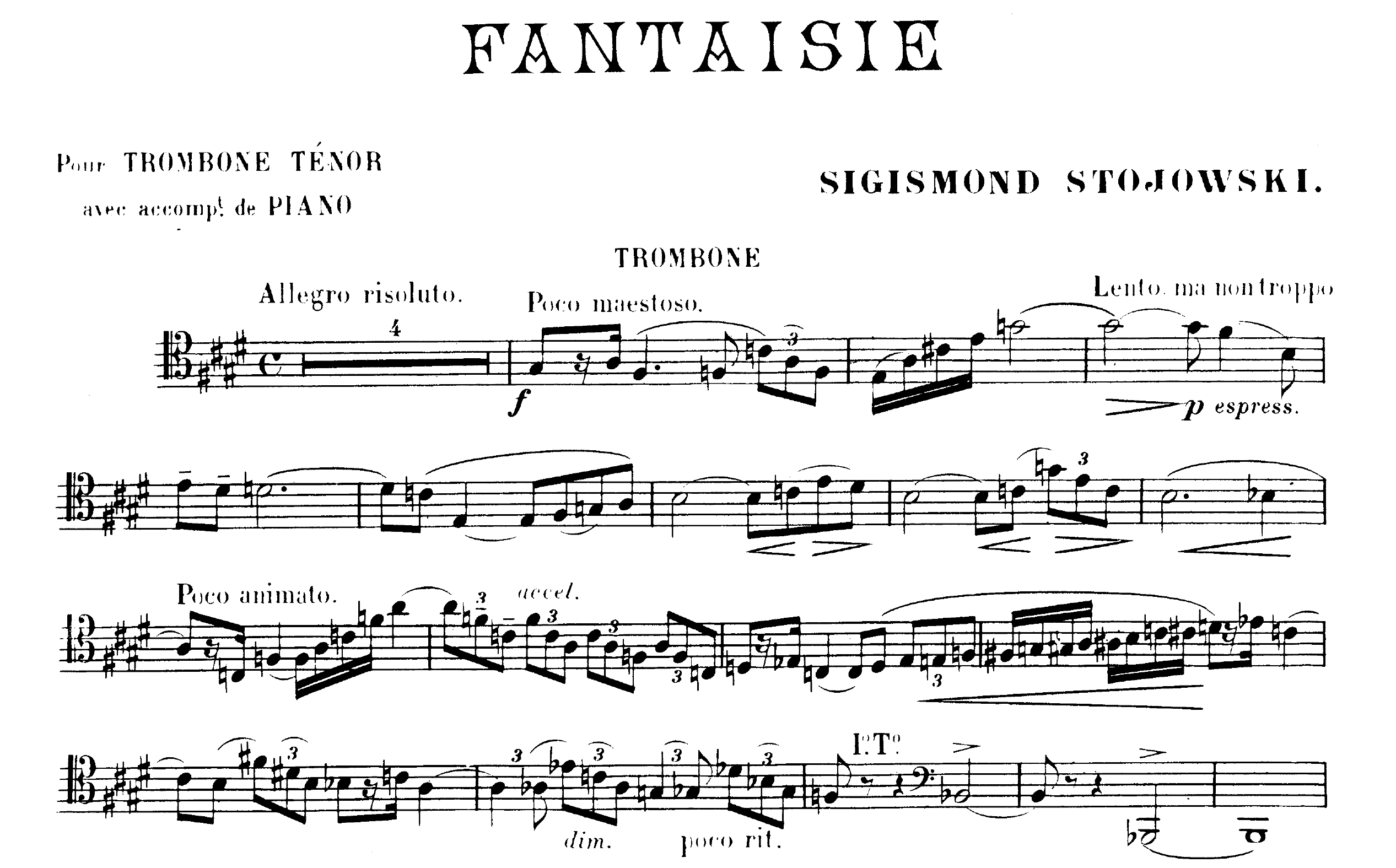
Stojowski_Fantaisie_trombone_incipit

Sigismond Stojowski, Fantasie (incipit). 1905.

Joannès Rochut won second prize at the Conservatoire in 1903, playing Bernard Croce-Spinelli’s Solo de concours (that contest was won by Eugene Adam, whose name we shall see again later in this article), and second prize again in 1904, playing Morceau de concours of Edmond J. Missa. Rochut graduated from the Conservatoire in 1905 with first prize in its annual Concours; the required solo was Zygmunt Denis Antoni Jordan “Sigismond” de Stojowski’s Fantasie. [NB: Stojowski was born in Strzelce, Poland, in 1870. He entered the Paris Conservatoire at age 17 and also studied at Sorbonne University. He was a friend of Peter Tchaikovsky (Tchaikovsky’s Symphony No. 4 was dedicated to Stojowski), and Stojowski came to the United States in 1905 where he wrote his Fantasie for trombone. For a more detailed biography of Stojowski, see: Paul Krzywicki, From Paderewski to Penderecki: The Polish Musician in Philadelphia (Paul Krzywicki, 2016).] 

Holton_1920_Rochut_Sordillo

Holton Trombone catalog, c. 1920. Endorsements by Joannès Rochut and Fortunato Sordillo.

While a member of the Orchestre de la Garde républicaine (French Republican Guard Band) during World War I, Rochut toured the United States in 1918; the band played concerts in 208 cities in 37 states. It was probably at that time that Rochut tried and later endorsed Holton trombones (Rochut’s Holton endorsement is pictured above) but there is no record of Rochut taking a Holton trombone back to Paris.

Following his service in the Republican Guard Band, Rochut performed with numerous orchestras in France including the Société des Nouveaux-Concerts (Orchestre Lamoureux) and l’Opera Comique (Paris); among his many students at that time was Andre Lafosse (1890-1975), who later served as professor of trombone at the Paris Conservatoire (1948-1960). Rochut also helped organize the first of the Concerts Koussevitzky (1921, Paris) which were instrumental in establishing the reputation of Russian conductor Serge Koussevitzky (1897-1951). Koussevitzky was appointed music director of the Boston Symphony Orchestra in 1924, and in October 1925, he engaged Rochut as the orchestra’s principal trombonist, a position he held for five seasons. Rochut joined the faculty of New England Conservatory of Music in 1926; among his students in Boston was John Coffey (bass trombonist of the Cleveland Orchestra 1937-1941, and bass trombonist of the Boston Symphony, 1941-1952).

Rochut_Boston_clipping_1925

Photo of Joannès Rochut in Paris with his children, part of an article in the Boston Sunday Post, October 11, 1925. The photo inset on top right shows Ferdinand Gillet, who was hired as the Boston Symphony’s principal oboist at the same time Rochut was hired as principal trombonist. Courtesy of Boston Symphony Archives.

Rochut was one of 14 French musicians to join the Boston Symphony in the fall of 1925; he played principal trombone in the BSO through the 1929-1930 season. The addition of Jacob Raichman to the trombone section in 1927—Koussevitzky knew Raichman in Russia where Raichman played alongside Vladislav Blazhevich in the Bolshoi Theater Orchestra in Moscow before leaving for Cuba and then the United States—probably hastened Rochut’s departure from Boston. The Frenchman and the Russian famously did not get along well, and when Rochut returned to France in 1930, Raichman, who had been named co-principal trombone around 1928, assumed the principal trombone position in the BSO. In 1955, Raichman was succeeded as principal trombone by William Gibson who was succeeded by Ronald Barron in 1975 who was succeeded by Toby Oft in 2008.

Rochut_1925_Boston_Post

“New Symphony Virtuosos,” Boston Post, October 6, 1925. Joannès Rochut (third from left) is pictured with three other newly hired principal players of the Boston Symphony Orchestra: Edmond Allegra, principal clarinet, Ferdinand Gillet, principal oboe, and Jean Lefranc, principal viola. Courtesy of Boston Symphony Orchestra Archives.

The earliest known photo of Joannès Rochut as a member of the Boston Symphony was printed in in the Boston Post on October 6, 1925 (above).

Boston_Symphony_brass_section_Rochut_1925

Boston Symphony Orchestra brass section, 1925. Courtesy of Boston Symphony Orchestra Archives.
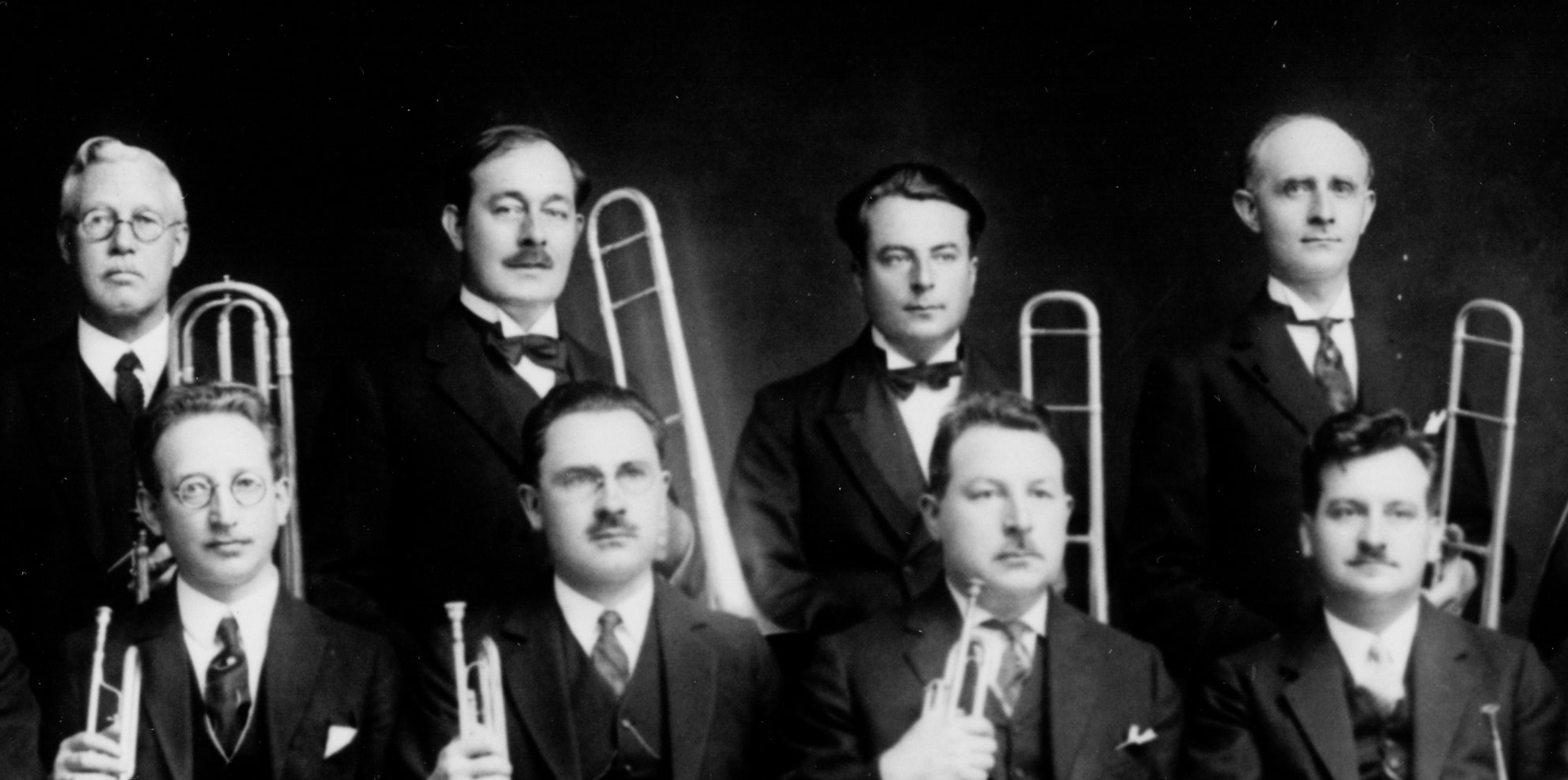
Boston_Symphony_brass_section_Rochut_1925_detail

Later in 1925, the Boston Symphony brass section posed for a group photo (above). Rochut is standing in the center; the other trombone players are (back row, left to right) Leroy Kenfield (bass trombone), Eugene Adam (assistant principal trombone), and Lucien Hansotte (second trombone). The tubist, far right, is Paul Sidow. Seated in front of Rochut is Georg Wendler, principal horn (Wendler was the son-in-law of Eduard Kruspe, the celebrated German maker of brass instruments); in front of Hansotte is George Mager, principal trumpet. Mager, who also taught at New England Conservatory of Music, was the teacher of Adolph Herseth (1921-2013), who played principal trumpet in the Chicago Symphony Orchestra from 1948 to 2001.

BSO_1925_Rochut_ed

This grainy photo, above, from an undated newspaper clipping from a Boston Symphony press scrapbook, probably dates from 1925-1926. Back row (left to right): Joannès Rochut, Eugene Adam (assistant principal trombone), Lucien Hansotte (second trombone), Leroy Kenfield (bass trombone), Paul Sidow (tuba).
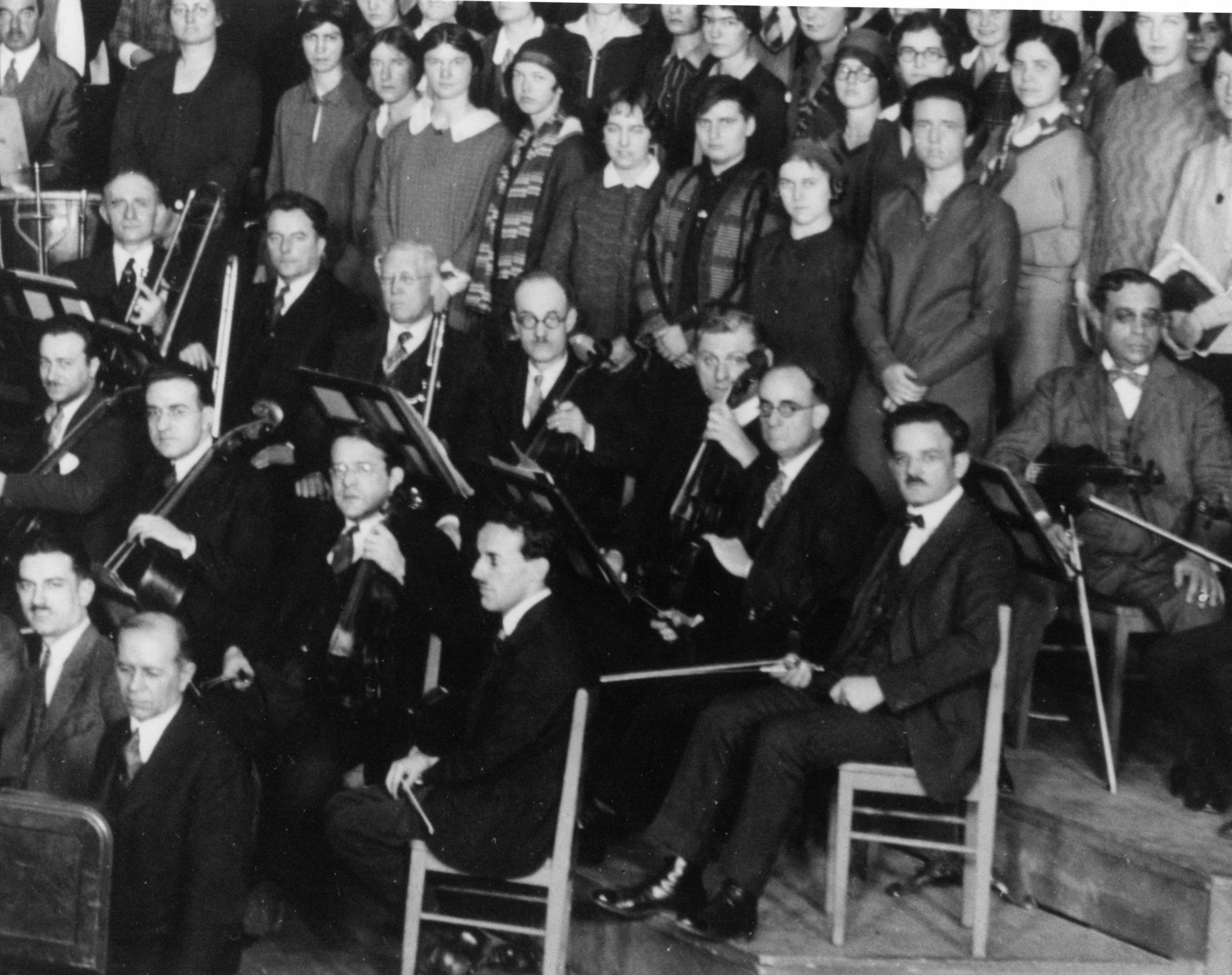
BSO_1927_Beethoven_9_Rochut

[Above] Boston Symphony Orchestra, performance of Beethoven Symphony No. 9, Serge Koussevitzky, conductor. March 29, 1927. Courtesy of Boston Symphony Orchestra Archives.
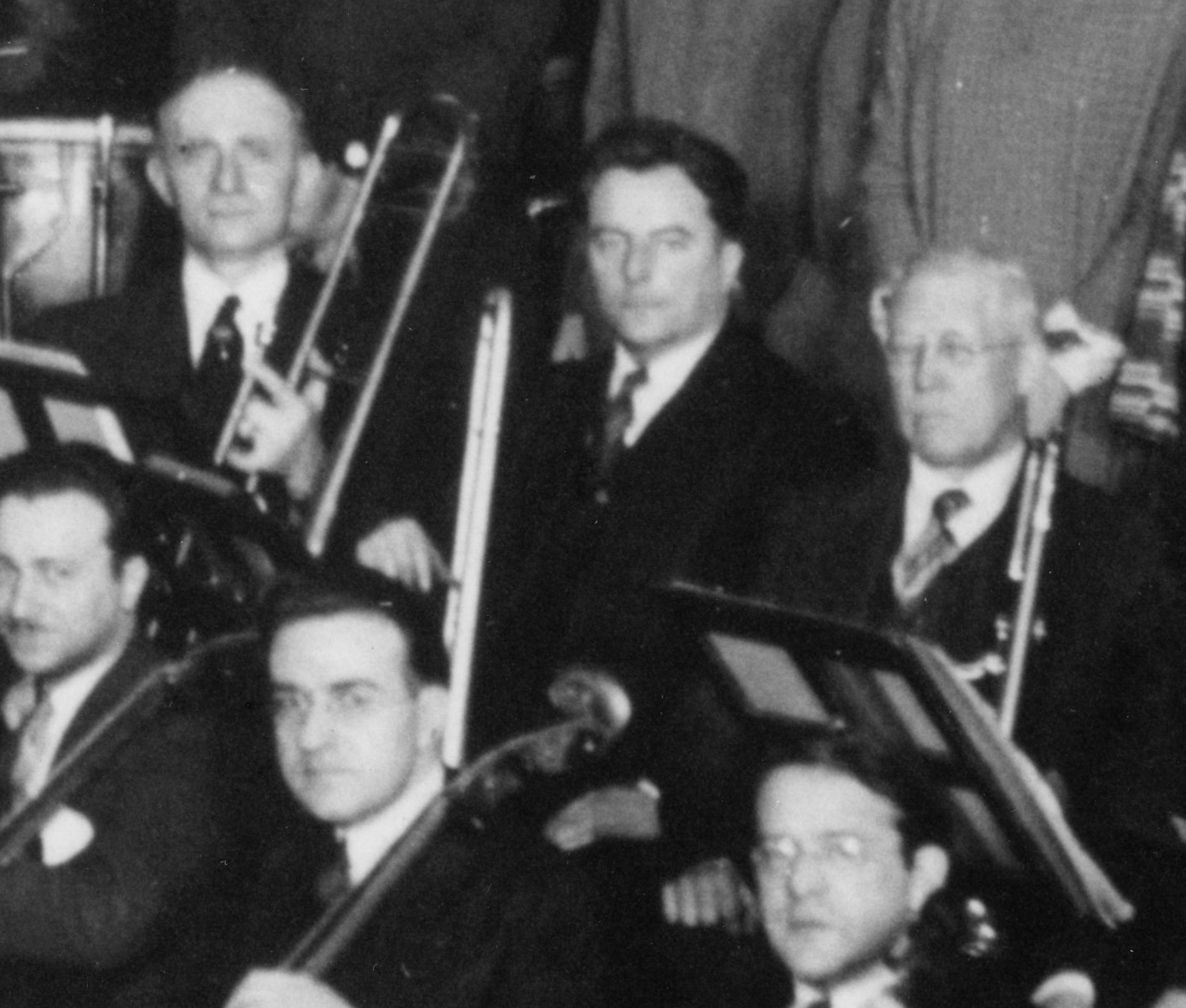
BSO_1927_Beethoven_9_Rochut_detail

This photo of Rochut on stage in Boston’s Symphony Hall (above) was taken at the time of a performance of Beethoven’s Symphony No. 9 in 1927. The Boston Symphony’s trombone section for that performance consisted of (above, left to right) Rochut, Lucian Hansotte (second trombone), and Leroy Kenfield (bass trombone). 
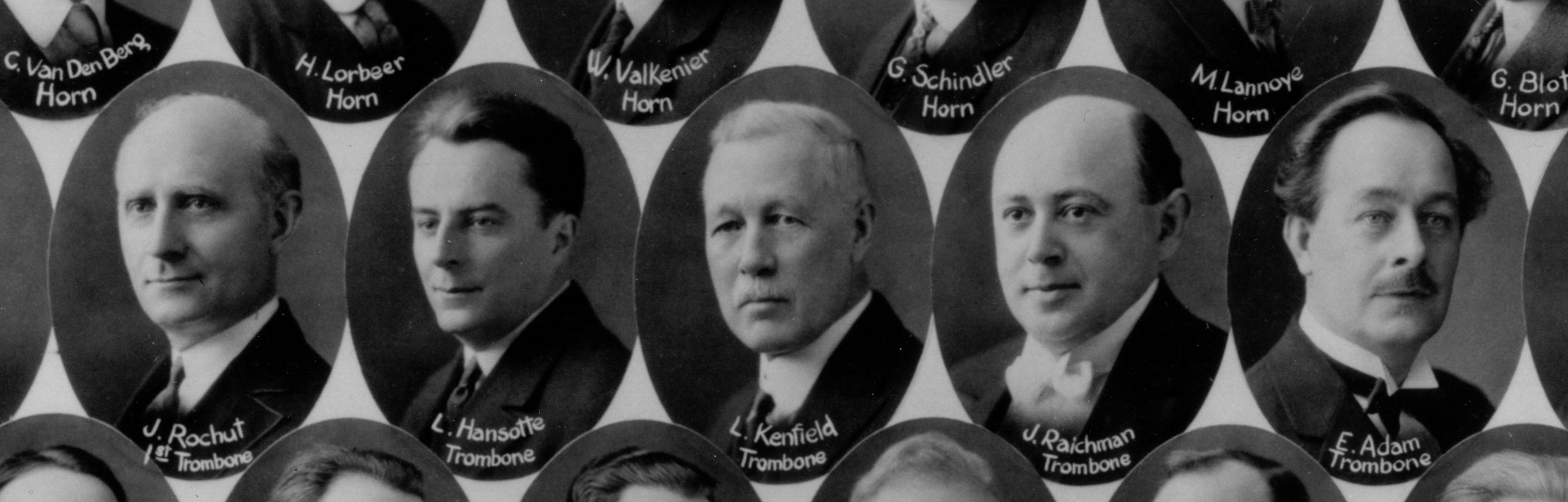
 

Boston_Symphony_players_Rochut_1928._detail

[Above] Members of the Boston Symphony Orchestra, 1928. Courtesy of Boston Symphony Orchestra Archives.

At the beginning of the 1928-1929 season, the members of the Boston Symphony Orchestra sat for individual photos that were collected into a collage. When Jacob Raichman joined the orchestra in 1927, the trombone section expanded to five players. Shown in the photo are (left to right), Rochut, Lucien Hansotte (second trombone), Leroy Kenfield (bass trombone), Jacob Raichman (co-principal trombone), and Eugene Adam (assistant principal trombone).

Fiedler_Sinfonietta_Rochut_1929

[Above] Arthur Fiedler (standing, center) with the Arthur Fiedler Sinfonietta (Boston Sinfonietta), c. 1929. Courtesy of Boston Symphony Archives.

Fiedler_Sinfonietta_Rochut_1929_detailMembers of the Arthur Fiedler Sinfonietta. Back row (left to right): Abdon Laus, principal bassoon, Joannès Rochut, Marcel LaFosse, trumpet, Georges Mager, principal trumpet.

Conductor Arthur Fielder (1894-1979) is well-known for his long tenure as the conductor of the Boston Pops from 1930 to 1979. But what is lesser known is that before he achieved fame with the Pops, he founded the Boston Sinfonietta—also known as the Arthur Fiedler Sinfonietta—in 1924. The orchestra was made up mostly of Boston Symphony players and it played concerts and made recordings for RCA Victor. Rochut played in Fiedler’s Sinfonietta along with many other Boston Symphony principal players including Georges Mager.

BSO_Rochut_Raichman_Hatch_Shell_1929_crop

[Above] Boston Symphony Orchestra (Boston Pops Orchestra) on the Charles River Esplanade, July 4, 1929. Courtesy of Boston Symphony Orchestra Archives.
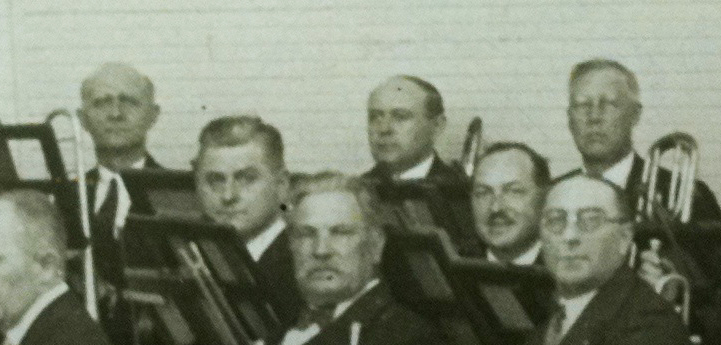
BSO_Rochut_Raichman_Hatch_Shell_1929_detail

[Above] Members of the Boston Symphony Orchestra (Boston Pops Orchestra). Back row (left to right): Joannès Rochut, Jacob Raichman (playing second trombone), Leroy Kenfield (bass trombone).

On July 4, 1929, the Boston Pops played a concert on the Charles River Esplanade in Boston. A temporary shell had been constructed for the concert and Rochut, Raichman, and Kenfield played trombone. [NB: A second temporary bandshell was built in 1934, and a permanent structure was built in 1940.  The Edward A. Hatch Memorial Shell—Bostonians refer to it as “The Hatch Shell”—underwent a major renovation in 2018.]

Rochut_Lefevre_trombones

When Joannès Rochut joined the Boston Symphony, he brought with him two trombones by the Parisian maker Lefevre. Founded in 1812 by François Lefevre, the workshop was particularly known for its woodwind instruments. Extant trombones by Lefevre are few, and the shop went out of business by 1911. Rochut’s Lefevre trombones are both narrow bore (.455″). The straight trombone has a six-inch diameter bell, and the trombone with a piston valve activated  F-attachment (which also has a Stillventil or static rotary valve that can be turned by hand to put the attachment in E) has a 6 1/2 inch diameter bell. 

When Rochut left Boston to return to Paris in 1930, he left his Lefevre trombones behind in Symphony Hall. In the 1970s, they were discovered in a storeroom and put up for auction by the BSO as part of a fundraising program, “Salute to Symphony.” The trombones sold at auction but the buyer did not want to take them. William Moyer, the orchestra’s personnel manager who had played second trombone in the BSO from 1952-1966, took the trombones home for safekeeping. When I joined the BSO in 1985 and told Bill Moyer of my interest in knowing more about Rochut, he gave me the trombones. 

Rochut_trombone_Oft_2009

I never considered Rochut’s trombones to be “mine.” I always felt they had been entrusted to me to care for them. They are a part of the Boston Symphony’s history, priceless artificats from one of the most important trombonists to have ever played the instrument. When Toby Oft received tenure as principal trombonist of the Boston Symphony in July 2009, I decided to entrust Rochut’s straight trombone to him. Then, when Steve Lange received tenure as second trombonist of the Boston Symphony in 2011, I entrusted the F-attachment trombone to him. I had small plaques made that I put in the case for each instrument that documented the exchange. Toby and Steve both understood that the instruments were not “theirs,” rather, they were to care for them until they left the BSO at which time they would entrust the instruments to their successors. In this, Rochut’s trombones will always be in the care of Boston Symphony trombonists.

Rochut played his Lefevre trombone in Paris before he came to Boston and during his years he was a member of the BSO; it can be seen in photos throughout this article. Rochut used a Besson trombone for a time in 1927-28 but returned to his Lefevre. Then, on November 22, 1929, Rochut purchased one of the first trombones made by Vincent Bach, serial number 0023 (.514/.525″ dual slide bore, eight-inch diameter bell). How much Rochut used his Bach trombone in Boston and whereabouts of Rochut’s Besson and Bach trombones are not known to me.
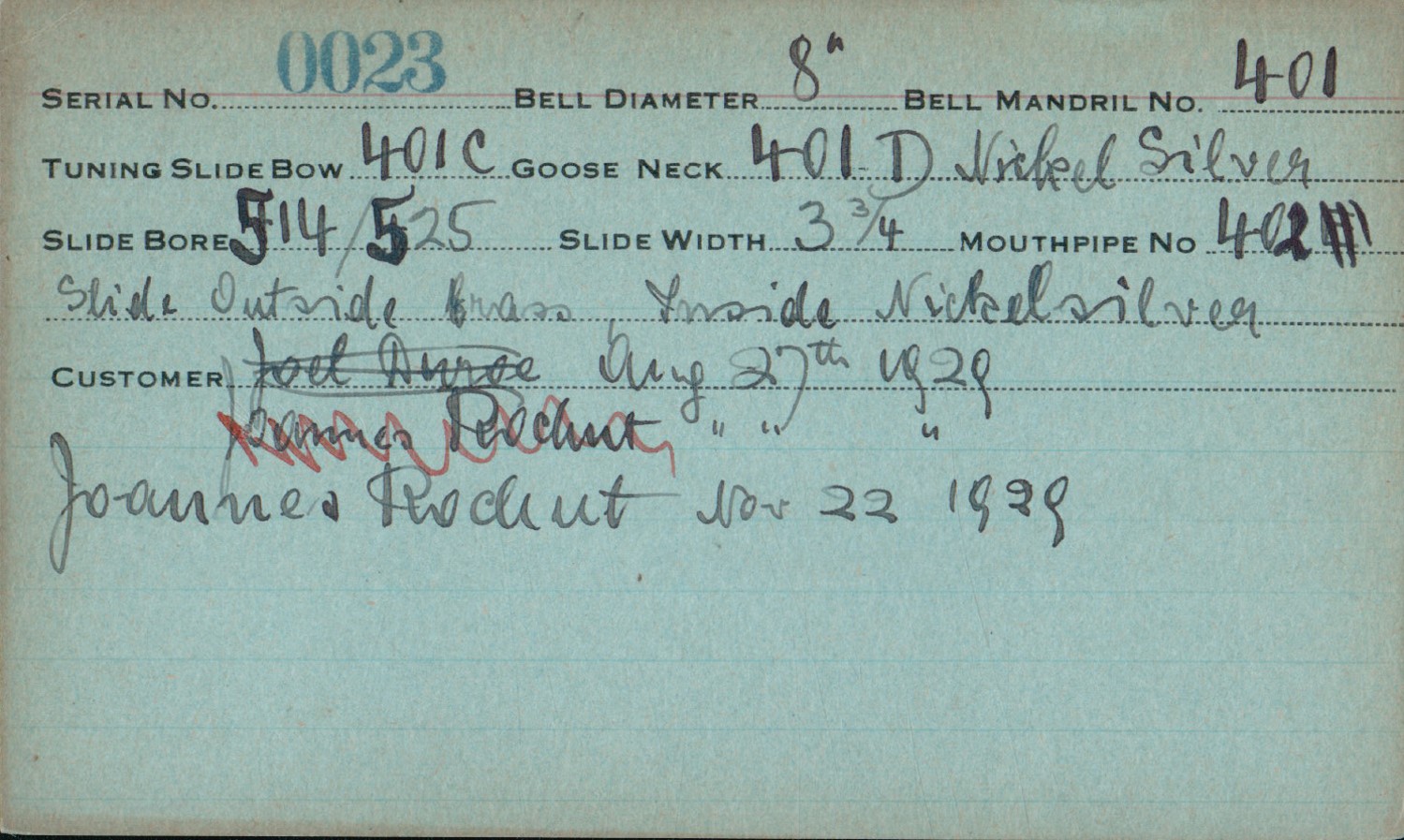
Bach shop card Rochut Nr. 23

Vincent Bach’s shop card for trombone serial number 0023, purchased by Joannès Rochut on November 22, 1929. Courtesy of Roy Hempley.

In addition to leaving his Lefevre trombones behind in Boston, Rochut also left his mouthpiece. It is exceptionally small, with a 21.6 mm interior rim diameter. It is funnel shaped, in the style of French trombone mouthpieces of the time. A comparison of Rochut’s mouthpiece that he used with his Lefevre trombone with a Bach 6 1/2 AL graphically shows how small Rochut’s mouthpiece actually was. 
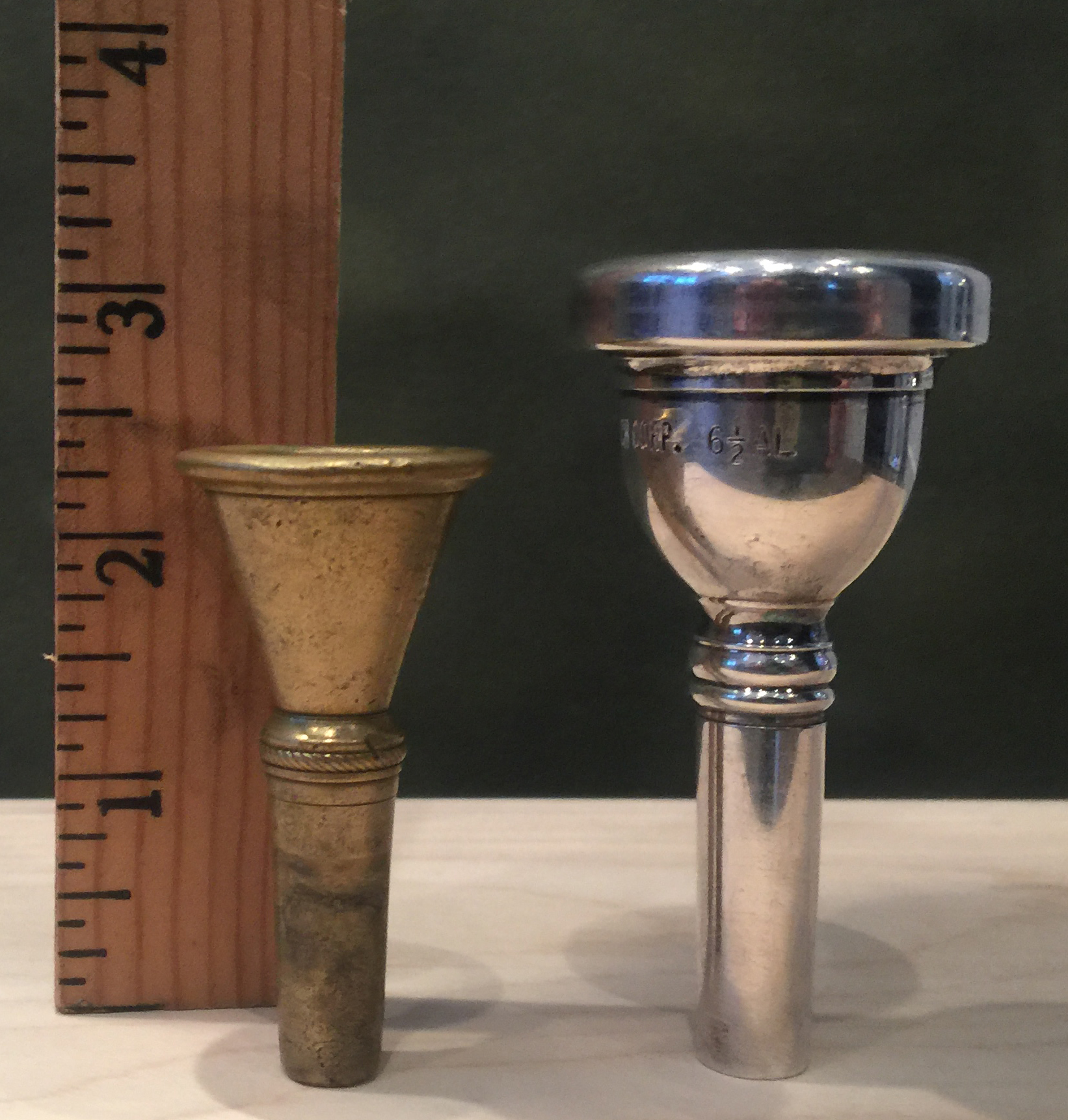
Rochut_trombone_mouthpieceMouthpiece (left) used by Joannès Rochut with his Lefevre trombone, compared with a Bach 6 1/2 AL mouthpiece (right). Photo by Mike Oft.

I recently asked Toby Oft to take some photographs of Rochut’s Lefevre trombone as well as some photos that would show the difference in size between the Lefevre and Toby’s Edwards trombone. I want to thank Toby for taking these superb photos which are not only informative, but display the trombones as works of art, which they are.

Rochut_Trombone_©Toby_Oft

Joannès Rochut’s Lefevre trombone. Photo by and © Toby Oft. Note the siphon valve on the bottom bow of the hand slide. Pressing the bottom of the hand slide to the floor activates a spring and allows condensation to drain  out.

Rochut_Trombone2_©Toby_Oft

The bell engraving of Joannès Rochut’s Lefevre trombone. Photo by and © Toby Oft.
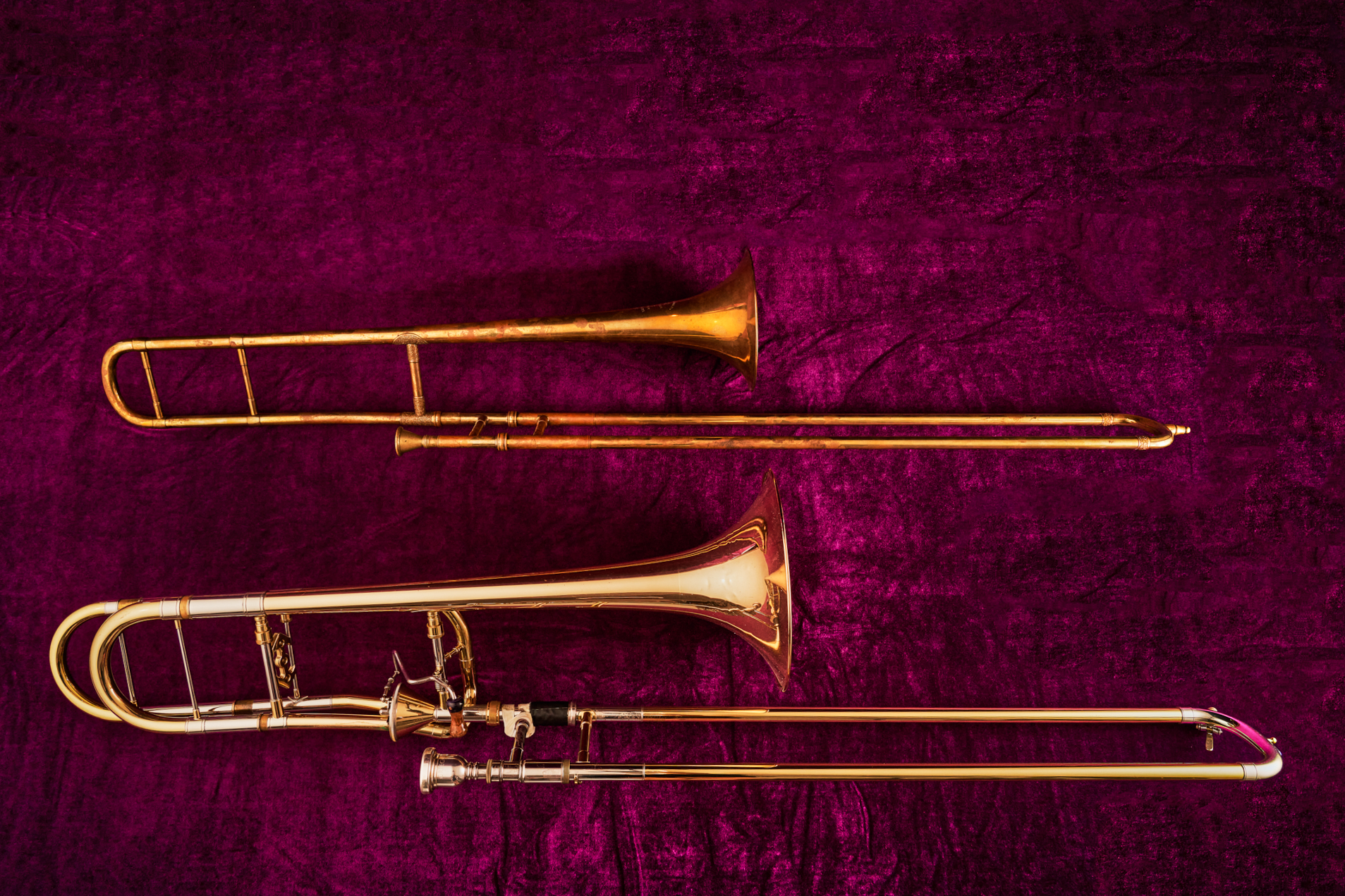
Rochut_Edwards_Trombone_©Toby_Oft

Comparison of Joannès Rochut’s Lefevre trombone with Toby Oft’s Edwards trombone. Photo by and © Toby Oft.
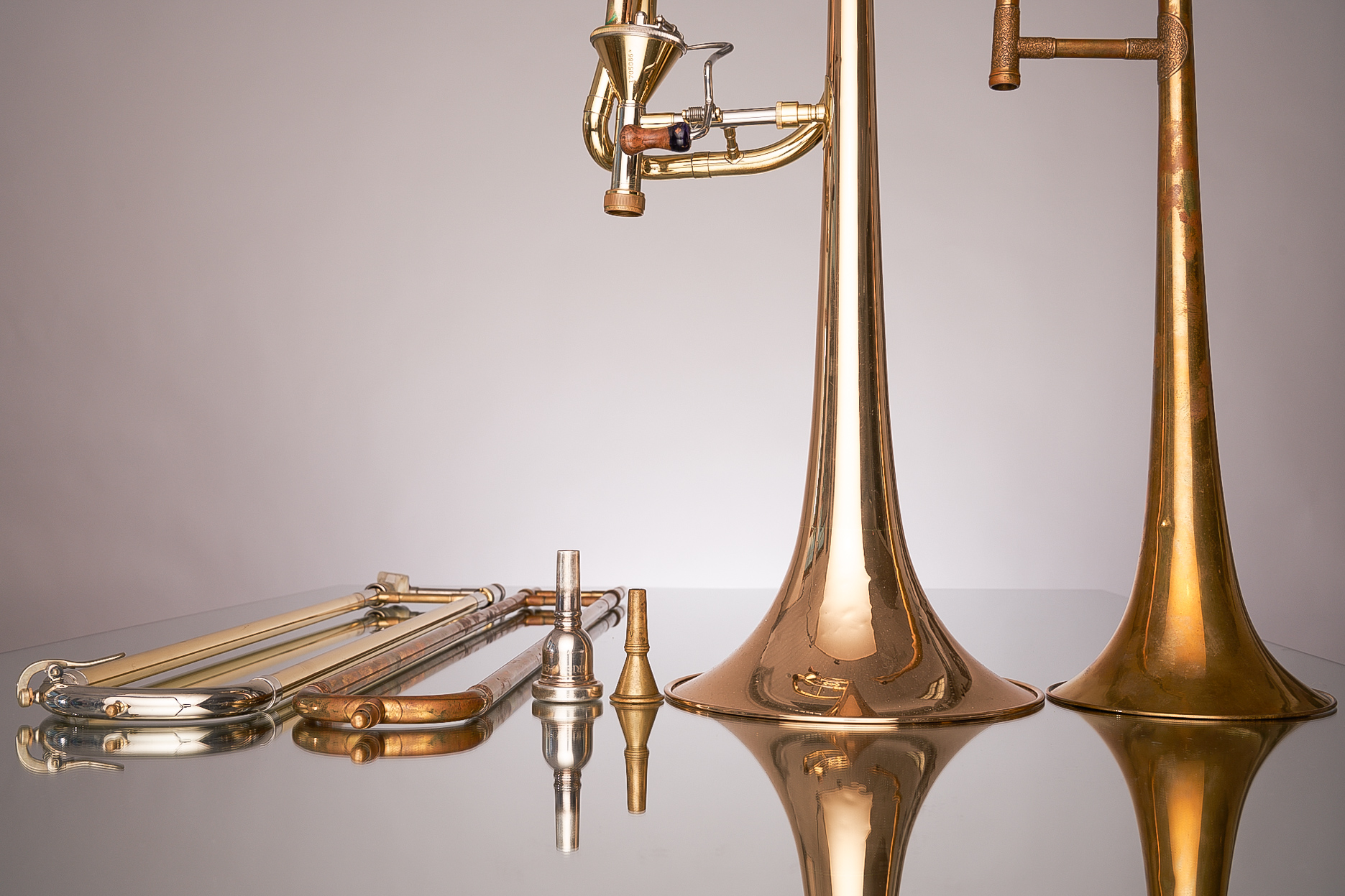
Edwards_Rochut_Comparison_©Toby_Oft

Comparison of Joannès Rochut’s Lefevre trombone with Toby Oft’s Edwards trombone. Photo by and © Toby Oft.
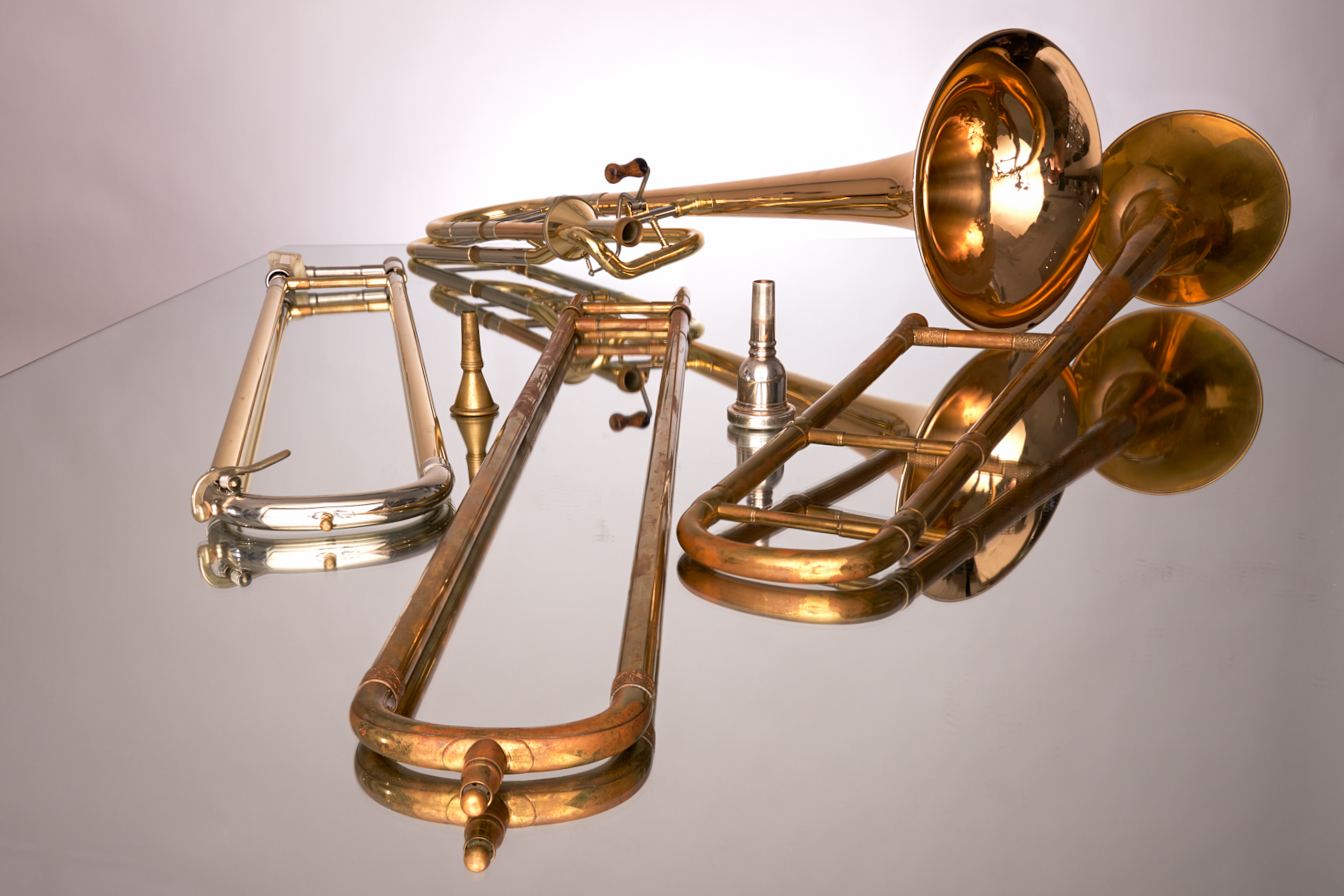
Edwards_Oft_Trombone_vs_Rochut_©Toby_Oft

Comparison of Joannès Rochut’s Lefevre trombone with Toby Oft’s Edwards trombone. Photo by and © Toby Oft.
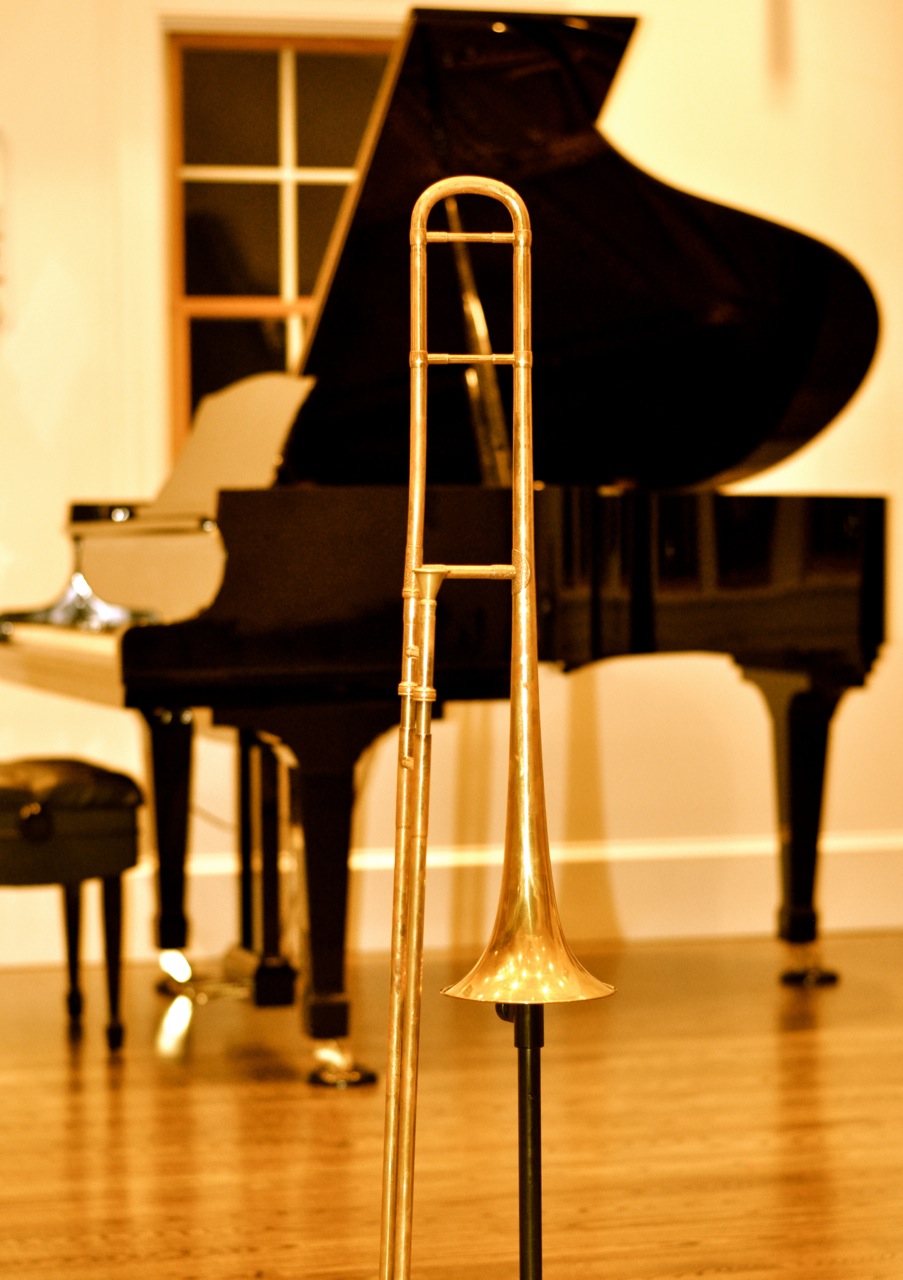
Rochut_Trombone_on_stand_©Toby_Oft

Joannès Rochut’s Lefevre trombone. Photo by and © Toby Oft.

There is much more to the story of the life and work of Joannès Rochut. That will unfold in my article in progress for the International Trombone Association Journal. His is a name that trombonists around the world have known for nearly a century. My hope is that this article has added to our understanding about Rochut, his Lefevre trombone, and his years as principal trombonist of the Boston Symphony Orchestra. 

[Special thanks to the Boston Symphony Orchestra Archives, Bridget Carr, Archivist, and Toby and Mike Oft for their photos.]

Two orchestras, 31 years, 11 colleagues

Two orchestras, 31 years, 11 colleagues

I’ve written many articles for many journals and magazines, but I’ve written the most for the International Trombone Association Journal. I joined the Association in 1973 during its first year of existence—the ITA was incorporated in September, 1972—while I was still in high school. I honestly don’t recall how many articles I’ve written for the ITA Journal; dozens, for sure, as well as many reviews. These articles have included tributes to great players and teachers (click on the links highlighted below and you can read the articles) including Edward Kleinhammer (bass trombonist of the Chicago Symphony, 1940-1985, and my teacher during my years as a student at Wheaton College, Illinois), Keith Brown (long time trombone teacher at Indiana University, former member of the Philadelphia and Metropolitan Opera Orchestras, and my teacher during my freshman year when I was at IU), and Russell “Big Chief” Moore (an outstanding Native American jazz trombonist who played with Louis Armstrong’s “All Stars” and many other great jazz artists). Other articles have been historical in nature, such as my photo essay about trombone players in the Boston Symphony from 1887-1986, and my article about the history of the double-valve bass trombone. I’ve also done interviews with well known players such as bass trombonists David Taylor and Denson Paul Pollard.

There have also been occasions when I’ve been interviewed for articles that others have written. A few weeks ago, my friend, Megumi Kanda, principal trombonist of the Milwaukee Symphony who, along with Matt Walley, edits the ITA Journal’s Orchestral Sectional column, asked if I would join with four other low brass players in answering some questions about what it is like to work day in and day out in a symphony orchestra low brass section. Megumi asked some good questions that got me thinking about the colleagues with whom I’ve worked over the years. At this season of life, looking back at those relationships and friendships and collaborations brings back a lot of memories of the times we shared together. After I hit “send” and the answers to Megumi’s questions were on the way to her (I don’t know when they will be published in the ITA Journal but I expect it will be sometime in 2021), I decided to write this article, a tribute to the players with whom I spent so much time making music over the years.  While I no longer play full time in a major symphony orchestra—something I did for over 31 years in two orchestras—I continue to enjoy envigorating  artistic collaborations with many people. I’m not done yet! But working with these eleven players in two orchestras changed and shaped me and helped bring me to where I am today. 

Baltimore Symphony Orchestra (1981-1985)

Balto_Sym_trombones_summer_1981

Baltimore Symphony Orchestra trombone section, Harborplace, Baltimore, summer 1981. Left to right: James Olin, co-principal trombone; David Fetter, co-principal trombone; Eric Carlson, second trombone; Douglas Yeo, bass trombone. 

I joined the Baltimore Symphony Orchestra in May, 1981, after two years as the band director at St. Thomas Aquinas High School in Edison, New Jersey. When I joined the BSO—as it was and is still called, although a few years later, I would join another BSO, the Boston Symphony Orchestra—the low brass section consisted of David Fetter and James Olin, co-principal trombone, Eric Carlson, second trombone, and Daniel Brown, tuba. Dan left at the end of my second season and David Fedderly come on as our tubist. While just a few weeks after I joined the orchestra we were locked out in a labor dispute with the orchestra’s management—we settled our contract in January 1982; that was a very long lockout—I enjoyed a very special four years in Baltimore. David Fetter was a name I knew well from his many arrangements with Ensemble Publications. Before coming to Baltimore, he had been assistant principal trombonist in the Cleveland Orchestra. Jim Olin and I were the same age, and he had studied with Frank Crisafulli at Northwestern University at the same time I was studying with Edward Kleinhammer. Eric Carlson and I had been classmates at Wheaton College together where we played together in the orchestra, band, and a trombone quartet. When I graduated from Wheaton in 1976, Eric went on to play second trombone with the North Carolina Symphony. He joined the Baltimore Symphony in 1980 and a year later, I was sitting next to him again.

Baltimore_Symphony_program_1982

Overture Magazine (program of the Baltimore Symphony Orchestra), October 23-November 12, 1982. Clockwise from top: Phillip Kolker, principal bassoon; W. Daniel Brown, tuba; Paula Sisson Francis, first violin, Douglas Yeo, bass trombone.

It was in Baltimore that I made my first recording with a symphony orchestra (the Concerto for the Left Hand of Maurice Ravel, with Leon Fleischer, piano soloist); it was where I first played a solo in front of a symphony orchestra (Patrick McCarty’s Sonata); and our second daughter was born there. During my second season, the orchestra opened its new concert hall, Meyerhoff Hall. Those were four very good years, but in May of my fourth season, after a concert in Carnegie Hall, I left Baltimore and headed up Interstate 95 to join the other BSO – the Boston Symphony Orchestra. And, as an aside, a year later, Eric Carlson left the Baltimore Symphony for the Philadelphia Orchestra from which he has just announced his retirement earlier this month.

Boston Symphony Orchestra (1985-2001)

Boston_Symphony_brass_section_1988

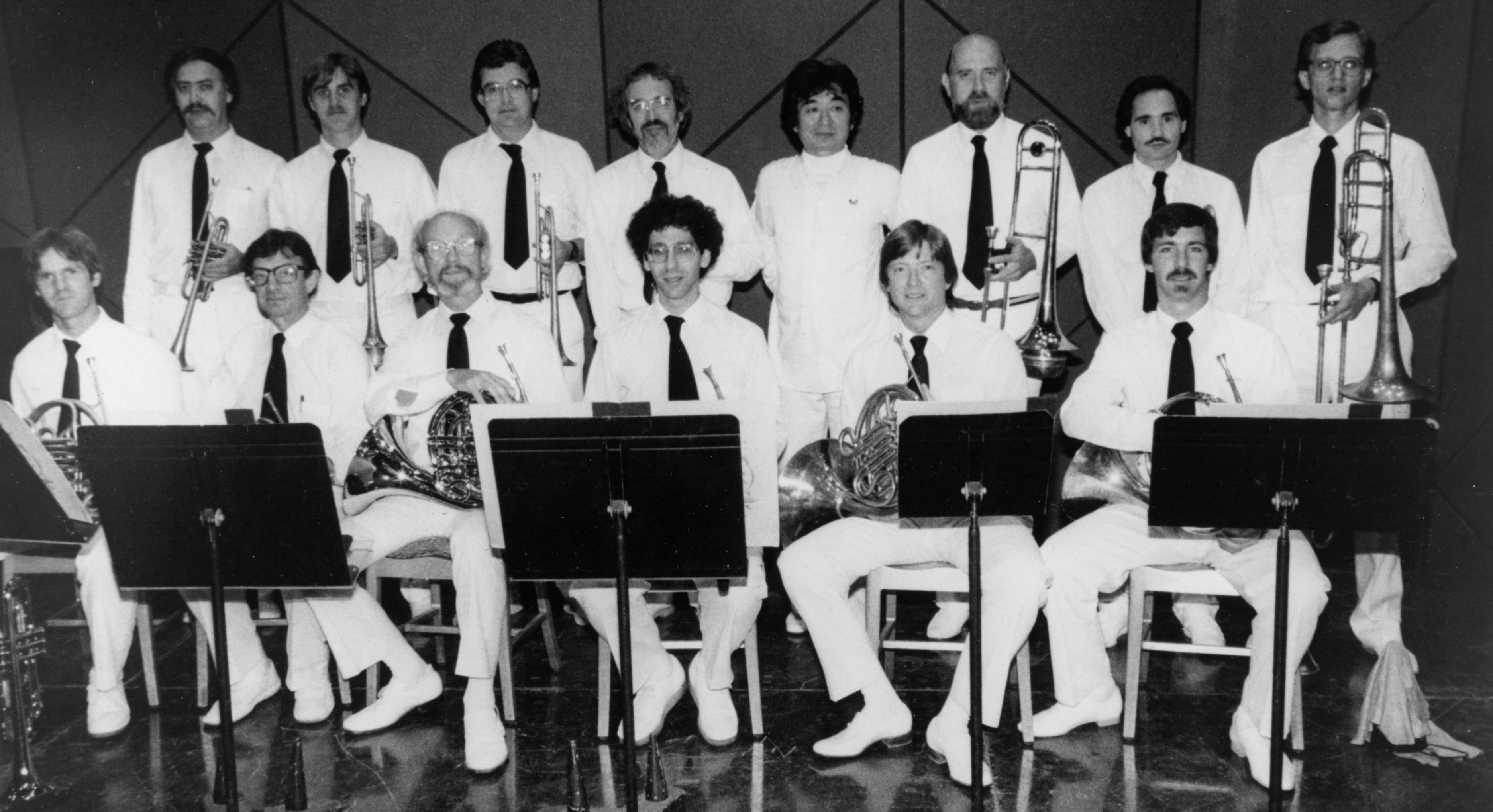
Boston Symphony brass section, Tanglewood, summer 1987. From center, left to right: Seiji Ozawa, music director; Ronald Barron, principal trombone; Norman Bolter, second trombone; Douglas Yeo, bass trombone. (Not pictured: Chester Schmitz, tuba)

Boston_Symphony_low_brass_section_Barron_Bolter_Yeo_Schmitz_2001_standing

Boston Symphony low brass section, Symphony Hall, Boston, 2001. Left to right: Ronald Barron, principal trombone; Norman Bolter, second trombone;  Douglas Yeo, bass trombone; Chester Schmitz, tuba.

I joined the Boston Symphony Orchestra in May 1985, in the middle of that year’s spring Boston Pops season. The Boston Pops Orchestra is drawn from members of the Boston Symphony, so the Pops was just part of my job as bass trombonist of the BSO. I recall that my first service—a concert—was recorded for television broadcast, the PBS show, “Evening at Pops.” I had no rehearsal. Before the concert, I introduced myself to the conductor of the Boston Pops, John Williams, and within the first minute of talking he asked me, “Have you heard from Spanky?” I right away knew who he was taking about. He was asking about George Roberts, the great Los Angeles based bass trombonist, known to generations of players as “Mr. Bass Trombone.” George and I had been friends for a long time and John had worked with George on many of his film sessions.

George_Roberts_Yeo_2004

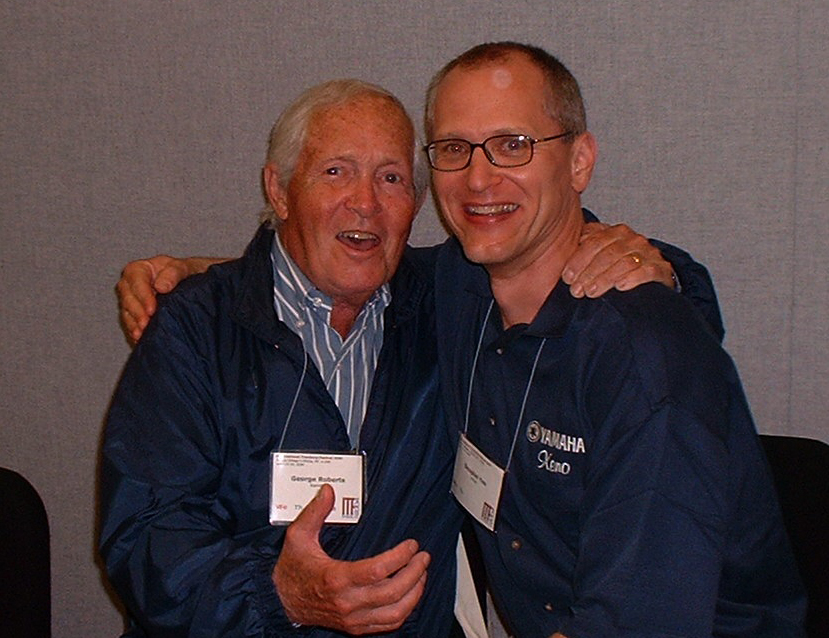
George Roberts and Douglas Yeo, International Trombone Festival, Ithaca College, New York, 2004. That was George, always hugging and smiling.

As things were, I had recently talked with George—”Spanky” as John called him—and I could give John a report on how he was doing. But I made a note to myself: Whenever John Williams was coming to Boston for a run of concerts, I always made sure I called George first so I’d have something to pass on to John. And George always ended our conversations with, “And give John a kiss, and tell him I love him.” If you knew George Roberts, you’ll be smiling right now. George always said something like that. He was always about hugging and loving and caring about people. George died in 2014. I miss him.

Yeo_Williams_Concerto_1991_05_24_ed

Douglas Yeo performing John Williams’ Tuba Concerto, Symphony Hall, Boston, May 24, 1991. Boston Pops Orchestra, John Williams Conductor. Photo by Chester Schmitz.

At that time (1985), principal players of the Boston Symphony didn’t play in the Boston Pops Orchestra. Instead, they formed the Boston Symphony Chamber Players and assistant principal or second players in the BSO moved up to play principal during the Pops season. Norman Bolter, second trombonist of the BSO, played principal in Pops and we had several players work with us over the year to fill the second trombone chair, including Larry Isaacson, Douglas Wright, Darren Acosta, John Faieta, Hans Bohn, Alexi Doohovskoy, and Jim Nova. Oh, wow, we had fun. We made so many recordings with John Williams, and also with Keith Lockhart (and one with Leonard Bernstein), we recorded countless television shows, and we toured Japan twice with John Williams conducting. I performed several concertos with the Boston Pops during my years including the first performances of John Williams’ Tuba Concerto on bass trombone (the piece had been written in 1985 on a commission from the Boston Symphony and it was dedicated to the orchestra’s tuba player, Chester Schmitz), many performances of Chris Brubeck’s Concerto for Bass Trombone conducted by Keith Lockhart, performances of Chris’ second bass trombone concerto, the Prague Concerto, Gerald Steichen, conducting, and also performances of Simon Proctor’s Serpent Concerto with John conducting. Fun times.

Yeo_Proctor_Williams_Serpent_Concerto_1997

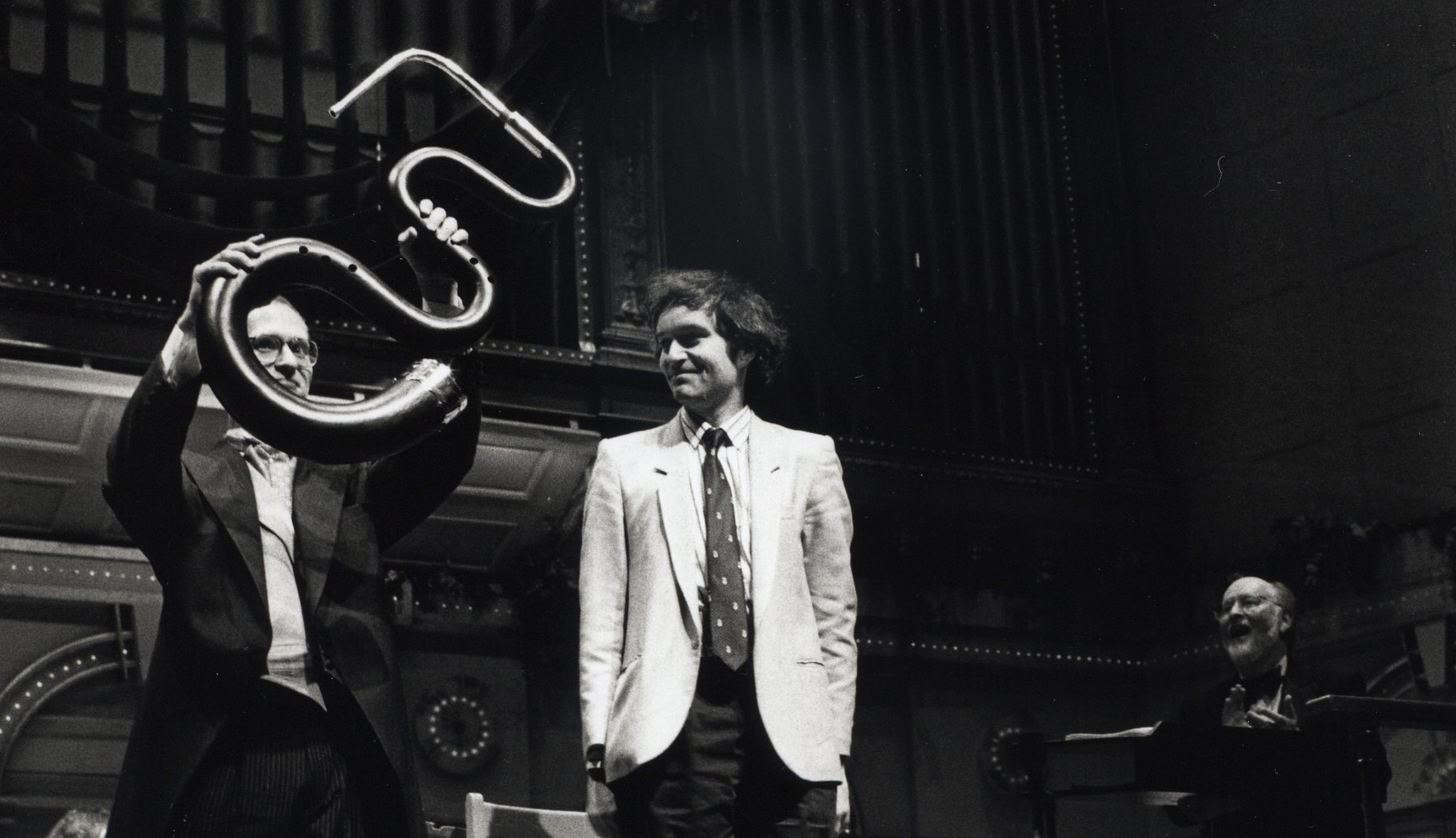
Douglas Yeo (left) after performing Simon Proctor’s Serpent Concerto, Symphony Hall, Boston, May 29, 1997. Boston Pops Orchestra, John Williams, conductor (right) with Simon Proctor (center). 

From 1985 to 2001, our Boston Symphony low brass section was Ronald Barron, principal, Norman Bolter, second, Chester Schmitz, tuba, and me on bass trombone. That’s 17 years we spent together and we did it all. For 17 years, I was the new guy in the section. We recorded all of the Mahler Symphonies with Seiji Ozawa and all of the Brahms Symphonies with Bernard Haitink. And dozens of other recordings of music from Bach to Gubaidulina. We took an international tour during most seasons, traveling across the United States, to South America, all over Europe, the Canary Islands off the coast of Africa, and to Japan and Hong Kong many times. Unforgettable experiences. Working together with the same people for so long allowed us to develop understandings among us. After several years, we didn’t have to talk much about how we were going to approach certain pieces; we just knew. I knew exactly how Norman would breath in, say, a Schumann symphony, or when Chester was going to circular breathe in a Bruckner symphony. Ours was a collaboration of understanding. I learned so much from Ron, Norman, and Chester. So much. Little did I imagine that an event in 2001 would set off a chain reaction of change in the BSO low brass section that would take over a decade to settle. 

Boston Symphony Orchestra (2001-2003)

A career in a symphony orchestra is not a straight line.

Following a September 2001 performance of Brahms Symphony No. 2 in the Amsterdam Concertgebouw conducted by Bernard Haitink (just a few days before the 9/11 attacks), Chester Schmitz retired. He had joined the BSO in 1966, fresh out of the United States Army Band (“Pershing’s Own”) in Washington D.C. It was the end of an era for the BSO low brass section. After being together for 17 years, our low brass section was changing. We held two auditions for Chester’s position but did not hire anyone. I know how frustrating it is for people to prepare for and come to an audition and have it end without someone being hired. “They don’t know what they want!” is a familiar cry. But the truth is we DID know what we wanted; we just didn’t hear it at those auditions. We knew that replacing Chester Schmitz was impossible. But Chester was the standard for tuba playing we all had in our mind. From 2001-2003, we had a succession of substitute tuba players that worked alongside Ron, Norman, and me. 

Boston Symphony Orchestra (2003-2008)

Barron_Bolter_Yeo_Roylance_Levine_2007

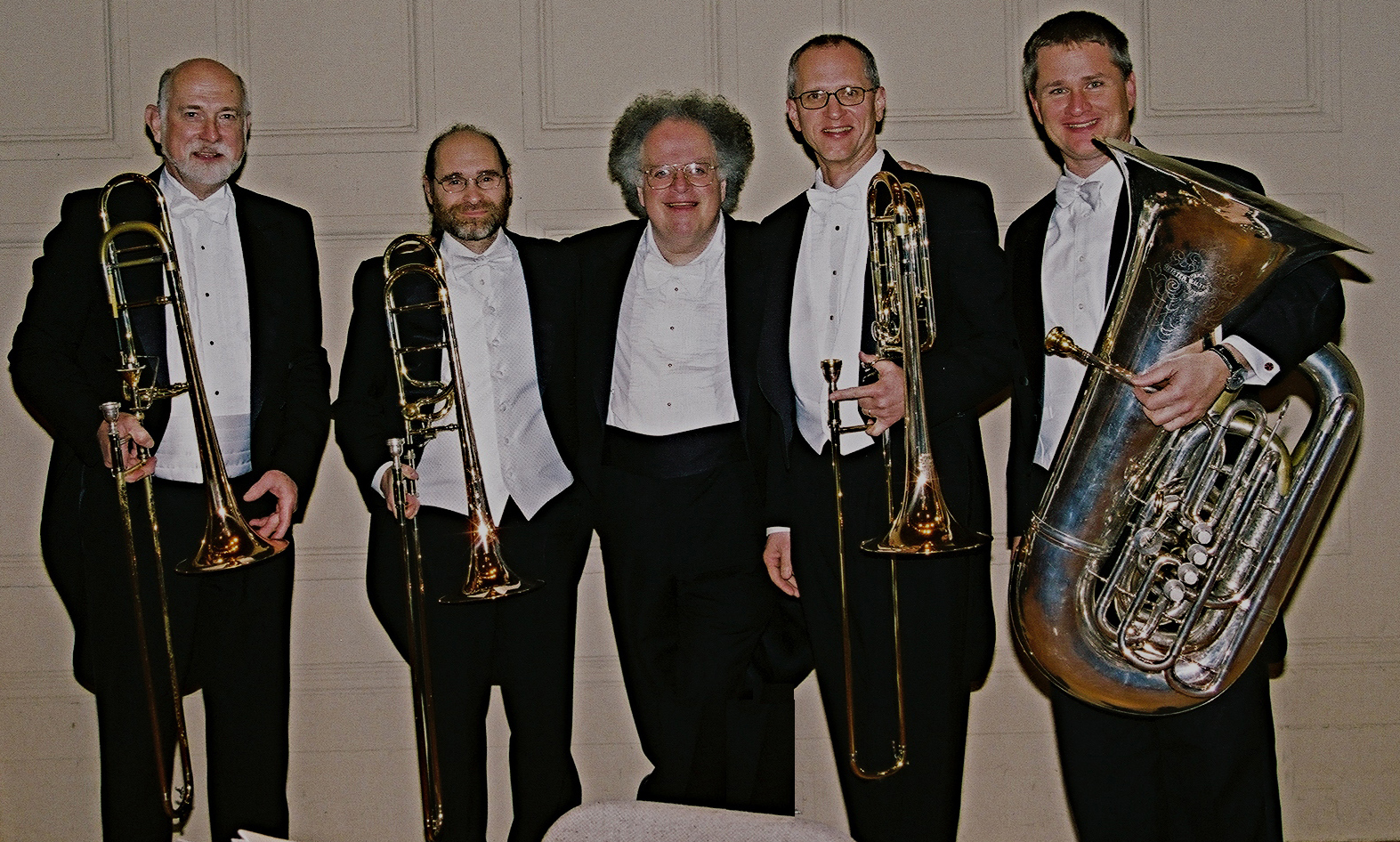
Boston Symphony Low Brass Section, Symphony Hall, Boston, 2007. Left to right: Ronald Barron, principal trombone; Norman Bolter, second trombone; James Levine, music director; Douglas Yeo, bass trombone; Mike Roylance, tuba.

After a third tuba audition, Mike Roylance joined the BSO 2003. He was the first new member of the low brass section in 19 years. Mike arrived during an interim period between two music directors, Seiji Ozawa (1973-2002) and James Levine (2004-2011). Our section was complete once again. But not for long.

Boston Symphony Orchestra (2008-2010)

Barron_Bolter_Yeo_2007

Boston Symphony Orchestra Trombone Section, 2008. Left to right: Ronald Barron, principal trombone; Norman Bolter, second trombone; Douglas Yeo; bass trombone.

Ron Barron joined the Boston Symphony in 1970 as second trombonist, and then won the principal trombone position in 1975 upon the retirement of William Gibson. In that same year, 1975, Norman Bolter won the second trombone position that Ron had just vacated. Incredibly, both Norman and Ron decided to retire from the BSO in the same year, 2008. Their final season was bittersweet for me. Suddenly, the trombone section that I had known for the previous 23 years was gone. With two vacancies in the section, the decision was made to hold an audition for a new principal trombonist and after that player received tenure, then schedule an audition for a new second trombonist. That way, the new principal player could serve on the audition committee for the new second player. It made sense but it set up two years when we did not have a full section. For two years, we had substitute players fill the second trombone chair.

Oft_Yeo_2008

Toby Oft and Douglas Yeo, Symphony Hall, Boston, December 24, 2008.

Toby Oft, former principal trombonist of the San Diego Symphony, was hired as our new principal trombonist and he began with the BSO at the start of the 2008 season. I went on sabbatical from the orchestra for six months beginning in January 2009—something that had been planned two years earlier, before Norman and Ron announced their retirement—Toby received tenure in the summer of 2009, and we then held an audition for a new second trombonist. 

Boston Symphony Orchestra (2010-2012)

Lange_Yeo_Oft_2012

Boston Symphony Orchestra Trombone Section, basement of Symphony Hall, Boston, 2012. Left to right: Stephen Lange, second trombone; Douglas Yeo, bass trombone; Toby Oft; principal trombone. Photo by Randall Hawes.

In 2010, we hired Stephen Lange as second trombonist. Steve, who had played for the previous 10 years with the Saint Louis Symphony, completed our low brass section that had been in flux since Norman and Ron’s retirement in 2008. But yet another change was on the horizon. I decided to retire from the BSO in 2012, after over 27 years of occupying the bass trombone chair. But my final two seasons were very special to me as the oldest, most experienced member of my new section, and a carrier of the flame of the BSO’s long performance traditions.

Yeo_Haitink_Sym_Hall_final_bow_2012

My final bow on stage at Symphony Hall, Boston, May 2012. Behind me are BSO concertmaster Malcolm Lowe and conductor Bernard Haitink.

During my last season with the BSO (click HERE to read an interview I gave for the Boston Symphony Program Book in 2011 where I looked back on my long career in the orchestra)—my final concert in Symphony Hall in May 2012 was Beethoven Symphony No. 9 conducted by Bernard Haitink.

Yeo_Final_Bow_Tanglewood_BSO_2012

My final bow on stage at Tanglewood, the summer home of the BSO—my last concert with the Boston Symphony Orchestra—August 5, 2012. 

When I played my final concert with the orchestra at Tanglewood in August 2012—Berlioz Symphonie fantastique conducted by Loren Maazel—a page was turned in the history of BSO low brass playing. The last vestige of the Boston Symphony trombone section that came together when I joined the orchestra in 1985 was no more. When James Markey began as the BSO’s bass trombonist the day after I retired, a new tradition with an entirely new section was born. Toby Oft, Steve Lange, Jim Markey, and Mike Roylance are making their own mark as the BSO’s low brass section. Already they have been at it for eight years. Will the four of them play together for 17 years as Ron, Norman, Chester, and I did? Will the trombone section stay together for 23 years as Ron, Norman, and I did? Time will tell.

But there is this: All of us—Ron, Norman, Chester; Toby, Steve, Jim, Mike, and I—are part of a long stream of low brass players that goes back to the Boston Symphony’s founding in 1881. From George Stewart to Leroy Kenfield to Joannès Rochut to Eugene Adam to Kilton Vinal Smith to Jacob Raichman to Kauko Kahila to William Gibson, all of us were touched by those who came before us. And the same can be said for my colleagues in the Baltimore Symphony; David, Jim, Eric, Dan, David, and I  were part of a long stream of low brass players that came through that orchestra, including John Melick Jr., Ted Griffith, Philip Donatelli, John Marcellus, Douglas Edelman, Charles Vernon, and John Engelkes. Touched, influenced, inspired, changed. I’m glad that Megumi Kanda asked me those questions about working in an orchestral trombone section. It gave me the opportunity to dig out some old photos, recall some old memories, and offer gratitude to God for the life in music that He has given me, a life shared with many others. Thirty one years in two orchestras, sitting amidst 11 colleagues. Thank you, all of you.

[Header photo: Boston Symphony Low Brass Section, Symphony Hall, Boston, February 1992 (performance of Dvorak Symphony No. 9, “From the New World”). Left to right: Ronald Barron, principal trombone; Norman Bolter, second trombone; Douglas Yeo, bass trombone; Chester Schmitz, tuba.]

Memorial Day, Saving Private Ryan, Abraham Lincoln, and the trombone

Memorial Day, Saving Private Ryan, Abraham Lincoln, and the trombone

In the United States, yesterday was Memorial Day. A national holiday, it is a day of remembrance to honor and mourn those who died while in the service of the United States Military. It is often observed with parades, speeches, cemetery visits, and non-related things like family picnics and cookouts that celebrate Memorial Day as the unofficial beginning of summer. This year, the coronavirus pandemic curtailed many of those traditional events but the significance of Memorial Day remains undiminished. We owe a great debt of gratitude to those who died serving our country. That gratitude can never be overstated and it can never be repaid.

Yesterday, my wife and I watched the Steven Spielberg motion picture, Saving Private Ryan, for the first time. Released in 1998, the movie is considered to be one of the most significant movies of all time. It took me 22 years to decide to watch it because I am not a person who likes/enjoys/wants to see graphic portrayals of violence. I had heard about the movie’s intense opening 30 minute scene of the beginning of the D-Day invasion. My heart wanted to see the movie but my stomach was not sure.

But yesterday, on Memorial Day 2020, it was time. We watched Saving Private Ryan in our home (Blu-Ray) and found the movie to be a powerful, moving reminder of sacrifice and service. Yes, some scenes were very intense. Very, very intense. But even the most intense scene could only communicate a fraction—a very small fraction—of what those who served in war actually experienced. I’m glad we watched it, and I will watch it again.

I had another reason for wanting to watch Saving Private Ryan. I played on the movie’s soundtrack.

02.Yeo_Williams_Fanfare_for_Fenway_2012

As readers of The Last Trombone know, I was bass trombonist of the Boston Symphony Orchestra from 1985-2012. During the early years of my tenure in the orchestra, John Williams was the conductor of the Boston Pops and after he left that position, he continued a fruitful relationship with the Boston Symphony and Boston Pops that continues to this day. My respect for him is enormous, and I was very fortunate to record many Boston Pops albums under his direction, and also be the first bass trombonist to perform his Tuba Concerto (on bass trombone, in May 1991) with the Boston Pops with John conducting. The photo above shows John and me in Symphony Hall, Boston, taken at a recording session in 2012 for his Fanfare for Fenway, that celebrated the 100th anniversary of Boston’s Fenway Park, the home of the Boston Red Sox.

Saving_Pravate_Ryan_soundtrack_cover

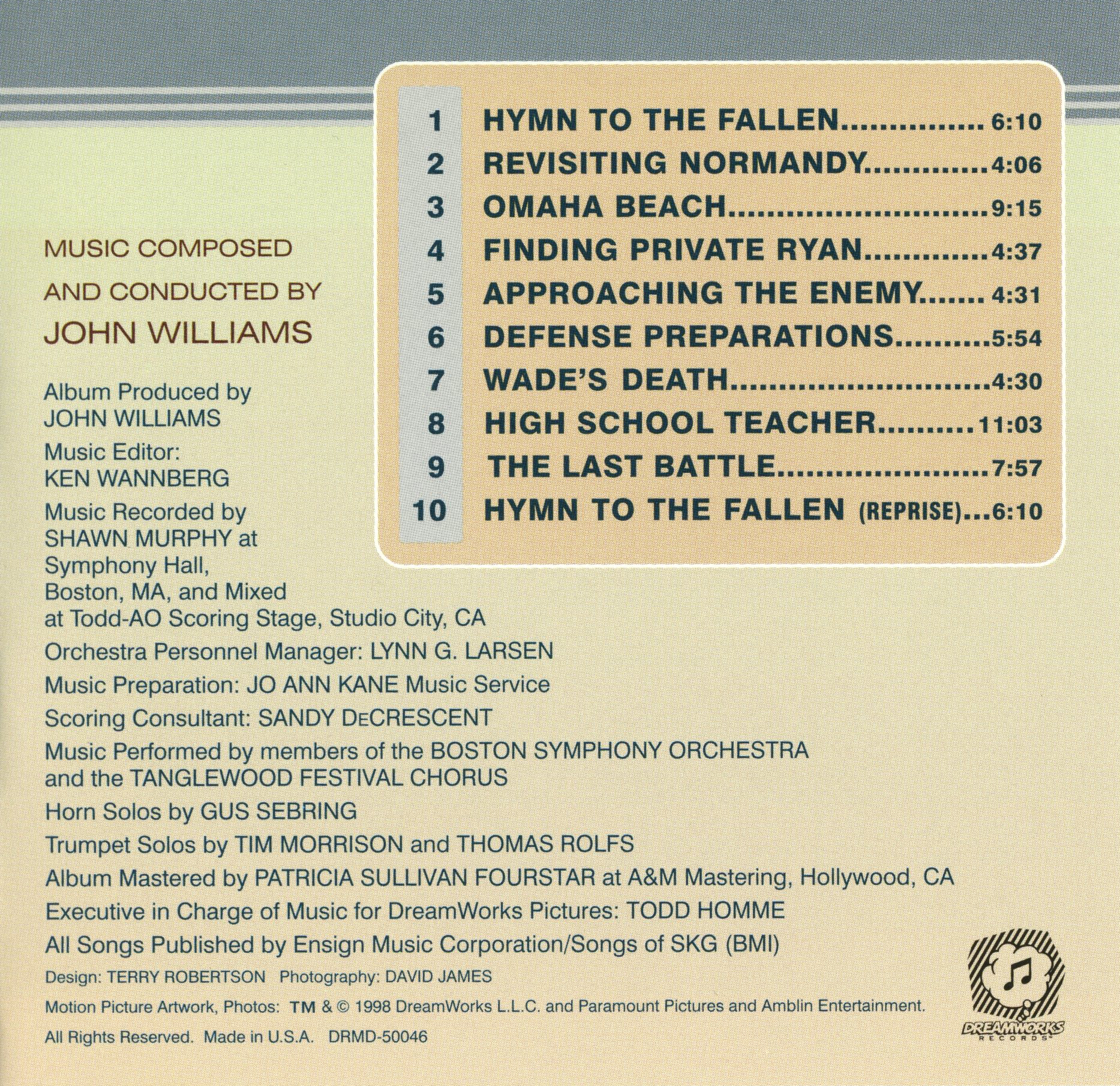
Saving Private Ryan was the second John Williams film score that I recorded as a member of the Boston Symphony Orchestra, following on the recording sessions for Schindler’s List in 1993. The soundtrack for Saving Private Ryan was recorded over three days in February 1998 in Symphony Hall. I recall Steven Spielberg being there for all of the sessions, and Tom Hanks (who had the role of Captain John H. Miller in the movie) being in attendance at the first session. The music is very unconventional for a war movie: there is no loud music. Instead, Williams used music mostly to guide the audience in both anticipation and contemplation of combat. There is no music during battle scenes.

The movie’s longest musical segment occurs at the end of the film, over the credits. That music, titled “Hymn to the Fallen,” features a long brass chorale that still, 22 years later, moves me to tears. You can hear the recording of “Hymn to the Fallen” for the Saving Private Ryan soundtrack by clicking below or you can hear it on YouTube by clicking HERE.

This is not a movie with loud trombone playing like Star Wars or Raiders of the Lost Ark. What you’ll hear are trombones in a supporting role, adding depth and texture to strings, and stepping forward from time to time in chorales, soft but intense rhythmic punctuations, and contemplative warmth.

Saving_Private_Ryan_credits

Seeing the movie yesterday for the first time brought back a flood of memories about those recording sessions. Tim Morrison and Tom Rolfs played the beautiful, haunting trumpet solos and duets, and Richard “Gus” Sebring did the same on french horn. Ronald Barron, Norman Bolter, and I were the trombone section and Gary Ofenloch and Chris Hall played tuba, substituting for Chester Schmitz. Spielberg and Williams wanted to record with the Boston Symphony in Symphony Hall rather than with a studio orchestra because they wanted to “hear the air” of the hall in the music, and work with a group of players who played together everyday and understood Williams so well.

Then Boston Globe music critic Steven Dyer wrote a long article about the recording sessions that describes some of the back room scenes and work of those days in February, 1998. You can read that article HERE.

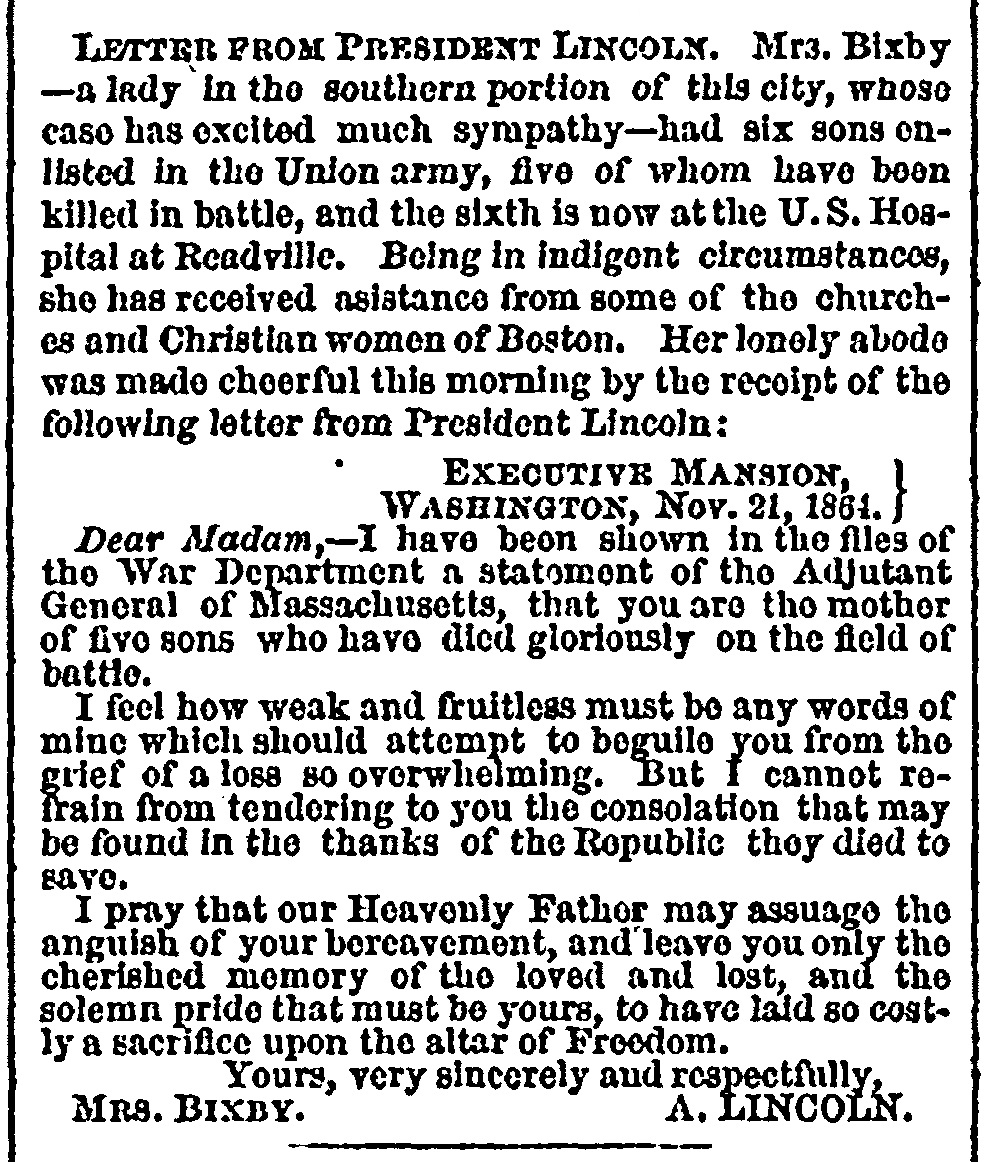
Also, at the beginning of the first recording session, Tom Hanks read the letter from President Abraham Lincoln to Mrs. Lydia Parker Bixby who had lost five sons in the Civil War. Written on November 21, 1864, it was first published in the Boston Evening Transcript four days later. It remains one of the most poignant consolations I have ever read, and the letter figures both in the plot and the narrative of Saving Private Ryan. Here is the letter as first published in the Boston Evening Transcript:

Bixby_Letter_newspaper

If you’ve seen Saving Private Ryan, you have your own thoughts about the movie. If you haven’t seen it, I encourage you to do so if you feel you can handle intense depictions of the brutality of war. If you can’t—like I felt I couldn’t for the last 22 years—you might want to pick up the soundtrack album. The movie is a strong reminder of the sacrifice and heroism that we  gratefully recognize on Memorial Day. The music is haunting, moving, powerful, and contemplative. I often turn to Hymn to the Fallen when I need music to help me think about or remember something important. It has become a kind of Adagio for Strings (of Samuel Barber) for our time.

Memorial Day. Saving Private Ryan. Abraham Lincoln. And the trombone. They’re all tied up in my memory.

A different kind of graduation day

A different kind of graduation day

Today is graduation day at Wheaton College, Illinois. The college is both my undergraduate alma mater and also where I now teach trombone to eager, gifted, and hard-working students. One of my students, Brendan, is graduating today. But instead of walking down the aisle of Edman Chapel with his classmates, hearing an inspiring commencement speech, praying and singing with faculty, administrators, families, and fellow students, and then having joyful celebrations at home with food, friends, and relatives, today’s graduation ceremony takes place in the form of a celebratory YouTube video followed by a Zoom meeting. I’ve just finished watching it. It was very nice; it was very joyful; it was very meaningful. But it was different. Still, I am confident that our graduates of 2020 will remember their graduation every bit as vividly as I remember mine. Each graduation is unique, and its memory becomes a part of us.

D-Yeo_JTHS_1973

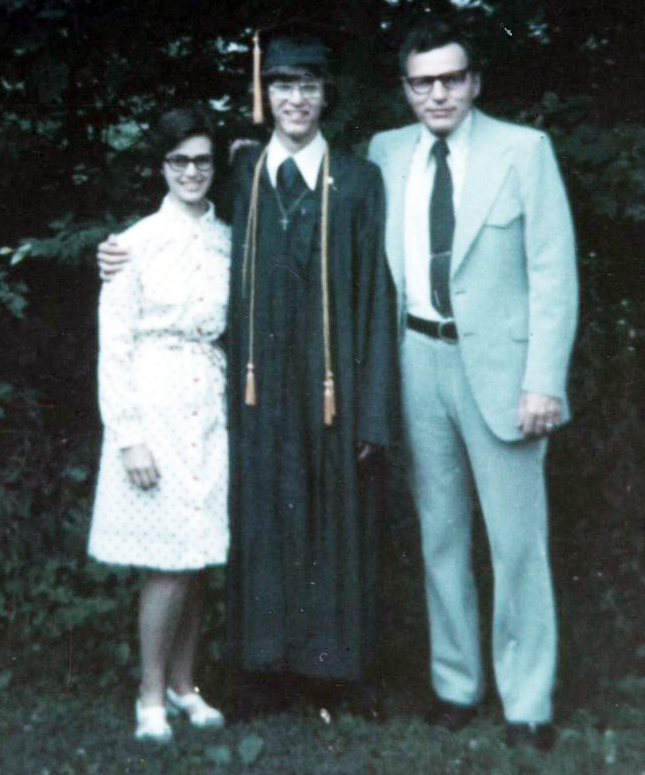
I’ve received a degree at three graduation ceremonies. I graduated from Jefferson Township High School in New Jersey, 1973. I think the ceremony was outside, on the school’s football field. I only have one photo from that day, a blurry snapshot of me with my mom and dad, taken in our backyard before we left home for the event, above. I received the senior class awards in music and English during the ceremony. People often say that music and math go together. Not for me. I can’t even do basic arithmetic much less mathematics. My body seems to reject math and science. Happily for me, my wife excels in those things so we are a good pair.

Pat_Doug_Hudson_Armerding_May_1976

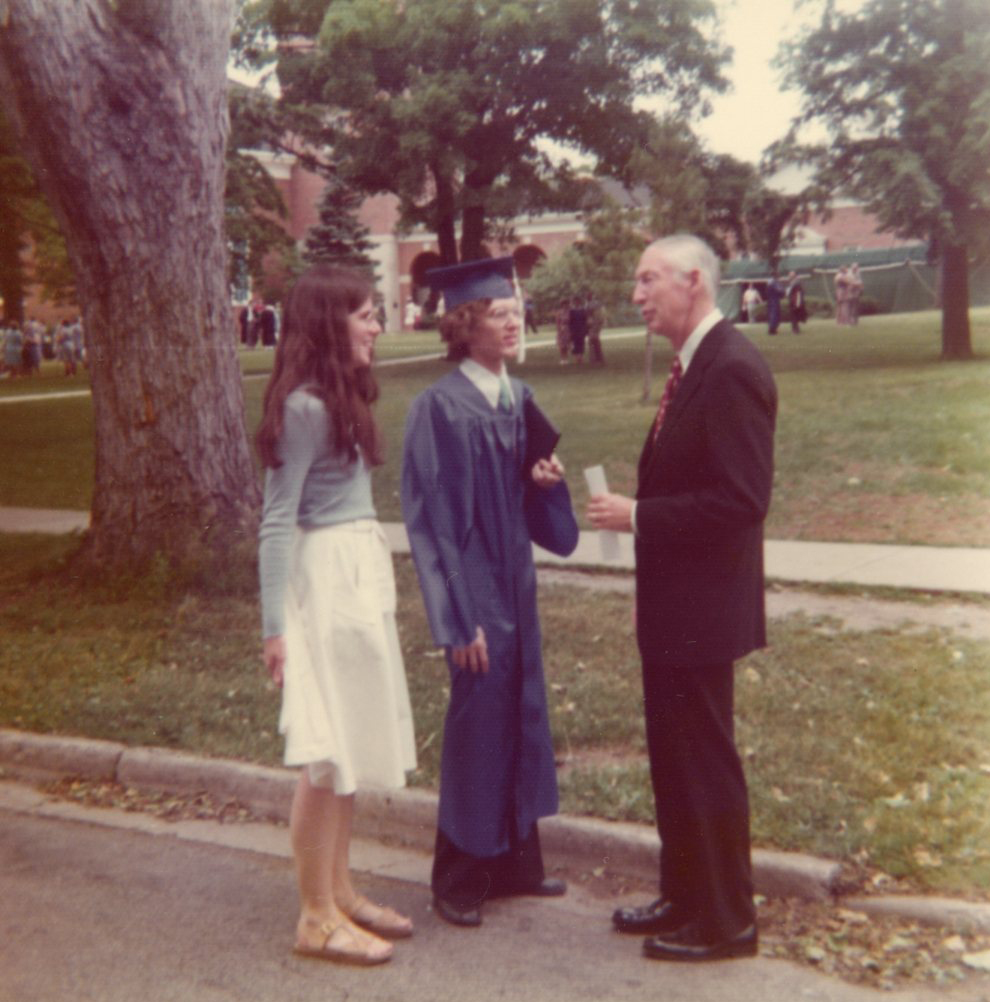
My graduation from Wheaton College in 1976 was very memorable. The weather was nice, my parents and my wife’s parents travelled to Wheaton from New Jersey for the festivities, and the next day, Pat and I headed back to New Jersey to start our new life in New York City. After the ceremony, she and I had a conversation with Wheaton College’s President, Hudson Armerding (photo above), one of the most godly men I have ever known and a person whom I still hold in the highest esteem.

Three years later, in 1979, I graduated from New York University. Thousands of students graduated that day so a single representative from each of NYU’s colleges received their degree on the platform on behalf of the other graduates. My strongest memory from that day in Washington Square Park was that I played in the NYU band, doing my part to play Elgar’s Pomp and Circumstance March No. 2 more times than I could count. And I also got paid to play in the band that day. $25, I think. Nice. I don’t have a photo from that day; nobody had yet thought of what we, today, call a “selfie.”

HIDA_Convocation_all_graduates_2016

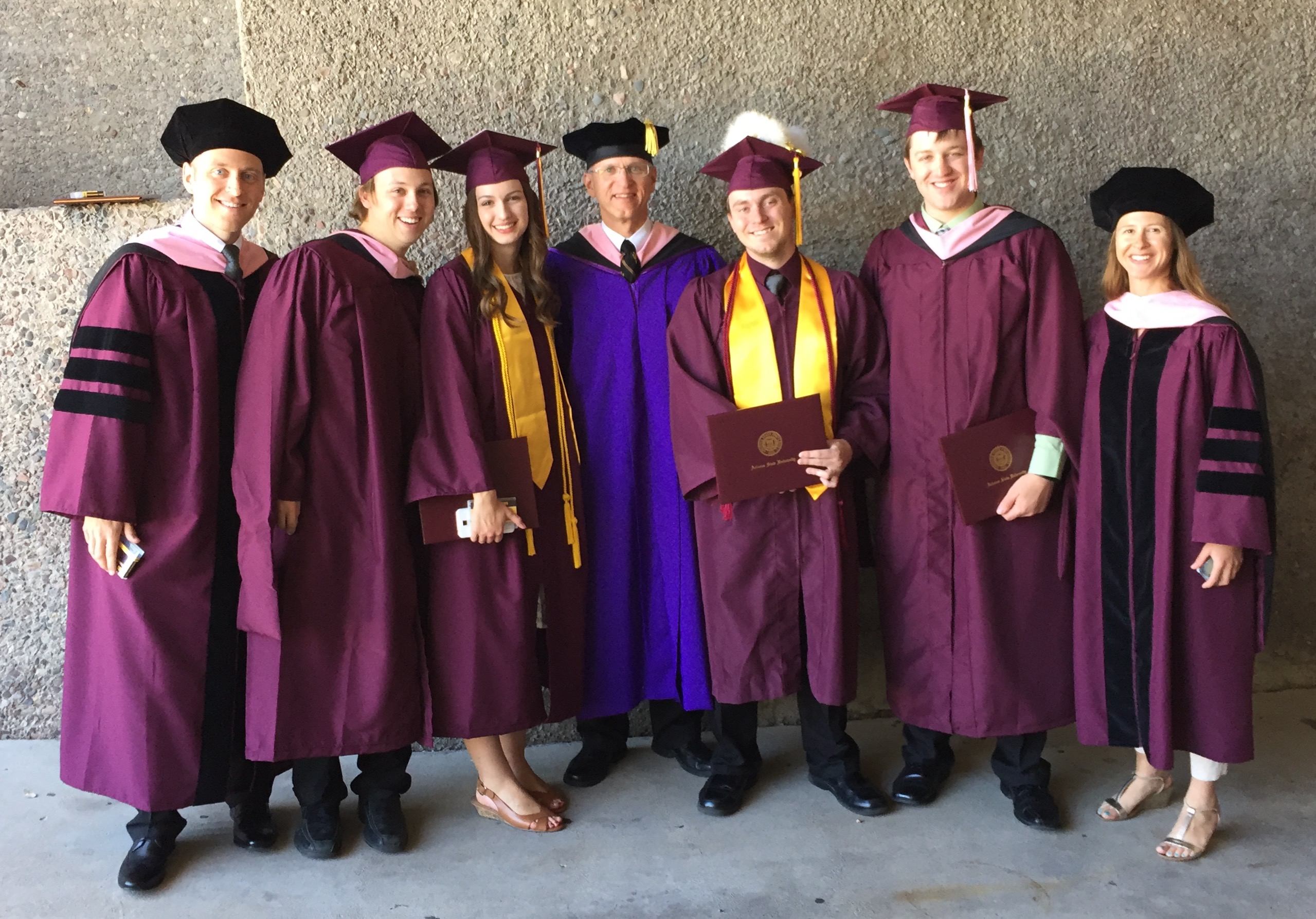
I last attended a graduation ceremony in 2016, my final year as Professor of Trombone at Arizona State University.  In that year, I had six students walk the aisle; every student walked and received their diploma. Seeing this photo (above) brings back so many memories. Look at those smiling faces. Timothy Hutchens (DMA), Paul Lynch (MM; he went on to receive his DMA at ASU a few years later), Kristie Steele (BME), David Willers (BME), Adam Dixon (MM; he also went on to receive his DMA at ASU a few years later), and Emmy Rozanski (DMA).

Today’s graduation ceremonies are different due to the coronavirus pandemic. But we should not for a second think that the accomplishments of our students who graduate today are any less for the fact that their commencement celebration comes across a computer monitor rather than in a football stadium, college arena, or chapel. Today, we celebrate their completion of a race, and their turning of a page to a new chapter. These are ones who will change the world, who will make a difference. We applaud them, celebrate them, and want to encourage them. And so we do. I have just finished watching the Wheaton College Conservatory of Music virtual graduation celebration. I laughed a little, cried a little, and was very grateful. I found it very meaningful to hear Dean Michael Wilder reflect on the last four years, see and hear reflections by graduates, and greetings from faculty. I don’t know how long it will stay up on YouTube but it’s there now. If you want to see a meaningful graduation celebration for the class of 2020, click HERE. Thank you, Wheaton College, for having the vision to put together something so joyful, emotional, and meaningful.

On June 10, 2006, I gave the commencement address at Caritas Academy of Arts and Sciences in Massachusetts. As I reviewed those comments, which appear HERE on my website, I realized that I could have written them yesterday.They are just as timely today as when I wrote them 14 years ago.  I titled my comments, “Hold on to Hope.” Hope is very much a part of our thinking right now where the world is upside down. I thought I would share it again here on The Last Trombone. To graduates everywhere: congratulations! And please, hold on to hope.

HOLD ON TO HOPE

Graduation address by Douglas Yeo
Caritas Academy of Arts and Sciences, Hudson, Massachusetts
June 10, 2006

You may sit here wondering, “What can a trombone player from the Boston Symphony bring to a high school graduation ceremony? Especially if he doesn’t have a trombone in his hand?” That’s a good question. And it is my fervent prayer that you will have an answer to that question in a few minutes time.

I bring to each of you today a warning, a hope, and a task. On occasions such as this, speakers are called upon to offer inspiring words of wisdom to the graduates, a pat on the head to the parents, and encouragement to faculty. But honesty requires something more. I will not pray an Irish blessing over this graduation, as I know that the road will not always rise to meet you, and the wind will not always blow softly at your back. Life is hard. We live in a desperately fallen world, one in need of the redemption that comes only through Jesus Christ. It is a world that screams of its fallenness – natural disaster, war, famine, ethnic conflict, hatred. Discouragement is there for the picking, temptation is constantly knocking at your door. The burden of “doing the right thing” is often suffocating. You do not need platitudes from me. I come with something different. Something “other.”

Midway along the journey of our life
I woke to find myself in a dark wood,
for I had wandered off from the straight path.

Some of you know the context of these words, don’t you? They’re the opening of Dante’s Inferno, the first of the books of his Divine Comedy which includes Inferno, Purgatorio, and Paradiso. Wandering from the straight path, we find ourselves in a dark wood. The dark wood may be something literal, such as a wrong turn when trying to get somewhere and you end up in a forest – or in Connecticut. But more often than that, do we not all end up in a metaphorical dark wood sometimes – the dark wood of an exam without adequate preparation, the dark wood of a confrontation with a friend that goes in a direction that causes hurt that seems irreparable, the darkwood of substance abuse, or the dark wood of any number of poor choices that we could make?

As we travel down the path, we can usually see what is going to happen; there is always that still small voice – or perhaps one that screams as in a hurricane – but we often ignore the words and the decibels. In too deep to get out but not in so far that we can’t wish we could turn around, we head straight into the mouth of disaster.

I’ve been there. We all have. And sometimes those moments can be pretty dark.

The dark moments are moments when Satan can grab us. And one of his most successful tactics is to cause us to give up hope – to think it’s impossible to get through the dark wood, to feel like there is no way out.

Alexander Pope reminds us that “Hope springs eternal.” And so it does. Right now, there are those of you who are hoping that I will get done speaking early so you can get on to your graduation party, or you hope to get back to the computer, the cellphone, your Palm or Treo so you can attend to the tyranny of the urgent.

But hope can be lost when we are overwhelmed. We can give up. While Philippians tells us:

I press on in order that I may lay hold of that for which also I was laid hold of by Christ Jesus. (Philippians 3:12)

we sometimes nevertheless give up and lose hope, the thought of pressing on through a circumstance being too great a weight to bear.

In fact, perhaps the most depressing words that were ever penned are those above the entrance to Hell as found in Dante’s Inferno:

Abandon every hope, all you who enter.

Several years ago, the Boston Symphony Orchestra performed Puccini’s masterpiece, Madama Butterfly. It is the story of a 15 year old Japanese girl from a poor family who marries an American Navy Lieutenant. The officer, Lt. Benjamin Franklin Pinkerton has no intention of remaining faithful to the girl but she takes his vows and covenant at their word. Even after he abandons her for three years – after she has given birth to a child he has never seen – she holds onto hope. Even when all of her friends tell her that he is gone, never to come back, she still hopes. Only when he returns with his new, American wife does she realize that her hope was in vain. Having renounced her religion to marry the American, having lost her family as they in turn renounced her, having lost her virginity, having lost her freedom, having lost her husband, she agrees to his request to give her child to him. In what I find to be the most crushing moment of the opera, Butterfly cries,

O triste madre, triste madre,
Abbandonar mio filio.

“O sorrowful mother,
to abandon my child.”

In the end, she kills herself. For, as her Shinto tradition perversely reminds her, “To die with honor is better than to live with dishonor.”

This is heady stuff even for opera. But Butterfly’s hope is not unlike that which grips many in this world. While everything looks hopeless and overwhelming, people hold on to hope – even hope in something that offers no hope – because they have nothing else.

But our world tells them that there really is nothing to hope for. After all, a popular line of sporting equipment marketed a slogan that said simply:

Life is short, then you die.

That’s about as hopeless as one can get. Isaiah speaks of this as well when he recalls the comments of those nihilists in his time who said:

Let us eat and drink, for tomorrow we may die. (Isa. 22:13).

You see, our society, like Isaiah’s, is obsessed with the here and now. We live in the FAST culture, the NOW culture, the IMMEDIATE culture. Hard work and self-denial give way to the quick fix and the easy get-around.

My trombone teacher while I was a student at Wheaton College, Edward Kleinhammer, played bass trombone in the Chicago Symphony Orchestra for 45 years. He was one of the most disciplined, hard working people I have ever known, and a man who knows and loves the Lord. Several years ago we wrote a book together with the pretentious title “Mastering the Trombone.” In his preface, he penned a sentence that either inspires dedication or causes one to abandon hope. He wrote:

World-class trombone players do not just happen. Their talents are forged in the dual furnaces of determination and diligence.

Not very popular words. Forge, furnace, determination, diligence. White hot heat, self-denial, hard work, discipline.

Why bother, if “tomorrow we die?”

Several years ago I was in Hong Kong and saw a young man with a t-shirt, on which was emblazoned the slogan:

Whoever dies with the most toys – still dies.

What’s the use, why not just “abandon all hope” and wait for the end to come? Look around, do we not all know people like this? Television, the Internet, pornography, the skateboard, video games – we know those who are amusing themselves to death, those who like Peter Pan resist at every turn the siren call to grow up and move ahead, who deny the call to fulfill their calling.

But, we who know Christ know that there is hope, a hope that transcends the collection of “toys,” a hope that makes all we do worthwhile. We have the great promise, told to us in Jeremiah 29:11

‘For I know the plans that I have for you,’ declares the LORD, ‘plans for welfare and not for calamity to give you a future and a hope.’

We know this – even in our darkest moments – and while it may take all of our will and way to keep Satan from deceiving us into believing that the promise is a lie, we DO know this. And we also know that by constantly keeping THE BOOK – God’s word – before us, we can resist the “flaming arrows of the evil one” as he tries to wrest our hope from us.

We know the promise of sticking with the task, and how true are the words of Hebrews:

Therefore, do not throw away your confidence, which has a great reward. For you have need of endurance, so that when you have done the will of God, you may receive what was promised. (Hebrews 10:35-36)

Press on, endure, “stick with it,” determination, diligence.

And, so, we have the warning: the world will try to strip you of your hope. Be on your guard and don’t believe the lie.

We have a hope, the only hope that is worth hoping in: hope in Jesus Christ, hope that there is a future, hope that no matter what this fallen world throws at us, that God is with us not in the twisted untruth of the bumper sticker, “God is my co-pilot” (co-pilot? co-pilot? No: God is not our co-pilot; He is our pilot) but rather, our prayer is to the truth of St. Patrick paraphrased by the great hymn write Cecil Alexander:

Christ be with me, Christ within me,
Christ behind me, Christ before me,
Christ beside me, Christ to win me,
Christ to comfort and restore me.
Christ beneath me, Christ above me,
Christ in quiet, Christ in danger,
Christ in hearts of all that love me,
Christ in mouth of friend and stranger.

And now, the task.

To the teachers of these graduates, I say: remember them. You have left a piece of yourself in each of these students. You nurtured, you lectured, you disciplined, you rejoiced, you felt sympathy, even pity, and at times exercised mercy. You shared your knowledge with them but you also learned from them. As much as you have influenced them, they have also found a way into your life. Perhaps someday they will even write to you and thank you for what you gave them. But remember this: a teacher without a student speaks only to desks and the chalkboard. These graduates have allowed you to fulfill your calling and exercise your gift of teaching. The Talmud says, “Whoever teaches a student teaches that student’s student – and so on until the end of man’s generations.” (Talmud Kedushin 30, a) You are in them. Remember them.

To friends of these graduates, I say: encourage them. They are, at this moment, poised on a precipice. The world is before them, they rejoice at this memorable accomplishment. They look ahead with fear and trembling, with hope and joy. They will know rapturous success and they will stumble. Will you, in the name of Christ, offer them your hand? Will you write them, call them, admonish them, rejoice with them, pray for them? Will you be the kind of friend that can tell them things they don’t want to hear? Will you be the kind of friend who weeps with them – tears of joy when they do well and tears of hurt when they fall? Can you offer encouragement when they need it, can you resist the temptation to act like you know everything and need to impart it to them? Will you be faithful to them, will you remember them in your prayers, and remind them that wherever they may be, there is one in another place who has their face in your eyes, their voice in your mind and their friendship in your heart. Encourage them.

To parents of these graduates, I say: love them. This is both a joyful and wrenching moment for you. Many years of parenting have brought you and your child to this moment in time. You have watched them grow from a helpless infant into a young adult. You have dried their tears, put band- aids on their skinned knees, taught them to ride a bicycle and drive a car. You have cheered their successes and agonized over their failings. They have made you proud and they have let you down. But in all of this, you have loved them. They are ready to fly – they will move away. As they are in transition, so you are in transition as well. You are beginning along the road that will lead to your new role as “parent of adult child.” Your son or daughter still needs your guiding hand but as the years go on, your role as their primary teacher will change significantly. With this milestone event you begin the process of letting them go. You knew this day would come many years ago when they were born, but like Sleeping Beauty’s parents, you hoped that all of the spinning wheels had been taken away lest a finger be pricked. But that is not the way God ordains families to be. You have trained up your child in God’s way. Today you begin the process – which will take a few more years – of releasing them. Your son or daughter will face many temptations. Every choice they make will not be a good one or the right one. But through anything and all things, give them your love. Let them know that no matter what may happen, no matter how low they may fall, no matter what condemnation the world brings upon them, no matter how great their success may be, that they have in you one who loves them. One who will, as you always have – even imperfectly – come alongside them and love them. Let them know that home is the one place on this fallen planet where love – unconditional, deep, abiding love – lives. Love them.

And, finally, to these graduates, I say: hold on to hope. Each of you entered this day full of anticipation. This milestone event is one for which you can be justifiably proud. You know the work it took to get here. But graduation from Caritas Academy is not a goal, it’s a way station. It’s the first punch on your ticket as you move on to accomplish what life has before you. You move from here to somewhere else – to college or the work force, to new relationships, and eventually to a new place to call “home.” This transition, like every step of life, will not be easy. While you may feel you are “boldly going where no man has gone before,” the truth is you’re leaving the comfort of what you know for the uncertainty of what you do not know. All of the confidence in the world will not keep boulders out of your path. You will be hurt, beaten down, discouraged. You will be tempted to give up hope. But look up! We who know Christ understand that He is the blessed hope. That the promises of God are true even when they feel empty. Our culture works hard to plant seeds of doubt in your mind. You are bombarded with advertising that seeks to convince you that you are dissatisfied with all you possess. Don’t believe the lie. You are a child of God, an heir to the throne. You have been gifted with abilities and talents which not only CAN but which WILL have an impact on the world around you. But you have to hold on to your hope. Keep the Book close to you; meditate on it day and night, write it on your forehead. Remember its promise:

Beloved, do not be surprised at the fiery ordeal among you, which comes upon you for your testing, as though some strange thing were happening to you; but to the degree that you share the sufferings of Christ, keep on rejoicing; so that also at the revelation of His glory, you may rejoice with exultation. (1 Peter 4:12-13)

View the world about you with the proper perspective. William Blake wrote:

This life’s dim windows of the soul
Distorts the Heavens from pole to pole,
And leads you to believe a lie
When you see with, not through, the eye.

Malcolm Muggeridge helps us understand this when he said that seeing THROUGH the eye “is to grasp the significance of what is seen, to see it in relation to the totality of God’s creation.” Seeing all before you through the eye of God – the eye which looks past the superficial to the truly important – will help you hold on to your hope, to remain true to your calling, and to persevere through trials and trouble.

And don’t forget THIS: you did not get here alone. Teachers, friends and parents walked with you in this journey called life. They will continue to do so. As you have been blessed by them, remember to bless others. Trust God, Honor God, Thank God, Humble yourself before God. Remember the words of Romans 12:10:

Be devoted to one another in brotherly love; give preference to one another in honor; not lagging behind in diligence, fervent in spirit, serving the Lord; rejoicing in hope, persevering in tribulation, devoted to prayer, contributing to the needs of the saints, practicing hospitality.

And may the God and Father of our Lord Jesus Christ, the Father of mercies and God of all comfort; who comforts us in all our affliction so that we may be able to comfort those who are in any affliction with the comfort with which we ourselves are comforted by God, uphold, guide, perfect, confirm, strengthen and establish you. (2 Corinthians 2:3-4, 1 Peter 5:10)

Amen.