Category: Boston and New England

A day in the Boston Symphony Orchestra Archives with Joannès Rochut

A day in the Boston Symphony Orchestra Archives with Joannès Rochut

by Douglas Yeo (August 15, 2024)

I’ve loved reading, researching, and writing for as long as I can remember. My curious nature leads me to want to know more about things. And when I learn things, I like to tell others about them and share the excitement I feel when I make a new discovery.

Over the years, I’ve published five books and many articles, book chapters, and dictionary entries. If you’re interested in some of what I’ve written over the years, you can find a list of many of my publications HERE. While there, you can click on the names of titles and view PDFs of some of my articles.

At the moment, I am deeply immersed in researching and writing an article about the celebrated French trombonist, Joannès Rochut, who played principal trombone in the Boston Symphony Orchestra from 1925–1930. I have been interested in learning more about Rochut ever since I joined the Boston Symphony Orchestra in 1985.
Yeo_Rochut_ITF_2024

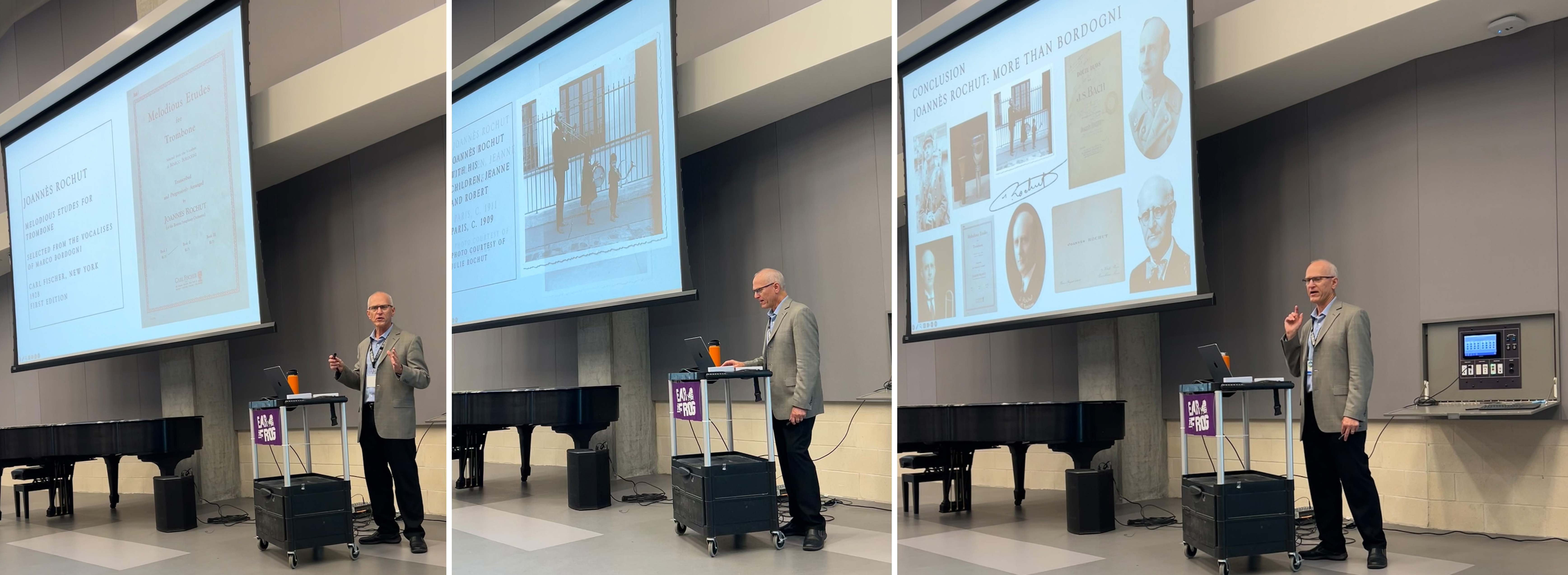
Douglas Yeo giving a presentation about Joannès Rochut, International Trombone Festival, Texas Christian University, Fort Worth, Texas, May 28, 2024

I gave a presentation about Joannès Rochut at the recent International Trombone Festival that was held at Texas Christian University in Fort Worth, Texas. I wrote about my experience at the Festival—including my presentation and other things I did there such as recitals and roundtable discussions HERE. Now I’m continuing the research I conducted to make that presentation and I’m writing a major article about Rochut that will appear in the January 2025 International Trombone Association Journal.

Rochut_Bordogni_1_ed_cover

Douglas Yeo’s copy of the first edition of Joannès Rochut’s  Melodious Etudes for Trombone, selected from the Vocalises of Marco Bordogni (New York: Carl Fischer, 1928)

I would be hard pressed to think of any serious student of the trombone—including professional players who are life-long students—who does not know the name “Joannès Rochut.” That’s because Rochut compiled three volumes of Melodious Etudes that he transcribed from Vocalises of Marco Bordogni that were published by Carl Fischer in 1928. Rochut’s books are among the most important and most frequently used trombone books in the world. Yet, most people don’t know a thing about Joannès Rochut except the fact that he published these books of Bordogni’s music.

One of the things I tell my students—especially my doctoral students who need to write a thesis or dissertation—is that research takes time. It takes discipline. It takes patience. And it requires money. Not everything is free; not everything can be accomplished from the comfort of your favorite chair at home. The Internet is a remarkable, helpful tool (while, at the same time, it is also toxic cesspool), but anyone that assumes they can successfully research a subject simply by putting a few words in a search engine or an artificial intelligence program will found out quickly that they need to do more. There is no substitute for what I call “real research.” Not “compilation,” which is taking the work of others, stitching it together, and rewording it. I’m talking about real research: finding information from diverse sources, connecting dots, and creating a coherent, new narrative that sheds light on things that are not widely known. THAT is research.

Working in and with museums, universities, libraries, archives, and other institutions is essential if one wants to find information that informs research. In my research of Joannès Rochut, I’ve been in contact with many such institutions. The Library of Congress in Washington D.C. has the Serge Koussevitzky Collection. Koussevitzky was the conductor of the Boston Symphony Orchestra when Rochut played in the orchestra, and Rochut also worked for Koussevitzky in Paris before both of them came to Boston. The LOC has letters that Rochut wrote to Koussevitzky, letters that Rochut’s Boston Symphony Orchestra colleague, Jacob Raichman, wrote to Koussevitzky, and programs from Rochut’s and Koussevitzky’s shared time together in Paris.

Ida Bisbee_1926_NEC_NEUME_cropped

Excerpt from page 27 of the 1926 New England Conservatory of Music yearbook, The NEUME, showing Ida Isabella Bisbee, trombone student of Joannès Rochut. Courtesy of New England Conservatory of Music Archives.

The New England Conservatory Archives has yearbooks, student cards, catalogs, and other information about students and faculty including Joannès Rochut and his students. Rochut’s first student at NEC was Ida Isabella Bisbee; she graduated in 1926.

The Sibley Library at Eastman School of Music has the Edna White Collection which contains more photographs of Ida Isabella Bisbee.
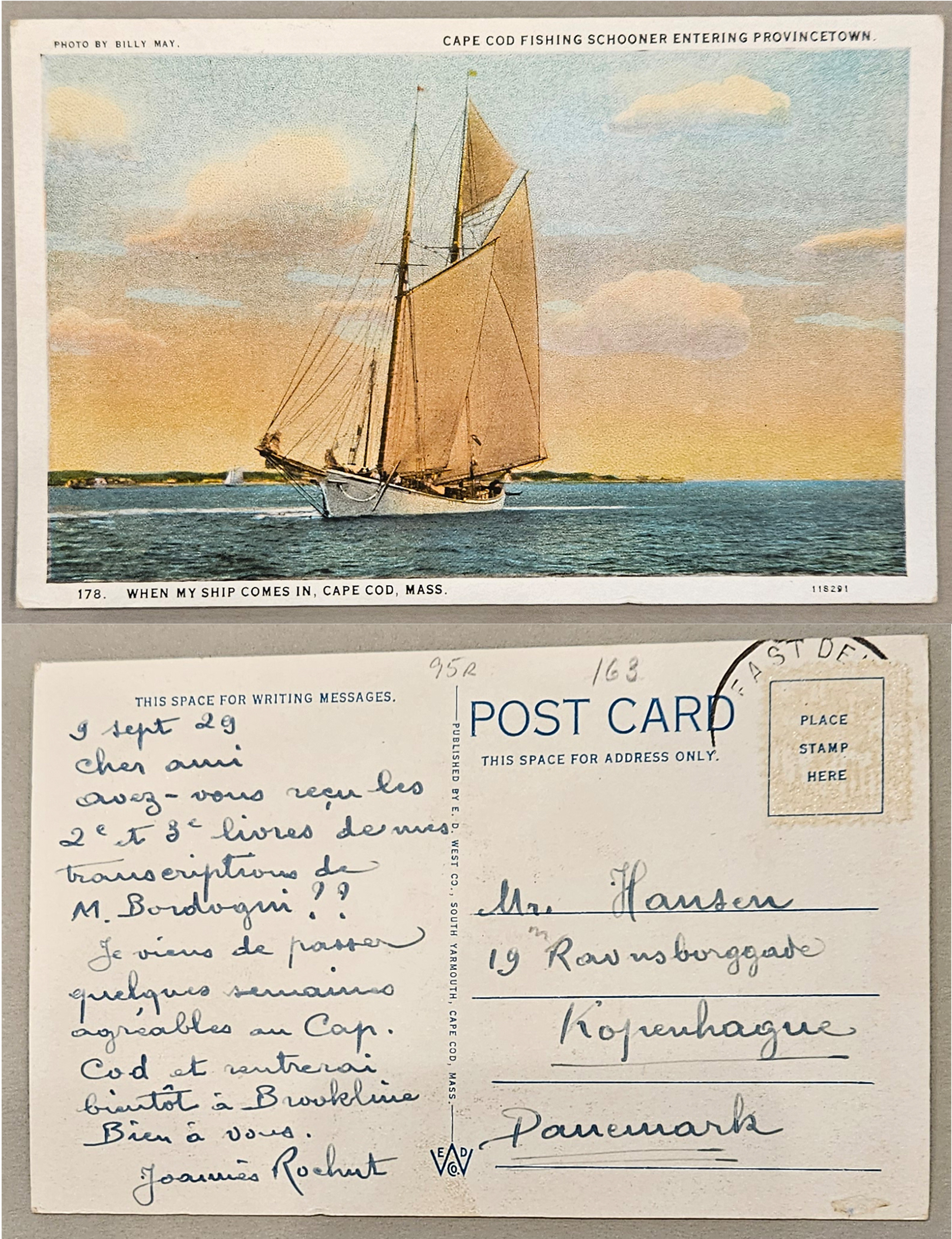
1929_Rochut_to_Hansen_postcard

Postcard from Joannès Rochut to Anton Hansen. The text of the card (translated from the original French) reads: 9 September 1929 [the postcard was mailed from East Dennis, Massachusetts], Dear friend, Have you received the 2nd and 3rd books of my transcriptions of Mr. Bordogni?? I just spent a few pleasant weeks at Cape Cod and will soon return to Brookline. Best Regards, Joannès Rochut. Courtesy of the Royal Danish Library, with thanks to Mogens Andresen for photographing the card on my behalf.

The Royal Danish Library in Copenhagen has the papers of the influential Danish trombonist, Anton Hanson, including many letters that Rochut and Hansen wrote to each other in the 1920s and 1930s.

The National Music Museum in Vermillion, South Dakota, has an extensive collection of information about trombone manufacturers, including Besson (of London) who made an instrument that Joannès Rochut played for several years.

The Registrar of Deeds in Norfolk County, Massachusetts, helped me obtain information about the house that Joannès Rochut and his wife, Louis, purchased in 1927.

The Bibliotheque national de France has many documents relating to the annual Paris Conservatoire Concours at which Joannès Rochut won first prize in 1905.

Then there is networking, connecting with old and new friends, and gratefully receiving their considerable help when I ask questions or ask for their assistance. Benny Sluchin in Paris (who has helped me in countless ways, including taking photographs of Joannès Rochut’s home and grave), David Fetter, Ronald Barron, Mogens Andresen, and Carsten Svanberg, and many more. All of them will be thanked in my article.

JULIE_ROCHUT_Joannes_Boston_business_card

Joannès Rochut’s business card, 1927, courtesy of the Rochut Family

Most importantly, I made contact with the Rochut family in France. The Rochut family has been exceptionally generous in sharing photographs, documents, and information about Joannès Rochut. I have always said that if you are researching a historical individual and you can find a family member who is willing to share things with you, the needles you find in haystacks suddenly turn to diamonds. I am so grateful to the Rochut family for their kind assistance and generosity.

The list goes on. Without connections to these institutions and individuals, my article about Joannès Rochut would amount to no more than a junior high school level term paper on the level with a paper titled, “My Summer Vacation.” 

Sometimes archives are able to provide me with resources through scanning and then sending them to me. In other cases, if it’s not possible for me to get to an archive, a friend of mine is able to view the resources I’m looking for on my behalf. And sometimes, you just have to go yourself.

A few weeks ago, I decided I needed to spend one day researching in the Boston Symphony Orchestra Archives. This is a place that is near and dear to my heart. When I joined the Boston Symphony Orchestra in 1985, I wanted to learn as much as I could about the orchestra and its low brass players in particular, including Joannès Rochut. I asked William Moyer, who at the time (1985) was personnel manager of the BSO (he had played second trombone in the BSO from 1953 to 1966 before becoming personnel manager), if the orchestra had an archive. He took me to a building adjacent to Symphony Hall, what was, at the time, called the Symphony Hall Annex (today, fully renovated, it is the Cohen Wing of Symphony Hall). It was a run down building that the orchestra had plans to renovate someday. Bill and I came to a locked door, he put a key in the door, opened the door, and there was the Boston Symphony Orchestra archives.

It was a shambles. As I walked into the room—a large room with another room next to it—and Bill turned on the light, I saw shelves that stretched from floor to ceiling. There were jumbles of documents, books, and other materials strewn around the room. Filing cabinets were open and documents were falling out. There was no heating or cooling system in the room. It was damp. 

But I could tell right away that the room was full of treasures. Despite the chaotic disorganization of materials, my mind raced and recalled on Howard Carter’s words when he first peered into King Tutankhamen’s tomb and was asked what he saw. “I see wonderful things,” Carter said. Yes. I saw wonderful things.

Yeo_BSO_photo_negatives

Two of the several dozen negatives Douglas Yeo had made from photographs in the proto-Boston Symphony Archives, 1985–1987

Because of my interest in researching Joannès Rochut and other Boston Symphony Orchestra brass players, Bill gave me a key to this room. The BSO had no archivist at the time; Bill just gave me a key. He told me I could look through it and if I found things that were helpful to my research, I could use them. So I did. I spent hundreds of hours in those rooms, during rehearsal breaks, between rehearsals, before concerts, on some of my days off. And this was in the era before personal computers, scanners, or cell-phone cameras. If I found a photograph I thought I would someday use in an article, I needed to take photographs to a photography studio and have large negatives made so I could submit the images to publications. This was expensive. But it was the only way I could have permanent access to the images I wanted to use and continue to reference.

1986_ITA_Journal_BSO_low_brass_Yeo

Cover of the Fall 1986 issue of the International Trombone Association Journal that contains the article by Douglas Yeo, “A Pictorial History of Low Brass Players in the Boston Symphony Orchestra, 1887–1986”

I began to systematically work through the contents of these disorganized rooms, looking for photographs and information about Boston Symphony Orchestra trombone and tuba players. I found a lot. I carefully made new piles of materials on the disorganized shelves, an attempt to bring some order to the mess. I would bring my discoveries to Bill Moyer who shared my excitement and in time, I amassed a great deal of information that eventually found its way into four articles I wrote about Boston Symphony Orchestra brass players (click on the titles to read a PDF of these articles):

These were among my earliest published research projects and if I did them over today, I would do them very differently. My research methods have improved over the years, no doubt about that. But they were an earnest attempt to inform readers about some of the rich history of Boston Symphony Orchestra brass players. Even after my articles were published, I continued my research into the lives and work of the fascinating individuals who played brass instruments in the BSO. 

1987_Yeo_BSO_archives_memo_incipit

The opening paragraphs of a draft memo Douglas Yeo wrote for Boston Symphony Orchestra acting General Manager Daniel Gustin after meetings of the first ac-hoc committee to explore the establishment of the Boston Symphony Orchestra Archives (Douglas Yeo, Steven Ledbetter, Bruce Creditor, and Eleanor McGourty), April 27, 1987

But there was more. Intuitively, I knew that the Boston Symphony Orchestra’s history needed to be better preserved. Two disorganized rooms were not a proper archive. I began talking with others in Symphony Hall about this. I started with Daniel Gustin, who was, at the time, acting General Manager of the Boston Symphony Orchestra. He listened to all I had to say about the need for a proper archives at Symphony Hall. He suggested I get together with others who shared an interest in the BSO’s history and come up with a proposal that he could consider. So I began talking with Bruce Creditor who was Bill Moyer’s assistant. Eleanor McGourty was director of publications for the orchestra—she was responsible for putting together the weekly concert programs for the orchestra along with Steven Ledbetter who, as the orchestra’s musicologist, wrote program notes for the concert programs. Bruce, Steven, Eleanor, and I loved the BSO and its rich history, and we met to put our heads together. After we met, I drafted a memo on April 24, 1987, that summarized some of our discussion. You can read that memo (the opening paragraphs are in the photograph, above) HERE. It was a seminal document, the basis for a subsequent memo that was used by Daniel Gustin and then his successor, Boston Symphony Orchestra General Manager Kenneth Haas, as the orchestra’s management discussed the idea of a proper archive with the Board of Trustees. The happy result was the formal establishment of the Boston Symphony Orchestra Archives and the hiring of a full time archivist, Bridget Carr, who holds the position of Blanche and George Jones Director of Archives/Digital Collections for the Boston Symphony Orchestra, including the Boston Pops, Tanglewood, and Symphony Hall.

If you look at the four articles  I wrote about Boston Symphony brass players that appeared in the International Trombone Association Journal, the T.U.B.A. Journal (now the International Tuba Euphonium Association Journal), the International Trumpet Guild Journal, and The Horn Call (linked above), you will see that most of the material that informed those articles came from the Boston Symphony Orchestra Archives. As I’ve continued my research on Joannès Rochut more recently, it became clear to me that I needed to spend some dedicated time in the BSO Archives to get information that can only be found there. Many archivists around the world have been extremely helpful to me—including Bridget Carr—in locating and sending me documents and photographs. But archivists are not my personal research assistants. There is a limit to what I can ask them to do. And, while I had a long list of things I knew I wanted to see in the BSO Archives, I also wanted to look at resources and files and see what I might find that I didn’t even know I wanted.

So, last Tuesday (August 6, 2024), I flew to Boston to spend a day in the Boston Symphony Orchestra Archives. It was another “crazy day,” my second one this summer. Readers of TheLastTrombone know that when my flight to Texas was cancelled when I was scheduled to attend the International Trombone Festival in Fort Worth, I did the only thing I could do to get to the Festival on time: I drove. 16 hours from Chicago to Fort Worth, 960 miles. Straight through, no overnight stop. Truly crazy. My trip to the BSO Archives was not THAT crazy. OK, I did have to get up at 3:00 am to get my 6:05 am flight from Chicago’s O’Hare airport to Boston’s Logan Airport. And I walked in my front door after my return at midnight the same day. But with a $139 round trip plane ticket (thank you, American Airlines), a couple of Uber rides to and from Logan, parking at O’Hare, and lunch and dinner (of COURSE I had a bowl of New England Clam Chowder and a lobster roll at Legal Sea Foods for dinner at Logan airport), my less than $500 investment in the trip bore rich fruit. 

Yeo_Cassell_Symphony_Hall_2024_08_06

Douglas Yeo and Charles Cassell in the basement of Symphony Hall, Boston, August 6, 2024. Photo by Bridget Carr.

Bridget Carr met me at the Symphony Hall Stage door, and as we wound our way through the hall to the Archives, the first person I saw was my friend, Charles Cassell. We met with a big hug. Charlie is the only member of the Symphony Hall house crew who is still there from the years I was a member of the orchestra (1985–2012). When I was a member of the BSO, I always felt that he and the other members of the house crew were superheroes. They cared so deeply about Symphony Hall and nobody cared more—and knew more—about Symphony Hall than Charlie. I appreciated those great guys of the Symphony Hall house crew, and they appreciated me. It was really, really wonderful to see him.

Douglas Yeo Visits the BSO Archives_IMG_7445

Douglas Yeo in the Reading Room of the Boston Symphony Orchestra Archives, August 6, 2024. Photo by Bridget Carr.

It was an absolute joy to be back in the Boston Symphony Orchestra Archives. It is one of my happy places. Archivist Bridget Carr and I have been good friends for over 30 years. With my long list of things I hoped to find during my time in the Archives in her hand before I arrived, Bridget had them all ready for me in the Archives’ Reading Room. The day flew by and the discoveries mounted up. Bridget was exceptionally accommodating and helpful beyond words as we discussed Joannès Rochut and his time in the Boston Symphony Orchestra. All day long, I kept asking questions, Bridget kept pulling out more resources from the shelves and stacks in the Archives, and we immersed ourself in a moment of time in BSO trombone history nearly 100 years ago.

Sept_1926_BSO_contract_salary_notes_Rochut_CROPPED

Handwritten comments by Boston Symphony Orchestra President of the Board Frederick P. Cabot, referencing Joannès Rochut on a document that was used to guide renewal of player contracts and salary adjustments for the 1926–1927 season. Cabot’s comments about Rochut read, “increase pay – magnificent.” Courtesy of the Boston Symphony Orchestra Archives.

I was interested in learning about BSO member salaries at the time. The records were there. I wanted to learn about the impact of the Great Depression on the Boston Symphony Orchestra. The annual auditor reports were there. I wanted to find more photographs of Rochut with the BSO. They were there. I wanted to find newspaper clippings and reviews of concerts. They were there. 
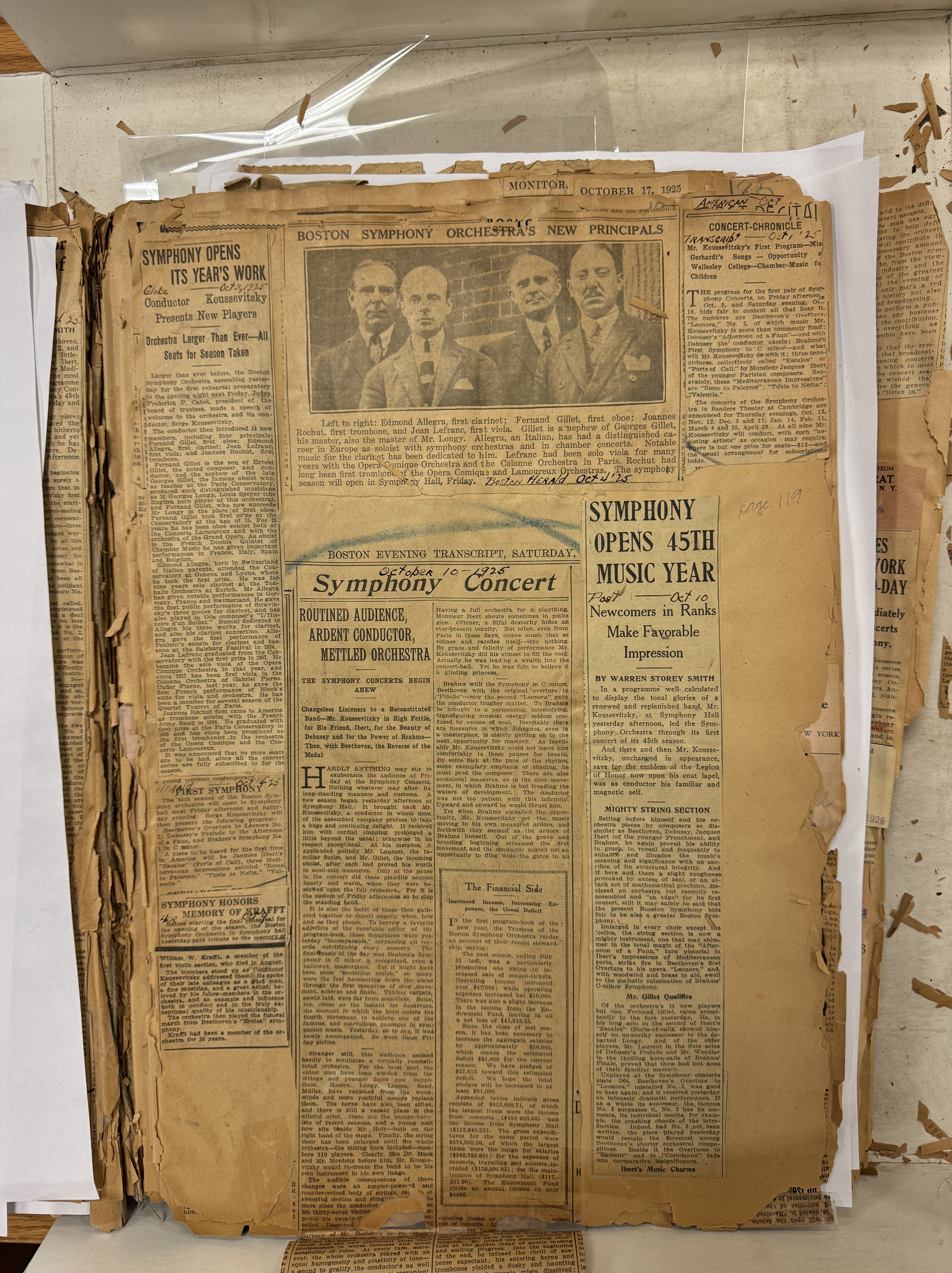
1925_Oct_4_BSO_scrapbook_Rochut_new_members

A page from a Boston Symphony Orchestra scrapbook that includes an announcement in the Boston Herald of “Boston Symphony Orchestra’s New Principals” (October 4, 1925). In the photo at the top of the page, Joannès Rochut is second from right. Courtesy of the Boston Symphony Orchestra Archives.

I found a photograph of Joannès Rochut in a Boston Symphony Orchestra scrapbook from 1925 (above). It appeared in an article in the Boston Herald on October 4, 1925. These scrapbooks proved to be invaluable during my research trip. I must have looked at 15 of them during my visit to the Archives. They are old and brittle, but, fortunately, they also have been photographed so the treasures they hold will be available for researchers to consult long after the fragile paper turns to dust.

Fiedler_Rochut_check_August_1929

A check from Arthur Fiedler to Joannès Rochut, payment for one week of concerts on the Charles River Esplanade, August, 1929. Courtesy of the Boston Symphony Orchestra Archives.

And there were other discoveries, like this check (above) that conductor Arthur Fiedler wrote to Joannès Rochut for playing a week of summer concerts with Boston Symphony Orchestra members on the Charles River Esplanade in Boston during the summer of 1929.

1929_Pops_esplanade_ROCHUT

Arthur Fiedler with members of the Boston Symphony Orchestra in a concert in the Hatch Memorial Shell, Charles River Esplanade, Boston, summer 1929. Courtesy of the Boston Symphony Orchestra Archives.
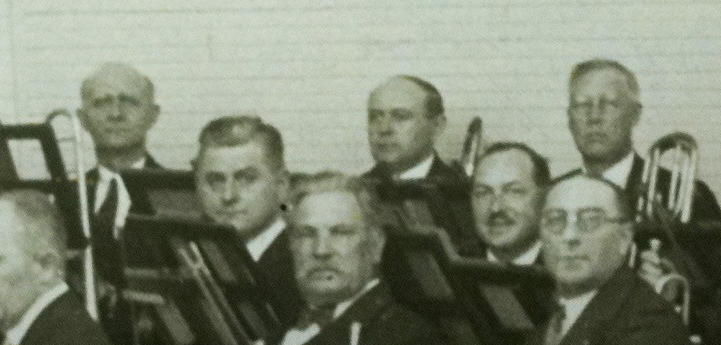
BSO_Rochut_Raichman_Hatch_Shell_1929_detail

Detail of the above photo. Boston Symphony Orchestra trombone section members Joannès Rochut, Jacob Raichman, and Leroy Kenfield, Hatch Memorial Shell, Charles River Esplanade, summer 1929. Courtesy of the Boston Symphony Orchestra Archives.

Bridget brought out a huge photo of Arthur Fiedler with members of the Boston Symphony Orchestra at a Charles River Esplanade concert in the summer of 1929 (above), one of many things that brought Rochut’s time in Boston to life during my visit to the BSO Archives.
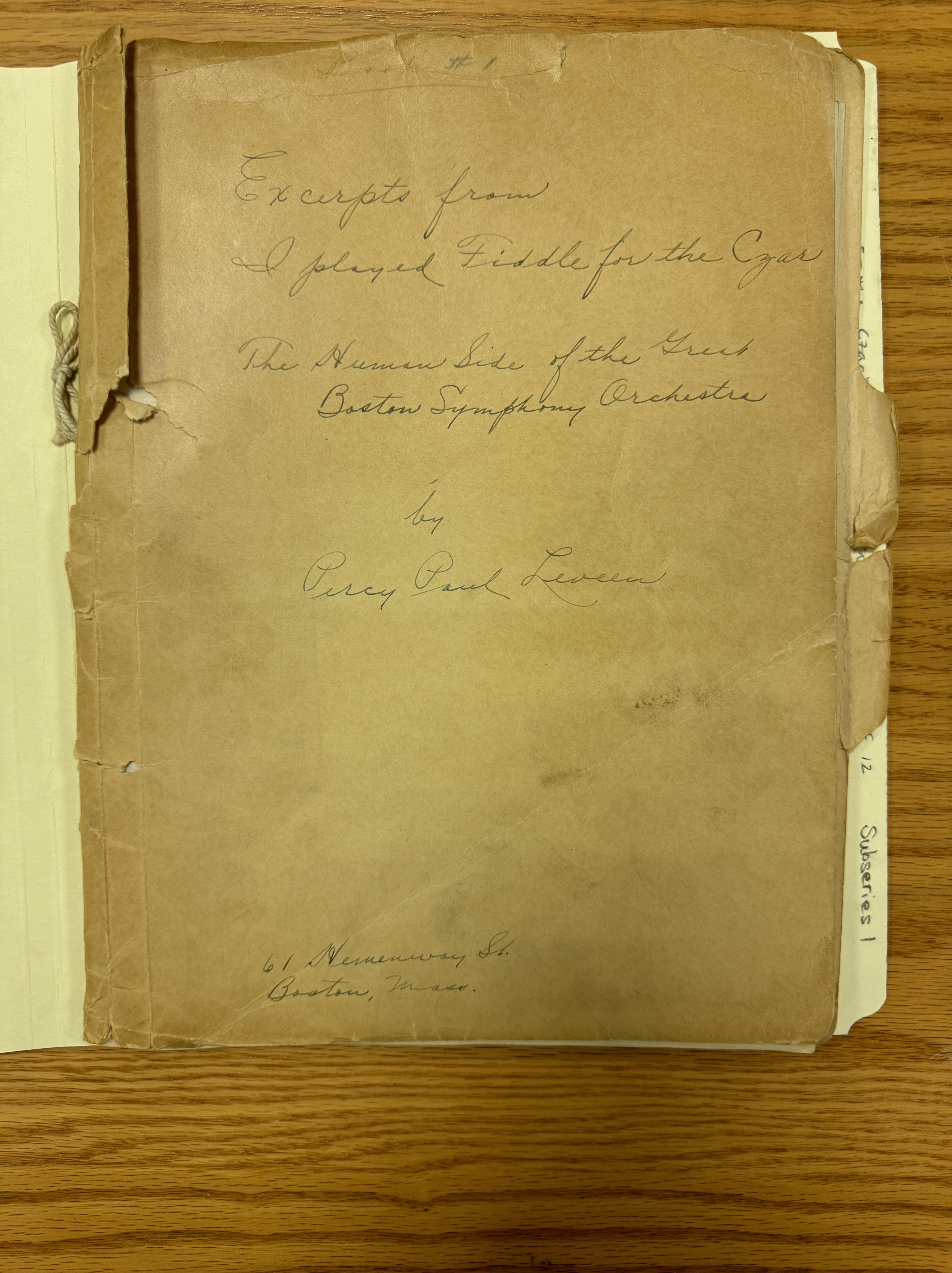
Percy_Paul_Leveen_I_Played_Fiddle_Czar_cover

The cover of Percy Paul Leveen’s unpublished book manuscript, I Played Fiddle for the Czar. Courtesy of the Boston Symphony Orchestra Archives.

The Archives had another treasure I had not previously known about—the memoirs of violinist Percy Paul Leveen, who was a member of the BSO from 1919–1944. Leveen’s unpublished manuscript for a planned book, I Played Fiddle For the Czar—there is no doubt, after reading the manuscript, that “the Czar” was BSO conductor Serge Koussevitzky—provides first person insight to pivotal moments in Boston Symphony Orchestra history. Such as “Black Tuesday,” October 19, 1929, that signaled the beginning of the Great Depression. On that fateful day, the Boston Symphony Orchestra was in Chicago for a concert in Orchestra Hall. Leveen’s comments about how players reacted to those life-changing economic events are riveting. And I will use some of Percy Paul Leveen’s insights in my article. 

Boston_Symphony_Hall_2024_08_06

A view from the stage of Symphony Hall, Boston, August 6, 2024

On my way out of Symphony Hall, I told Bridget I’d like to have a look at the inside of the hall itself. I was very happy to stand on the Symphony Hall stage again. The hall was undergoing the changeover from the Boston Pops season—the usual seats are removed on the main floor and replaced with tables and chairs during Pops—while the orchestra is at its summer home, Tanglewood, and there was maintenance work going on. I played so many concerts in Symphony Hall; seeing it again brought back a lot of memories. I played concerts on that stage for over 27 years, the same stage where Joannès Rochut played many concerts. Symphony Hall remains a very special place to my family and me.

In the days since I’ve returned from my visit to the Boston Symphony Orchestra Archives, my article on Joannès Rochut has taken on a new dimension. I have a lot more work to do in the coming weeks before I hit the submission deadline for my article, but many of the documents and photographs I obtained during my visit will now be part of my article. I am so grateful to Bridget Carr and her staff who are keepers of the history of the Boston Symphony Orchestra, and the value of her helpfulness cannot be overstated.

Douglas_Yeo_Bridget_Carr_BSO_Archives_2024_08_06

Douglas Yeo and Bridget Carr in the Boston Symphony Orchestra Archives, August 6, 2024

This is research. Looking, digging, contacting, networking, visiting, calling, emailing, connecting. Last Tuesday, all of those things came together in Symphony Hall, Boston’s proud temple of music. The fruits of my research on Joannès Rochut will appear in print soon. His story is quite a story, and thanks to places like the Boston Symphony Orchestra Archives and people like Bridget Carr, I will be able to tell it in a way that has never been told before. Stay tuned.

[And here’s a little bonus. Compare this photo of me, below, that I took last week outside of Symphony Hall’s Stage Door with the following photo of three members of the Boston Symphony Orchestra that was taken in 1934, 90 years ago. I love this stuff.]

Douglas_Yeo_Symphony_Hall_stage_door_Aug_6_2024

Douglas Yeo at the Symphony Hall Stage Door, Boston, August 6, 2024

Raichman, VandenBerg, Gebhardt, Boston Sym 1934

Three members of the Boston Symphony Orchestra: Jacob Raichman (trombone), Cornelius Van den Berg (horn), and William Gebhart (horn), Symphony Hall Stage Door, 1934. Courtesy of Irene Raichman Shermont. 

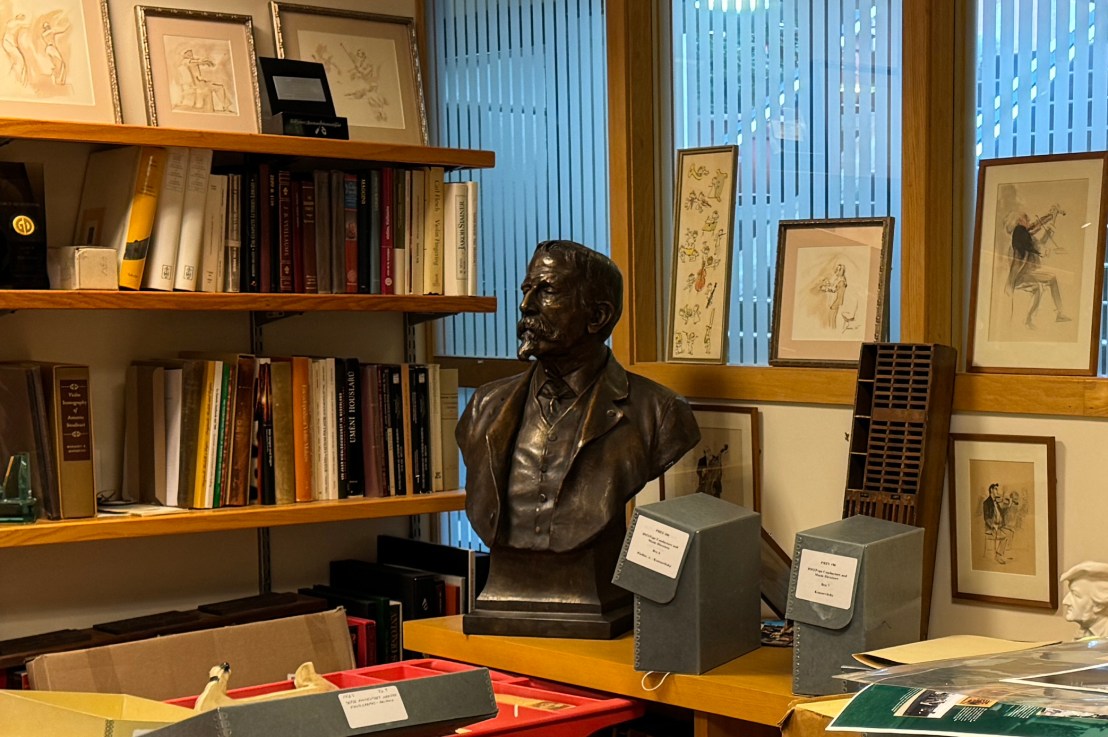
[Header photo: The reading room in the Boston Symphony Orchestra Archives. The bust on the table is of Major Henry Higginson, founder and sustainer of the Boston Symphony Orchestra.]

For everything there is a season

For everything there is a season

by Douglas Yeo (May 19, 2024)

The Bible gives us answers, and it reminds us of this (Ecclesiastes 3:1-8, English Standard Version):

For everything there is a season, and a time for every matter under heaven:

a time to be born, and a time to die; a time to plant, and a time to pluck up what is planted;

a time to kill, and a time to heal; a time to break down, and a time to build up;

a time to weep, and a time to laugh; a time to mourn, and a time to dance;

a time to cast away stones, and a time to gather stones together; a time to embrace, and a time to refrain from embracing;

a time to seek, and a time to lose; a time to keep, and a time to cast away;

a time to tear, and a time to sew; a time to keep silence, and a time to speak;

a time to love, and a time to hate; a time for war, and a time for peace.

For each of us, our lives are full of seasons, and I have recently turned the page on a very long season of life and a new season is upon me.

Pearce_trombone_Concert_stylings

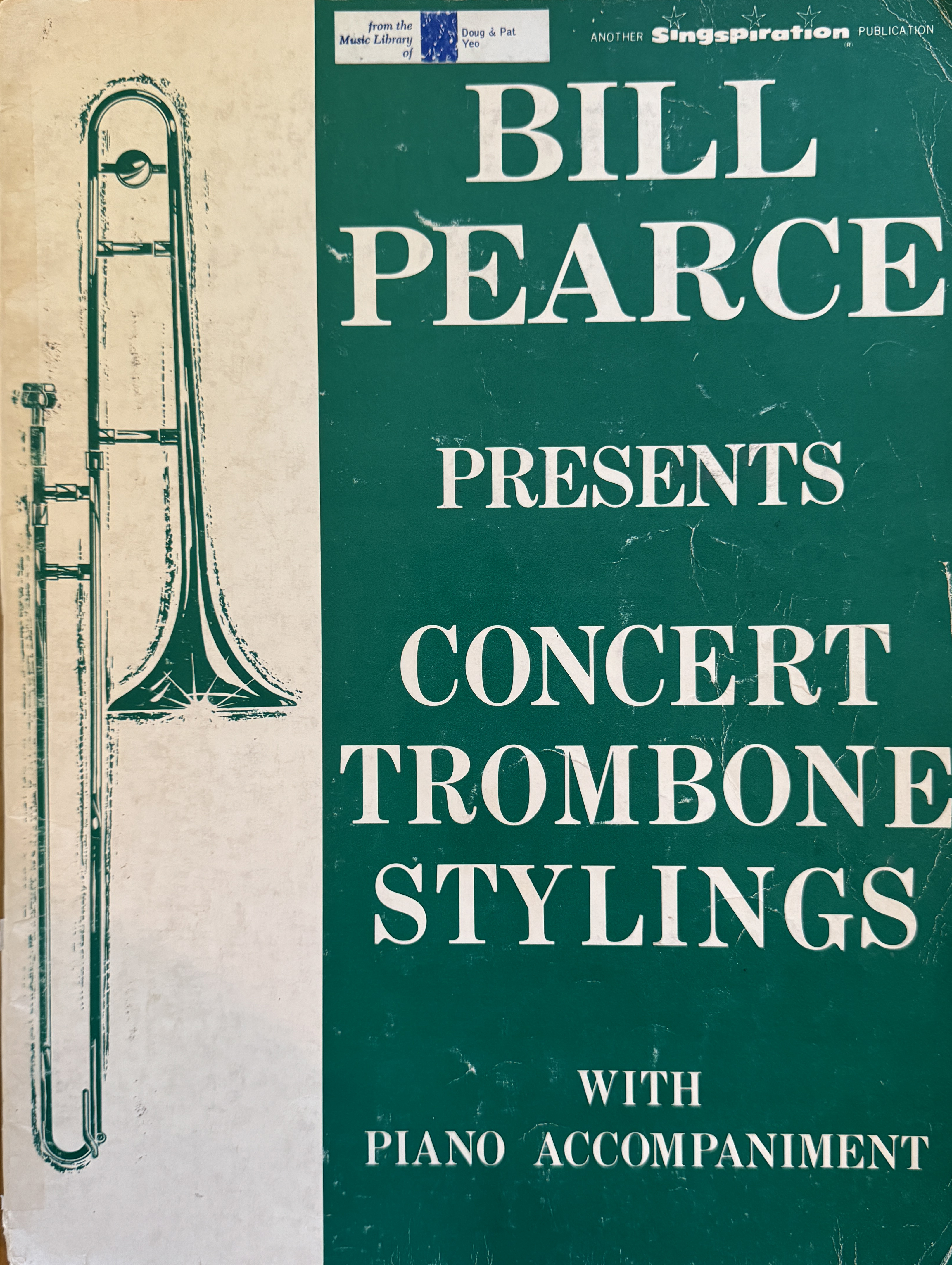
One of the Bill Pearce solo trombone with piano books that my first trombone student, Lloyd, gave to me in payment for trombone lessons I gave him at Wheaton College in the summer of 1974.

I have been teaching trombone lessons since the summer of 1974. At that time, I was a student at Wheaton College and another student on campus, Lloyd, asked if he could take some lessons with me. Lloyd wasn’t a trombone major; in fact, he was a student at Wheaton College for only that one summer quarter. But I was happy to help him improve his skills. At the end of the lessons, Lloyd told me he didn’t have money to pay me but if I would accept them, he would give me five books of solos for trombone and piano by the great gospel trombonist Bill Pearce. 50 years later, I still have and use those books. After that summer, I began teaching weekly lessons to young players through the College’s Preparatory Department. Doing so helped me get through college without any debt (that job along with other jobs that included working as student manager of the College artist series, working two days a week at a local White Hen Pantry, and shoveling snow for an office park in the winter).

Since that time, I’ve taught regularly in many schools, first as a high school band director, then as trombone teacher/professor of trombone:

STA_My_Fair_Lady_pit_band

St. Thomas Aquinas High School, Edison NJ (1979-1981) — with students in rehearsal for the school’s production of My Fair Lady, 1981.

Peabody_News_1982

Peabody Institute of Johns Hopkins University, Baltimore MD (1982-1985) — Announcement from September 1982  in Peabody News listing faculty members who were members of the Baltimore Symphony Orchestra

NEC_Trombones_1990_01

New England Conservatory of Music (1984-2012) — conducting the New England Trombone Choir at New England Conservatory, 1990

ASU_Desert_Bones_2016

Arizona State University, Tempe AZ (2012-2016) — ASU Trombone Studio with the University’s mascot, Sparky, 2016

Wheaton College, Wheaton IL (2019-2023) — performance of Canzone by Girolamo Frescobaldi, arr. Eddy Koopman, Wheaton College faculty recital, April 23, 2022

UIUC_Illinois_trombone_studio_2024_signed_photo

University of Illinois Urbana-Champaign, IL (2022-2024) — signed photo given to me by members of the University of Illinois Trombone Studio, May 2024

Since I retired from the Boston Symphony Orchestra in 2012 after more than 27 years as a member of that great orchestra, my life has taken many turns. My wife, Patricia, and I moved to Arizona where I immediately flunked retirement and accepted the full time position as professor of trombone at Arizona State University. In 2018, we moved to the Chicago area to be near our grandchildren (grandkids truly make you do crazy things, like move from Arizona to the Midwest) and I flunked retirement again when I was asked to teach at my undergraduate alma mater, Wheaton College. When University of Illinois asked me to take a one year position as professor of trombone for 2022-2023—a position that came to me most unexpectedly and I thoroughly enjoyed—I looked forward to trying this retirement thing again in 2023 when that appointment was up and, at the same time, I decided to step away from teaching at Wheaton College. But as things turned out, one year of teaching at Illinois turned into two years. Happily, the Illinois School of Music recently hired a new full time trombone professor and my appointment at Illinois concluded.

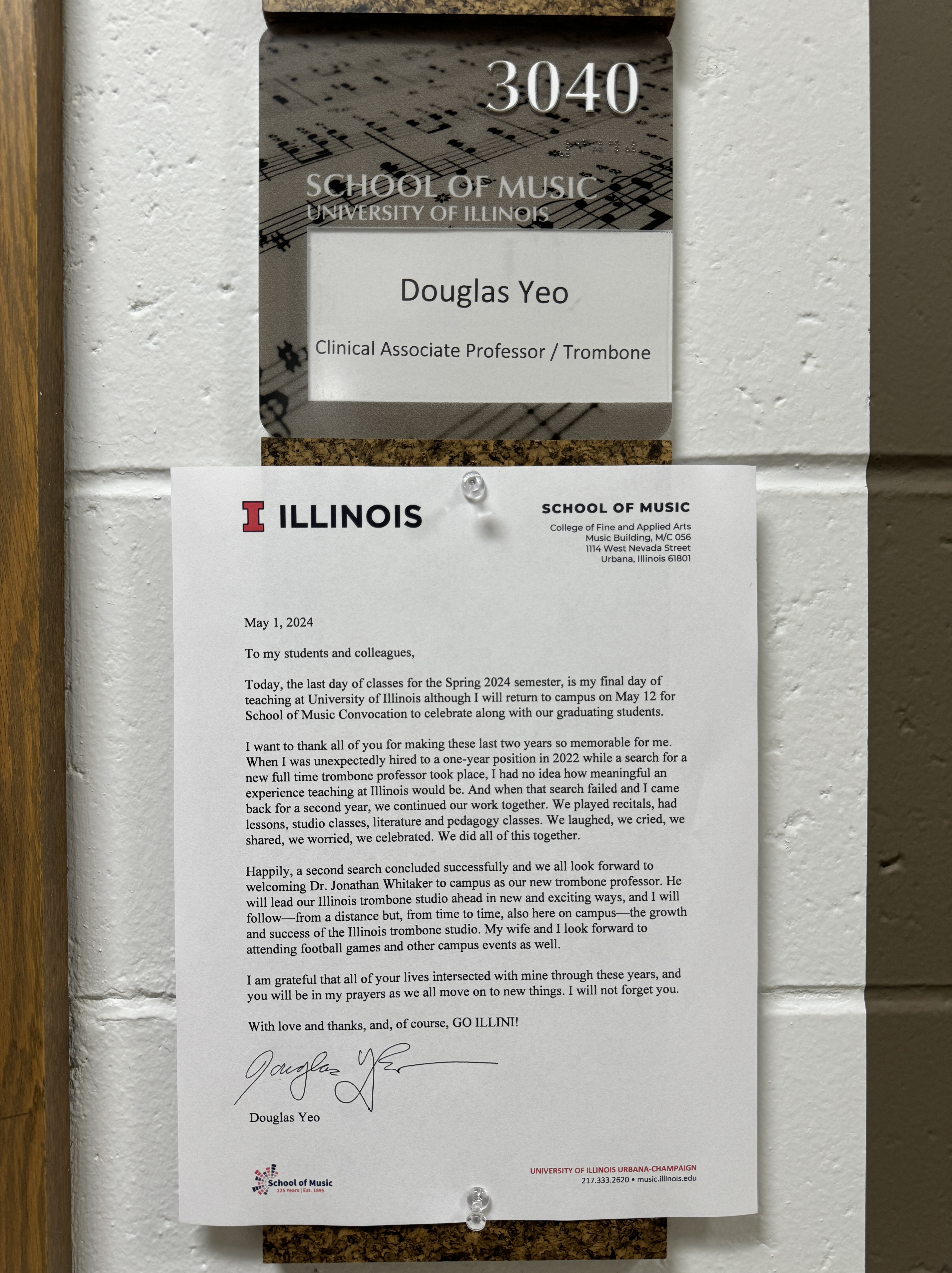
Yeo_UIUC_office_letter

I taught my last trombone lessons at University of Illinois Urbana-Champaign on May 1 and before I headed home, I wrote a letter to my students and colleagues that I posted on the bulletin board next to my office, shown above.

UIUC_Convocation_students_2024

With my graduating students at University of Illinois Urbana-Champaign School of Music Convocation, May 12, 2024. Left to right: Rachel Lin (Bachelor of Music Education), Jerry Min (Bachelor of Music), Lorraine Montana (Master of Music)

I returned to campus on May 12 when  University of Illinois held a Convocation ceremony for the School of Music and I celebrated the graduation of three of my students. In a sense it was a graduation ceremony for me, too, as I closed out two memorable years teaching at University of Illinois, a campus community where I feel a very strong connection. When the ceremony was over, I took off my academic regalia, switched off the lights in my office, and turned in my keys. On the long drive home through the beautiful, newly planted Illinois cornfields, I began to reflect on all that had just happened. A new season had begun.

Illinois_cornfields_May_2024

Newly planted Illinois cornfields along Illinois Route 115, May 12, 2024

Illinois_corn_May_2024

The corn is now just a few inches tall and in late fall it will be, in the words of the song, “Oh, What a Beautiful Mornin'” from the musical Oklahoma!, “as high as an elephant’s eye.”

As I see it, “retirement” is a lousy word. When I decided to retire from the Boston Symphony, many of my colleagues asked me, “So, are you going to take up golf?” Nope. Golf doesn’t interest me. And I never saw “retirement” as a season of life devoted to non-stop self-entertainment. After decades playing in symphony orchestras, I looked forward to new adventures. I wanted to have more time to research and write, to travel with my wife, to enjoy more time with our daughters and their families, and, with open hands, respond to God’s call to His purposes for my life.

Retirement, as it turned out, meant not playing golf or kicking back and “doing nothing,” but, rather that I was busy doing a host of engaging activities.

UIUC_trombone_studio_Lincoln_poster

The poster that hung in my office at University of Illinois for the last two years. It contains a logo my friend, Lennie Peterson, designed for our trombone studio, my five core tenets of teaching, and a quotation from Dr. Robert E. Gray that sums up the ethos of the University of Illinois Trombone Studio.

I’ve spent most of the last 12 years teaching at colleges and universities each week of the academic year: Arizona State, Wheaton College, University of Illinois. Working with those students has been such a big part of my life. But as I near a birthday with a zero on the end of it (it’s not 60; that was a long time ago. . .), I decided, after much thought and prayer, to step aside from weekly trombone teaching and have more time to do other things. This doesn’t mean I’ve taught my last trombone lesson. I love teaching; I still do. But this change in my life means I won’t be doing that teaching every week as a school’s trombone professor. This freedom gives me time to explore and enjoy both new and familiar things.

And there is a lot ahead for me. Later this month, I’ll travel to Texas Christian University (TCU) in Fort Worth, Texas, to take part in the International Trombone Festival. I’ll give a recital, serve on two roundtable discussion panels (one is about diversity considerations in recital programming; the other is about trombone research), give a major presentation about the celebrated trombonist Joannès Rochut, perform with the TCU trombone choir, and accept the International Trombone Association’s Lifetime Achievement Award. This summer my wife and I will take hiking trips to Grand Canyon and Zion National Parks (with our oldest daughter’s family, including our grandchildren), and Sequoia and King’s Canyon National Parks (with our youngest daughter and her husband). In September, I’ll conduct a trombone residency at University of Texas, Austin. In October I’ll play ophicleide in concerts with the San Francisco-based early music group, Philharmonia Baroque. We’ll attend many baseball games this summer (Chicago Cubs, Schaumberg Boomers, Chicago Dogs, Kane County Cougars, Oakland Ballers), and fall will bring us to our seats in Chicago’s Soldier Field for Chicago Bears football. A major American symphony orchestra has asked if I would be willing to substitute with them in the coming season. Research and writing projects are on my plate (watch the July 2024 issue of the International Trombone Association Journal for my article about the history and a chemical analysis of trombone slide oil, and the January 2025 issue for my article about Joannès Rochut; I’m also at work on a new book for Oxford University Press), as are hikes, walks and tandem bicycle rides with Patricia. And serving our church and enjoying life with our grandchildren.

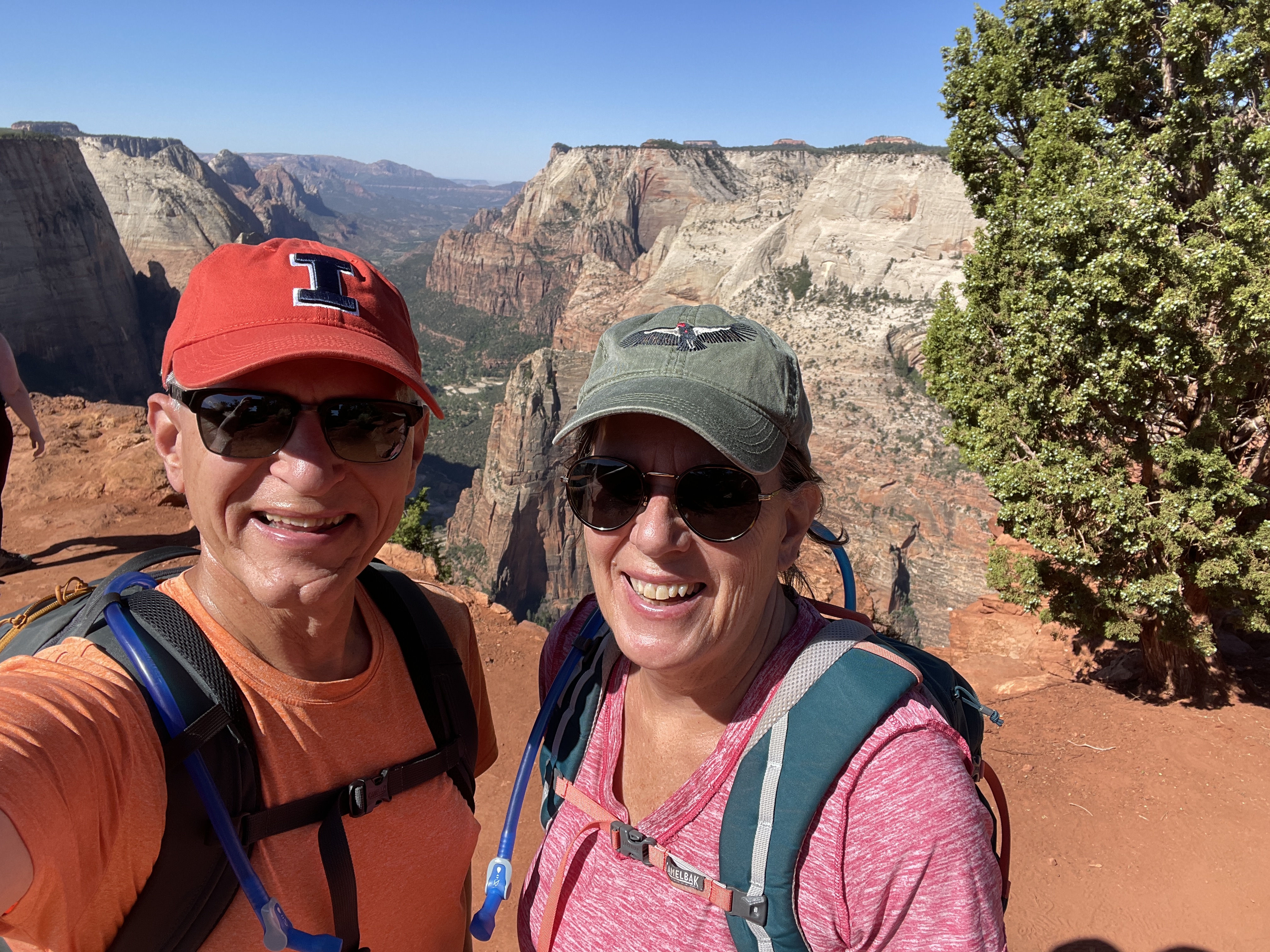
Doug_Pat_Zion_Observation_Point_June_2023

With my wife, Patricia, at Observation Point, Zion National Park, June 2023. We will return to this special place next month; it will be our 19th trip to Zion National Park.

So, as my long season of institutional teaching has turned a page, I look back at those decades with great fondness and gratitude. And I have learned this: I don’t know all of what God has for me going forward.  With open hands, I’m grateful for the opportunities I’ve had to serve, learn, and contribute. I plan to keep doing that in both new and familiar ways as God leads. I look forward to seeing you along the road.

Remembering Seiji Ozawa (1935–2024)

Remembering Seiji Ozawa (1935–2024)

by Douglas Yeo (February 12, 2024)

Last Friday, I arrived at my office at University of Illinois Urbana-Champaign at 7:00 am to get ready for a full day of teaching. As is my habit before taking out my trombone and warming up, I opened my laptop, quickly checked my email, and scanned the morning’s news headlines where I read an announcement that conductor Seiji Ozawa had died on Tuesday, February 6, at the age of 88.

I burst into tears and cried like a baby.

Seiji Ozawa hired me into the Boston Symphony Orchestra in 1985. At age 29, I joined the BSO for a career that extended until 2012, 27 years of memorable music making and other wonderful experiences. Seiji was music director of the BSO from 1973 to 2002, and his death brings back unforgettable memories of the intersection of our lives. Here is the Seiji Ozawa I knew and will always remember.

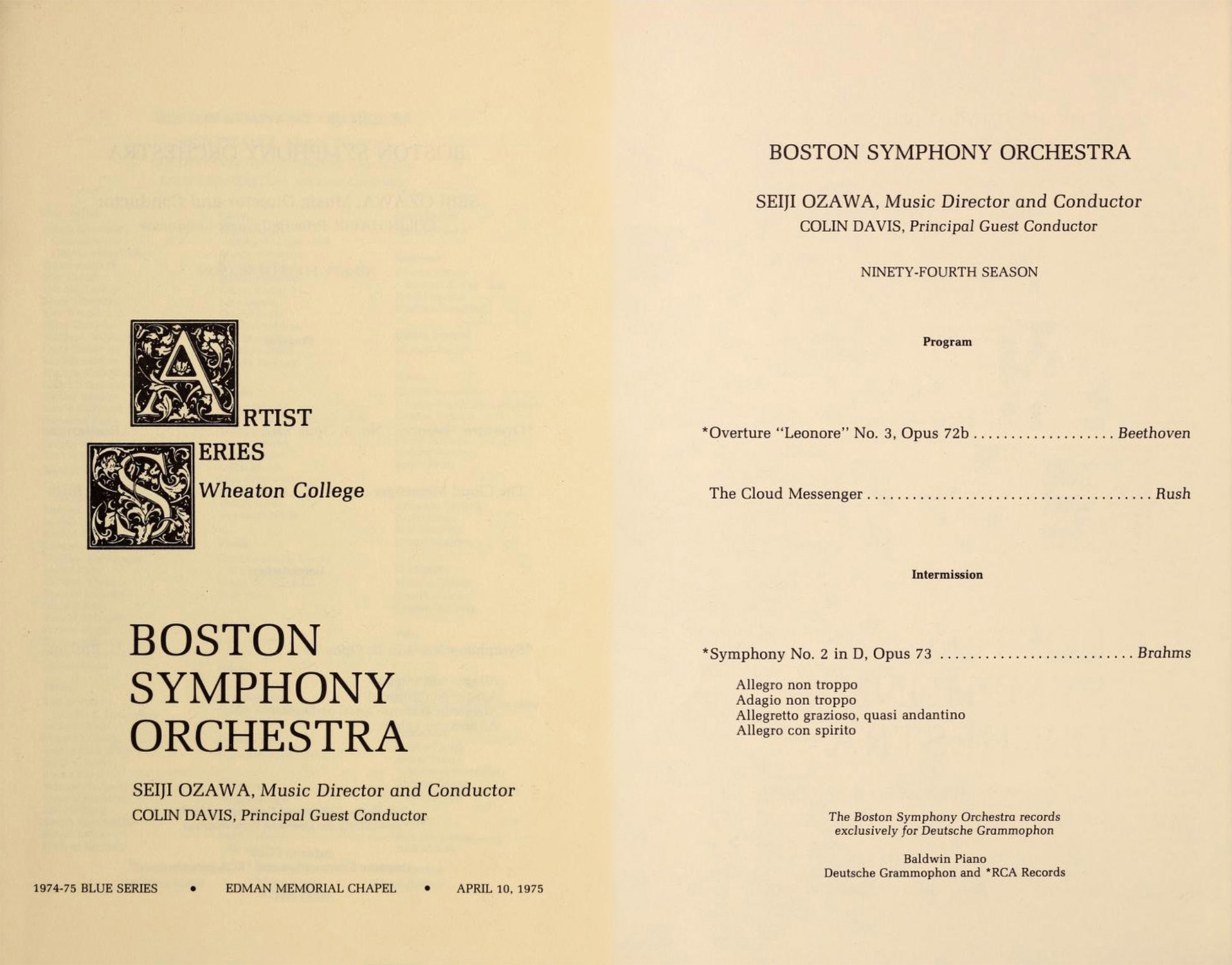
BSO_Wheaton_College_1975_program

Wheaton College Artist Series program, Boston Symphony Orchestra, April 10, 1975

I first met Seiji Ozawa in April 1975 while I was a student at Wheaton College, Illinois. The college had an artist series of eight concerts each year and the Boston Symphony Orchestra came to give a performance in Edman Memorial Chapel. I had been tapped to be student manager of the artist series for my senior year at Wheaton, 1975-1976, so, being groomed for that position the season before, I had backstage access to the BSO concert. I was wowed that I got to see and hear the Boston Symphony Orchestra up close. Even though I was studying trombone with Edward Kleinhammer, the great bass trombonist of the Chicago Symphony Orchestra from 1940-1985, and the CSO was front and center in my orchestral universe, I had always loved the Boston Symphony Orchestra. In fact, in my high school yearbook (1973), in that pretentious paragraph seniors get to write about themselves with our favorite inspirational quotations and our hopes and dreams for the future, I wrote, “I want to play in the Boston Symphony Orchestra.”

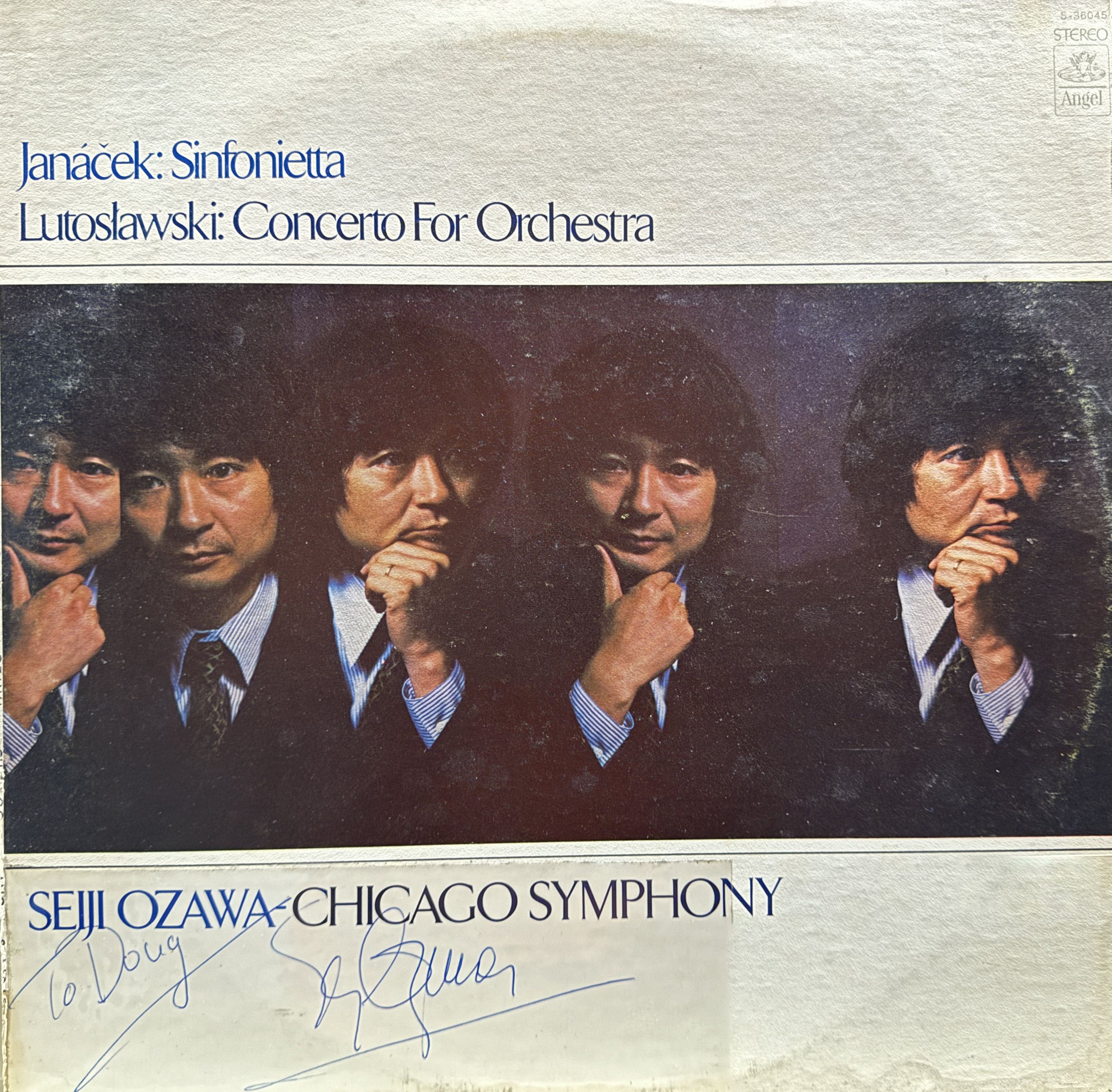
CSO_Janacek_Ozawa_LP

Chicago Symphony Orchestra recording of Janéček Sinfonietta and Lutoslawski Concerto for Orchestra with Seiji Ozawa, conductor. Angel S-36045; recorded 1970.

I met the orchestra’s trombone section: William Gibson, Ronald Barron, and Gordon Hallberg. And I met Seiji Ozawa. I brought a record for him to autograph which he graciously did (above). Today I look back and shake my head: I asked him to sign a recording he made with the Chicago Symphony (Seiji had been music director of the Ravinia Festival, summer home of the CSO), not the Boston Symphony! But he was kind to sign the record jacket for me and I still have that LP; it is a treasure. At the concert, held the door to the stage open a little bit when the BSO’s principal trumpet player, Armando Ghitalla, played the offstage trumpet solo to Beethoven’s Leonore Overture No. 3. The whole experience was unforgettable. Little did I know that 10 years later, I would be sitting on stage with many of those same Boston Symphony players with Seiji conducting me.

BSO_bass_trombone_audition_ad_1984

Advertisement in the International Musician for the Boston Symphony Orchestra bass trombone position, 1984.

After graduation from Wheaton College in 1976, my wife and I moved to New York City where she completed her nursing degree at Columbia University and I freelanced, worked a secretarial job to pay the bills, and got my master’s degree at New York University. After two years as a high school band director from 1979-1981, I joined the Baltimore Symphony Orchestra. And it was at intermission of a Baltimore Symphony rehearsal in 1983 that Joseph Silverstein, who, at that time, was both concertmaster of the Boston Symphony Orchestra and principal guest conductor of the Baltimore Symphony, came up to me at the break in a rehearsal. He said he liked my playing, and he wanted me to know that the Boston Symphony Orchestra would be having an audition for a bass trombonist. Soon. Sure enough, a few months later, the International Musician, the monthly publication of the American Federation of Musicians, ran an advertisement for the position (above). Of course I had to take that audition. I was very happy in the Baltimore Symphony, but the Boston Symphony? Boston?? I got ready for the audition.

I submitted my resume and a few weeks later, I was asked to make a pre-screening audition tape. I had taken a number of auditions by that time and this was the first time I was asked to make a pre-screening tape. So I did. You can hear my Boston Symphony audition tape HERE. I did not find out until many months later that the orchestra had received 88 pre-screen tapes for the audition and they had accepted only one: mine. Joining me at the audition were about a dozen other fine bass trombonists who had positions in other major American symphony orchestras. They were invited directly to the live rounds of the audition without having to make a pre-screening tape.

Mahler_2_Tanglewood_1984_BSO

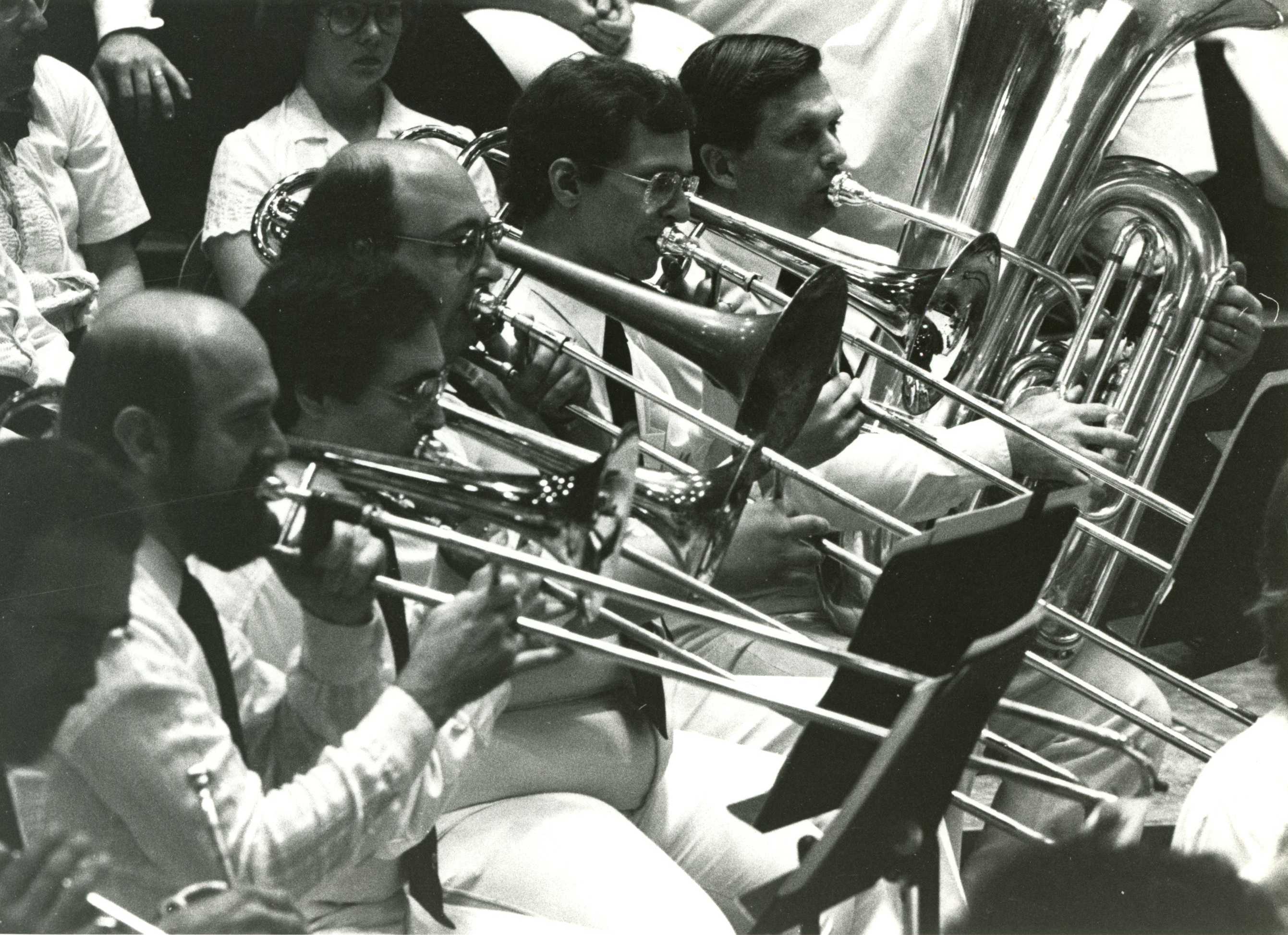
Boston Symphony Orchestra low brass section, Mahler Symphony No. 2, Tanglewood, August 1984. Ronald Barron, Norman Bolter, Lamar Jones, Douglas Yeo, Chester Schmitz (tuba).

The audition was held in Spring 1984 and at the end of the day, I was the last candidate standing. But I was not offered the position. Seiji told me he liked my playing very much but he would like me to make some small changes to my sound and approach. There would be another audition later in the year but in the meantime, he asked me to come to Tanglewood, the summer home of the Boston Symphony Orchestra, to play two weeks of concerts, then go to Europe with the BSO for three weeks, and then return to Boston to make a recording of Richard Strauss’ Don Quixote with Yo-Yo Ma as soloist. I was thrilled to accept the offer of weeks to play with the BSO. Those weeks at Tanglewood, in Europe, and in Boston were unforgettable. Symphony No. 2 of Gustav Mahler with Jessye Norman as soloist, Don Quixote and the Dvorak Cello Concerto with Yo-Yo. Dvorak Symphony No. 9 and Shostakovich Symphony No. 10, and more.

BSO_1984_Berlin_Shostakovich_10 copy

Boston Symphony Orchestra, Seiji Ozawa, conducting. Performance of Shostakovich Symphony No. 10, Berlin Philharmonie, September 1984. Trombones in the back row, right, are Ronald Barron, Carl Lenthe (substitute), Douglas Yeo, bass.

I returned home to Baltimore and at a second audition in December 1984, I won the bass trombone position with the Boston Symphony Orchestra and began my tenure there in May 1985.

Thus began my remarkable adventure as a member of the Boston Symphony Orchestra. It was electrifying to sit under Seiji’s baton. Yes, we all called him Seiji. Not maestro, not Mr. Ozawa. Seiji saw the BSO as a family. He cared deeply about the orchestra, the institution, its history, and its members. Seiji was so much more than a superb musician. He cared. He cared so much about so many things. And he loved Boston. Unlike so many music directors today, Seiji was deeply involved in the city of Boston, and Tanglewood was his happy place.

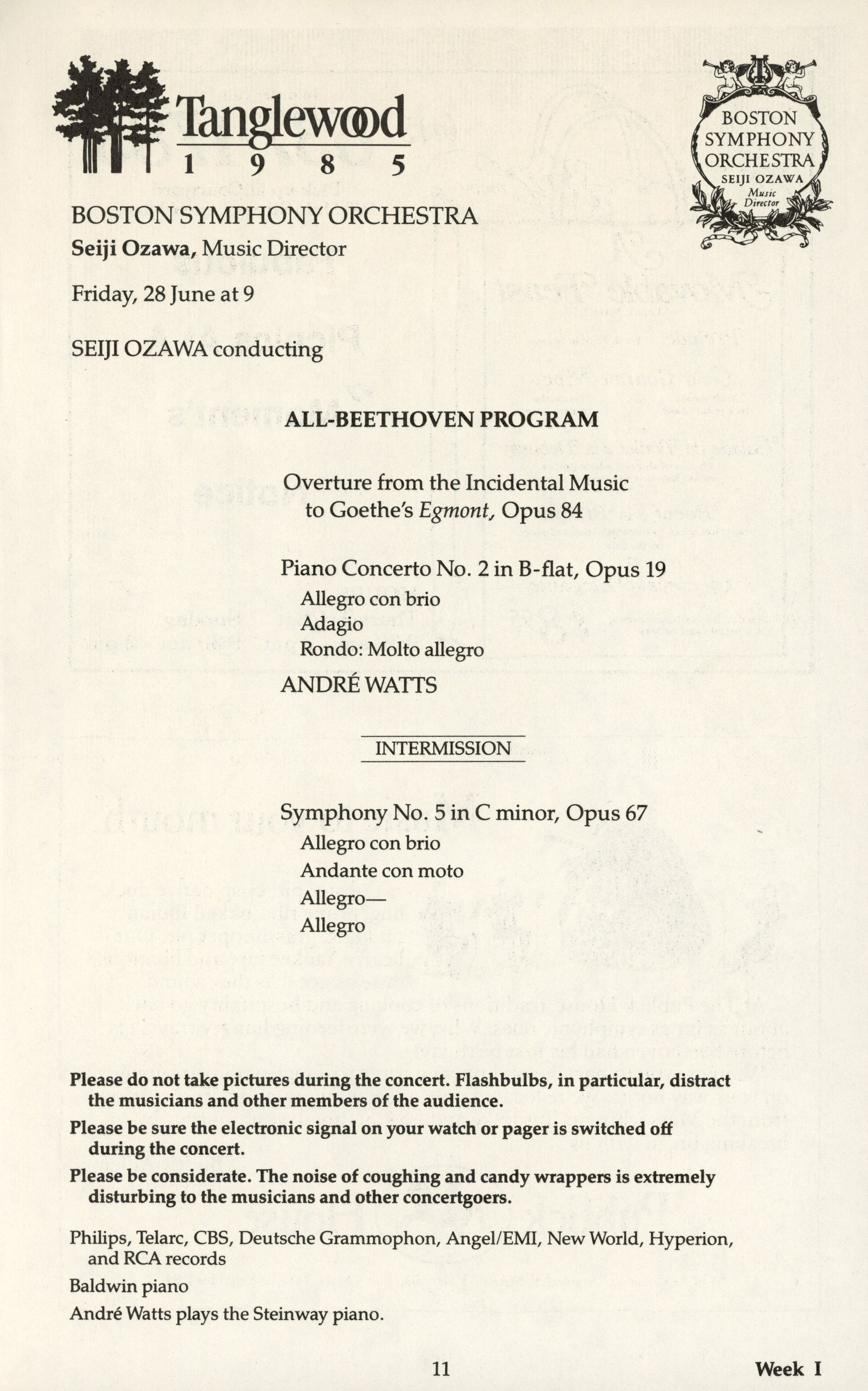
1985_Tanglewood_opening_night

Boston Symphony Orchestra, Seiji Ozawa conducting. Program for opening night at Tanglewood, June 28, 1985.

My first opening night concert with the Boston Symphony Orchestra was at Tanglewood, June 28, 1985. Seiji conducted an all-Beethoven program. It was a memorable start to my years with the BSO, playing what is arguably the most famous symphony ever written, Beethoven’s Symphony No. 5.

BSO_1985_1986_season_brochure

Boston Symphony Orchestra 1985–1986 season brochure.

The 1985–1986 season was my first full season with the Boston Symphony Orchestra. It was like a dream come true. The conductors: Seiji, Bernard Haitink, Giuseppe Sinopoli, Kurt Masur, Christoph Eschenbach, Pierre Boulez, Jeffrey Tate, Leonard Slatkin. The soloists: Maurice André, Itzhak Perlman, Viktoria Mullova, Alicia de Larrocha, Maurizio Pollini, André Watts, Hildegard Behrens, Gilbert Kalish. The repertoire: Brahms Symphonies 1 and 4, Shostakovich Symphony 8, Mahler Symphony 3 and 7; the list goes on. And it was like that every year, with Seiji headlining the season.

BSO_opening_night_Symphony_Hall_October_1985

Boston Symphony Orchestra, Seiji Ozawa conducting. Program for opening night at Symphony Hall, October 1, 1985.

Opening night at Symphony in 1985, my first Symphony Hall opening night, featured Don Juan by Richard Strauss, Brahms’ Symphony 1, and with trumpet soloist Maurice André. I had played the Brahms Symphony with the BSO earlier that year at Tanglewood with Leonard Bernstein (I wrote about that experience HERE). Now I was playing it in the glorious acoustics of Boston’s Symphony Hall. Then there was Maurice André, a remarkable trumpet player. When I was a student at Wheaton College, he came to the college Artist Series and played a spectacular, memorable recital. Now I was up close, sitting in Symphony Hall to hear him in rehearsal (there were no trombones called for in his solo pieces).

BSO_brass_Ozawa_1987

Boston Symphony Orchestra brass section, Seiji Ozawa (center), conductor. Tanglewood, Summer 1987. Trombones: Ronald Barron, Norman Bolter,  Douglas Yeo.

Symphony Hall. That proud temple of music in Boston, built in 1900, considered to be acoustically perfect, and one of the three greatest concert halls in the world along with Carnegie Hall in New York City and the Concertgebouw in Amsterdam. Seiji reveled in Symphony Hall. Its warmth fit the Boston Symphony Orchestra like a glove. The BSO could deliver power when called for. But it was the elegance of the orchestra for which it was known. Seiji brought out that elegance like no other conductor. When he conducted, Seiji was poetry—he was ballet—in motion. He had no self-serving, extraneous motions. His body communicated the essence of the music and we in the orchestra knew exactly how to respond.

BSO Symphony Hall May 1988

Boston Symphony Orchestra, Seiji Ozawa, music director. Symphony Hall, Boston, May 1988.

Seiji Ozawa was a truly great artist, musician, conductor. We all knew it; the world knew it. But for me, his musical persona was secondary to the fact that he was a genuine, caring human being. He loved the Boston Symphony Orchestra and its players. He showed this over and over. I had many personal encounters with Seiji, memorable moments that are frozen in time, so indelibly imprinted in my mind. One of the most significant is from the summer of 1989 when my oldest daughter, Linda, and I were in a horrific car accident at Tanglewood (a fuel oil truck sped through a red light and hit us broadside; we never saw it coming). Linda and I were taken by ambulance to the hospital; she was seriously injured and was in a coma. At first it was touch and go whether or not Linda would live but we prayed and prayed and prayed. The day after the accident, Seiji came to the hospital to visit our family. He had no entourage; he came without an announcement. He didn’t come as my boss, as “Music Director of the Boston Symphony Orchestra.” There were no cameras or microphones around. He came as the father of two children of his own who was visiting a friend whose daughter was profoundly injured. Seiji and I hugged and cried. We walked into the intensive care unit together to see Linda; Seiji was shaken. Fortunately, God gave us a miracle and Linda recovered—today she is a fine bass trombonist and music teacher, and the mother of our grandchildren—to see her now is a testament to God’s mercy, grace, and healing power. And Seiji’s visit—a visit that came with no fanfare—remains in my mind as I remember him as not only a great musician, but as a caring person.

I also remember many conversations I had with Seiji about God and faith. When we met and spoke in private, he opened up about many things. Seiji’s mother was a Christian; his father was Buddhist. In a conversation, he told me that the first Western music he ever heard was his mother singing to him, in English, the old African-American spiritual, “Nobody knows the trouble I’ve seen, nobody knows but Jesus.” When asked in an interview what he thought was the most important piece of classical music ever written, Seiji said—without hesitation—”The Bach Saint Matthew Passion.” When he retired from the Boston Symphony Orchestra in 2002, I gave Seiji a book of memories of our time together along with a New Testament Bible in Japanese. He received the gift with gratitude and grace.

Yeo_Ozawa_Japan_1989

Douglas Yeo and Seiji Ozawa, Boston Symphony Orchestra Japan tour, 1989.

When the BSO was on tour, Seiji always threw a party for the orchestra. Nowhere were these parties more lavish and fun than when we toured Japan. There, Seiji was truly in his element, his comfort zone, so happy to be showing off his orchestra to his country, and so engaged with all of the orchestra’s players. The photo above shows Seiji and me at a party on a tour of Japan in 1989, one of those memorable times when, without instruments or batons in our hands, Seiji’s fun side came out.

Ozawa_Lockhart_Yeo_Wright_2_6_1995

Keith Lockhart and Seiji Ozawa with R. Douglas Wright and Douglas Yeo. February 6, 1995.

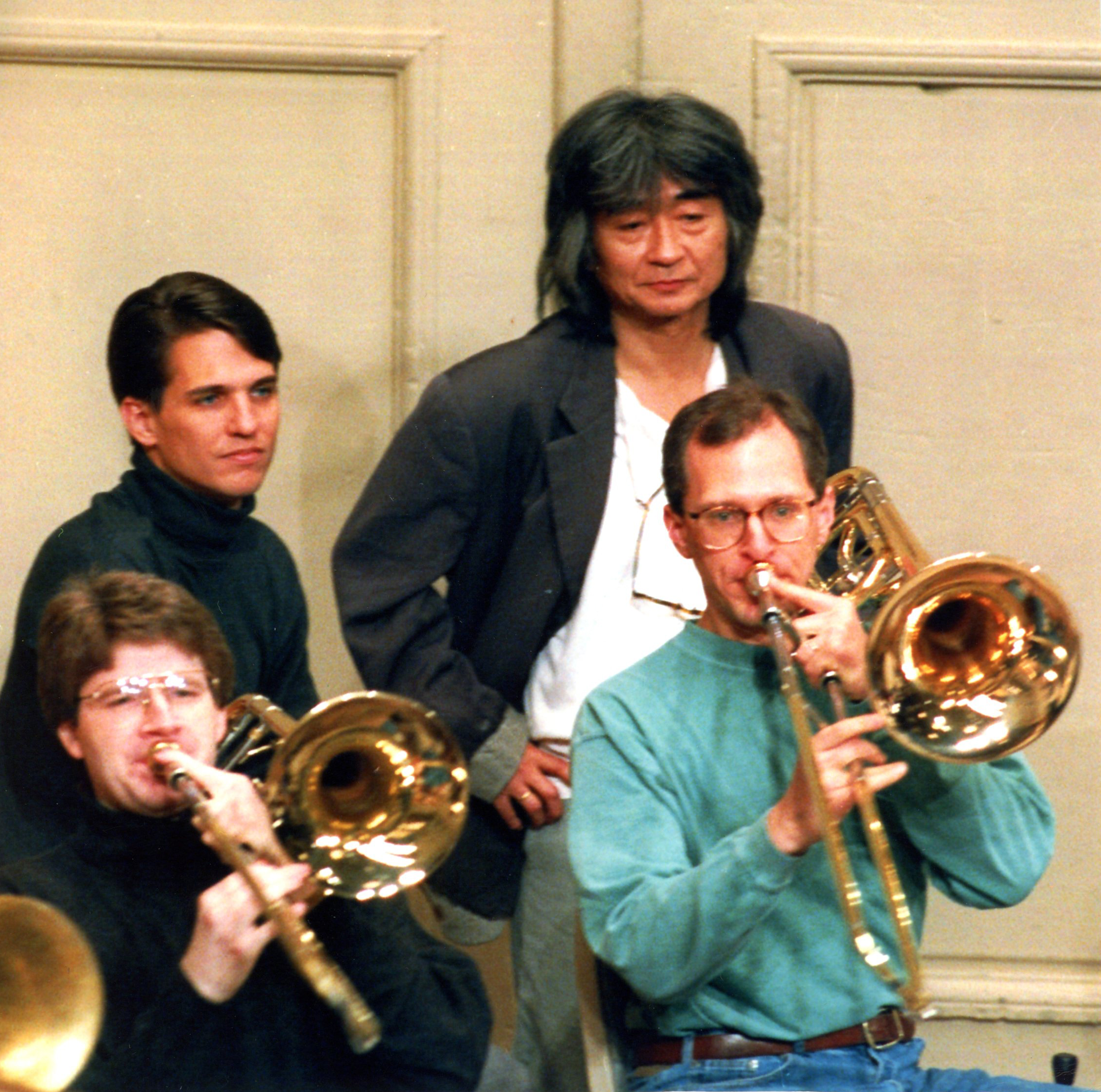
This is one of my favorite photos of Seiji, above. Keith Lockhart was named conductor of the Boston Pops in February 1995. That day, during a rehearsal at Symphony Hall, Keith and Seiji walked behind the back row of brass players and parked themselves behind R. Douglas Wright and me. Doug, who is currently principal trombonist of the Minnesota Orchestra, was the BSO’s and Boston Pops’ regular substitute player for many years, and we laughed when this photo appeared in the Boston Globe on February 7, 1996 with the caption, “New Boston Pops conductor Keith Lockhart (rear left, with Boston Symphony Orchestra music director Seiji Ozawa) will also direct the BSO’s youth concerts. ‘I can’t wait to get started,’ he said.” Somehow that caption never felt adequate for the expressions on Keith and Seiji’s faces. Caption contest, anyone?

BSO_Japan_1999_Ozawa_Robin_Yeo

Seiji Ozawa with extra trumpet players for a performance of Respighi’s Pines of Rome, Tokyo Forum, May 1999. Our daughter, Robin, is standing tall, third from right.

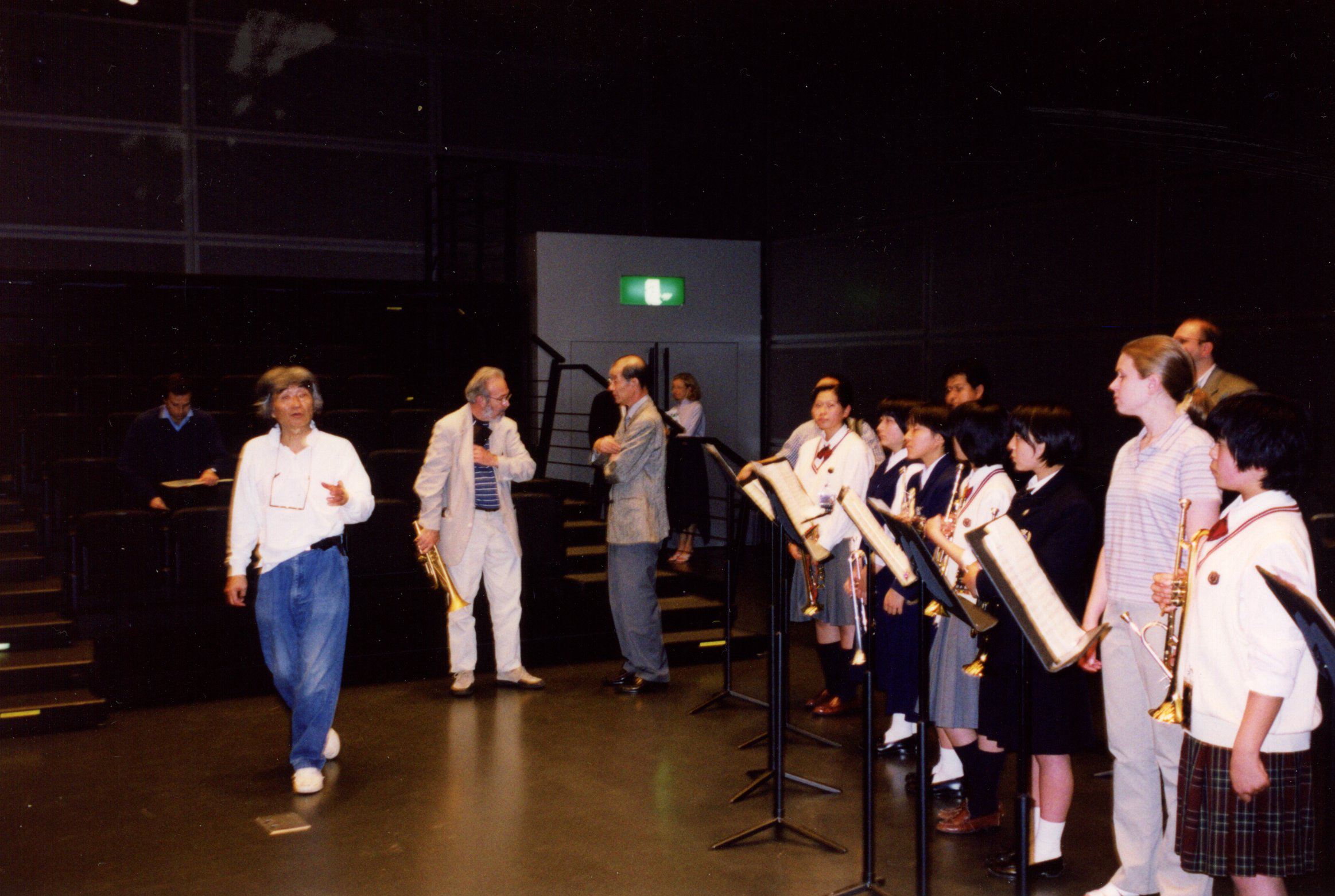
Seiji had more interactions with my family. In Spring 1999, I brought our youngest daughter, Robin, on the BSO’s Japan tour.  For this tour, the BSO gave a concert in the Tokyo Forum on a national holiday, “Children’s Day.” As part of the concert, a group of Japanese school children who played trumpet and trombone were selected to play the additional brass parts for Respighi’s Pines of Rome. Since Robin was a fine trumpet player (first chair trumpet in Massachusetts All-State Orchestra and other groups), Seiji agreed to let Robin play with the group of school children at the Tokyo concert. The photo above shows Seiji coming in for a rehearsal in Tokyo with the Japanese students, Robin towering over the other players, trumpet in hand.

BSO_brass_Patriots_Ozawa_Yeo_1999

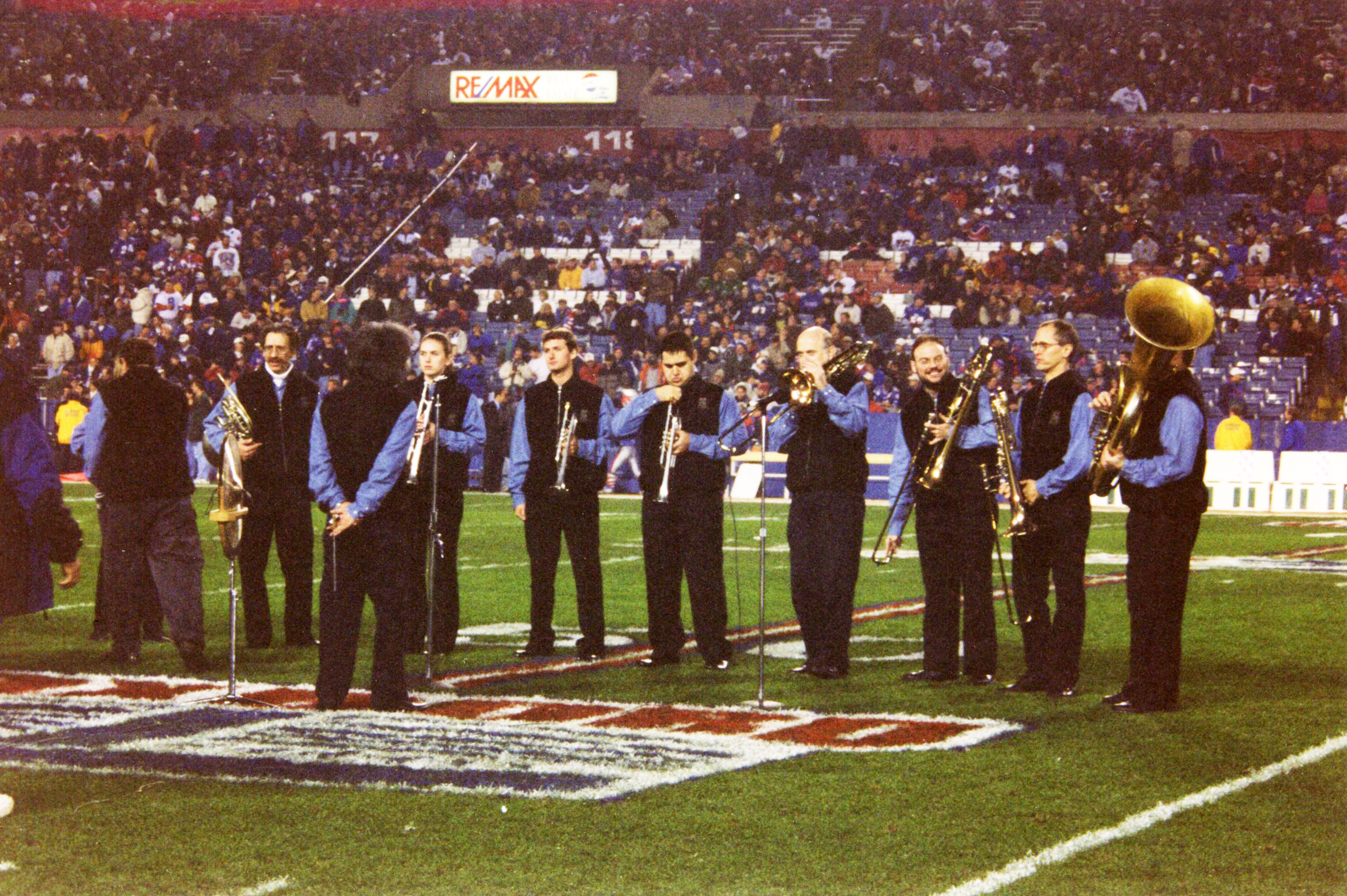
Members of the Boston Symphony Orchestra with extra players, performing the National Anthem at a New England Patriots game, Foxborough Stadium, Massachusetts, fall 1999. Trombone section: Ronald Barron, Darren Acosta, Douglas Yeo. Our daughter, Robin, can be seen just to the right of Seiji Ozawa.

Seiji was an avid sports fan who was deeply invested in Boston sports. Particularly the Boston Red Sox and New England Patriots. Our Boston Symphony brass section played the National Anthem at many Patriots and Red Sox games, and for one Patriots game at the old Foxborough Stadium in 1999, we were in need of another trumpet player and Robin was asked to play with us. It was a thrill for me to stand on the 50-yard line and play the National Anthem with Seiji conducting and Robin just a few feet away from me.

Ozawa_Yeo_Patriots_1999

Seiji Ozawa and Douglas Yeo, Foxborough Stadium, Massachusetts, fall 1999.

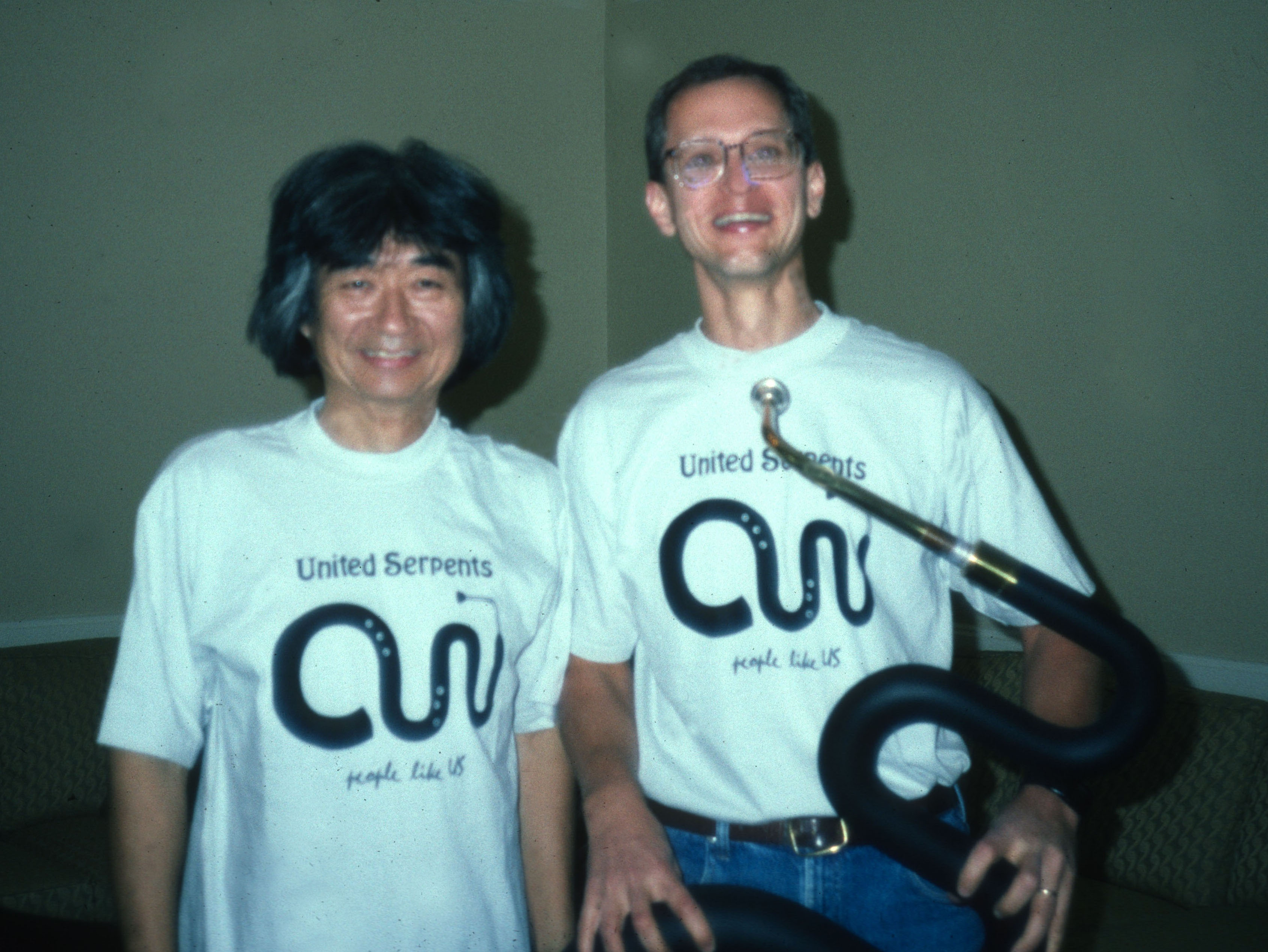
In 1994, the Boston Symphony Orchestra gave the United States and Asian premieres of a newly discovered work by Hector Berlioz, his Messe solennelle. When I looked at the score for the piece, I noticed there was a prominent solo for serpent. I had seen serpents in museums and the Boston Symphony had several serpents in its historical instrument collection. I thought to myself, “I think I’d like to play serpent on the Berlioz Messe.” Having never held a serpent in my hand before and with no idea what I was getting into, I purchased an instrument, learned how to play it, auditioned it for Seiji, and he was thrilled. He’d never heard a serpent before and he was intrigued by the instrument and its sound. Before a rehearsal, I gave Seiji a serpent t-shirt and he immediately pulled off his shirt and put on the t-shirt for the rehearsal. This was classic Seiji: inquisitive, always wanting to learn, and having fun in the process. Seiji gave me a chance with the serpent and since that time, I have played serpent on many concerts with the BSO and other orchestras, given serpent recitals, made a serpent CD and DVD, and enjoyed numerous forays into the “early music” movement because of the serpent. And it all started with Seiji giving the serpent and me a chance.

Ozawa_Yeo_serpent_1994

Seiji Ozawa and Douglas Yeo, Symphony Hall, Boston, Fall 1994.

Ozawa_BSO_recordings

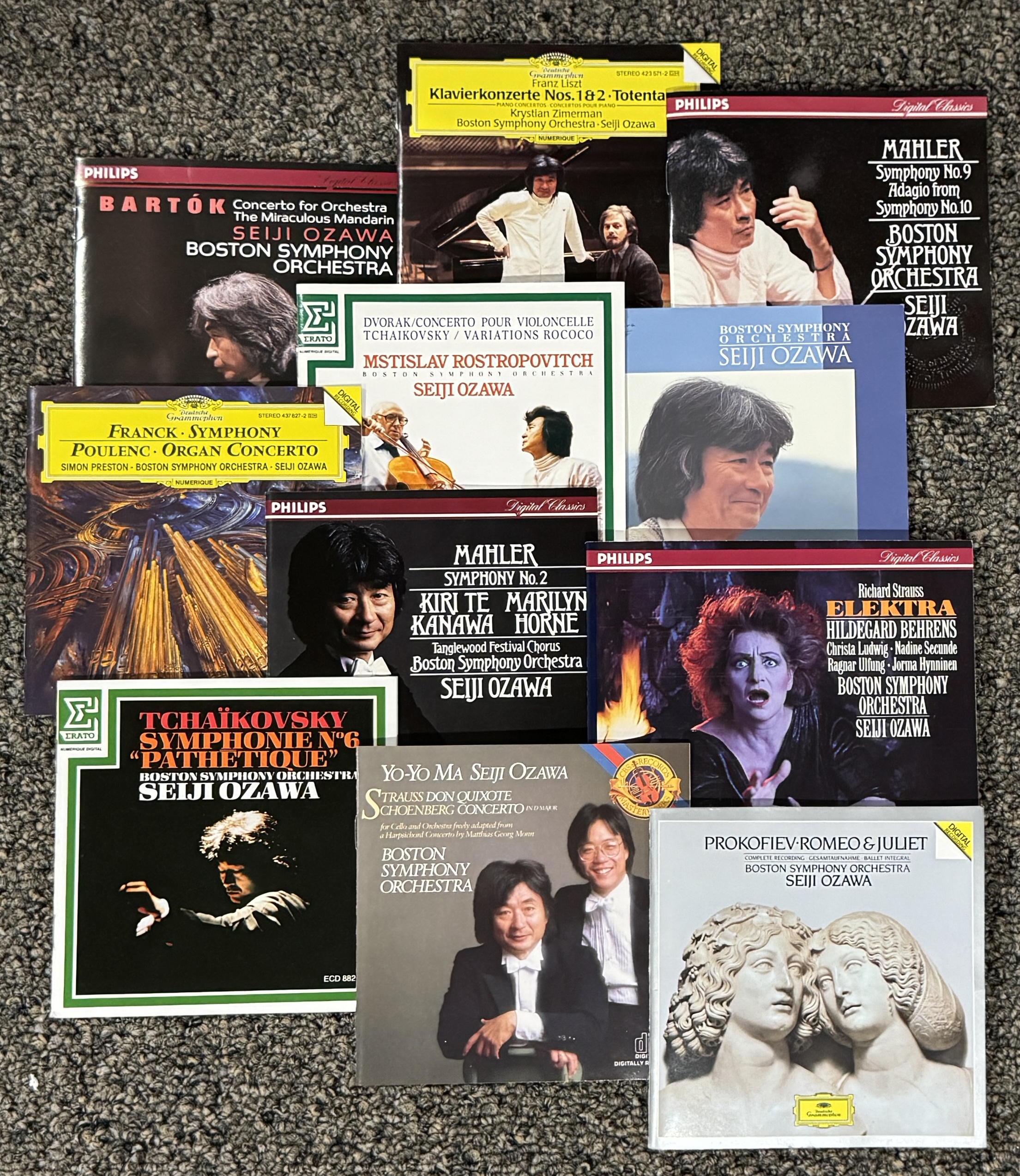
 (1985–2002)A sample of recordings made by the Boston Symphony Orchestra conducted by Seiji Ozawa, 1985–2002.

During the years that Seiji’s and my tenures at the Boston Symphony overlapped (1985–2002), we made many recordings together. These included all of the Mahler symphonies except Symphony No. 8 (recorded before I came to the BSO) and Symphony No. 4 (which does not include trombones), concertos with Yo-Yo Ma, Krystian Zimerman, Mstislav Rostropovich, and others, operas, the Concerto for Orchestra and Miraculous Mandarin by Bartok, and much more. That recorded legacy that I shared with Seiji and the Boston Symphony is something I cherish, and it is an ongoing reminder of the remarkable collaborations we shared together. Here’s a list of the recordings I made with Seiji Ozawa and the Boston Symphony Orchestra:

  • Twentieth Century Bach [arrangements of music by J.S. Bach by Stravinsky, Webern, Stokowski, Schönberg, Saito] (Philips/Boston Symphony/Ozawa)
  • Bartok: Concerto for Orchestra and The Miraculous Mandarin [complete ballet]                         (Philips/Boston Symphony/Ozawa)
  • Bartok: Concerto for Violin No. 2 (DGG/Mutter/Boston Symphony/Ozawa)
  • Berlioz: Cléopâtre (Decca/Norman/Boston Symphony/Ozawa)
  • Berlioz: Requiem (RCA Victor/Boston Symphony/Ozawa)
  • Britten: Young People’s Guide to the Orchestra (Fun House/Boston Symphony/Ozawa)
  • Britten: Les illuminations (Philips/McNair/Boston Symphony/Ozawa)
  • Britten: Diversions (SONY/Fleisher/Boston Symphony/Ozawa)
  • Debussy: La Damoiselle élue (Philips/McNair/Graham/Boston Symphony/Ozawa)
  • Dutilleux: The Shadows of Time (Erato/Boston Symphony/Ozawa)
  • Dvorak: Cello Concerto (Erato/Rostropovich/Boston Symphony/Ozawa)
  • Dvorak: Dvorak in Prague (Sony/Ma/Perlman/Boston Symphony/Ozawa)
  • Faure: Requiem (DGG/Bonney/Hakegard/Boston Symphony/Ozawa)
  • Faure: Pelléas et Mélisande, Dolly (DGG/Hunt/Boston Symphony/Ozawa)
  • Franck: Symphony in d (DG/Boston Symphony/Ozawa)
  • Gubaidulina: Offertorium (DGG/Kremer/Boston Symphony/Ozawa)
  • Liszt: Piano Concerto No. 1 and No. 2, Totentanz (DGG/Zimerman/Boston                                     Symphony/Ozawa)
  • Mahler: Symphonies 1, 2, 3, 5, 6, 7, 9, 10 (Philips/Boston Symphony/Ozawa)
  • Mendelssohn: A Midsummer Night’s Dream (DGG/Battle/von Stade/Densch/Boston                         Symphony/Ozawa)
  • Poulenc: Gloria, Stabat Mater (DGG/Battle/Boston Symphony/Ozawa)
  • Prokofiev: Romeo and Juliet [complete ballet] (DGG/Boston Symphony/Ozawa)
  • Prokofiev: Concerto for the left hand (SONY/Fleisher/Boston Symphony/Ozawa)
  • Rachmaninoff: Piano Concerto No. 1 and No. 2 (DGG/Zimerman/Boston Symphony/Ozawa)
  • Rachmaninoff: Piano Concerto No. 3 (RCA/Kissin/Boston Symphony/Ozawa)
  • Ravel: Concerto for Piano in D for the left hand (SONY/Fleisher/Boston Symphony/Ozawa)
  • Ravel: Shéherazade (Philips/McNair/Boston Symphony/Ozawa)
  • Sibelius: Violin Concerto (Philips/Mullova/Boston Symphony/Ozawa)
  • Strauss: Elektra [playing bass trumpet] (Philips/Boston Symphony/Ozawa)
  • Strauss: Don Quixote (CBS/Ma/Boston Symphony/Ozawa)
  • Tchaikowsky: Nutcracker [complete ballet] (DGG/Boston Symphony/Ozawa)
  • Tchaikowsky: Pique Dame (RCA-BMG Classics/Boston Symphony/Ozawa)
  • Tchaikowsky: Symphony 6 (Erato/Boston Symphony/Ozawa)

Seiji’s last concert in Symphony Hall as music director of the Boston Symphony Orchestra was on April 20, 2022. By then he had been music director for 29 years. He was ready for a change but it was difficult for me to say goodbye to this man who meant so much to so many of us for so long.

BSO Mahler 9 2008 DVD cover

Cover of the NHK DVD featuring two works performed by the Boston Symphony Orchestra and Seiji Ozawa. Beethoven Symphony No. 7 (Suntory Hall Tokyo, 1989) and Mahler Symphony No. 9 (2002). NHK DVD NSDS-14717; NHK Blu-ray NSBB-14721.

Seiji’s last concert in Symphony Hall as music director of the Boston Symphony Orchestra had a single work on the program: Gustav Mahler’s Symphony No. 9. We had recorded and performed this piece with Seiji on numerous occasions. And it seemed a fitting piece for us to play together as he closed his tenure as music director of the BSO. NHK (Japan) filmed the concert and later released it on a DVD and Blu-ray along with a 1989 performance of the BSO playing Beethoven’s Symphony No. 7. I am so glad to have this document of the concert.

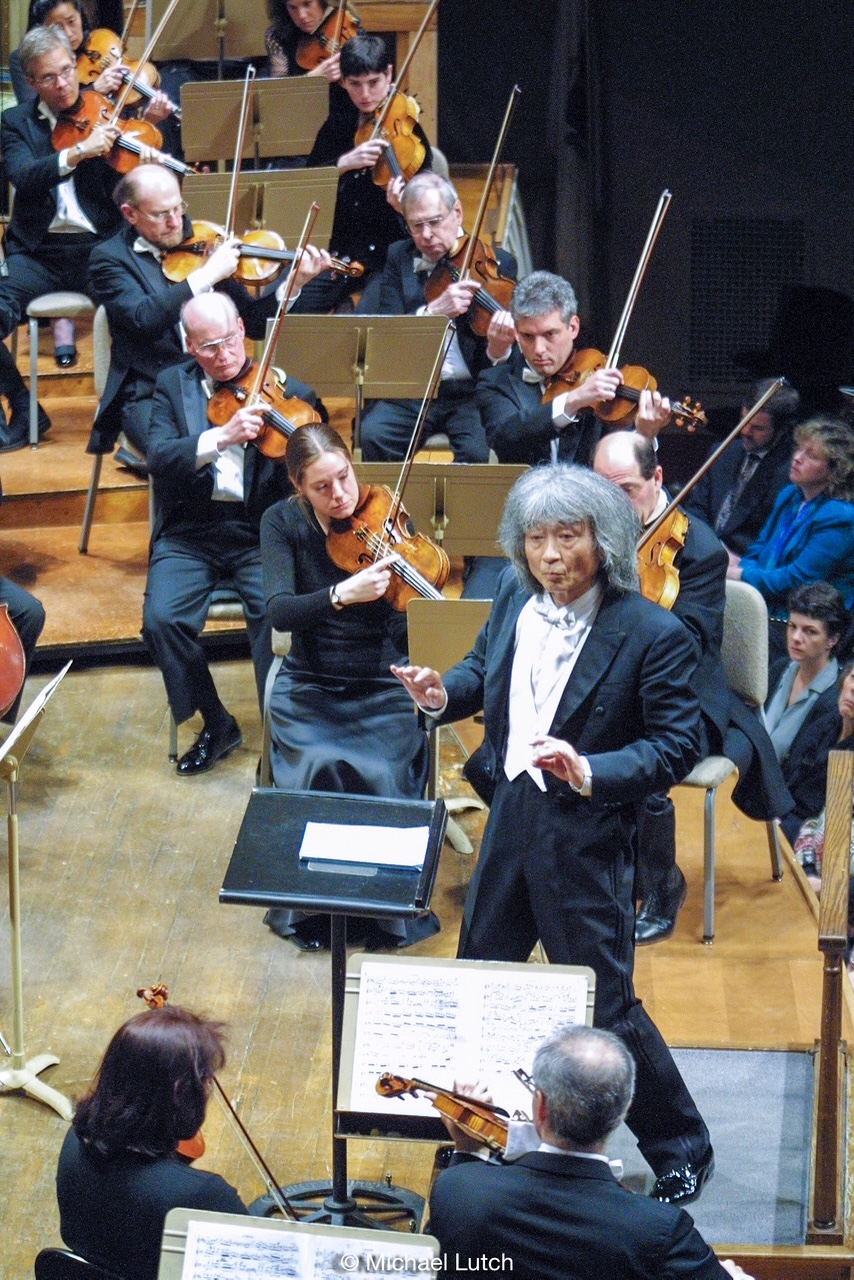
BSO_Ozawa_2002_MICHAEL_ LUTCH

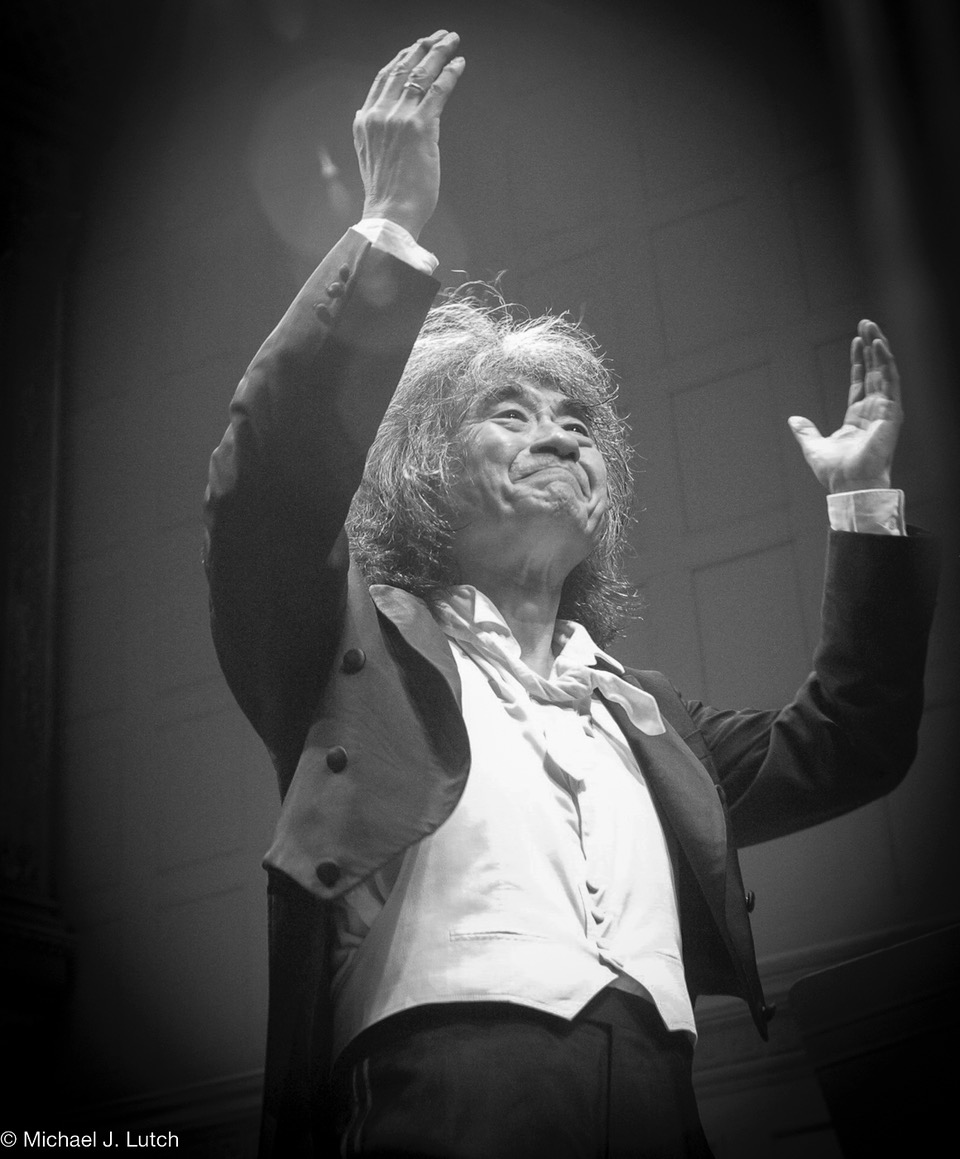
Seiji Ozawa leading the Boston Symphony Orchestra in his final concert in Symphony Hall as Music Director of the BSO, April 20, 2002. Photo © Michael Lutch. Used with permission.

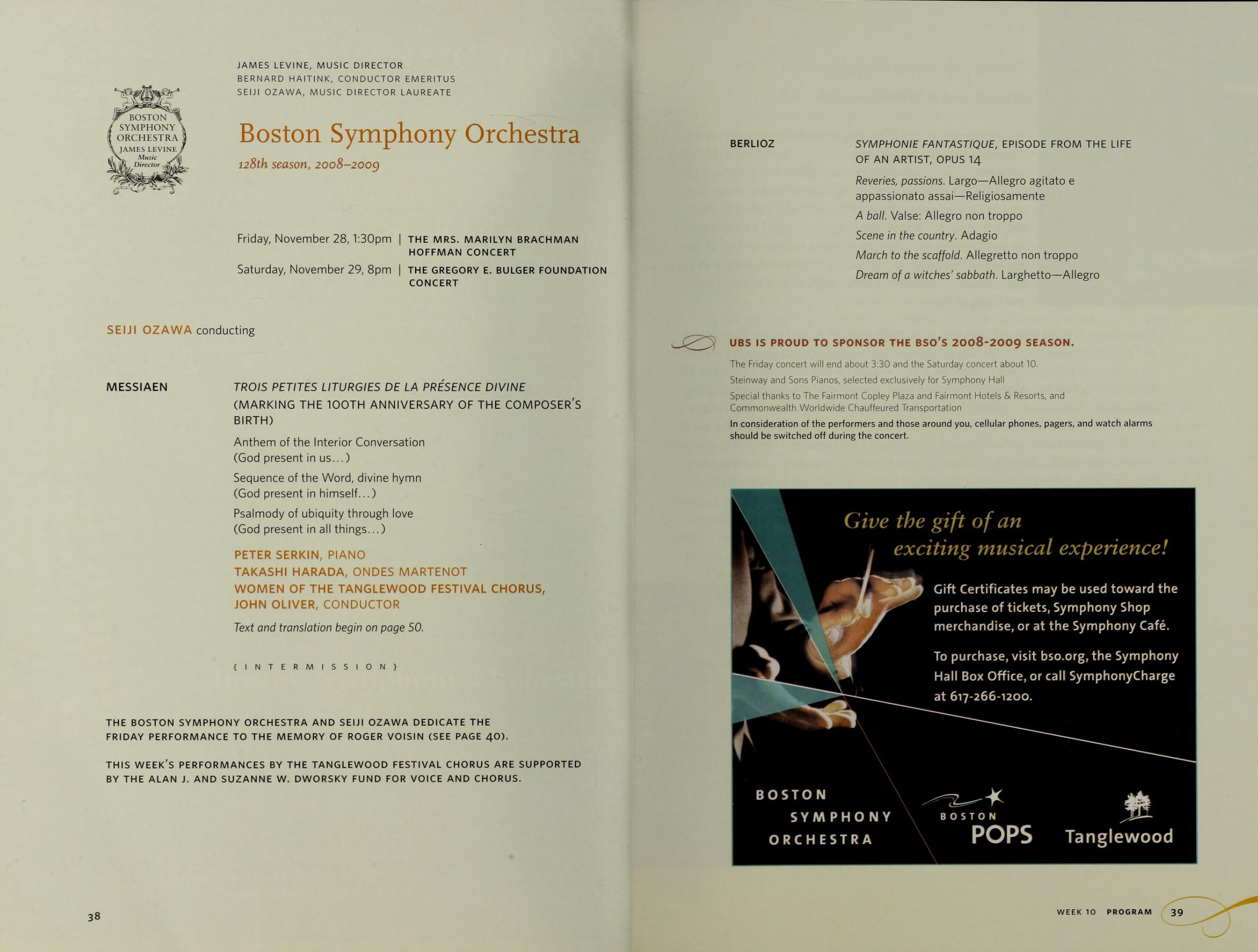
BSO_program_November_2008_Ozawa

Boston Symphony Orchestra program for Seiji Ozawa’s final concerts with the orchestra, November 28 and 29, 2008. Symphony Hall, Boston.

The concert was emotional on so many levels. But, fortunately, we had not really said goodbye to Seiji. In 2006 , he returned for a concert at Tanglewood (a performance of Gustav Mahler’s Symphony No. 2), and in 2008, he returned once again to Symphony Hall for concerts that included Symphonie fantastique by Hector Berlioz. The Symphonie was one of Seiji’s “party pieces,” a piece we played more times than I can count at home and on tour, and a piece that he and the orchestra did exceptionally well. The NHK DVD of Seiji’s final concert as music director of the BSO in 2002 also included a segment about his return to Symphony Hall in November 2008. The DVD contains some video of the rehearsals and concerts from that memorable occasion, as well as interviews by Seiji and a few BSO members, including me.

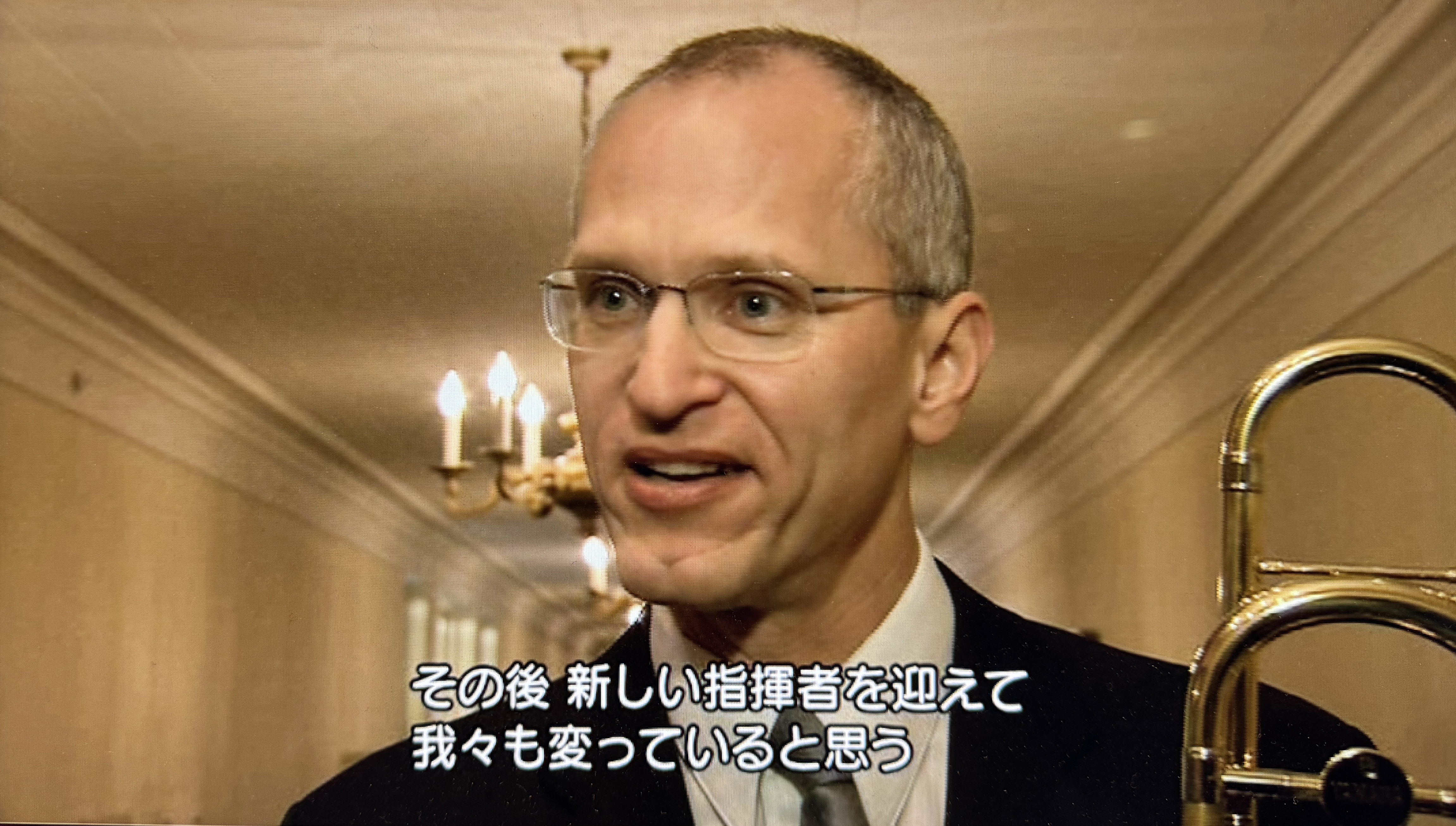
Yeo_2008_BSO_DVD

Douglas Yeo interview segment for NHK DVD/Blu-ray of Mahler Symphony No. 9, Beethoven Symphony No. 7, and a special segment on Seiji Ozawa’s return to Symphony Hall in November 2008.

I was so happy to be asked to say a few words on camera about Seiji and what he meant to both the orchestra and to me. Here’s some of what I said:

I think Seiji has such a way of communicating the music with musicians. Now, there’s a combination of his being older and even deeper as a musician, and the musicians of the Boston Symphony trusting him even more. He comes back now as, sort of, like our grandfather, like a hero to us because we had so many years with him. Now we have Seiji come back to remind us of those many years of great performances. And I have to say, for me personally, it is very, very exciting.

It was exciting. It was always exciting. The video (below) produced by WCVB-TV (Channel 5) in Boston when Seiji returned to Symphony Hall in 2008 shows some of the excitement we all experienced with Seiji on the podium.

Television segment produced by WCVB-TV Channel 5, Boston, on the occasion of Seiji Ozawa’s return to Symphony Hall, November 2008.

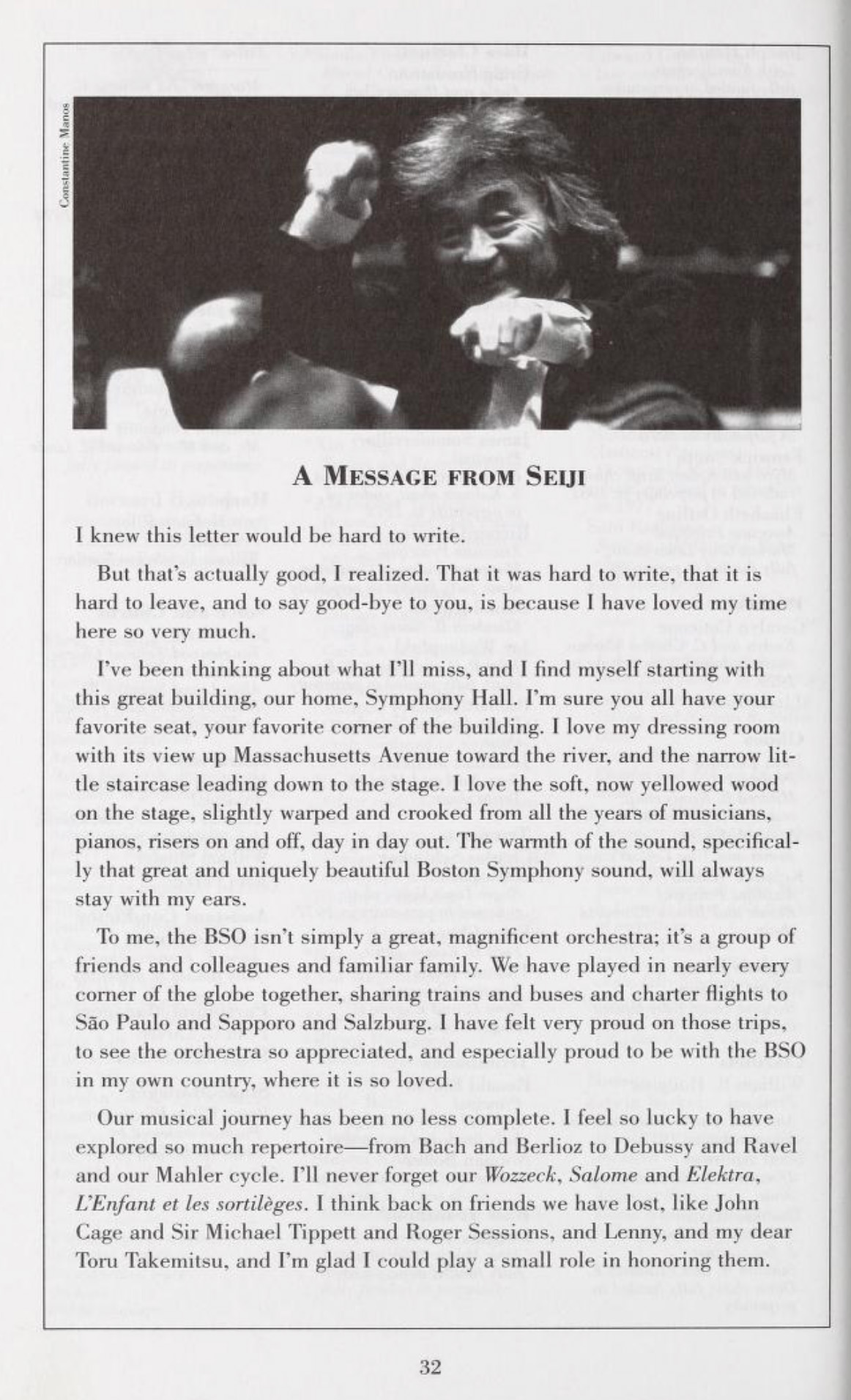
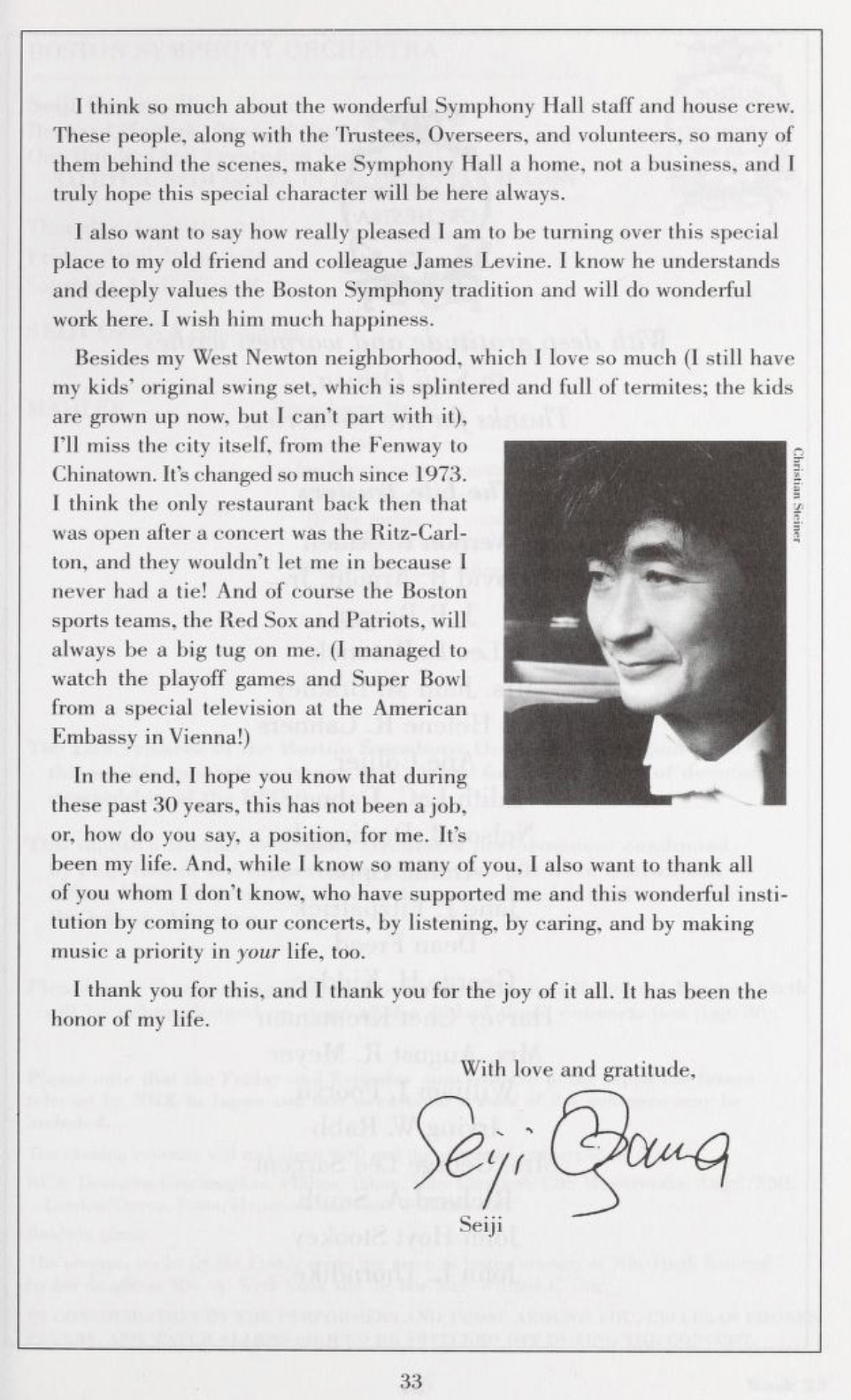
Here is the message that Seiji had for Boston Symphony audiences, from the program book for his final concerts in Symphony Hall as music director of the BSO, April 18, 19, 20, 2002.

Ozawa_farewall_Message_2002_01

Ozawa_farewall_Message_2002_02

Message from Seiji Ozawa, from the Boston Symphony Orchestra program book for April 18, 19, 20, 2002.

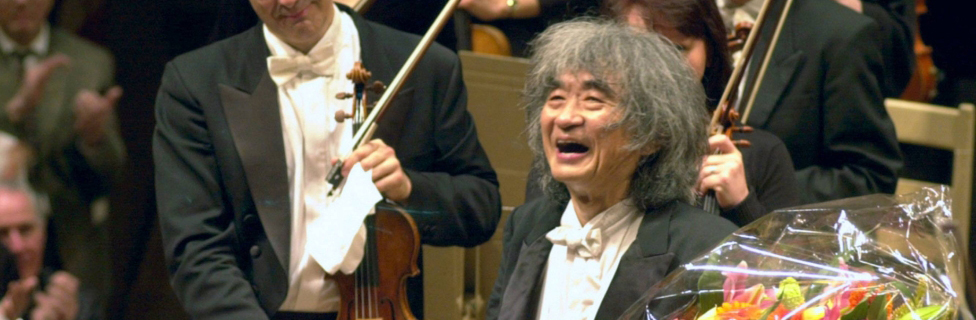
Seiji Ozawa was music director of the Boston Symphony Orchestra for 29 years, from 1973 to 2002. He hired me into the Boston Symphony in 1985 and became one of my musical inspirations as well as a friend. The photo below was taken by my friend, Michael Lutch, at Seiji’s final concert in Symphony Hall as music director of the BSO, on April 20, 2002. This was at the end of our performance of Gustav Mahler’s Symphony No. 9. Seiji was exhausted; emotionally spent. Yet, this is how I will always remember Seiji. His smile, his engagement with the orchestra and the audience, and his commitment to the art of music are things I will never forget. Working with Seiji Ozawa changed my life and I will always be grateful for how God brought our lives together. I miss him, but I will never forget him.

BSO_Ozawa_2002_MICHAEL_LUTCH_02

Seiji Ozawa taking a bow with the Boston Symphony Orchestra after his final concert in Symphony Hall as Music Director of the BSO, April 20, 2002. Photo © Michael Lutch. Used with permission.

What is happening? It’s not all about you. Or me. It’s about the music.

What is happening? It’s not all about you. Or me. It’s about the music.

by Douglas Yeo (October 15, 2023)

I retired from the Boston Symphony Orchestra in 2012 after nearly 30 years as a member of that remarkable institution. I use the word institution because the BSO was more than an orchestra. Yes, the orchestra itself was the raison d’être for BSO Inc., but there was so much that flowed from the decision by Major Henry Higginson to establish a symphony orchestra in Boston in 1881. The Boston Symphony Orchestra, the Boston Pops Orchestra—which is the BSO minus most of its principal players—Symphony Hall in Boston, the BSO’s annual summer festival at Tanglewood, recordings, tours. It’s all part of the life I led for so many years and I am grateful that I was able to live my dream.

In the 11 years since I retired from the BSO, I’ve been engaged in a host of interesting and very rewarding activities. From recreational trips with my wife and other members of our family, to the joy of living near our grandchildren, to writing many books and articles, to teaching in several colleges/universities (Arizona State University, Wheaton College (Illinois), University of Illinois Urbana-Champaign), to serving now as interim music director at my church, New Covenant Church in Naperville, Illinois, my life is full and interesting. Yet while I left the full time symphony orchestra world in 2012, I’m still interested in it. Now, however, I’m mostly looking at it from the outside. And with this new perspective, I’m increasingly asking myself this question:

What is happening?

“Time,” as the hymn writer Isaac Watts reminded us in his great hymn, Our God, Our Help in Ages Past, is “like an ever-rolling stream.” Times change, things change. Nothing stays the same. It’s easy for someone at my season of life to look back at “the good old days” and assume the ways things were done back then were always better than they are today. Through an honest lens, I can say that some things were better. But not everything. And part of getting older is seeing things change and evaluating them in light of the ever-rolling stream of the passage of time.

As a college professor and one who now sits more frequently in the audience at concerts than on the stage, I am observing many trends in the performing arts. Many of these flow from current cultural mores, the evolution (and let’s remember that evolution of anything is not always for the better) of cultural thinking and operating. Recently, I’ve observed and heard about some things in the orchestra world that have me asking,

What is happening?

To wit, I recently:

  • Attended a concert by a certain professional symphony orchestra where a member of the ensemble—who did not play in the second movement of a piano concerto—took a large sheaf of yellow lined papers out from his tail coat pocket, crossed his legs, sat back in his chair, and proceeded to read the papers—shuffling the pages—for 10 minutes while the concert was going on around him.
  • Learned that a member of a certain professional symphony orchestra was recently dismissed because the member arrived late to a concert and had to conspicuously walk through the orchestra to get to the member’s seat in full view of the audience.
  • Saw a concert performed by a certain professional symphony orchestra where a player had a rough time with a long, exposed solo—I’m sympathetic to the problem; it can happen to anyone—and while he was missing notes all over the place, leaned back in his chair and kicked up his legs, making light of the situation.
  • Learned that a member of a certain professional orchestra was recently dismissed for being rude and insubordinate to the orchestra’s conductor and playing inappropriately loudly after repeatedly being asked to stop doing so during rehearsals and concerts.
  • Attended a concert by a certain professional symphony orchestra where a member of the brass section added many extra notes to his part, took several notes down an octave, and generally obliterated the orchestra with his crass, loud playing. And at the end of the concert, he smiled broadly.
  • Learned recently that the trombone section of a certain professional symphony orchestra is “the most hated section in the orchestra” because they play so loudly and out of context.

What is happening?

When I joined the Boston Symphony Orchestra in 1985, I was 30 years old. I was an experienced bass trombonist, having been a member of the Baltimore Symphony Orchestra for four years, and having worked in New York City as a freelance player for five years. I was very aware of the storied history of the Boston Symphony, its long roster of celebrated music directors, and its unparalleled recorded legacy. I was also aware that Joannès Rochut, whose name is familiar to many of not most trombonists because of the three volumes of Melodious Etudes he arranged from works of Marco Bordogni, had been principal trombonist of the BSO from 1925–1930. I knew I was coming into something that had been around for over 100 years before me.

The Boston Symphony Orchestra has traditions. Tradition is a word that gets knocked about these days. Many people equate tradition with stuffiness, with a “dead” way of doing things. But that’s not the case if tradition is vibrant. For the 104 years before I joined the Boston Symphony, it had evolved to do things in particular ways. The sound of the orchestra was rich and lush, a sound that was enhanced by the fact that the orchestra played in one of the finest concert halls in the world, Symphony Hall, built in 1900.

Boston_Symphony_low_brass_section_Barron_Bolter_Yeo_Schmitz_2001_standing

Boston Symphony Orchestra low brass section: Ronald Barron, Norman Bolter, Douglas Yeo, Chester Schmitz. Symphony Hall, Boston, 2001.

At the time I joined the BSO, there were members in the orchestra who had been hired by the orchestra’s music director from 1924–1949, Serge Koussevitzky, and many more had been hired by Charles Munch, who was music director from 1949–1962. A member of the orchestra’s cello section had played with Glenn Miller’s orchestra during World War II and was part of Miller’s group at the time Miller died when his plane’s frozen carburetor caused it to crash into the English Channel on December 15, 1944. There were men in the orchestra who wore a jacket and tie to rehearsal. There were certain ways the orchestra played, and the expectation was that new players would come into the orchestra and add to that tradition by blending with the rest of the orchestra while adding one’s own musical personality in appropriate ways. It was exhilarating. There I was, sitting in the orchestra’s low brass section between Chester Schmitz—hands down the finest orchestral tuba player that I have ever heard—and Norman Bolter—who had joined the BSO at the age of 20, a prodigy of epic proportions. Ronald Barron headed our low brass section as principal trombonist. Principal bassoonist Sherman Walt, principal clarinetist Harold “Buddy” Wright, principal timpanist Everett “Vic” Firth—they were all there, plying their craft at the highest level. I sat, I played, I observed, I learned, and above all, I fit in. Fitting in required a measure of humility. It wasn’t just because I was “the young guy” and I needed to wait my turn. No, this was normal, usual operating procedure. The goal of the entire orchestra was to present a unified musical product. And we did.

CSO_low_brass_May_1972

Members of the Chicago Symphony Orchestra brass section. Back row: Adolph Herseth, trumpet; James Gilbertson, Jay Friedman (with euphonium), Frank Crisafulli, Edward Kleinhammer, Arnold Jacobs. Orchestra Hall, Chicago, 1972. Photo courtesy of the Chicago Symphony Orchestra Archives.

I learned the importance of this when I was an undergraduate student at Wheaton College. I studied with Edward Kleinhammer, the celebrated bass trombonist of the Chicago Symphony Orchestra from 1940–1985. In 1975, my wife and I attended a CSO performance of Richard Strauss’ Eine Alpensinfonie. I had never heard the piece before I heard it at that concert (imagine a time in the world’s history where there was only one recording of Strauss’ epic work—and I had not heard it) and I was stunned by the piece and the CSO’s performance. After the concert, my wife and I waited for Mr. Kleinhammer to come up the stairs from the basement of Orchestra Hall and when he arrived at the lobby landing, I blathered away about how amazing he was in the concert. He looked at me with a penetrating stare and then said, “If you heard me, I was a failure. You shouldn’t have heard a fourth trombone player. You should have heard a great orchestra.” And he walked away. I was stunned.

The next day I had a lesson with Mr. Kleinhammer where he unpacked his comment. He told me I was listening to the wrong things. That Eine Alpensinfonie was not all about the fourth trombone player—or the trombones at all. Yes, there were moments when the trombones had a melodic line. But for most of the piece, they worked in community, supporting other instruments. Mr. Kleinhammer told me, “Douglas, it’s not about me. It’s about the MUSIC.” It was at that moment that scales fell from my eyes. I was intoxicated with the trombone section and I missed the orchestra. I had lost the forest for the trees.

And, as God can only do because He is God, I came home from that lesson and opened my Bible and read something that got my attention and changed my life. In the book of First Corinthians, the Apostle Paul wrote about the church, and how a healthy church should be and act. He wrote (1 Corinthians 12:14–27, English Standard Version):

For the body does not consist of one member but of many. If the foot should say, “Because I am not a hand, I do not belong to the body,” that would not make it any less a part of the body. And if the ear should say, “Because I am not an eye, I do not belong to the body,” that would not make it any less a part of the body. If the whole body were an eye, where would be the sense of hearing? If the whole body were an ear, where would be the sense of smell? But as it is, God arranged the members in the body, each one of them, as he chose. If all were a single member, where would the body be? As it is, there are many parts, yet one body.

The eye cannot say to the hand, “I have no need of you,” nor again the head to the feet, “I have no need of you.” On the contrary, the parts of the body that seem to be weaker are indispensable, and on those parts of the body that we think less honorable we bestow the greater honor, and our unpresentable parts are treated with greater modesty, which our more presentable parts do not require. But God has so composed the body, giving greater honor to the part that lacked it, that there may be no division in the body, but that the members may have the same care for one another. If one member suffers, all suffer together; if one member is honored, all rejoice together.

Now you are the body of Christ and individually members of it.

It was at that moment I understood the flaw in my musical thinking. I realized that playing the trombone in an orchestra was not about me. It was not about showing anyone else what I could do, it was not about strutting my stuff, it was not about calling attention to myself. The Apostle Paul’s metaphor for the proper working of the Church—the human body and all of its diverse parts, each of which has a unique function—was a metaphor for the proper working of ANY group of people. A friendship, a marriage, a football team, a business, a church. And a symphony orchestra.

It was then that I distilled Paul’s words into a phrase that I have repeated countless times to my students and colleagues (just ask them; they’ll tell you I say this frequently):

All members of the orchestra are equally important, but at any given moment, all members of the orchestra are not equally prominent.

This is what a symphony orchestra should be about. Each member is equally important. Whether playing the melody, or an underlying rhythmic figure, or soft whole notes, every part is equally important. Just like every part of the body. But when I have long soft notes to play, they are not as prominent as the melody played by the first oboe player. The fact that the oboist has the melody in no way diminishes my contribution at that moment. And if, at the end of the concert, the conductor asks the oboe player to stand up and take a bow and the conductor does not ask me to do so, that is fine, and I will join in the applause for my colleague. Because my oboist colleague was more prominent than I was. It wasn’t about me. It’s about the MUSIC.

If I had made it about me—if I had played my whole notes in a manner that brought attention to myself while obliterating the oboe player’s solo—I would have ruined the performance. So, I committed myself to being a team player, to being part of the body that is the symphony orchestra, and to understanding my role in the greater whole. And this I did—and do—in the service of the MUSIC.

Yeo_team_player_ITAJ

Header graphic and title for Douglas Yeo’s article, “Me, Myself, and I—Are Orchestral Brass Players Losing the Concept of Being Team Players? International Trombone Association Journal, Vol. 25, No. 1, Winter 1997, 21–23.

In 1997, I wrote an article on this subject that was published in the International Trombone Association Journal (Vol. 25, No. 1, Winter 1997); it was subsequently republished in the Tubists Universal Brotherhood Association Journal—the organization has since changed its name to International Tuba Euphonium Association—(Vol. 24, No. 3, Summer 1997). My article was titled, “Me, Myself, and I: Are Orchestral Brass Players Losing the Concept of Being Team Players?” I wrote it in response to a trend I was observing—the very trend that, 26 years later, I am speaking about in this present blog post on The Last Trombone—where I sensed that students and colleagues were beginning to shift from working together to create a unified whole in performance to wanting to stand out and be noticed. A few months later, my friend Gene Pokorny, tubist with the Chicago Symphony, penned a response to my article that was published in the T.U.B.A. Journal in its Winter 1998 issue (Vol. 25, No. 2) in which he echoed and supported my arguments. You can read my article and excerpts from Gene’s response on my website,  HERE and Gene’s whole article HERE.

Which brings me back to my question:

What is happening?

As Gene said in his article:

It may be inexperience which dictates some players to not be part of the team on stage but in many cases it is CHOICE. There are many venerable professionals out there who know how to be ensemble players but, for whatever reasons, choose to not be part of the group. Some of it is carelessness, but some of it is choosing to “get back” at a conductor, make a point to a player on stage, impress some friend in the audience, etc. Whatever the reason, the choice of not playing together with everybody else on stage is a mistake in which everybody pays for somebody else’s lack of maturity. . .

Yet, here we are in 2023, and I’m writing about this again. As I observe the ongoing evolution of musical art, I am seeing more, not less of this tendency to promote one’s self at the expense of the whole. As the examples at the top of this article show so clearly, the “me first” attitude, the “it’s all about me” attitude, the “who are you to tell me what to do” attitude is on display. Players want their students to think of them as “monster” players. A monster? How about being a great trombonist who understands the role of your part in the greater whole? How about some humility? How about an understanding of the difference between importance and prominence? And how about some respect for the music, for your colleagues, for the audience, and for the tradition and history of the ensemble of which you are a part, and to be, as Gene said in his article, “a cog in the wheel” instead of “the nut behind the wheel”? Nobody—including me—does this perfectly. But can this be the goal, the aspiration, something to strive for, and can we talk about this with—even call out— those whose inherent selfishness ruins concerts on a regular basis?

There are things to learn from the way things used to be done. From from our teachers, from the teachers of our teachers, from the people in the jackets and ties. Last week, I was talking with a friend about this ongoing trend of individual players who play in order to be heard and noticed rather than playing in order to support the whole product. Like me, he studied bass trombone with Edward Kleinhammer, and my friend I and frequently talk about the state of the modern symphony orchestra. In a series of text messages last week, he offered:

I miss the old days and our old role models.

Why is the easy stuff SO HARD for some people?

God love you, Ed Kleinhammer.

To which I replied,

Preach it, brother.

Last night, when I was reading my Bible, I turned to this passage (Jeremiah 6:16, English Standard Version) that reminds us of something very important. It starts off with words of wisdom but then observes the response of many people:

Thus says the Lord: “Stand by the roads, and look, and ask for the ancient paths, where the good way is; and walk in it, and find rest for your souls. But they said, ‘We will not walk in it.’”

The ancient paths. The good way. There is a lot we can learn from them. When it comes to playing the trombone, I learned about them from Edward Kleinhammer, and I have tried to emulate his spirit of being a team player throughout my career. My students have heard this from me through my over 40 years of college teaching. There are many players who understand the Apostle Paul’s metaphor of the body and how it perfectly shows us how each of us is valuable and important to any task as long as we understand our role. But there are also many who are hung up on themselves and who ruin music and music making because of their unwillingness to be a team player. Guess what? People are noticing you. Just like the music critic who noticed the trombone section when he heard a certain professional symphony orchestra perform Richard Strauss’ Also Sprach Zarathustra (New York Times, February 15, 1995; review by Alex Ross):

The trombones, who had been emitting ghastly sounds all night, blared too loudly in the “Zarathustra” fanfare, obliterating the top trumpet line.

Yes. You’re noticed.

Will you join me and many others—like Edward Kleinhammer, who taught so many of us about this—in walking “where the good way is”? It’s not all about you. It’s not all about me. It’s about the MUSIC.