Author: Douglas Yeo

Important discoveries for brass players – with big implications

Important discoveries for brass players – with big implications

Players of brass instruments spend a lot of time thinking about their tongue, and how it factors in tone production, tonal range and articulation. Many books have been written on the subject but the truth is that since we can’t SEE inside our mouth while we’re playing and it’s very difficult to feel where the tongue actually IS while playing, a lot of what has been said on the subject is just theoretical.

Until now.

In what is proving to be a fascinating study with significant implications, Dr. Peter Iltis (Professor of Kinesiology at Gordon College) and Eli Epstein (former 2nd horn of the Cleveland Orchestra, now teaching at the Boston Conservatory at Berklee and New England Conservatory of Music) are announcing research involving the filming of elite horn players by way of MRI technology. This allows us to see inside the oral cavity of a group of superb players and begin to draw conclusions about the placement of their tongue while playing. Iltis and Epstein have created a Youtube channel to present some of their findings. These findings are applicable to all brass players, not just horn players. For convenience, here are two of the videos. They are each about 20 minutes long but if you are a brass player, they will definitely get your attention and get you thinking about tonguing in a completely new way:

Their second video continues the discussion:

But wait, there’s more! My friend, Dr. John Ericson, horn professor at Arizona State University, has three video podcasts in which he has further conversations with Dr. Peter Iltis about the MRI horn insights. You can see them here:

John Ericson and Peter Iltis, discussion 1

John Ericson and Peter Iltis, discussion 2

John Ericson and Peter Iltis, discussion 3

If you’ve stuck with this so far, then you will want to read this article by Peter Iltis, Jens Frahm, Dirk Voit, Arun Joseph, Erwin Schoonderwalds and Eckart Altenmüller (click the title below to read or download the article – it’s free):

Divergent oral cavity motor strategies between healthy elite and dystonic horn players

This article discusses the comparison between group of elite horn players and a group of players who are experiencing a form of “focal dystonia,” and how tongue placement is an important aspect of healthy brass playing. The article is technical but readable and understandable. And a real revelation.

I think we are just now at the beginning of a new era of understanding about this very important aspect of brass playing. I tip my hat to John Ericson for letting me know about this. I don’t know about you, but after looking at all of this, I think I need to go and practice.



What’s the count?

What’s the count?

I’ve spent the last few days doing some organizing of materials in my several filing cabinets. It’s a good project to do every few years – things get misfiled, too many things get filed that don’t need to be kept, and you never know what you’ll find. In addition to filling up my recycling bin with things I no longer need need, I came across a few surprises.

The little item above will resonate with anyone who remembers the 2000 US Presidential election. George W. Bush, Al Gore and Ralph Nader were running for President. You know the rest of the story – and if you don’t, you can look it up.

This image made the rounds of the Internet that year, the work of some clever trombonist. When I found it deep inside in a filing cabinet the other day, I laughed out loud. In a political season that is sometimes lacking in humor, perhaps this might make you smile, no matter who you voted for in 2000 or will vote for in 2016.

A memorable day out

A memorable day out

It’s hot in Phoenix in the summer. Sure, we know the old joke, found on the postcards in the airport:

dry_heat.jpg

And to an extent it’s true. I’d much rather be in the middle of 110 degrees with 12% humidity than 90 degrees with 90% humidity. No doubt about that from where I sit. This is the tradeoff we get here: five months of hot followed by seven months of amazing weather. And, as I like to say, I don’t have to shovel heat  (like I used to have to shovel snow).  But, still, it’s hot, and in the summer, we look for things to do to get out of the house and out of the heat. Sometimes we travel to cooler places–more on that in future posts–but sometimes there are things nearby that are just waiting to be explored.

Even before we moved to Arizona in 2012 we were fascinated by many aspects of the state. Its geography, arts culture, the Native American story, the flora and fauna and so much more. We moved here for specific reasons, and one of those big reasons was our interest in continuing to learn more about this place that is so very different than the east coast where we spent most of our lives.

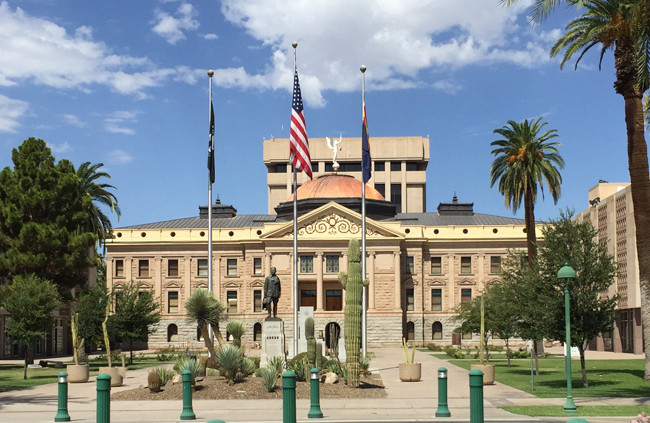
Earlier this week, my wife and I went to visit the Arizona State Capitol in Phoenix. “Big deal,” you might say. Well, it actually IS a big deal here. Arizona’s capitol building was built in 1901 when Arizona was still aTerritory, before it became a State in 1912. State  government has outgrown the old Capitol building so, instead of tearing it down, it is now a museum that pays tribute to the state’s history. It was a nice way to spend a few hours out of the heat.

But there was a bonus. Before going into the Capitol with its copper-toned dome (and if you don’t know why copper is important to Arizona, click this link to find out), we took advantage of the moderate morning temperatures (it was a balmy 91 degrees when we stepped out of the car and a few high clouds helped keep the sun from heating things up) to walk around the  Wesley Bolin Memorial Plaza that adjoins the Capitol building. The Plaza has 30 memorial monuments dedicated to a host of topics including a memorial to the victims of the 9/11 attacks, veterans and fallen heroes from many wars and conflicts and, as its centerpiece, a memorial to the USS Arizona, sunk in Pearl Harbor on December 7, 1941 with the loss of 1,777 lives.

USS_Arizona_anchor_small

The USS Arizona’s anchor has pride of place in the memorial and it is a powerful reminder of the sacrifices that the men and women in our armed forces make every day to ensure our freedoms. Inside the Capitol building, there were more tributes to the USS Arizona, including a large piece of the ship’s hull.

USS_Arizona_hull_small

It’s one thing to read history in a book. It is another to see it right before your eyes. You can touch this twisted piece of metal, look around the room at photos that show where it was before the ship sank. Our trip to the Capitol was full of powerful moments, a welcome distraction from the heat, and an opportunity to celebrate many of the things that make our state such a fascinating place.

Arizona_promised_land_small

As we were leaving the Capital, we went through a room that featured articles about Arizona’s early tourism industry. I smiled when I saw the old postcard, pictured above, with its old spelling of “canyon” as “canon” and its iconic association of the great saguaro cactus with the State. We continue to enjoy exploring Arizona, and days like we had earlier this week are serendipitous reminders of the joys and wonders to discover when you get out of the house. Even on a hot day.

Heed rashness and use perseverance

Heed rashness and use perseverance

Last week I was in San Francisco, and took the opportunity to visit the Asian Art Museum. In my travels I have been to Japan, Taiwan and mainland China and have come to appreciate the cultures and art of these fascinating places. The Asian Art Museum has a special exhibition of items from the National Palace Museum in Taipei and it was quite something to behold. Included in the exhibition is one of the most popular and important pieces of Chinese art, the so-called “meat shaped stone” or “priceless porkbelly”, carved from a piece of jasper during the Qing Dynasty and appearing in the United States now for the first time.

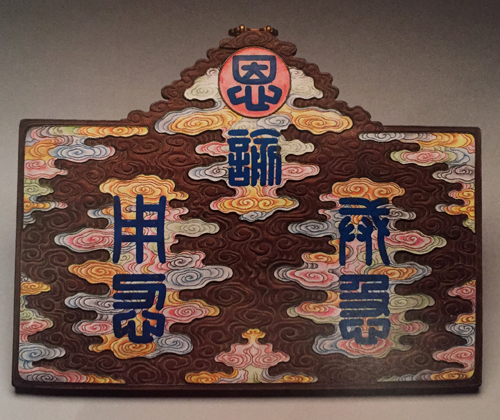
But something else caught my eye and I kept returning to it. It is a sign in lacquer on wood, created for the Emperor Yongzheng who reigned from 1723-1735. Apparently the emperor, when he was a prince, was prone to some habits that displeased his father, Emperor Kongxi. The son took his father’s advice to heart, and had signs made that he put around the palace to remind him of his shortcomings. The photo above shows one of these signs and the message is:

Heed rashness and use perseverance.

In other words, pay attention to your tendency to act rashly and take your time to carefully persevere in tasks.

This is a phrase that has been around since the beginning of time. But this father’s words of wisdom – beautifully portrayed in this sign – are a reminder of the importance of carefully considering what we say and do. We live in an age where it is too easy to “shoot from the hip” – or lip – without thinking through an action. Of course any successful musician has learned the value of the disciplined life, of not acting rashly or looking for quick fixes, but persevering through difficult tasks in order to find success.

When I need advice on how to proceed in a situation, I often turn to the book of Proverbs in the Bible. It has a tremendous amount of wisdom that speaks to every situation you may encounter. On the subjects of rashness, perseverance and heeding advice, it has a great deal to say:

There is one whose rash words are like sword thrusts, but the tongue of the wise brings healing. (Proverbs 12:18)

A wise son hears his father’s instruction, but a scoffer does not listen to rebuke. (Proverbs 13:1)

Whoever loves discipline loves knowledge, but he who hates reproof is stupid. (Proverbs 12:1)

The way of a fool is right in his own eyes, but a wise man listens to advice. (Proverbs 12:15)

And this passage that speaks to the value of perseverance, with a model taken from one of the smallest animals on earth:

Go to the ant, O sluggard; consider her ways, and be wise. Without having any chief, officer, or ruler, she prepares her bread in summer and gathers her food in harvest. How long will you lie there, O sluggard? When will you arise from your sleep? A little sleep, a little slumber, a little folding of the hands to rest, and poverty will come upon you like a robber, and want like an armed man. (Proverbs 6:6-11)

My trombone teacher, Edward Kleinhammer (bass trombonist of the Chicago Symphony Orchestra, 1940-1985) taught me important lessons about perseverance. In the book we wrote together, Mastering the Trombone, Mr. Kleinhammer wrote these important and challenging words:

World class trombone players do not just happen. Their talents are forged by the dual furnaces of determination and diligence.

In this, Edward Kleinhammer was acting like the loving Emperor Kongxi, reminding his son, Emperor Yongzheng, of the importance to “Heed rashness and use perseverance.”

I think I need to go practice now…