Author: Douglas Yeo

“It is the hope of man translated into a piece of music.”

“It is the hope of man translated into a piece of music.”

by Douglas Yeo

I’m reflecting on my recent trip to Japan, something I will write about more presently.

Among the many new friends I made on my trip to Nagoya, where I was guest artist at the Nagoya Trombone Festival, was Hiroshi Kurata, trombone professor at Aichi Prefectural University. Kurata-San gave me two of his CDs as gifts. They are treasures, and unlike anything I have heard and seen before. That’s because Kurata-San is not only a superb tenor trombonist. He is a tenor. A singer. And his albums, Speranza and Tromvoce, feature him both singing and playing the trombone. It works. It really, really works. This man is a fine, fine trombonist and a fine, fine singer. More than that, he is a fine artist / musician.

This afternoon, while I was driving home from church, I was listening to Tromvoce. Among the tracks was an arrangement of themes from Giacomo Puccini’s Turandot by K. Ohashi, for trombone and voice titled Turandot Fantasy. When Tanaka-San got to the famous Act III aria, “Nessun dorma,” I pulled off the road so I could pay attention. I have loved this aria as so many others have loved it since Puccini wrote it in 1926. Kurata-San sang the aria magnificently, and when I got home, I got out my copy of the June 21, 1993 issue of The New Yorker that contains an article about the great Italian tenor, Luciano Pavarotti. The article, “The Last Italian Tenor” by David Remnick, is a riveting piece of writing, and in it Pavarotti is remarkably candid. And insightful.

Screen Shot 2018-05-20 at 1.49.36 PM

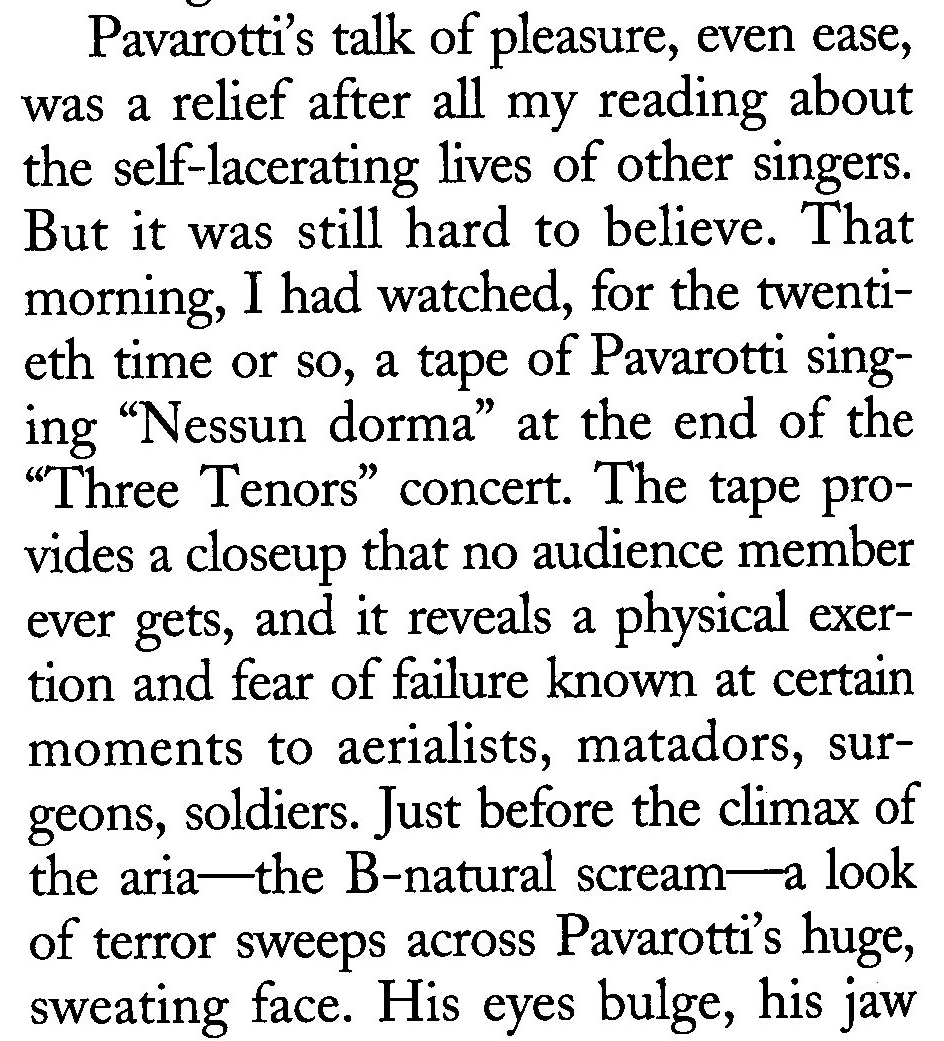
There were a few paragraphs from the article that I have used in many masterclasses, and I used them again in Japan while working with students. My message was this: What we do with the trombone in our hands is important. What we do as artists / musicians / trombonists is consequential because it makes a difference in people’s lives. I quoted Pavarotti’s comments about “Nessun dorma.”

The end of this aria contains these dramatic words:

Dilegua, o notte!              Vanish, o night!

Tramontate, stelle!          Fade, you stars!

Tramontate, stelle!          Fade, you stars!

All’alba vincerò!              At dawn, I will win!

Vincerò! Vincerò!            I will win! I will win!

Read Pavarotti’s comments below:
Pavarotti_Nessun_dorma_interview_01

Pavarotti_Nessun_dorma_interview_02

To me — and I am not alone in this thinking — this is the essence of music. Communication with an audience of an essential truth that speaks directly to the heart. The emotion of “Nessun dorma” is inescapable and Pavarotti’s comments are very, very insightful. What kind of singer are YOU? One who tries to make your music making “perfect” at all costs or one who, with honest, heartfelt expression, takes chances and wishes to change people’s lives in the process?

Listen for yourself. First, here is a recording of Pavarotti in concert from 1994. His performance, which is recorded live, is very fine. Watch it so you can observe Pavarotti’s face. “In this there is all the hope of a man,” Pavarotti said. Here, he sings it. Observe the look on his face as he sings the final Vincerò! I mean, REALLY look at his face at the final cadence; you will see exactly what Remnick was referencing in his article. This is musical and emotional  involvement of the highest order. [NOTE: due to copyright restrictions, you may not be able to watch the video embedded in my blog but you CAN watch it on YouTube by clicking here.]

Haven’t had enough of “Nessun dorma”? Then click on this link for an article that has links to 10 more performances. Each has something to say.

I end this blog post where I began, with my friend, Hiroshi Kurata. Here is a video of him playing and singing “Nessun dorma.” Any trombone player will appreciate the difficulty of what he is doing here. No overdubbing. This is a live recital. Playing the trombone with great beauty and expression, then immediately singing with tremendous passion. This is a rare accomplishment. [ To view this video on YouTube, click here.]

Thank you, Kurata-San. Thank you, Pavarotti. Thank you, God, for this remarkable gift that we call music that can stir our hearts.

Vincerò!

Screen Shot 2018-05-20 at 1.12.45 PM copy

Keith Brown (1933-2018)

Keith Brown (1933-2018)

My trombone teacher during my freshman year of college at Indiana University (1973-74), Keith Brown, died today after a long battle with Parkinson’s Disease.

Keith Brown’s name is certainly known to thousands upon thousands of trombone students and professionals. If one did know that he had been a member of the Indianapolis Symphony (1957-58), the New York Brass Quintet (1958-1959), the Symphony of the Air (1958-1959), the Philadelphia Orchestra (1959-1962), the Metropolitan Opera Orchestra (1962-1965), the Aspen Festival (1957-1969) the Casals Festival Orchestra in Puerto Rico (1958-1980), Professor of Music at Temple University (1965-1971), and Professor of Trombone and conductor of orchestras at Indiana University (1971-1997), one certainly knew him from his dozens of publications for International Music Company, including ten volumes of orchestral excerpts. “The Brown Books” were known to players by the color of their covers. “See you at 7 o’clock for excerpts; bring the red, yellow and blue Brown books” was often heard coming from the lips of college trombone players. Everybody had them.

IMG_9428

His editions of the Kreutzer Violin Etudes, and the K. Stephanovsky Bass Trombone Etudes are on my music stand every day. Every day.

IMG_9429

Those I bought in my first weeks of studying with him along with Richard Fote’s edition of selected studies by G. Kopprasch; the photo below shows the first page of my Kopprasch book. His students will recognize his handwriting at the top of the etude with the date he first assigned it to me: 9/26/[1973], the first semester of my freshman year.

IMG_9430

I met Keith Brown in Boston in January 1973. I was a senior in high school, and by virtue of my being first chair trombone in New Jersey All State Orchestra in 1972, had been selected to be a member of the All Eastern Orchestra in 1973. The orchestra – made up of students from the states of Maryland northward through New England – met in Boston and Keith Brown was the conductor. My trombone section included Doug Elliott, the renowned mouthpiece maker, and trumpeter Dennis Alves, who is now Director of Artistic Planning for the Boston Pops; I played bass trombone. It was actually the first time I had ever played bass trombone, and the program consisted of Leonard Bernstein’s “Overture to Candide,” Dvorak Symphony No. 8 and Brahms Symphony No. 3. Mr. Brown spoke to me several times during that week and he encouraged me to apply to Indiana University and come to study with him. So I did.

Screen Shot 2018-05-10 at 6.53.32 AM

I learned a lot from Keith Brown. A lot. It was with him that I really started working seriously on the bass trombone. During my first semester, I played in Orchestra 4 at IU, in a section along with William McElheney who became a very close friend; he later went on to be a trombonist with the Vienna State Opera (Vienna Philharmonic) for many years. It was with that orchestra I first played Tchaikovsky’s Symphony 5. With Keith Brown conducting.

IMG_9426

By my second semester, I was playing in IU’s top orchestra, the Philharmonic, where I played Alban Berg’s opera, “Wozzeck.” As a freshman. It was a heady time for me, plowing through repertoire with Mr. Brown, developing my low register, learning orchestral repertoire. His students formed a trombone choir that played at his church on Easter Sunday 1974, followed by a dinner at his home. We called him “Coach,” and we referred to him among ourselves as “K.B.” Long before NIKE had adopted the slogan in 1988, Keith would tell me, in lessons, “Doug, just do it.” He even gave me a button with that slogan.

IMG_9435

He was kind, generous, and helpful (even if he did sometimes have a cigar in his hand during a lesson!). This photo below shows Keith Brown and me at my last lesson at IU, May 3, 1974. Earlier that year, I had decided to transfer to Wheaton College in Illinois. Not because I was unhappy at IU, but because there was this girl going to Wheaton in the fall. My high school sweetheart, Patricia, and this August we will celebrate our 43rd wedding anniversary. Wheaton also brought with it the opportunity to study with Edward Kleinhammer, bass trombonist of the Chicago Symphony. But that is a story for another time.

img156

Over the years, I kept in touch with Mr. Brown. He was always happy to hear my voice on the phone, and when he started a sentence with, “Well, very honestly, Doug. . .” I knew I needed to pay attention. I went to IU in 2010 to give a masterclass and spent an afternoon with Keith at his home. We had a great time remembering old times, and he was so proud of my long career as a member of the Boston Symphony (1985-2012).

yeo_brown

In 2010, the Boston Symphony trombone section consisted of Toby Oft (principal), Steve Lange (second) and myself (bass). As it turned out, all three of us studied with Keith Brown at Indiana University, at least for a time. So in 2011, Toby, Steve, and I got the idea to invite Keith and his wife, Maggie, to the Boston Symphony’s summer home, Tanglewood, to hear three of his former students play together in one of the world’s great orchestras. The program: Tchaikovsky Symphony 6. Seeing Keith in the audience, front and center, grinning from ear to ear, standing and cheering for Toby, Steve, and me, is something I will never forget.

After the concert, everyone came with their families over to our home for a cookout. It was a wonderful time of conversation, remembering our lessons with Keith, talking about the orchestra business. It was a beautiful day. Memorable. It was the last time that I saw him.

Steve_Toby_Keith_Doug_01

[Photo above: Steve Lange, Toby Oft, Keith Brown, Douglas Yeo – July 11, 2011]

Keith and I would talk on the phone from time to time in the years that followed. But Parkinson’s Disease began to ravage his body and he little by little slipped away. Today, he breathed his last. I’m glad he was a part of my life, as he was a part of so many lives. Part of me is who I am today because of Keith Brown.

[Header photo of Keith Brown from his LP recording, Keith Brown: Trombone, Golden Crest Recital Series RE 7043, recorded c. 1972]

Returning to Japan

Returning to Japan

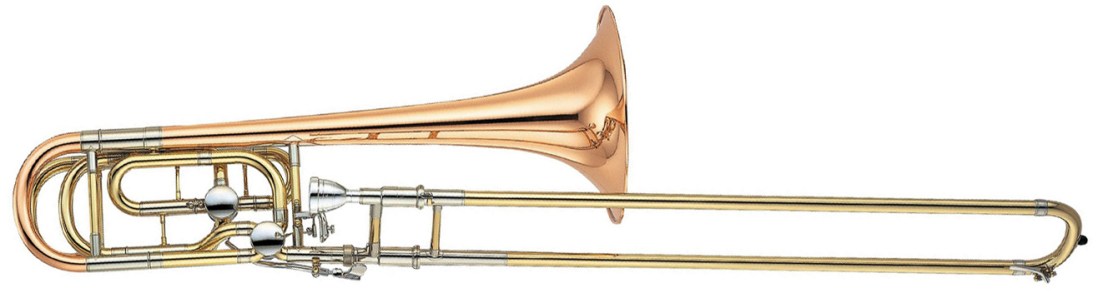
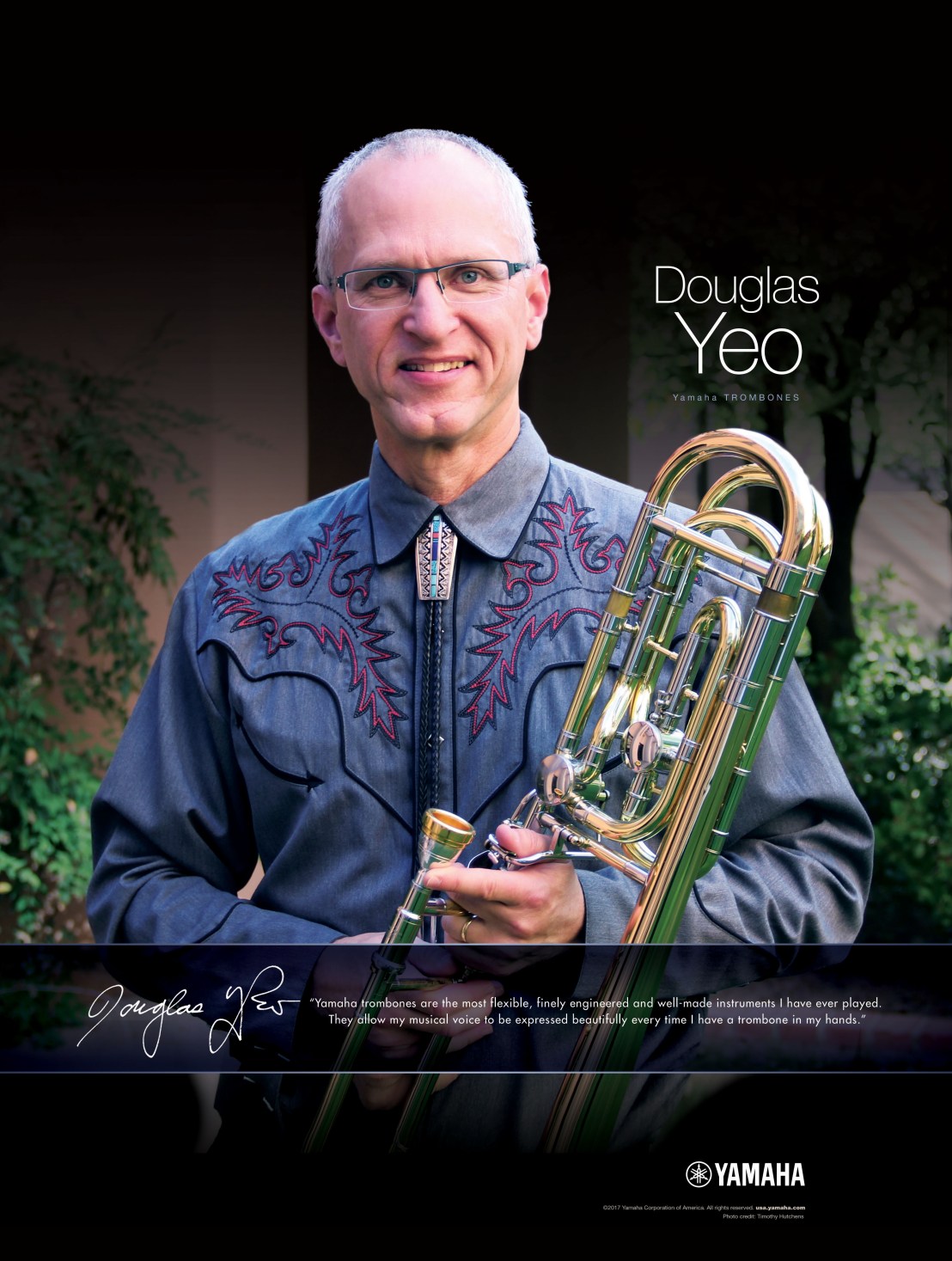
I have been to Japan more times than I can count — maybe 12 or 13 times — and on my many trips, I have always had a trombone in my hand. During my nearly thirty years as bass trombonist of the Boston Symphony, I took part in many Boston Symphony and Boston Pops Orchestra tours to Japan, conducted by Seiji Ozawa and John Williams. The first of these tours, in 1986, led to my introduction to YAMAHA, which resulted in the beginning of my long, productive, and happy relationship with the company and its people. Together we have worked to develop the YAMAHA YBL-822G bass trombone and YAMAHA Douglas Yeo Signature Series Mouthpiece that I have been playing for decades.

822.jpg

I have also traveled to Japan many times to serve on the faculty of the Hamamatsu International Wind Instrument Academy and Festival, an annual event that brings together an international group of teachers and performers to work with talented students. Sponsored by YAMAHA and the City of Hamamatsu, times working at the Academy have been memorable.

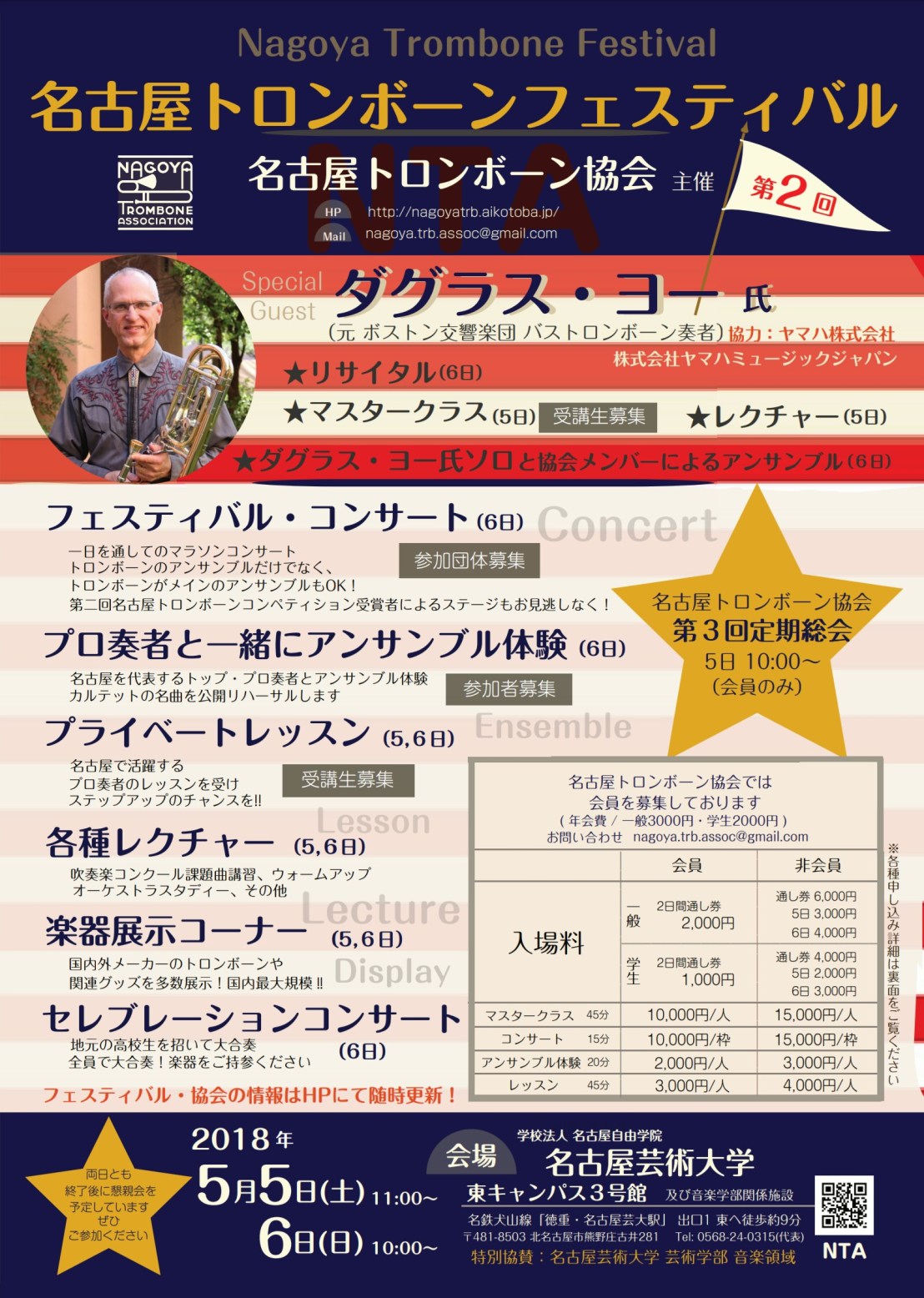
Next week, I will return to Japan once again, as the guest of the Nagoya Trombone Festival, sponsored by the Nagoya Trombone Association. During the two day Festival, I will play a recital (accompanied by a superb pianist, Shoko Gamo), perform as soloist with a trombone ensemble, conduct two trombone ensembles, and give a lecture on the history of the trombone. Here are a few more details:

Yeo_Nagoya_trombone_festival_poster

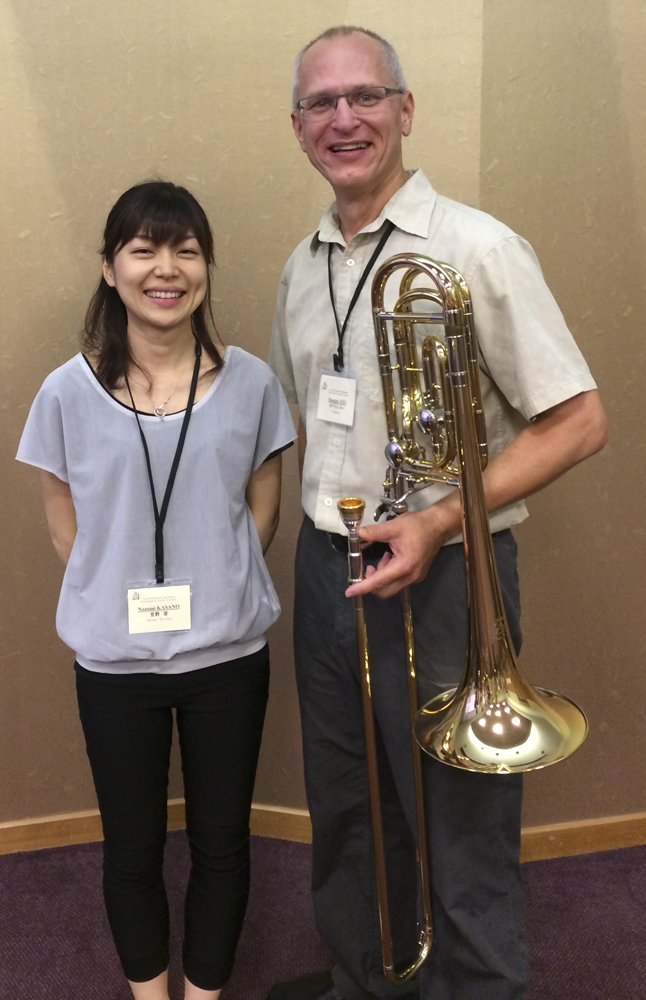
One of the special joys of this trip will be to see my former student, Nozomi Kasano Flatt, who plays bass trombone in the Japan Century Orchestra in Osaka. I met Nozomi in 2004 at the Hamamatsu Academy where she was a student in my trombone class. She subsequently came to Boston where we worked together for three years and she received her Graduate Diploma and Master of Music Degrees at New England Conservatory. I am exceptionally proud of Nozomi and all of her accomplishments and in 2014, she served as my translator for my class at the Hamamatsu Academy. Next week, she will be my translator once again, and we will also play a duet on my recital.

Kasano_Yeo

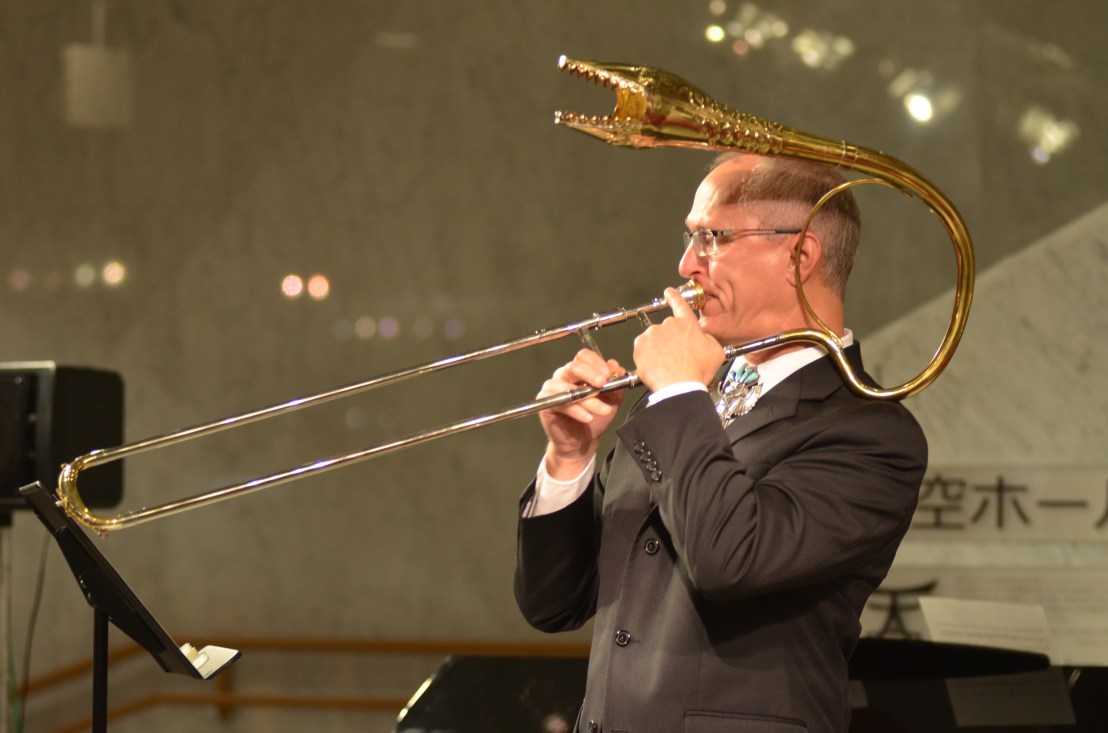
One of the pieces I will play on my recital is an arrangement of a Canzone by Frescobaldi by Eddie Koopman. Koopman’s electronic accompaniment gives a new flavor to this piece from the Renaissance and to inject something different into my recital, I will play it on a buccin, a dragon bell trombone. In 2015, I gave a recital at the Hamamatsu Museum of Musical Instruments and played this piece on a buccin made by YAMAHA. It’s a great instrument, made by YAMAHA factory workers in their spare time. It’s very nice of YAMAHA to let me use this instrument once again in Nagoya where I will be able to bring a very different kind of trombone sound to the audience.

DSC_0600

In addition to my work at the Nagoya Trombone Festival, I will also give a masterclass at Aichi Prefectural University. While there, I will work with several talented young trombonists and also have an informal talk with the students about my life in music. Here is a poster with some more information about my time at the University.

Nagoya_poster_2.jpeg

Japan. Nagoya. Trombone. Music. Friends.

Schermafbeelding-2016-12-21-om-11.55.40-2.png

Screen Shot 2018-04-28 at 7.47.14 AM.png


Trombones in Texas: y’all come!

Trombones in Texas: y’all come!

Texas. It’s a big state. And it has a lot of trombone players.

Next week I’ll be in the Lone Star State, giving masterclasses and performing at University of Texas, Austin (Dr. Nathaniel Brickens, Professor of Trombone) and Texas Christian University (Dr. David Begnoche, Associate Professor of Trombone). I’ve been to these two schools and worked with these fine teachers on previous occasions; it has always been a joy and pleasure to work with their students and enjoy time together.

If you find yourself in Austin or Fort Worth, Texas next week, come on by to some of the events listed below. Here’s a flyer with some of my University of Texas, Austin activities:

Screen Shot 2018-04-05 at 7.11.01 PM

Click on the TCU logo below; it will take you to the website of the TCU Trombone Summit, to be held on Saturday, April 14. It’s an all day event with masterclasses by several artists and a gala concert at night. If you can’t view the image below, click HERE to go to the TCU Trombone Summit website.

Screen Shot 2018-04-05 at 7.08.51 PM

I’d also like to say that I’m very grateful to YAMAHA Corporation of America for their kind sponsorship of my appearance at these Texas events. For information about the YAMAHA YBL-822G trombone that I play — I began my very happy relationship with YAMAHA in 1986 — click HERE.

YAMAHA_Yeo_Poster_18x24_FINAL