Author: Douglas Yeo

Symphony Hall: Boston’s proud temple of music since 1900

Symphony Hall: Boston’s proud temple of music since 1900

From 1985-2012, I was bass trombonist of the Boston Symphony Orchestra. The orchestra’s home is Symphony Hall, on the corner of Huntington and Massachusetts Avenues in Boston’s Back Bay section (301 Massachusetts Avenue). Opened in 1900 after the orchestra left the Boston Music Hall where it had played concerts since it was founded in 1881, Symphony Hall is considered to be one of the three finest concert halls in the world, with its acclaimed acoustics putting it in the company of the Musikvereinsaal (Vienna) and Concertgebouw (Amsterdam). Before it was destroyed in World War II, the old (alte) Gewandhaus in Leipzig was also similarly acclaimed. Having played concerts in the halls in Vienna and Amsterdam, I can say that in my view, Symphony Hall is simply the finest concert hall in which I have ever performed.

When I joined the Boston Symphony, I was aware of the rich history of both the orchestra itself and its storied home. I’ve read everything I could find about the BSO and Symphony Hall, spent countless hours in the orchestra’s archives (with which I had a hand in formally establishing in 1987), and have been fascinated at all I have found and learned.

Two important books have informed my quest for information about Symphony Hall.

Johnson_Symphony_Hall_Boston_1950

Published in 1950 on the occasion of the 50th anniversary of the opening of Symphony Hall, H. Earle Johnson’s Symphony Hall, Boston (Boston: Little, Brown and Co., 1950)  surveys the orchestra’s first 50 years, discusses programming and personnel, and features commentary on the building and opening of Symphony Hall. Now out of print (but copies can be found on through used book outlets such a abebooks.com), it unfortunately has no illustrations. 

Stebbins_Symphony_Hall_2000


Richard Poate Stebbins’ book, The Making of Symphony Hall: A History with Documents (Boston: Boston Symphony Orchestra, 2000) is a superb volume that documents, in fascinating detail, the planning, construction, and opening of Symphony Hall. It was published on Symphony Hall’s centennial, a year I remember with great fondness for the many historical exhibits in the Hall’s corridors and the many celebrations of the Hall throughout the year. The cover of the book features an early, color rendering of the original design of the hall, with many statues, inscriptions, and decorative cornices. Ultimately, none of these items were incorporated in hall when it was finished. Money ran out, and to this day, even there is no external decoration to the hall. Even the Hall’s  name is not found on its exterior. Yet it is this austerity that is part of Symphony Hall’s charm; somehow it fits in with the Boston way.

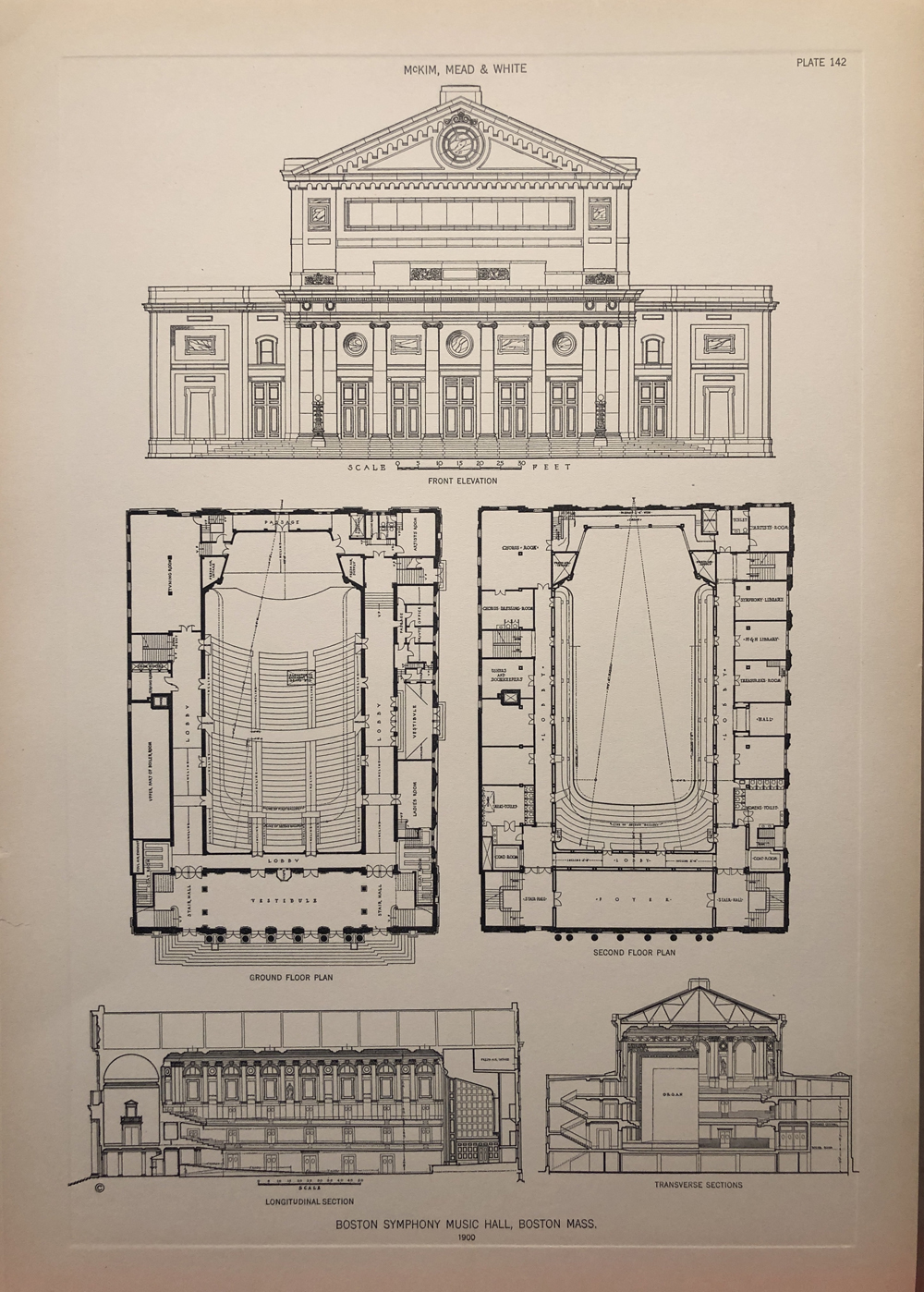
Symphony Hall was designed by  the architectural firm of McKim, Mead & White and an early photo of the completed Hall appeared in A Monograph of the Work of McKim, Mead & White, 1879-1915 (New York: Architectural Book Publishing Co, 1915), below. The publication was a massive four volume set with nearly 400 photographs; each had a simple caption without commentary. It details the breadth of the buildings designed by McKim, Mead & White and it includes three plates that feature Symphony Hall, plates 141, 142, and 143. Several years ago, I was able to obtain original copies of these plates, which are also contained in a modern reproduction of the original four volume set that is still readily and affordably available (McKim, Mead & White, The Architecture of McKim, Mead & White in Photographs, Plans and Elevations (New York: Dover Publications, 1990).  While McKim, Mead & White’s portfolio was published in 1915, the caption reflects the original name for Symphony Hall, The Boston Symphony Music Hall, which was changed to Symphony Hall just before its opening in October, 1900.

Symphony_Hall_plate_141

The other two plates feature some interior and exterior cross sections of Symphony Hall (the aisles on the main floor were changed to a different configuration in the final design), plate 142:
Symphony_Hall_plate_142

And plate 143, that features details of exterior design for the Hall:
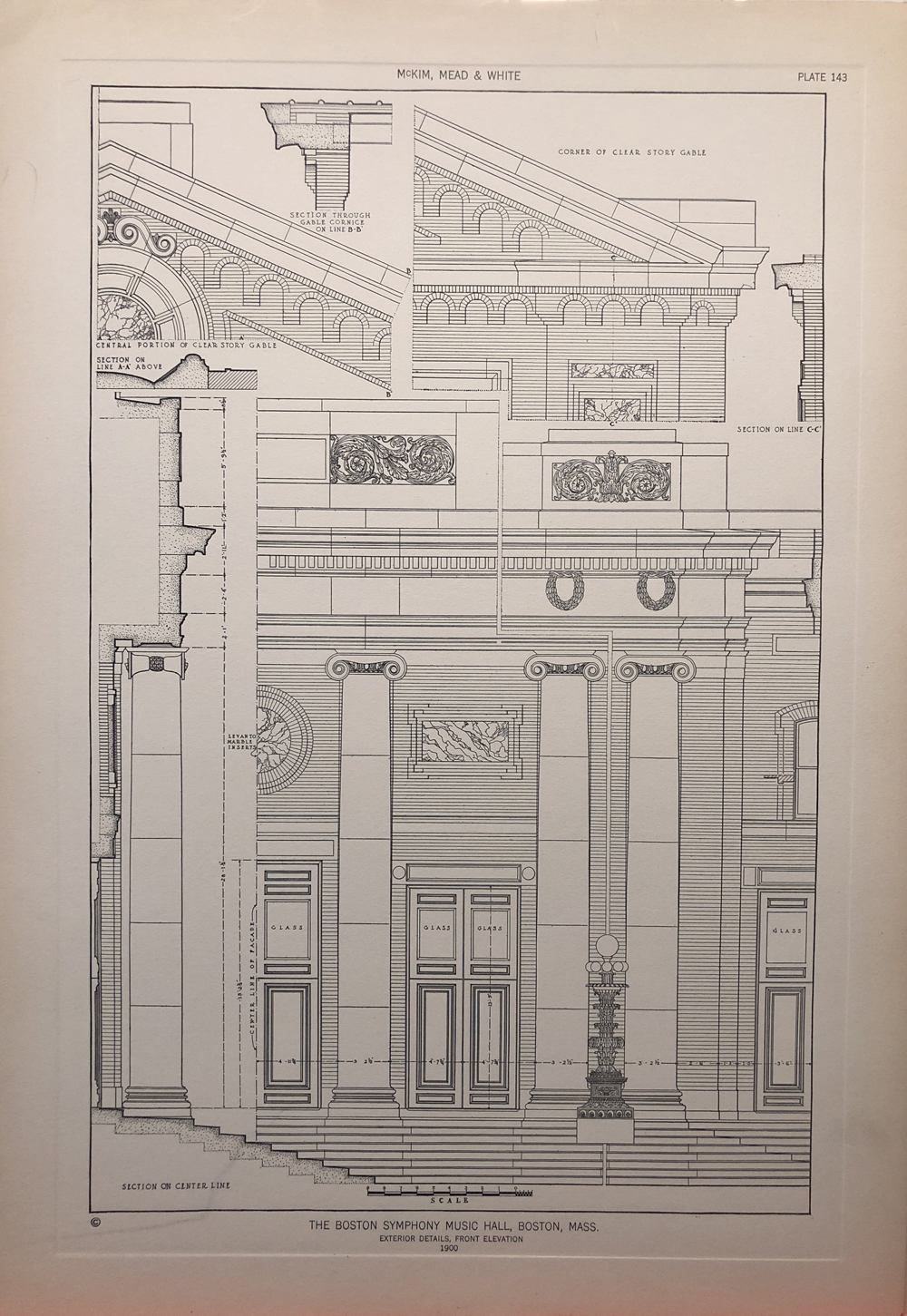
Symphony_Hall_plate_143

Over the years, I have collected many postcards of Symphony Hall; I usually paid only one or two dollars apiece for a piece of Boston Symphony history. I was fascinated at how many different images of the facade of the Hall had been made over nearly 100 years. In all, I found dozens of different postcards with nearly 30 images of the exterior of the hall. Many were crisp and clean, but the ones that were most interesting were the ones that had been used, with writing, stamps, and postmarks. It is these postcards that helped to document the approximate time when the photo or image of Symphony Hall was made. Early postcards were black and white; later ones were hand tinted before reproduction, and later ones are faithful photographic reproductions. Most postcards do not have copyright dates; I am not an expert at automobile models which could help further pinpoint years photos were taken. Still, these cards tell the story of Symphony Hall in a unique way. I’m presenting them here in rough chronological order with only light commentary; captions appear beneath each card. The images speak for themselves and are a reminder of a very important part of my life and the lives of thousands upon thousands of lovers of music who have walked through the doors of Symphony Hall, Boston’s proud Temple of Music. 
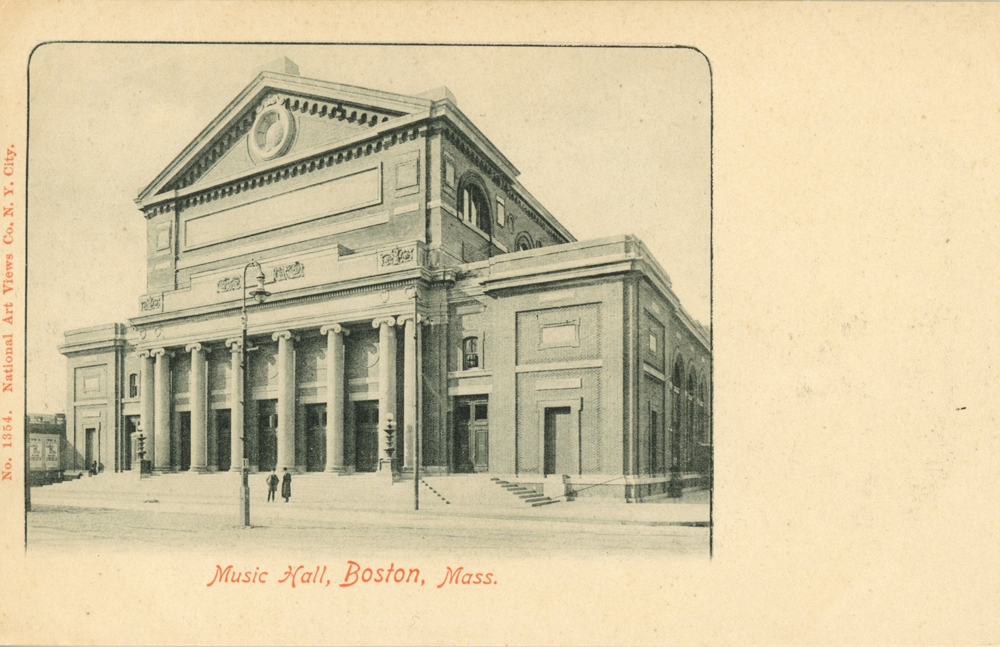
01_Symphony_Hall_Yeo_postcard

01. Music Hall, Boston, Mass. c. 1900. Card produced by National Art Views Co., N. Y. City. One of the earliest photos of the exterior of Symphony Hall, the view is of the original front entrance of Symphony Hall on Huntington Avenue; the Huntington Avenue trolly line power lines have been removed from this image. The Hall’s original name, Music Hall, which was changed to Symphony Hall before the first Boston Symphony concert was performed there on October 15, 1900, is featured in the caption.
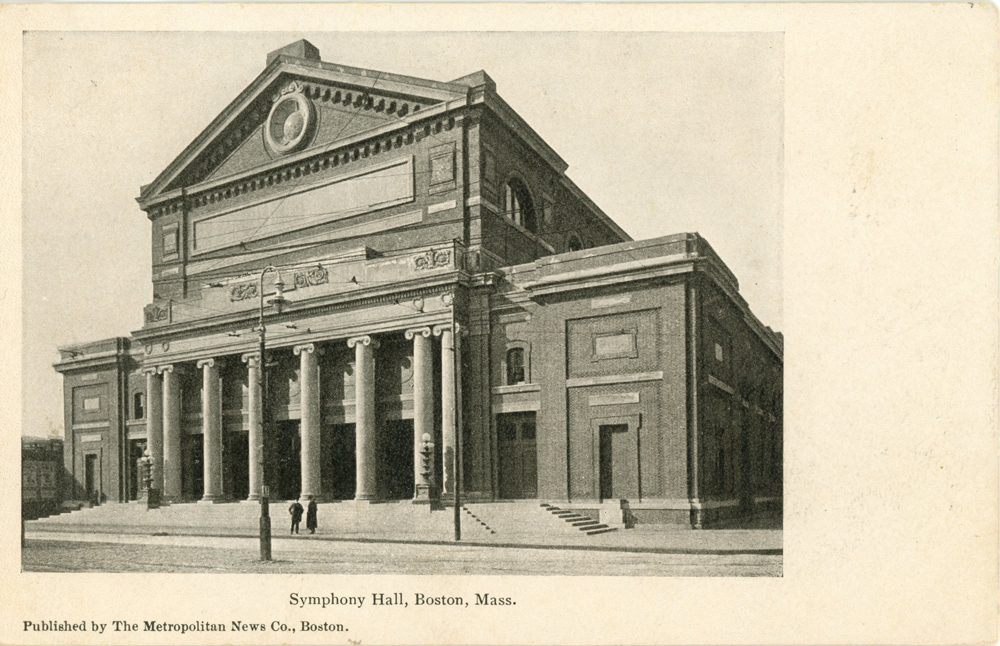
02_Symphony_Hall_Yeo_postcard

02. Symphony Hall, Boston, Mass. c. 1900. Card produced by The Metropolitan News Co., Boston. This is the identical photo seen in the previous card except the trolley power lines have not been removed. Note the name of the Hall has now been changed from Music Hall to Symphony Hall.

03_Symphony_Hall_Yeo_postcard

03. Symphony Hall. c. 1902. This collage of buildings are from Boston’s Back Bay area, including the Horticultural Hall, which is across the street from Symphony Hall on Massachusetts Avenue. The Art Museum on the card is the Museum of Fine Arts, Boston, which moved from its original location in Copley Square (shown on the card) to its present location on Huntington Avenue in 1907.

03a_Symphony_Hall_Yeo_postcard

03a. Symphony Hall, Boston, Mass. c. 1904. Card produced by Detroit Photographic Co. The card is used and is postmarked October 7, 1908, addressed to Miss Mary Merkins, Winsted, Connecticut. The copyright date of the image is given as 1904. Note the woman in the bottom right corner who is holding on to her hat in the gusting wind.

04_Symphony_Hall_Yeo_postcard

04. Symphony Hall, Boston, Mass. c. 1905. Produced by F. von Bardelben, New York & Germany. Made in Germany. Note the presence of a single horse-drawn carriage.

05_Symphony_Hall_Yeo_postcard

05. Symphony Hall, c. 1905. Card produced by Chisholm Bros., Portland, Maine. The card is used and is postmarked September 4, 1905, addressed to Miss Myrtle Kiefer, Homer, Michigan. The view is similar to the card above but several pedestrians are seen standing against the building.
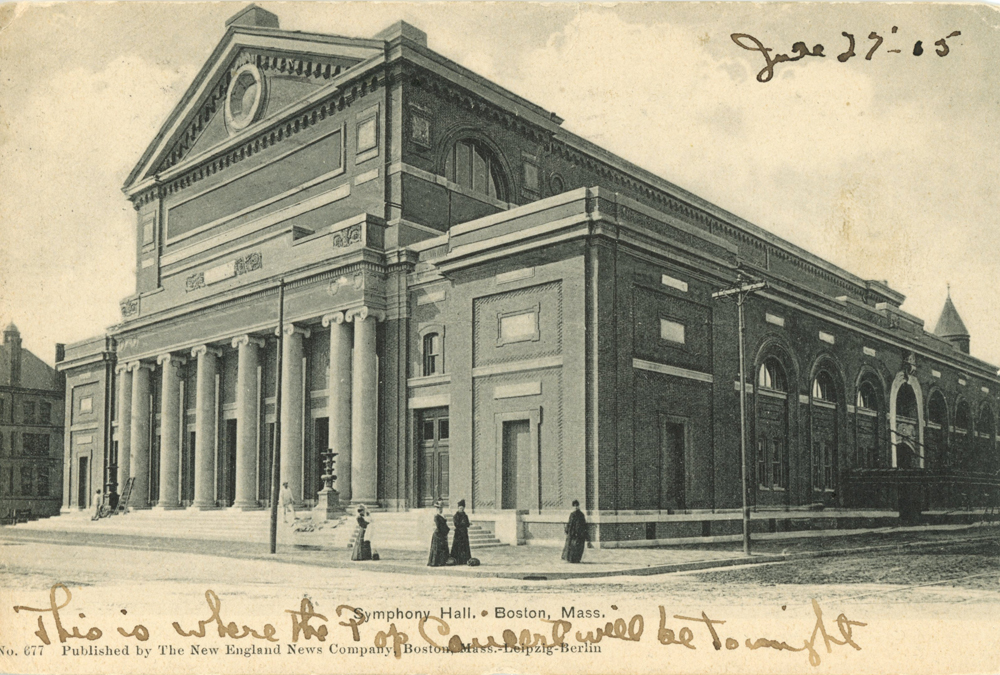
06_Symphony_Hall_Yeo_postcard

06. Symphony Hall, Boston, Mass. c. 1905. Card produced by The New England News Company, Boston, Mass. – Leipzig — Berlin. The card is used and is postmarked June 29, 1905, addressed to Mrs. K. B. Keene of Washington, D.C. In this view, one can see one of the rising-sun  shaped windows in the clerestory; these were boarded up during World War II (a blackout precaution) and were only reopened in the early 2000s at which time natural light once again could shine into the Hall.
07_Symphony_Hall_Yeo_postcard

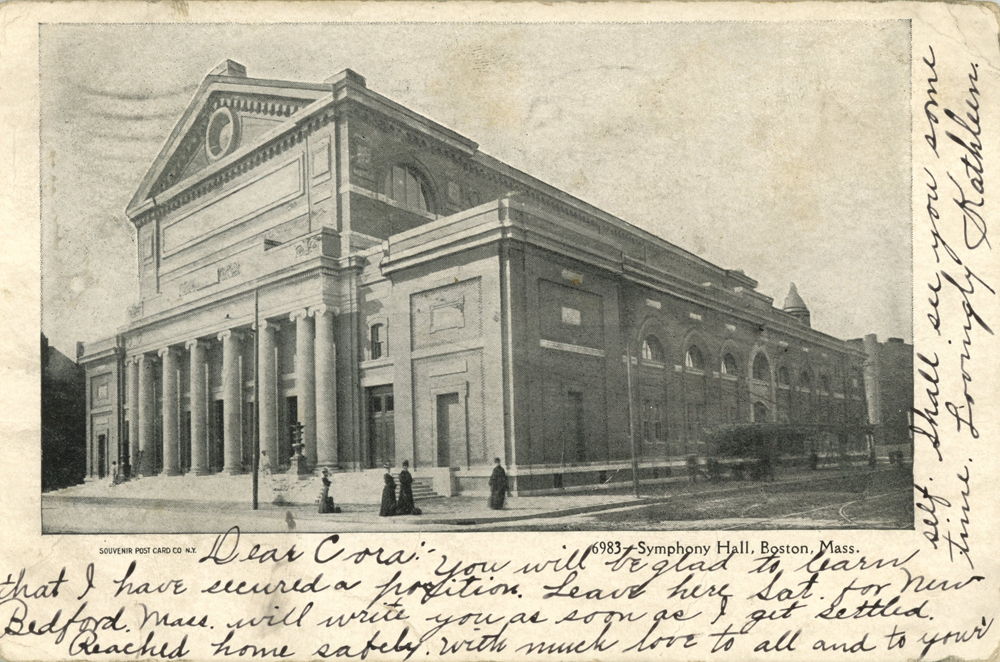
07. Symphony Hall, Boston, Mass. c. 1905. Card produced by Souvenir Post Card Co., New York. The card is used and is postmarked November 11, 1906, addressed to Mrs. A. L. Turner of Atlantic, Massachusetts. The photo is identical to the one in the card above although it is cropped differently and you can see many people along the Massachusetts Avenue side of Symphony Hall who had been removed in the previous card. I own a second copy of this card that was also used, postmarked March 7, 1907, addressed to Mr. George A. Ohlmsted, Barre, Vermont (c/o Ladd’s Grocery).

07a_Symphony_Hall_Yeo_postcard

07a. Symphony Hall, Boston, Mass. c. 1907. Card produced by Reichner Bros., Boston, München, Prag., Leipzig. Made in Austria. This curious card appears in version with no text on the image side and also as shown here, with the imprint of an event – Welcome to Boston, Old Home Week, July 28-Aug. 3, 1907 – that was probably held in Symphony Hall that had nothing to do with the Boston Symphony. Organizations sometimes issued commemorative cards with their own imprint to celebrate their events. Note the Boston bean pots in the four corners. The photo of Symphony Hall is centered in an artist’s palate. 
08_Symphony_Hall_Yeo_postcard

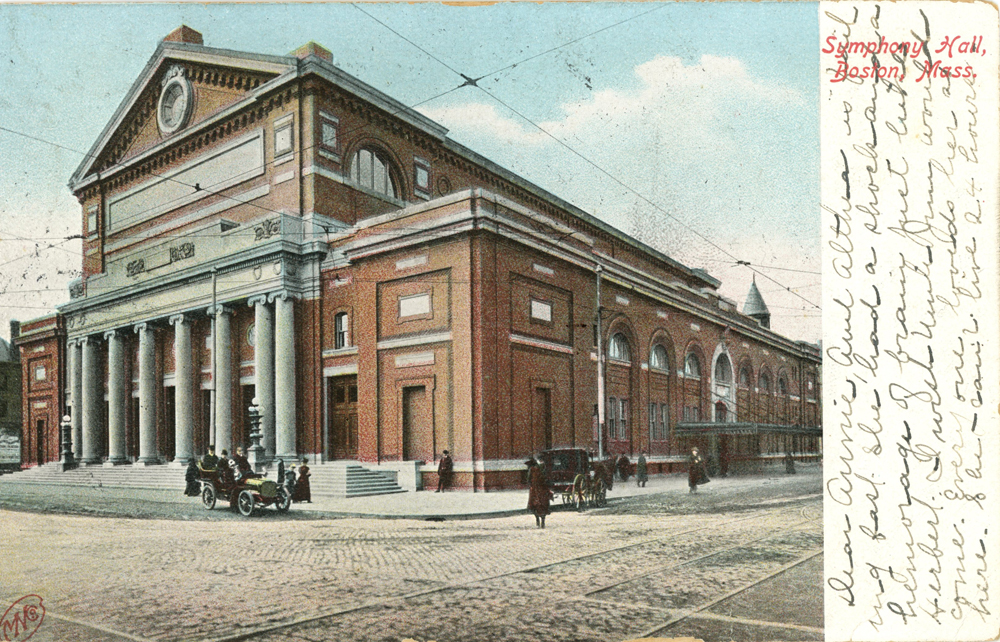
08. Symphony Hall, Boston, Mass. c. 1908. Card produced by Robbins Bros., Boston, Mass. Made in Germany. The card is used and is postmarked April 6, 1908, addressed to Mrs. Robert Skillings, Danville, Quebec. This card is the earliest I have seen that shows an automobile – on Huntington Avenue around the corner from a horse drawn carriage on Massachusetts Avenue.

09_Symphony_Hall_Yeo_postcard

09. Boston, Mass., Symphony Hall. c. 1911. Card produced by  The Hugh C. Leighton Co., Portland, ME, USA. Made in Germany. The card is used and is postmarked November 10, 1911, addressed to Mr. Georgie Worren, Wilton, New Hampshire. Two things are notable: The card was sold by Poole Piano Company (established in Boston in 1893) which inserted its company name and the hot air balloon with a piano hovering above the hall. This was a common advertising tool in the late nineteenth and early twentieth centuries. Also, note the sign that says “POPS” above the right pair of columns. This sign indicates that the photo was taken during the Boston Pops season. Pops concerts – originally “Promenade concerts” – began in 1885 and continue to this day. Today, this lighted sign is installed each year over the Massachusetts Avenue side of Symphony Hall (see card 24, below).

10_Symphony_Hall_Yeo_postcard

10. Symphony Hall and Horticultural Society Building, Huntington Ave., Boston, Mass. c. 1912. The card is used and is postmarked  December 10, 1912, addressed to Mrs. C. E. Palmer, Bath, Maine. This card looks down Huntington Avenue and shows the proximity of Symphony Hall and the Horticultural Hall (built in 1901); note, too, the three modes of transportation: horse-drawn carriage, automobile, and trolley.

11_Symphony_Hall_Yeo_postcard

11. Boston, Mass., Symphony Hall. c. 1913. Card produced by Raphael Tuck & Sons, Art Publishers to Their Majesties the King & Queen. Printed in Holland.  The card’s caption on the back reads, “SYMPHONY HALL, successor of the old Music Hall, is the home of the Symphony Orchestra, and here the oratorios of Handel and Hayden Society are even. The Hall has a seating capacity of 2,500, and the interior decorations, lighting, etc., are up-to-date as it was erected recently.”

12_Symphony_Hall_Yeo_postcard

12. Symphony Hall, Boston, Mass. c. 1914. Card produced by The Leighton & Valentine Co., N. Y. City. Printed in United States. The card is used, postmarked 1914, addressed to Mrs. C. H. Gateo, Petersham, Massachusetts. The lighted POPS sign is seen again in this card, as are two trollies and a horse-drawn carriage. Notice, too, the large three-sheet advertisements for Boston Pops concerts in the niches on the corners of the building as well as one standing against the Huntington Avenue columns.

13_Symphony_Hall_Yeo_postcard

13. Symphony Hall, Boston, Mass. c. 1914. Published by Tichnor Bros., Inc., Cambridge, Mass. Huntington Avenue is bustling with activity; many signs lean up against the Huntington Avenue columns to advertise upcoming concerts and events. Two styles of automobiles are seen as well as the wheel of a horse-drawn carriage on the far left. Crossing Massachusetts Avenue on the right side of the card is someone with a long case or parcel. Could it be a member of the Boston Symphony heading to a rehearsal?

14_Symphony_Hall_Yeo_postcard

14. Symphony Hall, Boston, Mass. c. 1915. Card produced by  E. H. & F. A. Rugg, Medford, Mass. Visible in this card is one of the shutters — standing open — that could be raised to cover   the rising-sun clerestory windows. 

14a_Symphony_Hall_Yeo_postcard

14a. Symphony Hall and Horticultural Hall, Massachusetts Avenue, Boston, Mass. c. 1927. Card produced by  Tichnor Bros., Inc., at Cambridge, Mass, USA. The postcard is used and is postmarked 1927, addressed to Mrs. Wilber Tasker, Etna, Maine. This view shows Symphony Hall and the Horticultural Hall, with the dome of the mother church of First Church, Christ Scientist (built in 1906) rising in the background. The caption on the back of the postcard refers to Symphony Hall as “Boston’s Temple of Music.”

15_Symphony_Hall_Yeo_postcard

15. Symphony Hall, Boston, Mass. c. 1930s? Card produced by C. T. American Art. 

16_Symphony_Hall_Yeo_postcard

16. Symphony Hall, Boston, Mass. c. 1930s? Card produced by The New England News Company, Boston, Mass. 

17_Symphony_Hall_Yeo_postcard

17. Symphony Hall, Boston, Mass. c. 1930s? Card produced by The Process Photo Studios, Troy at 21st St., Chicago, Ill. The presence of a kiosk in the intersection of Huntington and Massachusetts Avenues with an traffic officer from the Boston Police Department adds a certain kind of frightening charm to this image. I would not have wanted to be in his position.
18_Symphony_Hall_Yeo_postcard

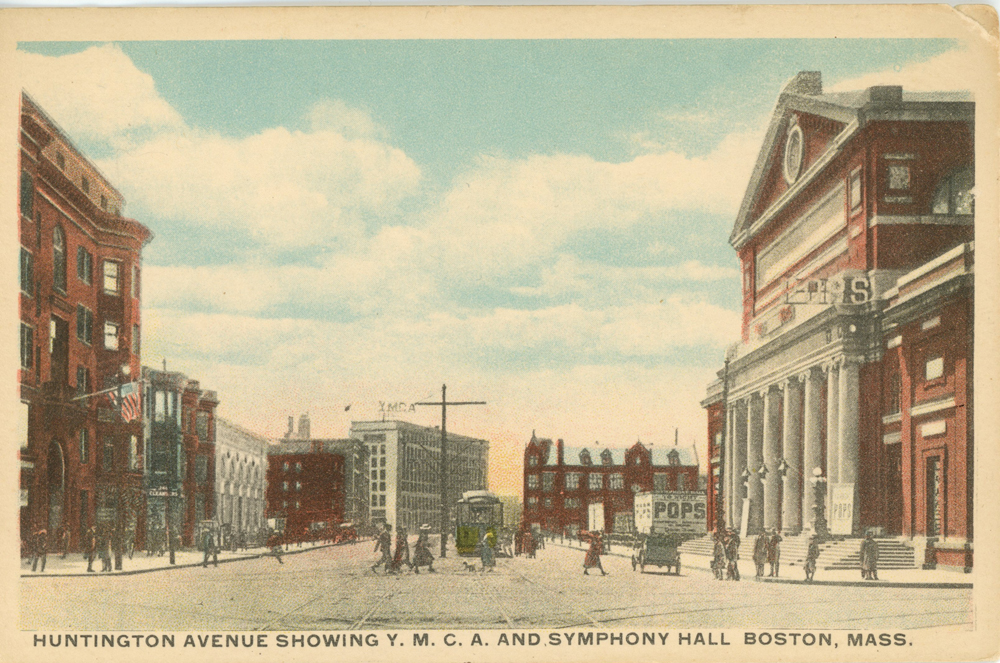
18. Huntington Avenue Showing Y.M.C.A. and Symphony Hall, Boston, Mass. Before 1941. Card produced by M. Abrams, Roxbury, Massachusetts. This view is down Huntington Avenue and shows Symphony Hall on the right (with the POPS lighted sign in place), and the Boston Y.M.C.A. building in the center. To the left of the Y.M.C.A. is New England Conservatory of Music where I taught from 1985-2012; many Boston Symphony musicians teach at NEC owing to its close proximity to Symphony Hall.

19_Symphony_Hall_Yeo_postcard

19. Symphony Hall, Y.M.C.A. and Junction, Mass. Ave. and Huntington Ave., Boston, Mass. Before 1941. Card produced by The New England News Company, Boston, Mass. Similar to the view above, this postcard features later style automobiles, the absence of the POPS advertising, and large American flags on top of the Y.M.C.A.

20_Symphony_Hall_Yeo_postcard

20. Symphony Hall, Boston, Mass. c. 1941. Card produced by United Art Co., Boston, Mass. I do not know if the large American flag on the roof of Symphony Hall was actually a feature of the hall for a time or if it is an artistic addition from around the time of World War II. I have been on the roof of Symphony Hall and do not recall seeing a stand for a flag of that size although it’s quite possible it was there at one time.

21_Symphony_Hall_Yeo_postcard

21. Huntington Avenue at Massachusetts Avenue Showing Symphony Hall, Horticultural Hall and Dome of Christian Science Church. Boston, Mass. c. 1949. Card produced by “COLOURPICTURE” Publications, Cambridge, Mass. USA. The card is used and is postmarked September 7, 1949, addressed to Mrs. Harry Monroe, Fitchburg, Massachusetts. In 1941, the Tremont Street Subway (now the Green Line E spur) was moved from surface level to underground to avoid traffic on Massachusetts Avenue. This made using the original Huntington Avenue entrance of Symphony Hall more difficult since the road was necessarily more narrow. The main entrance of the Hall was switched to the Massachusetts Avenue side. This was a practical decision but it has disrupted the original flow of concert goers into the Hall; they now enter the auditorium from the side rather than from the rear.

22_Symphony_Hall_Yeo_postcard

22. Symphony Hall, Massachusetts and Huntington Avenue, Boston, Mass. c. 1954. Card Produced by United Art Co., 89 Bedford St., Boston, Mass. The postcard is used and is postmarked July 21, 1954, addressed to Mr. & Mrs. Harry Davidson, Lakewood, Ohio. This interesting view shows a long building to the left of Symphony Hall (a sign for a bowling alley is visible). This building, which stretches for the whole block, is now owned by the Boston Symphony which has plans to redevelop the block with a new building. Currently it houses the Orchestra’s Cohen Wing which includes the Symphony Hall gift shop, BSO archives, management offices, the Casadesus Collection of Musical Instruments, and various other businesses that rent space from the Boston Symphony.

23_Symphony_Hall_Yeo_postcard

23. Symphony Hall. c. 1990. Card photo by Lincoln Russell, Stockbridge, MA. Symphony Hall at dusk, in a time-lapse photograph. 

24_Symphony_Hall_Yeo_postcard

24. Symphony Hall. c. 1995. Card photo by Helen Eddy, Cambridge, Massachusetts. This view is of the canopy over the Massachusetts avenue entrance to Symphony Hall, showing decorative bunting and the lighted POPS sign celebrating the spring season of the Boston Pops Orchestra.

25_Symphony_Hall_Yeo_postcard.jpg

25. Seiji Ozawa and the Boston Symphony Orchestra, Symphony Hall. c. 2000. Card photo by Christian Steiner, New York, New York. This photo shows a view of the stage of Symphony Hall near the end of the tenure of Music Director Seiji Ozawa (music director 1973-2002). The trumpets and trombones are seated in the back row of the orchestra in front of librarians and personnel mangers and stage managers who are standing in the center: Thomas Rolfs, Peter Chapman and Charles Schlueter, trumpets; Ronald Barron, Norman Bolter, Douglas Yeo, trombones; Chester Schmitz, tuba. The story of the interior of Symphony Hall is one for another time!


André Previn (and J. J. Johnson)

André Previn (and J. J. Johnson)

Last week, André Previn died at the age of 89. He was known for many things: he was a conductor, composer, and pianist, and his private life was very public (among his five wives were actress Mia Farrow and violinist Anne-Sophie Mutter). During my long career with the Boston Symphony, I played many concerts under Previn’s direction, beginning with the Elgar Symphony No. 1 in August 1985; the last time I worked with him was when he conducted Ravel’s La Valse in August 2009. In all, I played 81 concerts under his baton, including concerts in February 1997 when he led the Boston Symphony Orchestra on a tour to the Canary Islands and Florida.

Previn was born in Berlin in 1929; his name was Andreas Ludwig Prewin. His father was Jewish and in 1938, the family fled the Nazis and moved to Paris and then Los Angeles. He became an American citizen in 1943 and was, to my mind, a thoroughly American musical personality. Previn had a dry wit, a “matter-of-factness” when he addressed the orchestra in rehearsal. His ear was always finely attuned to balance and when, during a rehearsal of Antonin Dvorak’s Symphony 8 he said to an over-enthusiastic brass player, “We don’t need the zenith, apocalyptic fortissimo,” his point was succinctly made. And he had coined a phrase that I and many others have used from time to time.

During that 1997 tour of the Canary Islands, Previn hosted a party for the orchestra. This was a long tradition on Boston Symphony tours, and a generous gesture on the part of the tour’s conductor. Of course, sending the Boston Symphony to the Canary Islands during the teeth of a Boston winter was like letting children loose in a candy story. Many of my colleagues took every opportunity to frolic on the famous beaches and more than a few players came to a concert with severe sunburn. At the party, Previn rose to toast the orchestra. “I’m terribly sorry,” he said as he lifted his glass, “if the concerts are interfering with the tour.” And he sat down. That was Previn. He didn’t need many words to make a point and when he used them, sometimes you just had to smile and muffle a hearty chuckle.

Previn_Johnson_Mack_the_Knife

But I first got acquainted with André Previn long before I joined the Boston Symphony and began playing concerts with him. In 1971, I visited our local public library and noticed a jazz trombone recording by J. J. Johnson. At that time, I had heard few recordings of great trombone players. This one got my attention. Recorded in 1962, it was titled, André Previn and J. J. Johnson play Kurt Weill’s Mack the Knife & Bilbao-Song and Other Music from The Threepenny Opera. That’s a mouthful. But here’s what got my attention: Previn got top billing. Who was he? I quickly found out.

The eight tracks – the combo was rounded out with Red Mitchell, bass, and Frank Capp, drums – were stunning in their creativity. Johnson I knew; he did not disappoint. But Previn was someone new to me, and his piano playing was stellar. Recorded in 1962, the recording had a freshness and vibrancy that spoke to me. And as the record turned, I was particularly interested to hear what these two performers would do with Mack the Knife, one of the most frequently recorded songs. What could they do and say that hadn’t been done and said.

They did and said something new. As you can hear in the link above (or click HERE to listen to the track on YouTube), Previn started Mack the Knife with an innocuous introduction in G-flat. No surprise there. But then Johnson came in. In the key of C. The bitonality was shocking. Truly shocking. Then, on the second verse, Johnson played in G-flat and Previn played in C. My young ears had never heard anything like it before. It remains as shocking and wonderful today as it did when I first heard it nearly 50 years ago.

Johnson_Previn_02

Years later, during a break at a Boston Symphony rehearsal, I asked Previn about that recording session. I wanted to know how they came up with that incredibly creative idea. Previn looked at me and shook his head. “It just happened,” he said. “I vamped an intro and J. J. just started playing in a different key. It all flowed from there. We didn’t talk it through, we didn’t work it out. It just happened.”

Amazing.

Incredibly, this album has been long out of print. It appeared on two CD releases (one was released only in Japan) but they disappeared from the catalog quickly. But used copies can still be found on Discogs and other used record/CD outlets. It’s worth tracking down.

André Previn is remembered by many people for many different things. I’m grateful that I got to play so many concerts with him on the podium. But most of all I’m grateful that I can still be inspired by a jazz album he made with one of the greatest trombonists of all time, and that the creativity exhibited on that disc is still with us.

[Photos of J. J. Johnson and Andre Previn from the back cover of the original issue of André Previn and J. J. Johnson play Kurt Weill’s Mack the Knife & Bilbao-Song and Other Music from The Threepenny Opera, Columbia LP SICP 2384.]


Tubby the Tuba

Tubby the Tuba

Among my many projects that are happily occupying my time is my work on several book projects. One of them is An Illustrated Dictionary for the Modern Trombone, Euphonium, and Tuba Player, to be published by Rowman & Littlefield. This is a very interesting project for me: to come up with about 600 terms (instruments, instrument parts, accessories, composers, companies, players, etc.) that low brass players might want to know more about. It is a dictionary, not an encyclopedia, so my entries are necessarily brief, but an extensive bibliography will help readers know where to go to get more information.

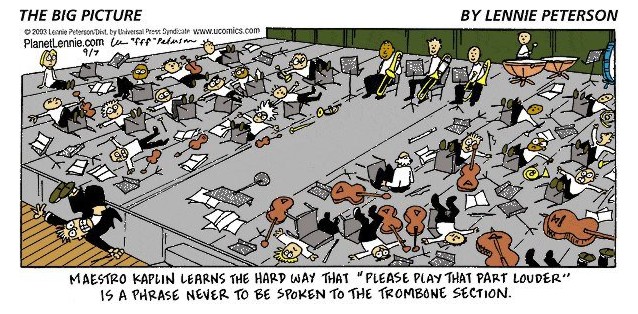
The book will be illustrated by my friend, Lennie Peterson, a trombonist and artist living in Boston but who works around the world. Many readers of The Last Trombone already know Lennie even if they don’t know him: I’d venture to say that any readers who are trombone players have seen Lennie’s most famous cartoon from the many years when his syndicated daily cartoon, “The Big Picture,” was part of newspapers around the country.

Lennie_Peterson_trombone_Kaplin

But Lennie is also a superb fine artist, and his illustrations for my new book will add measurably to help readers understand my words even better.

Over the last few days, I’ve been researching an entry for my book, about the piece,  Tubby the Tuba. Many readers probably know about this charming work for orchestra, narrator, and tuba. But it wasn’t until I actually sat down to research it that I found some very interesting things that I’d like to share with readers.

Tubby the Tuba was written by George Kleinsinger (music) and Paul Tripp (story). Tubist Herbert Jenkel asked Kleinsinger to write him a concerto for tuba and Tubby was the result. Kleinsinger and Tripp began their collaboration for Tubby in 1941 but World War II interrupted their work. They finally finished it in 1945 and it was premiered the following year in a concert by the American Youth Orchestra conducted by Dean Dixon with tubist Herbert Wekselblatt (who went on to be tubist with the Metropolitan Opera Orchestra for many years). The first performance of Tubby by a professional orchestra was given by the Philadelphia Orchestra conducted by Alexander Hilsberg. The concert, on October 19, 1946, was part of the Worcester (Massachusetts) Festival and featured the orchestra’s tubist, Philip A. Donatelli, as soloist. Tubby the Tuba became the first major piece for tuba solo with orchestra, predating Ralph Vaughan Williams’ Tuba Concerto by 10 years.

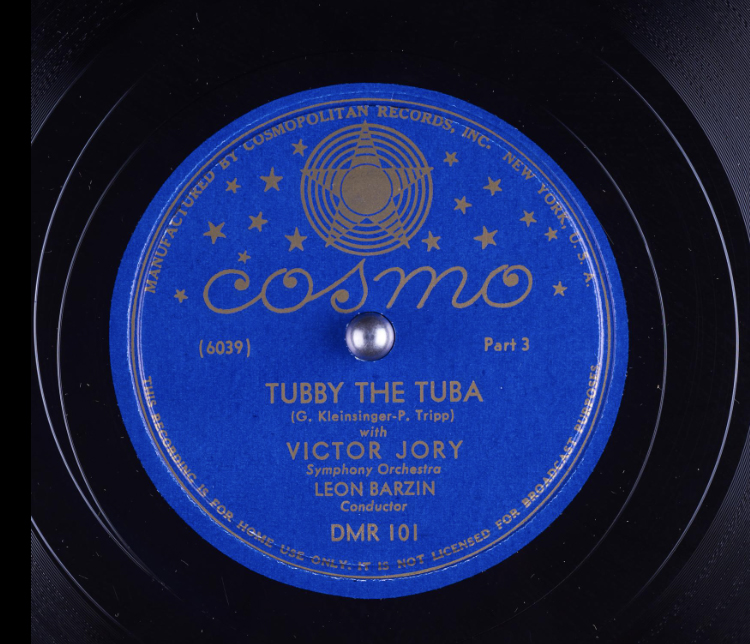
Tubby_Barzin

Tubby was first recorded in 1945 (The recording, on Cosmo Records, was released in December of that year) with Herbert Jenkel, tuba. This recording, with an orchestra conducted by Leo Barzin and Victor Jory narrating, may be heard HERE. Unfortunately, Jenkel was not credited on the album.

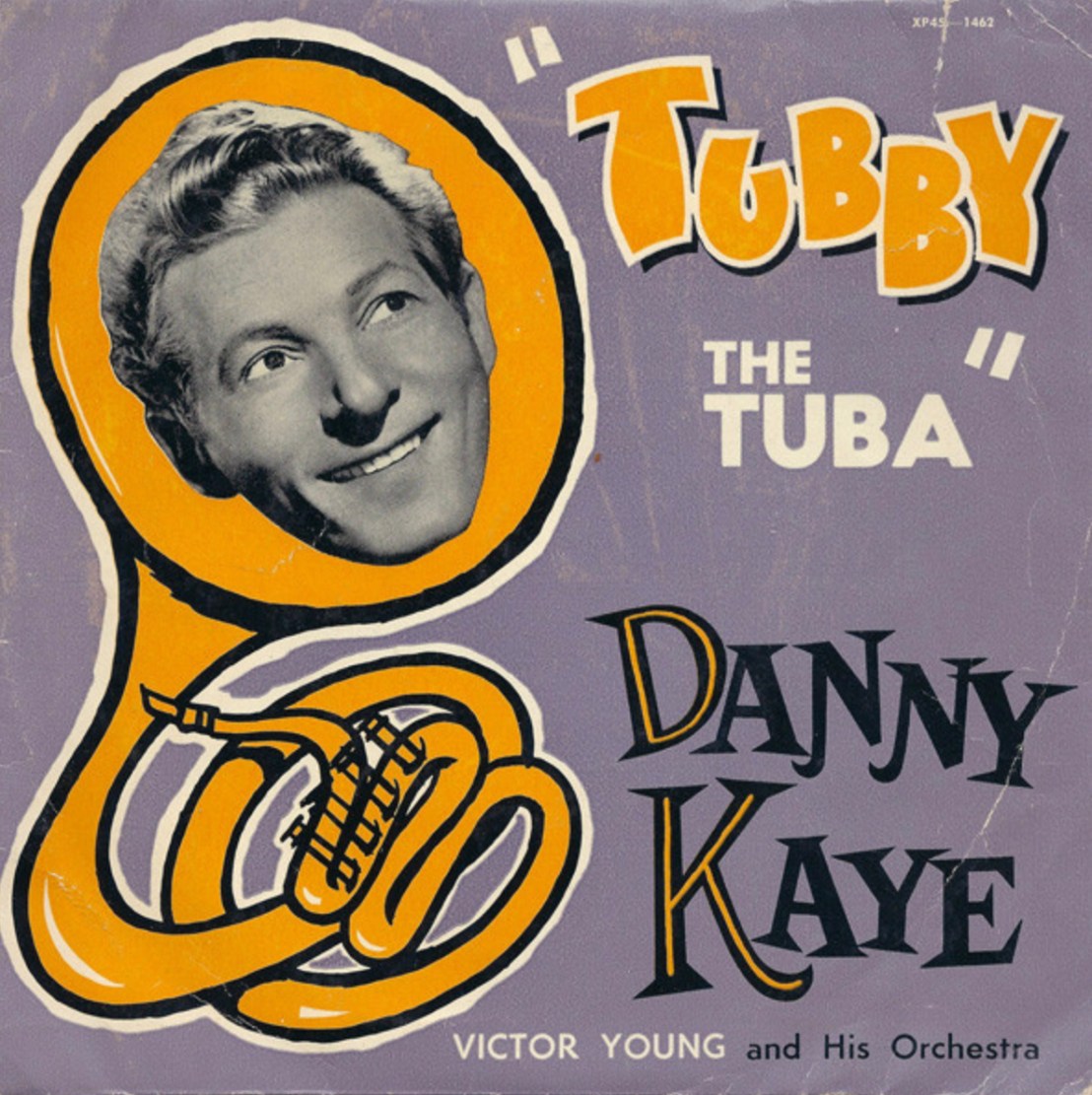
Tubby_Kaye

Tubby was then recorded in 1946 by Victor Young and his Concert Orchestra; Danny Kaye was the narrator with an uncredited tuba soloist. That recording may be heard HERE.

That same year, 1946, Tubby the Tuba made it to the big screen, as an animated short. It’s a charming film which received an Oscar nomination for best animated short. The film, a stop-action creation of George Pal and released as one of his Puppetoons productions, is absolutely delightful; unfortunately the tuba soloist is uncredited. If you cannot view the video embedded in this article, you can view it on YouTube by clicking HERE.

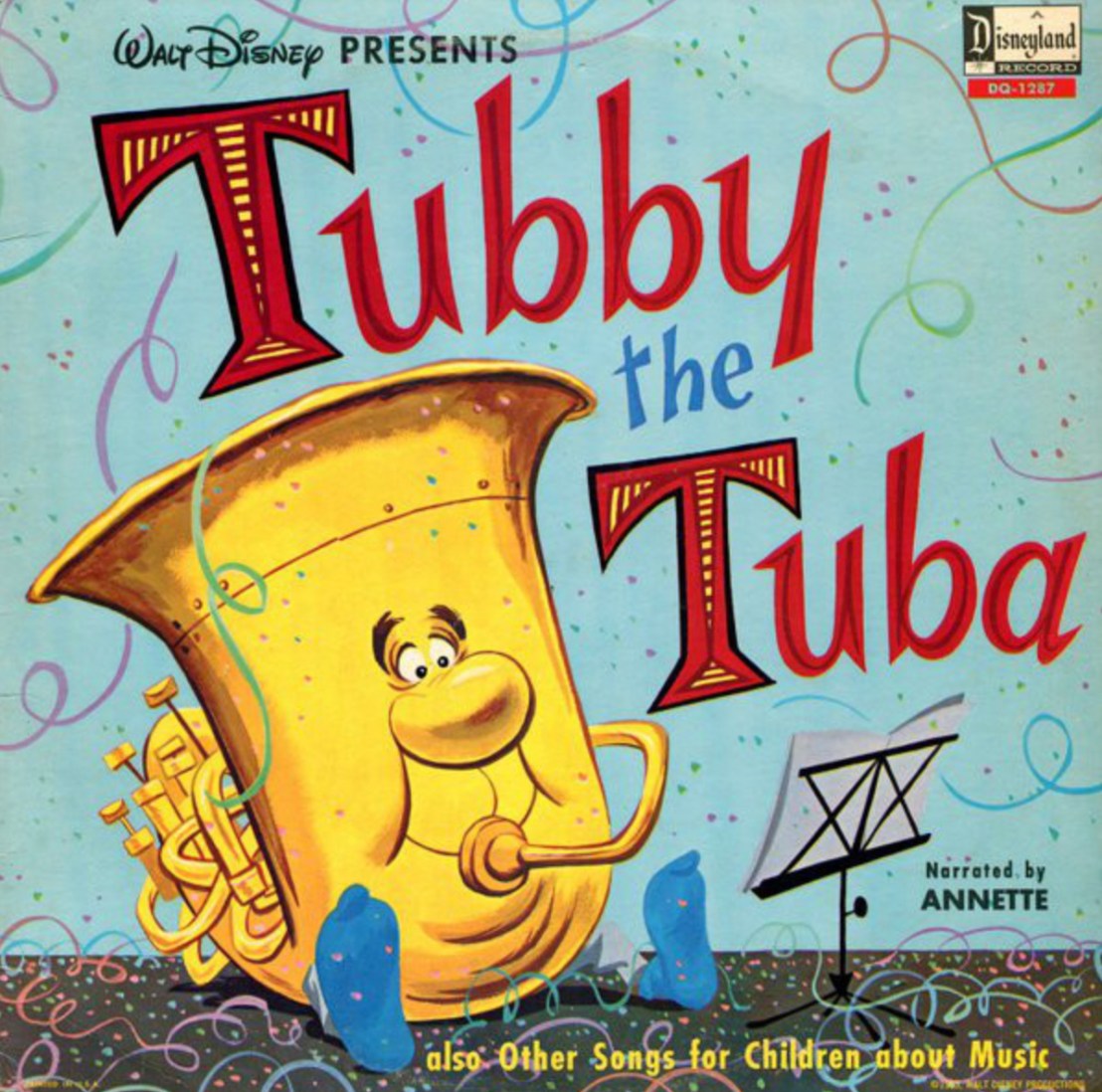
In 1963, Disney released another recording of Tubby the Tuba, with Annette Funicello (she of Mickey Mouse Musketeer fame) narrating with, yet again, an uncredited tuba soloist. That recording may be heard HERE.

Tubby_Annette

Tubby the Tuba found its way to the big screen again in 1975 (not 1977, as the video below indicates), as a full length motion picture starring Dick van Dyke as the voice of Tubby. It was a commercial failure; turning a ten minute piece into a  one hour, twenty minute film simply resulted in a bloated production that lost a lot of its original charm. Here is the familiar refrain: the tuba soloist is uncredited. If you cannot view the video embedded in this article, you may view it on YouTube by clicking HERE.

Tubby_Child_Schmitz

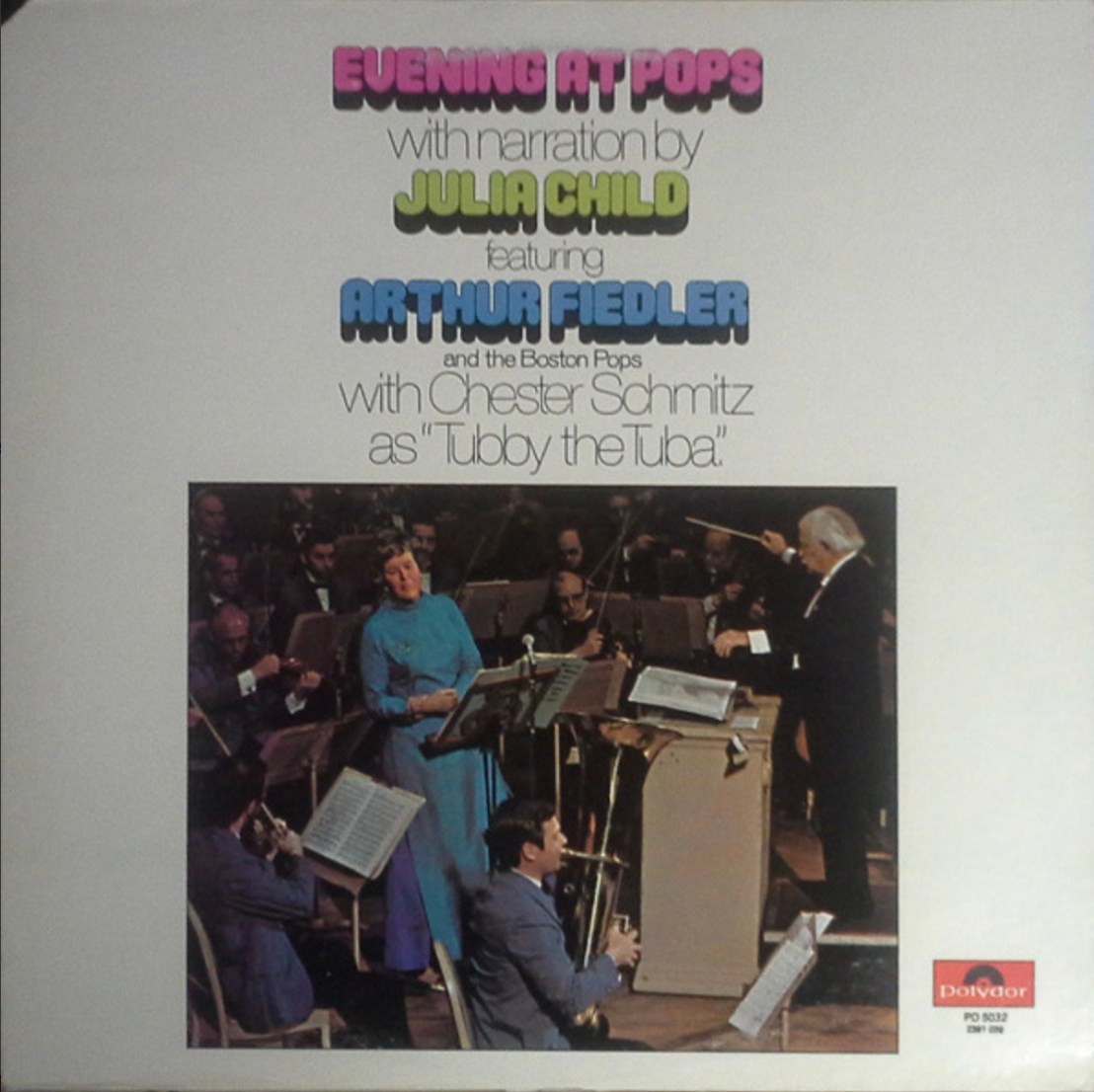
But of all of the versions of Tubby the Tuba, my favorite dates from 1971. Julia Child recorded the piece with the Boston Pops Orchestra conducted by Arthur Fiedler. Not only was this performance issued on LP, but it was recorded live for television broadcast on the PBS show, “Evening at Pops.” The tuba soloist was my Boston Symphony tuba colleague, Chester Schmitz (Chester played in the Boston Symphony from 1966-2001; we sat next to each other from 1985-2001). I have sung Chester’s praises many times before but I never tire of singing them again: he was, to my mind, the finest player of ANY wind instrument that I have ever heard. Chester had a remarkably natural ease to his playing, and his performance of Tubby, recorded in his fifth year with the Boston Symphony Orchestra is absolutely superb. His playing, combined with Julia Child’s wit, make this a performance for the ages. If you cannot view the video embedded in this article, you can see it on YouTube by clicking HERE. Enjoy!

For more information about Tubby the Tuba, read Cary O’Dell’s fine essay that was created for the Library of Congress when Tubby the Tuba was added to the National Registry in 2006. Tubby the Tuba: a delightful, unpretentious little piece with a very big history.


Surprises

Surprises

Life is full of surprises, unexpected things that intersect our lives. Sometimes a surprise is shocking, such as a car accident, or the sudden death of a friend or loved one. Sometimes surprises are joyful, like getting accepted to a college you thought was out of reach. No matter how they come, surprises always get our attention. A recent surprise got me thinking of how interesting this theme of surprises (good ones!) has been in my life recently.

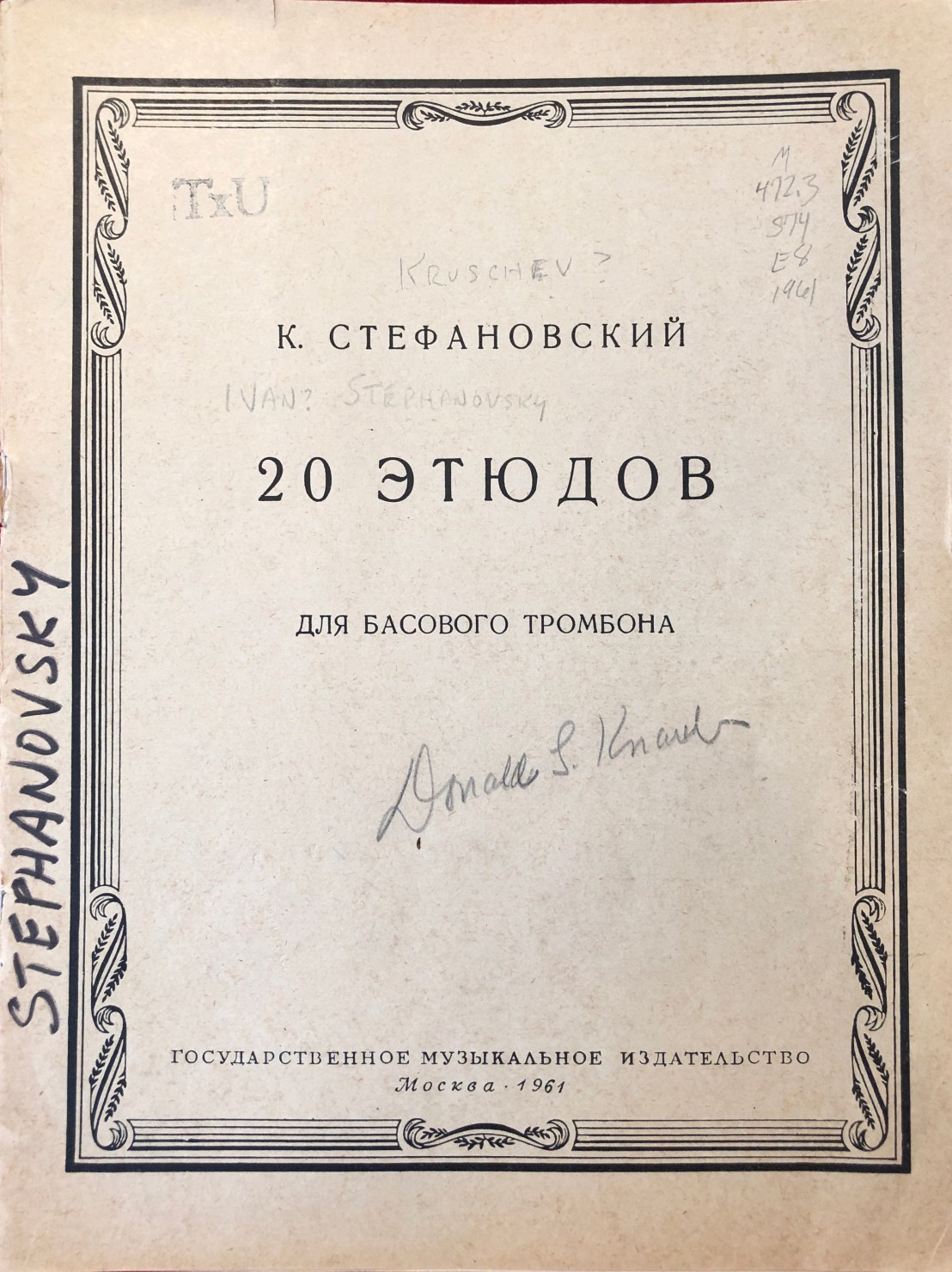
Among my many ongoing projects, I have been doing a study of the Stephanovsky 20 Etudes for Bass Trombone. As my friend, Peter Ellefson (Professor of Trombone at Indiana University) pointed out to me a few weeks ago, Keith Brown’s 1964 edition of the Stephanovsky 20 Etudes contains a great deal of common material with Brown’s edition of Fritz Werner’s 38 Studies for Trombone. What? Two composers whose books contain much music that is identical? Keith Brown died last year so he isn’t here to explain what happened. So I’ve been trying to figure out this little puzzle.

In my research, I learned that the 20 Etudes were first published under Stephanovsky’s name in the Soviet Union, first around 1950 and then again in 1961 (Werner’s book was first published in 1927). I hunted around for copies of Stephanovsky’s Russian editions to obtain via Inter Library Loan and finally located a copy of the 1961 edition (I did locate a copy of the c. 1950 edition but the library that owns it is in Europe and does not participate in ILL) in the library at University of Texas, Austin. In a few days, it was heading to me for examination.

SURPRISE! When I opened it, the title page revealed that this copy had been previously owned by Donald S. Knaub, former professor of trombone at Eastman School of Music and University of Texas. Knaub is one of the most respected trombone teachers of the twentieth century; I was very privileged to meet him a few years ago when I gave a masterclass at University of Houston. A book from his personal library? Nice.

stephanovksy_cover_knaub_copy_1961

SURPRISE! Someone (it was probably Knaub since the handwriting looks like his) made some assumptions about the name of the composer of this music. No, it was not Kruschev, nor Ivan. Stephanovsky’s first name was Karl. The University of Texas librarians got the name right when they entered the music into their catalog.

Whenever I hold music that was owned by someone else, I have great anticipation when I open it up since there are often hand-written markings that prove to be as interesting to me as the music itself. Knaub’s music didn’t disappoint.

stephanovsky_14_detail_knaub_copy

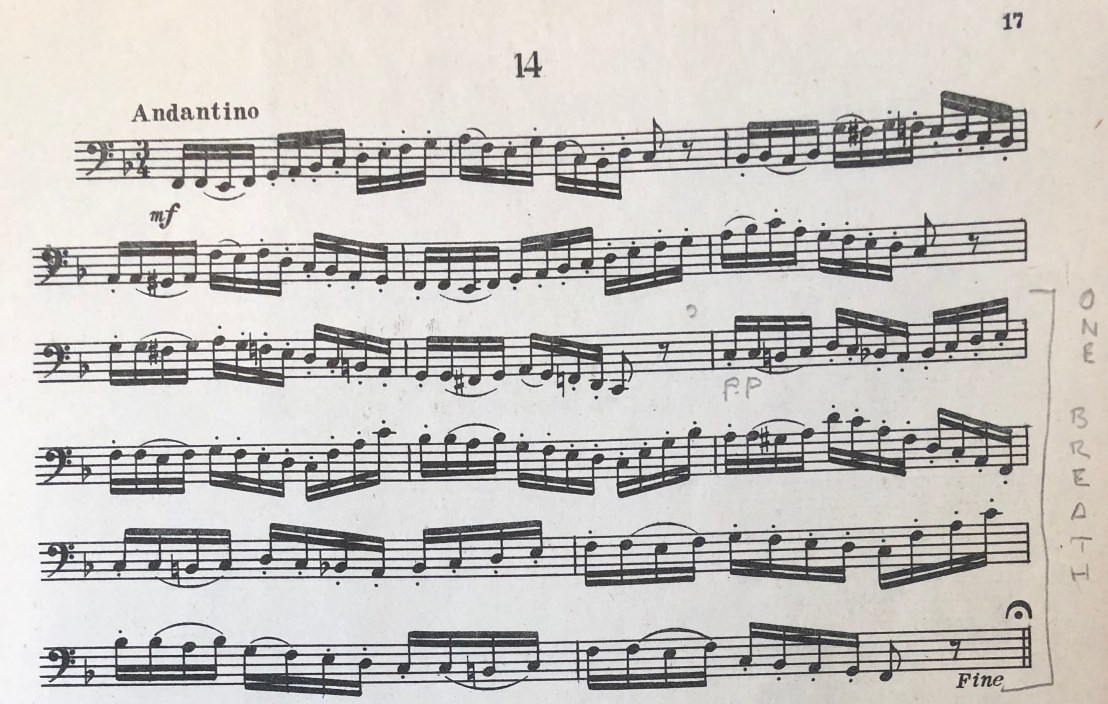
SURPRISE! When I turned to Etude 14 I saw Knaub’s handwriting that marked out several bracketed staves where he had written “ONE BREATH” next to them, after having changed the dynamic of mezzoforte to pianissimo. I had to smile. I have made the same indications in many copies of this book when I have assigned that same etude to students over my many decades of teaching. Pushing ourselves to play long phrases is an essential part of learning good breath control. It was nice to see that Knaub asked the same thing of himself – and he probably asked it of his students as well.

stephanovsky_20_detail_knaub_copy

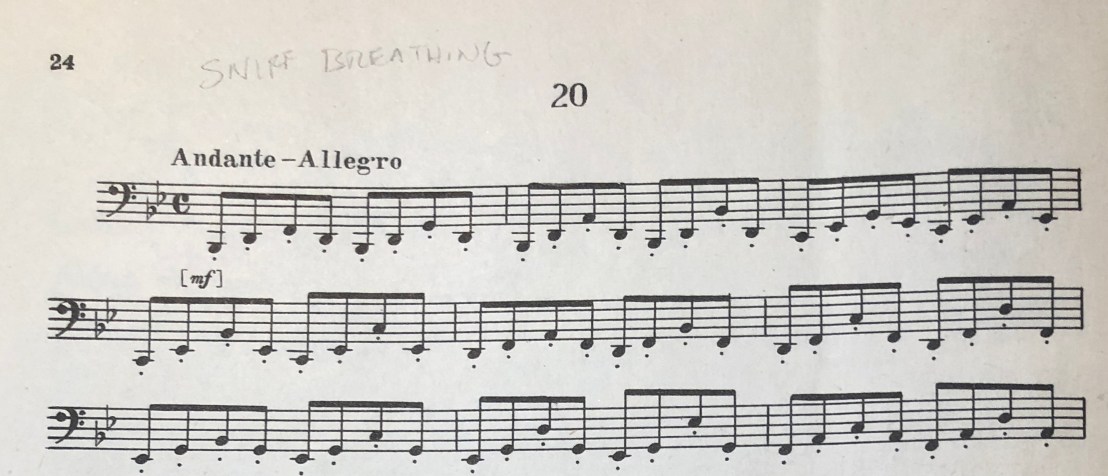
SURPRISE! When I turned to the final page of the book, Knaub had written “SNIFF BREATHING” at the top of Etude 20. Another big smile from me. I have been extolling the virtues of sniff breathing – that is, taking quick breaths through the nose rather than breathing through the mouth while playing – as a way to deal with playing music like this where there just isn’t a good place to take a breath. I was taught this technique by my former Boston Symphony tuba colleague, Chester Schmitz, and it has served me (and my students) well ever since then. To see that Knaub suggested using sniff breathing on this etude was a great verification to me, since this is the very kind of etude I assign to my students to practice this useful breathing technique.

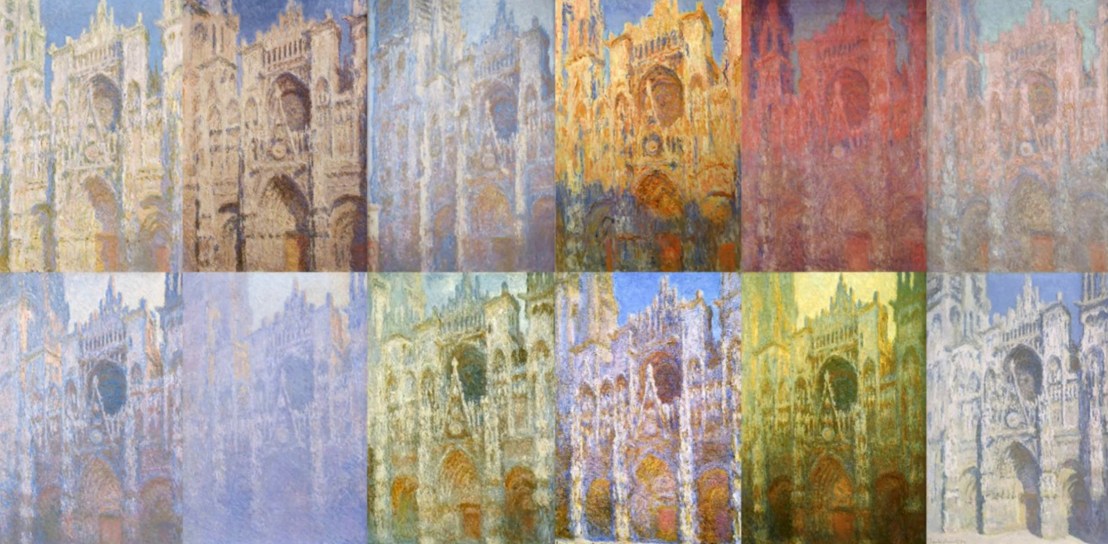
In 2010, I was in Rouen, France, doing some teaching and performing en route to a conference in Paris that was devoted to the musical instrument called the serpent. Whenever I go to Europe, I always seek out cathedrals and large churches. I have a great interest in Gothic-era church architecture. Rouen, of course, has one of the most famous cathedrals in the world, made all the more famous by the more than thirty paintings of its west front by Claude Monet (below).

rouen_cathedral_monet

My oldest daughter, Linda (who was accompanying me on the trip), and I spent some time inside and outside this magnificent church, but my host and friend, Volny Hostiou, told us of another interesting church in Rouen that is much less known. And it had a surprise.

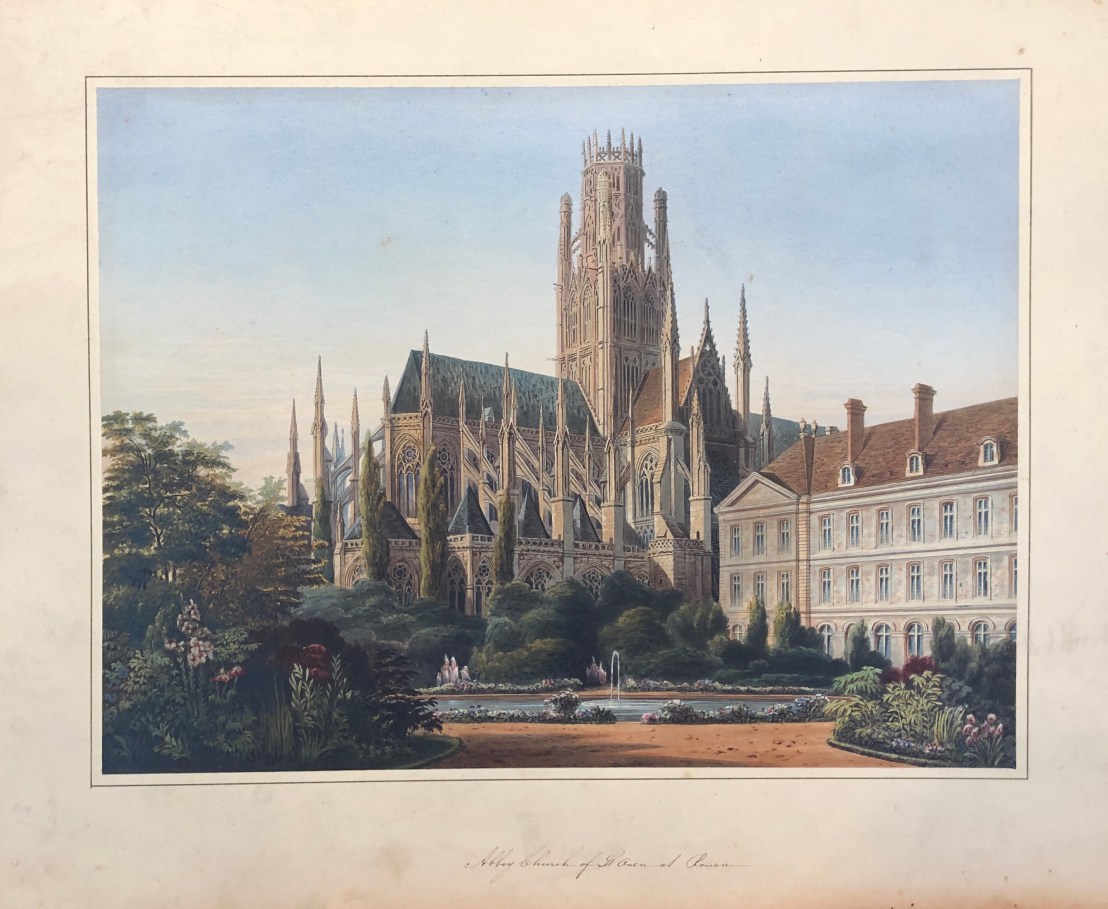
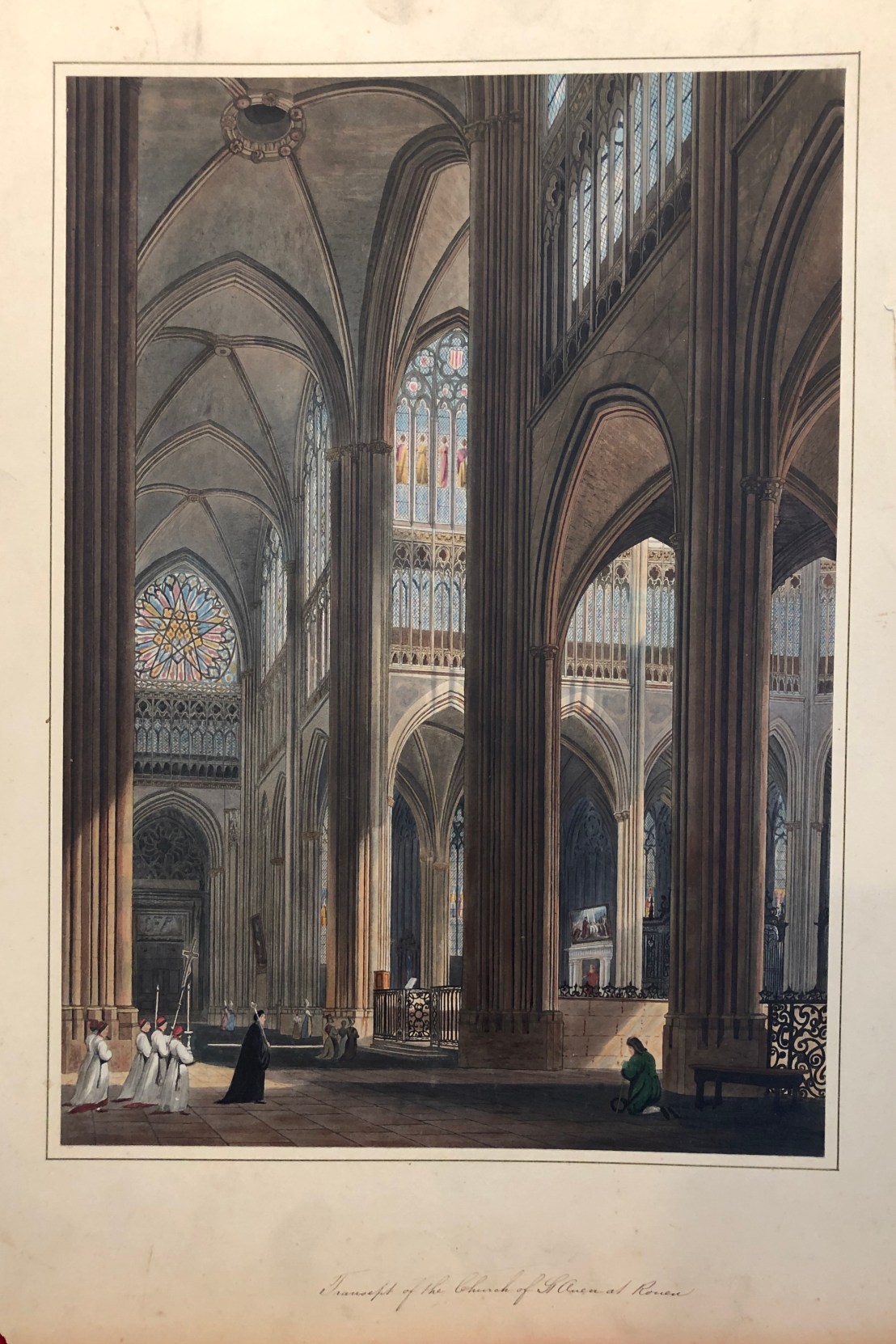
SURPRISE! Actually, when Volny told me about the Abbey Church of St. Ouen, he was surprised it was not the first time I had heard of it. I’ve been aware of its architecture ever since a set of twelve aquatints by the English artist, Charles Wild, came into my possession many years ago. Wild’s “Twelve Selected Examples of the Ecclesiastical Architecture of the Middle Ages, Chiefly in France.” In 2001, I wrote an article about one of these prints, “The Choir of the Cathedral of Amiens,” where I discussed the serpent players depicted in the print (you can view and download my article about this in the Historic Brass Society Journal by clicking this link). Among the prints in Wild’s set are two of the Abbey Church of St. Ouen in Rouen. One is of the outside of the church:

wild_abbey_church_rouen_01

And the other is of the church’s transept:

wild_abbey_church_rouen_02

These are beautiful images, ones that have taught me a great deal about Gothic architecture and cathedral/church life. But now Volny had a surprise for me. “When you go inside,” he said, “look up. You will find a serpent player.” Linda and I made a trip to the Abbey Church to find out what Volny was talking about.

st_ouen_serpent_angel_01

SURPRISE! We looked all through the church for the serpent player and finally we found him. High up on the ceiling in a side chapel, there it was, a remarkable painting of an angel playing the serpent. Nothing there about harps in heaven!

st_ouen_serpent

The serpent, which had been invented sometime in the late fifteenth or early sixteenth century and then evolved to be an instrument to accompany the singing of chant in the Church in France, would have been well known to every person who had worshipped in St. Ouen in the sixteenth through nineteenth centuries. The painting is heavily damaged but it is still remarkable nonetheless. Who painted it? When? Questions. . .

st_ouen_serpent_angel_04

SURPRISE! But there was more. As we looked more carefully at the painting, we realized that the serpent player was not alone. Look at the image, above. Just to the right of the serpent-playing angel’s left wing you see another face. It’s very faint and hard to find. (Maybe this will help: look at the chin of the serpent-playing angel, then move your eyes to the right until the stonework of the ceiling appears. The second angel’s face is there, just to the side of the larger angel’s wing.) You can clearly make out the face of another angel who is looking at the serpent-playing angel. An unexpected surprise on top of a surprise. Did this other angel originally have an instrument in hand? What did the rest of the ceiling look like when the paint was all intact? Questions. . .

Some of my biggest surprises come in books. Because of the nature of the research I do, I purchase a lot of used books, and mostly books that are out of print. I get all of my used books through abebooks.com, a website that serves as a massive catalog of the holdings of thousands of bookstores around the world. I can usually find any book I want there, and usually for only a few dollars. And sometimes when I open up a used book, I find a surprise.

halas_by_halas_cover

SURPRISE! My wife and I enjoy football and one of the first things we did when we moved to the Chicago area last fall was to become season ticket holders for the Chicago Bears. We’re all in with the Bears and since we want get to know the team better, I’ve been acquiring several books and DVDs about its history. Last week, I ordered a used copy of Halas by Halas (New York: McGraw-Hill Co., 1979), the autobiography of George S. Halas who was not only the first coach, then player, then owner of the Chicago Bears, but was the driving force behind the creation of the National Football League in 1919.

halas_by_halas_autographs

You can imagine my surprise when I opened this book – which I purchased for under $20 – and I found several autographs inside the front cover. There is Doug Atkins, defensive end for the Chicago Bears from 1955-1966 and a member of the Pro Football Hall of Fame. And Mike Pyle, center for the Bears from 1961-1969. And George Connor, another member of the Pro Football Hall of Fame who played linebacker/tackle for the Bears from 1948-1955. There is also the signature of Jeanne Morris, a pioneering female television sports broadcaster, and two members of the short-lived Chicago Bears cheerleading squad, the Honey Bears. Also of interest is the book plate that celebrates the event where books were distributed and the autographs were probably inscribed. I wonder who else was there at that Chicago Bears Reunion Dinner? Who was “Charlie,” to whom some of the autographs are signed? Questions. . .

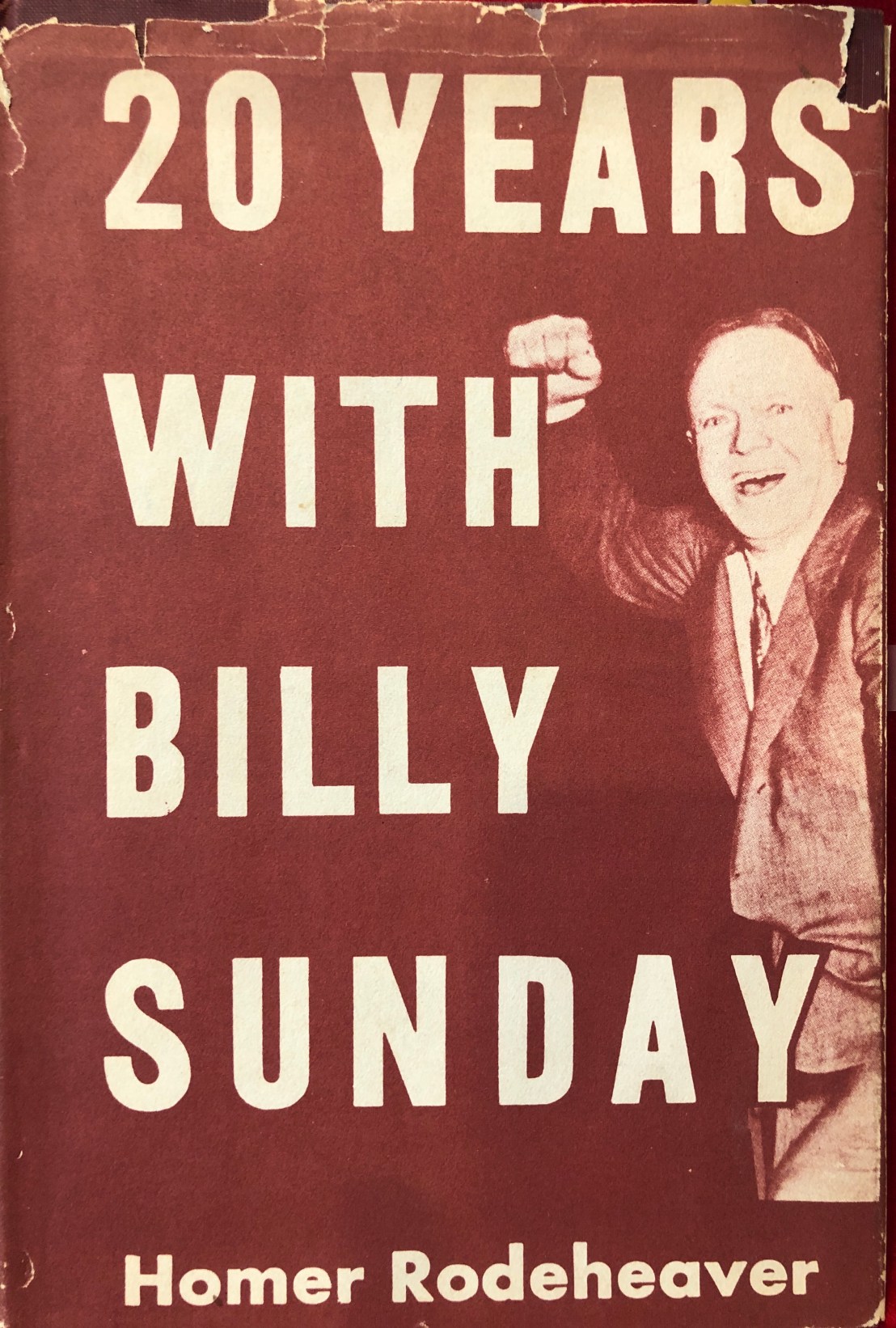
rodeheaver_20_years_billy_sunday_cover

Among the several books I am writing at the moment is a biography of Homer Rodeheaver, the trombone-playing song leader for evangelist William Ashley “Billy” Sunday in the first third of the twentieth century. Rodeheaver is a fascinating character who was a driving force in the promotion of gospel music in the twentieth century through his publishing company, record company, and evangelistic work. With my friend and co-author, Kevin Mungons, we are moving along in the process of bringing this book to publication with University of Illinois Press.

In the course of our research, both Kevin and I have acquired many (hundreds, for sure, maybe thousands?) of books that inform our understanding of Rodeheaver, his life, times, and work. Among them is Rodeheaver’s own book, 20 Years With Billy Sunday (Winona Lake, Indiana: Rodeheaver Hall-Mack Co., 1936), the story of his years as songleader for evangelist Billy Sunday. While long out of print, copies of the book are not especially rare. But. . .

rodeheaver_20_years_billy_sunday_autograph

SURPRISE! When I opened my used copy of Rodeheaver’s book, I found his inscription inside the front cover, with a reference from the Bible, Colossians 3:16, “Let the word of Christ dwell in you richly, teaching and admonishing one another in all wisdom, singing psalms and hymns and spiritual songs with thankfulness in your hearts to God.” I’m not an autograph collector, but to hold and own a copy of Rodeheaver’s book in my hands that he had held in his own hands was a very nice surprise. As to Watts Franklin (or Franklin Watts?) of Elizabethtown, Kentucky, a previous owner of this book – his (her?) return address label appears on the page with Rodeheaver’s signature – I have not been able to learn anything. Did Watts meet Rodeheaver and ask him to sign the book? Was it a gift to him/her? Questions. . .

Unlike Homer Rodeheaver whose life has never been chronicled in a biography, Billy Sunday is the subject of many books. Some were written during his lifetime (he died in 1935) and others are more contemporary. Books about Sunday – whether authorized by the evangelist or not – provide a fascinating window into his life and ministry as seen through the lens of the time in which he lived.

brown_sunday_cover

One of these books is by Elijah P. Brown, The Real Billy Sunday (New York: Fleming H. Revell Co., 1914). My used copy has a stamp in the back that says it was owned by Sarah A. Kemmerer of Allentown, Pennsylvania. Who she was I do not know. More questions. . .

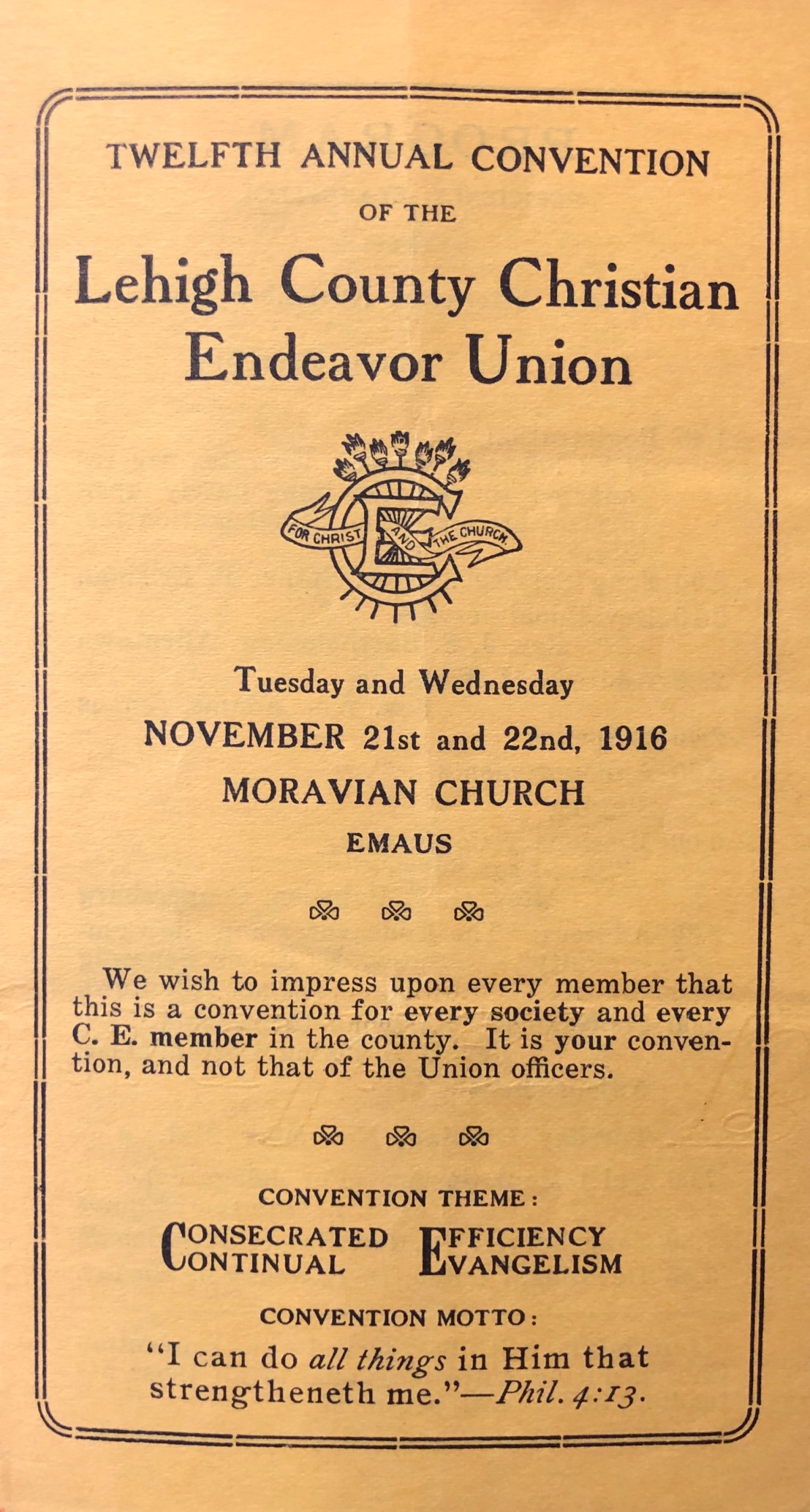
lehigh_christian_endeavor_pamphlet_1916

SURPRISE! When I opened my used copy of Brown’s book, a small, six page pamphlet fluttered to the floor. It was a program for the 1916 convention of the Lehigh (Pennsylvania) County Christian Endeavor Union, November 1916. Held at the Moravian church in Emaus, Pennsylvania (this spelling was used for the borough from 1830-1938; before and after that time it was/is spelled Emmaus), the convention featured sermons, singing, devotionals, and other activities for youth and adults. It provides a fascinating glimpse into the schedule of one of these meetings which were common occurrences at the time.

ellis_billy_sunday_cover

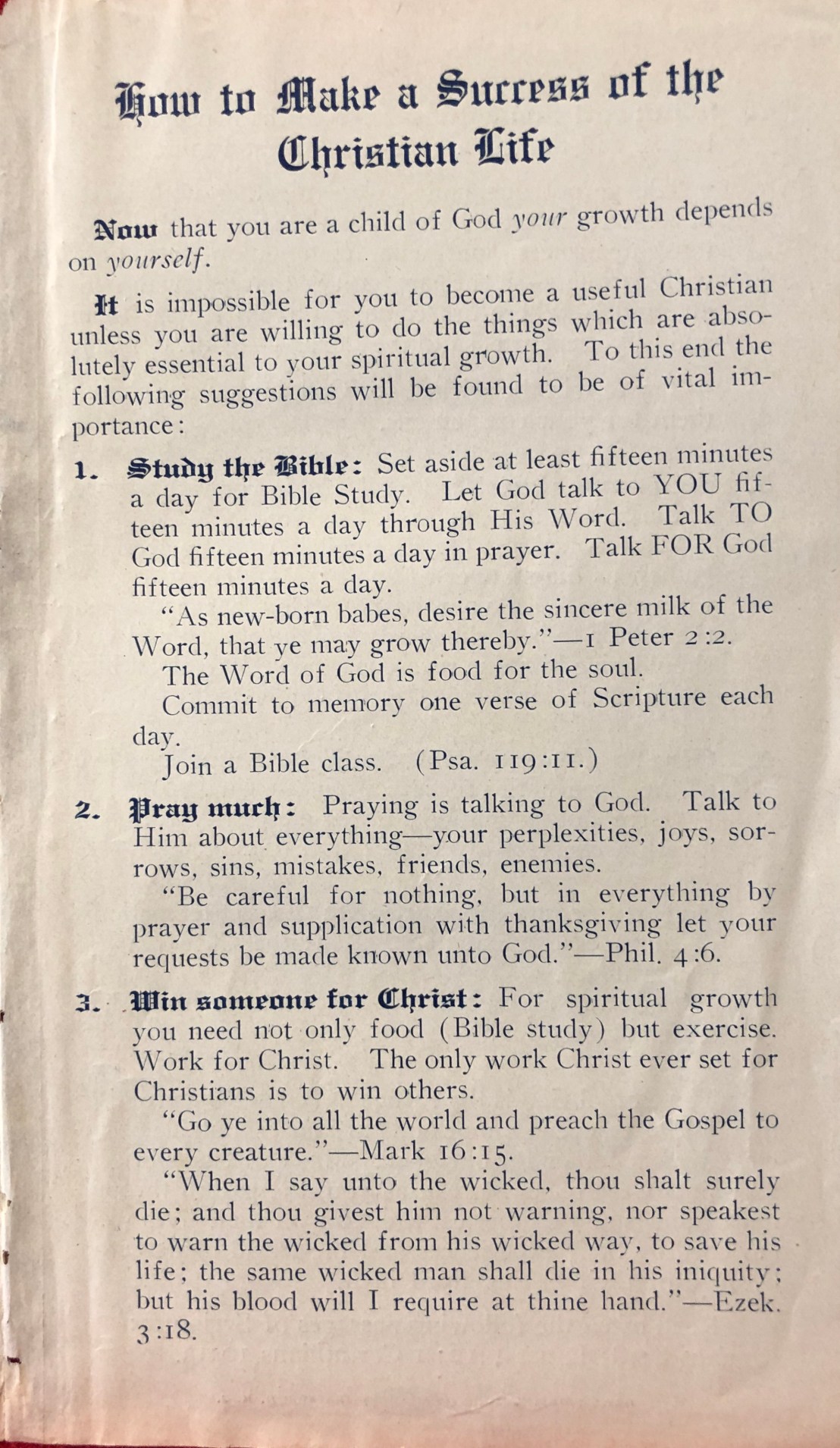
SURPRISE! Another among my many biographies of Billy Sunday is “Billy Sunday” The Man and His Message by William T. Ellis (Philadelphia: John C. Winston Co., 1914). This used copy contained a remarkable surprise: an original copy of the brochure that Billy Sunday put into the hands of tens of thousands of people who attended his tabernacle meetings and “walked the sawdust trail” up the aisle to shake hands with the evangelist as they made a public profession to trust Jesus Christ as Savior. The fact that this tract was kept in the book made me wonder if a previous owner bought the book at one of Sunday’s meetings and then put the pamphlet inside that very night for safekeeping. Names of two previous owners of the book are inscribed inside the front cover: a signature of Arthur S. Beale, and a label with the name L. Wilkins of Watertown, Massachusetts. Who were they? When and how did they come to own this book? Questions. . .

The pamphlet is a remarkable historical document and one that is as fresh today as when it was first used by Sunday in the early twentieth century. There are many things I find interesting about this pamphlet, including the fact that it bears the imprint of a union publishing house, Allied Printing of Paterson, New Jersey. Could this brochure have been printed for the 1917 Billy Sunday meetings in New York City? Questions. . .

Sunday asks some important questions and gives some important advice. Have a look.

sunday_tract_01sunday_tract_02sunday_tract_03sunday_tract_04

Life is full of surprises. Sometimes they cause you to ask questions. Sometimes they can change your life.