
by Douglas Yeo (February 12, 2026)
Our recent trip to Egypt brought with it many avenues for ongoing exploration and learning. Among these are the two trumpets found in the tomb of Tutankhamun, now on display in the Grand Egyptian Museum in Giza. I have been interested in these instruments ever since I heard of them many years ago, and I recently wrote about them in the new book about the trombone I’m writing for Oxford University Press. In an opening chapter about the ancestors of the trombone, these trumpets figure in an important way.

Douglas Yeo with the trumpets found in the tomb of Tutankhamun, Grand Egyptian Museum, Giza. Photo by Patricia Yeo, January 15, 2026.
Of course, Tutankhamun’s tomb is especially famous for the over 5,000 treasures that were buried with him. Among these are his golden throne and golden death mask, iconic works that have entered into the consciousness of people around the world since the tomb discovered in the modern era by Hussein Abdel Rasoul—a 12-year Egyptian water boy who, while working on the site, discovered the first step that led to the tomb—and the site’s lead archaeologist, Howard Carter, who spent the next ten years cataloguing and removing all of the tomb’s artifacts. All of those artifacts are now beautifully displayed at the Grand Egyptian Museum in Giza, and a sample of them may be found in this article I wrote recently on TheLastTrombone, Egypt. Is is amazing.
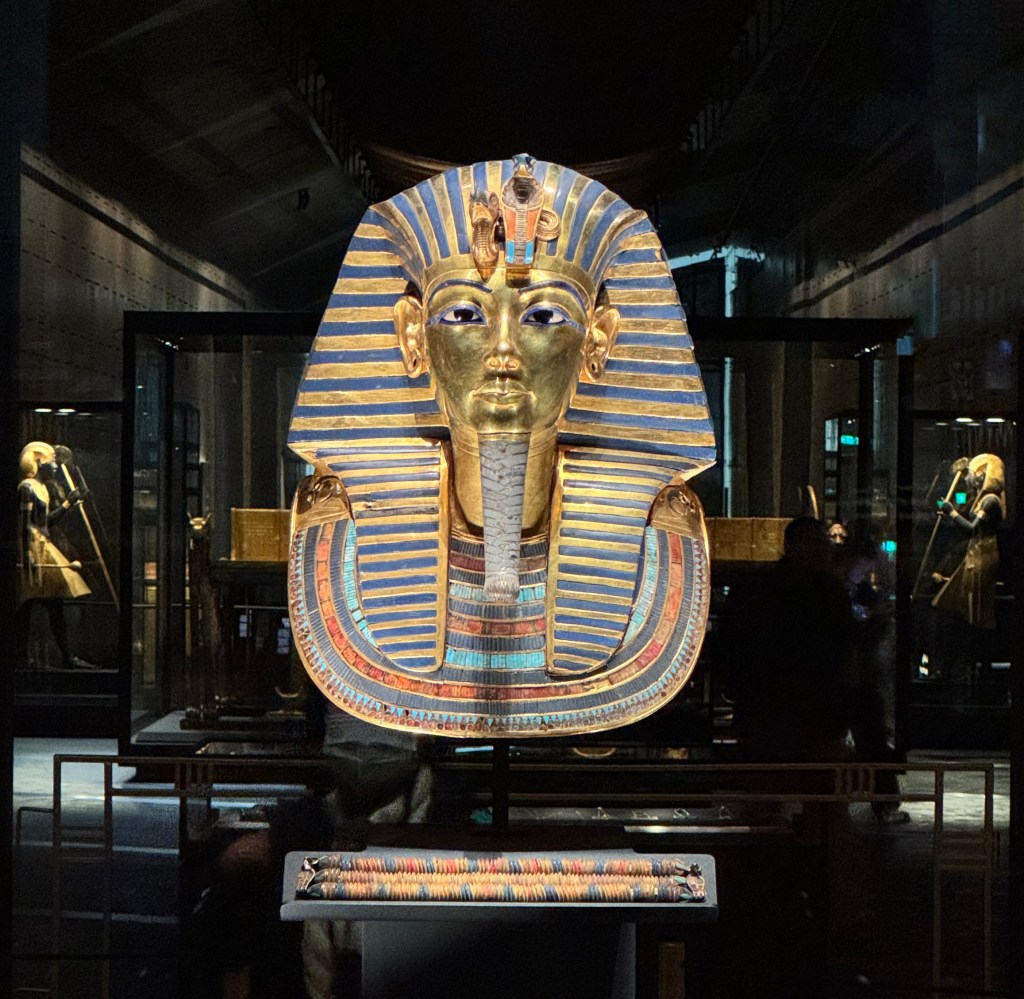
The golden mask of Tutankhamun, Grand Egyptian Museum, Giza. Photo by Douglas Yeo, January 15, 2026.
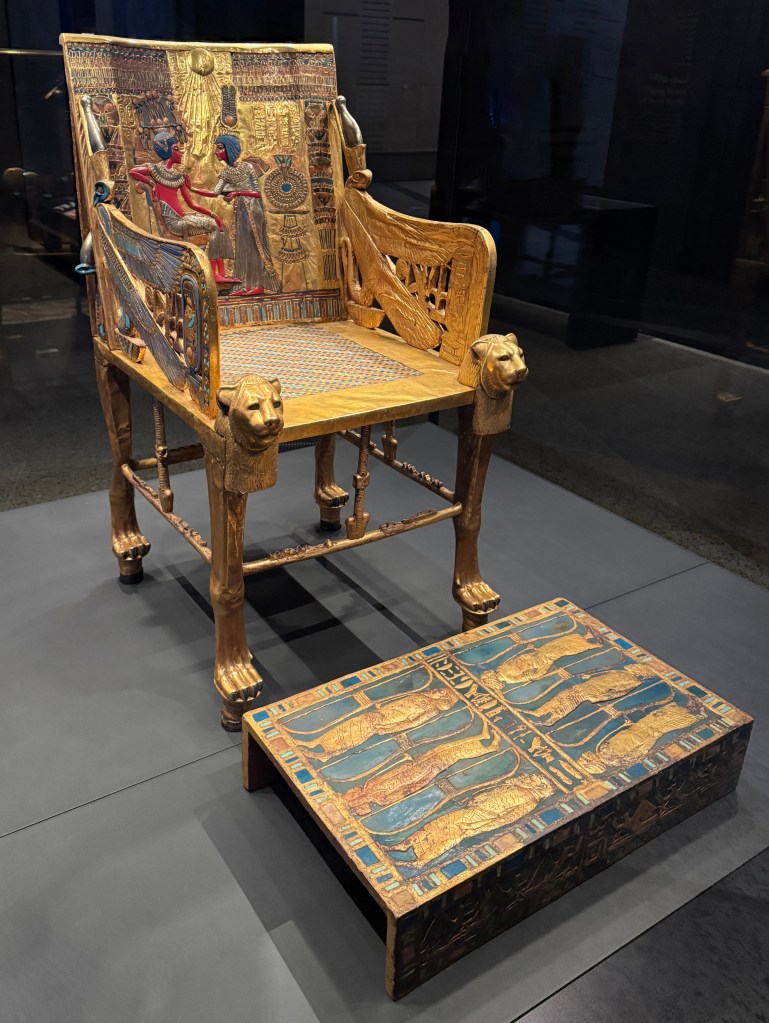
The throne of Tutankhamun, Grand Egyptian Museum, Giza. Photo by Douglas Yeo, January 15, 2026.
The trombone was invented in the fifteenth century. Whether it evolved from an instrument scholars refer to as the “Renaissance slide trumpet”—the existence of such an instrument is presumed from iconography but no contemporaneous descriptions or physical specimens have ever surfaced—or through another creational path is not settled. But no matter how it came to be, the trombone is a direct descendant of the trumpet, an instrument known for thousands of years. Long before the invention of the valve by Heinrich Stölzel and Friedrich Blühmel in the early nineteenth century—both filed patents for their valve invention around the same time and a joint patent was eventually awarded to both men in 1818—the trumpet (and horn) were “natural” instruments with fixed lengths of tubing. The trombone, therefore, was a huge step forward in brass instrument development, with its ability to play chromatically throughout the range of the instrument.
That said, the trumpet is the most important and direct ancestor of the trombone. While ancient iconography shows what may be lip-activated instruments made of natural materials—wood, bone, ivory—none of those instruments from antiquity have survived. It is metal ancestors we look for, instruments that we can hold in our hand and say, “Aha! So THIS is what it looked, felt, and sounded like.” But before claims can be made, researchers need to establish a secure date for any historical artifact. Brass cannot be dated through carbon-14 dating, so finding instruments in places alongside other materials found in the same location that can be dated is important.
Two distinct instruments have vied for pride of place as the “first” metal brasswind instrument: the Scandinavian lur and the Egyptian trumpet.
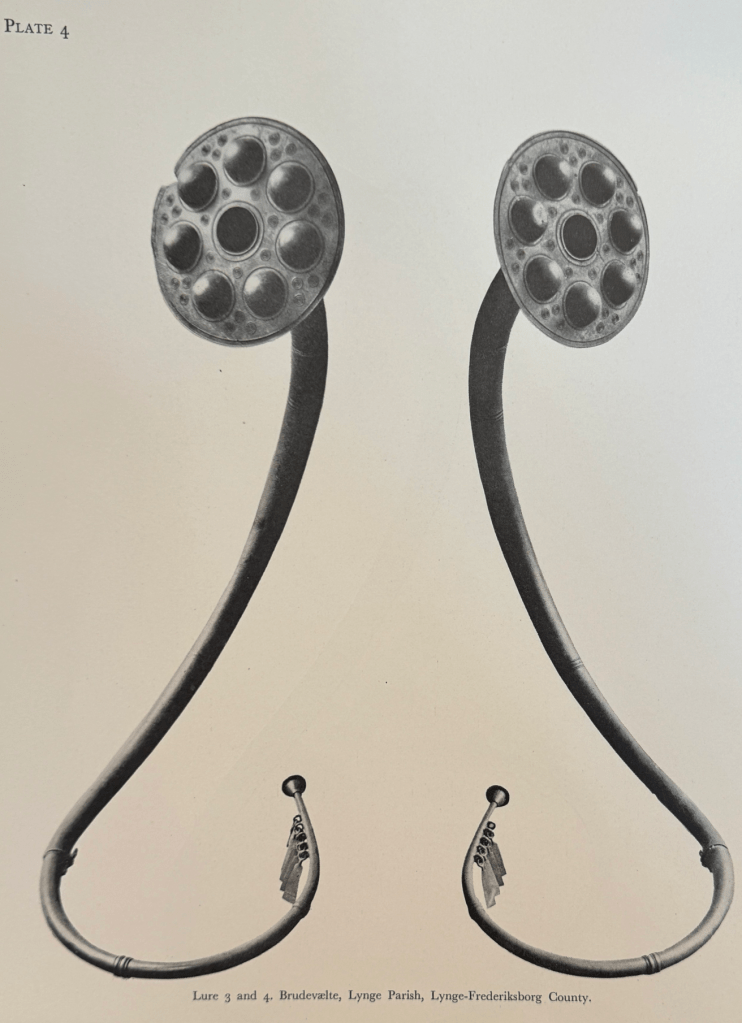
Two lurs. Photograph from H. C. Broholm, William P. Larsen, and Godtfred Skjerne, The Lures of the Bronze Age: An Archaeological, Technical, and Musicological Investigation (Copenhagen: Glydendalske Boghandel, 1949), plate 4.
The lur—a beautifully elegant instrument made in the lost-wax casting process—is often described as made between from between c. 1500 and 500 BC.[1] These instruments have been discovered in bogs mostly in Denmark and other parts of Scandinavia. As Hans Broholm, William Larsen, and Godtfred Skjerne said in their seminal book about the lur, “The main difficulty in solving [the lur dating] problem is that the lures were never found together with other objects the chronological data of which within the Bronze Age were known.”[2] Other scholars, like John Coles, have cast serious doubt on the early dating of lurs, noting that dating lurs based on comparison of their decorative elements with other securely dated Bronze Age artifacts for which an accurate date of construction is known, represents “an error in this line of thought.”[3]
As a result, consensus has coalesced around a date of about 1000 BC for the earliest lurs, as recognized by The National Museum of Denmark (Nationalmuseet).
Continuing the search for even older brasswind instruments of metal led to the tomb of Tutankhamun.
Two trumpets were found in Tutankhamun’s tomb. One of silver with gold accents (item 175) was found on the floor in a corner of the Pharaoh’s burial chamber, between the wall and the first of the four golden shrines that surrounded his sarcophagus.
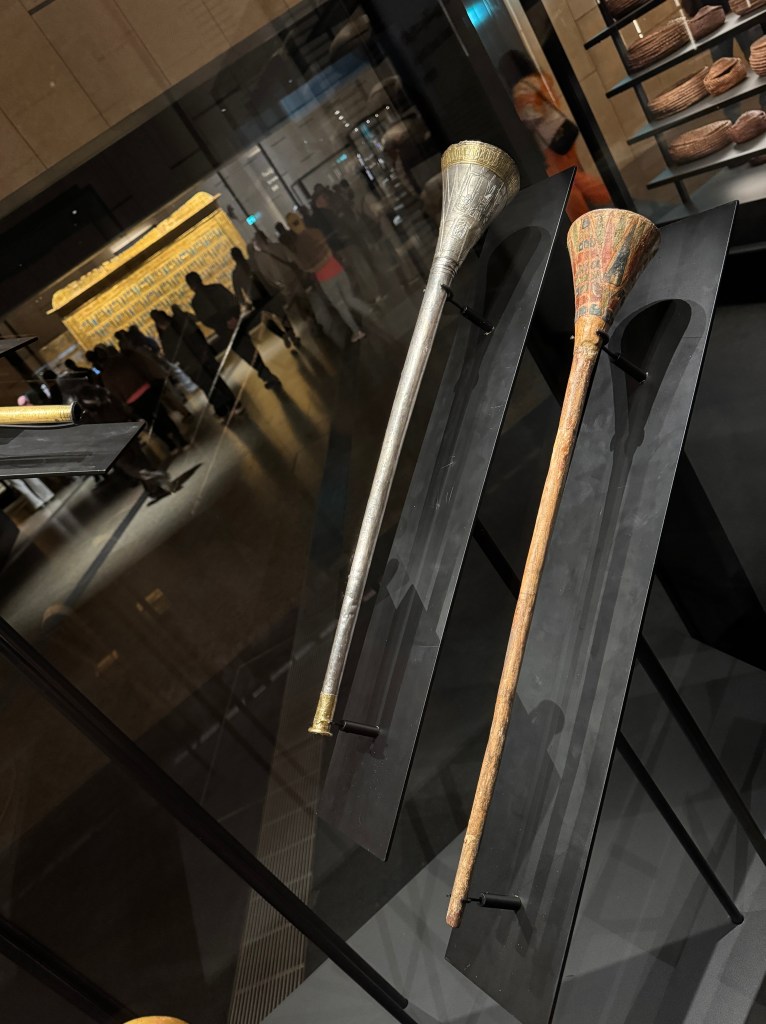
The silver (with gold accents) trumpet found in Tutankhamun’s tomb, with its associated wooden protective insert, Grand Egyptian Museum, Giza. Photo by Douglas Yeo, January 15, 2026.
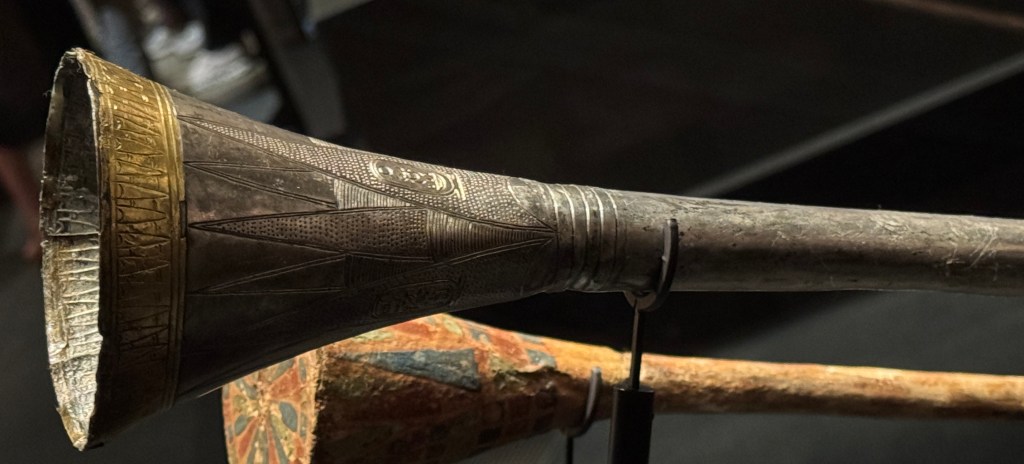
The silver (with gold accents) trumpet of Tutankhamun, Grand Egyptian Museum, Giza. Photo by Douglas Yeo, January 15, 2026.
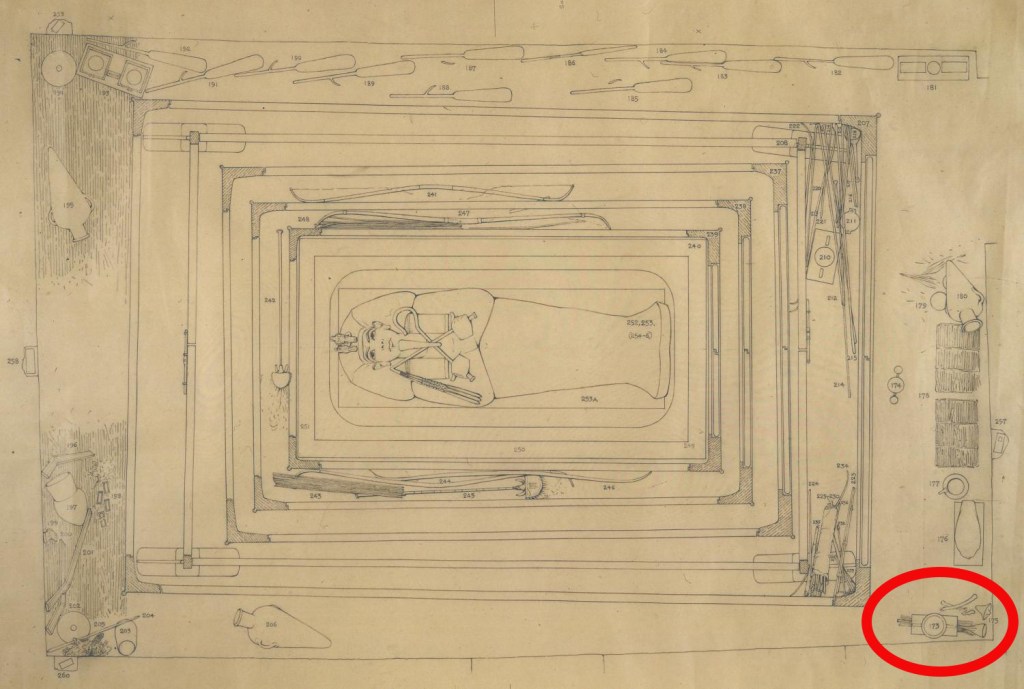
Drawing by Howard Carter of the burial chamber in the tomb of Tutankhamun, showing the place where the silver trumpet was discovered. Courtesy The Griffith Institute.
Another trumpet—of bronze or copper with gold accents (item 50gg)—was found in a box in the antechamber that led to the burial chamber:
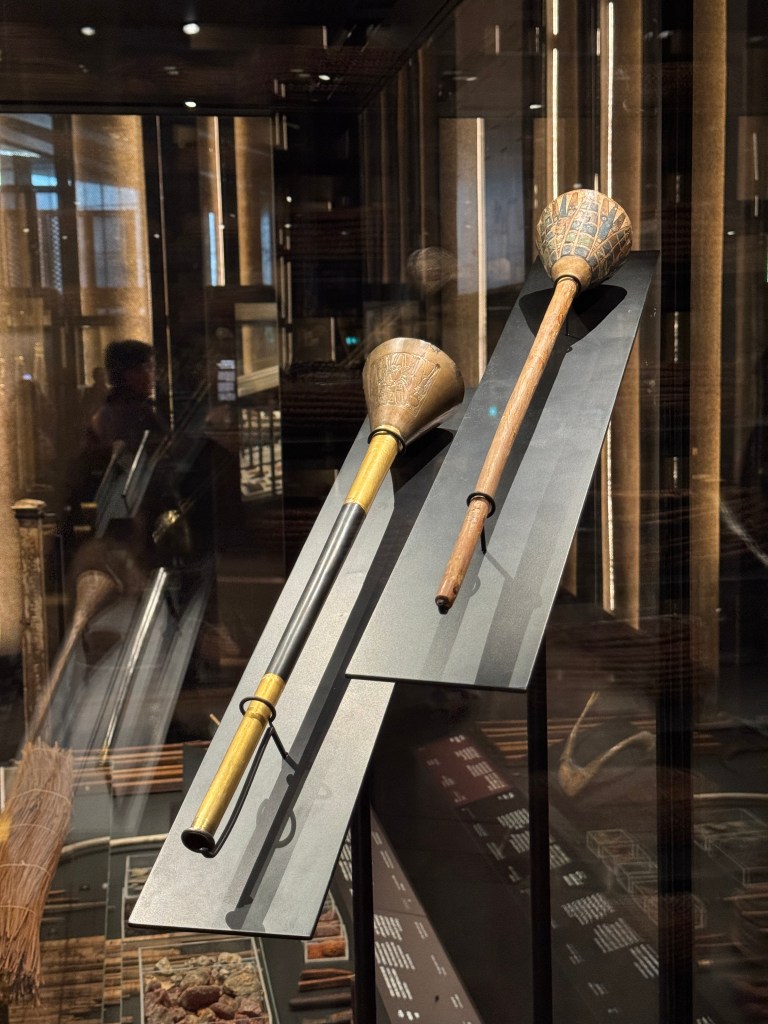
The bronze or copper (with gold accents) trumpet found in Tutankhamun’s tomb, with its associated wooden protective insert, Grand Egyptian Museum, Giza. Photo by Douglas Yeo, January 15, 2026.
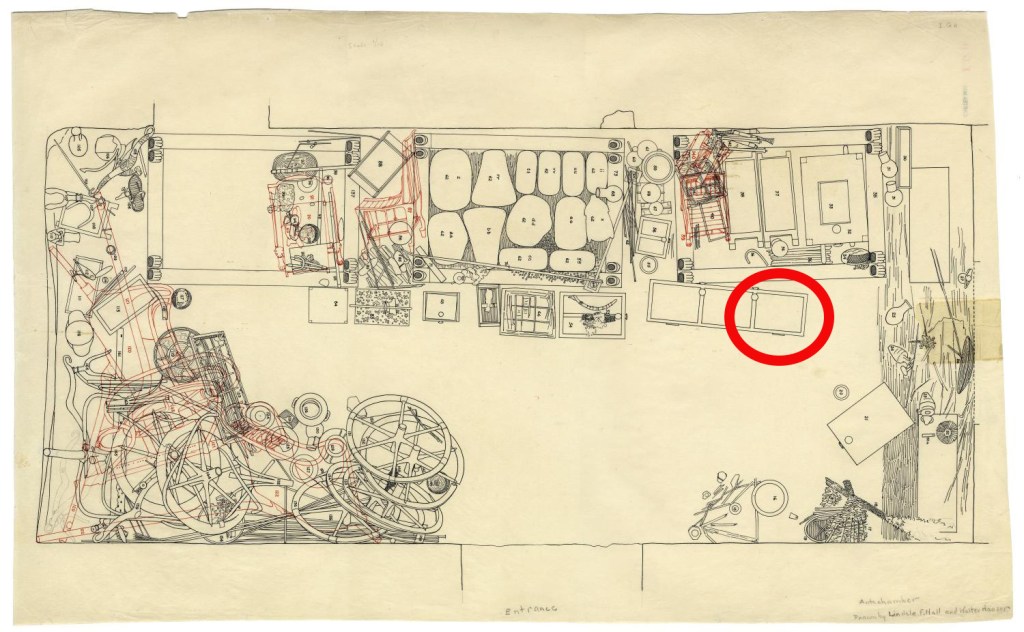
Drawing by Lindsey F. Hall and Walter Hauser of the antechamber of the tomb of Tutankhamun, showing the place where the bronze or copper trumpet was discovered, inside a chest. Courtesy the Griffith Institute.
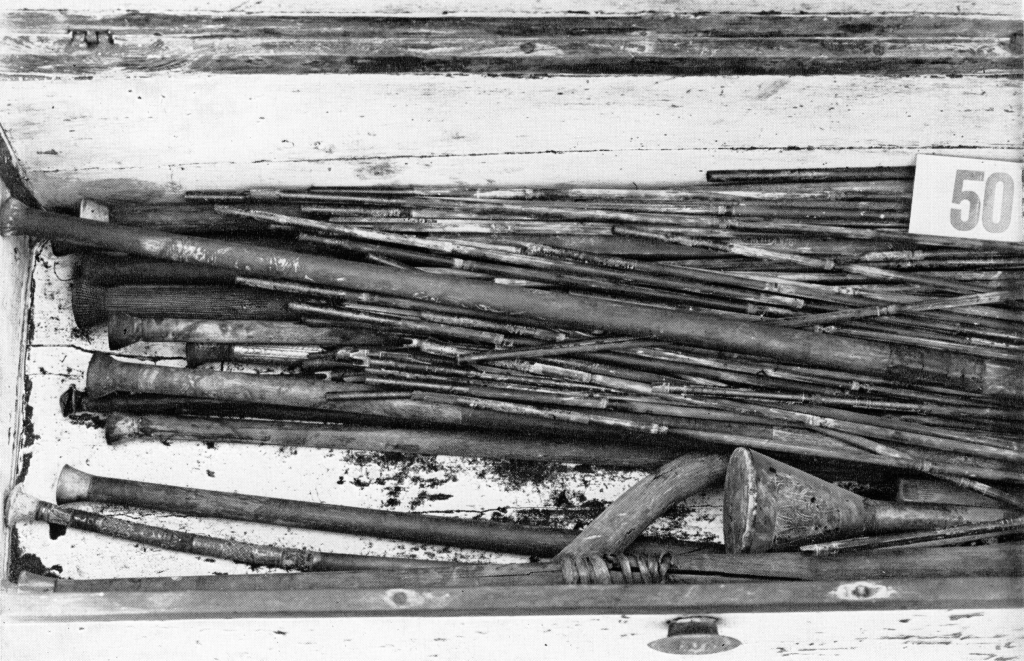
The bronze or copper trumpet found in a chest in the Antechamber of the tomb of Tutankhamun, in situ. Photo by Harry Burton, The Griffith Institute. Reproduced in, Lise Manniche, Musical Instruments From the Tomb of Tut’ankhamūn (Oxford: Griffith Institute, 1976), vol. VI, plate XII.
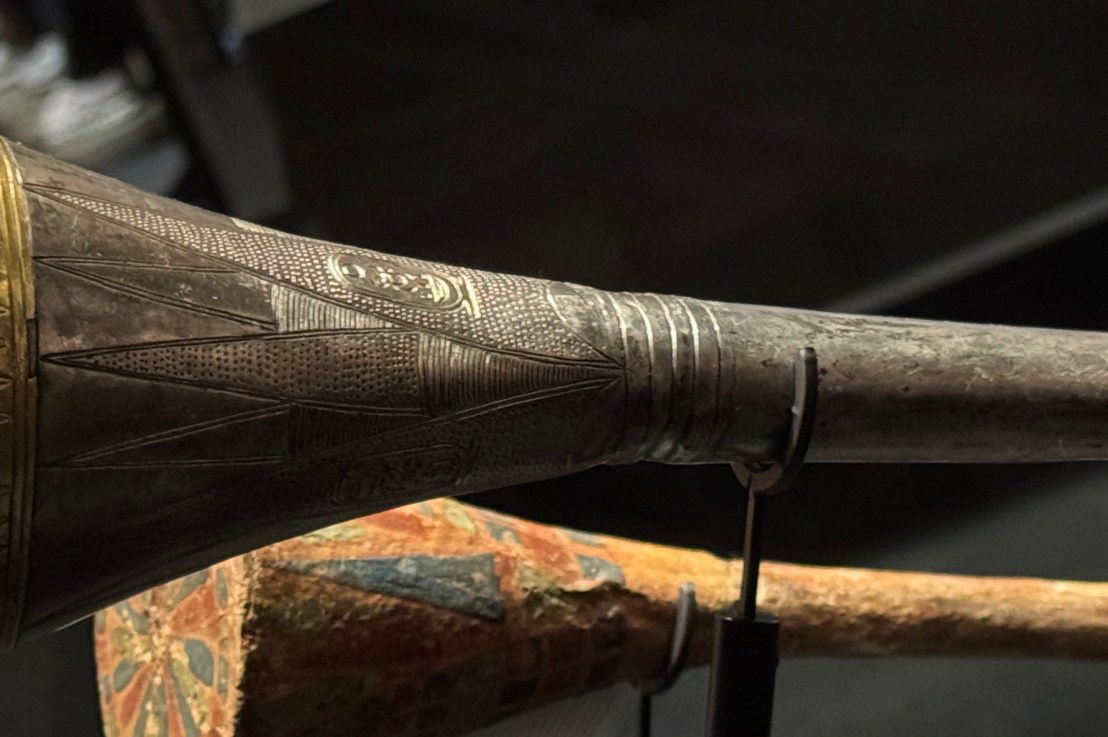
These trumpets are simple, straight instruments, beautifully engraved with hieroglyphics (including his two cartouches, or signatures) and scenes featuring Tutankhamun and various Egyptian gods.
The literature about these trumpets is copious, and various sources emphasize particular aspects of the trumpets—their materials, construction process, decoration, and use. Over the years, I’ve collected many resources that discuss the Tutankhamun trumpets and for those interested, they provide an interesting study. Here is a sample:
- Hans Hickmann, La trompette dans l’égypte ancienne (Cairo: l’institut Français, 1946)
- Lise Manniche, Musical Instruments From the Tomb of Tut’ankhamūn (Oxford: Griffith Institute, 1976), vol. VI.
- Jeremy Montagu, “One of Tut’ankhamūn’s Trumpets,” The Journal of Egyptian Archaeology 64 (1978), 133–134.
- Nicholas Reeves, The Complete Tutankhamun (London: Thames and Hudson, 1990), 164–165.
- Zahi Hawass and Sandro Vannini, Tutankhamun: The Treasures of the Tomb (London: Thames & Hudson, 2007), 76.
- Jeremy Montagu, Horns and Trumpets of the World (Lanham: Roman & Littlefield, 2007), 71–74.
- Jeremy Montagu, Tutankhamon’s Trumpets and the Hatsots’rot, www.jeremymontagu.co.uk/tutankhamon.pdf
- Toby Wilkinson, Tutankhamun’s Trumpet: Ancient Egypt in 100 Objects From the Boy King’s Tomb (New York: Norton, 2023), 410–413.
Happily, Tutankhamun’s trumpets can be securely dated. We know that Tutankhamun ruled from c. 1332 to 1323 BC. The fact that these trumpets were found undisturbed in his tomb allows us to date the trumpets to as early as 1323 BC—the date the tomb was sealed—or perhaps earlier. With this, we can—until or unless an earlier example can be identified—look to Egypt as the birthplace of the metal trumpet, an instrument securely documented to be around 3350 years old—or older.
Iconography in Egyptian temples also shows images of trumpeters, and a particularly interesting example is found in the mortuary temple of Queen/Pharaoh Hatshepsut, daughter of Thutmose I. Hatshepsut reigned from 1473 to 1458 BC. Her mortuary temple at Deir el-Bahari (Luxor) includes a painted, carved frieze on the south side of the lower colonnade that shows a trumpet player in a procession with a trumpet that looks similar to the ones found in Tutankhamun’s tomb.
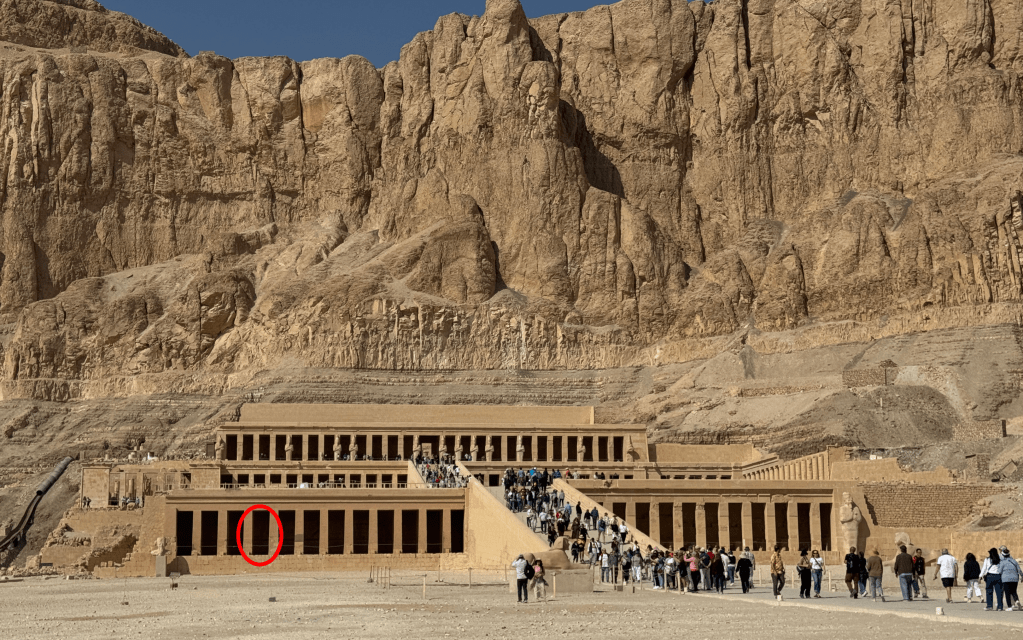
Mortuary Temple of Hatshepsut (Deir el-Bahari). The location of the following photos is circled in red. Photo by Douglas Yeo, January 20, 2026.
The image was badly defaced in antiquity, so much so that the trumpet is barely visible today. The carving was probably defaced by a successor to Hapshetsut to remove a vertical hieroglyphic inscription (see the images below), and the trumpet, which was next to the inscription, became a casualty. In January 2026, during a trip to Egypt, I took this photo of the trumpet player—from a distance of about 30 yards. The south side of the lower colonnade was closed so this was the best photo I could obtain from my vantage point. Unfortunately, the faint image of the trumpet was not visible from where I stood.
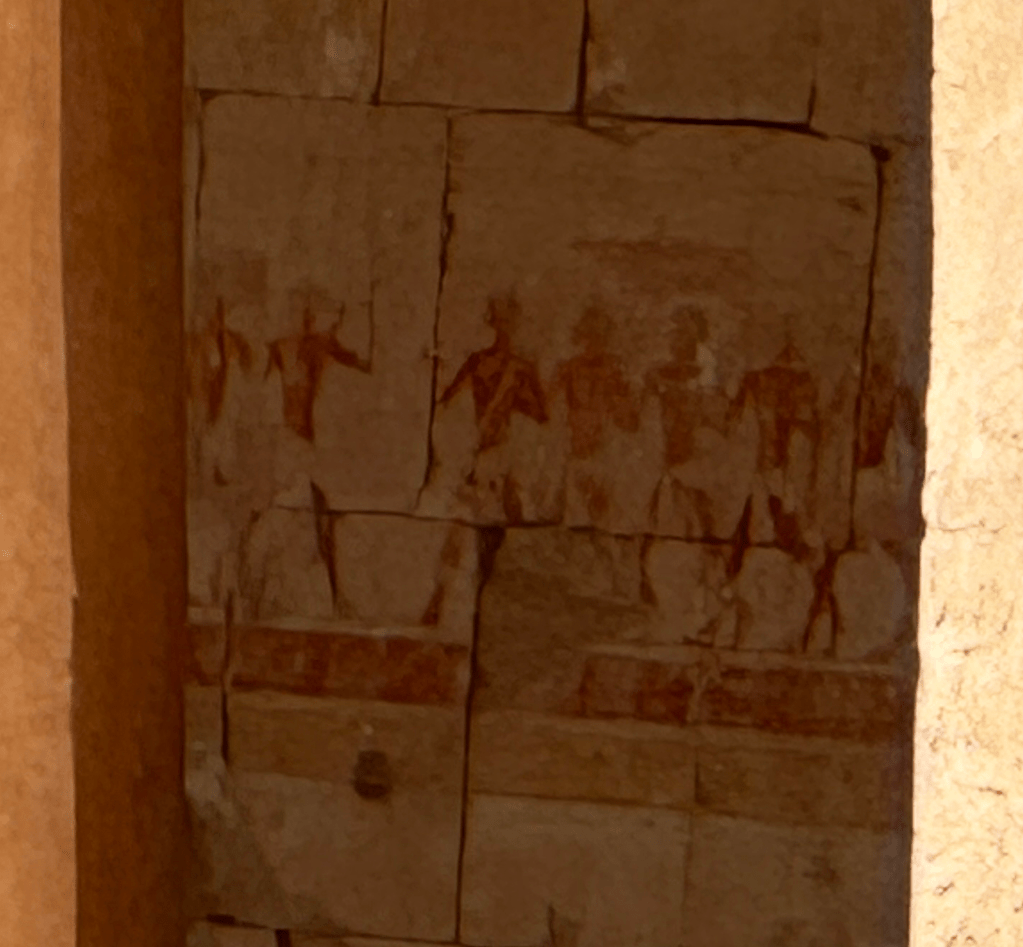
Painted frieze of a trumpet player, lower colonnade (south wall), Mortuary Temple of Hatshepsut (Deir el-Bahari). Photo by Douglas Yeo, January 20, 2026.
However, in 1908, Edouard Naville made a drawing of the image based on his close examination of the south wall. Because of his drawing, and a subsequent redrawing by Hans Hickmann in 1946, we know the trumpet is still there, however faint. I am hoping that when I return to Egypt someday, the south wall of the lower colonnade at Dier el-Bahari will be open so I can carefully examine this important image myself.
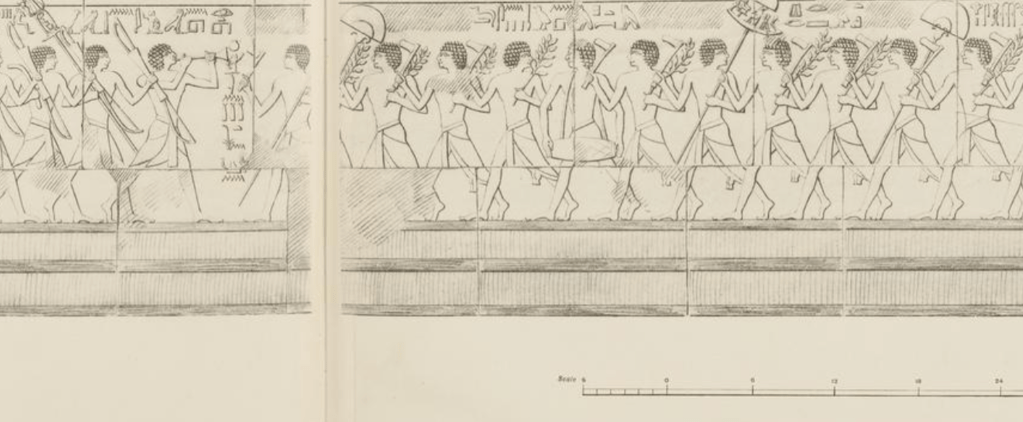
Drawing of painted frieze of a trumpet player, lower colonnade (south wall), Mortuary Temple of Hatshepsut (Deir el-Bahari). From: Edouard Naville, The Temple of Deir El Bahari (London: Egypt Exploration Fund, 1908), part VI, plate CLV.
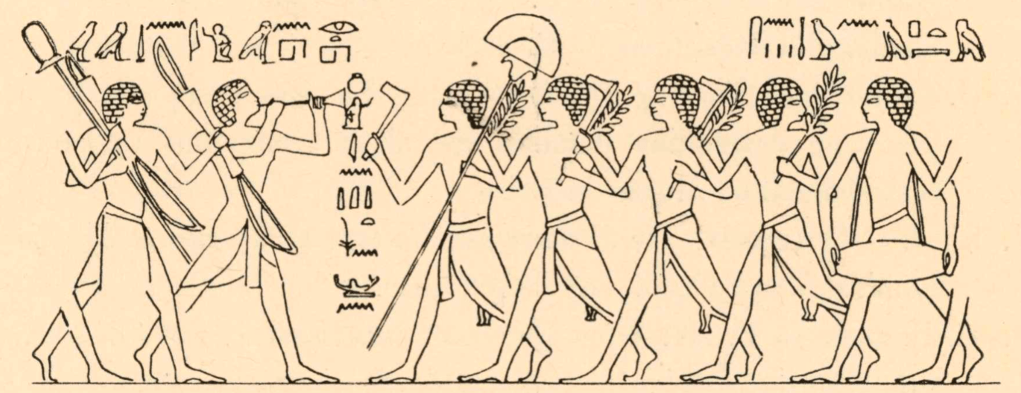
Drawing of painted frieze of a trumpet player, lower colonnade (south wall), Mortuary Temple of Hatshepsut (Deir el-Bahari). From: Hans Hickmann, la trompette dans l’égypte ancienne (Cairo: l’Institut Français d’Archéologie Orientale, 1946), 4. Based on, Edouard Naville, The Temple of Deir El-Bahari (London: Egypt Exploration Fund, 1908), part VI, plate CL.
Because we know that Hatshepsut’s mortuary temple was built in her lifetime, we can securely date the image of the trumpet player as from at least 1458 BC—or earlier. This is 135 years before the death of Tutankhamun.
All of this is a walk along a fascinating breadcrumb trail through history. The search for the earliest metal ancestor of the trombone leads through Egypt, one of the most important, advanced, and influential civilizations in human history. Who knew that when Howard Carter looked inside Tutankhamun’s tomb for the first time and said—in response to the question, “Do you see anything?”—”Yes, it is wonderful”—two of the wonders would be trumpets.[4] Think about that the next time you pick up your trombone.
• • •
NOTES:
Header image: The silver (with gold accents) trumpet from the tomb of Tutankhamun, Grand Egyptian Museum, Giza. Photo by Douglas Yeo, January 15, 2026
[1] James W. McKinnon and Birgit Kjellström, “Lur,” in Grove Dictionary of Music Instruments, ed. Laurence Libin (Oxford: Oxford University Press, 2014), Vol. 3, 322
[2] H. C. Broholm, William P. Larsen, and Godtfred Skjerne, The Lures of the Bronze Age: An Archaeological, Technical, and Musicological Investigation (Copenhagen: GlydendalskeBoghandel, 1949), 51.
[3] John M. Coles, “Irish Bronze Age Horns and their relations with Northern Europe,” in Proceedings of the Prehistoric Society 29 (December 1963), 344.
[4] Howard Carter, diary entry for November 26, 1922, from the first excavation season in the tomb of Tutankhamun, Part 1: October 28 to December 31, 1922.
 The Last Trombone – Douglas Yeo