
by Douglas Yeo (April 22, 2025)
In 1986, I began a collaboration with YAMAHA Corporation to make a new bass trombone. The happy result was the YAMAHA YBL-622 dependent valve double valve bass trombone (with detachable second valve) that, several years ago, was added to YAMAHA’s Xeno trombone line and renamed the YAMAHA YBL-822G bass trombone. Over the years, I’ve continued to try other bass trombones by many different makers. I like to know what is on the market and how those instruments play. I want to play a bass trombone what works best for me but every time I try something else, I keep coming back to my YAMAHA. That instrument works best for me.


Detail of the bell and slide of a Kruspe bass trombone, showing the Schlangenverzierung (“snake garland”).
That said, I love the history of the trombone, and I’ve always enjoyed playing and hearing trombones made by great German makers like Heckel and Kruspe that were made in the late nineteenth and early twentieth centuries. This school of trombone manufacturing is considered a “golden age” of trombone craftsmanship, and these old German trombones are things of beauty, both visually and aurally. They have a unique sound, a truly beautiful sound that blends with rotary valve trumpets and the other winds of the orchestra in a unique way. And visually, there is nothing like the beautiful Schlangenverzierung, or “snake garland” that is found at the top of the bell section and on the hand slide bow (photos above). The artistic design of ferrules, the wrap of the F-attachment, and the leather thumb strap (rather than a fixed, metal linkage) that operates the F-attachment valve add to the beauty of these instruments.
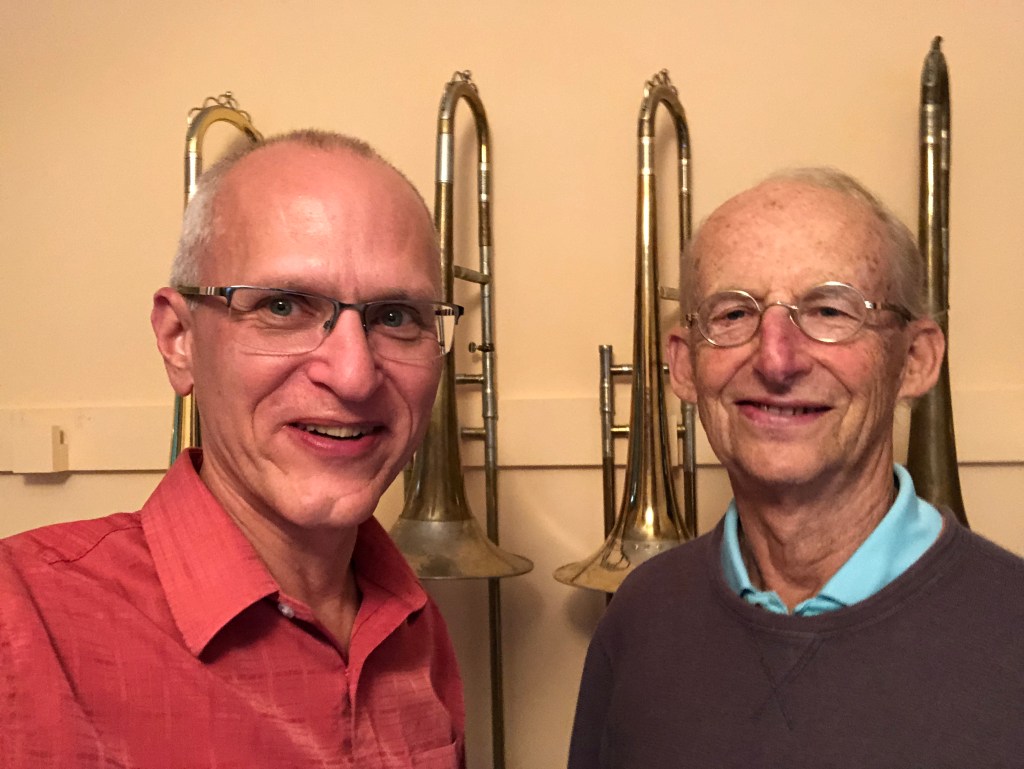
Douglas Yeo and Jay Friedman with some of Jay’s Kruspe trombones, September 9, 2019.
My friend, Jay Friedman, principal trombonist of the Chicago Symphony Orchestra, has an extensive collection of vintage Kruspe trombones, and we often talk about the unique qualities of these iconic instruments.
I played a Kruspe bass trombone during my last seasons as a member of the Boston Symphony Orchestra. Five vintage Kruspe trombones—an alto, two tenors, an F-attachment tenor, and a single valve bass—came on the market in 2007 and I persuaded the management of the BSO to purchase them. I loved playing that Kruspe bass trombone, and I used the BSO’s Kruspe bass whenever we played German repertoire from the 18th through 19th centuries. Music of Mozart, Haydn, Beethoven, Schumann, Schubert, Brahms and their compatriots. Whether my colleagues were using a modern alto and smaller bore tenor trombone, or using the Kruspe alto and a tenor, or an alto and tenor trombone by the modern German maker, Thein, the Kruspe bass blended spectacularly with all of them.

Members of the Boston Symphony Orchestra trombone section, c. 1905, with Holton trombones. Left to right: Leroy Kenfield, bass; Anton Mausebach, second; Carl Hampe, principal.
It’s interesting to note, from an historical perspective, that the American musical instrument makers Frank Holton and C. G. Conn modeled their early 20th century trombones after instruments made by great German makers. This photograph (above) of members of the Boston Symphony Orchestra trombone section (Leroy Kenfield, bass; Anton Mausebach, second; Carl Hampe, principal) was taken around 1905 and they are all playing Holton trombones made in the German style. Likewise, iconic instruments like the Conn 70H bass trombone (including the prized Conn Fuchs model bass trombone) were based on earlier German models. The beauty of sound of these instruments—many factors go into this but they include the bell taper, the bore size, and the type of brass used—is something to behold, and while modern trombonists often favor playing with more “muscle,” there is a lot to be said for the exceptional quality of these German style instruments in the hands of a player who is truly interested in blending into rather than dominating the orchestral texture.

Douglas Yeo’s final bow in Symphony Hall (with Kruspe bass trombone) as a member of the Boston Symphony Orchestra, May 8, 2012. Performance of Beethoven Symphony No. 9. Also shown (standing) are concertmaster Malcolm Lowe (clapping) and conductor Bernard Haitink.
When I retired from the Boston Symphony Orchestra in 2012, I had to leave that Kruspe bass trombone behind. However, it makes me smile when I remember that the last concert I played in Boston’s Symphony Hall in May, 2012, was the Symphony No. 9 by Ludwig van Beethoven conducted by Bernard Haitink (photo above). I had used BSO’s Kruspe bass trombone for that performance and my final bow in Symphony Hall with the orchestra.
Earlier this year, I played bass trombone with the Atlanta Symphony in performances of Beethoven Symphony No. 5. Acting principal trombonist Nathan Zgnoc played a Thein alto trombone and acting second trombonist Jason Robins played a Conn 8H (that instrument, now owned by Nathan, had previously been owned by Keith Brown). For those performances, I used my YAMAHA YBL-601 Vienna style bass trombone, a dual-bore, single valve bass trombone made in the classic German tradition that, unfortunately, is no longer part of YAMAHA’s trombone catalogue. Our blend worked very nicely in those performances, but knowing I would be returning to the ASO in May 2025 for performances of Beethoven’s Missa solemnis, I began a quest to fulfill a dream and acquire a vintage bass trombone made by the workshop of Eduard Kruspe of Erfurt, Germany.
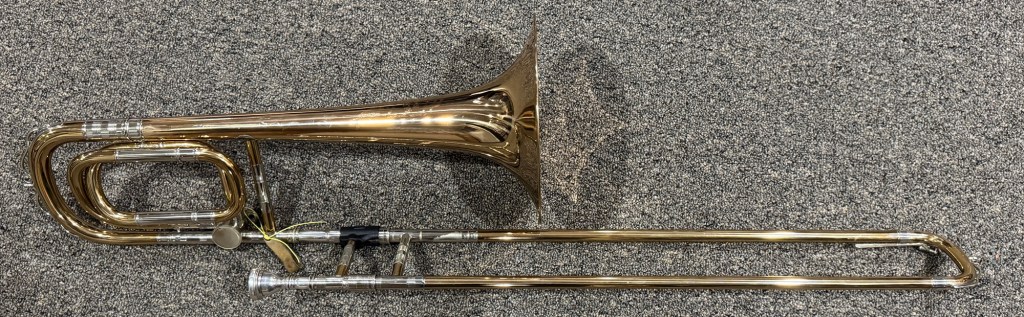
My bass trombone by Kruspe. There is no serial number on the instrument although the number “3” is stamped on the bell receiver.

The bell engraving on my Kruspe bass trombone.
Happily, my search didn’t take long, and in a short time a 100-year old Kruspe single valve bass trombone—of the same vintage as that Kruspe bass I played in the Boston Symphony Orchestra—arrived on my doorstep thanks to Noah Gladstone who runs The Brass Ark in California. Like the BSO’s Kruspe, this instrument is spectacular, and after a little TLC from both Noah and my local brass technician (no, he is much more than a technician, he is an artist, actually), Dana Hofer, I began to get to know my new instrument. Happy times.
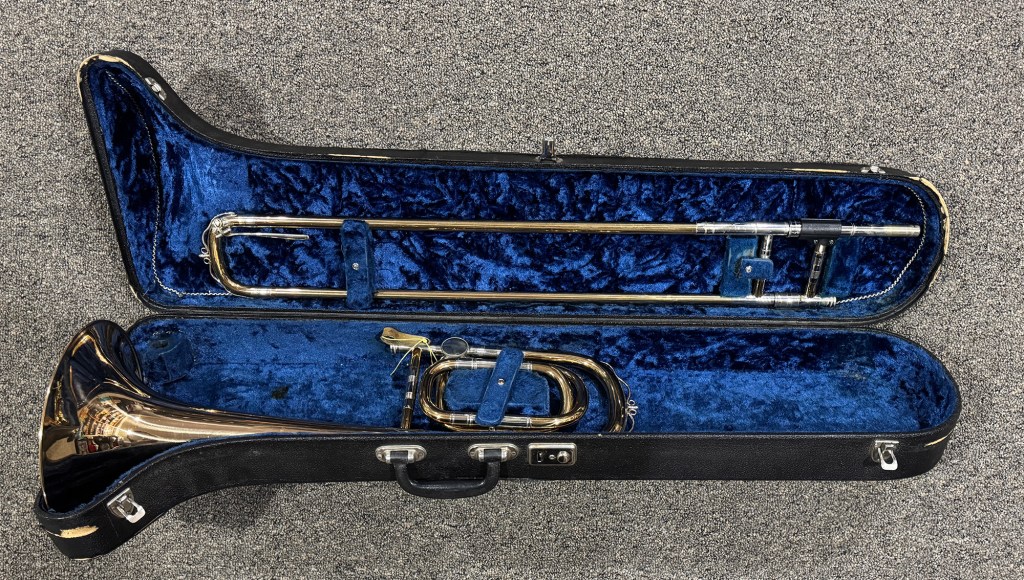

The original wooden case for my Kruspe bass trombone.
My Kruspe bass trombone came in its original wooden case which works quite well but the case is extremely compact (photos above). When I travel by airplane with my trombone, I always bring it onboard (the case for my YAMAHA YBL-822G is very compact) and put it in an overhead compartment, but you never never know when a flight attendant will be less than thrilled to see a trombone in an overhead bin and I might be required to check my trombone as baggage. Because of this, I always pack my trombone in its case as if it had to be checked as baggage, just in case. Fortunately, my YAMAHA YBL-822G case travels very well as checked baggage (with the addition of a styrofoam cone in the bell, the instrument has never suffered damage when I check it as baggage; see my FAQ on my website about traveling with a trombone for some tips). However, while the original Kruspe case is great for normal use of the trombone, it is so compact that I am not confident it would protect my trombone well enough if it ended up as checked baggage.

The slide of my Kruspe bass trombone placed in my YAMAHA YBL-822G bass trombone case.
Unfortunately, solving this dilemma of how to transport my Kruspe bass trombone while flying is not as simple as putting my Kruspe bass trombone in my YAMAHA bass trombone case. As you can see in the photo above, the slide to my Kruspe bass trombone is very long; 35 1/2″ long. My YAMAHA trombone slide is 32″ long. This is typical of these vintage German trombones, and early Conn trombones as well. Their slides are long while their bell sections are short.

Three bass trombone slides, top to bottom: Kruspe bass trombone, Conn 70H bass trombone (made in 1921), Yamaha YBL-822G bass trombone. The black plastic attachment on the Kruspe and Yamaha slides supports a Neotech hand brace.
Trombonists who want a modern trombone case that will fit an historical German bass trombone with a long hand slide do not have many options. I searched a long time to find such a case and happily, Protec came to the rescue.
There are many manufacturers who make aftermarket trombone cases and gig bags. I’m not a fan of gig bags. The risk of damage to a trombone in a soft or semi-hard trombone case is simply too high. I use a rigid trombone case at all times.
My search to find an aftermarket trombone case to fit my Kruspe bass trombone took some time to reach a good result. Manufacturers make their cases to be as compact as possible. Bass trombone cases are manufactured to fit standard 32″ long trombone slides. The additional 3 1/2″ length of the Kruspe slide meant that a case had to be longer. Most bass trombone cases top out at 36″ length and with the padding inside the case, that’s just not long enough to accommodate a 35 1/2″ bass trombone slide. I searched up for a case that had a length that would accommodate the Kruspe slide. And I finally found one: the Protec MAX contoured case.
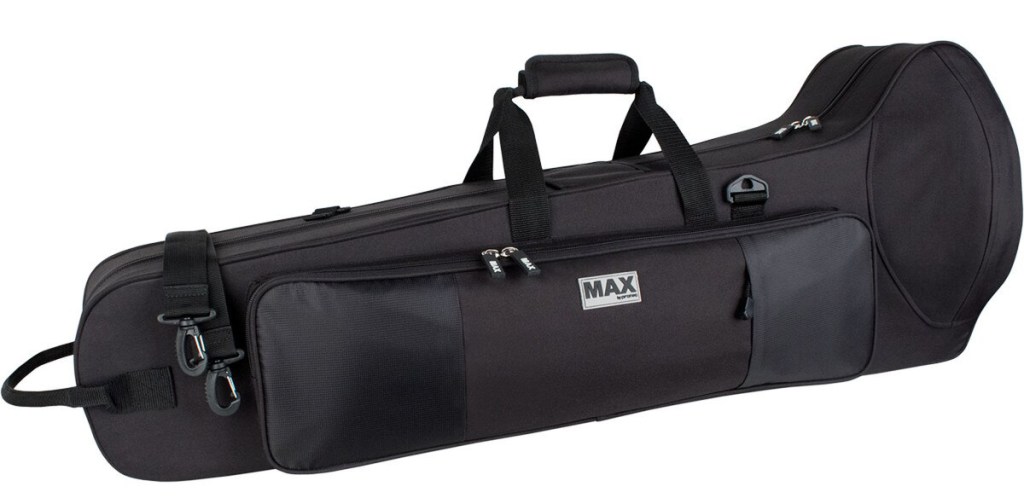
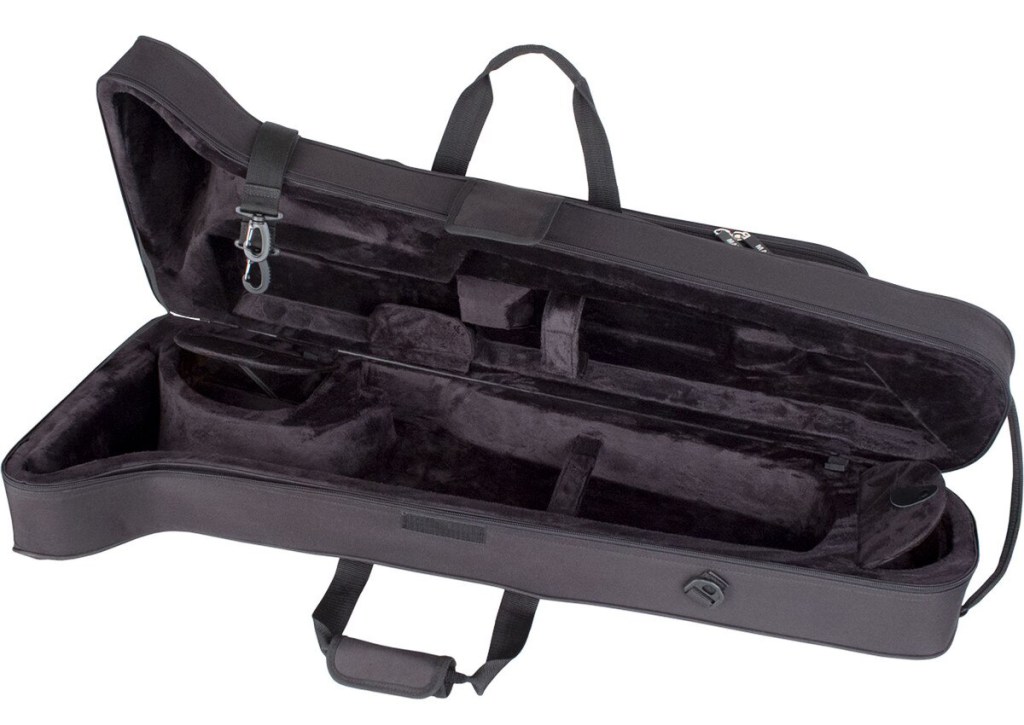
The Protec MAX bass trombone case. Photos courtesy of Protec.
The Protec MAX contoured case is made with EPS styrofoam covered with plush velvet; the outside is covered with durable nylon fabric. With the case’s 38″ length, I thought it might accommodate my Kruspe slide. I called Protec and spent some time talking with Michael Corter. We discussed all of the interior dimensions of the case. As manufactured, the Protec MAX’s compartment for the bass trombone slide was made for a standard 32″ slide. But Michael sent me some photos of the case and I saw that with a slight modification, I could lengthen the slide compartment by a few inches by cutting away some of the styrofoam. It was worth a try.
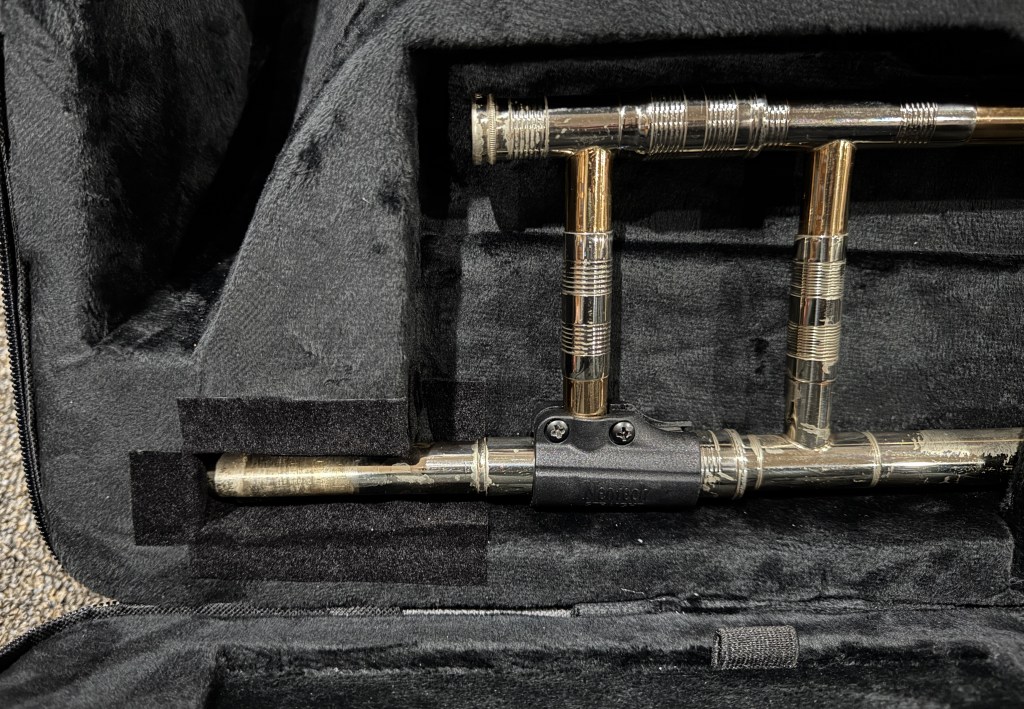
The interior of my Protec MAX case, showing the cutout I made to accommodate the long Kruspe bass trombone slide tenon.
The result turned out to be exactly what I wanted. With a razor blade, I cut away some of the slide compartment foam so it would fit the long slide tenon of my Kruspe bass trombone. Then, I covered the exposed styrofoam with self-adhesive velvet flocked fabric. This is available from amazon.com for $12.99 for 20 sheets, in black and many other colors. After I cut and applied this fabric to the case, everything looked clean and neat and my Kruspe trombone slide fit nicely in the case. The Protec MAX case also has two storage compartments inside the case, a large storage pocket on the outside of the case, backpack straps (that can be hidden under a fabric panel), and a shoulder strap. Most of all, my Kruspe bass trombone is well protected, ready for my next flight.

My Protec MAX case with my Kruspe bass trombone.
If you have a vintage Conn bass trombone or an historical German bass trombone that has a long slide that will not fit in your modern bass trombone case, Protec has a case for you. I also want to say this as well: My experience with Protec was superb in every way. My conversation with Michael Corter was extremely helpful and informative. Protec’s customer service was outstanding. The case was well packed for shipment and it arrived on my doorstep in perfect condition. The workmanship of the Protec case is also superb. The zippers work easily, the interior storage compartments open and close smoothly, and look at the price of the Protec MAX bass trombone case (it comes with free shipping!) on the Protec website—it is a very affordable product. Props to Protec for making this case, and for manufacturing it in such a way that a user can make modifications to it very easily.
Protec also makes a full line of trombone cases (and cases for other instruments) and case accessories. Visit their website to see all of their products.
Now, it’s time to get back to practicing my part for Beethoven’s Missa solemnis. As an aside, I recently wrote an article about Missa solemnis for the blog hosted by my church, New Covenant Church of Naperville, Illinois. The article is titled, The Nicene Creed, Beethoven, and the Power of a Small Word. Have a look. There is something about how Beethoven set the Credo to his Missa solemnis that I find truly remarkable.
Beethoven. Kruspe. Protec. A good combination!
 The Last Trombone – Douglas Yeo