
by Douglas Yeo (December 17, 2024)
When I was at work on my book about Homer Rodeheaver (Kevin Mungons and Douglas Yeo, Homer Rodeheaver and the Rise of the Gospel Music Industry, Urbana: University of Illinois Press, 2021)— Rodeheaver was the trombone-playing song leader for the Christian evangelist Billy Sunday in the first third of the 20th century—a side aspect to my research was an investigation into the work of many other trombonists who used their trombones to play sacred music and share the good news of the Gospel. There have been many of them. For instance, Cliff Barrows, who knew Rodeheaver well and who was the song leader for Billy Graham for many years, played the trombone:

Cliff and Billie Barrows with Billy Graham, c. 1948. Wheaton College Archives and Special Collections.
Others made recordings of gospel music with a trombone in hand, including Joe and Marion Talley (their name is misspelled on the cover of this album, below):
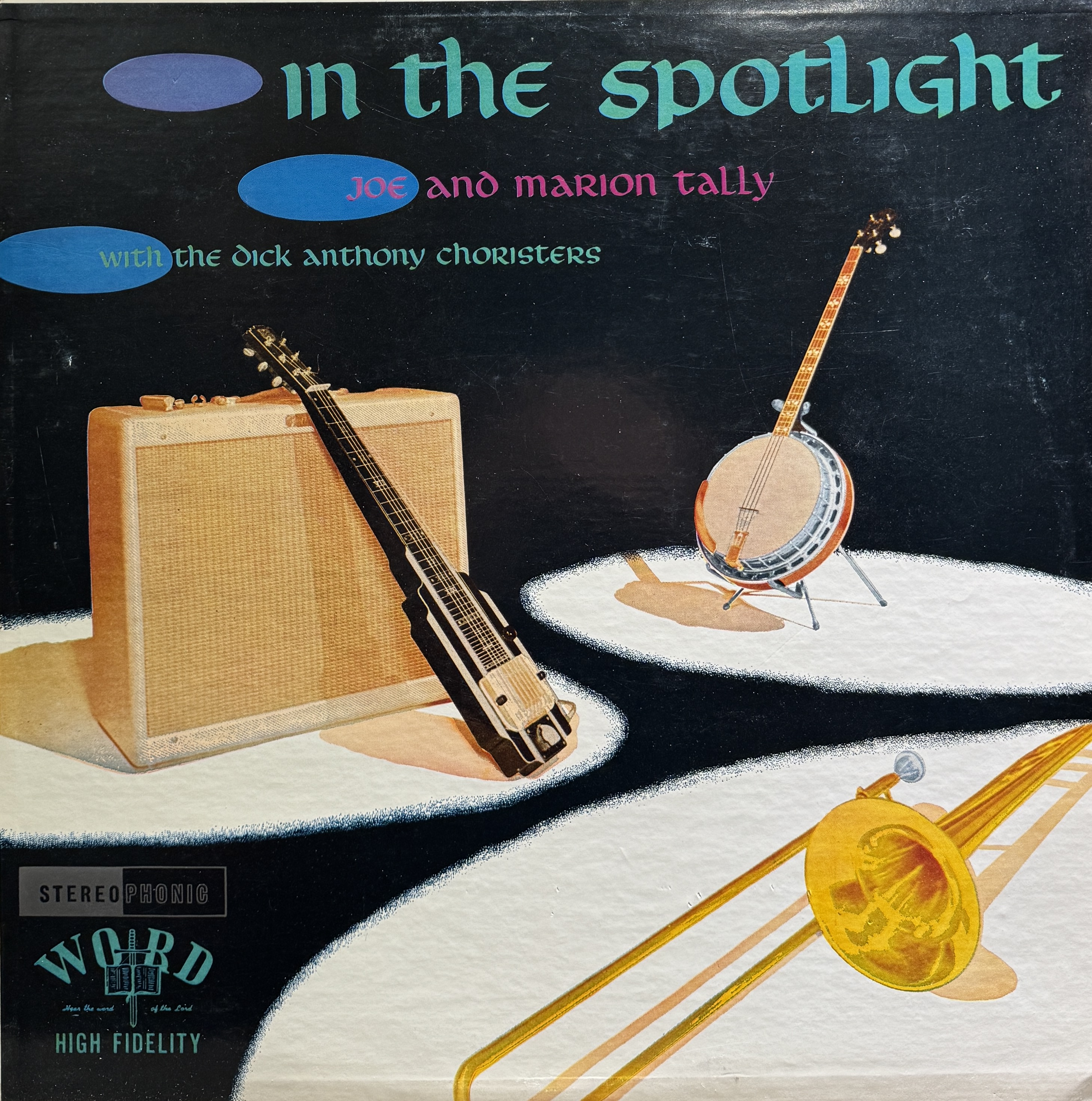
Joe and Marion Talley, In the Spotlight. WORD WST-8037 (1960)
. . . Marcy Tigner:

Marcy Tigner, Marcy Tigner Trombone, Christian Faith Recordings 351 (1961)
. . . Sam Salter:
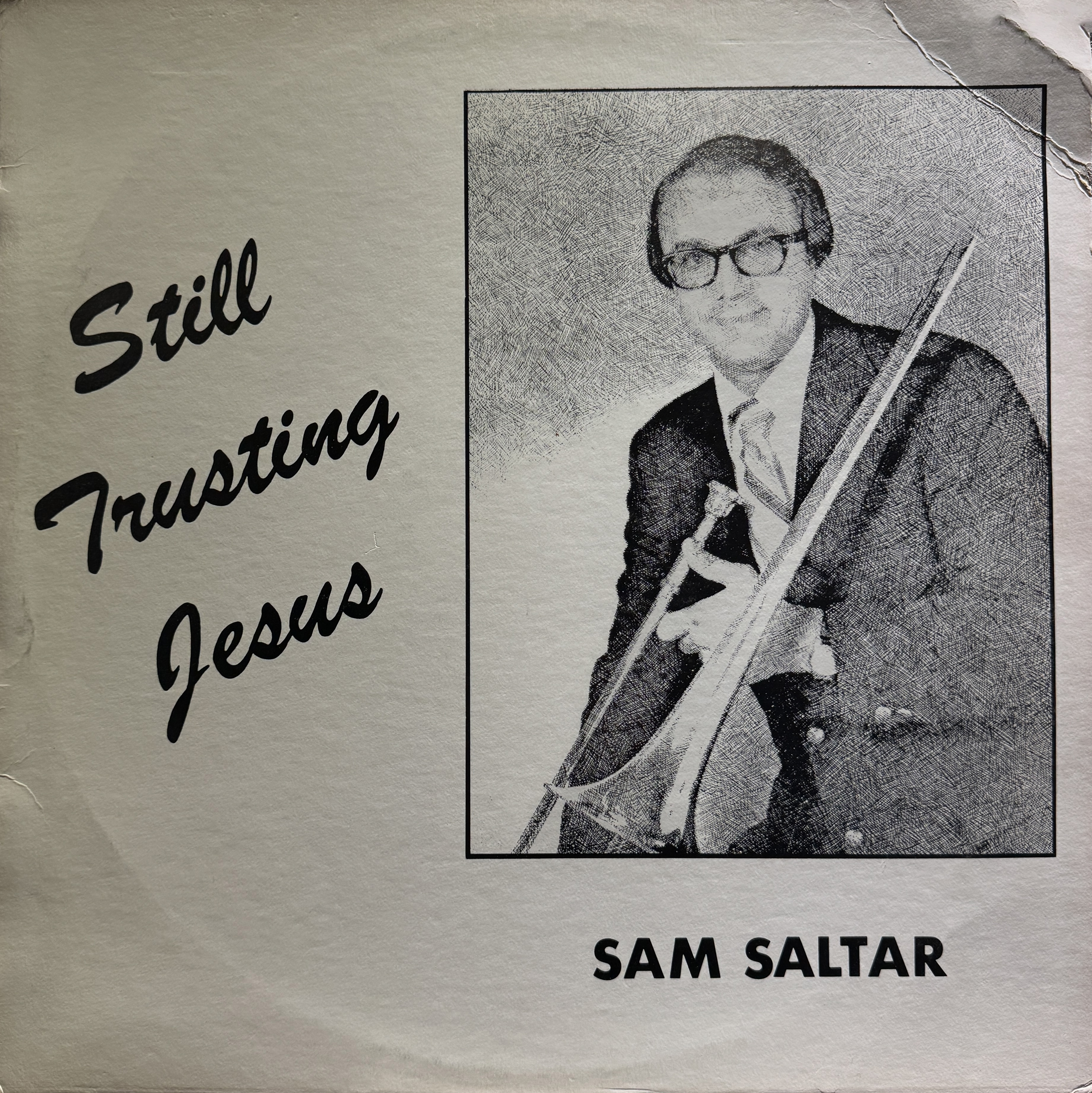
Sam Saltar, Still Trusting Jesus, Glory Records GL-151
. . . Tom Dale:
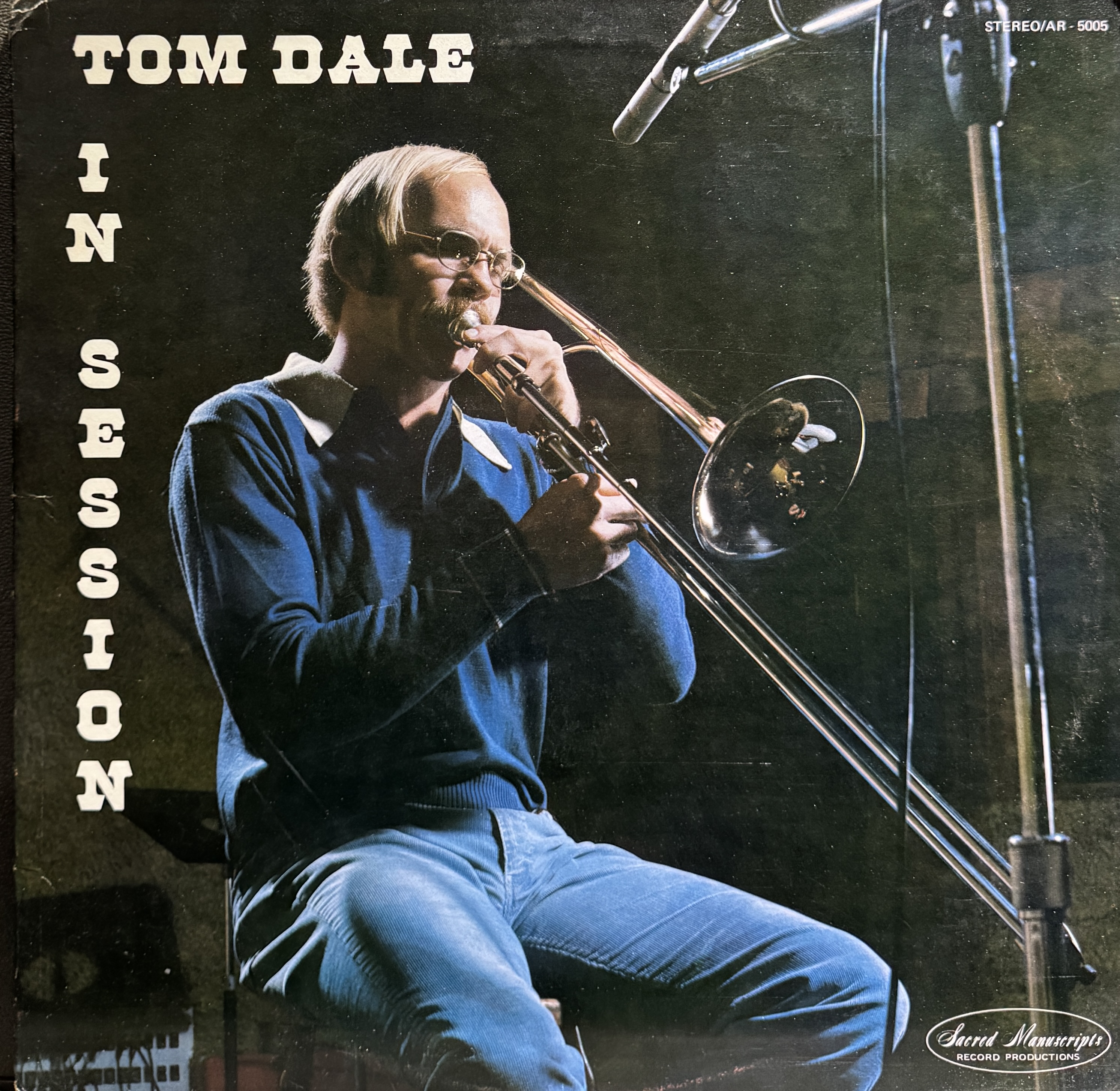
Tom Dale, In Session, Sacred Manuscripts Record Productions AR-5005
and Bill Pearce:

Bill Pearce, The Remarkable Trombone of Bill Pearce, WORD WST-8312 (1964)
There are also many superb recordings with enthusiastic playing of the trombone shout bands that rose in the United House of Prayer for All People:

The Tigers Trombone Shout Band, Dancing with Daddy G, Fire Ant 1004 (1993)
In recent years, Megumi Kanda (principal trombonist of the Milwaukee Symphony):

Megumi Kanda, Amazing Grace, Victor VICC-60316 (2002)
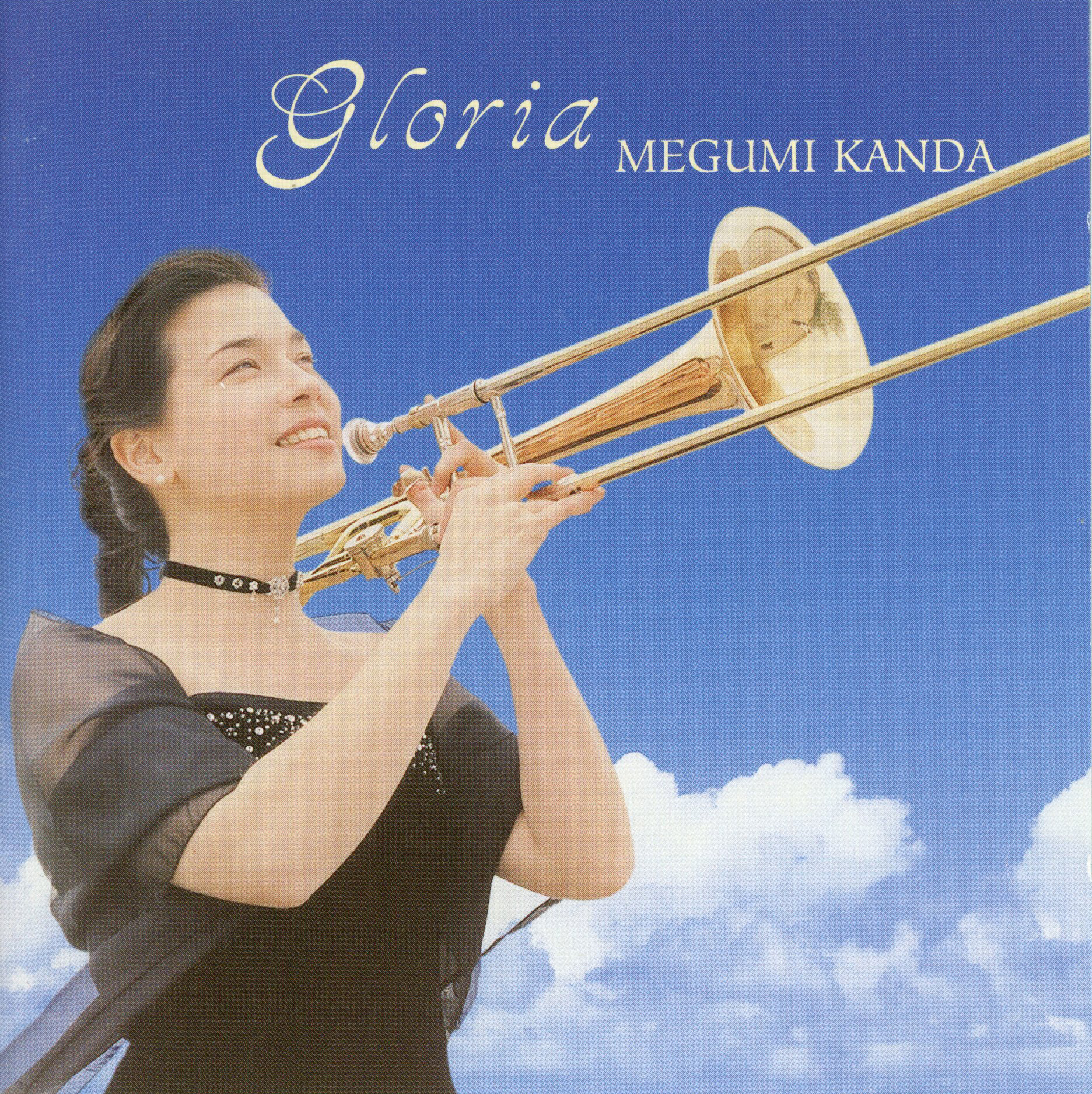
Megumi Kanda, Gloria, Albany Records TROY694 (2004)
. . . Wycliffe Gordon

Wycliffe Gordon, The Gospel Truth, Criss Cross Jazz 1192 (2000)
. . . and I have released albums of hymns, gospel songs, and spirituals.

Douglas Yeo, Cornerstone, Die letzte Posaune CD93175 (2000)
I’m at work on an article about “The Gospel Trombonist,” but with several other writing projects in the pipeline, that article won’t appear for a while. But the subject is on my mind because Christmas is around the corner, and the ubiquitous sound of Salvation Army bell ringers and brass players fills the air at shopping centers, supermarkets, and malls. The work of the Salvation Army to preach the Gospel and help the less fortunate—what Jesus Christ referred to as, “the least of these” (Matthew 25:45)—is well known. The Salvation Army’s motto is, “Doing the most good.” We should also remember that in addition to its religious and humanitarian work, the Salvation Army was also influential in the rise and influence of the brass band movement in England and around the world.
A little history: In 1878, William Booth’s Christian Revival Society—founded in the East End of London in 1865 and later called the Christian Mission—changed its name to The Salvation Army. In that same year, a brass quartet of two cornets, valve trombone and euphonium formed by itinerant preacher Charles Fry and his three sons began supporting outdoor meetings of the Salvation Army in Salisbury, England. Booth, who had long harbored ambivalence toward musical groups accompanying singing, quickly realized the value of an ensemble of brass instruments in helping to attract a crowd, and others would learn from this example. By the following year, organized brass bands had become an integral part of Salvation Army worship and evangelistic efforts.[1]
The Salvation Army has also published a tremendous amount of music for brass band, brass ensemble, and solo brass instruments, and it has released many recordings of its music, including the popular series with a jazz trombone ensemble, Spiritual to the Bone:

Spiritual to the Bone, Salvation Army USA South CRD018 (1993)
But there was someone who was first among the many high-profile, trombone-playing representatives of the Gospel message, and we do right to remember him.
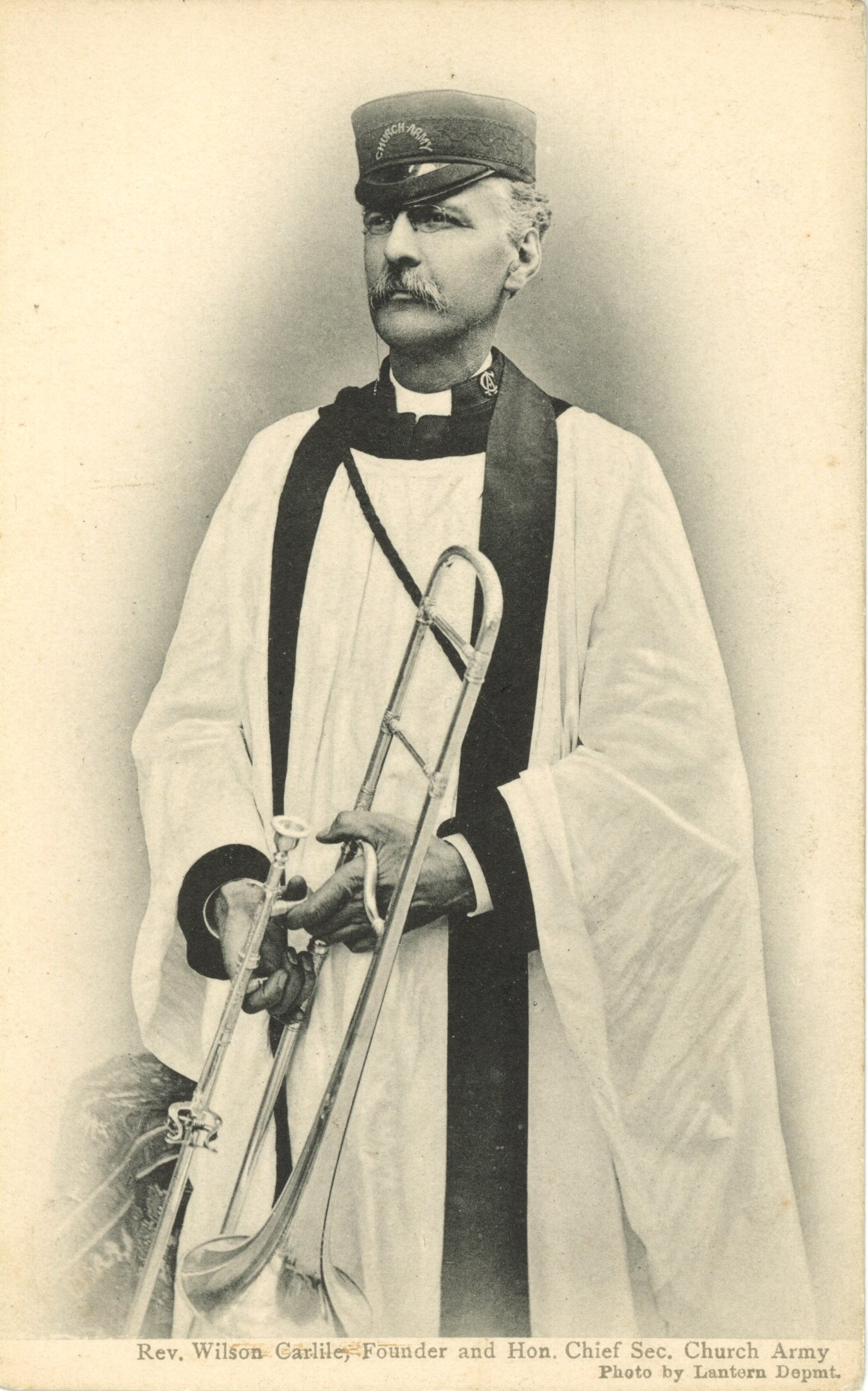
Rev. Wilson Carlile, c. 1900
Into the environment of brass playing that was popularized by William Booth in England came Wilson Carlile (1847–1942).[2] Carlile was ordained a deacon in the Church of England in 1880 and served as a curate to the Vicar of Kensington. He began holding open-air evangelistic meetings in an effort to reach people who otherwise might not enter a church. Unlike William Booth–who broke from the Methodist Church to set up his own denomination–Carlile worked within the Church of England to overcome denominational resistance to his desire to be a missionary to the slums of London. In 1882, Carlile resigned his formal position with the Church of England and formed The Church Army, with himself at its head while he and The Church Army maintained close ties with the Church of England.
As a child, Carlile’s first musical instrument was a toy drum that he later put down in favor of the trombone. He admitted his trombone playing was less than accomplished, as when he related a story of an argument over his drum with one of his sisters that resulted in the instrument breaking and inflicting a deep wound on his hand:
I’m afraid that some of my friends today, persecuted by the trombone, wish my early musical talent had received an even sharper lesson.[2]
While the Salvation Army fully embraced the presence of brass instruments during their worship services, and by 1879 brass bands were being organized in many churches [3], Wilson Carlile was, at first, somewhat of an enigma to the Church of England. In an article from 1900 that was headlined, “Newest and Strangest Ally of the Dignified Old Church of England,” Curtis Brown reported the strange occurrence of a trombone in the pulpit in “the haughty old Church of England”:
That most dignified, serious and conservative of institutions, the Church of England, has taken into alliance a man with a trombone, who horrified the stately Bishops at first by carrying his instrument into his pulpit and playing it right lustily, too. . . .The man with the trombone typifies this queer army which is beginning to attract general attention. He has played that trombone in the streets, in saloons and in dance halls, and has had it pretty badly battered in many an encounter with toughs. He was laid up six months after one such fight, and he and his trombone had to be patched before they could get into line again.[4]

“Preachers in their Pulpits: The Rev. Wilson Carlile of the Church Army.” The Tatler, No. 109 (July 22, 1903)
The sight of Wilson Carlile marching around London in his clerical frock while playing his trombone achieved its desired effect. The parade of curiosity seekers that followed Carlile to St. Mary-at-Hill on London’s Love Lane experienced a church service like no other. As Homer Rodeheaver was to do later, Carlile adopted the “magic lantern,” an early form of projector that displayed large images on a large white sheet above the church’s altar. These projections were, in the main, of Biblical characters and scenes, but Carlile also engaged in social commentary, showing the contrast between slum life and the “palaces of the rich.” Carlile also employed a large phonograph during services, a “monsterphone,” from which which emanated sermons by other preachers including the Archbishop of Canterbury as well as an occasional Sousa march.[5] “This,” Carlile’s biographer wrote, “had the effect of driving away all orthodox people in horror, and attracting the loafers from the street, who warmly supported the new form of service long before it received a friendly smile from the Bishops.”[6] Carlile’s message of the Gospel changed lives.
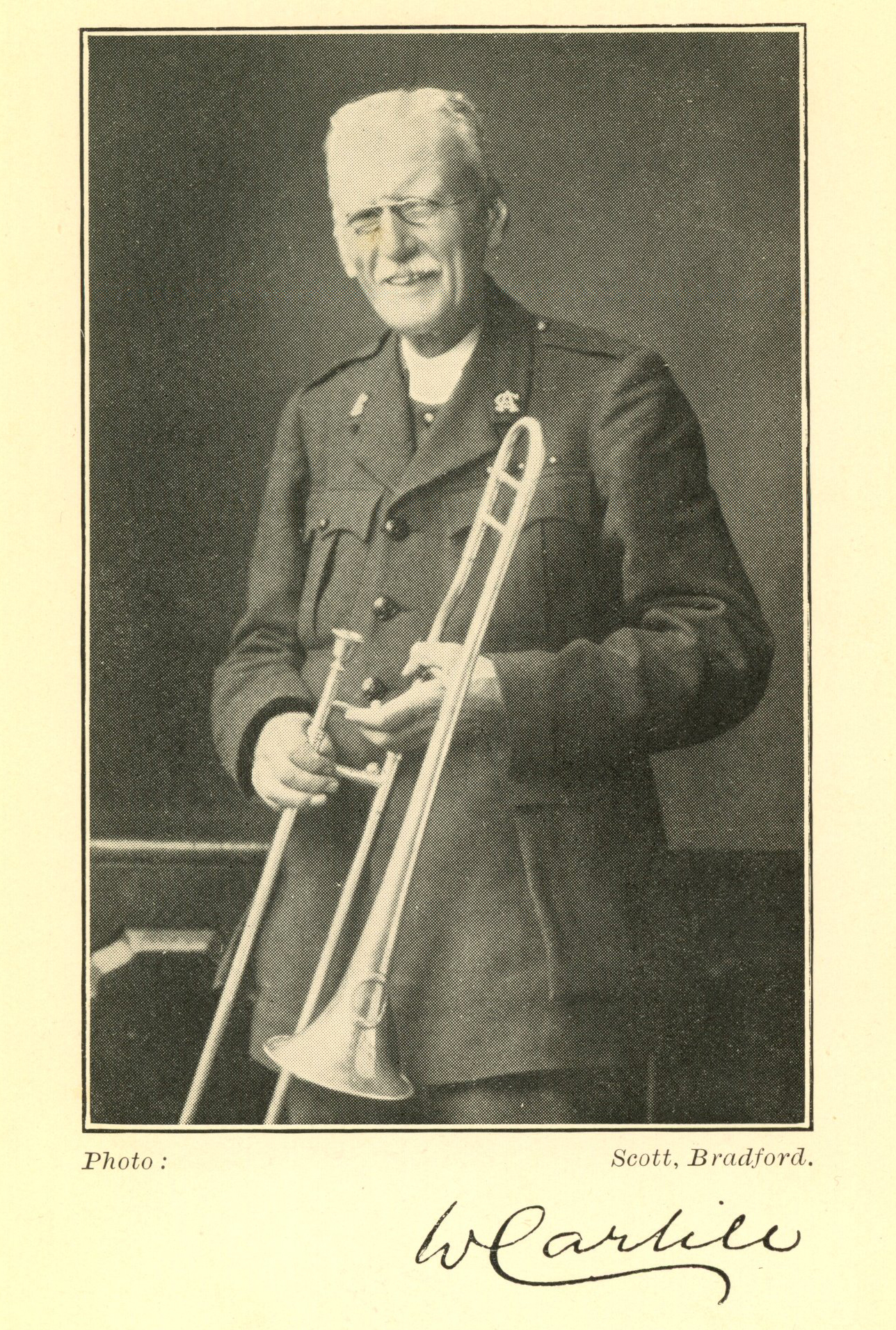
Wilson Carlile. From: Edgar Rowan, Wilson Carlile and the Church Army (London: The Church Army Bookroom, 3rd edition, 1926)
Newspapers across the United States ran articles about Carlile and his unconventional evangelistic outreach. The Louisville Courier-Journal devoted an entire page to the “Man with the Trombone and His Great Army: Newest and Strangest Ally of the Dignified Old Church of England.” [7] The Chicago Daily Tribune painted a vivid picture of Carlile’s use of the trombone as a tool for reaching audiences with his evangelistic message:
The real power of the man behind the trombone is illustrated in the career of the Rev. Wilson Carlile of England, the head of the Church Army. He began his career with a broken-winded harmonium, but he soon found that to reach the masses he must have a trombone. For eight years he has blown that trombone. He has blown it in streets, saloons, and dance halls, and has horrified the stately Bishops by sounding its sonorous blasts in the pulpit. Occasionally the roughs of London have objected to his music, and then he and his trombone have been laid up for repairs, both badly battered. . . . The man with the trombone is an indefatigable worker. . . . He plays on his trombone. He exhorts. He sings. He makes things generally lively in the pulpit. He gathers his audience for the night service by marshaling his band and choir, which he heads with his trusty trombone, and makes a procession through the streets near his church, blowing lustily. The crowd follows him. At each saloon the march halts, while the trombone man drags out three or four habitués who join the procession. When he gets back and sounds the first blast in his pulpit, the church is packed. . . .
All this is the work of the man behind the trombone, and for the possibilities that lie in that much-maligned instrument let all trombone players be respected. They are not as bad as they look. In the hands of a man truly great the trombone is more powerful than the sword.[7]
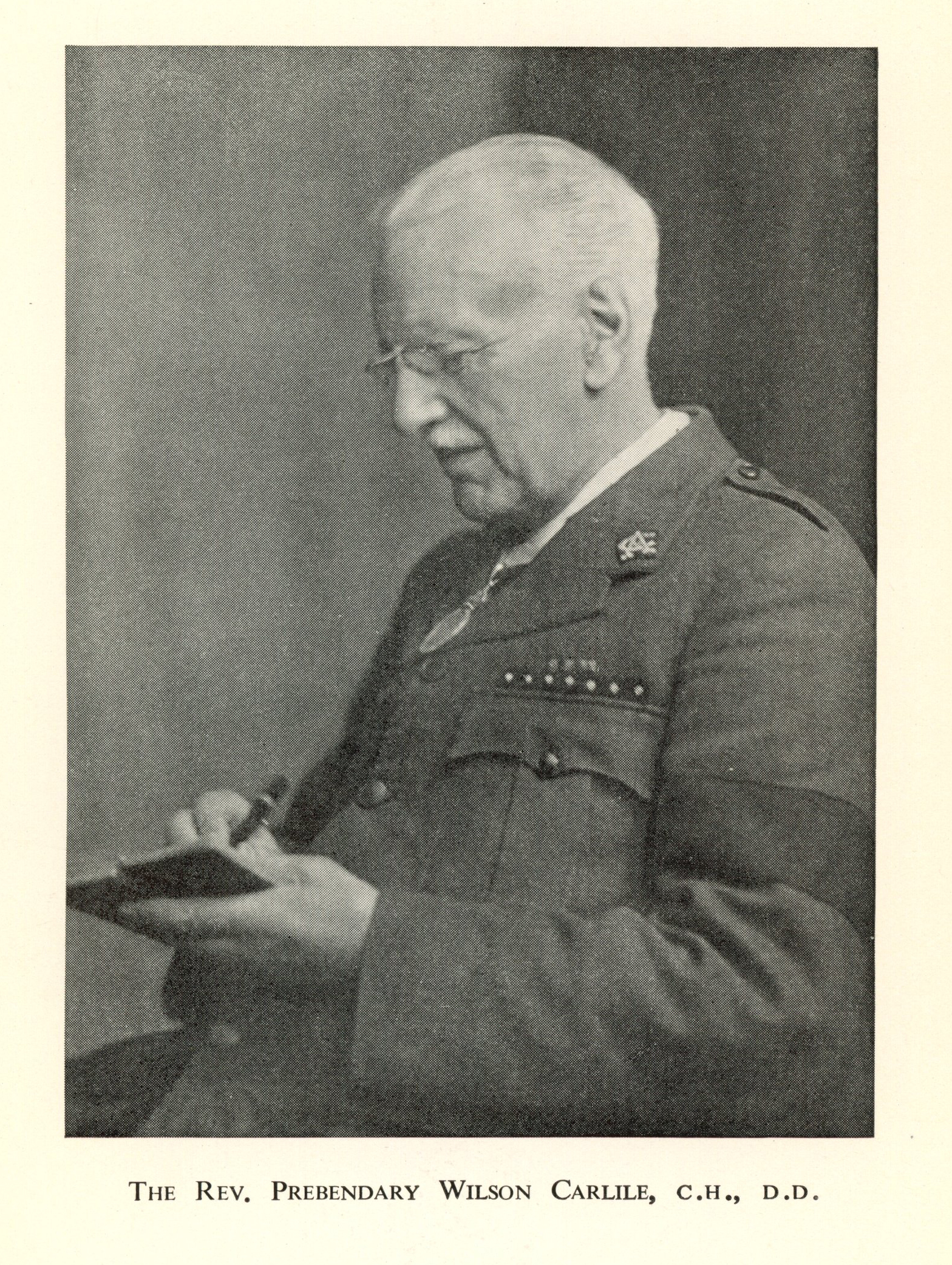
Wilson Carlile. From: A. E. Reffold: The Audacity to Live: A Résumé of the Life and Work of Wilson Carlile (London: Marshall, Morgan, & Scott, 1936)
Now, as Christmas approaches and the sound of brass instruments is in the air, we look at Wilson Carlile—and many others—who joyfully brought—and bring—the Gospel message of hope and good news to a hurting world with a trombone in hand, a message that came to us 2000 years ago in a manger in Bethlehem, to change lives and bring true, lasting peace (Luke 2:14).
• • •
NOTE: Here follows the full text of the article about Wilson Carlile that was referenced above, “The Man Behind the Trombone,” from the Chicago Daily Tribune, March 4, 1900. Notes for this blog post about are found at the end of the Chicago Daily Tribune article.

[1] Ronald W. Holz, Brass Bands of the Salvation Army: Their Mission and Music. Volume 1 (Stotfold, Herts.: Street Publishers, 2006), 63–74.
[2] Edgar Rowan, Wilson Carlile and the Church Army, 3rd ed. (London: Church Army Bookroom, 1926), 5.
[3] Ronald W. Holz, Brass Bands of the Salvation Army: Their Mission and Music. Volume 1, 69.
[4] Curtis Brown, “Man With the Trombone and His Great Army: Newest and Strangest Ally of the Dignified Old Church of England,” The Courier-Journal (Louisville, Kentucky), February 25, 1900.
[5] Stephen Bottomore, “Projecting for the Lord: The Work of Wilson Carlile,” Film History, Vol. 14, No. 2, Film and Religion (2002), 199-200.
[6] Edgar Rowan, Wilson Carlile and The Church Army, 60.
[7] “The Man Behind the Trombone,” Chicago Daily Tribune, March 4, 1900.
 The Last Trombone – Douglas Yeo