By Douglas Yeo (November 11, 2024)
It has been a few months since I’ve posted anything to The Last Trombone and to those who have asked me why, it’s simply that I’ve been busy with other things. Busy with a lot of things. Here’s a quick update before I offer a thought on something else.

Douglas Yeo with members of the University of Illinois Marching Illini trombone section: Derrick Neal, Pablo Rosales, Douglas Yeo, Poorna Kumar (who, in addition to being a dual major in trombone performance and community health, is also a drum major for the Marching Illini), Jake Bae, Sam Murray, September 2024.
In September, my wife, Patricia, and I returned to the campus of University of Illinois Urbana-Champaign where I served as trombone professor from 2022–2024. We were there for homecoming and the Illinois football game against Central Michigan (the Illini won, 30–9). While there, I met up with several of my former students who are in the Marching Illini. I was so happy to see them again.

Douglas Yeo with Dr. Nathaniel Brickens and members of the University of Texas trombone studio, September 2024.
The next week, I spent a few days at University of Texas in Austin, in residence with the trombone studio of my good friend and UT’s trombone professor, Dr. Nathaniel Brickens. I always enjoy being at UT and working with its talented trombonists (and sporting a headpiece of the university’s mascot, Bevo, above).

In October, I traveled to San Francisco for a week where I played ophicleide with the superb early music group, Philharmonia Baroque. The conductor, Grete Pedersen, led us in a program that included the overture to Felix Mendelssohn’s A Midsummer Night’s Dream. What a joy it was to play under her leadership with this fine ensemble (I’ve been playing serpent and ophicleide with Philharmonia Baroque since 2009). While there, I visited the Fine Arts Museums of San Francisco. It was my first time visiting these superb museums, and in addition to seeing iconic art by Auguste Rodin, Claude Seurat, Claude Monet, and many others, my eyes were opened at two special exhibitions of art by Mary Cassat and Tamara de Lempicka. Art old and new that inspires, soothes, and provokes.

A day after I returned home from San Francisco, I flew to Atlanta where played bass trombone with the Atlanta Symphony, substituting for a week on a program that included Serge Rachmaninoff’s Symphonic Dances conducted by Roderick Cox. While I was there, I was a guest for a session with Slide School, hosted by Atlanta Symphony acting principal trombonist, Nathan Zgonc, and Brian Hecht of the Dallas Symphony. I also had the happy opportunity to spend a lot of time working with the ASO’s two fellowship players, bass trombonist Jordan Johnson (who, a few days later, won the bass trombone position with Houston Grand Opera—bravo, Jordan!) and tubist Joshua Williams. I look forward to returning to the Atlanta Symphony for a few more weeks after the calendar turns to 2025.

Douglas Yeo in front of historic Ebenezer Baptist Church, Atlanta, October 2024.
While in Atlanta, I visited the Dr. Martin Luther King Jr. national historic site. In the book I co-authored with Kevin Mungons, Homer Rodeheaver and the Rise of the Gospel Music Industry (Rowman and Littlefield, 2021), we introduced Rodeheaver to readers with an opening chapter, Prologue, in which we described the 1917 Billy Sunday meetings in Atlanta (Homer Rodeheaver was Billy Sunday’s trombone-playing song leader for 20 years). To stand in front of and inside historic Ebenezer Baptist Church (where Dr. King, his father, and his father’s father-in-law all served as pastor, and where Dr. King’s mother, Alberta Williams King, was tragically murdered in 1974 while she was playing The Lord’s Prayer at the organ), to see the grave of Dr. King and his wife, Coretta Scott King, and imagine the huge temporary, wooden, 15,000 seat tabernacle that Billy Sunday erected on what is now the site of the historic site’s Visitor Center, was powerful, indeed.

Douglas and Patricia Yeo on the Fay Canyon trail, Sedona, Arizona, October 2024.
Right after I returned home from Atlanta, my wife, Patricia, and I spent a week in Arizona where we enjoyed some great hiking on spectacular trails in Sedona and Phoenix. After so many weeks of traveling with a trombone in my hand, it was nice to be together on the trail where the sky was blue, the rocks were orange and red, and the peacefulness and beauty of the Sonoran desert was on full display.

Excerpt from page 27 of the 1926 New England Conservatory of Music yearbook, The NEUME, showing Ida Isabella Bisbee, trombone student of Joannès Rochut. Courtesy of New England Conservatory of Music Archives.
My big project for this autumn was finishing my article about Joannès Rochut that will appear in the January 2025 International Trombone Association Journal. This is an article that has been nearly 40 years in the making. I’ve written a little about my research process for this article; read this post on The Last Trombone about my one day research trip to the Boston Symphony Orchestra archives in August of this year where I uncovered some important information about Rochut’s life and work. Rochut’s influence on the trombone—and brass—world has been remarkable, and in the course of my research, I learned so much about this iconic influencer in the trombone community. Including, thanks to the archives of New England Conservatory of Music, the fact that Rochut’s first student at NEC was Ida Isabella Bisbee, the first woman to graduate from NEC (in 1926) with a degree in trombone performance (above). I’m looking forward to receiving proofs very soon of what is expected to be an 80 page article in the Journal. Stay tuned.
And, overarching all of this in last few months is the tremendous joy I’ve had of playing trombone duets and trios with my granddaughter and her mom, our oldest daughter, Linda (who is a fine bass trombonist and low brass teacher). Our granddaughter, who is 10 years old, began playing trombone in May when I was at the International Trombone Festival. She loves playing the trombone—she’s good, too!—and in our little family of my wife and me, our two daughters and their husbands, and our two grandchildren, our granddaughter is the sixth brass player (and the fourth female brass player: Patricia plays baritone horn, Linda and and her daughter play trombone, and our other daughter, Robin, plays trumpet). Our grandson has told us he wants to play the tuba next year. When that happens, he will become the seventh brass player in our family.
All of these activities were and are fun, exciting, and rejuvenating. But then, there was also an event of momentous importance: the national election here in the United States that was held on November 5. In the midst of all that swirled around that impactful day, I was heartened when I received an email from Dr. Linda Moorhouse, Director of the School of Music at University of Illinois. On election day, she sent a message to all students, faculty, and staff in the School of Music with some helpful, sensible, and comforting thoughts on how to navigate this contentious election season and what follows. Her words, in a message titled, “Managing the Noise,” resonated deeply with me. Dr. Moorhouse wrote, in part:
As a School full of practicing musicians, we manage all kinds of noise every day. And outside of musical noise, we also know how the vast volume of information, opinions, and discussions can sometimes become overwhelming or disruptive.
I’m reaching out to remind you that you are a part of a School of Music community, and while this day and the next few days may be stressful, we are here for one another. Listed below are a few ways we can navigate the next few days and weeks together and keep our environment supportive and respectful:
- Be Mindful of Election “Noise”
Staying informed is important, but the constant influx of election-related content can become a source of stress. Take breaks from social media, limit your news intake to trusted sources, and remember it’s okay to step away when things get to be too much. Giving ourselves space can help maintain balance.
- Respect Diverse Perspectives
We all have different viewpoints shaped by our unique experiences, and recognizing this helps foster mutual respect. Election season is a celebration of our democratic process, and despite differing opinions, we can share in that respect for civic engagement. Supporting each other through this season means being thoughtful and considerate in our communications.
- Practice Self-Care
Anxiety around election outcomes is normal. Be kind to yourself by setting aside time for things that bring you peace and comfort. Exercise, hobbies, meditation, or simply stepping away from the news cycle are great ways to maintain your emotional health.
- Be Good to Each Other
Kindness goes a long way, especially in uncertain times. Small gestures of thoughtfulness and understanding can create a sense of community and support. Let’s check in on each other, be gentle in our interactions, and focus on the qualities that unite us rather than divide us.
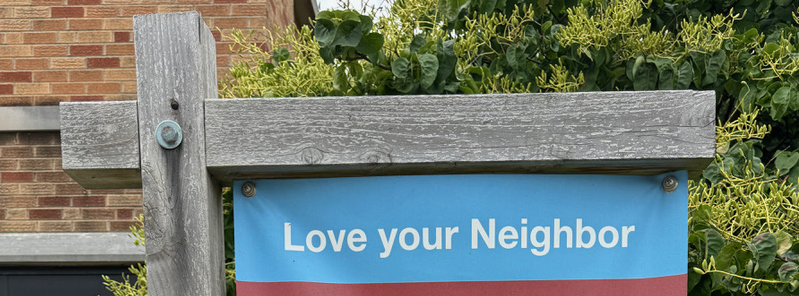
One of the reasons I found Dr. Moorhouse’s words so impactful was the fact that a few weeks before her message arrived, a lunchtime conversation I had with a friend and an encounter with a sign I saw on my way home from that meeting got me thinking about some related things.
As a result, I wrote a short article for the blog hosted by my church, New Covenant Church of Naperville, Illinois. The article—it was published two days after the election, on November 7, 2024—is about the well-known and well-worn phrase from the Bible, “Love your neighbor.” I’ll let the article speak for itself. Have a look at the article—and the rest of the sign—HERE.

In a time where there is a lot of shouting, a lot of judging, a lot of anger, a lot of finger pointing; in a time when many people make assumptions about the motives and beliefs of others without taking the time to speak with and understand them; in a time when name calling and insulting others has risen to a harmful, toxic level; the admonition to “Love your neighbor” has, as I discovered on that day when I had lunch with a friend, some unexpected components. It got me thinking. Have a look at my article. Maybe that sign and its implications will prompt you to do some thinking, too.


 The Last Trombone – Douglas Yeo